OUT OF PRINT / LAST COPY

STANDEFER JOHN FAVORITE ORIGINAL SOLOS AND ARRANGEMENTS CD TABLATURE CHITARRA MEL BAY

STANDEFER JOHN, FAVORITE ORIGINAL SOLOS AND ARRANGEMENTS. CD TAB.

Product Description:
Great solo fingerstyle guitar arrangements by 2002 National Champion Fingerstyle Guitarist John Standefer. The collection contains John's most loved original pieces - and it's written in his own format, which he calls 'Picture-Perfect' TAB. This new method of writing guitar music makes it more complete, easier and faster to learn. Great player. Great music. Great way to learn it. It's the triple threat! Get this book and CD set today!

Format: Book/CD Set

Song Title: Composer/Source:
As a Little Child John Standefer
Badlands John Standefer
Brand New Life John Standefer
Growing Fruit John Standefer
His Majesty John Standefer
In His Arms John Standefer
The Conflict John Standefer
What Child Is This? Traditional

Price: €99,95
€99,95

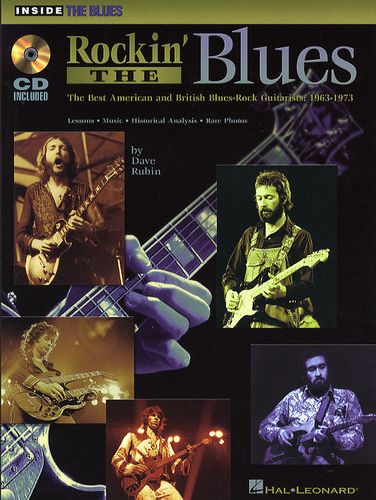
ROCKIN' THE BLUES-The Best American and British Blues-Rock Guitarists: 1963-1973 CD TABLATURE SPARTITI

ROCKIN' THE BLUES, The Best American and British Blues-Rock Guitarists: 1963-1973. CD TAB.

Series: Guitar Educational
Softcover with CD - TAB
Author: Dave Rubin

Take a journey inside the blues with Dave Rubin's latest book, Rockin' the Blues: 1963-1973. This seminal 10 years produced some of the most influential blues-rock guitarists of all time. Learn about the lives of these trail-blazing guitarists, their individual styles, accomplishments, and techniques, then play along with the accompanying CD and taste the magic yourself. Each chapter delves into the world of a key blues-rock guitarist from this period, with rare photos, historic insights, interviews, and guitar solos written in standard notation and tablature and performed by a full band on the included audio CD. Explore this exciting time in music history with a book that covers it like no other. Artists covered include: Duane Allman, Jeff Beck, Roy Buchanan, Eric Clapton, Alvin Lee, Keith Richards, Robbie Robertson, and others. 64 pages

Price: €31,99
€31,99

ESSENTIAL BLUES GUITAR Dave Celentano Centerstream Publications BOOK CD TABLATURE CHITARRA LIBRO

ESSENTIAL BLUES GUITAR, D. Celentano. CD TAB.

Series: Guitar
Publisher: Centerstream Publications
Medium: Softcover with CD
Composer: Dave Celentano

This handy guide to playing blues guitars emphasizes the essentials, such as: chord changes, scales, rhythms, turn arounds, phrasing, soloing and more. Includes lots of examples, plus 10 rhythm tracks for soloing and improvising. 80 pages.

Price: €99,95
€99,95

VELVET REVOLVER CONTRABAND Guitar Recorded Version TABLATURE BOOK CHITARRA SPARTITI LIBRO

VELVET REVOLVER, CONTRABAND. TAB.

Series: Guitar Recorded Version TAB

Scott Weiland and the remaining Guns N'Roses guys crank out 13 rocking new songs on this debut release. Includes: PARENTAL ADVISORY FOR EXPLICIT LYRICS.

Big Machine
Dirty Little Thing
Do It For The Kids
Fall To Pieces
Headspace
Illegal I Song
Loving The Alien
Set Me Free
Slither
Spectacle
Suckertrain Blues
Superhuman
You Got No Right

162 pages

Price: €139,99
€139,99

THE ROOTS OF JAZZ GUITAR songs and licks Fred Sokolow CD TABLATURE CHITARRA LIBRO SPARTITI

THE ROOTS OF JAZZ. CD TABLATURE
The songs and licks that made it happen. 

Dinah
East Of The Sun (And West Of The Moon)
Honeysuckle Rose
I'll Remember April
Rose Room
Yesterdays

The Roots of Jazz Guitar
Series: Guitar Collection
Format: Softcover with CD - TAB
Composer: Fred Sokolow
Inventory #HL 00699082
ISBN: 9780793577347
UPC: 073999990829
Width: 9.0"
Length: 12.0"
64 pages

A complete survey of jazz guitar, its pioneers and how it developed. Includes: six note-for-note transcriptions of famous standards pivotal to the genre; instruction in the essential playing styles; the history and development of jazz guitar; biographies of the pioneering artists; a recording of the songs, exercises, and licks; and more.

Songs include:

- Dinah (Eddie Lang)

- East of the Sun (And West of the Moon) (Barney Kessel)

- Honeysuckle Rose (Charlie Christian)

- I'll Remember April (George Van Eps)

- Rose Room (Django Reinhardt)

- Yesterdays (Wes Montgomery).

64 pages.


MUSCAL INTRODUCTION
A LOOK AT THE ROOTS OF JAZZ GUITAR
At the beginning of the twentieth century, New Orleans bands began combining two traditions: They
borrowed some repertoire from European bands, which often included strings, horns, and a piano,
and performed classical pieces, polkas, mazurkas, sentimental ballads and waltzes. They also imitated
Southern string bands, sometimes called "spasm bands," which consisted of guitars, banjos, violins,
mandolins and string bass, and who played ragtime, blues, jigs and reels. New Orleans bandleaders
like Buddy Bolden and Kid Ory used all these instruments and fused the musical styles, and
their music began to be identified as "jazz."
Johnny St. Cyr, who played with Kid Ory, Jelly Roll Morton and many of the New Orleans bands,
was typical of the first jazz guitarists: he was a four-string banjo player who played guitar as a sideline.
Seldom soloing, he strummed four-beats-to-the-bar and provided bands with a rhythmic backbone.
In pre-microphone days, banjo was audible over loud horns; guitar did not cut it. But in the
'20s, as phonograph recordings gained popularity, the guitar became more prominent. It was easier
to record than banjo.

HOT JAZZ: GUITARIN THE '20s
Jazz was the hot popular dance music of the decade that is often called "The Jazz Age."
Accomplished pickers like Roy Smeck, Nick Lucas and Lonnie Johnson performed the first melodic
guitar solos on records in the 1920s. These versatile players played popular tunes, blues and
whatever the traffic would bear, sometimes fingerpicking but usually flatpicking scales, chords and
arpeggios. But most performing guitarists in jazz bands simply strummed chords, until Eddie Lang
came along.
Lang performed with many of the popular ensembles of his day, including the Goldkette Orchestra,
Red Nichols and the Five Pennies, Paul Whiteman and Bing Crosby. One of the first studio guitar
aces, he accompanied most of the stars of his era on records. Live and in the studio, Lang combined
rhythmic strumming with a melodic soloing style, opening up new possibilities for a whole generation
of guitarists. When he died, in 1933, he left a recorded legacy of ensemble work, solos and duets
with Lonnie Johnson and with lifelong musical companion, violinist Joe Venuti. He inspired countless
jazz banjoists to play guitar, and to be melodic as well as rhythmic. The guitar became a soloing
voice in jazz.

THE '30s SWING ERA
During the swing or big-band era, guitarists in popular swing orchestras played rhythm. Count
Basie's guitarist, Freddie Greene, never played a solo. Some guitarists like Carl Kress, Dick
McDonough, George Van Eps and George Barnes followed Eddie Lang's lead and created beautiful,
harmonically rich, chord-based soloing styles. They recorded solos, duets and small ensemble "listening"
(not dancing) records for jazz afficionados. Like Lang, they usually played Gibson L-5 archtop guitars.
Meanwhile, inspired players like Snoozer Quinn, Teddy Bunn and Oscar Aleman (who played an allmetal
National guitar) helped develop the art of single-note jazz soloing throughout the '30s. But the
creative genius who caught most listeners' and players' ears was the Belgian gypsy, Django Reinhardt.
The first international jazz star, Reinhardt rose to fame playing with his "quintette" in Paris. Although
his own style and his duets with violinist Stephane Grappelli were admittedly based on the
LangNenuti model, he took single-note guitar soloing to new heights. His ad-lib improvisations were
fiery, tender, incredibly inventive, and he always swung. Budding country, blues and jazz guitarists
memorized his solos.
 

DINAH, EDDIE LANG

Born into a musical Italian family October 25, 1902 in Philadelphia, Salvatore Massaro studied violin
and music theory at age seven. By his teens he was playing four- and six-string banjo in pop
orchestras, often with his boyhood friend, violinist Joe Venuti. Venuti claims Lang was self-taught,
and the only guitarist he recalls Lang mentioning as an inspiration was Segovia. When asked who
Lang imitated, Venuti said "Who else was there? Eddie started it all."
In 1924, using the name of boyhood baseball hero Eddie Lang, he joined the Mound City Blue
Blowers, a sort of jug band, as a guitarist. The recordings he made with them demonstrate why
Lang is said to have legitimized guitar as a jazz instrument: instead of simply strumming the chords,
he played several chords per measure, and peppered his backup with bass runs, passing tones,
arpeggios, single-string fills, bluesy string-bending and harmonics.
In the next several years, Lang was increasingly in demand as a performer. He played with the big
bands of Jean Goldkette (where he befriended Bix Beiderbecke), Roger Kahn, Adrian Rollini, and
Paul Whiteman. Although he was capable of reading music, Lang played by ear. During his tenure
with Whiteman, he kept a piece of paper the size of a business card in his pocket that contained on
it (in markings only decipherable by Lang) everything he needed to know about Whiteman's musical
repertoire. When Whiteman's singer, Bing Crosby, went solo, Lang became Crosby's guitarist and
appeared with him in the 1932 film, The Big Broadcast.
One of the first versatile studio guitarists, Lang recorded with Red Nichols and His Five Pennies,
Cliff Edwards (known as Ukulele Ike), AI Jolson, Ruth Etting, Sophie Tucker, the Boswell Sisters,
Emmett Miller and a host of blues singers, including Bessie Smith, Victoria Spivey and Texas
Alexander. His technique was most audible when he recorded solo (often composing his own
songs), and in duets with Joe Venuti or with small ensembles such as Venuti's Blue Four or Blue
Five. These were probably the first listening (not dancing) jazz recordings. Using the name "Blind
Willie Dunn," he recorded memorable duets with guitarist Lonnie Johnson, the other guitar giant of
the '20s, who, like Lang, played both blues and jazz.
By 1933, when Lang died of complications from a tonsillectomy, most jazz bands had switched from
banjo to guitar, and most guitarists were playing the archtop, F-hole instrument Lang preferred.
Using blues and classical techniques, he inspired the first generation of jazz guitarists, most of
whom agree: Lang laid the groundwork for jazz guitar.

PERFORMANCE NOTES
"Dinah" features Lang's backup and lead styles. It has a typical pop song structure, and in 1928 Joe
Venuti's Blue Four, recording for Okeh Records in New York City, gave it the usual jazz treatment
(see as follows). Released in Europe by Parlaphone, it was one of the "chamber jazz" sides that
made Venuti and Lang internationally famous. The quartet consisted of Venuti, Lang, a pianist and
baritone sax.

SONG STRUCTURE AND THE JAZZ TREATMENT
Like many pop tunes, "Dinah" has an AABA structure:
• An eight-bar section ("A part") is played twice in a row, with a slightly different ending the second time.
• An eight-bar bridge follows (that's "B").
• The "A part" is repeated.
 

Price: €29,99
€29,99

CRASH COURSE ON JAZZ GUITAR VOICINGS The Essential Guide for All Guitarists. Hugh Burns CD TABLATURE

CRASH COURSE ON JAZZ GUITAR VOICINGS, The Essential Guide for All Guitarists. Hugh Burns. CD TAB.

Series: Guitar Educational
Publisher: Artemis Editions
Softcover with CD - TAB
Author: Hugh Burns

Which chords should I use if I want to play jazz? How does jazz harmony work? How can I sound like a real jazz guitarist? You'll find the answers to these questions and many more in this detailed introduction to jazz guitar voicings. By learning only a handful of simple shapes, you'll soon be playing classic jazz sequences and jamming along with the 50+ professional live backing tracks on the accompanying CD. Packed with hints and tips on how to get an authentic jazz sound, this pack includes: simple explanations of basic jazz harmony; jazz chord voicings that sound great; three complete tunes to learn and play along with; and more. 32 pages

Price: €99,99
€99,99

BUILDING ROCK BASS LINES Ed Friedland BOOK & CD A Solid Foundation for the Rock Bassist HAL LEONARD

BUILDING ROCK BASS LINES, Friedland. CD TAB.

A Solid Foundation for the Rock Bassist
Series: Bass Builders
Medium: Softcover with CD
Author: Ed Friedland

There's more to rock bass playing than just following the guitarist's left hand! This book gives you all the tools you need to construct your own bass lines, creatively and effectively, in a rock context. You'll learn: tips on playing position and posture; warm-up exercises; essential scales and rhythms; building with octaves, approach notes and fifths; box shapes, pentatonic scales and blues; rhythmic variations; and more. The CD includes exercises and full-length tunes. 48 pages.

Price: €27,99
€27,99

SOUL GUITAR BIBLE Guitar Recorded Version TABLATURE LIBRO SPARTITI CHITARRA ACCORDI

SOUL GUITAR BIBLE. TAB.

Series: Guitar Recorded Version TAB
Note-for-note tab transcriptions of 33 standards of soul:

COLD SWEAT, PT. 1
BORN UNDER A BAD SIGN
GREEN ONIONS
GROOVIN'
HOLD ON I'M COMIN'
I HEARD IT THROUGH THE GRAPEVINE
I'LL COME RUNNING BACK TO YOU
I'LL PLAY THE BLUES FOR YOU
I'VE BEEN LOVING YOU TOO LONG
IN THE MIDNIGHT HOUR
IT'S GONNA WORK OUT FINE
KNOCK ON WOOD
LAND OF A THOUSAND DANCES
LET'S GET IT ON
MY GIRL
PAIN IN MY HEART
PAPA'S GOT A BRAND NEW BAG
PICK UP THE PIECES
RESPECT
RESPECT YOURSELF
SEND ME SOME LOVIN'
THEME FROM SHAFT
(SITTIN' ON) THE DOCK OF THE BAY
634-5789
SOUL FINGER
SOUL LIMBO
SOUL MAN
TIME IS TIGHT
TIRED OF BEING ALONE
WALKIN' THE DOG
WRAP IT UP
YOU DON'T KNOW LIKE I KNOW
(YOUR LOVE KEEPS LIFTING ME) HIGHER AND HIGHER

208 pages

Price: €127,99
€127,99

COLOR YOUR CHORDS CD TABLATURE LIBRO SPARTITI CHITARRA ACCORDI KEITH RICHARDS-MALCOM YOUNG

COLOR YOUR CHORDS. Perlmutter. CD TAB.

Hendrix-ize a C chord! Van Halen-ize a G chord! Color your chords like the masters of rock guitar! With expert yet user-friendly advice on fretting, voicing, technique, feel and other topics, you'll learn how to cop the chordal styles of: Chuck Berry, John Frusciante, Jimi Hendrix, James Hetfield, Dave Matthews, Jimmy Page, Keith Richards, Pete Townshend, Eddie Van Halen and Angus and Malcolm Young.

Price: €21,99
€21,99

MASTERY OF THE FLAMENCO GUITAR SERIES VOLUME 3 Guillermo Rios DVD VIDEO CHITARRA FLAMENCA

MASTERY OF THE FLAMENCO GUITAR SERIES VOLUME 3. Guillermo Rios. DVD

In an artistic and enormously informative program, Guillermo Rios takes us into the magic world of the "Toques Libres". The absence of a metered pulse in these forms in no way limits their potential musical medium to serve the artist the fullest expressive possibilities. Malaguenas, Mineras, Rondenas, Granadinas, Tarantas are all discussed. The split screen increases clear views of both Guillermo's hands and includes performances of his own exquisite arrangements in these beautiful flamenco forms.

85 minutes. 


Guillermo Rios
 
Currently Guillermo lives and teaches in the Los Angeles, California area and works as a solo guitarist, Flamenco dance accompanist, and for nine years has been building and repairing guitars (a luthier) at Long Beach Guitar Repair, specializing in Flamenco guitars.
 
In September 1972, Guillermo Rios stepped off a plane in Madrid, Spain and began realizing a lifelong dream.  A graduate of the University of Pennsylvania in Philadelphia, he received his degree in English literature in 1968 and was subsequently commissioned a second lieutenant in the United States Marine Corps.  By 1972, Captain Rios had completed two long combat tours in Vietnam and recovered from his wounds.  He arrived in Madrid at the age of twenty-six armed with fluent spanish and a burning desire to learn the Flamenco guitar.


Guillermo’s principal teacher was Juan Maya “Marote” - an artist of legendary knowledge with an incredible delivery.  “Marote” immediately declared that a twenty-six-year-old beginner could progress as far as anyone else, and that Guillermo would be able to start working as a Flamenco guitarist within two years; the only precondition was that Guillermo had to faithfully execute every detail of the maestro’s instruction.


Less than two years later, Guillermo was allowed to play alongside veteran musicians in Madrid’s Flamenco clubs where he began to accrue the enormous skills required of every professional.  For the next eight years, Guillermo worked the requisite seven-nights-a-week in the clubs: Torres Bermejas, Arco de Cuchilleros, and five continuous years in Las Cuevas de Nemesio.  He was then hired to tour Spain, Europe and Canada with the prestigious companies of Carmen Mora, Manolete Maya (Juan’s brother), Mariano Torres and Ricardo El Pelao.  He continued to study with Juan Maya - now his son’s godfather - as well as with Pepe Habichuela.  Counting the great Sabicas as one of his intimate friends, Rios constantly and respectfully grilled him about the art of Flamenco guitar.


 In 1983 Guillermo joined the Maria Benitez Dance Company and was her leading guitarist and musical director for five years.  Since then, he has appeared with every major Spanish dance company in the US, notable those lead by Jose Greco, Jose Greco II, Rosa Montoya, Jose Molina, and La Tania.  


Together with Rosa Montoya, Guillermo was awarded a grant for new music from Meet the Composer in New York; this was the first time the committee had every awarded it’s grant to a Flamenco guitarist.  Concurrent with his ensemble activities, Guillermo also developed a solo career and in 1983 was awarded a Canada Council Arts Grant for for compositional studies with Pepe Habichuela.  Guillermo has given solo concerts with his friend and teacher Juan Maya and with Mario Escudero throughout the USA, Spain and Canada.


In 1991, Guillermo became a member of the quarter Festival of Four, formerly known as A Festival of Strings.  With this group he had the good fortune to collaborate for four years with Emanuil Sheynkman, a highly esteemed Russian national who was considered a balalaika and mandolin virtuoso.  Sheynkman helped Guillermo adapt to the way classical musicians conceive, hear and play their music.  Now that Mr. Sheynkman is gone, the quarter consists of three guitarists and a flautist.  Festival of Four tours have been long and successful.  The group is currently on the roster of the Community Concerts Association.


Guillermo has also worked with the great Indian parodist Aashish Khan, and regularly collaborates with Pepe Habichuela on a variety of projects.  Guillermo lives and teaches in the Los Angeles, California area and journeys to Spain frequently to visit old friends.  He has three children.
Price: €35,99
€35,99
Syndicate content