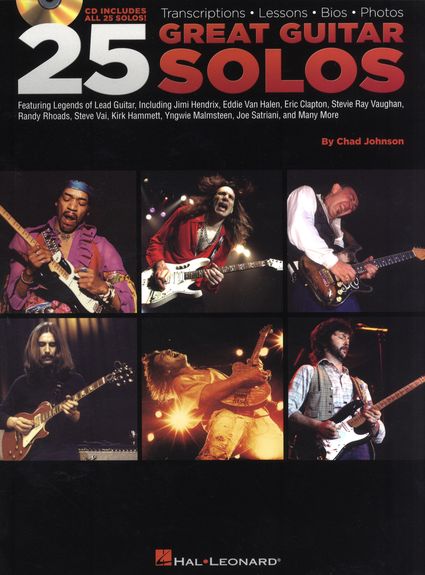
In 25 Great Guitar Solos, we take an in-depth look at some of rock guitar's finest moments. Whether it's the jaw-dropping technique of Yngwie Malmsteen, the unmistakable individuality of Jeff Beck, or the melodic brilliance of Mark Knopfler, each solo stands out as a unique achievement within the rock guitar genre. Travel through time as we explore rock' n' roll history with bios, photos, lessons, full notation and tablature, a sound-alike audio CD, and much more. There's plenty here to keep you occupied and enough stylistic variation to satisfy your occasional craving for the eclectic. About the CD. The accompanying audio CD with this book includes all 25 solos performed note for note with a full band and is playable on any CD player. For PC and MAC computer users, the CD is enhanced with Amazing Slow Downer software so you can adjust the recording to any tempo without changing pitch! The time code shown at the start of each solo transcription indicates the point at which the solo begins in the original recording. All solos on the CD performed by Hal Leonard studio musicians. Scotty Moore, Jeff Beck, Eddie Van Halen, Steve Vai and many others, take an inside look at the genesis of rock lead guitar. The book and CD compendium provides solo transcriptions in standard notation and tablature, lessons on how to play them "HOW TO PLAY IT", guitarist biographies, AGE AT TIME OF RECORDING, GUITARS, AMPS, equipment, photos, history and much more. The accompanying CD contains full-band demonstrations of every guitar solo in the book! 152 pages. Note: only solos are notated, not complete songs.
25 Great Guitar Solos is the latest instructional paperback release from Hal Leonard Publishing, the leader in educational material for musicians. It's 25 transcriptions of some of the greatest signature guitar solos ever recorded. This collection will no doubt thrill any burgeoning, motivated guitarist, whether they're young or old, novice or veteran. The content is comprehensive and accurate, yet portrayed in a simplified manner that doesn't overwhelm or discourage the learner. The book is complete with transcriptions, lessons on how to, biographies on each song and artist, photos, and a notation legend. A CD is attached as well, which includes note-for-note renditions of all 25 songs, done by a complete band, and playable on any CD player. Additionally, the CD is enhanced for PC and MAC users, with slow down software for a painless learning experience. You can decelerate the songs to any tempo without changing note pitch. Taking full advantage of the lessons in this book will improve and add sparkle to any guitarist. The bio sections are fascinating, and loaded with info pertaining to the songs and the recording artists who played them. For example: 'All Along The Watchtower' gives a short bio of the life of Jimi Hendrix and his music, and then goes into detail about how the song is done, its arrangement and chord changes, key and measure continuance, and also about the guitar and gear used. The collection of songs is excellent.
Transcriptions · Lessons · Bios · Photos
Series: Guitar Book
Softcover with CD - TAB
Author: Chad Johnson
"A composer does not just write the main Inelody; he composes every orchestrated part in the entire sound spectrum. That is also what I do, but I do it in the form of rock 'n' roll." -Yngwie Malmsteen. Of all the eighties "shredders," Yngwie Malmsteen stands out as the most prominent. He raised the bar more than any other single guitarist and inspired legions of followers in the same way as Eddie Van Halen (see "Eruption"), Joe Satriani (see "Satch Boogie"), or Steve Vai (see "Big Trouble"). With the release of 1984's Rising Force came a fully-developed and entirely unique style that fused heavy metal and classical music with dizzying results. Eddie's technique was awesome, but Yngwie's was simply staggering. He had solidified his place instantly among the guitar gods. Born Lars Johann Yngwie Lannerback in 1963 in Stockholm, Sweden, he adopted his mother's maiden name, Malmsteen, after his parents divorced. As a young child he was particularly unruly and actually refused his mother's suggestions to take up a musical instrument, feeling as though music wasn't quite macho enough. At the age of seven, however, this would change. Yngwie saw a documentary on Jimi Hendrix (see "All Along the Watchtower") in which he burned his guitar on stage, and that was all Yngwie needed. Hendrix and Deep Purple's Ritchie Blackmore (see "Highway Star") inspired him early on, and Yngwie was particularly interested in the way Blackmore combined classicallytinged minor lines with heavy rock riffs. To say he became obsessed would even be an understatement; Yngwie eventually dropped out of school at around age ten (!) so. he could stay home and practice. His mother, well aware of the talent young Yngwie displayed, supported the decision. Through his sister, Yngwie was introduced to the music of classical composers such as Bach, Beethoven, Mozart, and Paganini. He became particularly interested in Paganini, who combined a dazzling technique with an unruly, "wild man" demeanor. Yngwie patterned much of his attitudes after the nineteenth-century violinist, eventually resulting in a healthy ego and wild on-stage antics. By his late teens, Yngwie was playing in several local bands around Sweden but finding little success with the then pop-dominated musical tastes of the time. After sending demo tapes to several labels in the U.S., he struck gold in the form of Mike Varney. The president of Shrapnel records, a label tailored to the new "shredding" style emerging at the time, Varney invited Malmsteen to Los Angeles in 1981. Yngwie quickly joined the band Steeler, which did release one album, but he soon left in search of a band with a style better suited to his. Alcatrazz was a closer fit, and Yngwie remained with them until 1983, releasing one studio album (No Parole from Rock 'N' Roll) and one live album (Live Sentence) before deciding to set out on his own. Yngwie's spot in Alcatrazz would be filled by Steve Vai. Yngwie recruited his longtime keyboardist friend Jens Johansson and formed his own band, Yngwie J. Malmsteen's Rising Force. Their debut album, Rising Force, was released in 1984 and sent shockwaves through the rock guitar world. The album actually peaked at #60 on the charts-an extremely impressive feat considering the majority of the album was instrumental- and received a Grammy nomination for Best Rock Instrumental Performance. Yngwie swept the readers' polls in ...
... over 13 million. The band instantly became the biggest in the world, and they freely indulged in all of the debaucheries that rock stardom affords. In 1988 they released G N' R Lies, an album that combined their first EP with four new acoustic-based songs. They scored another huge hit with the delicate ballad "Patience," but "One in a Million," with its shocking, outspoken lyrical content, swarmed the band in controversy and negative publicity. At the American Music Awards, Slash and bassist Duff McKagan, both severely intoxicated, made an extremely inappropriate acceptance speech laced with profanity, further damaging the band's public image. By 1990, both Slash and Steven Adler had developed serious heroin addictions, and while on tour with the Rolling Stones, Axl announced that he would leave the band if certain members didn't stop "dancing with Mr. Brownstone." Although Slash was able to get himself clean, Adler continued to truggle and was eventually fired from the band, with Matt Sorum (from the Cult) brought in as a replacement. Amid all the controversy and drama, the band had been working on their followup album, augmented in the studio by keyboardist Dizzy Reed. The release was delayed for nearly a year, but Use Your Illusion I and Use Your Illusion II finally came out in September of 1991-unfortunately for them, this was the same month that Nirvana's Nevermind hit the helves. Though the Illusion albums sold ell initially, it was only a matter of time before grunge took the nation by storm. The Spaghetti Incident?, a collection of punk covers, was released in 1993. but failed to make much of a splash. Since then, Slash has stayed active with Slash's Snakepit in the mid-nineties and more recently the successful Velvet Revolver, which features former Stone Temple Pilots frontman Scott Weiland, Duff McKagan, and Matt Sorum. Axl Rose, the only remaining member of G N' R, has been promising the release of a new album for nearly a decade, which has turned into somewhat of a running joke amongst the music industry. How to Play It: Slash was truly a breath of fresh air in the late eighties. His sound was so raw and unpolished compared to others of the day, yet he still had considerable chops that seemed unlikely given his punkish edge. With "Sweet Child 0' Mine," he created one of the most memorable guitar tracks of the decade. The infamous intro was striking enough, but the lengthy solo really provided him an opportunity to shine. At first the song comes off as a jangly, upbeat pop rock song, complete with loves truck lyrics and the standard changes. The entire mood changes at the solo, however, and that new darker, menacing vibe carries out through the rest of the song. The solo begins with a dramatic key change from D major to E minor by way of a chromatic walk-up. Slash begins navigating the new Em-C-B7-Am progression with sparse, tasty phrases from the E minor scale, occasionally alluding to the harmonic minor scale over the B7 chord. He employs imitative phrasing throughout to lend direction to the solo, as is evident is measures 2-3, 6-8, and 9-14. He makes extensi e use of both half- and whole-step bends throughout, with pitch-perfect intonation in each instance. Notice how Slash works with the rhythm section, gently accenting the "and" of beat 2 with many of his melodies to reinforce the main rhythmic pulse of the song. At the end of measure 16 he kicks on the wah and unleashes a pre-composed sixteenth-note ascenuing rUll based 011 the E harmonic minor scale that ushers in the energized second half of the solo. The lick lasts two measures, as the Am chord is extended for one extra measure to heighten the build-up into the next section. Though it begins in seventh position, it ends up in twelfth position, shifting positions on the high E string exclusively with pinky slides. The first two beats don't pose much of a fingering problem, but after that things can get hairy if you don't think ahead. Try fingering the C and D# notes in the second half of beat 3 (measure 16) with your first and third fingers, respectively. After that, you should be able to continue sliding your pinky up for the position shifts without a problem. At measure 18, over the new four-measure progression of Em-GS-AS-BS-CSDS- G5, Slash turns up the heat with gutsy pentatonic-based phrases mostly in... Vital Stats: Guitarist: Slash, Song: "Sweet Child O' Mine", Album: Appetite for Destruction, 1987 Age at time of recording: 22, Guitar: Gibson Les Paul, Effects: wah wah, Amp: Marshall
YEAR, SONG, GUITARIST, ARTIST / BAND, ALBUM
1955, Rock Around The Clock, DANNY CEDRONE, BILL HALEY, shake, rattle & roll
1956, Hound Dog, SCOTTY MOORE, ELVIS PRESLEY, The real Elvis
1967, Sunshine Of Your Love, ERIC CLAPTON, CREAM, Disraeli Gears
1968, All Along The Watchtower, JIMI HENDRIX, Electric Ladyland
1969, Let It Be, GEORGE HARRISON, THE BEATLES, Let it be
1970, 25 Or 6 To 4, TERRY KATH, CHIGAGO, Chicago II
1972, Blue Sky, DUANE ALLMAN, DICKEY BETTS, ALLMAN BROTHERS BAND, Eat a Peach
1972, Blue Sky, PART 2 SOLO, DUANE ALLMAN, DICKEY BETTS, ALLMAN BROTHERS BAND, Eat a Peach
1972, Highway Star, RITCHIE BLACKMORE, DEEP PURPLE, Machine Head
1973, Free Bird, GARY ROSSINGTON, ALLEN COLLINS, LYNYRD SKYNYRD, Pronounced Leh-Nerd Skin-Nerd
1973, La Grange, BILLY GIBBONS, ZZ TOP, Tres Hombres
1975, Bohemian Rhapsody, BRIAN MAY, QUEEN, A Night At the Opera
1975, She's A Woman, JEFF BECK, Blow by Blow
1975, Walk This Way, JOE PERRY, AEROSMITH, Toys in the attic
1978, Eruption, VAN HALEN, Van Halen
1978, Sultans Of Swing, MARK KNOPFLER, DIRE STRAITS, Dire Straits
1978, Sultans Of Swing, PART 2 SOLO, MARK KNOPFLER, DIRE STRAITS, Dire Straits
1980, Crazy Train, RANDY RHOADS, Blizzard of Ozz
1980, You Shook Me All Night Long, ANGUS YOUNG, AC/DC, Back in Black
1983, (You Can Still) Rock In America, BRAD GILLIS, JEFF WATSON, NIGHT RANGER, Midnight Madness
1983, (You Can Still) Rock In America, PART 2 SOLO BRAD GILLIS, JEFF WATSON, NIGHT RANGER
1983, Am I Evil? KIRK HAMMETT, METALLICA, Garage Inc.
1983, Pride And Joy, STEVIE RAY VAUGHAN, Texas Flood
1984, Black Star, YNGWIE MALMSTEEN, Rising Force
1986, Big Trouble, STEVE VAI, Eat 'em and Smile
1987, Satch Boogie, JOE SATRIANI, Surfing with the Alien
1987, Sweet Child O' Mine, SLASH, GUNS N' ROSES, Appetite for destruction
1990, Get The Funk Out, NUNO BETTENCOURT, EXTREME, Pornograffitti

 Italiano
 English