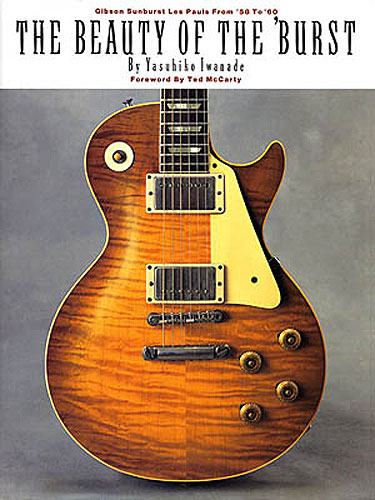
THE BEAUTY OF THE 'BURST, Iwanade Gibson's magnificent Sunburst Les Pauls made between 1958 and 1960.
THE BEAUTY OF THE 'BURST
Series: Book
Publisher: Hal Leonard
Medium: Softcover
Author: Yasuhiko Iwanade
Inventory #HL 00330265
ISBN: 9780793573745
UPC: 073999327182
Width: 8.5"
Length: 11.
Finally, the long-awaited English edition of this historic Japanese book is here! The Beauty of the 'Burst pays tribute to Gibson's magnificent Sunburst Les Pauls made between 1958 and 1960, the most highly prized solidbody electric guitars ever. The magnitude of their value is directly related to their look (outrageous wood patterns, or "figured" timber), since non-players are paying top dollar for them. The book features lavish full-color photos of these beautiful instruments throughout; the guitars of famous players; a foreword by Ted McCarty; a bio of the author, world renowned collector Yasuhiko Iwanade; and the "Science of the Burst" section with over 30 pages of detailed reference facts on every facet of the guitar, including colors, wood figure, pick-ups, hardware and qualities of "voice." This may be the closest guitarists will ever be able to get to these incredibly collectible beauties! 216 pages, softcover. 224 pages.
The Color yellow layer on top of the maple plays a very very important role in the background of the sunburst. Without this layer the radiant effect of the finish could not be obtained. As such, this layer acts as reflective lighting. On the vintage Sunburst Les Pauls, special pigment was chosen for this purpose. Contrary to belief, Gibson did not use dye to color the wood itself. The dye stain is not as reflective as pigment stain. The pigment chosen for this purpose was special. It remained vivid without hiding the grain. Combining this color layer along with the highly reflective qualities of maple created the beautiful sunburst finish of the Les Paul Sunburst. Interestingly enough, this yellow color layer never fades. Sunburst layer. The term sunburst is derived from the beautiful multi color spectrum of colors that occurs during a sunset on the horizon. With respect to guitars, the term sunburst refers to the actual spraying of red paint over the edge of a guitar on top of the yellow base coat. This produces a "sunset" effect. This procedure was done by hand; the painters use of the spray gun, the paint viscosity, the weather, and the humidity all contributed to the final outcome of this arrangement. The role of the sunburst layer differs considerably from the yellow layer. The sunburst layer does not actually shine. Rather the layer should be looked at as a passive color filter from the light coming through from the yellow base coat. For that reason, contrary to the yellow layer the sunburst layer employed a dye colorant. This dye colorant has an ideal characteristic for the sunburst layer because it is translucent. However, it has the disadvantage of being difficult to apply evenly. Also, as widely known, it is prone to fading. The common belief is that the appearance of this burst layer is due to uneven fading. This is partly true. However, it is also the case that some of this unevenness was caused by production procedure. While not so noticeable when it was new, over time it became obvious that the multiple layers of dye had been unevenly applied - only to be revealed later after the top layers had faded. This can be observed at the edge of the top, close to the end pin. On Sunburst Les Pauls, the sunburst layer gets most of the aging affect, resulting in fading or discoloration. This is most common on 1958 models through mid 1960. By late 1960 the paint formula changed, and the finish became more resistant to fading. This section primarily applies to the 1959 models. Henceforth, we have used the term fading to describe a loss of color. Actually, this is a very vague and incorrect expression. Fading does not occur simply to the red color of the sunburst layer. Cherry red is not one color - it is a mixture.
Original 1959 Cherry-Red
It is commonly known that the dye colorant red is most prone to fading. Undoubtedly that is the primary reason that the Sunburst Les Paul finish "ill fade. However, that does not explain everything about that subtle hue of the finish. The mixture of colors goes a long way toward understanding the aging and fading processes. A 1959 cherry-red color was comprised primarily of dye colorant red. To add depth to the color, a small amount of blue was added. Since 1959 cherry-red is in actuality a slightly blueish deep red, sunburst is created as the light bounces back from the yellow base coat through the cherry-red layer. So what happens then when this mixture of colors fade? As already mentioned, red fades fastest. The real issue is the ratio that each of the two colors that comprise the sunburst fade at. When the finish is new, the gloving yellow light from the base coat comes up through sunburst shading. The small amount of blue in cherry-red, together with this yellow creates green, which is a complementary color to red. In the beginning stage of fading, this green is such a low ratio that it is suppressed by red. However, as time goes by, red begins to fade more. Yellow stays unchanged. Blue fades but far slower than red. So the ratio of green against red becomes higher and higher. At a certain point of this red versus green sequence, the top starts to take a hue of brown. And this reddishbrown color is the most often seen teaburst. From there it could become green burst but usually by this time blue also starts to fade, so usually it turns into honeyburst. When all red and blue are gone from cherry-red shading, then there is no shading. It becomes a 'Lemon drop.' To further understand the topic, let us look at the process of fading in sequence and consider it with other factors. As stated, the speed of fading differs from color to color. In other words each color has its own pace of fading. If only one color is concerned, the pattern of fading remains constant. However, when fading of certain mixtures of colors are observed, each color needs to be examined independently. The way each color fades will impact the total look of the finish. So as far as Sunburst Les Pauls are concerned, fading does not mean just a loss of color. In actuality, of all the colors involved, the yellow from the base coat does not fade. Red, which is the main ingredient of cherry-red, is added with blue to make cherry-red. Both the red and the blue fade independently of each other. The change of balance among these three colors at a given time is fading. To understand the "fading sunburst" phenomenon, it is important to know the cause of it. The primary cause of fading is widely known. It is an exposure to ultraviolet light from various light sources. This makes a dramatic difference between a guitar kept and stored away for years and the one always out of the case being played. The second cause would be a chemical reaction. We often see a discoloration of the top where the elbow hits during playing. Since the film of clear lacquer has microscopic holes, acid and ammonia ridden sweat from the guitar players arm can reach through the clear lacquer, penetrating the color layer and affecting it. Also, moisture in the air can have a similar effect on the entire surface of the finish. Since the ultraviolet fading and the chemical reaction fading are mutually exclusive they may not happen simultaneously. [n different ways, both of these processes are affected by the climate, temperature and other factors. Hence, the many variations of the Sunburst's color are a result of multiple factors, influences ranging from the slight variations in the painting on each individual instrument, to the chemical and the ultraviolet fading that we have just discussed. 3. Clear Coat We have learned that the lighl which bounces back from the wood's surface through the yellow base coat goes through sunburst shading to create the glowing sunburst finish effect. However, there is one more layer the light needs to go through before it reaches our eves. That layer is a clear lacquer top coat. The film of clear lacquer is there to protect the color layer from being rubbed off and also to protect the wood from moisture and contaminants. This film of clear coat is usuallv comprised of several layers of lacquer applied successively. As we know, lacquer ages or 'burns' to a pleasant hue of amber. This means there is one more film of color laid on lap of the sunburst. The aging or anlbering effect of this film is a primal)' concern here but first 11'1' must understand amber as a color. How does it affect the way a finish looks' Examined carefully, amber is a mixture of black and orange. The black comes from the decomposition of lacquer through its deterioration. This black pigment acts as a subtle obstruction to the light bouncing back from the wood's surface. The color saturation and luminosity is suppressed by this black pigment. On Sunbursl Les Pauls, the subtle balance of bright yellow and this obstructive black pigment create a distinctive "vintage" look. The orange element of the amber, on lhe other hand, gives warmth and depth 10 the color. This is also a part of the “vintage" look. There is one more character to tllis film. It is 11rtually a frosted glass. When new, tllis film of clear lacquer is buffed and polished to a high gloss. The more flat the surface, the more radiant it becomes. However, as lacquer ages, losing small amounts of leftover solvents and plasticizers, it shrinks and becomes brittle. The film may hal'e numerous small cracks and checks. Decreased finish would expose the wood texture underneatll. All of these factors together, the surface of the clear film is given the slight satin look which complements the soft defused light effect of the overall look of the guitar. in antique jargon, this is called patina. As a conclusion, let us layout the sequence of this phenomenon of the 11ntage Les Paul Sunburst effect we just learned about. Light first reaches the top of the guitar going through the amberI'd top clear lal'er, then the cherry-red shading, the yellow base coat and finally the reflective surface of maple. Then, it bounces back OUI going through the yellow base coat again, cherry-red shading and amberI'd clear coat. It finally reaches our eyes after being mixed together Wilh the small amount of defused light that was reflecled by the surface of the top coat film of clear lacquer. Again, tllis is the oplical process which makes the Sunburst Les Paul guitar so attractive.
CONTENTS
FOREWORD by TED McCARTY
ULTIMATE SUNBURST FILE
1958 SUNBURST LES PAUL
1959 SUNBURST LES PAUL
1960 SUNBURST LES PAUL
RARE BEAUTY ·
LABYRINTH OF THE 'BURST
THE 'BURST SLiNGERS
SCIENCE OF THE 'BURST - LAYERS OF COLORS
STUDY OF THE FIGURE - 3 DIMENSIONAL PHENOMENON
PAF, THE HEART OF THE 'BURST .. ·
HARDWARE
FROM GOLD TOP TO SUNBURST ... ·
STRUCTURE OF THE 'BURST .. ·
VOICE OF THE 'BURST
FACTS OF THE 'BURST ·
'BURST TALK - INTERVIEW WITH THE OWNERS
BILLY GIBBONS (ZZ TOP)
JOHN CLARDY .
VIC DA PRA .
PERRY MARGOULEFF
ICHIRO KATO
ALBERT MOLINARO
RONNY PROLER
TOM WITIROCK
SERIAL NUMBER LIST ·
SUNBURST LES PAUL PHRASEOLOGY

 Italiano
 English