PIANO/KEYBOARDS e...

BEST OF BLUES PIANO, Signature Licks. Todd Lowry. CD

BEST OF BLUES PIANO, Signature Licks. Todd Lowry. CD

A step-by-step breakdown of the piano styles and techniques of Dr. John, Pete Johnson, Professor Longhair, Pinetop Perkins, and others that uses their actual licks to teach. 14 songs are covered: Big Chief (Professor Longhair) o Blueberry Hill (Fats Domino) -(The Original "Pinetop") Boogie Woogie (Pinetop Smith) -Caldonia (What Makes Your Big Head So Hard?) (Pinetop Perkins) -Confessin' the Blues (Jay McShann) -Cow Cow Blues (Cow Cow Davenport) -Cryin' in My Sleep (Jimmy Yancey) -Diving Duck (Otis Spann) -Everyday I Have the Blues (Memphis Slim) -Honky Tonk Train Blues (Meade "Lux" Lewis) -The Pearls (Jelly Roll Morton) -Roll 'Em Pete (Pete Johnson) -Route 66 (Charles Brown) -Tipitina (Dr. John).

Songlist:
(The Original) Boogie Woogie
Big Chief
Blueberry Hill
Caldonia (What Makes Your Big Head So Hard?)
Confessin' The Blues
Cow Cow Blues
Cryin' In My Sleep
Diving Duck
Everyday I Have The Blues
Honky Tonk Train (Honky Tonk Train Blues)
Roll 'em Pete
Route 66
The Pearls
Tipitina

Price: €20,00
€20,00

BEST OF ROCK KEYBOARD SIGNATURE LICKS TODD LOWRY LIBRO CD PIANOFORTE

BEST OF ROCK KEYBOARD. SIGNATURE LICKS. Lowry. CD

A Step-by-Step Breakdown of Famous Rock Keyboard Styles and Techniques
Series: Signature Licks Keyboard
Medium: Softcover with CD
Author: Todd Lowry

Explore the classic riffs and solos of rock's greatest keyboardists with this informative book/CD pack. Includes detailed instruction, transcriptions, and a CD with demos. 12 songs are analyzed: Bloody Well Right (Supertramp) - Cold as Ice (Foreigner) - Don't Do Me Like That (Tom Petty & The Heartbreakers) - Don't Let the Sun Go Down on Me (Elton John) - I'd Do Anything for Love (Meat Loaf) - Killer Queen (Queen) - Lady Madonna (The Beatles) - Light My Fire (The Doors) - Piano Man (Billy Joel) - Point of No Return (Kansas) - Separate Ways (Journey) - Werewolves of London (Warren Zevon).

Bloody Well Right
Cold As Ice
Don't Do Me Like That
Don't Let The Sun Go Down On Me
I'd Do Anything For Love (But I Won't Do That)
Killer Queen
Lady Madonna
Light My Fire
Piano Man
Point Of Know Return
Separate Ways (Worlds Apart)
Werewolves Of London

64 pages

Price: €27,99
€27,99

BEBOP JAZZ PIANO, John Valerio. Hal Leonard Keyboard Style CD

BEBOP JAZZ PIANO. J. Valerio. CD

Hal Leonard Keyboard Style Series
Series: keyboard instruction
Medium: Softcover with CD
Author: John Valerio

In this book in the Hal Leonard Keyboard Style Series, author John Valerio provides essential, detailed information for bebop and jazz pianists on the following topics: chords and voicings, harmony and chord progressions, scales and tonality, common melodic figures and patterns, comping, characteristic tunes, the styles of Bud Powell and Thelonious Monk, and much more. The accompanying CD features many of the examples in the book performed either solo or with a full band. Also included are combo performances of five of the tunes featured at the end of the book. 48 pages.

Price: €18,99
€18,99

PLAY TRUMPET TODAY! SONGBOOK. CD

PLAY TRUMPET TODAY! SONGBOOK. CD

Price: €14,00
€14,00

STRIDE & SWING PIANO John Valerio Hal Leonard Keyboard Style Series CD LIBRO PIANOFORTE BOOGIE WOOGIE

STRIDE & SWING PIANO. John Valerio. CD

Hal Leonard Keyboard Style Series
Series: keyboard instruction
Medium: Softcover with CD
Author: John Valerio

Focusing on styles such as classic ragtime, early blues & boogie woogie, New Orleans jazz, stride and swing, this new book/CD pack in the Hal Leonard Keyboard Style Series teaches left- and right-hand techniques including chords, bass runs, patterns and more. Key players of these styles Scott Joplin, Jimmy Yancey, Pete Johnson, Jelly Roll Morton, James P. Johnson, Fats Waller, Teddy Wilson and Art Tatum are prominently referenced. Includes 14 full songs to play, and an accompanying CD! 96 pages


INTRODUCTION
Welcome
to Stride and Swing Piano! This book is an in-depth look at early solo jazz
piano styles from the 1900s to the 1940s. Many pianists know the term stride as an accompaniment
technique in which the left hand alternates between a bass note and a
chord in an "oom-pah, oom-pah" manner. But stride was also the label given to a style of piano
music that emerged in the 1920s. This was an early form of jazz that evolved from predecessors like
ragtime, blues, and New Orleans style, and culminated in the swing style of the 1930s and' 40s.
Most of the early jazz piano styles up to and including swing piano feature this striding left-hand
motion.
This book traces the evolution of stride and swing piano styles-from their predecessors to their
fullest development; each chapter focuses on a particular style and player:
Classic Ragtime: Though not jazz per se, ragtime was an important forerunner, serving
as a model for styles like New Orleans and stride. Invented by Black Americans, ragtime
emerged during the 1890s and was a strictly written music with formal and rhythmic constraints.
Scott Joplin was its most famous composer.

Blues & Boogie Woogie: Also invented by Black Americans (in the 1800s), blues
was another important forerunner of stride and swing jazz styles. A looser music, blues had
its own melodic material, accompaniment style, and rhythmic feel. Jimmy Yancey was a premiere
blues pianist; Pete Johnson was a well-known player in the faster, boogie woogie style.

New Orleans Jazz: In the early 1900s, New Orleans pianists developed jazz, a style that
merged ragtime with blues, and added improvisation. Jelly Roll Morton was the most important
early jazz pianist. He loosened the "even subdivisions" of ragtime and made jazz swing.

Stride: Stride was a fast, virtuosic piano music born in Harlem during the 1920s and' 30s.
Early stride,
ala James P. Johnson, was more appropriately called "Eastern ragtime" than
later stride, which evolved into a lighter, smoother music, as played by Fats Waller.

Swing: Swing emerged during the mid '30s with jazz big bands. The driving accents of
stride were ironed out, and an even 4/4 pulse became the norm. Teddy Wilson best represented
the swing style; Art Tatum took it to its highest point.

The one element that all of these styles have in common is the almost continuous playing of the
pulse (on every beat) by the left hand. This was accomplished by: 1) bass note vs. chord alternation,
2) the playing of bass lines, or 3) the continuous playing of chords.
Modern jazz piano styles have done away with the left hand's time keeping role [or the most pat1,
and contemporary players are often at a loss when called upon to play the left hand in an older solo
style. Stride and Swing Piano offers an introduction to the usage of traditional left-hand devicesincluding
characteristic chord voicings and bass note intervals, such as octaves and tenths-as well
as right-hand techniques such as single-note lines, chord voicings, intervals, mns, and improvisation.
Each chapter culminates in one or more original tunes demonstrating the style and its techniques.
Practice suggestions are also included. The reader is encouraged to learn and study these
tunes, and to apply all of the techniques in the book to standard jazz and pop songs of the era.
About the CD
The accompanying CD features many of the examples in the book-including 14 original tunesperformed
on solo piano. Listen to the CD to better understand each style and to practice your
own solo playing.


Early jazz had always been evolving on two simultaneous fronts-as a small ensemble
music, and as a solo piano music. By the mid 1930s, ensembles were changing. Jazz
bands were growing larger, into "big bands"-essentially, hybrids of the jazz combos and
larger dance bands of the '20s. Along with the transition from smaller to larger groups, a
"smoothing out" process took place in the music, and a distinctly new piano style emerged.
One crucial defining characteristic of swing* music is the evenness of all four beats played by the
rhythm section. The rhythm sections of the big bands used a bassist who usually played on all
four beats of the measure, laying down an even 4/4. This was different from the tuba or bass
players of older New Orleans style, who usually played on beats I and 3, with occasional walking
fills. The epitome of a swing rhythm section was Count Basie's band; they played all four beats
of each measure with such evenness and precision they sound like one person.
Swing pianists were caught between two worlds. Still rooted in the stride/ragtime model, they
began exploring new ways to establish the 4/4 pulse while freeing up the left hand. Swing demanded
a lighter touch and a looser feel; the driving accents of stride piano were ironed out.
Although the left hand still relied on an oom-pah striding motion, dynamic levels became more
consistent for bass notes and after-chords. So-called "walking bass" lines became commonplace.
The consummate swing pianist was Teddy Wilson (1912-1986). His playing represents the highest
cultivation of the pure swing style. Balance and restraint characterize his approach. Classically
trained, Wilson had a refined sense of touch. His technique was supple, and his music, subtle.
One reason for the lighter touch of the swing pianists was the use of the microphone; the earlier
jazz pianists had to pound on the piano to be heard within a group setting. Wilson gained notoriety
when he teamed up with clarinetist Benny Goodman and drummer Gene Krupa to form the
Benny Goodman Trio. This group was historically important not only for the great music they
created but also for being the first publicized interracial jazz performing group. The fact that this
trio had no bass player is a testament to Wilson's astounding left-hand technique and conception.
Wilson played solo piano in much the same way as he approached playing with a group.
*The term swing as used here refers to the style of jazz that evolved from the mid 1930s to the mid' 40s. It should not be confused
with the more general use of the word denoting the rhythmic conception associated with most jazz.
Left-Hand Techniques
Most of the left-hand techniques used by swing pianists were already used by the late stride players.
As with earlier styles, the left hand mostly kept time by playing the quarter-note pulse.
Crucial differences were that now all of the beats were played with equal stress, the touch was
much lighter, and the feeling was more relaxed. The hard-driving left hand of the stride pianists
was replaced by a steady, relaxed groove. There was also a difference in when and how often the
swing pianists applied each left-hand technique. These newer approaches are described in the following
pages.


CONTENTS

1 CLASSIC RAGTIME .
Scott Joplin

2 BLUES & BOOGIE WOOGIE
Jimmy Yancey & Pete Johnson

3 NEW ORLEANS JAZZ .
Jelly Roll Morton

4 STRIDE PIANO I.
James P. Johnson

5 STRIDE PIANO II.
Fats Waller

6 SWING PIANO I .
Teddy Wilson

7 SWING PIANO II .
Art Tatum

Price: €18,99
€18,99

SMOOTH JAZZ PIANO CD HAL LEONARD KEYBOARD comping soloing scales chords harmony voicings

SMOOTH JAZZ PIANO. CD

Keyboard Style Series
Series: keyboard instruction
Medium: Softcover with CD
Author: Mark Harrison
Artist: Various

This comprehensive book and CD package will teach you the basic skills you need to play smooth jazz piano. From comping to soloing, you'll learn the theory, the tools, and the tricks used by the pros. The accompanying CD features many of the examples in the book performed either solo or with a full band. Specifically, you'll learn: scales and chords, harmony and voicings, progressions and comping, rhythmic concepts, melodies and soloing, characteristic stylings, the history of jazz, and more. THE HAL LEONARD KEYBOARD STYLE SERIES provides focused lessons that contain valuable how-to insight, essential playing tips, and beneficial information for all players. Comprehensive treatment is given to each subject, complete with a companion CD. 80 pages

Price: €19,99
€19,99

BLUES PIANO. M. Harrison. CD

BLUES PIANO. M. Harrison. 79 Pages. CD

Hal Leonard Keyboard Style Series
Series: keyboard instruction
Medium: Softcover with CD
Author: Mark Harrison

Ever wanted to play the blues, but weren't sure where to start? Blues Piano will teach you the basic skills you need. From comping to soloing, you'll learn the theory, the tools, and even the tricks that the pros use. And, you get seven complete tunes to jam on. Listen to the CD, then start playing along! Covers: scales and chords; left-hand patterns; walking bass; endings and turnarounds; right-hand techniques; how to solo with blues scales; crossover licks; and more. 80 pages.

Price: €18,00
€18,00

JAZZ BALLADS, Piano Play-Along Volume 2. CD

JAZZ BALLADS, Piano Play-Along Volume 2. CD

Composer: Various Composers
Your favorite sheet music will come to life with the innovative Piano Play-Along series! With these book/CD collections, piano and keyboard players will be able to practice and perform with professional-sounding accompaniments. Containing eight cream-of-the-crop songs each, the books feature new engravings, with a separate vocal staff, plus guitar frames, so players and their friends can sing or strum along. The CDs feature two tracks for each tune: a full performance for listening, and a separate backing track that lets players take the lead on keyboard. The high-quality, sound-alike accompaniments exactly match the printed music.
Volume 2 includes:

Autumn In New York
Do You Know What It Means To Miss New Orleans
Georgia On My Mind
In A Sentimental Mood
More Than You Know
The Nearness Of You
The Very Thought Of You
When Sunny Gets Blue

37 pages

Price: €15,00
€15,00

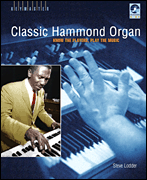
CLASSIC HAMMOND ORGAN Know the Players Play the Music CD BOOK LIBRO TASTIERA SPARTITI MUSICA

CLASSIC HAMMOND ORGAN, Know the Players, Play the Music. CD BOOK

Series: Book
Publisher: Backbeat Books
Medium: Hardcover with CD
Release Date: 06/15/2008
Author: Steve Lodder
A hands-on history and tutorial on one of the greatest keyboards ever.

Professional session player Steve Lodder's Classic Hammond Organ explores the history of this enduringly popular instrument and examines some of the best performers to get their hands on the twin manuals. The book features:
Analysis of the styles of Jimmy Smith, Rick Wakeman, Jon Lord, and Keith Emerson among others.
Expert instruction on a variety of Hammond exercises designed to get you playing in the style of the greats.
An accompanying CD that provides support audio for these exercises. 160 pages

Price: €31,99
€31,99

IMPROVVISAZIONE ALLA TASTIERA, Mariani. In italiano. CD

IMPROVVISAZIONE ALLA TASTIERA, Mariani. In italiano. CD

M. Mariani [Metodi + CD | Piano & Tastiere]

Questo testo vi propone un approccio progressivo e evolutivo all’improv-visazione in modo da permettervi d’ingurgitare i diversi elementi man mano che si va avanti nello studio per dare il più possibile libero corso all’immaginazione ed alla libertà di creare. Ogni nuovo elemento potrà in questo modo essere considerato come un arricchimento piuttosto che come una restrizione. Studieremo quindi in questo metodo le nozioni di base (intervalli, scale, accordi, armonizzazione, tonalità), l’indipendenza delle mani, gli accordi di settima di dominante, le forme di accompagnamento per la mano sinistra, l’estensione degli accordi, i principi ritmici, armonici nonché melodici insomma tutto quello che dovete sapere per conoscere appieno l’arte dell’improvvisazione. Libro + CD

Price: €23,00
€23,00
Syndicate content