GUITAR SIGNATURE LICKS

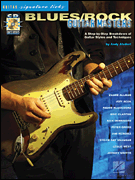
BLUES/ROCK GUITAR MASTERS CD TABLATURE lazy-smoke on the water-Strange Brew-Stumble-hey joe-badge

BLUES/ROCK GUITAR MASTERS. CD TAB.

A Step-by-Step Breakdown of Guitar Styles and Techniques
Series: Signature Licks Guitar
Softcover with CD - TAB
Author: Andy Aledort

This book/CD pack offers detailed analysis and instruction on the playing of nine of the greatest blues/rock guitar heroes that have ever lived: Duane Allman, Jeff Beck, Ritchie Blackmore, Eric Clapton, Rick Derringer, Peter Green, Jimi Hendrix, Stevie Ray Vaughan, Leslie West and Johnny Winter. Learn to play like them by studying their signature licks in 17 songs:

Badge
Dreams Of Milk & Honey
Hey Joe
Killing Floor
Lazy
Let Me Love You
Mississippi Queen
Pride And Joy
Rock And Roll Hoochie Koo
Rock My Plimsoul
Smoke On The Water
Someday, After Awhile (You'll Be Sorry)
Statesboro Blues
Still Alive And Well
Strange Brew
The Stumble
Whipping Post

112 pages

Price: €21,99
€21,99

BEATLES, BEST OF FOR ACOUSTIC GUITAR. CD TABLATURE

BEATLES, BEST OF FOR ACOUSTIC GUITAR. CD TAB.

Series: Signature Licks Guitar
Softcover with CD - TAB
Author: Wolf Marshall

Learn the trademark acoustic guitar elements of rock's most influential band! This book/CD pack by guitar dean Wolf Marshall provides in-depth analysis of 21 songs, including:

Across The Universe
And I Love Her
Blackbird
Girl
Her Majesty
Here Comes The Sun
Hey Jude
I Will
I'm Looking Through You
I've Just Seen A Face
Julia
Long Long Long
Lovely Rita
Mother Nature's Son
Norwegian Wood (This Bird Has Flown)
Revolution 1
Rocky Raccoon
Till There Was You
Two Of Us
Yesterday
You've Got To Hide Your Love Away

80 pages

Price: €21,95
€21,95

LEE ROTH DAVID BEST OF Guitar Signature Licks CD TABLATURE VAN HALEN-JASON BECKER-STEVE VAI

LEE ROTH DAVID, BEST OF. A Step-By-Step Breakdown of the Styles and Techniques of the Guitarists of David Lee Roth. Signature Licks Guitar. CD TABLATURE

Discography
Recording
About the Author
EDDIE VAN HALEN
STEVE VAI
JASON BECKER

TUNING

Ain't Talkin' 'Bout Love - VAN HALEN
And The Cradle Will Rock - VAN HALEN
Beautiful Girls - VAN HALEN
Goin' Crazy - STEVE VAI
Hang 'Em High - VAN HALEN
Hot For Teacher - VAN HALEN
Jump - VAN HALEN
Just Like Paradise - STEVE VAI
A Lil' Ain't Enough - JASON BECKER
Mean Street - VAN HALEN
Panama - VAN HALEN
Runnin' With The Devil - VAN HALEN
Skyscraper - STEVE VAI
Unchained - VAN HALEN
Yankee Rose - STEVE VAI

Best of David Lee Roth
A Step-By-Step Breakdown of the Styles and Techniques of the Guitarists of David Lee Roth
Series: Signature Licks Guitar
Format: Softcover with CD - TAB
Artist: David Lee Roth
Arranger: Joe Charupakorn

Learn to play the blazing licks and solos as performed by David Lee Roth's renowned guitarists, including Eddie Van Halen, Steve Vai, and Jason Becker. Songs include: Ain't Talkin' 'bout Love - Beautiful Girls - Goin' Crazy - Hot for Teacher - Jump - Panama - Runnin' with the Devil - Yankee Rose - and 7 more. Includes an introduction.

Inventory #HL 00695843
ISBN: 9780634079719
UPC: 073999958430
Width: 9.0"
Length: 12.0"
112 pages


INTRODUCTION

Worshipped by his legions of fans and despised by ex-band members, David Lee
Roth embodies everything that defines the rock star. Sure, he can sing; that's a given.
What makes him "Diamond Dave," however, is that he's incredibly charismatic, vainglorious
beyond belief, has tremendous stage presence, and is a self-promoting, marketing
genius. These are the magic ingredients that separate the extraordinary from the merely
pedestrian. Guitarist Steve Vai characterized Dave as "hysteria personified." Dave craves
the spotlight and, over the course of his career, has created a larger-than-life public persona.
For instance, as Dave was very "giving" of himself, he attempted to get paternity
insurance should he get hit up for child-support payments down the line. Dave can't seem
to separate his public image from his personal life. He's Diamond Dave 24/7, and this
intensity is what makes him the incredible entertainer that he is.
David Lee Roth was born on October 10, 1954, in Bloomington, Indiana, into an
upper-middle-class family (Dave's father was an ophthalmologist). As a child, he was
extremely hyperactive, and by age six he started seeing a shrink regularly. At around the
same time, the Roths moved east to Massachusetts, and Dave, being both a Jew and the
new kid on the block, was quickly ostracized. This alienation led to an inner-rage that still
drives Roth to this day. In his autobiography, Crazy From the Heat, he recalled, "Every
step I took on that stage was smashing some Jew-hating, lousy punk ever deeper into the
deck. Every step." As a loner, he found solace in reading and was particularly affected by
two magazines: Mad and Playboy. These magazines shaped the course of his development.
Another pivotal element in Roth's development was his uncle Manny's club, Cafe
Wha?, in New York City's Greenwich Village. As a kid, Roth hung out there fairly often and
was exposed to every facet of society. This eye-opening experience led to an appreciation
of cultural differences and played a strong part in cultivating Roth's flamboyant persona.
Eventually, the Roths settled in Pasadena, California. As a teen, Dave sang in the
Red Ball Jets (named after a sneaker), an R&B-influenced outfit that played the backyardparty
circuit. It was at a party that Dave first heard Eddie Van Halen, who was then guitarist
and singer for Mammoth, wailin' away on some Black Sabbath covers. Dave was
blown away-"What he does with his hands I wanna do with my feet, with my voice." Roth
would later join Mammoth, and after a simple yet brilliant renaming, Van Halen was born.
Van Halen developed a huge following and conquered the local scene by packing
every gig. It was soon time for greener pastures, and in 1974 Van Halen headed to
Hollywood. It was in Tinseltown that things started to happen. The band secured a residency
at Gazarri's and made its presence known. The next turning point was playing the
Golden West Ballroom with UFO. Prior to this gig, Van Halen's set contained a mixture of
covers and originals; this was the band's first all-original set. The band wowed the audience,
and the generated buzz paved the way for gigs at the Whisky-a-Go-Go and the
Starwood-two essential places for aspiring rock bands to play. It was at the Starwood
that KISS bass player and entrepreneur Gene Simmons heard Van Halen. He immediately
saw the potential and proposed a deal whereby he would produce the band's demo and
shop it to the major labels. If no one bit, the band was free to walk. Van Halen jumped at
the offer, and Simmons flew the band to New York to record. Shockingly, not a single
record label expressed any interest. In hindsight, David Lee Roth suspected that
Simmons was surreptitiously trying to poach Eddie Van Halen.
It was later, in the hands of their first manager, Marshall Berle (actor Vincent
Berle's nephew), that the pieces would come together. He managed to get Warner
Brothers president Mo Ostin and producer Ted Templeman to a Van Halen show at the
Starwood. The band was signed immediately, and on February 10, 1978, Van Halen was
released.


Eddie Van Halen is the king of modern rock guitar, considered by many to be the
greatest rock guitarist ever. He was born Edward Loedwijk Van Halen on January 26,
1957, in Nijmegen, just outside of Amsterdam, Holland, to a Dutch father, Jan, and an
Indonesian mother, Eugenia. In the early '60s, the Van Halens immigrated to sunny
Pasadena, California, with only $25 and a piano (Alex Van Halen claims that both he and
Eddie played piano on the boat to pay for their passage). It was in their early childhood
that the seeds for Van Halen, the band, were planted. Their father was a professional
musician and made both of the boys take piano lessons (later on down the line, Jan would
play clarinet on "Big Bad Bill (Is Sweet William Now)" from Van Halen's fifth album, Diver
Down). Eddie, in particular, was highly accomplished at the piano and placed first several
times at annual piano tournaments.
During their first few school years, Eddie and Alex, because of their language barrier,
kept mainly to themselves and developed a life-long, impenetrable bond. While still in
grade school, they formed their first band called the Broken Combs; Eddie played piano,
Alex played sax, and they wrote well-titled pieces such as "Boogie Booger" and "Rumpus."
At around age twelve, Eddie heard "Wipe Out" and bought a $125 St. George drum set,
while Alex picked up a flamenco guitar. To pay for the drum set, Eddie took on a paper
route. As Eddie rode around the neighborhood delivering newspapers, Alex banged away
on Eddie's set. Alex got pretty good at the drums so they decided to swap instruments.
Eddie subsequently bought a cheapo four-pickup Teisco Del Ray guitar from Sears. The
high school years saw the Van Halen brothers in various bands. First came The Trojan
Rubber Company and then Genesis, which was renamed Mammoth after the guys found
out about the pre-existence of English prog-rockers, Genesis. In Mammoth, Eddie handled
not only the guitar duties but the lead vocals as well.
The Van Halen brothers first met David Lee Roth when Mammoth went up against
Roth's band at the time, the Red Ball Jets, in a battle of the bands at Hamilton Park in
Pasadena. Mammoth would later wind up renting Roth's PA for gigs because they didn't
own one. Eventually, Eddie stepped down from the lead vocal role and, in a sheer bit of
brilliant opportunism, offered Roth the gig. Roth accepted, and the band gained a charismatic
lead singer, plus free use of his PA.The band was then renamed Van Halen.
Michael Sobolewski (a.k.a. Michael Anthony) lucked his way into the Van Halen
gig. At a Pasadena High School concert, both Van Halen and Snake, Anthony's band at
the time, were on the bill. The PA broke down, and Van Halen was out of luck. Anthony
stepped in and offered the use of his PA.Van Halen used it and was not only won over by
Anthony's generosity but also impressed by his bass playing. Shortly thereafter, original
bassist Mark Stone got the boot, and Michael Anthony became a core member.
In late 1983, everything came together for Eddie and the band. At the request of
music impresario Quincy Jones, Eddie played a killer guitar solo (for free) on Michael
Jackson's pop mega-hit "Beat It" from Jackson's album Thriller. This album was #1 on the
Billboard charts for 37 weeks and, ultimately, became the best-selling album of all time.
At around the same time, Van Halen's 1984 album, an absolute masterpiece with three
heavily rotated MTV videos, went from Gold to Platinum to Multi-platinum to, ultimately,
Diamond status (ten million copies sold). The band was on top of the world. Then, suddenly,
on April 1, 1985 (April Fool's Day), Roth pulled the plug and walked away from Van
Halen to pursue a solo career. Van Halen had recorded six albums with David Lee Roth
and become the most important rock band of the '80s, achieving legendary status; however,
at the height of their career, the party was over.
David Lee Roth pursued a solo career and Van Halen enlisted Sammy "Red
Rocker" Hagar-who Eddie got in touch with through a mutual acquaintance, their
mechanic, Claudio-to continue the Van Halen legacy. After five albums, including a live
album, Live: Right Here, Right Now, Hagar and Van Halen parted ways; their split was...

Price: €49,99
€49,99

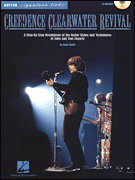
CREEDENCE CLEARWATER REVIVAL-Step-by-Step Guitar Styles Techniques John Fogerty-CD TABLATURE

CREEDENCE CLEARWATER REVIVAL, A Step-by-Step Breakdown of the Guitar Styles and Techniques of John and Tom Fogerty. CD TAB.

Series: Signature Licks Guitar
Softcover with CD - TAB
Artist: Creedence Clearwater Revival
Author: Dave Rubin

Dave Rubin teaches the trademark riffs and licks behind 12 of CCR's biggest hits, including:

Bad Moon Rising
Born On The Bayou
Down On The Corner
Fortunate Son
Green River
Keep On Chooglin'
Lodi
Lookin' Out My Back Door
Proud Mary
Run Through The Jungle
Travelin' Band
Who'll Stop The Rain

64 pages

Price: €29,99
€29,99

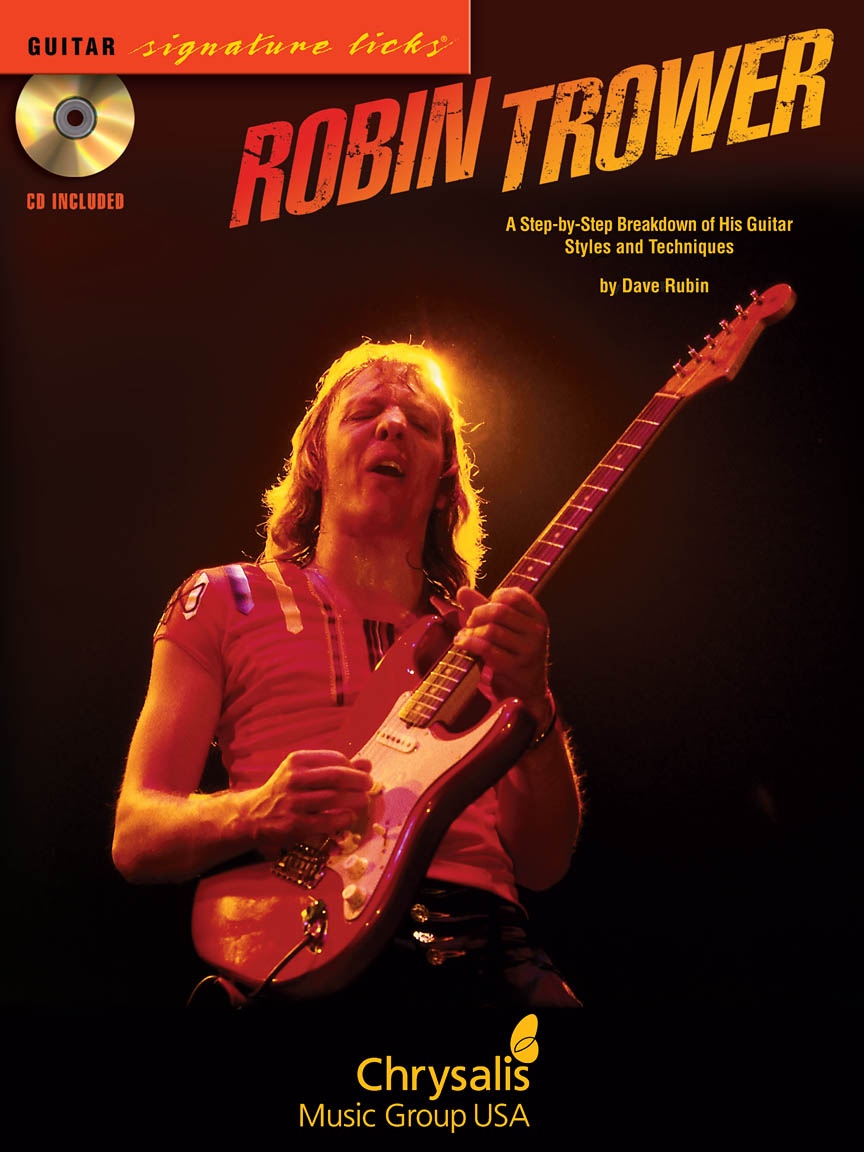
TROWER ROBIN A Step-by-Step Breakdown of His Guitar Styles and Techniques CD TABLATURE LIBRO

TROWER ROBIN, A Step-by-Step Breakdown of His Guitar Styles and Techniques. CD TAB.

Series: Signature Licks Guitar
Softcover with CD - TAB
Artist: Robin Trower

English rocker Robin Trower has earned a rabid following for his guitar work with Procol Harum and on his solo records. This book/CD provides an in-depth look at his powerful, soulful playing by exploring his most famous licks from a dozen songs, including:

Bluebird
Bridge Of Sighs
Day Of The Eagle
Daydream
For Earth Below
I Can't Stand It
I Can't Wait Much Longer
Little Bit Of Sympathy
Living Out Of Time
Long Misty Days
Messin' The Blues
Too Rolling Stoned

72 pages

Price: €109,99
€109,99

CHRISTIAN CHARLIE GUITAR SIGNATURE LICKS Andy Aledort DVD-Benny's Bugle-Gone with "What" Wind -Grand Slam

CHRISTIAN CHARLIE, SIGNATURE. DVD

Author: Andy Aledort
Artist: Charlie Christian
Explore the riffs, solos and sounds of the original electric jazz guitar virtuoso with this in-depth analysis of 8 songs: Air Mail Special -Benny's Bugle -Gone with "What" Wind -Grand Slam -Seven Come Eleven -Shivers -Solo Flight -Till Tom Special.

Songlist:
Table of contents:
Air Mail Special
Benny's Bugle
Gone With 'What' Wind
Grand Slam
Seven Come Eleven
Shivers
Solo Flight
Till Tom Special
Running time: 1hr. 23 min.

Price: €22,99
€22,99

HENDRIX JIMI, VOLUME 2. A Step-by-Step Breakdown of His Guitar Styles and Techniques. CD TABLATURE

HENDRIX JIMI, VOLUME 2. A Step-by-Step Breakdown of His Guitar Styles and Techniques. CD TAB.

Series: Signature Licks Guitar
Publisher: Hal Leonard TAB
Author: Chad Johnson
Artist: Jimi Hendrix

Learn 12 more Hendrix signature songs in this detailed book/CD pack featuring a step-by-step breakdown of rock music's greatest guitarist's style and techniques. The CD features slowed-down and regular tempo demos. The songs covered are, 104 pages.

All Along The Watchtower
Angel
The Burning Of The Midnight Lamp
Crosstown Traffic
Dolly Dagger
Freedom
Hey Baby (New Rising Sun)
I Don't Live Today
Machine Gun
Star Spangled Banner (Instrumental)
Stone Free
Third Stone From The Sun

Price: €25,99
€25,99

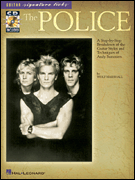
POLICE A Step-by-Step Guitar Styles Techniques Andy Summers Signature Licks LIBRO CD TABLATURE

POLICE, A Step-by-Step Breakdown of the Guitar Styles and Techniques of Andy Summers, Signature Licks. CD TAB.

Techniques of Andy Summers
Series: Signature Licks Guitar
Softcover with CD - TAB
Artist: The Police
Author: Wolf Marshall

In this book/CD pack, guitar dean Wolf Marshall will help you explore Andy Summers' unique and groundbreaking style through a thorough analysis of 16 Police hits, 72 pages

The Bed's Too Big Without You
Can't Stand Losing You
De Do Do Do, De Da Da Da
Don't Stand So Close To Me '86
Don't Stand So Close To Me
Every Breath You Take
Invisible Sun
King Of Pain
Message In A Bottle
Roxanne
So Lonely
Spirits In The Material World
Synchronicity II
Walking On The Moon
When The World Is Running Down, You Make The Best Of What's Still Around
Wrapped Around Your Finger

Price: €99,99
€99,99

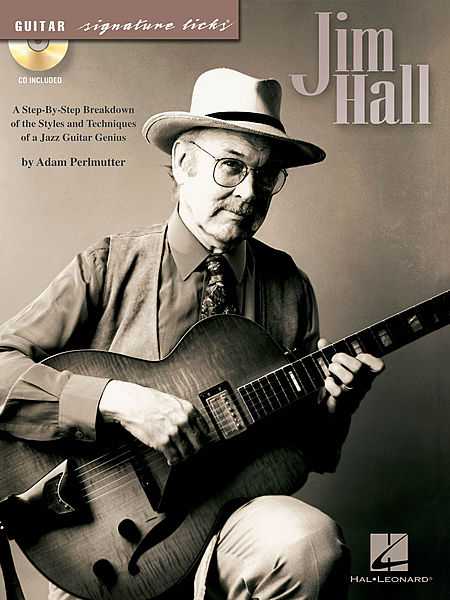
HALL JIM A Step-by-Step the Styles and Techniques of a Jazz Guitar Genius Signature Licks CD TABLATURE

HALL JIM, A Step-by-Step Breakdown of the Styles and Techniques of a Jazz Guitar Genius, Signature Licks. CD TABLATURE

Series: Signature Licks Guitar
Softcover with CD - TAB
Author: Adam Perlmutter
Artist: Jim Hall

Discover the quiet elegance of one of jazz guitar's most renowned players with this Signature Licks book/CD pack. Each song chapter contains in-depth analysis and audio with slow demos. 80 pages


INTRODUCTION
Jim Hall (1930-) was steeped in classical music before he came to jazz. Hall attended the Cleveland Institute of Music, then moved to Los Angeles, California, where he studied nylon-string guitar with Vincente Gomez. While on the West Coast, he began to make a name for himself as a jazz guitarist, playing in the quintet of drummer Chico Hamilton, from 1955 to 1956, and in the trio of reed player Jimmy Giuffre, from 1956-1959. He also worked with modern improvisers such as pianist John Lewis and alto saxophonist Lee Konitz, and in 1960 toured South America (where he was exposed to bossa nova) with singer Ella Fitzgerald.
Around the same time, Hall moved to New York City, where through several intense collaborations, he was established as one of the world's most sophisticated jazz guitarists. From 1961 to 1962, he was a member of the tenor saxophonist Sonny Rollins's great quartet, with which he recorded the seminal album The Bridge. In the '60s Hall coled a quartet with trumpeter Art Farmer; he also recorded with the quartet of alto saxophonist Paul Desmond and found ideal duet partners in pianist Bill Evans and bassist Ron Carter. With Evans, Hall recorded two albums, Undercurrent (1962) and Intermodulation (1966), two of the most intimate and beautiful recordings in all of jazz. (From Intermodulation, see the transcription of "My Man's Gone Now," on page 34.) It was while performing in these fertile contexts that Hall found his own voice, an understated modern style characterized by melodic finesse, harmonic sophistication, and structural awareness-a logical extension of the language developed by such jazz-guitar pioneers as Charlie Christian, Wes Montgomery, and Django Reinhardt. This approach has been of profound influence to countless modern guitarists, including Hall's student Bill Frisell, who sounds radically different than Hall, but has a strikingly similar guitar conception. Hall's approach is best witnessed on the excellent albums he has recorded under his own name, including Concierto (1975), Jim Hall Live! (1976), and All Across the City (1989), transcriptions from all of which can be found on the following pages.
Besides being one of jazz's premier guitarists, Hall is a celebrated arranger and composer. In 1997, he won the New York Jazz Critics Circle Award for Best Jazz Composer/Arranger; his composition for jazz quartet and string quartet, "Quartet Plus Four," earned the Jazzpar Prize in Denmark, and his works for string, brass, and vocal ensembles can be heard on the albums Textures (1997) and By Arrangement (1998). In 2004, the Baltimore Symphony Orchestra debuted Hall's Peace Movement, a concerto for guitar and orchestra, dedicated to the cause of international harmony. That same year, for all his accomplishments as a composer, arranger, and performer, Hall was named a Jazz Master by the National Endowment for the Arts.
One of Hall's most recent projects, Hemispheres, was recorded with Bill Frisell and features one disc of duets and a second disc that adds the rhythm section of bassist Scott Colley and drummer Joey Baron. The album is available at Hall's Web site where a fan can catch of glimpse of what goes into the creation of the guitarist's recent projects. Meanwhile, when not composing or working with his own trio, Hall-ever the adventurous artist-has been playing with various modern improvisers, including saxophonists Joe Lovano and Greg Osby, and guitarist Pat Metheny. For now in the sixth decade of his career, Hall remains as vital a musician as ever.
DISCOGRAPHY
The selections on the accompanying CD are based on the following recordings:
ALL ACROSS THE CITY-Concord Jazz: "Big Blues"
ALONE TOGETHER-Milestone: "Autumn Leaves," "St. Thomas-
BALLAD ESSENTlAL-Concord Jazz: "Prelude to a Kiss"
CONCIERTO-CTI: "You'd Be So Nice to Come Home To"
(continua)

(All Of A Sudden) My Heart Sings - HAROLD ROME - 1941
Angel Eyes - MATT DENNIS - 1946
Autumn Leaves - JOSEPH KOSMA - 1947
Big Blues - JAMES S. HALL - 1978
My Man's Gone Now - GEORGE GERSHWIN - 1935
Prelude To A Kiss - DUKE ELLINGTON - 1938
St. Thomas - SONNY ROLLINS - 1963
Scrapple From The Apple - CHARLIE PARKER - 1957
Tangerine - VICTOR SCHERTZINGER - 1942
Things Ain't What They Used To Be - MERCER ELLINGTON - 1942
Without A Song - VINCENT YOUMANS - 1929
You'd Be So Nice To Come Home To - COLE PORTER - 1942


ANGEL EYES
(Jim Hall Live!, 1976)
Words by Earl Brent
Music by Matt Dennis
Figure 3-lntro, Head, and Solo (Chorus 1)
While many of Jim Hall's studio recordings show the guitarist to be thoughtful and
well-mannered, in concert he has been known to play with abandon. This side of Hall can
be heard on Jim Hall Live!, one of his finest live recordings, taken from a series of dates
in 1975 at Toronto's Bourbon Street. The recording finds Hall in top form, paired with
bassist Don Thompson and drummer Terry Clarke.
One of the highlights of the album is a Latin-tinged take of the jazz standard "Angel
Eyes," which was originally a 32-bar AABA song. Hall & Co. double the tune's harmonic
rhythm, so that the form is now 64 bars in length. (A chord that originally occupied two
beats now gets four beats, an entire bar.) Hall starts things off by moving a barred Am7
shape in parallel fashion against the open A string, resulting in some interesting polychordal
harmony, such as the m/A chord (voiced A-A~-m-F, low to high) on beat 1 of bar
2 and the B/A (A-F~-B-m) on beat 1 of bar 4. He also throws various dominant and
diminished chord voicings into the mix, including the partial E7#9 (A~/m-D-G) in the last
part of bar 2 and mo (A~-D-F) on beat 1 of bar 6.
After closing out the intro with the same Am7 chord with which he started, Hall
takes the head (beginning at bar 17). He sticks pretty close to the original melody, adding
his own idiosyncratic touches here and there. One such Hall-ism involves placing an
octave-based idea at the end of a phrase-a striking, broken-octave fill appears in bars
23-24; a variation of this, in bar 39; and, in bar 72, a semi-chromatic descending line
played in fully voiced octaves. Throughout, there's a strong blues feel, especially in bar
32's fill, which comes from the A minor pentatonic scale (A-C-D-E-G), albeit unpredictably
ordered. A subtler touch involves ending certain phrases with a 12th-fret harmonic
on string 5 (see bars 30, 46, and 78), which lends a nice timbral contrast to the fretted
notes.
Beginning in bar 49, Hall uses a neat trick that effectively separates the bridge
from the A-section: while holding selected melody notes (upstemmed), he adds chord
stabs (downstemmed), not unlike a pianist would do with two hands. Also, Hall ventures
a little farther from the melody in this section-in bar 53, check out the improvised, angular
line that begins with a major 7th (B~to A) leap. These unique details give the listener
a taste of what's to come in Hall's excellent solo.
In the first A-section of his first chorus, Hall introduces an A minor pentatonic idea,
and then sees it through various permutations. He keeps it simple here; the only noticeable
jazzy melodic content is the Am11 arpeggio (A-C-E-G-B-D) in bars 108-109.
Throughout, Hall interjects some of the same chord voicings as found in the intro, most
often the E7=9chord. At the same time, he uses space wisely; for example, see the rests
in bars 107-108 and 116-117.
Hall steps out melodically in the bridge of the first chorus. In bars 122-123, he
plays a 6th-based motif that reappears later in the solo, and in bars 125-127, he smoothly
hits a variety of interesting note choices: the 7 (F#) on the Gm7 chord (the absence of
a pianist gives Hall harmonic leeway), the #9 (E~/m) on C7, and the #11 (B) on Fmaj7.
Beginning in bar 128, Hall plays a fleetingly-fingered line involving chromatic lower-neighbor
tones. This leads directly into a witty reference to Duke Ellington's "Raincheck" in bars
129-131. Quotation is an indispensable improvisational tool, and Hall masterfully adjusts
the melodic contour of "Raincheck" to suit the changes at hand, sailing with ease into the
b7 (A) of the B7 chord and the 3rd (G#) of the Emaj7 chord.


THINGS AIN'T WHAT THEY USED TO BE (Jazz Guitar: Jim Hall Trio, 1957)
By Mercer Ellington
Figure 15-Head and Solo
While Jim Hall's style is strikingly modern, it is deeply rooted in the traditional
sound of the blues. This is especially apparent in Hall's interpretation of the Mercer
Ellington classic "Things Ain't What They Used to Be," from his 1957 debut album, Jazz
Guitar: Jim Hall Trio, on which "Tangerine" (see page 56) also appears.
"Things Ain't What They Used to Be" is based on a 12-bar blues in m major,
played here with a neat, overlapping pair of ii-Vs in bars 8-11 (F7-m7-Bm7-Ab7-m7).
Hall kicks things off by playing the head twice, the first time accompanied by bassist Red
Mitchell. The guitarist basically plays the melody as it was originally written but adds some
bluesy, grace-note flourishes: in the m7 bars, a whole-step slide, from B to the melody
note F; and on the double stops, a half-step approach tone to each lower note.
As Hall restates the head, beginning in bar 13, pianist Carl Perkins joins in on the
proceedings; notice the chromatically ascending 7~9 chords that Perkins substitutes in
bars 21 and 22. Hall starts his reiteration of the head the same way he originally played
it, but at the end of bar 20, he raises the intensity by playing the melody up an octave.
Then, beginning in bar 23, he sets up his three-chorus solo with a triplet-based line that
comes mainly from the m minor pentatonic scale (m-Fb-Gb-Ab-Cb).
In the first chorus, Hall improvises variations on the original melody. In bars 29
and 30, he plays major 3rd-based double stops from the m blues scale (m-Fb-Gb-Abb-
Ab-Cb), then, in bar 31, toys with both the b3rd(HIE) and 3rd (F) of the m7 chord using
single notes. In bar 35, over the m7-Bb7 change, Hall plays a series of dyads that actually
imply the progression m7-GI>-Gbm, with the 3rd (m and Bbbin the bass on the latter
two). Note the contrary motion between the lower and higher voices of the first two
chords.
Beginning at the end of his first chorus and extending through the first several
bars of his second, Hall has a conversation with himself, playing phrases that start and
stop on the first string's fourth-fret Ab, and are answered by phrases that start and stop a
perfect 5th lower, on the third string's sixth-fret m. In bars 40-43, Hall plays the note Eb
at two different positions-string 2, fret 4 and string 3, fret 8-requiring a large fret-hand
stretch, but the nice contrast in timbre is worth the effort. Hall begins to conclude his second
chorus in bar 44 with a predominantly pentatonic phrase.
In his third and final chorus, Hall makes the most out of a few simple phrases, the
first of which is stated in the first half of bar 49. Similar to one found in his first chorus, this
bluesy, ascending phrase contains both the b3 and 3, and is carried throughout the first
several bars. Bar 52 contains an interesting move: Hall slides, via a half step, into a dyad
(Cb-Eb)that implies a m9 chord (m-F-Ab-Cb-Eb), then plays a descending chromatic line
(Ab-Abb-Gb-F) that sets up a m9 chord partial (F-Cb-Eb). First appearing on beat 2 of bar
53, an eighth-note triplet line (Fb-m-B) is played (except for a break in bar 54) until the
beginning of bar 56, and answered in bar 57 by a time-honored, jazz-blues phrase.
Hall thinks more harmonically as he ends his solo, arpeggiating m (m-F-Ab) and
Gb (Gb-Bb-m) triads in bar 59, approaching each 3rd with a half-step grace note. Then,
on beats 1 and 2 of the final bar, Hall plays double stops, Ab-m and G-m, that imply mm7
(Bb-m-F-Ab) and Eb7 (Eb-G-Bb-m) chords, respectively, delaying the final ii-V
(Ebm7-Ab7) change by two beats. 

Price: €34,99
€34,99

WINTER JOHNNY, Guitar Styles Techniques of a Blues Legend, Signature Licks CD TABLATURE Rock Me Baby

WINTER JOHNNY, Guitar Styles and Techniques of a Blues Legend, Signature Licks. CD TAB.

A Step-By-Step Breakdown of the Guitar Styles and Techniques of a Blues Legend
Series: Signature Licks Guitar
Softcover with CD - TAB
Author: Dave Rubin
Artist: Johnny Winter

Take an in-depth look at the fiery blues stylings of Johnny Winter with this instructional book/CD pack. You'll learn the main licks from 12 songs, including:

96 pages

Bad Luck Situation
Be Careful With A Fool
Bladie Mae
Highway 61 Revisited
It Was Raining
Leland Mississippi
Mean Town Blues
Rock And Roll Hoochie Koo
Rock Me Baby
Still Alive And Well
Sweet Love & Evil Women
TV Mama

Price: €23,99
€23,99
Syndicate content