PENTAGRAMMA - STANDARD NOTATION

SCARLATTI DOMENICO-MUSIC OF FOR TWO GUITARS-VOLUME 1-Julian Gray & Ronald Pearl SPARTITI

SCARLATTI DOMENICO, MUSIC OF FOR TWO GUITARS, VOLUME 1. by Julian Gray & Ronald Pearl.

Product Description:
Domenico Scarlatti's wealth of invention and the immediacy of his emotional appeal - from darkest tragedy to bold farce - have long attracted guitarists to make his music their own. This collection of nine sonatas arranged by the Gray/Pearl Duo gathers music displaying both Scarlatti's virtuosic dash and lyrical poignancy. The volume contains an un-edited score as well as performance-ready parts with suggested fingerings, technical solutions and interpretive articulations. This is the first book in an exciting new series from the eminent American guitar duo of Julian Gray and Ronald Pearl.

Song Title: Composer/Source:
K. 115 Domenico Scarlatti
K. 119 Domenico Scarlatti
K. 147 Domenico Scarlatti
K. 175 Domenico Scarlatti
K. 213 Domenico Scarlatti
K. 227 Domenico Scarlatti
K. 234 Domenico Scarlatti
K. 33 Domenico Scarlatti
K. 531 Domenico Scarlatti

Price: €24,99
€24,99

TECNICA VOCALE-Dena Murray 2CD LIBRO CANTO VOCE METODO IMPARARE CANTARE STUDIO MANUALE

TECNICA VOCALE, Dena Murray. In Italiano. 2CD

Una guida per trovare la vostra vera voce.
Concetti essenziali

Basta sforzare per intonare queste note alte! Sbloccate il vostro potenziale reale e cominciate a cantare facilmente e senza sforzo! Come respirare naturalmente; Come migliorare la voce parlata; Come smettere di trattenere, spingere, sforzare; Come sviluppare la vostra estensione naturale di tre ottave; Come impostare la voce di petto e di testa; Come collegare i registri e farli suonare come un'unica voce. Include 2 CD con dimostrazioni, esercizi guidati, e moltissime tracce per allenarvi!

Price: €27,99
€27,99

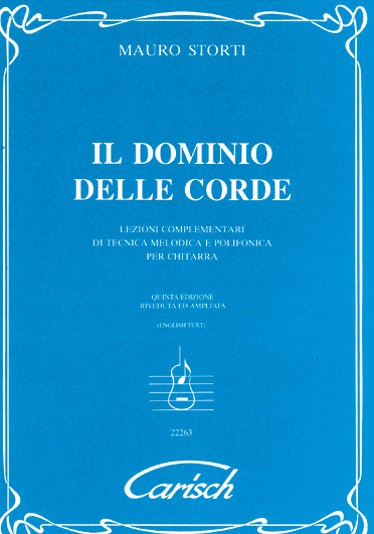
Storti Mauro-IL DOMINIO DELLE CORDE-Lezioni di tecnica melodica e polifonica per chitarra-


MASTERING THE

STRINGS


MAURO STORTI

COMPLEMENTARY LESSONS OF MELODIC AND POLYPHONIC TECHNIQUE FOR THE GUITAR

FIFTH EDITION REVISED AND ENLARGED

(Translation by Robert Miller)


Since the end of the last century, the art of the guitar has experienced two decisive turning points. The first was the setting up of the Tarrega School, important from the musical point of view, but with the technical consequences . resulting from abandoning the system of positions similar to those of the violin, made necessary by the need for a more precise configuration of the parts, in the spirit of romantic music; the second, which began some time ago and is still going on, is the enrichment of guitar music with an abundant production of contemporary music inspired by the art of Andres Segovia and his most gifted disciples. These two phenomena, whose enormous importance has been the mainspring of the current revival of the guitar, are accompanied by a paradoxical standstill in guitar teaching methods which today are still based almost entirely on the works of the great guitarists of the nineteenth century. Far from wishing in any way to belittle the historical-artistic value of the methods of Carulli, Carcassi, Giuliani, Aguado and Sor, it is undeniable that, when examined in the light of the present-day technical-musical situation, they contain serious shortcomings. Conceived within the very precise limits,pf the classical style, they have gradually lost all relevance to music today, answering less and less the needs that arose in subsequent phases of musical evolution, while little or nothing emerged later that could be added to this fundamental group of works. Tarrega's great contribution to the guitar school only rarely expressed itself in a clear, scholastic form as, with his lofty artist's nature, he preferred to give form to his intuitions, translating them into studies and preludes in the manner of his contemporaries. It is regrettably sad to note that where artistic genius is greatest, didactic sensitivity is all too often lacking: too intent on living his art, the great artist cannot find the time to pause and carry out an analysis. What is one to make today of Carcassi or Carulli who base their method on the sequence of keys, passing blithely from a very brief melodic exercise to a multi-voice study, almost completely ignoring the right hand? What is one to make of Giuliani's method which, published under the mystifying number of Op. I, reveals very scant didactic sensitivity, because if the beginner manages to survive the boredom of its 120 arpeggios, he will almost certainly succumb when faced with the difficulty of the following pages! And lastly, what is one to make of Aguado and Sor who, skipping the entire preparatory phase, offer the student, right from the first pages, those delightful but not easy pieces worthy of a better fate than being maltreated by inexperienced hands? Today, the guitar student still searches in vain for a "helping hand" to guide him unfailingly "from the first faltering steps to the peaks of perfection". The two weak points of the discontinuous teaching method that most teachers and students use nowadays are the introduction to the study of the guitar and the transition from the classical to the contemporary technique. The need for a new and more rational method for beginners is felt even more today as the average age of students has dropped noticeably. Up to a few years ago it was believed that the guitar could not be studied gainfully before the age of lIn, but, in reality, it was the lack of suitable texts and instrumentJ' that were almost always the cause of failure when the guitar was taken up, at an earlier age. As to the transition from the classical to the modern and contemporary school, which usually takes place around the 4th to 5th year, this can be the source of considerable difficulty and, at times, bitter disappointment, especially for those students who, having been more diligent, have better assimilated technical formulas and approaches that are both insufficient and outdated. With regard to this, it should be remembered that most classical studies, above all those of the Italian school, as also arpeggios and scales in the first position, lend themselves to easy execution (perhaps easier execution!) by using an incorrect approach with the left hand. The use of the thumb on the sixth string, which Carulli did, was both the cause and consequence of the inclined position of the left hand. On the wide necks of modern guitars, this position, which hinders the important, wide-ranging action of the little finger, turns out to be a serious impediment, capable of calling into question all the work done in years of study. The right hand, for its part, made stiff by having been used almost exclusively for arpeggios, lacks lightness, mobility, agility, entry precision, and softness in the crosswise and lengthwise strokes. The only way to get round these serious obstacles is to back up traditional studies, which, if intelligently chosen and revised, still possess an irreplaceable formative function, with suitable technical exercises aimed at preventing incorrect use of the hands and at familiarizing the student, right from the first year, with the formulas and methods used in modern guitar playing. Modern guitar music, written mostly by composers who are not themselves guitarists and thus not conditioned by the instrument, calls for total mastery of the guitar by the player which, in my opinion, can only be achieved beyond the t(mal system because, being a system, it rules out an infinite number of musical, and thus technical-instrumental, possibilities. Only practice of atonal exercises makes thorough knowledge of certain new aspects of technique possible which, seemingly of minor importance, later prove to be fundamental for high-level guitar playing. The lessons I present in this book are based on these ideas and aim at developing, in a harmonic and interdependent way, both physical faculties (elasticity, speed, strength equally distributed among the different fingers, bold attacks and changes of position) and mental ones (exact perception of distances, prompt memory of the fingerboard, sensitivity to the relationships between fingerboard space and musical space, memory and power of concentration). Only by assimilating these elements can the miracle of transforming an inert object like a musical instrument into a Jiving part of the performer be achieved.

Price: €19,99
€19,99

PATITUCCI JOHN 60 MELODIC ETUDES Acoustic Electric Bass major scale minor dominant 7 LIBRO

PATITUCCI JOHN, 60 MELODIC ETUDES. 

About 60 Melodic Etudes
(for Acoustic and Electric Bass) By John Patitucci. Instructional book for string bass. 128 pages.
With fingerings. Instructional, Etudes and Scales. 9x12 inches.

This new book from one of the most popular bass players in the business brings players great tools to improve their skills. Bass players can advance their knowledge of the fingerboard, improve intonation and time, develop flexibility and work though modes and scales presented in the book. This work combines music and technique in one powerful package!

Contents:
John Patitucci Biography
Foreword
PART I:
PART II:


This book is designed for acoustic bassists, electric bassists and cellists who want to:

• Improve their knowledge of the fingerboard.
• Practice interpreting and phrasing melodies.
• Improve their intonation and time.
• Learn to play with more flexible time by practicing rubato passages.
• Strengthen their ears to hear the five basic chord sounds within the diatonic
major scale: major, minor 7, dominant 7,minor 7b5and major 7#11.
• Learn to hear and use various diatonic modes and scales against these five
basic chords: Major, Dorian, Phrygian, Lydian, Mixolydian, Aeolian, and
Locrian.
• Gain valuable experience on the use of the melodic-minor scale over the
minor-seventh b5chord.
As far as I know, this is the first book to have a separate melodic etude for each
of these five chord sounds in all twelve keys. I also left room on a few occasions
for you to try your hand at improvising for a few measures within an etude. The
etudes have tempo markings, but should be practiced at different tempos and
even rubato (i.e., elastic and flexible time with room for speeding up and
slowing down to enhance the freedom of the artist's expression). These etudes
also help the bassist and cellist tackle the common technical problems that all
must deal with, such as shifting on one string, string crossing and alternating
right-hand plucking and bowing. For acoustic bassists and cellists, every etude
can be played pizzicato and/or arco. I deliberately shied away from providing
fingerings and bowings because I would rather you explore many alternatives
for each passage.
In Part II of the book (pp. 69-128), I have included a complete fingering chart
for both acoustic and electric bass for all the scales. The scale examples are
given in two ways: 1) Starting on the root note and 2) starting on the lowest
note available on the fingerboard. The second example is provided to foster a
more comprehensive knowledge of the instrument.
If you have a teacher-which I feel is extremely important-s/he may want to
write down ideas for you as well. Also, as you vary the tempo of each etude, you
may have to alter fingerings and bowings.
In closing, I sincerely hope and believe that this book will help you grow as a
musician and be a useful tool for many years to come.
-John Patitucci


John Patitucci has been at the forefront of the jazz world for the last twenty
years and active in all styles of music. He is a two-time Grammy award winner
and has been nominated eleven times. He has won many magazine polls and
awards as a double bassist and bass guitarist, most recently as a member of
the Wayne Shorter Quartet which won the 2003 Downbeat critics' poll for Best
Acoustic Jazz Group and Best Jazz Recoding for Footprints - Live!. He has
performed and/or recorded with jazz giants such as Dizzy Gillespie, Wayne
Shorter, Herbie Hancock, Chick Corea, Stan Getz, Freddie Hubbard, Roy
Haynes, Wymon Marsalis, Michael Brecker, John Scofield, Joe Lovano, Kenny
Garrett, Victor Feldman and countless others.
John has been active as a composer with eleven solo recordings of his own. He
has also been commissioned to write for various chamber music groups, most
recently the New York-based string quartet Elements. John was nominated for
a Grammy in 2003 for Best Instrumental Arrangement Accompanying a Vocal
for his arrangement of In the Bleak Midwinter from his CD Song, Stories and
Spirituals. He was nominated for a Grammy in 2002 for Best Instrumental
Composition for a piece entitled Communion that featured Branford Marsalis,
Brad Mehldau and violist Lawrence Dutton of the Emerson String Quartet.
Mr. Patitucci has been involved in education for many years, writing books,
making instructional videos and giving master classes around the world. He
was formerly the Artistic Director of The Bass Collective, a specialized school
in New York. In 2002, he began teaching at The City College of New York
(CUNY) and was named Associate Professor of Music there in 2003.


I would like to thank God, my wife Sachi, and my daughters-Gracie
and Bella, and all the other members of my family especially my
brother Thomas, my Mom and Dad, and sisters. Thanks are also
due to Chris Poehler, David Baker and all of the other teachers I
have had in my musical journey to this point (whose names could
take up as many pages as this book). Thanks also to the many
musicians I have worked with who have inspired me and taught me
(another very long list) and to Sandy Feldstein and John Castellano
for urging me to write this book.
Special Thanks to Mindy Sax, for the preliminary music copying.
Finally, thanks also to all the folks at Carl Fischer for the fine work
and support, especiallyAlexTeploff.
Cover photo by Bill Bytsura.


John Patitucci Biography .
Foreword
Part I: 60 Melodic Etudes
C Major Scale
F Major Scale
Bb Major Scale
Eb Major Scale
Ab Major Scale
Db Major Scale
Gb Major Scale
B Major Scale
E Major Scale
A Major Scale
D Major Scale
G Major Scale
C Aeolian Scale (Ballad) (Cm7)
F Dorian Scale (Ballad) (Fm7)
Db Aeolian Scale (Bbm7)
Eb Dorian Scale (Ebm7)
G# Phrygian Scale (G#m7)
C# Phrygian Scale (C#m7)
F# Phrygian Scale (F#m7)
B Phrygian Scale (Bm7)
E Dorian Scale (Em 7)
Aeolian Scale (Am 7)
D Dorian Scale (Dm7)
G Phrygian Scale (Gm7)
C Lydian Scale (Cmaj7# 11)
F Lydian Scale (Fmaj7#l1)
Bp Lydian Scale (Bbmaj7# 11)
Eb Lydian Scale (Ebmaj7# 11)
b Lydian Scale (Abmaj7#11)
Db Lydian Scale (Dbmaj7# 11)
Gb Lydian Scale (Gbmaj7#l1) .
B Lydian Scale (Bmaj7# 11) .
E Lydian Scale (Emaj7# 11) .
A Lydian Scale (Amaj7# 11) .
D Lydian Scale (Dmaj7# 11) .
G Lydian Scale (Gmaj7#11) .
C Mixolydian Scale (C7)
F Mixolydian Scale (F7) .
Bb Mixolydian Scale (Bb7)
Eb Mixolydian Scale (Eb7)
Ab Mixolydian Scale (Ab7) .
Db Mixolydian Scale (Db7)
Gb Mixolydian Scale (Gb7)
B Mixolydian Scale (B7)
E Mixolydian Scale (E7) .
A Mixolydian Scale (A7)
D Mixolydian Scale (D7)
G Mixolydian Scale (G 7)
C Loerian Scale (Cm7b5) .
Ab Melodic-minor Scale (Fm7b5)
Db Melodic-minor Scale (Bbm7b5)
Gb Melodic-minor Scale (Ebm7b5) .
G# Loerian Scale (G#m7b5) .
C# Loerian Scale (C#m7b5) .
F# Loerian Scale (F#m7b5) .
B Loerian Scale (Bm7b5) .
G Melodic-minor Scale (Em7b5) .
C Melodic-minor Scale (Am7b5) .
F Melodic-minor Scale (Dm7b5) .
G Loerian Scale (Gm7b5) .

Part II: 60 Melodic Scales
C Major Scale
F Major Scale
Bb Major Scale
Eb Major Scale
Ab Major Scale
Db Major Scale
Gb Major Scale
B Major Scale
E Major Scale
A Major Scale
D Major Scale
G Major Scale
C Aeolian Scale (Ballad) (Cm7)
F Dorian Scale (Ballad) (Fm7)
Db Aeolian Scale (Bbm7)
Eb Dorian Scale (Ebm7)
G# Phrygian Scale (G#m7)
C# Phrygian Scale (C#m 7)
F# Phrygian Scale (F#m7)
B Phrygian Scale (Bm7)
E Dorian Scale (Em7)
Aeolian Scale (Am 7)
D Dorian Scale (Dm7)
G Phrygian Scale (Gm 7)
C Lydian Scale (Cmaj7h1)
F Lydian Scale (Fmaj7# 11)
Bb Lydian Scale (Bbmaj7# 11)
Eb Lydian Scale (Ebmaj7# 11)
Ab Lydian Scale (Abmaj7# 11)
Db Lydian Scale (Dbmaj7#1)
Gb Lydian Scale (Gbmaj7#11) .
B Lydian Scale (Bmaj7#11) .
E Lydian Scale (Emaj7# 11) .
A Lydian Scale (Amaj7# 11) .
D Lydian Scale (Dmaj7# 11) .
G Lydian Scale (Gmaj7#11) .
C Mixolydian Scale (C7) .
F Mixolydian Scale (F7) .
Bb Mixolydian Scale (Bb7) .
Eb Mixolydian Scale (Eb7) .
Ab Mixolydian Scale (Ab7) .
Db Mixolydian Scale (Db7) .
Gb Mixolydian Scale (Gb7) .
B Mixolydian Scale (B7) .
E Mixolydian Scale (E7) .
A Mixolydian Scale (A7)
D Mixolydian Scale (D7) .
G Mixolydian Scale (G7) .
C Locrian Scale (Cm7b5) .
Ab Melodic-minor Scale (Fm7b5) .
Db Melodic-minor Scale (Bbm7b5) .
Gb Melodic-minor Scale (Ebm7b5) .
G# Locrian Scale (G#m7b5) .
C# Locrian Scale (C#m7b5) .
F# Locrian Scale (F#m7b5) .
B Locrian Scale (Bm7b5) .
G Melodic-minor Scale (Em7b5) .
C Melodic-minor Scale (Am7b5) .
F Melodic-minor Scale (Dm7b5) .
G Locrian Scale (Gm7b5) .
 

Price: €99,99
€99,99

ROMERO CELINO THE ART OF SPANISH GUITAR A METHOD CD LIBRO SPARTITO METODO CLASSICA

ROMERO CELINO, THE ART OF SPANISH GUITAR A METHOD. CD
LEARN TO PLAY SPANISH GUITAR THROUGH THE UNIQUE "ROMERO METHOD"
A Method By Celino Romero

Celino Romero's The Art of Spanish Guitar embodies more than two hundred years of guitar playing experience accumulated by three generations of Romeros. Celino embraces the variety of styles and innovations that the Romeros have brought to this art form individually and through the many years of playing together.
This book explores the complexity and subtlety of Spanish guitar while explaining it in a way that makes learning both accessible and highly enjoyable. By the end of this book, you will be able to apply the correct technique to your playing, and perform pieces by some of the most famous composers for Spanish guitar, such as Carcassi, Sor, and Tarrega.

You will learn:
• How to hold the guitar correctly
• Proper placement of right and left hands
• Apoyando and Enganchando (rest and free strokes)
• Rasgueado and Flamenco
• Giuliani's 120 Right-Hand Studies
• Daily exercises
• Essential studies and repertoire
• Shaping of the fingernails
• How to adopt the unique "Romero Touch"

Celino Romero's journey on the guitar began at the young age of three, under the careful tulelage of his legendary grandfather, Celedonio, and his famous father, Celin. Celino has played to great acclaim before numerous international audiences as a solo artist, with major orchestras, and as a member of "The Romeros" guitar quartet. He has appeared at the Hollywood Bowl, Carnegie Hall, the Metropolitan Museum of Art, the Auditorio Nacional (Madrid), Gewandhaus (Leipzig), Concert Hall (Seoul), the Cultural Center Concert Hall (Hong Kong),and Musikverein (Vienna).

For guitar. Method book. 143 pages. Celino Romero's "The Art of Spanish Guitar" embodies more than two hundred years of guitar playing experience accumulated by three generations of Romeros. Celino embraces the variety of styles and innovations that the Romeros have brought to this art form individually and thorugh the many years of playing together.

This book explores the complexity and subtlety of Spanish guitar while explaing it in a way that makes learning both accessible and highly enjoyable. By the end of this book, you will be able to apply the correct technique to your playing, and perform pieces by some of the most famous composers for Spanish guitar, such as Carcassi, Sor, and Tarrega.

THE ART OF SPANISH GUITAR: A Method by Celino Romero Book and CD pack. This priceless text embodies more than two hundred years of guitar playing experience accumulated by three generations of Romeros. Celino embraces the variety of styles and innovations that the Romeros have brought to this art form individually and through the many years of playing together.

Written by the grandson of Celedonio, nephew of Pepe and son of Celin Romero, this method represents the culmination of three generations of classical guitar playing. Covers all of the important aspects: position and posture, right-hand rest strokes and free strokes, chords, arpeggios, tremolo, ascending and descending slurs, more, plus how to achieve the Romero Touch. Celino's explanations of fundamental technique are clear and complete with many helpful photos. Includes sections on: ornaments, harmonics; Guitar Gymnastics to build velocity, strength and flexibility; 24 diatonic scales (with positions and fingering); shaping your fingernails (including close-up photos); and all of Giuliani's "120 Studies for Right Hand Development." Concepts are illustrated with studies by Carcassi, Sor, Aguado, Tarrega; with repertoire pieces from Schumann, Chopin and others. The 29-track CD features Celino demonstrating several exercises and studies. An indispensable resource for all classical guitarists beginner to advanced. 143 pp.

AUTHOR'S PREFACE
It Would be impossible to approach writing a book on the Romero guitar technique without first giving the reverence due my grandfather Celedonio Romero, the creator of the “Romero Technique." The Romero family has given the lovers of the classical guitar a technique and a special approach to this instrument that is so remarkable. Growing up in the Romero family, I was fortunate to have not just one, but four master teachers: my grandfather Celedonio, my father Celin, and my uncles Pepe and Angel. If you can imagine a small boy reaching out to touch, handle, and embrace this instrument of exquisite beauty, then you can get an inkling of my world as a child and teenager. From that to becoming an actual practicing member of the family has been my entire life. Given this magnificent gift of membership, I decided I would like to write a book that would share with other lovers of the guitar the unique "Romero Technique." This would consist of simple melodies, perfect finger placements, and the remarkable use of integrating melody and nuance while creating passion, personality, and character in the art of playing the guitar. All of these parts collectively form the embodiment of the Romero Technique. These parts reflect the training and technique of my grandfather and my own adaptations of these remarkable fundamentals. The exercises, rudies, and repertoire included in this book are the fitst steps mat my grandfather taught his sons, which were then passed on to my cousin Lito and me.
My hope is to give you the reader, you the guitatist, you the aficionado of the guitar all that my grandfather taught my family and me-the incredible art of the guitar. When we play an instrument, we must be very systematic in building our technique, since it will be one of the most vital tools for expressing our emotions through our instrument and its beautiful music. Without a solid technique, we will continuously struggle with our hands, fingers, maybe even with our entire body and our own mind. We should abandon the illusion that one can reach joy and satisfaction in the art of music making without having the proper working toolsour hands and fingers. Finding the correct technique will be an exciting process that will require your patience, sensitivity, and love. During this development, you have to enjoy playing a single note flavored with as much love as if playing a complete concerto. If you take pleasure and pride in playing a single beautiful note or chord, it will not be long before you play two beautiful notes, and then an entire composition. Playing the guitar might seem like entering a great labyrinth with so many possible paths and detailed instructions, but if you follow the instructions step-by-step, you will reach the desired goal. 


Contents:
CD Track List
Forward
Author's Preface
Acknowledgements
Position and Posture
How to Hold and Hug the Guitar
Lines to Remember
Tension: Enemy No. 1
The Right Hand
Terminology for the Right Hand
Placement for the Right Hand
Your First Sounds
Rest Strokes and Free Strokes
(Apoyando & Enganchando)
Exercises for the Rest Stroke Thumb
Exercises for the Rest Stroke Fingers
The Romero Touch
The Left Hand
Terminology for the Left Hand
Positioning for the Left Hand and Fingers
Economy of Force and Finger Exercises
Shifting Positions
Chormatic Scales and Exercises
Chromatic Shifts
Chromatic Triplets
Synchronization
Tarrega Symchronization Exercises
Scale Synchronization
Aguado Synchronization Exercises
Ligados
Ascending Slurs (The Hammer-On)
Ascending Slur Exercises
Decending Slurs (The Pull-Off)
Decending Slur Exercises
Chords
Matters of the Right Hand
Matters of the Left Hand
Chord Exercises
Bar Chords
Tarrega Exercises for the Bar Finger
Andante Allegro (Aguado)
Study No. 2, Op. 6
Arpeggios
The Thumb
The Full Plant
Sequential Planting
Giuliani's Right Hand Studies
Right Hand Studies Nos. 2-20
Repertoire for Right Hand Development
Prelude in A Minor
Estudio
Study No. 10
Prelude in C
Prelude in E Minor
Caprice in G
Study No. 1 in A Minor
Essential Studies
Study No. 1, Op. 60
Study No. 2, Op. 60
Study No. 3, Op. 60
Study No. 10, Op. 60
Study No. 14, Op. 60
Study No. 19, Op. 60
Study No. 9 in B Minor
Study No. 10 in D Minor
Tremolo
Tremolo: Step by Step
Study No. 7, Op. 60
Another Training Method
Flowing Techniques
Recuerdos de la Alhambra (Excerpt)
Rasgueado and Flamenco
Concierto de Aranjuez (Excerpt)
Sevillanas
Verdiales
Repertoire
Saltarello
Waltz in G
Vals in G
Romanze
Minuet
Prelude No. 7
Der Frohlicher LandMann, Op. 68, No. 10
Millitary March
Adelita
Romance Anonimo
Daily "Guitar Gymnastics"
Security
Walking
Velocity
Gymnastics No. 1
Variations on Gymnastics No. 1
Gymnastics No. 2
Flexibility
Crossing Exercises
"Spider" Exercises
Strength
Ascending Slurs
Descending Slurs
Bar Exercises
Ornaments
Vibrato
Grace Notes, Mordents, and Trills
Harmonics
Natural Harmonics
Artificial Harmonics
Appendix A: 24 Diatonic Scales
Appendix B: 120 Studies for Right-Hand Development
Appendix C: The Shaping of Fingernails
About the Author

Price: €137,99
€137,99

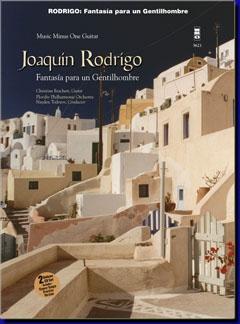
RODRIGO FANTASIA PARA UN GENTILHOMBRE BOOK CD BACKING TRACKS CHITARRA BASI SPARTITI LIBRO

RODRIGO, FANTASIA PARA UN GENTILHOMBRE. 2 CD

Performed by Christian Reichert, guitar
Accompaniment : Plovdiv Philharmonic Orchestra
Conductor : Nayden Todorov

Second only to the Concierto de Aranjuez in popularity among 20th-century guitar concerti is Rodrigo’s beautiful Fantasia para un Gentilhombre. It remains a requirement for any serious guitarist’s repertory, and couldn’t be more exciting and fun to learn than in the company of this luxurious symphony orchestra! This deluxe 2CD set includes a slow-tempo practice version to help you get up to speed.

Includes the authorized music score printed on high-quality ivory paper, featuring the guitar part with orchestral reduction; plus a separate guitar solo part; a digital stereo compact disc featuring a complete performance of the concerto with orchestra and soloist, and a second performance minus you, the soloist; and a second compact disc containing a full-speed version of the complete version as well as a special -20% slow-tempo version of the accompaniment for practice purposes. The concerto is voluminously indexed for your practice and performance convenience.

Price: €199,99
€199,99

Dowland John-Lute Songs of The Original First and Second Books Dowland’s Original Lute Tablature

Dowland John, Lute Songs of The Original First and Second Books Including Dowland’s Original Lute Tablature. TAB. per liuto.

The preeminent lute virtuoso and composer of the early 17th century, John Dowland wrote numerous songs, both gay and melancholy, that dazzled the courts of England and Europe. This rare compilation features 43 of these splendid works in transcriptions for voice and guitar, plus two dances. Original lute tablature and complete song texts included.

Table of Contents for Lute Songs of John Dowland: The Original First and Second Books Including Dowland’s Original Lute Tablature Introduction
About the Transcriptions
THE FIRST BOOK OF SONGS
I. Unquiet thoughts
II. Who ever thinks or hopes of love
III. My thoughts are wing'd with hopes
IV. If my complaints could passions move
V. Can she excuse my wrongs?
VI. "Now, O now, I needs must part"
VII. "Dear, if you change"
VIII. "Burst forth, my tears"
IX. Go crystal tears
X. Think'st thou then by thy feigning
XI. "Come away, come sweet love"
XII. Rest awhile you cruel cares
XIII. "Sleep, wayward thoughts"
XIV. "All ye, whom Love or Fortune"
XIVa. "All ye, whom Love or Fortune"
XV. "Wilt thou, unkind, thus reave me"
XVI. Would my conceit
XVII. Come again
XVIII. His golden locks
XIX. "Awake, sweet love, thou art return'd"
XX. "Come, heavy Sleep"
XXI. Away with these self-loving lads
My Lord Chamberlain his Galliard
(For two to play...)

THE SECOND BOOK OF SONGS
I. I saw my Lady weep
II. Flow my tears
III. "Sorrow, stay"
IV. Die not before thy day
V. "Mourn, day is with darkness fled"
VI. "Time's eldest son, Old Age (The first part)"
VII. Then sit thee down (The second part)
VIII. When others sing Venite (The third part)
IX. Praise blindness eyes
X. O sweet woods
XI. If floods of tears
XII. Fine knacks for ladies
XIII. Now cease my wand'ring eyes
XIV. Come ye heavy states of night
XV. White as lilies was her face
XVI. Woeful heart
XVII. A shepherd in a shade
XVIII. Faction that ever dwells
XIX. Shall I sue
XX. Toss not my soul
XXI. Clear or cloudy
XXIa. Clear or cloudy
XXII. Humour say what mak'st thou here (a Dialogue) Dowland's adieu for Master Oliver Cromwell

Price: €22,99
€22,99

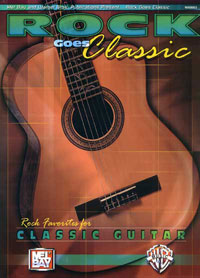
ROCK GOES CLASSIC-Rock Favorites for Classic Guitar-LIBRO-SPARTITI CHITARRA-Hotel California

ROCK GOES CLASSIC, Rock Favorites for Classic Guitar.

Product Description:
Here's a great collection of 17 rock favorites arranged for the intermediate-level classic guitarist. Features tasteful settings by John Carlini, Steve Siktberg Stephen Rekas, Levi Dendy and Kirk Hanser. Presented in standard notation with fingerings, these fine tunes are perfect for classic guitarists who want to add popular music to their repertoires. Contents include Hotel California, Wonderful Tonight, Moondance, Europa and many other rock favorites.

Format: Book

Contents:
American Pie Don McLean, arr. Steve Siktberg
Both Sides Now Joni Mitchell, arr. Stephen Rekas
Brown Eyed Girl Van Morrison, arr. Kirk Hanser
City of New Orleans Steve Goodman, arr. Kirk Hanser
Don't Speak Gwen Stefani and Eric Stefani, arr. Kirk Hanser
Europa (Earth's Cry Heaven's Smile) Carlos Santana and Tom Coster, arr. Kirk Hanser
Handy Man Otis Blackwell and Jimmy Jones, arr. Steve Siktberg
Hotel California Don Henley, Glenn Frey, and Don Felder; arr. Kirk Hanser
House at Pooh Corner Kenny Loggins, arr. Kirk Hanser
Layla Eric Clapton and Jim Gordon, arr. John McClellan
Lyin' Eyes Don Henley and Glenn Frey, arr. Steve Siktberg
Margaritaville Jimmy Buffett, arr. Kirk Hanser
Moondance Van Morrison, arr. Levi Dendy
Nights in White Satin Justin Hayward, arr. Kirk Hanser
Tears in Heaven Eric Clapton and Will Jennings, arr. Stephen Rekas
Vincent (Starry, Starry Night) Don McLean, arr. Kirk Hanser
Wonderful Tonight Eric Clapton, arr. Stephen Rekas

Price: €19,99
€19,99

YORK ANDREW THREE DIMENSIONS FOR SOLO GUITAR BOOK CHITARRA LIBRO SPARTITI

YORK ANDREW, THREE DIMENSIONS FOR SOLO GUITAR.

Product Description:
Classic guitarist Andrew York of the renowned Los Angeles Guitar Quartet displays his extra- ordinary compositional skills in these three reflective solo guitar pieces entitled Wish; Into Dark; and Higher Ground. Written in standard notation only.

Wish - Andrew York
Higher Ground -Andrew York
Into Dark - Andrew York

Price: €13,99
€13,99

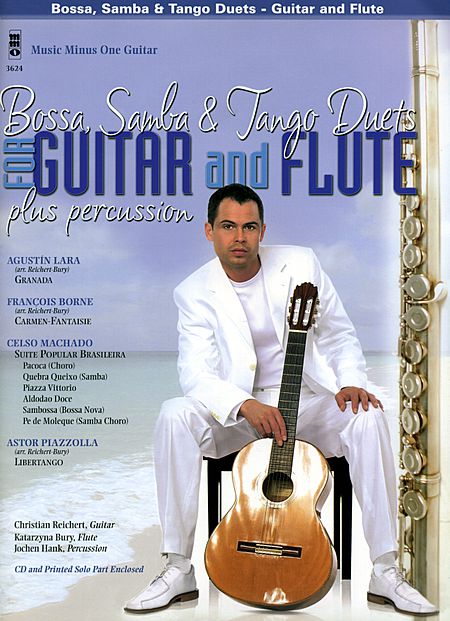
BOSSA SAMBA & TANGO DUETS FOR GUITAR AND FLUTE PLUES PERCUSSION CD LIBRO SPARTITI CHITARRA

BOSSA, SAMBA AND TANGO DUETS FOR GUITAR & FLUTE PLUS PERCUSSION. CD

Basi con libro.

Performed by Christian Reichert, guitar
Accompaniment : Katarzyna Bury, flute; Jochen Hank, percussion

Here is a collection of Latin masterpieces, arranged for flute, guitar and percussion. From the fabled Granada and François Borne’s rousing Fantasy on Themes from Bizet’s Carmen, to Brasilian superstar Celso Machado’s magnificent Suite Popular Brasileira and Astor Piazzolla’s Libertango, there is a wealth of thrilling music for every flutist. Listen to virtuosi Katarzyna Bury and Christian Reichert perform these classic pieces in a complete reference recording. Then you take Mr. Richert’s place alongside Mr. Reichert and the percussionist for a Latin music-fest that you will never forget! Bravo!

Includes a newly engraved, authoritative printed solo part, and a compact disc containing a complete version with soloist, in digitally recorded stereo; then a digital stereo version of the accompaniment, minus the soloist.

Piazzolla, Astor Libertango, della pubblicità VECCHIA ROMAGNA

Machado, Celso Suite Popular Brasileira: Paçoca (Choro)

Machado, Celso Suite Popular Brasileira: Quebra Queixo (Choro)

Machado, Celso Suite Popular Brasileira: Piazza Vittorio (Choro Maxixe)

Machado, Celso Suite Popular Brasileira: Algodao Doce (Choro)

Machado, Celso Suite Popular Brasileira: Sambossa (Bossa Nova)

Machado, Celso Suite Popular Brasileira: Pé de moleque (Samba Choro)

Bizet, Georges - Borne, Francois Carmen-Fantaisie

Lara, Agustín Granada

Price: €36,99
€36,99
Syndicate content