TRASCRIZIONE

REINHARDT DJANGO, THE MUSIC OF Tiger Rag-After You've Gone-Avalon-Swannee River-Charleston-chicago

REINHARDT DJANGO, THE MUSIC OF. The Music of Django Reinhardt. Forty-Four Classic Solos by the Legendary Guitarist with a Complete Analysis by Stan Ayeroff. 272 Pages.

Product Description:
The solos of Django Reinhardt are an endless source of inspiration and amazement for any musician. In this exciting book, the author has compiled precise solo transcriptions (in notation only), as well as a thorough analysis of each. There is also a complete "how to" section that is like a book in itself. This book contains some of Django's best work. It covers a period of 17 years, from Django's first trio and quintet recordings to one of his last bop-influenced sessions, "Live at the Club St. Germain." Multiple versions of many solos are included to show Djangos' musical development over his long career. Studying the music of the master of Gypsy Jazz can help lay a solid foundation for your own sound and style.

Format: Book

Contents:

A Note About Django Reinhardt
Preparation for The Complete Analysis of Django's solos
Symbols and Abbreviations
Scales
Arpeggios
Ornamentation
Chord Substitutions
Chord Progressions
Putting it All Together
Melodic Ideas and Devices
Exercises
Introduction to the Analysis Section

A Complete Analysis of the Solos
Tiger Rag I
After You've Gone I
Tiger Rag II
Avalon I
Swannee River I
Swannee River II
The Sheik of Araby I
Avalon II
Some of These Days
St. Louis Blues I
Limehouse Blues I
After You've Gone II
Limehouse Blues II
Shine
Charleston
Chicago
Hot Lips
Rose Room
Runnin' Wild
The Sheik of Araby II
Limehouse Blues III
Japanese Sandman I
St. Louis Blues II
Baby Won't You Please Come Home I
Baby Won't You Please Come Home II
Farewell Blues
My Melancholy Baby I
Limehouse Blues IV
Japanese Sandman II
My Melancholy Baby II
Tiger Rag III
My Melancholy Baby III
Japanese Sandman III
Limehouse Blues V
A Pretty Girl Is Like a Melody
Margie I
Tiger Rag IV
Dark Eyes I
Improvisation on Tiger Rag V
The World is Waiting for the Sunrise
After You've Gone III
Dark Eyes II
St. Louis Blues III
Darktown Strutter's Ball
Margie II

The Solos
Tiger Rag I
After You've Gone I
Tiger Rag II
Avalon I
Swannee River I
Swannee River II
The Sheik of Araby I
Avalon II
Some of These Days
St. Louis Blues I
Limehouse Blues I
After You've Gone II
Limehouse Blues II
Shine
Charleston
Chicago
Hot Lips
Rose Room
Runnin' Wild
The Sheik of Araby II
Limehouse Blues III
Japanese Sandman I
St. Louis Blues II
Baby Won't You Please Come Home I
Baby Won't You Please Come Home II
Farewell Blues
My Melancholy Baby I
Limehouse Blues IV
Japanese Sandman II
My Melancholy Baby II
Tiger Rag III
My Melancholy Baby III
Japanese Sandman III
Limehouse Blues V
A Pretty Girl is Like a Melody
Margie I
Tiger Rag IV
Dark Eyes I
Improvisation on Tiger Rag V
The World is Waiting for the Sunrise
After You've Gone III
Dark Eyes II
St. Louis Blues III
Darktown Strutter's Ball
Margie II

Discography
Links
Composer Credits
Stan Ayeroff Biography

Prezzo: €33,99
€33,99

REINHARDT DJANGO REAL ACOUSTIC GUITAR LIBRO GYPSY JAZZ CD BASI TABLATURE Belleville Minor Swing

REINHARDT DJANGO, REAL ACOUSTIC. SHEET MUSIC BOOK WITH CD & GUITAR TABLATURE .

LIBRO DI MUSICA GYPSY JAZZ CON CD,

SPARTITI PER CHITARRA CON :

ACCORDI, PENTAGRAMMA E TABLATURE . 


Titoli nel Libro :

- Minor Swing (1937) - CON BASE SU CD

- Minor Swing (1947)

- Minor Swing (1949) 

- Swing Guitars - CON BASE SU CD

- I'll See You In My Dreams - BASE SU CD

- Django's Tiger

- After You've Gone

- Djangology

- Blues Clair

- Blues En Mineur

- Belleville


Titoli nel CD :

Demo Play Minor Swing
■Lesson 1:
■Lesson 2:
■Demo Play Minor Swing

■Lesson 3:Minor Swing
■Lesson 4:
■Lesson 5:
■Demo Play Belleville
■Demo Play Nuages

Prezzo: €99,99
€99,99

METHENY PAT BRIGHT SIZE LIFE GUITAR RECORDED VERSIONS TABLATURE CHITARRA LIBRO SPARTITI

METHENY PAT, BRIGHT SIZE LIFE. SHEET MUSIC BOOK WITH GUITAR TABLATURE. 

LIBRO DI MUSICA PER CHITARRA ROCK JAZZ FUSION. 

SPARTITI PER CHITARRA CON: 

ACCORDI, PENTAGRAMMA, TABLATURE. 


Note-for-note guitar transcriptions (carefully reviewed and approved by Metheny himself!) for all 8 songs from his highly acclaimed 1975 studio debut - which also features one of the earliest recordings of bass legend Jaco Pastorius. Contains jazz-style handwritten notation and tablature, a full-page photo of Metheny, and a Guitar Notation Legend. 214 Pages.

Bright Size Life
Midwestern Nights Dream
Missouri Uncompromised
Omaha Celebration
Round Trip/Broadway Blues
Sirabhorn
Uniquity Road
Unity Village

Prezzo: €27,99
€27,99

METHENY PAT QUESTION AND ANSWER Guitar Recorded Version TABLATURE LIBRO CHITARRA

METHENY PAT, QUESTION AND ANSWER. TABLATURE

LIBRO DI MUSICA, SPERTITI PER CHITARRA CON TABLATURE. 


Series: Guitar Recorded Version TABLATURE
Note-for-note transcriptions with tab, in a handwritten jazz-style font and supervised by Metheny himself. Includes all the songs from this 1989 album that the All Music Guide describes as "nine tracks of sheer jazz joy," calling Pat's playing "modernistic, highly fluid, almost liquid lightning." 144 pages

Songlist:

All The Things You Are
Change Of Heart
H & H
Law Years
Never Too Far Away
Old Folks
Question & Answer
Solar
Three Flights Up

Prezzo: €27,99
€27,99

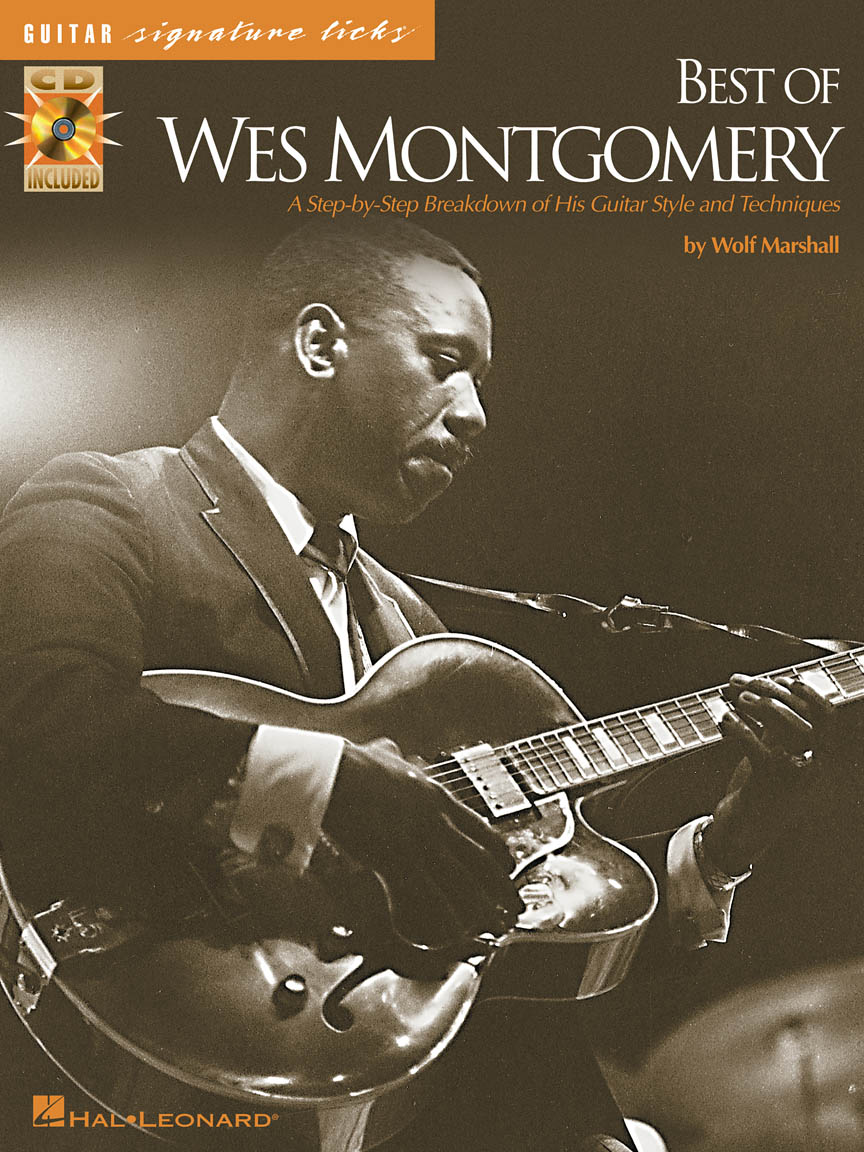
MONTGOMERY WES-BEST Signature Licks Guitar CD TABLATURE besame mucho-Missile blues-SPARTITI

MONTGOMERY WES, THE BEST. LIBRO CON CD E TABLATURE

LIBRO METODO DI MUSICA JAZZ, CON CD.

SPARTITI PER CHITARRA CON: 

ACCORDI, PENTAGRAMMA E TABLATURE. 

Performance notes, equipment, le tecnica del pollice, biografia. Invece di utilizzare il plettro, opta suonare con il polpastrello del pollice. Questa tecnica non ortodossa, affascina i chitarristi di oggi e stupisce per l'efficacia del suono caldo delle single-note. Missile blues -yesterdays -west coast blues -cariba -I¹ve grown accustomed to her face -bésame mucho (Kiss me much) -fried pies -mi cosa -four on six -misty -sundown -O.G.D. 

Guitar
Series: Signature Licks Guitar
Softcover with CD - TAB
Artist: Wes Montgomery
Author: Wolf Marshall

Explore the music of one of the greatest jazz guitarists of all time! This in-depth book/CD pack will guide you through 12 of the best-known tracks from the legendary Wes Montgomery, Features a foreword and introduction by Wolf Marshall, a discography and more.

Inventory # HAL LEONARD 00695387
ISBN: 0634009028
UPC: 73999953879
Width: 9
Length: 12
104 pages

Besame Mucho (Kiss Me Much)
Cariba
Four On Six
Fried Pies
I've Grown Accustomed To Her Face
Mi Cosa
Missile Blues
Misty
O.G.D.
Sundown
West Coast Blues
Yesterdays

Prezzo: €31,99
€31,99

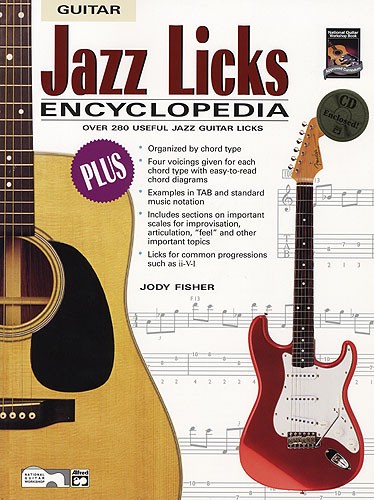
JAZZ LICKS ENCYCLOPEDIA Jody Fisher BOOK CD GUITAR TABLATURE VOICING IMPROVISATION

JAZZ LICKS ENCYCLOPEDIA. 280 frasi. SHEET MUSIC BOOK WITH CD & GUITAR TABLATURE . 

LIBRO DI MUSICA JAZZ CON CD .

SPARTITI PER CHITARRA : 

ACCORDI, PENTAGRAMMA, TABLATURE .


By Jody Fisher
ITEM: 00-19420
UPC: 038081184524
ISBN 10: 0739011189
ISBN 13: 9780739011188
CATEGORY: Guitar Method or Supplement
FORMAT: Book & CD

Nearly 300 useful jazz guitar licks organized by chord type. Examples are shown in easy-to-read TAB and standard music notation. Four voicings are given for each chord type along with easy-to-read chord diagrams. Licks for common progressions such as ii-V-I are shown. Includes sections on Important Scales for Improvisation, Articulation, "Feel" and other important topics.

GUITAR
OVER 280 USEFUL JAZZ GUITAR LlCKS

- Organized by chord type
- Four voicings given for each chord type with easy-to-read chord diagrams
- Examples in TAB and standard music notation
- Includes sections on important scales for improvisation, articulation, "feel" and other important topics
- Licks for common progressions such as ii-V-I
JODY FISHER
 

CONTENTS:

ABOUT THE AUTHOR
INTRODUCTION
PART I: LICKS FOR CHORDS

MAJOR 6 CHORDS (MAJOR 13 CHORDS)
Chord Formula & Voicings
One-Bar Licks for 6 Chords
Two-Bar Licks for 6 Chords

MAJOR 7 CHORDS
Chord Formula & Voicings
One-Bar Licks for Maj7 Chords
Two-Bar Licks for Maj7 Chords

MAJOR 9 CHORDS
Chord Formula & Voicings
One-Bar Licks for Maj9 Chords
Two-Bar Licks for Maj9 Chords

MINOR 6 CHORDS (MINOR 13 CHORDS)
Chord Formula & Voicings
One-Bar Licks for min6 Chords
Two-Bar Licks for min6 Chords

MINOR 7 CHORDS
Chord Formula & Voicings
One-Bar Licks for min7 Chords
Two-Bar Licks for min 7 Chords

MINOR 9 CHORDS
Chord Formula & Voicings
One-Bar Licks for min9 Chords
Two-Bar Licks for min9 Chords

MINOR I I CHORDS
Chord Formula & Voicings
One-Bar Licks for Min I I Chords
Two-Bar Licks for Min I I Chords

DOMINANT 7 CHORDS
Chord Formula & Voicings
One-Bar Licks for 7 Chords
Two-Bar Licks for 7 Chords

DOMINANT 9 CHORDS .
Chord Formula & Voicings .
One-Bar Licks for 9 Chords .
Two-Bar Licks for 9 Chords .

DOMINANT II CHORDS .
Chord Formula & Voicings .
One-Bar Licks for I I Chords .
Two-Bar Licks for I I Chords .

DOMINANT 13 CHORDS .
Chord Formula & Voicings .
One-Bar Licks for I 3 Chords .
Two-Bar Licks for I 3 Chords .

DOMINANT 7b5 CHORDS .
Chord Formula & Voicings .
One-Bar Licks for 7b5 Chords .
Two-Bar Licks for 7b5 Chords .

DOMINANT 7#5 CHORDS .
Chord Formula & Voicings .
One-Bar Licks for 7#5 Chords .
Two-Bar Licks for 7#5 Chords .

DOMINANT 7b9 CHORDS .
Chord Formula & Voicings .
One-Bar Licks for 7b9 Chords .
Two-Bar Licks for 7b9 Chords .

DOMINANT 7#9 CHORDS .
Chord Formula & Voicings .
One-Bar Licks for 7#9 Chords .
Two-Bar Licks for 7#9 Chords .

DOMINANT 7b5b9 CHORDS .
Chord Formula & Voicings .
One-Bar Licks for 7b5b9 Chords .
Two-Bar Licks for 7b5b9 Chords .

DOMINANT 7#5#9 CHORDS .
Chord Formula & Voicings .
One-Bar Licks for 7#5#9Chords .
Two-Bar Licks for 7#5#9Chords .

DOMINANT 7b5#9 CHORDS
Chord Formula & Voicings
One-Bar Licks for 7b5#9 Chords
Two-Bar Licks for 7b5#9 Chords

DOMINANT 7#5b9 CHORDS
Chord Formula & Voicings
One-Bar Licks for 7#5b9 Chords
Two-Bar Licks for 7#5b9 Chords

MAJOR 7#5 CHORDS
Chord Formula & Voicings
One-Bar Licks for Maj7#5 Chords
Two-Bar Licks for Maj7#5 Chords

MAJOR 7#11 CHORDS
Chord Formula & Voicings
One-Bar Licks for Maj7#11 Chords
Two-Bar Licks for Maj7#11 Chords

DOMINANT 9#11 CHORDS
Chord Formula & Voicings
One-Bar Licks for 9#11 Chords
Two-Bar Licks for 9#11 Chords

PART 2: LICKS FOR PROGRESSIONS

ii-V7 -I
Example Progressions i
Two-Bar Licks for ii-V7-I i
Four-Bar Licks for ii-V7-I.. i

MINOR ii- V7-i
Example Progressions j
Two-Bar Licks for ii-V7 -i
Four-Bar Licks for ii-V7 -i

ii- V7-1- VI7
Example Progressions
Two-Bar Licks for ii-V7 -I -VI7
Four-Bar Licks for ii-V7 -1-VI7

iii- VI7-11- V7 S
Example Progressions
Two-Bar Licks for iii-VI7 -ii-V7
Four-Bar Licks for iii-VI7 -ii-V7

III7- VI7-117- V7
Example Progressions
Two-Bar Licks for III7- VI7-II7-V7
Four-Bar Licks for III7-VI7-II7-V7

CHROMATIC PROGRESSIONS
Example Progressions
Two-Bar Licks for Chromatic Progressions
Four-Bar Licks for Chromatic Progressions

APPENDIX
Articulation and "Feeling"
Revamping Licks
Rhythmic Displacement
Important Scales for Improvisation

The CD that accompanies this book can make learning with the book
easier and more enjoyable. The symbol shown above will appear next to
every example that is on the CD. Use the CD to help insure that you are
capturing the feel of the examples, interpreting the rhythms correctly, and
so on. The track numbers below the symbols correspond directly to the
examples on that page. Track I will help you tune your guitar to this CD.


Introduction
There are many factors that go into a good jazz solo. Understanding music theory, along with the
ability to execute numerous scales, patterns and arpeggios, is just part of the picture. You must also
develop a sense of melody. Jazz students go about this by spending quite a bit of time studying the
improvised solos of others-specifically, "lifting" nice melodic ideas for use in their own solos, or at
least to influence their own playing in some way. These short melodic ideas become their "licks." This is perfectly acceptable.
In the long run, everything you have studied and listened to blends together to become your "sound:'
Problems arise when a player uses licks as the only tool for creating solos. Stringing an assortment of licks together is not improvising. Improvising is expressing the moment with spontaneously created ideas (as much as possible). Most of these ideas are based on things you have already learned, studied and heard.
Ideally,when improvising, we are combining these things in new and exciting ways. So, it makes sense to expose yourself to a lot of nice melodies. Learning a variety of tunes will help and so will learning licks-the ones you transcribe from recordings and the ones you get from books like this one.
This book has two main sections. The first part deals with licks that will work over specific chords.
Most types of chords are represented. For each type of chord, you will be shown the chord formula (as derived from a scale) and four sample voicings. In this section, there are four one-measure licks and six two-measure licks that will work well over the chord. When you find a melodic idea you like, memorize
it and learn to play it in all keys. Then practice inserting the idea into your own solos. Always look
for ways to vary the lick and make it your own.
The second section deals with licks that work over entire chord progressions. Many of the most common progressions are shown with longer melodic ideas. You will find two- and four-measure licks. Once again, when you find one you like, memorize it, transpose it and then start using it (or pieces of it, anyway).
At the end there is a short Appendix. In this section, you'll find ideas to help you get more mileage out of the licks you have learned. There is also a list of scales from which most of the licks in this book were mined. Eventually, you should know these scales in a few different fingerings.
The idea is to develop a strong musical vocabulary. Think of a scale as an "alphabet." Licks are some of the "words" you can create using that alphabet. Learning licks can help you to understand the scales you are studying by showing you some of the musical sentence possibilities.
I hope the examples in this book will open a few melodic doors for you!

NOTE:
All of the eighth notes in this book are swing Bths (played unevenly, long-short). However, it's always a good idea to try playing musical ideas straight, too. Experiment. On the CD that is available for this book, they are played as swing 8ths. 

Prezzo: €27,99
€27,99

JAZZ GUITAR STANDARDS BOOK CD TABLATURE CHITARRA LIBRO SPARTITI HAL LEONARD 00672356

JAZZ GUITAR STANDARDS. SHEET MUSIC BOOK FOR GUITAR WITH CD & TABLATURE.

LIBRO DI MUSICA JAZZ CON CD.

SPARTITI PER CHITARRA : 

ACCORDI, PENTAGRAMMA, TABLATURE. 


ARTIST TRANSCRIPTIONS

PLAY-ALONG BACKING TRACKS

HAL LEONARD 00672356

6 titoli :

-A Night In Tunisia, Billy Bauer

-Falling In Love With Love, Grant Green

-I've Got You Under My Skin, Jim Hall

-Stompin' At The Savoy, Charlie Christian

-Yardbird Suite, Joe Pass

-You Brought A New Kind Of Love To Me, Chuck Wayne. 

Prezzo: €39,95
€39,95

HENDERSON SCOTT THE BEST Guitar & Bass TABLATURE LIBRO SPARTITI-Black Cherry-Jakarta-Root Food

HENDERSON SCOTT, THE BEST. SHEET MUSIC BOOK WITH GUITAR TABLATURE .

LIBRO DI MUSICA ROCK - JAZZ, FUSION.
SPARTITI PER CHITARRA, BASSO E SYNTH. IN PENTAGRAMMA.
ACCORDI, PENTAGRAMMA E TABLATURE

GRIGLIA DEGLI ACCORDI .

CHITARRA: TABLATURE
BASSO: PENTAGRAMMA.
SINTH: PENTAGRAMMA.

TITOLI: 

- Black Cherry

- Jakarta

- Revenge Stew

- Root Food

- Slidin' Into Charlisa

- Stella By Infra

- Red High Particle Neutron Beam

- Susie's Dingsbums

-The Crawling Horror

-Torque

- Worlds Waiting.


Chitarra TABLATURE, Basso (no Tab.). 

Prezzo: €159,99
€159,99

JAZZ GUITAR FAVORITES LIBRO CD TABLATURE CHITARRA-All The Things You Are-Hank Garland-KESSEL

JAZZ GUITAR FAVORITES. CD TABLATURE

LIBRO DI MUSICA, SPARTITI PER CHITARRA CON CD E TABLATURE. 


6 titoli:

-All The Things You Are, Hank Garland

-I Hear A Rhapsody, Howard Roberts

-Oleo, Pat Martino

-Speak Low, Barney Kessel

-When Sunny Gets Blue, George Barnes

-Yesterdays, Wes Montgomery
 

Series: Guitar Collection
Medium: Softcover with CD
Arranger: Jack Grassel

Guitar transcriptions for these standards: All The Things You Are/Hank Garland - I Hear a Rhapsody/Howard Roberts - Oleo/Pat Martino - Speak Low/Barney Kessel - When Sunny Gets Blue/George Barnes - Yesterdays/Wes Montgomery.
40 pages

Table of contents :
All The Things You Are
I Hear A Rhapsody
Oleo
Speak Low
When Sunny Gets Blue
Yesterdays


INTRODUCTION

This publication represents a new format in jazz education which allows the learning improvisor and professional to access the benefits of studying classic guitar solos. Most transcription books require that the recordings (if available) be searched out, purchased, and only listened to since most players in the developmental stages of their playing would not have the technique to play the solos up to tempo. The solos in this book are:

1. Played in tune; many old recordings have been sped up to improve fidelity, raising the pitch as much as a whole step.

2. Recorded at an easy-to-play slow practice tempo.

3. Also recorded at a fast tempo slightly slower than the original, making performance attainable sooner.

4. Recorded on modern equipment with fidelity surpassing the original recordings with a modern rhythm section. Bass and drums are monophonic on both channels. Piano is on the right only. Guitar is on the left only.With your "balance control" you can choose what you want to hear. The solos are arranged in progressive order of technical difficulty.We chose performances that are most representative of each master's contribution to the development of jazz guitar.

Barney Kessel: This solo demonstrates his use of hard-driving melodic development and some of the first string bending on record by a jazz artist.

Wes Montgomery: The tone of the jazz guitar was forever changed by this man's thumb while adding to the post-bop vocabulary.

Howard Roberts: This early solo displays his formidable jazz talent which became unavailable to the public as Howard persued his pop hits, studio work and teaching careers in the late sixties.

Hank Garland: This Country-Western studio player shocked the jazz world in the early sixties with
his incredible jazz technique and swinging melodies.

George Barnes: With the use of almost every technique known to man, George uses bending, slides,
and hammer-ons to create a high level of expression seldom heard on the guitar.

Pat Martino: This solo is from the seventies after Pat had left his Wes Montgomery-influenced early
playing and developed his present polytonal-chromaticism, which is much different than the traditional jazz guitar approach.

The final form you see here is the result of an entire year of work; researching and choosing great solos, transcribing and proofreading for accuracy, countless hours of practicing and recording. Our motive is to increase the quality of jazz guitar playing and to preserve music which is or may become "out of print." Jeff Schroedl at Hal Leonard was a big help in developing and improving the book.

Up until starting this project I had avoided playing other's solos thinking that my own unique style of playing would be compromised. After spending a year with these masters, I've noticed that I have retained my original conception of guitar music, but have acquired a technical depth and more tools to play my music my way. So I now recommend this study to any jazz guitarist at any level.
Special thanks to the fine rhythm section who did their homework: Jim Sodke-keys, Del Bennett-drums, Tom McGirr-bass, and also Bill Littlefield-recording engineer.

Prezzo: €24,99
€24,99

GREEN GRANT BEST OF SIGNATURE LICKS CD TABLATURE GUITAR STYLES TECHNIQUES OF THE JAZZ GROOVE MASTER

GREEN GRANT, BEST OF. A step-by-step breakdown of the guitar styles and techniques of the jazz groove master. SHEET MUSIC BOOK with CD & GUITAR TABLATURE .

Series: Signature Licks Guitar
Softcover with CD - TAB
Artist: Grant Green
Author: Wolf Marshall

Explore the many stylistic turns of one of the most influential guitarists in jazz! Renowned guitar educator Wolf Marshall takes you inside 13 of Grant Green's most popular tunes to examine his unique lines and musicality. Includes: Airegin - Born to Be Blue - Cool Blues - If I Should Lose You - My Favorite Things - Oleo - Sookie Sookie - Stella by Starlight - This Could Be the Start of Something Big - Tune Up , and more. The CD includes full demos. 88 pages

TiTLES :
Ain't It Funky Now, Pt. 2
Airegin
Born To Be Blue
Cool Blues
If I Should Lose You
Little Girl Blue
My Favorite Things
Oleo
Sookie Sookie
Stella By Starlight
This Could Be The Start Of Something Big
Tune Up
Wives And Lovers (Hey, Little Girl)


INTRODUCTION
Grant Green personifies the appellation "soul jazz." He is one of the most colorful
and exciting guitarists to have emerged from the genre, and his work remains the yardstick
by which subsequent practitioners are measured to the present day. In the early and
mid 1960s, Grant Green was a leading exponent of the burgeoning hard bop movement
and a studio stalwart of countless recording sessions that chronicled the rise of the art
form. In these productive years Green lent his singular blue-tinged touch and talents to
groups led by luminaries like Jimmy Smith, Herbie Hancock, Lee Morgan, Larry Young,
Art Blakey, Lou Donaldson, Jack McDuff, Stanley Turrentine, Hank Mobley, Baby Face
Willette, Johnny Hodges, Ike Quebec, and many others. Green was one of the most prolific
recording artists in the prestigious Blue Note stable. He recorded an unheard-of seventeen
albums in 1961 alone, his first year with the company. Between 1961 and 1965,
his classic jazz years, Green made more records than any other artist at Blue Note.
During this time, in addition to his many sideman sessions, he established a formidable
legacy with a substantial catalog of his own albums as leader.
By decade's end, Green had expanded his artistic vision to include the new
rhythm and blues hybrid dubbed "funky jazz." As a result, in the late 1960s and 1970s he
enjoyed a second prominent and influential career as performer and innovator and was
hailed as the quintessential "groove master" of jazz. Green's contributions in the medium
affected countless players on both sides of the jazz-rock divide. You can put George
Benson, Pat Martino, Henry Johnson, Stevie Ray Vaughan, Carlos Santana, Mark
Whitfield, Eric Gale, John Scofield, Joshua Breakstone, Andy Summers, Melvin Sparks,
Dave Stryker, Kevin Eubanks, and Peter Bernstein on the top of the list.
This is the first Signature Licks book/CD to explore the music, style, and playing
techniques of Grant Green in depth. The note-for-note transcriptions will provide you with
countless hours of revelation, and the matching audio will invite you to step into his musical
world to put the theory into practice-the way Green himself did in his formative years.
The selections reflect the diversity of Green's approach and are drawn from his various
musical epochs. You will find material from the hard bop and soul jazz genres, straightahead
standards and blues, modal jazz outings, and funky rock-influenced sessions, all
attesting to the many shades of Green that have endured to become a vital piece of the
mosaic we know and love as the American musical experience.

Figure4-010
Green's two-chorus solo in "If I Should Lose You" is one of the finest of his early
years, a superb example of his hard-bop improvisation in a moderate swing tempo.
Throughout, he cultivates a relaxed soulful feeling distinguished by thoughtful melodic
invention and an ever-present rhythmic congruence.
Green plays unmistakable blues-based licks in Bb minor over the song's minormode
areas to begin each A section in measures 1-3, 17-19, 33-35, and 50-51.
Moreover, his cadential lines at the end of each sixteen-measure section, beginning with
the opening break, are harmonically active bop melodies that emphasize the movement
to and arrival in Bb minor. Green also imbues the crucial secondary dominant-seventh
sections of the song with related minor-mode sounds. In measures 13-14 and 45-46, he
applies characteristic Bb minor lines to Eb9, and approaches each phrase with an altered
dominant melody based on F, the V chord of Bb minor, in measures 12 and 44.
Green favors swing-oriented ideas and generally simpler, more diatonic bop lines
during the contrasting but tonally related major-mode portions (in Gb and Dbmajor) of the
tune. Check out measures 4-11,21-27,36-43, and 53-58. These measures contain a
mixture of scalar and arpeggiated patterns shaped into memorable solo phrases. A case
in point is the voice-leading figure in measures 8-10, a well-known and favorite Green
cliche. This trademark phrase implies an Ebm7-Ab7-Dbmaj7 progression with a descending
minor-seventh arpeggio (Db-Bb-Gb-Eb), disguised chromatic motion arranged in a
familiar zigzagging pattern of Eb-Bb-D-Bb-Db-Bb-C, a rising 9th chord arpeggio
(C-Eb-Gb-Bb), stepwise descent (Bb-Ab-Gb), and a resolving target figure (Gb-E-F).
Green pursues and develops a simple motive in measures 37-39 with an
inescapable logic. Note the melodic expansion and rotation in this three-part phrase.
Green was a master of this sort of melodic invention, and was able, on the fly, to harness
the same elements and procedures used by great classical composers to produce similar
thematically coherent results in improvisation.
Green plays signature raked arpeggio patterns in measures 20, 57, 60, and
62. These short, crammed figures are articulated with sweep picking in both ascending
and descending motion. Green applies side-slipping (in this instance "slipping" a half step
higher) in measures 46-47 to momentarily suggest the remote key center of A minor over
Eb7 and Ebm7. The phrase is made more striking with his barrage of crammed triplet
rhythms. Green's prevalent use of eighth-note triplet rhythm patterns in the solo further
energizes important phrases throughout, most notably in measures 27-28, 32, 43-44,
47-48, and 63-64. Another ear-catching highlight is the funky double-stop figure in measures
51-52. Here Green combines an anchoring pedal tone (Db)with a descending chromatic line.
 

Prezzo: €39,99
€39,99
Condividi contenuti