SPARTITI PER CHITARRA DI MUSICA COUNTRY BLUES

COUNTRY BLUES SONGBOOK, S.GROSSMAN TABLATURE

COUNTRY BLUES SONGBOOK, S.GROSSMAN TAB.

Prezzo: €23,00
€23,00

BLIND BLAKE-STEFAN GROSSMAN'S EARLY MASTERS OF AMERICAN BLUES GUITAR CD LIBRO SPARTITI

BLIND BLAKE, STEFAN GROSSMAN'S EARLY MASTERS OF AMERICAN BLUES GUITAR. SHEET MUSIC BOOK WITH CD & GUITAR TABLATURE

LIBRO DI MUSICA BLUES, CON CD.

SPARTITI PER VOCE E CHITARRA SOLA, CON: 

ACCORDI, PENTAGRAMMA, TABLATURE.

REGISTRAZIONI ORIGINALI !

ORIGINAL VINTAGE RECORDINGS.

Stefan Grossman's Early Masters of American Blues Guitar: Blind Blake
Blind Blake / transcr. Stefan Grossman

SERIES: Stefan Grossman’s Early Masters of American Blues Guitar
FORMAT: Book & CD

The Early Masters of American Blues series provides the unique opportunity to study the true roots of modern blues. Stefan Grossman, noted roots-blues guitarist and musicologist, has compiled this fascinating collection of 16 songs, transcribed exactly as performed by legendary blues master Blind Blake. In addition to Stefan's expert transcriptions, the book includes a CD containing the original recordings of Blind Blake so you can hear the music as he performed it.

Blind Blake was the greatest ragtime blues guitarist to record during the 1920s. His guitar styles and techniques were unique, capturing the pulsating rhythms of the blues, ragtime, and jazz music of the period. His records sold well and were greatly influential on generations of guitarists. This collection presents sixteen tunes that will keep your fingers very busy. Sound, feel, and control over right-hand thumb are the elements of Blind Blake's playing that will demand all your attention and patience. Enjoy the wonderful songs, and good luck developing your "sportin' right hand!"


TITOLI: 

-Blind Arthur's Breakdown
-Chump Man Blues
-Come On Boys, Let's Do That Messin' Around
-Diddie Wa Diddie
-Down In The Ountry
-Early Morning Blues
-Georgia Bound
-Guitar Chimes
-He's In Jailhouse Now
-Hey, Hey Daddy Blues
-Police Dog Blues
-Policy Blues
-Sweet Jivin' Mama
-That Will Never Happen No More
-Wabash Rag
-West Coast Blues 

Prezzo: €29,99
€29,99

BLIND BLAKE, THE GUITAR OF. M. Woody. 3 CD TABLATURE

BLIND BLAKE, THE GUITAR OF. 3 Ore di musica con le originali registrazioni. Audio lezione di M. Woody. 3 CD TAB.

Prezzo: €25,00
€25,00

BLIND BOY FULLER STEFAN GROSSMAN'S EARLY MASTERS OF AMERICAN BLUES GUITAR LIBRO CD ABLATURE

BLIND BOY FULLER, STEFAN GROSSMAN'S EARLY MASTERS OF AMERICAN BLUES GUITAR. CD TABLATURE

LIBRO DI MUSICA COUNTRY BLUES CON CD.

SPARTITI PER VOCE CON ACCORDI E PENTAGRAMMA.

SPARTITI PER CHITARRA CON ACCORDI, PENTAGRAMMA, TABLATURE. 

Stefan Grossman's Early Masters of American Blues Guitar: Blind Boy Fuller
Blind Boy Fuller / transcr. Stefan Grossman

SERIES: Stefan Grossman’s Early Masters of American Blues Guitar
FORMAT: Book & CD

The Early Masters of American Blues series provides the unique opportunity to study the true roots of modern blues. Stefan Grossman, noted roots-blues guitarist and musicologist, has compiled this fascinating collection of 19 songs, transcribed exactly as performed by legendary blues master Blind Boy Fuller. In addition to Stefan's expert transcriptions, the book includes a CD containing the original recordings of Blind Boy Fuller so you can hear the music as he performed it.

Blind Boy Fuller was one of the most popular "Piedmont Blues" artists, recording most of his work during the late 1930s. Close friends with Sonny Terry and Rev. Gary Davis, his "country blues" music and fingerpicking playing style influenced thousands of blues players.

Prezzo: €29,99
€29,99

BLOCK RORY, CLASSICS OF COUNTRY BLUES GUITAR . 6 CD

BLOCK RORY, CLASSICS OF COUNTRY BLUES GUITAR. 6 Ore di "Urla" con la musica di Willie Brown, Robert Johnson, Blind Blake, Skip James, e altri. 6 CD. TAB.

by Rory Block LEVEL 4 · INCLUDES TAB
Series: Homespun Tapes
Publisher: Homespun
BOOK W/CD - TAB
Composer: Rory Block

W.C. Handy Award-winner Rory Block breaks down some of the greatest Delta blues guitar solos of all time, providing the details of how to play them with all the nuances and subtleties of the originals. The classic tunes she teaches include: Old Country Rock - Statesboro Blues - Big Road Blues - Canned Heat - Walkin' Blues - Cross Road Blues - Frankie and Albert - Future Blues - M&O Blues - Police Dog Blues - Devil Got My Man - Mississippi Blues - Ain't No Way for Me to Get Along.

SIX CDs - LEVEL 4 - INCLUDES MUSIC + TAB 42 pages

Prezzo: €58,00
€58,00

BLOCK RORY TEACHES COUNTRY BLUES GUITAR libro CD chitarra TABLATURE

BLOCK RORY, TEACHES CLASSICS OF COUNTRY BLUES GUITAR. CD TABLATURE
a detailed course in repertoire and technique.

LIBRO DI MUSICA PER CHITARRA CON CD E TABLATURE.

Series: Guitar
Publisher: Homespun Listen and Learn Series
Medium: Softcover with CD
Author: Rory Block

Here are some of the greatest country blues solos of all time, taught in phrase-by-phrase detail. Rory Block, one of the most knowledgeable and talented exponents of this style, performs and breaks down these fingerstyle pieces by Willie Moore, Blind Willie McTell, Tommy Johnson, Mississippi John Hurt, Skip James and others. 32 pages


Introduction

Dear Friends,
There was a time when the last thing I wanted to do was to teach blues. I was 15 years old and
believed that one needed to devote ones life to apprenticeship with the masters in order to
learn the old music. I didn't have the perspective at the time to realize how briefly those
masters would be among us and how little access the country at large had to a small area of the
east coast and a dot in time. I hoarded the music jealously.
Later on I realized how the things I had learned firsthand from Son House, Reverend Gary
Davis, Mississippi John Hurt, Fred McDowell, Skip James and others did not just belong to
me, or to those who had the good fortune of being at the right place at the right time. I realized
that his precious music belonged to everyone, and that I was the last person who wanted to see
it die away. I began to desire to share whatever I knew, to pass on my small part of the puzzle,
to inspire and educate if I was able. During this time many other venerable musicians, famous
and obscure have added their own irreplaceable passion to the equation. We have also recently
seen a new wave of the second generation, children and grand children, heirs to this great
music, and at the same time an increase in both availability and interest in historic music.
Myoid frienn. Artie Traum was there, as was I, during the roots music revival of the '60s, and it
was Artie who suggested I sit down and record this first audio series of my all-time favorite
country blues songs. I now feel it a great honor to be a part of this process, and hope to inspire
in each listener and player a burning need to add something of themselves to everything they
play, because that connection with the soul, that expression of the individual in each note is
what really carries the music on.

TEACHES
Classics of Country Blues Guitar

Table of Contents

 Introduction

"Old Country Rock"
Intro Music - "Old Country Rock"
Introduction
Tuning Pitches
1st 4 Measures
G7 Chord
Connecting Run
Measures 7 and 8
1st 8 Measures - Slow Version
1st 8 Measures - Fast Version
Rhythmical "Gem"
Tag #1
Tag #2 ("A" Section)
Tag #2 ("D" Section)
"Old Country Rock"

"Statesboro Blues"
Intro Music - "Statesboro Blues"
Intro Breakdown
Full Intro
Song Breakdown
"Statesboro Blues"

"Big Road Blues"
Introduction
Intro Breakdown
Ascending Bassline
"Big Road Blues"
"D" Section Substitution
G7 Section
Right Hand Techniques
Right Hand Techniques Continued
"Snapping"
"Snapping" Continued
Last Section Breakdown

"Canned Heat"
Intro Music - "Canned Heat"
Song Breakdown
Song Review

"Future Blues"
Introduction
Tuning Pitches
"Future Blues"
Song Breakdown
Adding Vocals

"Devil Got My Man"
Introduction
Tuning Pitches
"Devil Got My Man"
Song Breakdown
Song Breakdown Continued
Song Discussion
"Devil Got My Man" with Vocal

"Police Dog Blues"
Intro Music - "Police Dog Blues"
Harmonics
Song Breakdown
Alternate Ending (meas. 15 and 16)
Alternate Verse #1 (meas. 7-11)
Alternate Verse #2 (meas. 7-11)
Song Review

"Mississippi Blues"
Introduction
Tuning Pitches
Song Discussion
"Mississippi Blues"
Intro Breakdown
Intro Review
Verse Breakdown
Verse Review
Solo Breakdown
"Mississippi Blues" with Vocals
Outro
Continue Your Studies with Rory Block
A Selected Discography 

Prezzo: €23,99
€23,99

BLUES SOLOS FOR ACOUSTIC GUITAR JOHNNY NORRIS LIBRO CD TABLATURE CHITARRA ACUSTICA COUNTRY

BLUES SOLOS FOR ACOUSTIC GUITAR. CD TABLATURE

LIBRO DI MUSICA BLUES CON CD.
SPARTITI PER CHITARRA. ACCORDI, PENTAGRAMMA E TABLATURE.

Di Johnny Norris; 16 stili in 16 istantanei brani. 

Play blues style guitar with this superb book/CD pack. Specially composed solos include 'Overdrivin'', 'Soho Blues' and 'Eight Bars On The Highway'.

Prezzo: €20,99
€20,99

BAKER DUCK, FINGERSTYLE BLUES GUITAR 101. CD TABLATURE

Baker Duck, FINGERSTYLE BLUES GUITAR 101. 11 distinti Blues in 26 minuti, solo per chitarra. CD TABLATURE

Duck Baker's Fingerstyle Blues Guitar 101,
80 PAGES
Product Description:
A collection of 12 great acoustic blues guitar solos by Duck Baker in notation and tablature. The solos are intermediate to advanced in difficulty and successfully capture the earthy myriad of influences comprising classic American blues guitar stylings. Chords, scales, keys and turnarounds for the blues are taught in this method book. Standard notation and tablature. All songs from the book are included on the CD.

In the context of traditional folk music, blues as we know it is a very new formo The classic 12-
bar form evolved during the early years of this century, and while there are c1early African
antecedents of presumably ancient origin, the harmonic underpinnings of alI but the most basic blues
mark the music as Afro-American. How far back into the 19th century the origins of this musical
strain (as separate from ragtime, spirituals, and other early black music) can be traced is an area for
scholars to filI in as best they can. The point remains, however, that in terms of traditional music, a
century or so is a short time. Modem composers can, of course, stretch the limits of their constructions
until they literally do not exist; their predecessors indulged in ever more-extended forms culminating
in Wagnerian cyc1es which take days to perform. But the folk song has to make its point, and quickly.
Dance tunes are usualIy constructed of 8-bar sections and the standard 32-bar popular song (also of
8-bar sections) is a far longer structure than most folk songs.
Contemporary culture is geared to the notion that even last year' s tunes are passe, so it bears
reinforcing the point I want to start with. Every form of American music in this century, except for
some free jazz and free improvised music, is an extension of forms which existed by the 1920s, of
which the popular song form and the blues are the newest. This is true of New Orleans jazz, swing,
be-bop, gospel, bluegrass, rhythm and blues, and even such hybrids as Western swing and rock and
roll. Not one of these styles can even be imagined without the vital element of the blues.
It is much easier, however, to talk about "blues" as either a structure or a kind of musical
flavoring than it is to define the parameters ofthe music called "blues". Even a term as geographicalIy
specific as "Delta blues" means little musicalIy, lumping together players as diverse as Son House,
John Hurt, Sam Chatman, and Skip James. Hurt, for instance, played a guitar style that was not at alI
rooted in folk inventions but in Victorian parlor music. Nonetheless, his early recordings have a
definite African feeling to them that has eluded his many imitators. Chatman' s band, the Mississippi
Sheiks, played in a jug-bandish style that inc1uded elements of blues, ragtime, minstrel tunes, and
early popular songs. Their composition "Sitting on Top of the World" remains popular with blues
players but also crossed over to Western swing by 1940, and then, sometime later, to bluegrass. The
Western Swingsters were particularly prone to cover race recordings (as welI as just about anything
else) and often did a great job of it. Milton Brown, for instance, was a hell of a blues singer.
Of course, black musicians in the South always learned from whites as well. Many spirituals
sound like syncopated Scottish folk songs (a fact which people who puzzi e over Stephen Foster's
ability to write "plantation" songs without ever going South would do welI to consider). Just hearing
pianos would have opened alI kinds of doors for people who didn 't previously think chordalIy. Doors
that lead, ultimately, to ragtime, stride, and jazz. The glorious truth of the matter is that alI white
American music has black elements, alI black American music has white elements, and it is exactly
this integration that makes American music great.
My own feeling is that music that is not open to other styles is in danger. A lot of contemporary
blues, jazz, rock, and country is tired and formularized, largely because each little world is
increasingly cut off from the others. As far as blues goes, I get the sense that a lot of young players
who are taken with the music wind up in the hands of teachers who consider themselves experts
because they try to imitate old recordings without getting the feeling. A better approach in my mind
is to let our own imaginations enter an area whose dimensions have been defined by the great masters
ofthe pasto There are lots of musical ideas that fit welI into that framework that Delta players didn't
use. Of course there are many that don't, notably the tendency ofyounger white players to rock-androlIize
the blues. One purpose of this book is simply to provide a whole lot of new licks that can be
used in old contexts (and hopefulIy give ideas for other new licks). There are ideas that are swing and
even country-oriented, but I have stopped welI short of anything truly "modern"-though all the
really great modernjazz players are great at the blues, from Miles and Monk to Coltrane and Omette.
Another basic purpose is to expand know ledge of the instrument for the student. A lot of what' s
here was designed to address specific problems that students have, like the tendency of the right
thumb to only approximate what itis he's supposed to be doing (with apologies to alI you southpaws,
who are, I hope, sufficiently habituated to right-handed chauvinism to be able to make the necessary
adjustments without too much pain).


"First song I ever played was the blues. I didn't know much but I knowed that much. After a while I begin to play the E blues, the D blues, Cblues, A blues, and G blues. That was all there was to it. " Scrapper Blackwell, in an interview with Art Rosenbaum


Format: Book/CD Set
Song Title: Composer/Source:

CONTENTS:

Introduction .

Blues in E .

E Blues #1 .

E Blues #2 .

An Idiot's Guide to Theory .

Major Scales .

Chords .

The Dominant Seventh .

Upper Interval Chords .

Turnarounds .

E Blues Again .

Baby Let Me Follow You Down .

Blues in A .

A Blues #1 .

Blues in C .

The Jackson Stomp .

Make Me a Pallet on Your Floor .

Blues in G .

Sister Kate Variations .

E Blues Again .

Seven Point One .

A Blues Again .

Still Staggerin' .

The Dirtman Cometh .

C Blues Again .

The Deep Blue C .

G Blues Again .

The Mighty Midget .

Prezzo: €20,99
€20,99

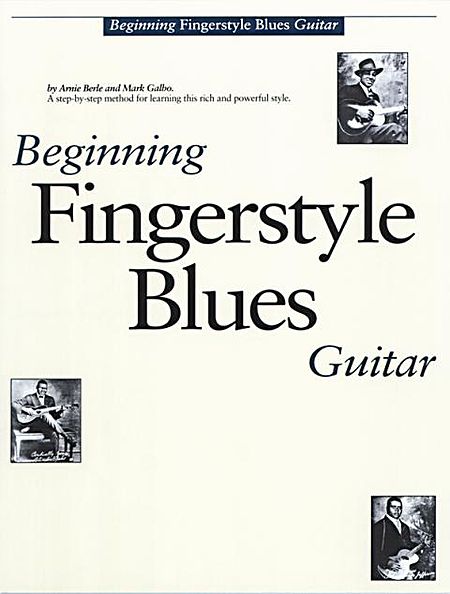
BEGINNING FINGERSTYLE BLUES GUITAR Arnie Berle Mark Galbo CD TABLATURE LIBRO CHITARRA SPARTITI

BEGINNING FINGERSTYLE BLUES GUITAR, Arnie Berle, Mark Galbo. SHEET MUSIC BOOK WITH CD & GUITAR TABLATURE .

LIBRO DI MUSICA BLUES CON CD . 

SPARTITI PER CHITARRA :

ACCORDI, PENTAGRAMMA, TABLATURE . 


About Beginning Fingerstyle Blues Guitar For guitar. Instructional and Blues. Beginner. Instructional book and examples CD. Guitar tablature, standard notation, chord names, guitar chord diagrams and instructional text. 96 pages. 
With guitar tablature, standard notation, chord names, guitar chord diagrams and instructional text. Instructional and Blues.
A step-by-step method for learning this rich and powerful style. Takes you from the fundamentals of fingerpicking to five authentic blues tunes.


BEGINNING FINGERSTYLE BLUES GUITAR
Series: Music Sales America
Publisher: Music Sales America
Format: Softcover with CD – TAB
Authors: Arnie Berle, Mark Galbo

A step-by-step method for learning this rich and powerful style. Takes you from the fundamentals of fingerpicking to five authentic blues tunes. Includes graded exercises, illustrated tips, plus standard notation and tablature.

Inventory #HL 14003799
ISBN: 9780825625565
UPC: 752187713906
Publisher Code: AM71390
Width: 9.0"
Length: 12.0"
98 pages


One day back in March of 1988 a oung man named Mark Galbo 

came to me to study jazz guitar. Over the next several weeks I
learned a lot about him. He was twenty-seven years old, he held a
degree in music, and he was an excellent blues guitarist. He taught
at his studio and as a guest clinician at blues festivals. He also
performed all over the country at these festivals and in clubs
throughout the New York area. He has played with some of the
leading blues guitarists of our time, including Etta Baker and John
Cephas. This was of great interest to me because although I have
been associated primarily with jazz through my hundreds of
columns for Guitar Player magazine and the many books I have
written, I greatly love fingerstyle blues guitar. For a long time I
had wanted to write a book on the subject. As time went by and I
saw Mark for his weekly lessons, I became more and more
impressed with his dedication to the blues, his conscientiousness
about everything he did, and his articulateness. I asked him if he
would like to collaborate with me on a book. This is the result of
that collaboration.
Since the blues falls into the category of folk or "unschooled"
music, there has always been a mystique as to how a student
might go about learning it. Legends abound about how Robert
Johnson learned his craft from the devil or a witch doctor. We
know that many bluesmen learned just by hanging around their
elders. But most of us don't have that opportunity and have to
turn to instructional books.
One type of book contains direct transcriptions of blues solos by
the masters. Unfortunately, many are dauntingly difficult and
require a rather advanced technique. The advantage to this book is
that we will start from the very beginning and gradually work
toward greater sophistication. Not only will you learn the
technique necessary to approach the works of the blues masters,
but you will acquire the tools to make up your own pieces. And if
you decide that you want to branch out into other styles of music,
the fingerpicking techniques you learn here will give you a good
basis for explorations into ragtime, country-and-western, folk, and
even classical music.


THE BLUES

Well before the beginning of the twentieth century there existed in America a large body of music performed by black people for black people. It included minstrel shows, work songs, field cries or hollers, and spirituals. However, at some time during the 1890s no one knows any exact dates-another kind of music could be heard in rural areas of the Deep South. This new music came to be called "the blues" sometime around 1900. Ma Rainey, quoted in Sandra R. Lieb's excellent biography Ma Rainey, Mother of the Blues, says that she first heard the word "blues" applied to a song she heard sung by a little girl on a street corner in 1902. Although the blues emerged from all over the South, many of the most important and influential blues musicians came from Mississippi. There, scores of impoverished, wandering performers accompanied themselves on the guitar at turpentine and lumber camps, roadside cafes, railroad stations, and street corners. Out of many a few were recorded and have become famous among aficionados of early blues. Bluesmen like Charlie Patton, Robert Johnson, Son House, and Bukka White helped develop a style known as country blues which has been copied over and over again throughout the world. Country blues were about unrequited love, loneliness, troubles at work, the desire to travel (I got to keep movin), or of specific events. "Backwater Blues" told of a flood on the Mississippi River. Other songs were about legendary personalities like C.C. Rider and Stagger Lee.

The early street musicians would sing their stories, adapting the musical form to their lyrics. It might have taken them nine, twelve, thirteen, or any number of measures to get through a verse. Their melodies were simple, direct, and elemental; their accompaniments often consisted of nothing more than a single chord or a repeated riff. However, the spread in popularity of the blues led inevitably to its modification and standardization. Ever larger numbers of phonograph owners picked up an interest in the blues and favored records that were to their own tastes. Bands began to play the blues not just as accompaniments but as instrumental pieces. W.C. Handy, who came to be known as "the Father of the Blues," wrote down songs so that they could be published and sold as sheet music. Handy himself receives credit ...


Contents
Origins Of The Blues
Preparing To Play Our First Blues
Preparing To Play A Blues In G
Preparing To Play A Blues In E
Melody Notes
Eighth Notes, Dotted Notes, And Syncopation
Blue Notes
Fretting-Hand Techniques
Picking-Hand Techniques
Playing Chords In The Higher Positions
Vamps
Singing The Blues
Five Blues Pieces


CONTENTS: 

Introduction 
The Origins of the Blues 
The Form 
The Beat 
Picking-Hand Technique for Fingerstyle Guitar 
Preparing to Play Our First Blues 
Building a Solid Technique 
The Alternating Bass 
Picking with the Fingers 
Combining the Thumb and Fingers 
Preparing to Playa Bluesin G 
Preparing to Playa Bluesin E 
Melody Notes 
Eighth Notes, Dotted Notes, and Syncopation 
Eighth Notes and the Alternating Bass 
Dotted Rhythms 
Syncopation 
Blue Notes 
Fretting-Hand Techniques 
Hamrnerons 
Pulloffs 
Slides 
Double Stops 
Bends 
Vibrato 
Picking-Hand Techniques 
The Brushstroke 
Heel Damping 
Walking Basslines 
Playing Chords in the Higher Positions 
Vamps 
Singing the Blues 
The Blues LyricForm 
Turnaround Fills 
FiveBlues Pieces 
Contents of Compact Disc 


A step-by-step method for learning this rich and powerful style.
Graded exercises take you from the fundamentals of fingerpicking to
five authentic blues tunes. Each technique is carefully explained and
illustrated in the book as well as on the accompanying compact disc.
All music is presented in both standard notation and tablature.
 
The origins of the blues
The 12-bar blues form
The importance of the beat in the blues
The roles of the thumb and of the fingers
Playing the alternating bass
Playing the melody
Putting the thumb and fingers together
Whole notes, half notes, and quarter notes
Fingerpicking patterns for various chords in various keys
Playing our first blues
The turnaround
Melody notes for each chord
Eighth notes and dotted quarter notes
Syncopation
Blue notes
Hammerons
Pulloffs
Slides
Double stops
Bends
Walking basslines
Brushstroking
Heel damping
Chord inversions
Vamps
Singing the blues
M&O Blues
Beekman Blues
Big Road Blues
32-20 Blues
Black Rat Swing
Prezzo: €29,99
€29,99

BIG BILL BROONZY, THE GUITAR OF. Woody Mann. 3 CD TABLATURE

BIG BILL BROONZY, THE GUITAR OF. 3 Ore di musica con le originali registrazioni. Audio lezione di Woody Mann. 3 CD TABLATURE

Big Bill Broonzy's recording career spanned from 1927 until his death in 1958. His repertoire was well recorded, from solos and duets to ensemble playing. He was rediscovered just as the "folk-revival" began in the early 1950's. Broonzy was a master of ragtime and country blues guitar whose playing was highlighted by a strong pulsating bass and melodic lead lines. In this comprehensive new audio lesson, Woody Mann explores the ideas, techniques, and styles of this legendary musician who has influenced generations of guitarists. The CDs contain three full hours of instruction featuring note-by-note, phrase-by-phrase instruction. Selections include: House Rent Stomp; Brownskin Shuffle; Moppin' Blues; Hey, Hey; Worryin' You Off My Mind; Stove Pipe Stomp; and Saturday Night Rub. Written in standard notation and tablature. Inlcudes 3 CD's. 


Brownskin Shuffle

House Rent Stomp

Worryin' You Off My Mind

Stove Pipe Stomp

Hey, Hey

Moppin' Blues

Saturday Night Rub

Prezzo: €27,99
€27,99
Condividi contenuti