SPARTITI PER CHITARRA DI MUSICA COUNTRY e BLUEGRASS

LIBRI, METODI, TABLATURE, TRASCRIZIONI, MANUALI, SPARTITI DI MUSICA COUNTRY & BLUEGRASS

SONGS OF THE TRAIL VOCE ACCORDI CHITARRA COWBOYS HAL LEONARD LIBRO SPARTITI

SONGS OF THE TRAIL. Per voce e accordi.

LIBRO DI MUSICA,

SPARTITI PER VOCE E ACCORDI.

PENTAGRAMMA E ACCORDI DELLA CHITARRA. 
CONTIENE NUMEROSE FOTOGRAFIE.

Series: Vocal
Publisher: Centerstream Publications
Arranger: Ron Middlebrook
Composer: Various Composers

Compiled by Ron Middlebrook. Cowboys have always held a special place in the hearts and imaginations of Americans. Images of riding bravely and happily into the sunset, fending off dangerous enemies, and singing around the campfire evoke a sense of pride and respect for a lifestyle nearly forgotten in this age of progress. Relive the days of the cowboys bringing the herds home in this interesting compilation of facts and music. 53 songs celebrate the life and times on the range by such noted writers as Doc Denning, Chris LeDoux, Rusty Richards, Roy Rogers Jr., and others. Their music is an actual view into their daily adventures, tribulations and entertainment. This unique publication also features articles on black cowboys, cowgirls, cowboys' Spanish ancestry, and more.

Adios Muchachos
Ballad Of Dawson Legate(Steagail
Blue Bonnet Lady (Paul W)
Call Of The Rollin Plains(Parker
A Cow Pony Friend (Clark/Thorp)
Cowboy Buckaroo (Williams M)
Cowboy Song (Paul W)
Cowboy's Christmas Ball, The
Cowboy's Got To Ride (Ledoux C)
A Cowboy's Life (Sizemore A)
Cowboy's Meditation, The
Cowboy's New Year's Dance
For Freckles Brown (Steagail R)
Ghost Of Serrano Ridge(Richards)
Great American Cowboy (Hannah J)
Gypsy Cowboy Band (Fleming M)
Hard Times Come Again No More
I Can't Ride Tony Tonight
I'd Like To Be In Texas(Clark K)
Idaho Winds (Sites E)
King Of The Cowboys (Rogers R)
Last Cattle Drive(Fleming/Bourne
Last Cowboy, The (Elman P)
Last Long Trail
Little Joe The Wrangler (Thorp N)
Mail Order Bride (Denning D)
Make Me A Cowboy Again (Haley J)
Man Walk Among Us (Robbins M)
Mountain Dunes (Elman P)
Pecos Bill
Rodeo Days (Clark/Barker)
Round-Up Day In Arizona (Hersher)
Saddle Tramp (Robbins M)
Saga Of Diamondfield Jack (Fara)
Sangre De Christo (Fleming M)
Sedona Serenade (Fara F)
Sentimental Trails (Denning D)
So Long Saddle Pals (Paul W)
Song For New Mexico (Hobbs J)
Stampede (Richards R)
Stutterin' Cowboy, The
Texas Girl (Richards R)
There's Smthing That Cowboy Know
Tips For Stage Travelers (Fara)
Trail Dust (Parker A)
Trailin Back To Old Mexico(Sites
Twilight On The Trail
Wyoming Nester, The
The Yellow Rose Of Texas
Yellow Stud (Ledoux C)

112 pages

Prezzo: €21,99
€21,99

ESSENTIAL COUNTRY GUITAR TECHNIQUE Michael Fath BOOK CD TABLATURE CHITARRA LIBRO SPARTITI

ESSENTIAL COUNTRY GUITAR TECHNIQUE. Michael Fath. SHEET MUSIC BOOK WITH CD & GUITAR TABLATURE .

LIBRO METODO DI MUSICA COUNTRY, CON CD.

SPARTITI PER CHITARRA :

ACCORDI, PENTAGRAMMA, TABLATURE.
 

ESSENTIAL COUNTRY GUITAR TECHNIQUE

Series: Guitar Educational
Publisher: Cherry Lane Music
HAL LEONARD
Softcover with CD - TAB
Author: Michael Fath


Gain some real Nashville chops and start your own country twangfest with Essential Country Guitar Technique! Starting right now you can become a country guitar daredevil by playing the exercises found in these pages. Twelve solos that demonstrate each technique are included so you can take your new-found skills for a test drive - and take charge of some hot country music while you're at it! You'll learn: Travis picking, pedal steel bends, country swing techniques, bluegrass-style banjo rolls, and much more! Recorded demos of every music example and solo are included on the CD. 

Inventory #HL 02500695

ISBN: 9781575607245
UPC: 073999083552
Width: 9.0"
Length: 12.0"
56 pages

Prezzo: €19,99
€19,99

DUELLING BANJOS Arthur Smith GUITAR & BANJO TABLATURE SPARTITO CHITARRA week-end di paura

DUELLING BANJOS, Based on "Feudin' Banjos", written by Arthur Smith. Film "Deliverance". SHEET MUSIC FOR BANJO & GUITAR TABLATURE .

SPARTITO DI MUSICA COUNTRY.

SPARTITI PER CHITARRA E BANJO CON:  

ACCORDI, PENTAGRAMMA, TABLATURE.

TABLATURE for BANJO & TABLATURE for GUITAR.  


DUELLING BANJOS ("DELIVERANCE" FILM)
"Un tranquillo week-end di paura" Un film di John Boorman.

By Arthur Smith. Guitar / banjo single for guitar and 5-string banjo. From the motion picture "Deliverance". G Major. 11 pages. With standard notation, guitar tablature, banjo tablature, chord names and strum and pick patterns. Bluegrass.

Prezzo: €13,99
€13,99

BRESH THOM, IN CONCERT. DVD

BRESH THOM, IN CONCERT. DVD


Series: Homespun Tapes
Publisher: Homespun Video
Medium: DVD
Artist: Thom Bresh

Here's a look at a consummate entertainer and powerful guitarist in concert. Thom Bresh performs one of his typically up-beat and musically exciting shows featuring the thumb picking style that he learned from his Dad, Merle Travis. 60 minutes.

Prezzo: €29,00
€29,00

BRESH TOM, THE REAL MERLE TRAVIS GUITAR, Like Father, Like Son. TABLATURE DVD

BRESH TOM, THE REAL MERLE TRAVIS GUITAR, Like Father, Like Son. TAB. DVD

Series: Homespun Tapes
Publisher: Homespun
Medium: DVD
Artist: Merle Travis
Author: Thom Bresh

Thom Bresh, the only son of the legendary guitarist Merle Travis, shows how to get the real Travis sound. He teaches several of Merle's best-loved guitar instrumentals: Guitar Rag, Cannonball Rag and others. A must-have for all serious acoustic guitar students!
90-MIN. INCLUDES MUSIC + TAB LEVEL 3

Prezzo: €33,00
€33,00

HILAND JOHNNY LICKS & TRICKS VOL.2 LIBRO CD TABLATURE CHITARRA COUNTRY B-BENDER

HILAND JOHNNY, LICKS & TRICKS VOL.2. CD TABLATURE

LIBRO DI MUSICA, SPARTITI PER CHITARRA CON CD E TABLATURE. 


Product Description:
Recorded lessons from one of America's greatest guitarists Johnny Hiland teaches essential Licks and Tricks every great country player should know. Lessons in standard notation and TAB with complete audio instruction.

Song Title:
B-Bender Chord Licks
B-Bender Licks
B-Bender Licks Without Using The B-Bender
Bending Behind The Nut
The Funky Chicken Lick
The Tractor Trailer Lick
Train Whistle Lick

Prezzo: €23,99
€23,99

HILAND JOHNNY LICKS & TRICKS VOL.1 LIBRO CD TABLATURE CHITARRA COUNTRY

HILAND JOHNNY, LICKS & TRICKS VOL.1. CD TABLATURE

LIBRO DI MUSICA, SPARTITI PE CHITARRA CON CD E TABLATURE. 

Product Description:
Recorded lessons from one of America's greatest guitarists Johnny Hiland teaches essential Licks and Tricks every great Blues and Rock player should know. Lessons in standard notation and TAB with complete audio instruction.

Song Title: Composer/Source:
Bending Blues Licks Johnny Hiland
Blues Rhythm Pattern Johnny Hiland
Classic Blues Licks Johnny Hiland
Heavy Metal Style Harmonics Johnny Hiland
Pick-Hand Finger Tapping Johnny Hiland
Slide Licks in Standard Tuning Johnny Hiland
Slide/Rhythm Licks in Open G Tuning Johnny Hiland

Prezzo: €24,99
€24,99

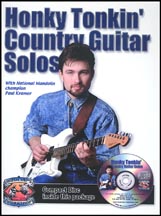
HONKY TONKIN' COUNTRY GUITAR SOLOS, Paul Kramer. CD TABLATURE

HONKY TONKIN' COUNTRY GUITAR SOLOS, Paul Kramer. CD TAB.

Demonstrates and explains how to get the sounds of today's great country pickers. Each solo is full of great licks you can use to build your own solos. Covers 10 tunes, each played once at full-speed, then at slow speed, followed by a phrase-by-phrase lesson. Songs include "Pick Me Up On Your Way Down," "Let It Roll," "Heartbroke," "Ramblin' Fever," "Highway 40 Blues," "Roll in My Sweet Baby's Arms," more. Tab book with CD.

Contents:
Ramblin' Fever
Pick Me Up On Your Way Down
Heartbroke
Two More Bottles of Wine
My Window Faces South
The Race Is On
Roll In My Sweet Baby's Arms
Let It Roll
Highway 40 Blues
I Think I'll Just Stay Here & Drink

Prezzo: €18,00
€18,00

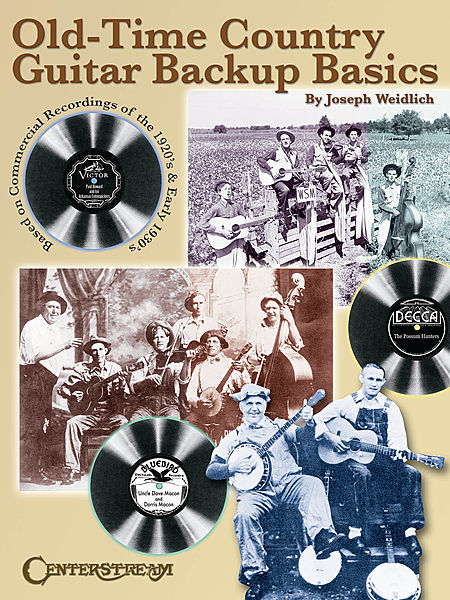
OLD TIME COUNTRY GUITAR BACKUP BASICS, Joseph Weidlich. Hal Leonard TABLATURE

OLD TIME COUNTRY GUITAR BACKUP BASICS, Joseph Weidlich. Based on commercial recordings of the 1920's & early 1930's. TABLATURE
 

Old Time Country Guitar Backup Basics
Series: Guitar
Publisher: Centerstream Publications
Author: Joseph Weidlich

This instructional book uses commercial recordings from 70 different “sides” from the 1920s and early 1930s as its basis to learn the principal guitar backup techniques commonly used in old-time country music. Topics covered include: boom-chick patterns • bass runs • uses of the pentatonic scale • rhythmic variations • minor chromatic nuances • the use of chromatic passing tones • licks based on chords or chord progressions • and more.

Inventory #HL 00000389
ISBN: 9781574241488
UPC: 073999501247
Width: 9.0"
Length: 12.0"
84 pages

In the rural setting of the South the singing of old songs was often unaccompanied. When music was played away from the home it tended to be for dancing or some kind of contest. The" core" instruments used were usually the fiddle and banjo, where the banjo "seconded" the fiddle. This style goes back to the early 19th century minstrel show [ca. 1843] whose standard instrumentation were the fiddle, banjo, bones and tambourine.

Fiddle. The principal instrument of the old-time music genre was the fiddle, seemingly always the lead instrument. The fiddle served several functions: to provide dance music, to provide accompaniment to the voice, or solo fiddle music without a particular social function, e.g., for their own enjoyment. The fiddle was particularly important in accompanying vocal music as it could be used to imitate, i.e., "double" the vocal line, thereby reinforcing the primary contours of the melody or to provide ornamentation, based on the melodic line. As the melodies of the songs became simpler, in the sense of using less vocal ornamentation, the fiddle style likewise became simpler. This transition was aided by the addition of the banjo and guitar, which provided additional decorative elements, thus freeing the fiddle to focus primarily on lead melodic functions.

Banjo. Besides the fiddle, the mountain banjo was the most important ensemble instrument, as it was used to reinforce the main notes of the melodies played by the fiddle. The banjo introduced a steady, strong rhythm to maintain the beat, so important when playing for dances. In fact, the clawhammer banjo style, in particular, was, and still is, highly regarded for this role. While the 19th century minstrel banjoists traditionally used two basic tunings (what today would be equivalent to the natural C tuning and open G tuning) an interesting feature of the Southern mountain banjo was the development of several additional tunings to suit the modal character of the traditional melodies being sung and played. Scholars seem to think that these systems of altered tunings HLP 8005 may have been worked out by the turn of the 19th century, perhaps influenced by open guitar tunings needed for playing certain parlor guitar songs (e.g., the Spanish fandango) and the beginning of the African-American blues guitar styles. These modal melodies would then be accompanied on the banjo so that the principal melodic notes could be played without the need to play harmonic chords or shift up and down the fingerboard, whose chord voicings would not be practical most of the time playing in these altered tunings (the newly introduced guitar would now supply this harmonic accompaniment). Occasionally, the banjo was used as a solo instrument on early commercial recordings (e.g., by Charlie Poole using fingerstyle techniques); however, its usual role was to support the fiddler. Guitar. While guitars had been available in the United States for most of the 19th century, principally in urban industrialized areas, e.g., by c.P. Martin, Ashborn, 55. Stewart, and Washburn, by the end of that century guitars were beginning to become available in even greater numbers, aided in part by a much improved mass transportation system, the advent of the industrial revolution, and mail-order houses like Sears Roebuck. In the last decade of that century the guitar was gaining rapidly in mass popularity due to its usage in mandolin bands, glee clubs, and university banjo bands, thus not just for use in its traditional 19th century environment, the parlor.

String Bands. From the 1920s, with the introduction of the guitar into the string band ensemble, the emphasis, at least in terms of recording, shifted from providing music for dances to the accompaniment of vocal songs and fiddle tunes. That necessarily changed the function of the string band instruments, freeing up the ensemble for various duties. The guitar was now used to mark out the...


TABLE OF CONTENTS
Biography .
A Brief Introduction To "Old-Time Music" .
Introduction to Old-Time Country Guitar Backup Basics .
 
PART ONE: BACKUP BASICS .
Lesson 1 Boom-Chick Patterns .
Lesson 2 Alternating Between Root and Fifth of a Chord .
Lesson 3 6-7-8 Bass Run Connectors .
Lesson 4 Golden Age Lick ,
Lesson 5 Third of the Chord in Back-Ups .
Lesson 6 3-2-1 Bass Run Connector .
Lesson 7 Pentatonic Scale .
Lesson 8 Ascending and Descending Triad Usage .
Lesson 9 Reinforce Melodic Line .
Lesson 10 Scales .
Lesson 11 Chord Progression Lick .
Lesson 12 5-6-7-8Bass Run Connector .
Lesson 13 Varied Golden Age Lick .
Lesson 14 Leading Tone Usage .
Lesson 15 Concluding Thoughts .
 
PART TWO: .
Variations On Backup Basics
Transcribed from Commercial Recordings of the 1920s and Early 1930s
Epilogue.
Song Reference List .
Prezzo: €16,99
€16,99

RAGTIME GUITAR 14 Songs Arranged for Solo-Entertainer CD LIBRO TABLATURE SPARTITI CHITARRA

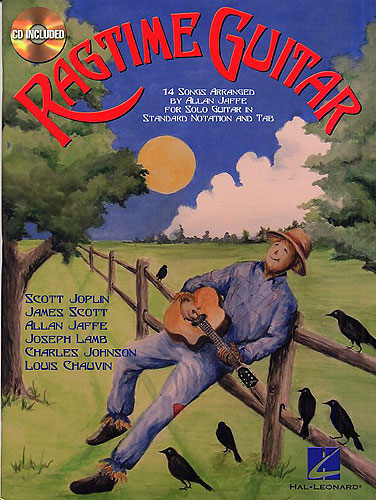
RAGTIME GUITAR, 14 Songs Arranged for Solo Guitar. Allan Jaffe. BOOK WITH CD & TABLATURE

LIBRO DI MUSICA RAGTIME CON CD.

SPARTITI PER CHITARRA CON:

ACCORDI, PENTAGRAMMA E TABLATURE. 

14 Songs Arranged for Solo Guitar

Series: Guitar Solo
Softcover with CD - TAB
Arranger: Allan Jaffe

14 of Jaffe's fingerstyle arrangements of ragtime favorites and originals in standard notation and tablature with accompanying CD, 80 pages

"As a musical entity ragtime was, and is an instrumental work in 2/4 time composed for the piano that combines a syncopated series of melodies accompanied by an even, steady rhythm."-David A. Jasen and Trebor J. Tichener, Rags and Ragtime. In the first twenty years of the 20th century, an unprecedented phenomenon erupted into the world of Western music. For the first time, a form of popular music which was a true fusion of African-American and Western European musical traditions emerged. Although it began as an oral form played by pianists in the bars and brothels of several major American cities, thanks to the publishing houses, it quickly spread through the United States and eventually Europe. Unlike any other music up until then, this music was completely biracial. Everyone called it "ragtime." In an era before the age of radio and recording, the only way for music to reach the public, aside from the concert hall, was through sheet music. Many homes in the United States had their own pianos, and at least one family member was able to play this instrument, albeit often in a rudimentary fashion. Apart from the classical repertoire, most pianists favored versions of popular songs of the day, notated with a very simple accompaniment. Although ragtime challenged the skill levels of the average amateur pianist, Americans quickly succumbed to the new and unusual syncopations. The music became so popular that schools sprouted up around the country specifically for the purpose of teaching the lay-person how to play this strange and seductive music. The original creators and developers of ragtime were the great ragtime pianists and composers of the period, the three acknowledged masters of the classic rag being Scott Joplin, James Scott, and Joseph Lamb. Eventually the Tin Pan Alley composers, the pop songwriters of the day, recognized the commercial potential of this form and began cranking out ragtime pieces by the score. By the end of the 1920s, over five thousand ragtime works had been published. Possibly due to this rampant commercialization, the quality of the music degenerated and eventually ragtime disappeared from public favor until it was revived as a repertoire form years later. During the twenty or so years of ragtime's heyday, many wonderful pieces of music were born from the pens of its finest composers. Along with the works of the above-mentioned masters, one can find a wonderful assortment of music by other great ragtime artists, such as Tom Turpin, Charlie Hunter, Charles Johnson, and Artie Matthews, among others. Ragtime displayed great melodic, harmonic, and rhythmic invention; each piece possessed its own clear emotional impact. When I was asked by Hal Leonard Publications to do a book of rags for the guitar, comprising eleven arrangements of classic rags and three of my own, I had little idea of the rich musical world I was about to enter. Over the past ten years I had been writing my own guitar rags, originally inspired by the work of the three great blues guitarists, Mississippi John Hurt, Reverend Gary Davis, and Arthur "Blind" Blake. However, apart from Scott Joplin's compositions, I was unaware of the richness of this musical period. Thanks to two excellent literary sources, Rags and Ragtime by David A. Jasen and Trebor J. Tichener and They All Played Ragtime by Rudi Blesh and Harriet Janis, plus the multitude of websites dedicated to ragtime, I steeped myself in this music. Eventually, I chose eleven pieces which I felt were some of the best and most important works of ragtime's great composers. As the statement quoted at the beginning of this intro shows, ragtime has always been associated with the solo piano. In talking with people about this project I often heard the same response, "I have never heard ragtime played on the guitar." Indeed, most of the guitar music that has been called "ragtime" comes from the blues and is associated with the works of blues, folk, or country artists such as Gary Davis, Doc Watson, or Dave Van Ronk. On the surface, this seems to be a far cry from the classical-sounding solo piano compositions of Joplin or Lamb. But in fact, the music produced by these artists all share a syncopated melodic line superimposed on a steady bassaccompaniment figure. I found that with the appropriate key changes this music adapted well to the guitar. The rhythmic, melodic, and multi-timbral nature of the guitar makes it an excellent medium for ragtime. Of course there are challenges. Since this music was developed by pianists for pianists-with thick chords, big octave leaps, and bass lines moving in contrary motion to the melodies-there are few major inherent technical difficulties when played on the piano. This is a different story on the guitar. However, through a process of distillation, careful key selection, register changes, and liberal use of open strings, I was able to create versions of these pieces that retain the lyrical, harmonic, and rhythmic richness of the originals, while acquiring through the translation process a character of their own. The result, I believe, is guitar pieces that are a joy to learn and play.

The Entertainer - Scott Joplin (1902)

Marvin Hamlisch's adaptation of this rag for the movie, The Sting in 1976, was responsible for bringing the music of Scott Joplin and ragtime back to the attention of the public. It was originally dedicated to the vaudeville entertainer, James Brown, and, although I was unable to get any information about this person, in arranging it I had in mind an elegant "soft-shoe" performer. In order to bring out the beautiful melodies I have decided on a slower tempo for this tune.

Maple Leaf Rag - Scott Joplin (1899)

A fitting end to one century and beginning to the next, the publication of "Maple Leaf Rag" by publisher John Stark marks the emergence of ragtime as a popular musical form. By 1909 it had sold over a half-million copies. To the aspiring ragtime composer "Maple Leaf" became the model for this relatively new form of music. My version diverges from Joplin's original in two ways: 1. I have chosen to swing it, and 2. I have left out the standard repetition of the A section after the B section.

Heliotrope Bouquet - Scott Joplin and Louis Chauvin (1907)

This beautifully lyrical piece was a collaboration between Joplin and the legendary genius Louis Chauvin. As Chauvin's music had not previously appeared in print, Joplin suggested that in order for him to get his first publication, they should collaborate on this one. The A and B sections were written by Chauvin, the last two by Joplin. One can get some insight into Chauvin's unusual harmonic sense from the haunting A section.

Frog Legs Rag - James Scott (1906)

Scott is the forgotten genius of ragtime. This tune was his first publication and it was an immediate success. Although the B section is reminiscent of "Maple Leaf," we become aware of Scott's considerable originality throughout. The entire piece dances and is, I believe, an imaginative depiction of the movement of the appendages for which it is named. The D section, with James Scott's characteristic "octave echo," is a challenge technically on the guitar, but I have suggested a fingering which makes it a joy to play.

Grace and Beauty - James Scott (1909)

For me, this is the most lyrical and unusual of the James Scott rags. Scott was known to be the most adept pianist of the major three rag composers, and this is one of his most pianistic, using his characteristic octave leaps and arpeggiated "rips." Consequently, in order to make my arrangement "guitaristic" I have taken some liberties with the melody and bass lines.

Sunburst Rag - James Scott (1909)

This is a joyful and exuberant statement by Scott. Scott's rhythmic clarity and variety is apparent in this composition from one section to the next. The C section, which I find to be a wonderful workout for the left hand, seems to have been echoed, whether consciously or unconsciously, about sixty years later in Herb Alpert's "Spanish Flea." This work is beautifully structured, with the B section reappearing at the end, transformed by its modulation up a fourth.

American Beauty Rag - Joseph Lamb (1913)

This is one of the two rags I have arranged in "dropped D" tuning and is a beautiful, and at the same time, revolutionary work. The first two sections here are yet another example of Lamb's extraordinary lyricism and gift for long, arching melodies. Yet midway through this composition, beginning with the transition between Band C, Lamb takes quite a different direction. Suddenly the focus is on rhythm. The C section is remarkable in that, unlike any of the rags of this period, it seems to incorporate the "swing" rhythmic approach of jazz. Lamb notates the "swing" as a dotted eighth and sixteenth note rhythm and effectively alternates it with a straighteighth rhythm. Also unusual in this rag is the increasing intensity of the piece, beginning with the C section and continuing until the end.


1988 - Al's Slow Rag [Jaffe, Allan] 

1913 - American Beauty Rag [Lamb, Joseph] 

1911 - Barber Pole Rag [Johnson, Charles] 

1986 - Delta Rag [Jaffe, Allan] 

1906 - Dill Pickles [Johnson, Charles] 

1906 - Frog Legs Rag [Scott, James] 

1909  - Grace And Beauty [Scott, James] 

1907 - Heliotrope Bouquet [Joplin, Scott] [Chauvin, Louis] 

1990 - Joplin Rag [Jaffe, Allan] 

1899 - Maple Leaf Rag [Joplin, Scott] 

1915 - Ragtime Nightingale [Lamb, Joseph] 

1909 - Sunburst Rag [Scott, James] 

1902 - The Entertainer [Joplin, Scott] 

1916 - Top Liner Rag [Lamb, Joseph]

Prezzo: €32,99
€32,99
Condividi contenuti