GUITAR MAKING

ACOUSTIC GUITAR OWNER'S MANUAL THE COMPLETE GUIDE magazine CHITARRA SPARTITI LIBRO

ACOUSTIC GUITAR OWNER'S MANUAL, THE COMPLETE GUIDE. acoustic guitar magazine guides. An acoustic guitar primer, inside your guitar, fifteen guitar myths debunked, a guide to steel and nylon strings: comparing broze strings, typical string gauges, nylon string tension, stringing a classical with steel, when to change strings, tuning up, sticking bridge pins, resonator guitar strings. Guitar care basics, cleaning and polishing: cleaning a resonator guitar.Humidity and your guitar, choosing a case, flying with your guitar, protecting your instrument from theft, getting a good guitar setup, setting the action, saddle and bridge pin materials, fret maintenance, refretting, caring for your guitar's finish, fixing rattles, when guitars crack, bridge repairs, neck resets, reparing and restoring vintage instruments, installing and troubleshooting pickups. 110 pages

Price: €23,99
€23,99

ELECTRIC GUITAR CONSTRUCTION A Guide for the First-Time Builder Tom Hirst LIBRO LIUTERIA CHITARRA

ELECTRIC GUITAR CONSTRUCTION. A Guide for the First-Time Builder, Tom Hirst. 168 pagine.
Electric Guitar Construction A Guide for the First-Time Builder. The definitive work on the design and construction of a solid body electric guitar.

Series: Guitar
Publisher: Centerstream Publications
Format: Softcover
Author: Tom Hirst


Q.: What on earth would make someone want to build an electric guitar from scratch? Can't you just buy one cheaper? A.: Well sure, but with this definitive book on the subject as your guide, you can create your own axe masterpiece, with the precise finish, the exact pickups, and the custom hardware you've always wanted. Plus, you'll have the indescribable satisfaction of knowing you created something cool out of nothing. And that sure beats buying off the rack! Organized logically from start to finish, this helpful guide will assist you every step of the way; from the design and planning stage to the final setup, each step in the process is written about in abundant detail, with hundreds of photographs, and special full-color sections on wood selection and finishing. Also includes a glossary of terms, an index of materials suppliers, and much more!

Inventory #HL 00000311
ISBN: 9781574241259
UPC: 073999648119
Width: 8.5"
Length: 11.0"
168 pages

What on Earth would make someone want to build an electric guitar from scratch? Can't you just buy one cheaper? What happens if it doesn't tum out? These questions and many many, more will be asked of you as you plow along through the excitement and anxity of building your first guitar. It does help if you're a little bit different and it's very true that it would be both faster and cheaper to just go buy one off the rack. But it wouldn't be the same one would it? Its fairly safe to assume that spending some time on this project will not be a problem for you. If you need an axe for a gig this weekend you're in the wrong place. You're going to have an investment of approximately $500 in your instrument and there are lots of $500 guitars out there, but how many will have the exact Seymour Duncan or EMG pickups and cusm tom deigned switching you want, the Schaller hard- ware and custom finish; yours will. Your guitar will also have that intangible, indescribable feeling that comes from creating something out of, well I can't say nothing, but you get the picture. Friends and relatives will say you're nuts and that you're wasting your time and money and then they'll want you to build them one too. I started building guitars almost by accident. I wanted a Fender Telecaster so badly, but I just couldn't come up with the money to buy one. I was hanging around in my favorite guitar store one day just being a nuisance when a guy came in with a box of guitar parts. He had a neck, a plywood Tele style body, and two of almost everything else; two pickguards, sets of pickups, bridges, etc. He had taken an el cheapo copy guitar and tried to upgrade it with new parts but nothing had fit where it was supposed to go and he was trying to trade the whole mess in on a new guitar. When the store told him they wouldn't take any of it in trade he asked them where the dumpster was. I politely showed him to the hatchback of my little station wagon and I had my Tele. All I had to do was re-assemble it and make it work. I did, and it did, and I was hooked. A short time later I was reading an article in Guitar Player on hot-rodding guitars and "kit" guitars.

First connect each pickup directly to the jack. Use temporary connections like alligator clips for this. They'll hum a bit for lack of shielding but will tell you if the parts are working right. Remember this technique is for problems with pickups and switches not working, and not for chasing down hum. After you've determined that each pickup works, you can connect them to the next item in the chain. This could be a volume pot, mini toggle switch or the main pickup selector depending on your design. Test the circuit after each part is added to the chain and sooner or later you will run into the problem again, only now you know exactly where it is and you can deal with it specifically. The wiring is complete and I'm tightening in the Electrosocket jack plate. "good solder joint/ bad solder joint" drawings. These can short out against other components or against the shield and cause the switch not to work as expected. in connecting your hot leads. Check your plan and your connections care- full y. Look for stray strands of wire that may not have gone through the solder terminal cleanly as was shown in the I like to plug the guitar in and give it a test before I secure the output jack and the rear cover plate. I have found, on occasion, that the guitar works fine in the test but not after the remaining parts are fastened in place. This can be the result of a wire or component shorting against the shielded cover of the electronics compartment. Sometimes the output jack won't fit well in the access hole when the plug is inserted. Most times this can be corrected by rotating the jack in the hole but I have had to take a 1/2 round file in there and open up the hole to get a good fit. This can be an extremely time consuming process and is not one to undertake when you're in a hurry or a bad mood. If you get frustrated with trying to solve a particular problem, take a break. Let it sit for awhile and come back when you are rested and in a better frame of mind. Remember, this guitar has taken a long time to get to this point and you didn't get here by rushing through all the previous steps. Take your time, be thorough and methodical and you'll find the guilty part(y). Using a mini chisel to clear away excess lacquer from the control cover "lip". There are times when all these good ideas fail and things still just don't work right. This can be a frus- trating time and lots of folks will simply take every- thing apart and try re-wiring it from scratch. Some- times this works, but more often you fall into the same rut and make the same mistake you did originally. My approach in these cases is to re-wire just as you did the drawing; from the pickup on down the line. Well now you have it wired tested and ready to rock. You can go ahead and put the rear cavity cover in place (if you've used one) and screw it down. From here we move on to the fi- nal set up adjust- ments. Wired, tested and ready for the final set up.

Electric Guitar Construction;

A Guide for the First Time

Table of contents:
Introduction:

1. Design:
D-I The importance of planning
D-2 Wood selection
D-3 Neck design
D-4 Body design
D-5 Color selection and hardware
D-6 Electronics
D-7 Pickguard design
D-8 What to buy and when to buy it..

2. Tools and Templates:
T-I List of tools
T-2 Power and hand tool safety
T-3 About templates
T-4 Headstock template
T-5 Body template
T-6 Pickguard and rear cover templates .
T-7 Optional templates .
T-8 Neck profile gauges
T-9 Fretboard radius gauge

3. Neck:
-1 Neck layout .
-2 Truss rod channel
-3 Mark and cut fretboard to length
N-4 Fretboard inlay
N-5 Assemble neck
N-6 Rough cut neck shape
-7 Tuning machine holes
-8 Side dots and rough sanding
-9 Sand inlay
I -10 Install fretwire
-11 Shape neck
-12 Finish sand neck

4. Body:
B-1 The body blank
B-2 Neck pocket
B-3 Necklbody axis
B-4 Bridge placement
B-5 Pickup placement and routing
B-6 Control cavity layout
B-7 Rough cut shape
B-8 Rear cavity rout
B-9 Sand body edges
B-1O Rout body edges
B-Il Input jack, strap buttons & wiring channels
B-12 Finish sand body

5. Plastics:
P-I Mark centerline and outline
P-2 Rough cut shape
P-3 Final fit rear cover
P-4 Rout edges (straight bit)
P-5 Bevel edges
P-6 Rout pickup openings
P-7 Drill mounting screw & control holes

6. Finishing:
F-l About finishing
F-2 Spray equipment
F-3 Clear finishes
F-4 Grain filler
F-5 Applying color
F-6 Applying clear coats
F-7 Wet-Sanding and Buffing
F-8 Finishing schedules

7. Assembly:
A-I Final fretwork
A-2 Rough shape the nut
A-3 Install the hardware
A-4 Neck to body assembly

8. Wiring:
W-I My method
W-2 Equipment and soldering
W-3 Shielding
W-4 Pickups
W-5 Mini switches
W-6 Pickup selectors
W-7 Pots and capacitors
W-8 The output jack
W-9 The complete diagram
W-IOTroubleshooting

9. Set up:
S-l What is a set up?
S-2 Slotting the nut
S-3 Adjusting the truss rod
S-4 Setting string height..
S-5 Setting intonation
S-6 Final adjustments

10. Cost Analysis for this guitar:
11. Index of Suppliers:
12. Glossary:
13. Index:  

Price: €99,99
€99,99

CONSTRUCTING A SOLID-BODY GUITAR A COMPLETE TECHNICAL GUIDE-ROGER H. SIMINOFF LIUTERIA LIBRO

CONSTRUCTING A SOLID-BODY GUITAR, ROGER H. Siminoff. Guida tecnica completa curata nei minimi particolari per la costruzione di una chitarra elettrica solid-body. I vari tipi di legno, il manico, la tastiera, il corpo, la posizione dei pickup, l'assemblaggio delle diverse parti, fino al colore e alla verniciatura. Il tutto illustrato da oltre 150 fotografie. Contiene anche un progetto pronto per essere realizzato a grandezza naturale. In inglese.

Whether you're a musician or a woodworking enthusiast, you'll thoroughly enjoy Roger Siminoff's book, Constructing A Solid Body Guitar. This 64-page manual uses over 150 photos, several illustrations and four life-size blueprints to assist the reader in choosing the proper materials and tools, as well as using the correct skills and techniques to produce a beautiful handmade instrment that doesn't look handmade at all! Plastic-comb bound.

Price: €69,99
€69,99

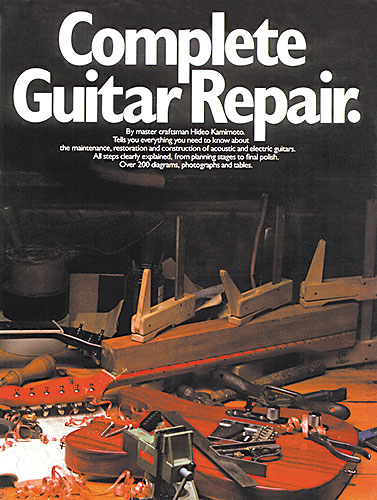
COMPLETE GUITAR REPAIR HIDEO KAMIMOTO-LIBRO-RIPARAZIONE-COSTRUZIONE-CHITARRA-

COMPLETE GUITAR REPAIR, KAMIMOTO.

Master craftsman tells you everythung you need to know about the maintenance, restoration and construction of acoustic and electric guitars. all steps cleary explained, from planning stages to final polish. Over 200 diagrams, photographs and tables.

Length: 160 pages
Language: English

Price: €34,99
€34,99

GUITAR PLAYER REPAIR GUIDE LIBRO MANUALE RIPARAZIONE CHITARRA ELETTRICA ACUSTICA

GUITAR PLAYER REPAIR GUIDE. D. Erlewine. 300 Pagine di consigli per la riparazione, mantenimento, accorgimenti, direttamente dai più noti liutai. Dalla corretta sostituzione delle corde (B.B. King usa avvolgere l'intera corda alle meccaniche) alle verniciature, con riferimenti in micron alle chitarre di Eric Clapton S.R.V. e tanti altri.

Price: €39,99
€39,99

HOW TO MAKE YOUR ELECTRIC GUITAR PLAY GREAT Dan Erlewine MANUAL LIBRO CHITARRA

HOW TO MAKE YOUR ELECTRIC GUITAR PLAY GREAT. Erlewine.

The Electric Guitar Owner's Manual
Series: Book
Publisher: Backbeat Books
Medium: Softcover
Author: Dan Erlewine

From shopping for a first electric guitar to setting customized action, this do-it-yourself player's primer for owning and maintaining an electric guitar explains the ins and outs of: choosing the right guitar; cleaning, tools and basic maintenance; personalizing and improving on a “factory setup”; trouble-shooting; basic guitar electronics; setups of the pros; and much more. Written by Dan Erlewine, author of the bestselling Guitar Player Repair Guide and the popular "Repairs" column in Guitar Player magazine, this book also includes a plastic sheet with specialized guitar tools you can snap-out! 138 pages.

Price: €31,99
€31,99

MAKE YOUR OWN ELECTRIC GUITAR, M. HISCOCK

MAKE YOUR OWN ELECTRIC GUITAR, MELVYN HISCOCK. Attenta analisi dei vari concetti di produzione delle industrie più prestigiose, con riferimento alle distanze tra la barrette di varie Gibson, Fender e Rickenbacker. Passo per passo le varie fasi della costruzione e un capitolo dedicato agli schemi dei circuiti elettrici. 220 pagine. In inglese.

Price: €25,00
€25,00

GUITARMAKING TRADITION AND TECHNOLOGY LIBRO LIUTERIA CHITARRA ACUSTICA CLASSICA COSTRUZIONE


GUITARMAKING: TRADITION AND TECHNOLOGY.

388 pagine illustrate, sulla costruzione e il design della chitarra folk e della chitarra classica.

Guitarmaking TRADITION AND TECHNOLOGY

A Complete Reference for the Design & Construction of the Steel·String Folk Guitar & the Classical Guitar

William R. Cumpiano and Jonathan D. Natelson
photographs by Clyde Herlitz / line dravvings by William R. Cumpiano

CHRONICLE BOOKS SAN FRANCISCO


LAYING OUT THE BRACING PATTERN

These depict the width of the cross struts. To denote the fan-brace locations, we now use as an inital reference the lower parallel line for the lower cross strut. Mark on that line, at intervals of 1/4 inches, three dots on both sides of the centerseam (that is, at1 1/4 inches, 2 ½ inches, and 3/4 inches from the seam). Next, measure ½ inches up the centerseam from the bottom of the outline, and make a dot. Using the ruler, find a point on the guitar outline that is 7 inches from that dot and draw a line connecting the two points. Repeat for the other side. These lines denote the bottom V of the bracing pattern. Measuring from the centerseam on each leg of the bottom V, mark dots at intervals of 2 inches. Connecting the six dots on the lower cross with the Six dots on the bottom V completes the fanbrace layout. The rosette grafts are laid out by drawing lines tangential to the soundhole and square to the cross struts, and then drawing parallel lines I inch from each tangent. To denote the finger braces, mark a dot on the upper parallel line of the lower cross strut % inch from the outer edge of each rosette graft. Then mark a dot on the lower parallel line of the upper cross strutI ½ inches from the outer edges of the rosette grafts, and connect the dots. Measure 1 ¼ inches up along the centerseam from the upper cross strut and draw a line perpendicular to the seam. Draw a parallel line 5/16 inch further up. These lines denote the upper transverse bar. Next, draw two vertical lines connecting the upper transverse bar with the upper cross strut, each 2 1/2 inches from the centerseam. These lines indicate the boundaries of the upper transverse graft. To locate the transverse bridge pad, mark from the top of the outline down the centerseam the distance from the twelfth fret to the saddle. For a 25.6-inch scale, that will be 12.8 inches plus .10 inch compensation, or 12.9 inches. Draw a line perpendicular to the centerseam at that point, and then parallel lines ¼ inch above andI inch below. The pad will actually be shaped as shown in Fig. 7-10 (scale drawings), but it will be positioned using the horizontal lines1 1 /4 inches apart. Finally, draw a line perpendicular to the centerseam tangent to the top of the outline. This will be a guideline for cutting off the top of the sound board squarely. Steel-string Bracing Layout The template outline and centerline have been marked on the undersurface of the soundboard. Refer to Fig. 7-10 (scale drawings) while reading the following steps. The headblock is represented by a 2 x 2l /2-inch rectangle, which is located at the upper center of the template outline. Draft the rectangle so that it is bisected by the sound board centerline. The top line of the rectangle must be set back 3/32 inch from the template outline (the thickness of the sides) and accurately perpendicular to the centerline. The accuracy of this line is vital, since we will alig the actual headblock to it when it is glued to the soundboard. If the headblock is crooked, the neck will be also. The bridge outline must be drafted on the undersurface of the sound board. Refer to Chapter 15 to make a bridge outline template, and locate its outline as shown in the layout drawing in Chapter 3. The upper face brace is just above the soundhole. Its closest edge is1/4 inch above the soundhole rim. Draw two parallel lines1/2 inch apart, perpendicular to the centerline. Extend the lines till they reach the template outline. The upper face graft is between the head block and the upper face brace. Draw two parallel lines 7/8 inch apart, perpendicular to the centerline. Center them in the space allotted. Connect the ends with angled lines as shown. The X-brace is represented by two sets of two parallel lines 5/16 inch apart, which cross at the centerline. You may copy the splay of the X brace from the diagram, paying particular attention to the distance between the ends of ...


CONTENTS
PREFACE
CHAPTER 1 The Guitars Anatomy
CHAPTER 2 Materials & Tools
CHAPTER 3 Preparation & Planning
CHAPTER 4 The Neck & the Headpiece
CHAPTER 5 The Plates
CHAPTER 6 The Soundhole Rosette II
CHAPTER 7 Soundboard Bracing
CHAPTER 8 Side Bending
CHAPTER 9 Assembly I
CHAPTER 10 Assembly II
CHAPTER 11 Purf1ing & Binding
CHAPTER 12 The Fingerboard
CHAPTER 13 Final Carving & Finiting
CHAPTER 14 Finishing
CHAPTER 15 The Bridge & Pinning the Steel-String Neck
CHAPTER 16 Set-Up
AFTERWORD Troubleshooting & Guitar Care
BIBLIOGRAPHY
BILL OF MATERIALS
SOURCES OF GUlTARMAKING SUPPLIES
INDEX  

Price: €74,99
€74,99

MAKE YOUR OWN ELECTRIC GUITAR AND BASS WARING AND RAYMOND CHITARRA LIBRO LIUTERIA

MAKE YOUR OWN ELECTRIC GUITAR AND BASS. DENNIS WARING AND DAVID RAYMOND. Fotografie a colori. 96 pages.

These well-detailed instructions for building a standard 6-string solid-body model guitar and bass emphasize simplicity & logic, use common tools and easy-to-order materials, and provide resources for buying electronic components and other hardware. Pictures and diagrams abound. Both traditional and modern features crop up, making the finished product perfect for any genre of music. 96 pp.

A thorough step-by-step guide to making your own personal guitar or bass. Explains the proper tools needed and provides detailed instructions with full color photographs.

Price: €49,99
€49,99

MAKING AN ARCHTOP GUITAR Robert Benedetto Centerstream Publications LIBRO LIUTERIA CHITARRA

MAKING AN ARCHTOP GUITAR. R. Benedetto. 260 pagine.

Series: Guitar
Publisher: Centerstream Publications
Medium: Softcover
Author: Robert Benedetto

The definitive work on the design and construction of an acoustic archtop guitar by one of the most talented luthiers of the twentieth century. Benedetto walks the reader through all aspects of construction through to marketing your finished work. Includes a list of suppliers to acquire all the tools and materials listed; a list of serial numbers for Benedetto guitars; full-color plates featuring the author's models; photos from the author's personal scrapbook of players who endorse his guitars; and fold-out templates for construction. 8-1/2? x 11. 279 pages.

Price: €99,99
€99,99
Syndicate content