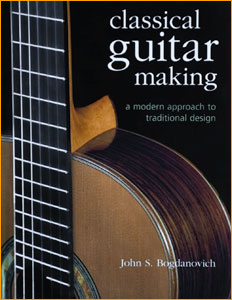
JOHN BOGDANOVICH, CLASSICAL GUITAR MAKING: A MODERN APPROACH TO TRADITIONAL DESIGN.
GUITAR BUILDING USES a combination of many talents and skills, including an eye for aesthetics, an ear for musical tone, woodworking ability, and an organized and methodical approach to the work. With diligence and practice, many of these assets can be developed and honed. Each of us also brings to this endeavor our own set of skills and experience. My own experience prior to building guitars proved to be a valuable asset in the pursuit of building the ultimate guitar. Initially, it was not my intention to make guitar building a career. Having returned to playing after an extended break, I was in need of a guitar but could not afford to purchase one that suited me, so I decided to try to build one myself. That first guitar turned out well and attracted a couple of local musicians to contract instruments from me. Guitar making felt so right that I put aside all other pursuits and earnestly began to make guitars professionally. A quest for purpose had ended and a new journey had begun. Before making guitars, there were a number of things that I felt passionate enough about to pursue, yet there would always seem to come a point where I would hit a wall and could go no further. Music became a big part of my life at the age of ten, and at twelve I took up the guitar. After high school, I majored in music at what is now part of The College of Staten Island. During this time, I was introduced to classical guitar and studied with Julio Prol in New York City. My intent was to become a performer, though I had difficulty performing in front of an audience. After having a few terrible experiences on stage, I realized that I needed to find something else to do, so I decided to follow another passion of mine, woodworking. As an apprentice cabinetmaker in a New York cabinet shop, I received a great woodworking education at the hands of a small group of old-world European craftsmen. Once my apprenticeship was completed, I decided go back to college rather than continue as a journeyman. I enrolled in the electrical engineering program at Pratt Institute in Brooklyn, New York. AT &T Bell Laboratories recruited me off-campus in my senior year to work in their research and development facility in Holmdel, New Jersey, where I was employed as a hardware designer. Taking part in their one-year on-campus graduate school program, I was able to get my master's ...
Recently I was informed by the publisher that the book has gone into second print, and this is rare for a book of this type. So thank you all once again for helping to make this book a resounding success. It is truly gratifying that I continue to hear from readers all over the world with thank you notes, encouraging comments and questions regarding the book. And, as one reader suggested I have included a page on the site with a selection of questions that have been sent to me, along with my replies, which may help to clarify some things for others in their guitar building attempts.
Since the book has been out I have heard from many of you that have sited errors or needed clarification in the first edition. These errors have been noted along with some additional text here and there for clarification and sent to the publisher for correction in the second printing. a PDF document containing all known errors can be downloaded in the errata section.
The book has been out for a couple of years now and it still amazes me how many of you out there are interested in building classical guitars, either for yourselves or in launching a guitar building career. The book has enabled me to launch a few new endeavors of my own such as holding classes in the shop, a line of guitar building products, and a DVD series due to be released in the fall. I am very fortunate that this has all come from my love of the classical guitar. The truth is, I never intended to write a book at all. The project just sort of fell into my lap.
In December, in the midst of planning to move the shop to Asheville, I was approached by Sterling Publishing and asked if I would like to write a book on guitar making. As I thought about it the prospect of undertaking such a huge project the challenge of producing something that I would be proud of became the focus of my enthusiasm. I had been given a rare opportunity - a vehicle to share my techniques and thoughts about something I love.
For the next year, nearly every day was a combination of building guitars, writing, and photo shoots. The book chronicles the building of a classical guitar from a stack of boards to putting on the strings and tuning it up. WIth almost 600 photos and drawings and over 300 pages of detailed text I attempted to recreate as accurately as possible the building process.
If you have never built a guitar and are planning your first attempt consider using this book as a guide. Only some basic woodworking skills and a minimally equipped shop are required. Due to the large amount of information necessary to cover the topic explanations of woodworking related techniques have been omitted and it is assumed the reader is already proficient in some basic woodworking techniques, or will consult the references listed in the bibliography of the book and in the reference section of the links page on this site. Alternative methods are presented to facilitate the availability of tools and equipment. The book was written with the first time builder in mind, but no doubt anyone with some building experience could benefit from some content, I know I am always looking for better ways to do things. Also, be sure to check out the guitar making classes being offered. Classes are being held in the shop that cover various aspects of the building process.
The guitar I am building in my shop today is very loosely based on the Hauser/Torres guitar design. The design has evolved in search of improved sound and playability. The plantilla is all that remains of the original 1937 Hauser from which this design began.
The sound of Segovia's 1937 Hauser always appealed to me, even with the less than ideal sound quality of the old recordings. Therefore, when I began making guitars I started trying to reproduce this sound with the Hauser/Torres design. The more conscious I became of the sound of the guitar in general, the more open I became to other influences and my concept for the ideal sound began to evolve and my design began to change. The design of my guitars has changed slowly over the years.
It is difficult at best to describe sound with words due to the fact that sound, and language, are both so subjective. So I will limit my words to those I typically hear other people use to describe the sound of my instruments. The phrase I hear most often is that they have a traditionally Spanish sound. I would not disagree with this statement. Additionally, they have character, a full tonal palette, and power. Enough said, I invite you to come and listen to one yourself.
Life as A luthier has been made possible for me only with the help of many people. First and foremost, I would like to thank my parents, Marion and Stan, for always supporting me, even when they may not have agreed with me. Without their support, none of this would have been possible. When I was a small boy, I had asked for a carpentry tool set long before it would be appropriate or safe for a child to play with. I was so insistent that my parents finally caved in and bought me one. While I was playing with the tools, set up under a tree in my grandparents' backyard, my grandfather watched from a window. Impressed with how intently I was able to amuse myself for such a long period of time, he told my mother, "That boy is going to do something with his hands." The time I spent in the Fine Woodworking Program at the College of the Redwoods actually changed my life. I was fortunate to have made some lifelong friends while at the school and will be forever indebted to the outstanding faculty. I would like to thank James Krenov, Jim Budlong, Michael Burns, and David Welter for their guidance, skill, and friendship, and for putting up with me during my time there. I would like to especially acknowledge James Krenov, whose book A Cabinetmaker's Notebook inspired me long ago, only to be eclipsed by later studying with him at the school. As one of his students, I could not help but admire his aesthetic, his approach to the craft, his keen observation of nature around him, and how all of this is evident in his work. I can only hope to follow his example. And thank you,]im, for your friendship. There are a few guitar builders who have both inspired and helped me in my journey as a luthier. I would like to thank Jeff Elliott, Cindy Burton, Greg Byers, John Gilbert, and Charles Fox for their generosity in sharing their knowledge of guitar building, and for their friendship. I would also like to thank the many guitarists who have provided feedback, which is invaluable to making a better instrument. In putting together this book, I called upon a few people to assist in one way or another. I would like to thank Cindy Park for all her help and support. She has helped with this project in more ways than she is probably aware of. I would like to thank Mariah Grant for doing a great job on the bulk of the photography. I would also like to thank Larry White at the University of North Carolina at Asheville for recommending her. In addition, I would like to thank Lacey Haslam and Franzi Charen for their help with the photography. And I would like to thank all the folks at Iris Photo/Graphic for keeping everything straight.
Contents
Acknowledgments
Foreword by James Krenov
Foreword by Jeffrey Van
Preface
Introduction
PART ONE—Preparation
CHAPTER 1. The Guitar
Anatomy of the Guitar
Sound
Choosing to Build or Buy
CHAPTER 2. The Wood
Types of Wood
Moisture Content
Cuts, Grain, and Selection
CHAPTER 3. The Shop
What You Need in Your Shop
Jigs You Will Need to Make
Hand Tools
Vises and Clamps
Bench Tools to Make
Specialty Items
Humidity Control
CHAPTER 4.
Templates and Molds
The Plantilla
A Transparent Template
Side Mold
Lining Mold
The Solera
Headpiece Template and Drilling Jig
Back Workboard
CHAPTER 5.
Layout and Planning
Choosing the Color and Design Scheme
Materials and Parts
Plans and Layout
PART TWO—Construction
CHAPTER 6. The Neck
The Neck Blank
The Headpiece
The Heel
CHAPTER 7. The Sides
Bending and Laminating the Sides
Linings
Assembling the Neck and Sides
CHAPTER 8. The Details
Bindings, Purflings, Back and Butt Strips
The Wheat Motif
CHAPTER 9. The Top
Selecting a Top 162
Jointing and Thicknessing
The Rosette
Bracing and Patches
CHAPTER 10. The Back
Jointing and Thicknessing
Bracing
CHAPTER 11.
Assembling the Body
Before Gluing on the Top
Gluing the Top
Preparing to Glue on the Back
Bindings and Purflings
Heel Cap and Butt Strip
CHAPTER 12.
The Fingerboard
Making and Installing the Fingerboard
Before Fretting
Fretting
Shaping the Neck
PART THREE—Final Touches
CHAPTER 13. Finishing
Understanding Finish
Final Touches and Prepping for
Finishing
French Polishing
Lacquering
CHAPTER 14. The Bridge
Bridge Design
Building the Bridge
Installing the Bridge
CHAPTER 15. The Setup
The Nut, Saddle, and Tuning Machines
Strings and Final Setup
Care of Your Guitar
The Gallery
Bibliography
Metric Equivalents
Index

 Italiano
 English