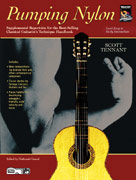
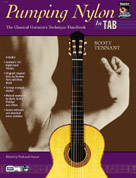
PUMPING NYLON, IN TAB. THE CLASSICAL GUITARIST'S TECHNIQUE HANDBOOK.
LIBRO PER CHITARRA CON TABLATURE
Manuale completo che comprende: i 120 studi per arpeggio di Giuliani, esercizi per di controllo della velocità, le scale, il tremolo, la tecnica del flamenco, il suono, le unghie della mano destra, con esempi da J.S. Bach. TABLATURE
Scott Tennant, world-class classical guitarist and well-respected guitar eduactor, has brought together the most comprehensive technique handbook for the classical guitarist. It is presented here in both standard music notation and TAB. In addition to technical information not available elsewhere, he has compiled selections from Giuliani's 120 Right-Hand Studies; musical examples by Bach, Turina, Rodrigo and others; Tarrega arpeggio studies; and original compositions by Andrew York and Brian Head. Essential information and a great sense of humor are effectively combined in this best-selling book.
Author Preface
Welcome! This is my little book about guitar technique. I want to make it clear from the start that the material in this book is meant to reflect my own way of doing things on the instrument. The exercises are those that have helped me, some of which I still practice every day.
The goal of Pumping Nylon is to offer ideas that will help solve various technical problems. The idea was to steer clear of assembling anything that resembled a method book. Rather, my intent was to focus only on specific technical issues which I felt had not been clearly explained elsewhere. Generally, the issues dealt with in this book are those that have been brought up time and time again by students in master classes and lessons over the past ten years or so.
The exercises and musical examples have been chosen because of their unique technical challenges. For instance, the Bach DOUBLE was taken from a solo guitar arrangement, stripped of all its bass notes and more comfortable fingerings, and transformed into a very effective string-crossing and scale study.
I don't pretend to have addressed every issue. (There are too many out there for one book!) The reader, however, is strongly encouraged to invent hislher own exercises whenever necessary, since all of our technical needs are so very different.
I hope you find a few answers to some of your questions. Go get 'em!
I would like to thank ...
Nat Gunod, for coaching me through this process for the last two years; Brian Head and Andy York for composing their wonderful "made-to-order" etudes; Billy Arcila for posing for the photos that were used to create the illustrations; Durmel DeLeon for the photography; John Dearman and Matt Greif for their technical assistance; an endless list of friends for their constant encouragement; and the students at the ational Guitar Summer Workshop, San Francisco Conservatory and the University of Southern California for being (not always voluntary) "guinea pigs" for much of the [I1aterial contained herein.
And special thanks to Ron Krown at Alfred Publishing for encouraging us to do this new edition.
Glossary of Signs
This list will help you to interpret the various markings in the music.
1, 2, 3, 4 Left hand fingers, numbered from index (1) to pinky (4).
p, i; m, a, Right hand fIngers: p = thumb, i = index, m = middle, a= ring finger.
The six strings of the guitar, numbered from low E 6 to high E 0.
IV, V, VII etc Roman numerals. Here is a quick review of these symbols: 1=1, 11=2, III=3, IV =4,
V=5, V1=6, VII=7, VIII=8, IX=9, X=IO, XI=11 and XII=12.
BII4 The B indicates a barre. The Roman numeral indicates the fret to be barred, and
the small subscript arabic numeral indicates the number of strings to be barred.
So, this symbol would indicate to barre four strings at the second fret.
-1, -2, -3, -4 A dash in front of a fingering indicates a guide finger shif . A shift is a movement
from one position to another. is a finger that can be used just before
and just after a shift. For instance, if the 4th finger has been used to play G on the
J st string. 3rd fret, and then moves to play A on the 1st string, 5th fret, it will be
marked -4.
Editor Preface
I hope you will enjoy this new edition of Scott's gratifyingly popular book. As a response to public
demand, we are happy to provide a version of the book that includes tablature. Hopefully, this will make the book useful to more guitarists. After all, everyone who plays the guitar has something to gain from learning some c1assical guitar technique, and something to learn from a great teacher.
This book evolved from a warm-up routine and technical regimen that Scott Tennant began teaching and writing about several years ago. It is this daily warm-up that has inspired the whimsical title.
Pumping nylon. But in the following pages Scott has done far more than merely map out an exercise routine.
He has provided a wealth of technical information not readily available elsewhere. He has also compiled a variety of both well- and lesser-known technical exercises such as the 120 Right Hand Studie" of Mauro Giuliani and some arpeggio studies by Francesco Tarrega, and has offered some exercises of his own as well. It is also through Scott Tennant that four great new studies. two by Brian Head and two by Andrew York, have been written and published.
But I think he has done a lot more than even those things.
What students and teachers alike will find inPumping Nylon is a joyful attitude toward problem-solving on the classical guitar. There is an underlying message that says if you are willing and able to look at an issue from a different perspective, and if you can bring the same creative powers that you bring to your music-making to your technical work, you can overcome obstacles. Furthermore. there's no law that says it can't be fun.
Anyone who has studied classical guitar is going to hnd ,lOl/lethùl.9 in this book that directly contradicts what you have been taught-or what you teach-about ,1olllethùl.q. This is inevitable. But ifyou dismiss this work for that reason. you will be missing much. I encourage you to read ono Take a look at ali the ideas presented here by this great player and teacher. You will come away better for it.
I expect that for years to come it will be commonplace to hnd well-worn copies of this book in students' hands. I am sure that for Scott Tennant, as for myself, that will be the biggest reward for this efrort.
Many thanks to the wonderful people at Alfred Publishing-especially the M.I. team-for helping to
make this and many other National Guitar Workshop books a reality.
Nathaniel Gunod Litchheld, Connecticut
July, 1997
How to Read Tablature
4th string,5th fret
An open C chord
T
A
B
An H over a slur - indicates a hammer-on.
A P over a slur - indicates a pull-off.
1st stringo 10th Fret ] __Played together
2nd string, l0th fret
Nathaniel Gunod has edited many guitar books including
Benjamin Verdery's by Howard \Vallach, and Play AIM. co-authored Benjamin Verdery's
instructional directed the video, is the author of Cla. Guitar. A recital·ist on Baroque. Classical period and modern c1assical guitars, he has taught students from ali over the world at the Peabody Conservatory of Music and the National Guitar Workshop. where he is Associate Director.
He is the founder of the NGSW Classical Guitar Seminar and the D'Addario Guitar Concerto Competition. Preface
Inspiration
Inspiration only lasts a relatively brief time. We alI eventually fìnd ourselves experiencing a "dry spell."
We get stuck on something in our practicing and can't seem to improve, and sometimes it may seem that we're getting worse. At times we may even think of just quitting. Have you ever felt that the joy you once had for playing is gone forever?
These are not emotions you're experiencing alone. They visit everyone now and then. OccasionalIy we need to give ourselves a break and put down the guitar for a day, a few days, or however long it takes to feel refreshed again. For those who play for a living and don't always have that luxury, some digging back into one's past might be the key. Why did you want to play the guitar in the fìrst piace? Try to recall the feelings you experienced when you fìrst decided that you really wanted to play. Perhaps recall the joy you felt when you heard that fìrst recording or concert that thrilled you. What qualities about the instrument first drew you to it?
As I have done for several circumstances in my life, it may make you feel better to jot down a few of these positive thoughts on a piece of papero Then, when you hit another rough period, you can read through them.
In Conclusion
Music is the most powerful of ali the arts. It instantly stirs up emotions, conjures visions, and offers
glimpses of other, higher dimensions. It arouses men to battle; kindles amorous passions in lovers; soothes a baby to sleep; comforts us when we grieve. It engages our hearts and our minds, and can bring out the best that we are. One can safely presume that not a single emotion, nor any human or natural event, has been left undocumented by music.
As musicians, our objective is to command the elements of music as best we can in order to tap into that other dimensiono It is our access into heaven, if only for a while. But while we are there we can take aH who are listening ith uso If just one person is uplifted by our playing and walks away feeling better than before he carne, we have made a difference. A healing has taken piace.
I very much hope that you have found at least one thing in this book that has helped you. I also hope that, as you work to improve your technique, you do not lose sight of the larger goals: to be able to express yourself freely on your instrument and to turn every note you play into great music. When you can do those things, you cease to be just a guitar player and become a healer and magician.
Table of Contents
Author' s Preface
Glossary of Signs
Editor' s Preface
How to Read Tablature
Some Do's and Don'ts
About the Hands
About the Body
About Holding the Guitar- The Triangle
The Left Hand
Finger Placement and Accuracy
Pressure and Release
Pressure/Release Exercise
Finger Exchange
Ascending Slurs (Hammer-ons)
Descending Slurs (Pull-offs)
Finger lndependence
#3 - Opposing Motion
#4 - Horizontal Character Builders
#5 - Odair's Favorite Drill
#6 - "The Spider"
The Barre
Weight vs. Pressure
Being Selective
Summing It AlI Up
Quadrivial quadrary by Andrew York -
A Four-Voice Study for the Left Hand :
Fanfare by Brian Head-A Slur Study
The Right Hand
Tone Production
Nail Length and Shape :
Nail Length
Nail rypes
Shaping the Nails
Angle and Placement
Rest Stroke (Apoyando)
Position
The Movement
Planting
Press ure
Release
Free Stroke (Tirando)
Right-Hand Finger lndependence
Walking
Arpeggios from Tarrega's The Complete TechnicaL Studies
The Thumb
Shaping the Nail
Develop That Thumb!
Flamenco Techniques .
What Else Can the Thumb Do? .
Sofeare. Falseta ,
Alzapua .
Alzapua Falseta ,
Rasgueados .
Some Practical Applications .
from Turina's Sevillana .
from Turina's Rafaga .
from Rodrigo's Conciato de Aranjuez, 2nd Movement .
Daily Warm-Up Routine .
Left-Hand Walking-#l, #2 & #3 .
Ascending Slurs - #4 .
Descending Slurs - #5 .
Triplets - #6 .
Fixed-Finger Exercises-#7 & #8 .
Right-Hand Walking - #9 .
Two-Finger Rasgueados-#10 .
Tremolo .
Psychological Outlook
Exercises .
Lopsided Tremolos .
Chant by Brian Head: A Tremolo Study .
Scales: Control and Velocity .
Misconceptions about speed .
Right-Hand Velocity .
Synchronization .
String Crossing .
Piecing Things Together .
Some Other Speed Aids .
Rhythmic Variations .
Speed Bursts .
Problem Solving in Scales .
Marking String Crossings .
Evolution of a Scale .
Scale Study - Double from the Courante, Partita No.1, BWV 1002, Johann Sebastian Bach .
Arpeggios .
Full Planting and Sequential Planting .
Giuliani's 120 Right-Hand Studies .
Practicing Tips .
Didactic Doodle by Andrew York .
Afterword .
Performance Anxiety .
Practice
Inspiration
In Conclusion
Scott Tennant .

 Italiano
 English