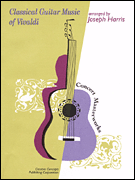
VIVALDI, CLASSICAL GUITAR MUSIC OF. SHEET MUSIC BOOK WITH GUITAR TABLATURE.
CONCERT MASTERWORKS
Classical Guitar Music of Vivaldi
Series: Creative Concepts Publishing
Publisher: Creative Concepts TAB
Artist: Antonio Vivaldi
Arranger: Joseph Harris
Features 31 pieces by Antonio Vivaldi arranged for solo guitar with tablature. Includes historical notes, performance suggestions, explanation of ornaments, and more.
Inventory #HL 00315187
ISBN: 9781569221945
UPC: 073999158755
Publisher Code: 074090
Width: 9.0"
Length: 12.0"
80 pages
About Classical Guitar Music Of Vivaldi - Guitar Solo
By Antonio Vivaldi (1678-1741), arranged by Joseph Harris. Guitar tablature songbook for guitar. 80 pages.
With standard guitar notation, guitar tablature, introductory text and instructional text. Baroque. 9x12 inches.
Features 31 pieces by Antonio Vivaldi arranged for solo guitar with tablature. Includes historical notes, performance suggestions, explanation of ornaments, and more.
For many years remembered only for his contribution of hundreds of violin concertos, Antonio Vivaldi is regarded today as a key musical figure of the Italian Baroque. Although his most visible and enduring influence was indeed in the development of the solo concerto, Vivaldi was also admired in his day as a composer of excellent chamber music, a stunning violinist and a popular composer of Italian opera. This composer of "The Four Seasons" was a bold and impetuous individual who managed to focus his musical impulses in a unique voice that was consistent yet expressive. Vivaldi was born in Venice in 1678 and trained for the priesthood, but ended up practicing this vocation for only a brief time. Vivaldi served for nearly forty years (from 1703 until just before his death in 1741) as musical director of the Conservatorio dell'Ospedale della Pieta, one of four girls' orphanages in Venice. The Ospedale provided outstanding musical instruction and under Vivaldi's direction created quite a musical sensation. Vivaldi's tasks at the Ospedale included teaching private lessons, composing music for both concerts and church services, repairing musical instruments and commissioning works from other composers for concerts at the Ospedale. Vivaldi was extremely prolific, composing over 50 operas, 90 sonatas and 450 concertos. Despite the apparent ease with which he could produce a composition (he once boasted he could compose a piece faster than it could be copied), Vivaldi is criticized sometimes for being too predictable. The twentieth century Italian composer Luigi Dallapiccola once asserted that Vivaldi did not compose 450 separate concertos, but wrote the same concerto 450 times. Whereas during the Baroque many musicians believed that the particular intent of a composition (church, chamber or theatre) should dictate its musical language, Vivaldi's style varied little between genres and even between mediums. His vocal music and instrumental music share similar musical characteristics, as do his sacred and secular works. Furthermore, Vivaldi's compositional style remained remarkably consistent throughout his career and evolved very little. The only major variances one finds are in surface details, such as melodic contour, which tended to reflect public tastes. However, it is a tribute to Vivaldi's skill as a composer that within such a limited musical vocabulary he exhibited a virtually inexhaustible variety of invention.
Sonatas for Violin, Op. 2
The 12 Sonatas for Violin, Op. 2 were Vivaldi's first solo sonatas. The Sonatas were published in Italy in 1709 and dedicated to Frederick IV of Denmark on the occasion of his visit to Venice. For the Sonatas, Vivaldi drew upon models of Arcangelo Corelli, a conservative Italian composer whose works are tidily constructed, yet highly expressive. Vivaldi's Sonatas are a composite of church and chamber styles, demonstrating his tendency to blur boundaries between genres. In the Sonatas, dance movements intermingle with abstract movements (those with only tempo designations). Baroque dances of the Italian variety differ considerably from their French or German equivalents. The slight differences in the names of dances (for example, compare the Italian giga to the French gigue) do not signify nationality only, but salient musical traits. Whereas the French gigue is a lively, bouncy dance in an imitative texture, the Italian giga has a more restrained sense of pulse, a less rhythmically active bass line and little or no imitation between voices. The Italian gavotta lacks the characteristic two upbeats and musette-like middle section of the French gavotte. The Italian corrente is faster and more "running" in character than the French courante. Also, the French courante may emphasize dotted rhythms and an alternation between duple and triple meter, while the corrente is more rhythmically consistent and metrically stable.
Sonata No.3
In the Adagio (found on page 7), the bass line should be played with a warm tone, especially in areas where it is exposed (as in the opening and in measure 9). To achieve a warm tone on the guitar, play with the right hand close to the fretboard and strike the string with the side of the thumb, using as much flesh as possible. The Giga (found on page 8) should be played dynamically strong throughout and in a lightning fast tempo.
Sonata No.6
The Preludio (found on page 12) should sound very elegant and graceful. Exaggerate the dotted rhythms by playing the long notes longer and the short notes shorter. The Giga (found on page 16) should be played in a moderately fast tempo. Count two beats per measure, not four, to give the piece a stronger and more stable sense of forward motion
Sonata No.7
The tempo of the Corrente (found on page 19) should be very fast. However, in areas where the bass line becomes more active (especially in mm. 17-21), make sure that neither voice breaks down.
Sonata No.9
The Preludio (found on page 23) is an energetic and dramatic piece. The movement contains elements of a "learned" style, which show off a composer's contrapuntal skills. Be sure to emphasize the points of imitation (as in the first few measures).
Sonata No. 11
The abundance of syncopated rhythms presents an interesting technical problem for the solo performer in the Gavotta (found on page 28). In order toconvey the meter clearly, keep the tempo steady and count two beats per measure. Hold on to notes with the left hand for as long as possible before fingering new notes.
Sonatas for One or Two Violins, Ope 5
The Six Sonatas, Op. 5 were first published in 1716. By this time, Vivaldi had chosen a new publisher, Etienne Roger in Amsterdam. There were at least two significant reasons for the switch: superior printing methods and an increased demand for the music of Vivaldi and other Italians in northern Europe. The Sonatas, Op. 5 were actually engraved and published at Roger's own expense. Such a practice was quite rare in Vivaldi's time and testifies to his immense popularity.
Sonata No. 13
The Sarabanda (found on page 30) lacks the lasciviously strong accent on the second beat characteristic of the Spanish sarabande. Keep the tempo slow, the meter even and play with as much vibrato as possible. Sonata No. 14
For the Gavotta (found on page 32), the left-hand slurs (as in mm. 7-9 and 39-41) may require some extra attention during practice. Isolate each slur and treat it as a trilling exercise. Devote a few minutes each day to these passages until they sound crisp and clear.
Sonata No. 16
In the Preludio (found on page 35), exaggerate the dotted rhythms and apply vibrato liberally. Because of the slow tempo, it will be necessary to think ahead and be aware of the melody's direction and shape. At some point, you may want to do a simple phrase analysis of the Preludio. Break the piece into small phrases, study how they relate to one another and then group them into longer phrases. The longer the phrases you envision, the better the sense of forward motion you will convey.
Sonata No. 18
The Air-Minuet (found on page 38) demonstrates an ambiguity in Vivaldi's choice of titles for movements. The designation "Air" suggests the vocal-like quality of the melody. The piece is also an instrumental dance movement, containing the clear four-bar phrasing and clear cadences typical of a minuet. Overall, the piece should sound stately, yet singing.
II cimento dell'armonia e dell'inventione, Op. 8
The Concertos, Op. 8 were first published in 1725 and dedicated to the Bohemian Count Wenzeslaus von Morzin. The first four concertos are collectively known as "The Four Seasons." A significant feature in each of these concertos is the inclusion of an explanatory sonnet, each line of poetry corresponding to a particular passage in the music.
Il cimento dell'armonia e dell'invenzione, Op. 8
Pubblicati per la prima volta nel 1725, i primi 4 concerti sono conosciuti come "Le quattro stagioni".
TABLE OF CONTENTS:
Historical Notes & Performance Suggestions
Explanation of Ornaments
Adagio Sonata for Violin, Op. 2, No.3
Giga from Sonata for Violin, Ope 2, No. 3
Preludio from Sonata for Violin, Ope 2, No. 6
Giga from Sonata for Violin, Ope 2, No. 6
Corrente from Sonata for Violin, Ope 2, No. 7
Largo from Concerto for Flute, Op. 10, NO.3 (''il Gardellino") ,
Preludio from Sonata for Violin, Op. 2, No. 9 ,
Gavotta from Sonata for Violin, Ope 2, No. 11
Sarabanda from Sonata for Violin, Ope 5, No. 13
Gavotta from Sonata for Violin, Ope 5, No. 14 .
Preludio from Sonata for Violin, Ope 5, No. 16 .
Air-Menuet from Sonata for Two Violins, Op. 5, No. 18 .
Allegro non molto From the Four Seasons, Op. 8, NO.2 (Summer) .
Largo From The Four Seasons, Op. 8, NO.4 (Winter) .
Affettuoso From Sonata for Flute, RV 48 .
Allegro assai From Sonata for Flute, RV 48 .
Allegro Sonata for Flute, RV48 .
Preludio from Sonata for Flute, RV 49 .
Sarabanda from Sonata for Flute, RV 49 .
Siciliana from Sonata for Flute, RV 49 .
Preludio from Sonata for Recorder, RV 52 .
Allemanda from Sonata for Recorder, RV 52 .
Aria di Giga from Sonata for Recorder, RV 52 .
Largo from Concerto for Lute and Two Violins, RV93 .
Largo from Concerto for Flute and Oboe, RV95 ("La Pastorella") .
Andante from Concerto for Flute, RV429 .
Grave from Concerto for Violin and Organ, RV541 .
Allegro alla Francese Violin and Oboe, RV 543
Largo from Concerto for Oboe and Violin, RV 548 .
Largo from Concerto for Flute, Op. 10, No.4 .
Largo from Sonata for Musette, Vielle, Flute, Oboe or Violin, Op. 13, No.6
Catalog #07- 4090
ISBN# 1-56922-194-4
CREATIVE CONCEPTS PUBLISHING CORPORATION
Creative Concepts Publishing Corp.

 Italiano
 English