FLAMENCO

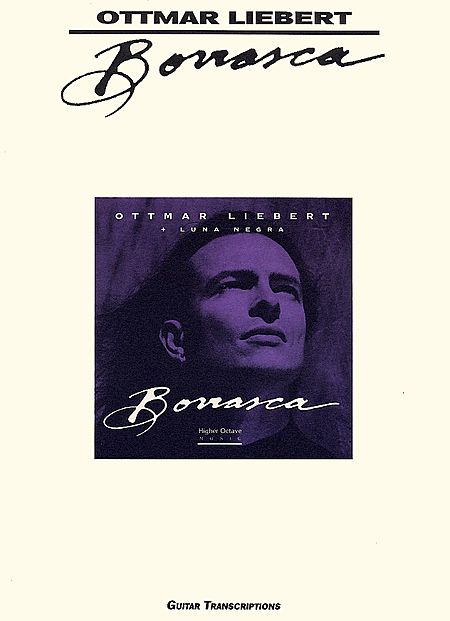
LIEBERT OTTMAR E LUNA NEGRA BORRASCA GUITAR TABLATURE BOOK CHITARRA SPARTITI LIBRO

LIEBERT OTTMAR E LUNA NEGRA, BORRASCA. TABLATURE

Series: Creative Concepts Publishing
Publisher: Creative Concepts TAB
Artist: Ottmar Liebert


On your early releases you overdubbed rhythm and lead parts. When
you began to tour, did you hire additional players for those parts?
I just did it by myself and kind of faked it. I also had a new percussionist
who was really hot, so it kind of worked. This year, to celebrate seven years
of Luna Negra [Ottmar's group], we plan to tour with a nine piece band that
will consist of three guitar players, three drummers, a horn section, and a
bass player. There are a lot of tunes from Borrasca [Lieben's sophomore
effort] that feature Rhumbas that shouldn't be faked.
You have a pretty respectable speed with your picking. Do you use a
pick, or is it always i,m (index and middle finger alternating)?
It is always i,m. The tremolo is i,m,a, with the first note of the triplets
starting with the a and the thumb. I only use a pick when I play live on the
electric; it is a pick made out of stone. I also use a sterling silver pick I
found at the Hard Rock Hotel in Las Vegas when we played there.
What did you do to build up speed and develop a smooth tremolo?
Well, the tremolo was more about reclaiming lost territory. When I was
a kid I spent countless hours reading and doing a tremolo at the same time.
The picato (i,a rest strokes) was just a matter of practicing. The picato was
easier than the rasqueados [the flamenco strums] because they are very
unnatural motions for the hands to make. I worked on them every day for a
couple of years. I recently had a studio musician in New York tell me about
several recordings by famous classical guitarists of Rodrigo's Concierto De
Aranjuez. These guitarists would keep a pick near their guitar for the passages
requiring the rasqueados, because they didn't have the technique. The first
time that Concierto was recorded correctly rhythmically was when Paco De
Lucia recorded it a few years ago. The slow movements are not as beautiful
as, say, Julian Bream's. I think this is because Flamenco players are not as
used to setting the note perfectly with an orchestra; the guitar tone is dead so
quickly. I think Paco's rendition is so beautiful; it has never been performed
like that before. I think he blurred the line between Classical and Flamenco.
Do you still maintain a practice routine?
If I don't practice for an hour or two every day I get edgy, physically
weird. My wife will tell me to go into the studio and practice. I am kind of
a high-strung, scattered person, and I am very unorganized. 1 get distracted
by my computer, phone calls, etc. Some of the practice is just physical, and
you need to practice like a runner. Sometimes, however, I will spend time
just playing around with melodies-not practicing technique, but practicing
musIc.
It sounds like you play what you hear, not what you find on the guitar.
Yes, I hear the next note or I don't play it.
How do you care for your nails?
I apply a little bit of Crazy Glue, then I add baking soda to it. This
combination creates an instantly hard shell. I try to take it off once a year to
let my nails breathe and rest.
What sort of ampl ijication do you use?
I hate'pickups, I've always played into a microphone. It used to be a
AKGC460 with a 63 capsule. Now it's a C480, which is a wonderful new
mic with a higher output and an incredible range. Live, I need to use a
pickup, depending on the size of the venue. I use an Acoustech, which is a
mic-pickup combination; it helps on the low end.
Tell me about your guitars.
My flamenco guitars are made by Keith Vizcarra, of Santa Fe, and are
Negras [cedar top/rosewood back and sides]. They are fitted with
revolutionary V-pegs that Vizcarra designed. The idea behind them is that
normal machine heads don't have the connection to the wood that friction
pegs have. Because of this, Vizcarra invented geared friction pegs, which
have a geared ratio with material that looks like wood and has wood on the
end. They contain the best of both worlds. You get the sound of friction and
the reliability of geared heads. They are absolutely brilliant.
 
Ottmar Liebert's phenomenal success in the last decade has been matched
by only a few mainstream pop/rock acts. That he is an instrumental guitarist
makes his story all the more unbelievable -not the stuff of gold and platinum
success. Not normally. Liebert is a self-described "mutt" born of Chinese
and German heritage and raised in Europe as a boy. His journey brought him to
America, where he followed his pop/rock muse through many frustrating
years. Looking for a change of pace, Liebert began playing nylon string
acoustic guitar in restaurants in his home town (eleven years to date) of Santa
Fe, New Mexico. A local artist funded a vanity pressing of 1,000 copies of
what turned out to be Nouveau Flamenco. When radio got a hold of this
unique hybrid of flamenco/pop instrumental tunes, a genre was born. Even
though the public readily took to Liebert's quasi-flamenco stylings, some
purists were, and still are, outraged. I met with Liebert after he had just
finished mixing his newest project, Leaning Into The Night, for Sony Classical.
When I heard your first CD, "Nouveau Flamenco," it seemed like a very
pop,oriented treatment of Flamenco styles. There is a lot of repetition and
musical hooks.
I had been playing mostly in rock bands, so I am one of those people
eho thinks in terms of verse/chorus/verse.
Even though you have released a half dozen records since, the first one
is still popular.
Higher Octave [the record label] is still working that first album; I only
did, three with them before signing with Sony. That album is now platinum in
the U.S., Canada, ew Zealand, and Australia. It is an amazing little record.
your experience with Flamenco wasn't all that great when you recorded
that fisrt record in Santa Fe.
A couple of years from the time I arrived, after taking a bunch of Flamenco
lessons and picking material off of records, I was developing the material for
Nouveau Flamenco. When I recorded that album I had only been playing
Flamenco for about a year, so I had very rudimentary technique. It was
interesting, because calling it Nouveau Flamenco was kind of a joke. If I had
pretended to be Spanish I would have called it "Nuevo Flamenco." My title
was suppoed to be funny, like "Nouvelle Cuisine." I kind of stepped right
into a hornet's nest with that title. I found myself thinking, "where is
everybody's sense of humor?" Here I was just starting out with a style I was
interested in, applying it to what I had already, and these guys were getting so
upset. Actually decided to keep it going, because it was becoming funny to
me. The people that are the most stern about "tradition" are not the players,
they are the critics-the people removed from it. Their attitude is, "this is
mine, I found it. I can't play it, but I know what it's supposed to be." You
have to take it with a sense of humor. I take some of the traditional meters
and apply them. In the beginning, to show people where I got them from, I
would write underneath [Buleria], and by no means is it a Buleria with regard
to key and chord sequence, but it is a Buleria rhythm. One time my guitar
builder made me aware of an Email newsletter. I got involved, which was
funny because they didn't believe it was me writing back. They had been
writing about me forever; one faction was saying "Ottmar sucks," and the
other group was saying, "He's introduced so many people to Flamenco, etc."
they had never checked the meter of the song. They just thought that it
wasn't a true Buleria because of a very narrow idea of what Flamenco is. It
is like saying Chuck Berry is Rock 'n Roll, but King Crimson isn't. To me
it's humorous but it is really a non-issue.
I have heard you say that you prefer instrumentals because the listener
is not being told what to think about. Can you elaborate?
Well, I think that instrumental music somehow involves the listener;
without that involvement it is just background. Instrumental music is very
much like a relationship: what you get out of it depends on how much you
put into it. A song format seems to say, "Check me out, I've got something to
say ! " The Iistener is just receiving, as opposed to being involved. The better
lyricists  i will involve you, but some of the pop-schlock is not involving at all.
it is fine for me if omeone wants to refer to instrumental music as background.
Because I think it is beautiful that music can have those different levels.


Matching folio to the album, including: August Moon - Baja La Luna Mix - Borrasca - Bullfighter's Dream - Driving 2 Madrid - In the Hands of Love - The Storm Sings, and more.

112 pages

Price: €99,99
€99,99

LIEBERT OTTMAR SELECTIONS FROM SOLO PARA TI/THE HOURS BETWEEN GUITAR TABLATURE

LIEBERT OTTMAR, SELECTIONS FROM, SOLO PARA TI/THE HOURS BETWEEN. TAB.

Price: €259,99
€259,99

MARTIN'S JUAN GUITAR METHOD EL ARTE FLAMENCO DE LA GUITARRA CD TABLATURE RASGUEADO GOLPE

MARTIN'S JUAN GUITAR METHOD, EL ARTE FLAMENCO DE LA GUITARRA. 170 pagine fitte di musica, spiegazioni, interessanti fotografie delle diverse posizioni delle mani. 60' CD TAB.

A book and CD set for those wishing to learn the marvellous art of the flamenco guitar, presented by one of the most celebrated performers.

This comprehensive method assumes no knowledge of flamenco or music on the part of the beginner. 168 pages.

Price: €49,99
€49,99

SABICAS VOLUME 1. CD TAB

SABICAS VOLUME 1. CD TAB

Price: €35,00
€35,00

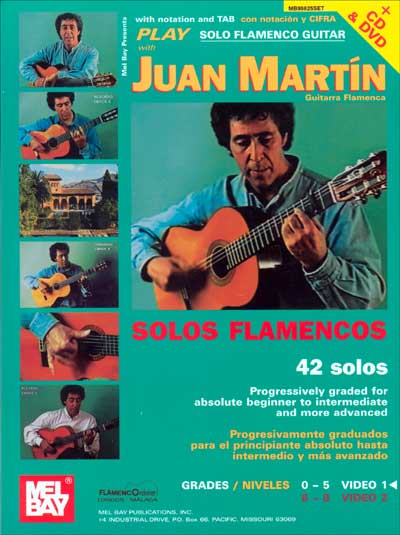
MARTIN JUAN PLAY SOLO FLAMENCO GUITAR VOL. 1 CD DVD TABLATURE CHITARRA METODO LIBRO


MARTIN JUAN, PLAY SOLO FLAMENCO GUITAR WITH. TABLATURE+CD+DVD


with notation and TAB    PLAY SOLO FLAMENCO GUITAR with

JUAN MARTiN


Guitarra Flamenca

SOLOS FLAMENCOS


42 solos

Progressively graded for absolute beginner to intermediate and more advanced

GRADES 0 - 5

con notacion CIFRA

Progresivamente graduados para el principiante absoluto hasta intermedio y mas avanzado

CD Contents

Primera  Solea  First Solea

Tientos   Anhelo (Yearning)

Sevillana   Copla tradicional

Verdiales   Malaga, mi tierra

Alegrias en Mi   Alborozo (Jubilation)

Tangos   Festejo (Celebration)

Guajira   Fiesta cubana

Solea La base

Fandango de Huelva

Alegrias en mi con silencio

Bulerias por arriba

Rumba Rumba del dia nueve

Malaguelia Velez

Granadinas Albaicin

Solea para acompaliar

Tientos de Ricardo a Paco

Seguiriyas Sabicas y ritmeo

Alegrias Melocotones de Ronda

Verdiales Coplas malaguenas

Bulerias Diego en menor

Guajiras from Cania raja

Solea Solea gitana

Seguiriyas Falsetas clasicas

Zapateado Taconeos

Rumba Cancion popular, more advanced (mas avanzada)

Solea por Bulerias Raices

Tarantas Aires de La Union

Alegrias Tema inicial (Opening theme)

Sevillana   Mi copla

Solea   Falseta tradicional

Alegrias en la

Tarantos   Toque de las minas

Zorongo

Cantilias   Luz y sombra (Light and shade)

Seguiriya   Lamento

Rumba   Rumba flamenca

Solea Falsetas sencillas (Simple falsetas)

Fandango de Alosno

Rumba Cancion popular

Tangos Impulso

Carcelero

Farruca Ritmo del baile (Rhythm of the dance)


FLAMENCOVISION AND PATRICK CAMPBELL

EXCLUSIVE SALES AGENT: MEL BAY PUBLICATIONS, INC., PACIFIC, MO 63069. MADE AND PRINTED IN U.S.A.


Designed as a comprehensive multimedia teaching set, this book, CD, and DVD present 42 solos, progressively graded in 6 levels from absolute beginners to more advanced, to suit players of all levels. It contains examples of eighteen different palos (rhythmic forms) of flamenco, with a wealth of melodic falsetas and rhythms. The music for all these is accurately written in notation and flamenco tab (cifra) in the book, and is also recorded on the companion CD. The DVD video contains over 57 minutes of solo music, and also includes introduction by Juan Martín and brief scenes of Andalucia today, which help to place this profoundly exciting and deeply felt music in the landscape of its origins. Juan Martín has succeeded here is showing how even music which is simple and very easy to start with can express the essential sound and emotion of flamenco, to build step by step the skills necessary for the performance of concert solos. Written in English and Spanish.


INTRODUCTION

Welcome to my new video series! It can help you to play flamenco guitar whatever your present level of skill. Many people who would like to play flamenco on the guitar tell me they are discouraged by the apparent difficulty of the techniques required. I want to try to change that, because the marvellous art of flamenco is much more about feeling and rhythm, those essential components of aire and compas, than always about sheer speed or amazing technique. The exciting challenge for me has been to arrange and compose music which includes classic elements with more modern sounds and rhythms that will capture for the student the true essence of flamenco guitar right from the very start, without sounding too simplified or lacking that characteristic flamenco sound.

The solos in this project are in a progressive series of grades, from an initial Grade a up to grade 8. This book, CD and video, the first of two sets, contain the pieces for grades a to 5. The grades are intended to be in line with the levels of musical advancement required for the grade examinations of music colleges for any musical instrument. This is a new kind of challenge for flamenco, but the art is now becoming so international that I believe it is time to see flamenco guitar as an art that can be learned in a progressive way by anybody who has the necessary devotion, understanding and determination. To many devotees of flamenco the idea of a formal graded approach, possibly subject to examination, may seem quite alien and even unwelcome. I want to look to the future, however, and to join with others who now nurture the growing world-wide interest in this precious art and the need for systematic methods of teaching. The essence of flamenco is so strong and distinctive that I do not believe its future is threatened by the increasing numbers of people who find in its soul what they want to express and to enjoy in music, any more than the music of the Mississippi Delta has been impoverished by the world-wide interest in the art of the Blues. There are no formal standards or guidelines in flamenco that are widely established to mark the student's stages of progress. In this project, therefore, I have given much thought to what I believe should be the appropriate levels of skill and musicianship necessary for achievement of the grades which can mark the advancement of technical ability and musical understanding. The book contains more details about the contents and requirements of each grade.

I have been greatly encouraged in this project by my young son Carlos, whose need for interesting music to play from the start of his learning the guitar has given me a valuable purpose and focus in preparing the music, particularly with the earliest grades.

There is bound to be disagreement about whether a piece is right for the grade assigned, or whether it is too easy or too difficult. I think that sort of argument is both unavoidable and not really very helpful. I have tried to present a logical development of musical understanding and of techniques for the right and left hand, but the important thing is not to be too rigid about the sequence of grades. Students and players have to differ in their capacities and needs. The music always matters more than anything else! More advanced players will be able to incorporate the music of the video in their own arrangements, and they should find things worth learning at any grade.

My aim is to give the student music which he or she will enjoy playing and which will reward the effort to practise and learn. This is not primarily a project to explain technique, but I have included some brief notes about the individual pieces. I hope you will share in the enjoyment I have had in undertaking this project with my good friend and former student Patrick Campbell who has again worked hard to communicate my playing through video, the CD and the printed page. I would also like to thank Bill Bay and his team for their invaluable advice and encouragement with what we believe to be a new advance in learning methods for flamenco. Viva el arte - y vamos a tocar!


Contents:

CONTENIDO / CONTENTS
Introduction By Juan Martín
Introducción Por Juan Martín
The Elements of Flamenco Guitar-Playing
Los Elementos del toque de la guitarra flamenca
Symbols and Notation
Símbolos y Notación

GRADE / NIVEL O Notes and Requirements/Notas y requisitos
PRIMERA SOLEÁ First Soleá
TIENTOS Anhelo (Yearning)
SEVILLANA Copla tradicional
VERDIALES Málaga, mi tierra
ALEGRÍAS EN MI Alborozo (Jubilation)
TANGOS Festejo (Celebration)
GUAJIRA Fiesta cubana

GRADE / NIVEL 1
Notes and Requirements/Notas y requisitos
SOLEÁ Falsetas sencillas (Simple falsetas)
FANDANGO DE ALOSNO
RUMBA Canción popular
TANGOS Impulso
CARCELERO
FARRUCA Ritmo del baile (Rhythm of the dance)
SEVILLANA Mi copla

GRADE / NIVEL 2
Notes and Requirements/Notas y requisitos
SOLEÁ Falseta tradicional
ALEGRÍAS EN LA
TARANTOS Toque de las minas
ZORONGO
CANTIÑAS Luz y sombra (Light and shade)
SEGUIRIYA Lamento
RUMBA Rumba flamenca

GRADE / NIVEL 3
Notes and Requirements/Notas y requisitos
SOLEÁ La base
FANDANGO DE HUELVA
ALEGRÍAS EN MI con silencio
BULERÍAS POR ARRIBA
RUMBA Rumba del día nueve
MALAGUEÑA Vélez
GRANADINAS Albaicín

GRADE / NIVEL 4
Notes and Requirements/Notas y requisitos
SOLEÁ Soleá gitana
SEGUIRIYAS Falsetas clásicas
ZAPATEADO Taconeos
RUMBA Canción popular, more advanced (más avanzada)
SOLEÁ POR BULERÍAS Raíces
TARANTAS Aires de La Unión
ALEGRÍAS Tema inicial (Opening theme)

GRADE / NIVEL 5
Notes and Requirements/Notas y requisitos
SOLEÁ PARA ACOMPAÑAR
TIENTOS de Ricardo a Paco
SEGUIRIYAS Sabicas y ritmeo
ALEGRÍAS Melocotones de Ronda
VERDIALES Coplas malagueñas
BULERÍAS Diego en menor
GUAJIRAS from Caña rajá

APPENDIX: PUBLICATIONS BY/PUBLICACIONES DE IUAN MARTÍN

Price: €32,99
€32,99

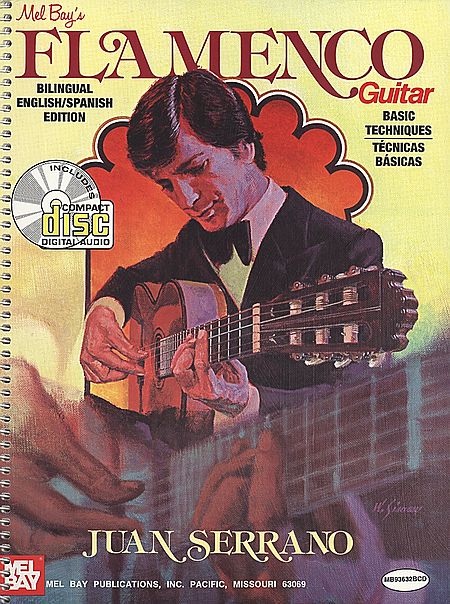
SERRANO JUAN FLAMENCO GUITAR TECNICAS BASICAS LIBRO CD TABLATURE CHITARRA METODO

SERRANO JUAN, FLAMENCO TECNICAS BASICAS. Metodo in inglese e spagnolo. CD. TAB.

Product Description:
This book, written in both English and Spanish is the most authoritative method available on flamenco guitar technique. Juan Serrano is one of the world's premier flamenco concert soloist and is a seasoned teacher and performer in this vibrant, colorful musical genre. The text describes the history and development of flamenco music; teaches basic music theory; presents developmental studies on flamenco guitar techniques such as rasgueado and tremolo; and offers 14 exciting flamenco guitar solos. Written in notation and tablature.

Format: Book/CD

Contents:

The history of flamenco
Music Theory
Learning Notes
Symbols
Tablature
Explanation of the Rasgueado
Preparatory Study
Rasgueado Exercises
Scale Study #1
Scale Study #2
Scale Study #3
Tremolo Study #1
Tremolo Study #2
Study for the Thumb
Studies in Legatos
Arpeggio Exercises
Study in C
Sevillanas I, II, III, and IV
Farrucas
Soleares
Alegrias
Alegrias para BaileFandangos de Huelva
Tempestad (Rumba flamenca)
Bulerias
Malaguena (Flamenca)
Malaguena (Regional)
Romance Flamenco

Price: €34,99
€34,99

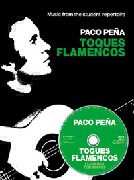
PACO PENA, TOQUES FLAMENCOS CD TABLATURE

Flamenco guitar music, together with flamenco singing and dancing, is a local form of expression which was developed by a certain people in a particular region of Spain - Andalucìa. It has become known outside Spain because Andalucìans have played it to larger and larger audiences and its general appeal and musical qualities have become apparent to more and more music lovers. As a result, quite a number of people have become interested in playing flamenco guitar themselves. But, traditionally, the Andalucìans have learnt the music from their family or friends within their small community; it was not written down. Therefore, it is very important to listen as much as possible to authentic flamenco played by people closely acquainted with it in order to appreciate the 'flamenco' quality of the music - which cannot be learnt from paper. In this book, we have attempted to write flamenco pieces as accurately as possible, using suitable symbols and explanations. Yet, in my experience, most students learn more quickly by listening to flamenco as well as reading it - especially when they first start to learn to play flamenco. This project is an attempt to combine both these approaches. The student can listen to a number of flamenco pieces, learn the notes and techniques from the written music, and then go back to the record to check that he is making the right sound. I was asked to compose some pieces easy enough for students to be able to play, but I found that flamenco pieces which are too easy do not sound attractive enough to encourage the student or to make interesting listening. So I have arrived at a compromise which I hope will satisfy most students. Some of the pieces are rather more complex than was originally intended, but most of the falsetas are quite straightforward. The rhythmic passages, rasgueados etc. are, for the most part not as intricate as I would play in other pieces, although I may use this kind of rasgueado when I play. My aim has been to produce some attractive and strictly authentic flamenco pieces easy enough for most students to play, yet difficult enough to encourage them to improve their technique and understanding of flamenco. Finally, I must add that flamenco is a free, improvised form of music, and the guitarist is not expected to play exactly what he has learned from somebody else. I strongly encourage him to experiment with the music. But before he can improvise he must have a very sound understanding of the compàs (rhythmic structure) and the character of the piece he is playing. Therefore, I advise the student to first learn these pieces strictly correctly. That way I trust he will get familiar with each of these flamenco styles and only then should he experiment and "do his own thing." Paco Peña 10 pieces from the album Toques Flamencos. In standard notation and tablature and complete with guidelines on technique and notation. Includes a CD TABLATURE


INTRODUCTION
Andalucla, whose musical tradition is embedded in its earliest history, must have built up that
tradition from the influences and remnants of the cultures left by the various peoples who passed
through or settled on its land. Among these different cultures one can note the Byzantine, Moorish,
Mozarabic and Jewish, whose influence must have finally crystallized and become integrated in the
songs and dances of the Andaluclan people. Andalucfa was under Moorish domination for many
centuries - Cordoba being at that time the capital of the Western Islamic world. Therefore the
music of this land already reflected the Oriental influence.
Later, in the 15th century, many tribes of gypsies found their way into Andalueta as a branch of
immigrants who around 1447 entered Spain by Catalonia. They lived mainly in the fields,
nomadically and in poor conditions. Traditionally the gypsies were not great poets - hardly surprising
considering their circumstances - but they had a remarkable facility for rhythm and music,
and in Andalucla they found a rich, colourful folklore of exceptional poetic charm. Unlike other
music they had come across elsewhere in Spain, this folklore suited their character and came to
form part of their lives. They assimilated it and added something different to it. This "marriage"
gave rise to the phenomenon of Cante Flamenco, neither "gypsy music" nor Andaluclan folklore,
but both. So, it can be said without doubt that there are two main elements in Flamenco:
Andalucla, with its old musical background, and the gypsies - without both, Flamenco would never
have existed.
Nobody knows for certain when it all started because there are very few written records available.
The first notice we have is about a singer of Seguiriyas, Tfo Luis el de la Juliana, around 1780.
But even that is a little dubious because it was not mentioned until a century later in 1881 - by
Antonio Machado Alvarez ("Demofilo"); in fact the Seguiriya seems to have developed later from
another style: Tonas.
There are three main periods in the history of Flamenco. From the beginning of the 19th
century to 1860 it was part of the life of Andaluclan gypsies and poor people who kept it for
themselves and never performed outside their communities. From 1860 to 1910 was the era of the
"Cafes Cantantes", special tablaos or places wholly dedicated to Flamenco music. Since then,
Flamenco has emerged from its original environment to become known throughout the world.
No evidence exists that guitars were used during the first period. But as Flamenco emerged
("Cafes Cantantes") the guitar, which was already the instrument of Spain, was brought in to
accompany and enhance the human voice. Paradoxically, it is the guitar as a solo instrument, rather
than the singing, which has made Flamenco popular, when in fact the guitar, like the dancing,
derives all its inspiration from the Cante Janda (Flamenco singing) - the purest expression of
Andalucfan art.
When accompanying, the function of the flamenco guitarist is to help the singer or dancer to
to bring out the best of his talent. He must create an atmosphere suitable to each piece, and he must
provide a good clear rhythm and follow the voice in whatever nuances the singer may bring to it.
Also he must colour it by playing falsetas, or brief melodic sequences, between verses. The guitarist
is then at the absolute service of the singing and from it he takes all his inspiration.
When playing solo, the guitarist must convey the whole atmosphere of Flamenco. The falsetas
become much more elaborate and musical to resemble the singing. The rhythm also becomes
stronger and more elaborate to resemble the "foot-work" of the dancer.


A La Feria (Sevillanas)
A Paso Lento (Tientos)
El Mantoncillo (Garrotin)
El Nuevo Dia (Colombiana)
En Las Cuevas (Farruca)
Herecia Latina (Rumba)
La Romeria (Alegrias)
Santuario (Soleares)
Son De Companas (Seguiriyas)
Tonos Levantinos (Tarantas)

Price: €30,99
€30,99

SERRANO JUAN KING OF THE FLAMENCO GUITAR CD TABLATURE CHITARRA LIBRO SPARTITI

SERRANO JUAN, KING OF FLAMENCO GUITAR. Mani vigorose e tendini tenaci, 230 pagine, Rapida introduzione alla tecnica di base della chitarra flamenca: rasgueado, studio sul tremolo, arpeggio, picado, golpe. CD TAB.

Product Description:
Introduces basic flamenco studies, concert selections, and a brief history of the flamenco tradition. Includes the four basic song forms (siguiriyas, soleares, tangos, and fandangos) that influence all flamenco music.

Format: Book/CD Set
232 PAGES.

Contents:

Dos Colores -- Juan Serrano
Punta Umbria -- Juan Serrano
Tarifa -- Juan Serrano
Nostalgia -- Juan Serrano
Cueva Gitana -- Juan Serrano
Lamento Gitano -- Juan Serrano
Amigo Mariano -- Juan Serrano
Lagriamas De Granda -- Juan Serrano
Fantasy -- Juan Serrano
La Juderia -- Juan Serrano
Dos Colores -- Juan Serrano
Punta Umbria -- Juan Serrano
Tarifa -- Juan Serrano
Nostalgia -- Juan Serrano
Cueva Gitana -- Juan Serrano
Lamento Gitano -- Juan Serrano
Amigo Mariano -- Juan Serrano
Lagriamas De Granda -- Juan Serrano
Fantasy -- Juan Serrano
La Juderia -- Juan Serrano

Price: €43,99
€43,99

SERRANO JUAN FLAMENCO CONCERT SELECTIONS LIBRO CD TABLATURE-Rumba-Soleares-Bulerìas-Verdiales

SERRANO JUAN, FLAMENCO CONCERT SELECTIONS. Verdiales, Petenera, Zambra, Farruca, Seguiriyas, Zapateado, Rumba, Guajiras, Soleares, Bulerìas, Danòn; il flamenco in tutte le sue varie tipologie, a seconda delle città, delle regioni, dei popoli, delle influenze arabe e occidentali. Ogni brano è preceduto da una breve introduzione storica e interpretativa, (in inglese e in spagnolo). Il flamenco come la musica blues è la musica di un popolo che suona, balla e canta, ripetendo ritmi, melodie, che si tramandano di generazione in generazione, senza teorie o libri. Tra questi musicisti ci sono degli uomini come, Maruza, Robert Johnson, Muddy Waters, Sabicas, ecc. che con la loro personalità, si distaccano dal "marmellatone uniforme", e creano qualcosa di proprio. Facendo un paragone, con la lingua popolare; possiamo dire che il dialetto è un linguaggio più vero e storico dell'italiano. Il dialetto ha in sé tutte le suggestioni delle genti e delle culture che hanno attraversato o che hanno dominato quella città, ha conservato le cadenze e le sonorità. In ogni dialetto vi è il passato di quella terra. C'è un paesino in Italia, ove per dialetto si parla una lingua molto simile al francese. Perché durante il turbine napoleonico nel 1797 fu invaso, e il linguaggio popolare ne è stato fortemente influenzato. E come ci sono dei poeti bravissimi che si esprimono con il dialetto, così è per la musica. Per chi ha un cognome diverso da De Lucia, e coloro che non possono imbarcarsi immediatamente per la terra Iberica, per frequentare un dispendioso corso di alto livello per chitarra, e per chi non discende da un casato di scatenati consuma-suole di Cordoba, ove i segreti e la cultura si trasmettono come nella migliore tradizione di questa forma musicale popolare, di padre in figlio. 200 Pagine di musica. CD TAB.
in spagnolo e in inglese

Product Description:
Written in Spanish and English, this book contains 12 of Juan Serrano's finest flamenco guitar solos. Selections include: Bella Mar (Verdiales); Ensueno (Petenera); Fantasy (Zambra); Juani (Farruca); Lidia; Majestuosas (Serguiriyas); Munequita (Zapateado); Nancy (Rumba); Nostalgia (Guajiras); Posadas (Soleares); Tentacion (Bulerias); and Verde Selva (Danzon). All solos are scored in notation and tablature.

Format: Book/CD Set

Contents:

Fantasy -- Juan Serrano
Majestuosas -- Juan Serrano
Lidia -- Juan Serrano
Nancy -- Juan Serrano
Bella Mar -- Juan Serrano
Juani -- Juan Serrano
Nostalgia -- Juan Serrano
Ensueno -- Juan Serrano
Posadas -- Juan Serrano
Muniquita -- Juan Serrano
Verde Selva -- Juan Serrano
Tentacion -- Juan Serrano

Price: €33,99
€33,99

VICTOR MONGE "SERRANITO" IN CONCERT. DVD

VICTOR MONGE "SERRANITO" IN CONCERT. DVD

Product Description:
Victor Monge "Serranito" is a legend in the history of Spanish music. His virtuoso technique combined with his supreme musicality has confirmed the fact, well known in musical circles, that he is one of the greats in flamenco guitar. As a composer he takes the greatest care in the form and foundation of his compositions, something which has taken him to an astonishing level of perfection in his music. In this video, he performs six of his compositions, accompanied by a second guitar, acoustic bass guitar, and percussion. A booklet of program notes is included in Spanish, English, French, and Japanese. A book with the music in notation and tablature is available separately.

Format: DVD

Song Title: Composer/Source:
Calle de la sangre (Bulerías) Victor Monge "Serranito"
Cazorla (Taranta) Victor Monge "Serranito"
Llora la farruca (Farruca) Victor Monge "Serranito"
Paseando por Triana (Soleá) Victor Monge "Serranito"
Por la vera el Genil (Tangos) Victor Monge "Serranito"
Romance para un poeta Victor Monge "Serranito"

Price: €40,99
€40,99
Syndicate content