FLAMENCO

DE LUCIA PACO-ALMORAIMA-TABLATURE SPARTITI LIBRO CHITARRA RIO ANCHO FLAMENCO MUSICA

DE LUCIA PACO, ALMORAIMA. TAB.

Transcripción por el maestro Enrique Vargas, director de la colección "Biblioteca Grandes Guitarras Flamencas de Hoy", quien ha afrontado la tremenda dificultad de transcribir de forma fiel y pormenorizada una obra de tamaña complejidad e importancia.

Paco de Lucía, emplea en "Almoraima" varias innovaciones sin precedentes hasta la fecha: Cada uno de los ocho temas del disco tienen más de una, y a veces hasta cinco pistas de guitarra; bajo eléctrico; percusión; una pista de guitarra tapá y, de vez en cuando, laúd y cante. Todos estos elementos han dificultado tremendamente la tarea de la transcripción. A pesar de ello, el maestro Enrique Vargas ofrece en cada tema diferentes soluciones siempre con la máxima fidelidad al original.

Todas las piezas son perfectamente ejecutables tanto para un solo como para un dueto (con excepción de la rumba y sevillanas que sólo son aptas para dueto). Cada tema viene además precedido por anotaciones explicativas bilingües castellano/inglés. Las partituras están presentadas en solfeo y en cifrado. Tanto las digitaciones de ambas manos como los matices dinámicos y técnicos se presentan de la forma más pormenorizada posible.

A continuación, una descripción técnica de cada partitura de esta obra.

Almoraima, (Bulerías)
En esta pieza se han transcrito las partes más importantes de la segunda guitarra y el bajo. Donde la segunda guitarra se limita a tocar acompañamiento genérico se ofrecen símbolos armónicos. La pista de laúd, interpretada por el maestro Paco de Lucía ha sido transcrita íntegramente. Esta pieza es apta para solo y dueto.

Cueva del Gato, (rondeña)
La parte de la guitarra de acompañamiento interpretada por Ramón de Algeciras está transcrita íntegramente lo que hace la pieza ideal tanto para un dueto como para un solo.

Cobre, (sevillanas)
Este tema es un dueto donde la guitarra principal interpreta cada sevillana en una tonalidad y, a veces, afinación distinta. La segunda guitarra mantiene la misma afinación sin cejilla, es decir, al aire. En la tercera copla de cada sevillana el maestro Paco de Lucía grabó la segunda pista del solo haciendo una especie de contrapunto con la guitarra principal. Esta segunda pista también ha sido transcrita íntegramente.

A la Perla de Cádiz, (cantiñas)
En esta pieza se han transcrito las partes más importantes de la segunda guitarra. Donde el acompañamiento es genérico se suministran símbolos armónicos. En la parte final el maestro Paco de Lucía desarrolla una brillante improvisación sobra la salida del cante por cantiñas . La melodía de esta salida ha sido transcrita para que sirva de referencia y también por si se desea interpretarla utilizando voces u otros instrumentos musicales. Apto tanto para solo como para dueto.

Olé, (jaleos)
A pesar de ser un dueto con las dos guitarras transcritas íntegramente, esta pieza es perfectamente ejecutable como un solo de guitarra.

Plaza Alta, (soleá)
Al final de este tema entra la segunda guitarra cuyas partes más importantes han sido transcritas íntegramente y en las partes genéricas se ofrecen símbolos armónicos. Puede ser interpretada como solo y como dueto.

Rio Ancho, (rumba)
Esta conocidísima rumba se presenta en el siguiente formato: la guitarra principal; las partes más importantes de la segunda guitarra y los símbolos armónicos.

Llanos del Real, (minera)
En la parte final de esta pieza entran la segunda y tercera guitarra que han sido transcritas íntegramente.

Formato A4
307 Páginas

At last, a long-awaited transcription book of the emblematic CD Almoraima by Paco de Lucía published by Gestión de Lucía (the artist management company) has arrived. This time the author of these charts has been no other than maestro Enrique Vargas, also the director of the collection The Great Flamenco Guitars of Today Library, who had to face the tremendous difficulty of transcribing accurately every little detail of this historic work of art.

In the process of an intense search for a new expressive melodic, structural and harmonic forms in flamenco, the genius guitarist from Algeciras implements in Almoraima various innovations unprecedented for the times: every one of the eight cuts of the CD has more than one - and some times up to five - guitar tracks; electric bass; percussion; a muted guitar track, and, sometimes, oud and singing. All of these elements made the task of transcribing this work tremendously difficult. In spite of this, maestro Enrique Vargas offers in every piece the solutions based on maximum fidelity to the original.

All of these pieces are perfectly playable by solo guitar and a duo (with the exception of the rumba and sevillanas than are only suitable for a duo). Every piece is preceded by annotations in Spanish and English. The charts are presented in notation and tab. The fingerings for both hands and dynamic and technical characteristics are explained in the smallest detail.

Contents:

"Almoraima" (bulerias)
In this piece the most important parts of the second guitar and the bass have been transcribed entirely. Where the second guitar plays generic accompaniment the chord symbols are provided. The oud track recorded by maestro Paco de Lucía has been transcribed entirely. This piece is playable as a solo as well as a duo.

"Cueva del Gato" (rondeña)
The guitar accompaniment played by Ramón de Algeciras has been transcribed entirely, which makes this piece ideal for a duo as well as a solo.

"Cobre" (sevillanas)
This piece is a duo where the main guitar interprets each sevillana in a different key and, sometimes, different tuning. The second guitar maintains the same tuning without a capo. In the third copla of each sevillana maestro Paco de Lucia recorded a second solo guitar track which does a sort of counterpoint with the main guitar. This track is also been transcribed.

"A la Perla de Cadiz" (cantiñas)
In this piece the most important parts of the second guitar have been transcribed. Where the accompaniment is generic chord symbols are supplied. In the final part of this piece maestro Paco de Lucía plays a brilliant improvisation over a sang melody that has been transcribed to be used as a reference or played by some other musical instrument if so desired. Can be played as a solo as well as a duo.

"Ole" (jaleos)
Despite this piece being a duo with both guitars completely transcribed, is perfectly playable as a solo, too.

"Plaza Alta" (soleá)
In the final part of this piece enters the second guitar whose more important parts have been transcribed entirely. In the generic parts chord symbols are supplied. Can be played as a solo as well as a duo.

"Rio Ancho" (rumba)
This famous rumba is presented as a guitar duo with the accompaniment explained and transcribed in its most important parts. Chords symbols are supplied throughout the whole piece.

"Llanos del Real" (minera)
In the final part of this piece enter the second and third guitars that also have been transcribed.

Price: €79,99
€79,99

SANLUCAR MANOLO MUNDO Y FORMAS DE LA GUITARRA FLAMENCA VOL.1 BOOK CD TABLATURE

SANLUCAR MANOLO, MUNDO Y FORMAS DE LA GUITARRA FLAMENCA VOL.1. CD TAB.

1 Andares gaditanos Zapateado
2 Fandangos de Onuba Fandango
3 Colombianas de Bajo Guía Colombiana
4 Taranto del Santo Rostro Taranto
5 Bulerías de las gitanas marquesas Bulerías
6 Herencia oriental Zambra
7 Sevillanas de las cuatro esquinas Sevillanas
8 Alegrías de la Torre Tavira Alegrías

Introduction in Spanish and English
Tab and musical score
A4 format
124 pages

The transcription of the first volume of the "Mundo y Formas de la Guitarra Flamenca" -the world and forms of the flamenco guitar-, one of the most important works by the great guitarist Manolo Sanlúcar. A veritable treasure of Spanish music which has been concealed for too long from both flamencos and guitarists worldwide, thus comes into reach for anyone who wishes to become acquainted with it.

The originality, authenticity and undeniable flamenco flavour of the music in this work which has transcended eras, fashions and trends. Becoming submerged in this magical document means crossing the threshold, that was inaccessible until now, of one of the most interesting chapters of the history of the flamenco guitar.

Price: €65,99
€65,99

LA GUITARE GITANE & FLAMENCA. Worms VOL.3. Compas e falsetas per bulerias e per fandangos. CD TABLATURE

LA GUITARE GITANE & FLAMENCA. Worms VOL.3. Compas e falsetas per bulerias e per fandangos. CD TAB.

Déjà une référence, cet ouvrage vous familiarisera avec la guitare gitane et flamenca, tant d’un point de vue rythmique, harmonique, mélodique que technique. Cet ouvrage s’appuie avant tout sur les styles dits "a compás", c’est à dire basés sur des cycles métriques fixes comportant un ou plusieurs systèmes d’accents rythmiques obligés : la soleá, la siguiriya, les tangos, les fandangos de Huelva et leurs dérivés. Le CD reprend tous les exemples du livre pour en faciliter la compréhension.

Price: €25,99
€25,99

LA GUITARE GITANE & FLAMENCA VOL.2-a compas-Claude Worms-CD TABLATURE LIBRO METODO

LA GUITARE GITANE & FLAMENCA VOL.2. Worms. CD TAB.

Pour ce deuxième volume, nous consacrerons deux chapittres à des styles "por medio", c’est-à-dire en mode flamenco de la (siguiriya, tientos et tangos) et un chapitre aux alegrias en tonalité de la majeur et la mineur, qui sera aussi l’occasion d’analyser quelques aspects de l’accompagnement de la danse.

Nous développerons les techniques de main droite abordées dans le volume 1 (picado, alzapúa, arpèges et rasgueados complexes) et en dècouvrirons de nouvelles (trémolo, etc.).

Nous travailleros aussi la mobilité et l’endurance de la main gauche (barrés, extensions, liaisons, sur tout le manche).

Les analyses harmoniques et rythmiques sont essentiellement conçues comme une approche de la guitare flamenca contemporaine.

Le CD, quant à lui, reprend la totalité des exemples musicaux de la méthode pour en faciliter la compréhension et donc aussi l’assimilation.

Price: €23,99
€23,99

LES MAITRES DE LA GUITARE FLAMENCA VOL.1 Worms Serranito Sanlucar Paco de Lucia CD TABLATURE LIBRO

LES MAITRES DE LA GUITARE FLAMENCA VOL.1. Worms. Serranito, Sanlucar, Paco de Lucia. CD TAB.

Ce volume fait partie d'une série d'ouvrages consacrés aux grands maîtres du flamenco. Ces recueils vous permettront donc de vous familiariser avec le style des principaux maîtres de la guitare flamenca et ainsi de refaire le parcours des jeunes guitaristes contemporains, qui ont tous construit leurs propres falsetas à partir d'une connaissance approfondie de l'?uvre de leurs aînés. Pour ce premier volume, nous avons sélectionné les falsetas caractéristiques de 3 grands maîtres qui ont incontestablement marqué l'histoire de la guitare flamenca au XXème siècle : Francisco Sánchez Gómez "Paco de Lucía", Victor Monge "Serranito", Muñoz Alcón "Manolo Sanlúcar". Pour chacun de ces guitaristes, nous vous proposons dix falsetas essentielles (soleá, soleá por medio, siguiriya, tientos et fandangos) que vous retrouverez sur le CD joint à cet ouvrage. Ici, vous l'aurez compris, pas de bla-bla inutile, l'ouvrage est intégralement consacré à la musique en elle-même!

PACO DE LUCIA: SOLEA -SOLEA POR MEDIO -SIGUIRIYA -TIENTOS -FANDANGOS

SERRANITO: SOLEA -SOLEA POR MEDIO -SIGUIRIYA -TIENTOS -FANDANGOS

SANLUCAR: SOLEA -SOLEA POR MEDIO -SIGUIRIYA -TIENTOS -FANDANGOS

Price: €22,99
€22,99

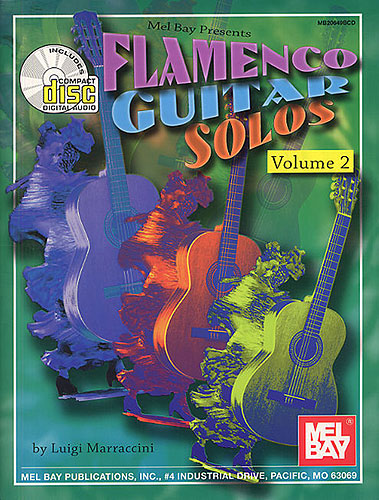
FLAMENCO GUITAR SOLOS VOLUME 2 Luigi Marraccini BOOK CD TABLATURE LIBRO SPARTITI CHITARRA

FLAMENCO GUITAR SOLOS VOLUME 2, Luigi Marraccini. CD TAB.

Product Description:
This book will appeal to any guitarist intrigued by the soulful and magical sound of the flamenco guitar. Presents 10 engaging, intermediate to advanced flamenco guitar solos in traditional forms in standard notation and tab with performance notes. All selections appear on the book's companion CD. So grab your guitar and get into flamenco, the musical heart of Spain!
Format: Book/CD Set
Publisher: Mel Bay Publications, Inc.

Contents:

Verdiales -- Luigi Marraccini
Bulerias Jerezanas -- Luigi Marraccini
Granadinas -- Luigi Marraccini
Zambra -- Luigi Marraccini
Alegrias -- Luigi Marraccini
Serranas -- Luigi Marraccini
Tanguillos -- Luigi Marraccini
Tientos -- Luigi Marraccini
Tangos -- Luigi Marraccini
Malaguena -- Luigi Marraccini

Price: €24,99
€24,99

GIPSY GUITAR RUMBAS FLAMENCAS AND MORE Gerhard Graf-Martinez LIBRO 2 CD TABLATURE DVD

GIPSY GUITAR: RUMBAS, FLAMENCAS, AND MORE. 2 CD. DVD TABLATURE

Gipsy Guitar Value Pack
Rumba-Styles of the Flamenco Guitar
Series: Guitar
Publisher: Schott
Format: Book & CD & DVD Package
Author: Gerhard Graf-Martinez

RUMBA-STYLES OF THE FLAMENCO GUITAR


Gerhard Graf-Martinez deals specifically with the Hispanic American form of the varied flamenco, the Rumba Flamenca, in this volume. It is with this style of flamenco that groups such as the Gipsy Kings hit the international charts and which has become the epitome of the flamenco to many people. The author leads every interested guitar player safely into the world of the Rumba Flamenca, providing him with solo and accompanying techniques in the form of music, tablature and two brilliant CD recordings, plus a bilingual DVD in German and English.

Inventory #HL 49017548
ISBN: 9783795758929
UPC: 841886011588
Publisher Code: ED8396-01
Width: 9.25"
Length: 12.0"
92 pages

Gerhard Graf-Martinez

After the great success of his two-volume flamenco Guitar method, in this volume Gerhard Graf-Martinez deals specifically with the Hispanic American form of the varied flamenco: the Rumba Flamenca. It is with this style of flamenco that groups such as the Gipsy Kings hit the international charts and which has become the epitome of the flamenco to many people. In 'Gipsy Guitar', the author leads every interested guitar player safely into the world of the Rumba Flamenca, providing him with solo and accompanying techniques in the form of music, tablature and two brilliant CD recordings. Also available now is the bilingual DVD.

DEUTCH- ENGLISH

VORWORT
Der erfreulich groBe Erfolg meiner zweibandigen Flamenco-
Gitarrenschule (SCHOTT ED 8253/8254 - mit CD), hat zu
vielen Zuschriften aus dem In- und Ausland und zu sehr
positiven Kritiken der Fachwelt und Fachpresse gefUhrt. Dabei
wurde oft der Wunsch an mich gerichtet, den hispano-amerikanisch
beeinfluBten Bereich, speziell die Rumba ("Rumba flamenca")
und deren Derivate noch ausfUhrlicher zu behandeln.
Diesem Wunsch komme ich mit dieser Verbffentlichung gerne
nacho
· 'un wird besonders die "Rumba flamenca" sehr kontrovers
behandelt. FUr die einen gehort sie nicht zum Flamenco und
wird als sogenannte U-Musik abgetan. FUrandere, weniger im
Flamenco invo]vierte, ist sie der Inbegriff der Flamenco-
· lu ik. DarUber hinaus ist es Tatsache, daB viele "Flamencos"
auBerhalb Spaniens erst durch die Rumba zur "Hohen Kunst"
de Flamenco gekommen sind. Auch Paco de Lucfa war lange
Zeit nur in Flamencokreisen als Genie bekannt, bevor er
-el~ eite Bekanntheit durch seine legendaren Kompositionen
.Entre Dos Aguas" und "Rio Ancho" (aus dem spater im Duo
mit I di Meola "Mediterrean Sundance" wurde) erlangte.
Au h die Gipsy Kings, deren Rumbas zu internationalen Hits
wurden.lassen es sich nicht nehmen, im Konzert ihr Publikum
mit einem "Fandango Natural" zu konfrontieren. Zehntausende
horen in diesem Moment "echten" Flamenco.
(l>er multikulturelle Interventionen diesel' Art laBt sich zwar
rreiten. aber schlecht kann es fUr den Flamenco keinesfalls
in. E ei denn, man ware bemLiht moglichsL wenige in den
Bereich der Flamenco-Musik eindringen zu lassen, urn so den
ei moglichst elitar zu halten.
EinigeBemerkungen zu den Kompostitionen: Viele Flamencoill
ke und "Falsetas" (Melodiepassagen), die vor Jahrzehnten
. eiert wurden, gehoren heute zum Standard. Oft laBt sich nicht
zUJiick erfolgen, vom wem dies oder jenes ursprLinglich erhaffen
wurde - ganz ahnlich wie bei den "Volksliedern".
-\uch wurde Flamenco-Musik nie notiert und nie nach Noten
gelehrt und gelernt. Doch genau dieser Umstand hat dem
Flamenco bis heute seine Flexibilitat und Spontanitat bewahrt.
Eine ..Falseta·' immer gleich zu spielen mag zwar in der
toung phase normal sein, aber spatestens nach Uberwindung
der technischen HUrde wird sie selten immer wieder gleich
reproduziert. 1m Laufe der Zeit verandern sich Artikulation
und Phrasierung. und irgendwann kann sogar etwas ganz
· 'eue daraus entstehen. Dies war auch ein Problem bei den
ompo itionen dieses Buches. "Falsetas" und Melodien so
e tzulegen und zu arrangieren, daB alles reproduziert werden
-ann. war nicht immer einfach. Vor allem die improvisierten
Teile in den langsamen Versionen so nachzuvollziehen, wie im
Originaltempo. war mit einigem Ubungsaufwand verbunden
und Dicht immer bis ins kleinste Detail moglich - eigentlich
au b nicht beabsichtigt. Mit diesem Buch und den beiliegend
n CD wiinsche ich viel SpaB und hoffe, daB damit auch die
..afi ion" zum Flamenco wachst.

PREFACE
The welcome success of my two volume Flamenco Guitar
Method (SCHOTT ED 8253/8254 - with CD) resulted in many
letters being received from within Germany and abroad and in
positive reviews in the specialist publications and flamenco
circles. Many correspondents expressed the wish that I treat the
Latin American forms, especially the rumba ("Rumba flamenca")
and its derivatives, in greater depth. I welcome the
opportunity of fulfilling this wish in this publication.
However, the "Rumba flamenca" is a very controversial area.
Some do not recognise this music as belonging to Flamenco or
dismiss it as a superficial form, while others less involved with
Flamenco, regard it as the very embodiment of flamenco
music. It should be said that many "flamencos" outside Spain
first came to the "higher forms" of Flamenco through the rumba.
Paco de Lucia had long been recognised as a genius only in
flamenco circles before he achieved world wide popularity
with his legendary compositions "Entre Dos Aguas" and "Rio
Ancho" (which later became "Mediterranean Sundance" in his
duo with Al di Meola).
The Gypsy Kings too, whose rumbas became international
hits, do not shy away from confronting their audience with a
"Fandango Natural" in their concerts. In such moments tens of
thousands are able to hear "real" Flamenco.
It is possible to disagree about this kind of multicultural
intervention, but it cannot be bad for Flamenco. That is unless
one wishes to ensure that as few people as possible gain access
to flamenco music, and thus limit the circle to an elite.
Concerning the compositions - many flamenco pieces or
"falsetas" (solo music passages) which were created decades
ago are today considered standard works. In a similar way to
folk music it is often impossible to determine who originally
composed which piece. Moreover, Flamenco music was never
transcribed and has never been taught and learned through
reading music. It is exactly this situation. however. that has
preserved the great flexibility and spontaneity of Flamenco to
this day. At the practice stage it may be normal to playa
"falseta" in exactly the same way every time, but as soon as the
technical difficulties have been overcome, it is unusual to
reproduce it in the same form time after time. In the course of
time, various aspects such as articulation and phrasing change,
and it may even happen that at some time something completely
new emerges.
This situation, however, proved to be a problem with the
compositions in this book. It was not always easy to pin down
the form of the "falsetas" and melodies and to arrange them so
that they could be reproduced. Above all it required more than
a little practice to play the improvised sections in the slow
versions in the same way as in the original and it was not alway
possible, nor was it really my intention, to reproduce them
down to the finest detail.
I hope you enjoy this book and the accompanying CDs, and
that it will advance the "aficion" for Flamenco.


INHALT
Vorwort 
Der Autor 
Grundbegriffe 
Kompositionen dieses Buches 
La Rumba 
Rhythmus-Muster 1
Rhythmus-Muster 2 

Caballos Blancos 
Tresillos 1 
Golpe mit Mittelfinger 
Rhythmus-Muster 3 

La Habana de ida 
Tresillos II 

La Habana de vuelta 
Rhythmus-Muster 4 

La Morita 
Rhythmus-Muster 5 
Rhythmus-Muster 6 

Sierra Blanca 
CD Inhalt 
Index 

CONTENTS
Preface .
The Author .
Basic Elements .
The Compositions in this Book .
La Rumba .
Rhythm -Pattern 1 .
Rhythm- Pattern 2 .

Caballos Blancos .
Tresillos I .
Golpe with Middle Finger .
Rhythm-Pattern 3 .

La Habana de ida .
Tresillos II .

La Habana de vuelta .
Rhythm-Pattern 4 .

La Morita .
Rhythm- Pattern 5 .
Rhythm-Pattern 6 .

Sierra Blanca .
CD Contents .
Index .

Price: €63,99
€63,99

MARTIN JUAN ANDALUCIAN SUITE NO. 1 LIBRO CD TABLATURE CHITARRA SPARTITI FLAMENCO BULERIAS

MARTIN JUAN, ANDALUCIAN SUITE, NO. 1. CD TAB.

Product Description:
Four exciting concert solos for flamenco guitar from Juan Martín’s best-selling album ‘The Andalucian Suites’. This is the first of the four suites on the album. These suites are transcribed into standard notation and flamenco tablature (cifra), with introductory playing notes by Juan Martín. The four solos on the accompanying CD are performed by Juan.

The complementary and contrasting variety of styles and rhythms of the four solos provide a brilliant display of Juan’s artistry and the expressive capabilities of the flamenco guitar. Each solo is complete in itself. A powerfully evocative Zambra Mora is followed by the much-requested rumba ‘La Feria’, then a gently melancholic Milonga and finally a thrilling Bulerías, which combines modern elements with pure gypsy falsetas from Moron del la Frontera. These solos provide an exceptional opportunity to learn and enjoy the music of a master flamenco guitarist, whose two volumes of graded ‘Solos Flamencos’ are already Mel Bay best-sellers.
Format: Book/CD Set 48 pages

Contents:

Biographical Note
The Four Solos, with playing notes
Key to Symbols and Notation
Evocación de la Invasión Árabe AD 711 (Zambra Mora)
La Feria (Rumba)
Alborada (Milonga)
Gitanos (Bulerías)

Price: €25,99
€25,99

SERRANO JUAN & COREY WHITEHEAD FLAMENCO CLASSICAL GUITAR TRADITION 1 Method CD LIBRO SPARTITO

SERRANO JUAN & COREY WHITEHEAD, FLAMENCO CLASSICAL GUITAR TRADITION, VOLUME 1, A Technical Guitar Method and Introduction to Music. 176 Pagine. 4 CD, no TAB.

Product Description:
This beginning guitar method is written for aspiring classical or flamenco guitarists who want to learn how to read music up to the intermediate level. Music from the Spanish tradition such as Romanza, Pica-Pica, El Vito, Café de las Chinitas, Perfidía, La Virgen de la Macarena and flamenco music of Juan Serrano provides a technical and musical foundation that improves facility in playing scales, arpeggios, tremolo, and rasgueado.

Tablature is not included as the one of the primary aims of this book is to improve note reading and the comprehension of the fundamental elements of music. Performances of all musical examples are available online that includes one performance at tempo for each of the more than 230 musical examples. Short repertoire pieces from Gaspar Sanz, Dionisio Aguado, Fernando Sor, Mauro Guiliani, Ferdinand Carulli, and Mateo Carcassi are included at the end of the book and are repertoire studies that will prepare guitarists for further study in classical and/or flamenco guitar.

Product Number: 21029
Format: Book
ISBN: 0786674652
UPC: 796279100489
ISBN13: 9780786674657
Series: Non-Series
Publisher: Mel Bay Publications, Inc.
Date Published: 12/18/2008
176 PAGES

Contents:

A Note from the Authors
The Guitar - A Brief History
La Guitarra (poem)
Preface
Parts of the Classical Guitar
Parts of the Flamenco Guitar
Names of the Open Strings
Tuning
Metronome
Note Locations on the Fretboard
Sitting Position and Holding the Guitar
The Fingers of the Right and Left Hand
Fingernail Shape and Maintenance
Picados (Scales) - Apoyando (Rest Stroke) and Tirando (Free Stroke)
Arpeggios (Broken Chords)
Tremolo (Preparatory Exercise)
Rasgueado (Strumming)
Basic Elements of Music Notation
Musical Expression Symbols
The Musical Alphabet
Half Steps and Whole Steps
The Major Scale
The Open Treble Strings
Systematic Arpeggio Exercises
Alternating Index and Middle Fingers...
Sueño
The Open Bass Strings
Playing on the Bass and Treble Strings
Notes on the First String
Soleares
Notes on the Second String
Music in Two Parts
Playing Eighth Notes
Notes on the Third String
Sevillanas
Sevillanas I (Trio)
Sharps and Flats on the 1st, 2nd and 3rd strings
The Fifth Position on the First String
The Natural Sign
Romanza in A Minor
Romanza
Farrucas
Sixteenth Notes
Slurs
Estudio No. 2
Estudio No. 2 (Duet)
The Major Scale
The Natural (Relative) Minor Scale
The A Harmonic Minor Scale
The A Melodic Minor Scale
The Chromatic Scale
Notes on the Fourth String
Chords
Fandango
Fandango Duo
Notes on the Fifth String
Historia de un Amor
The Dotted Quarter Note
Perfidia
Notes on the Sixth String
Farrucas (Bass Line)
Farrucas
El Zorongo (Bass Line)
El Zorongo (Melody)
Playing the F Major Chord
Playing Two Notes Together (Double-Stops)
El Vito
Rasgueado
Sevillanas Intro
The Natural Notes
Sharps and Flats on the Bass Strings
The Chromatic Scale
El Rancho Grande
Alternating Bass and Chord Progression
El Rancho Grande (Duet)
Ascending and Descending Slurs: Ligados
Left Hand Agility Exercise
Chords in C Major and A minor
Las Mañanitas
Greensleeves
Scales and Chord Progressions
Rumba Rhythm
Scales and Chord Progressions cont
The House of the Rising Sun
Variations on a Theme from Asturias
Malagueña
Intervals
Chords
Triads
C Major Arpeggio and Chord Inversion
The A Minor Arpeggio and Chord
The G Major Arpeggio and Chord
The F Major Triad
Barré Chords
Chord Progressions
Petenera
Café de Chinitas
La Virgen de la Macarena
The High D and E on the First String
Pica-Pica Melody (Guitar I)
Pica-Pica Accompaniment (Guitar II)
Pica-Pica Accompaniment (Guitar III)
Pica-Pica Accompaniment (Guitar IV)
Pica-Pica (quartet)
Key
Chord Substitution
Key Signatures
The Circle of Fifths
Major and Minor Scales in the First Position
More Chords in the Circle of Fifths...
Allegro by Ferdinand Carulli
Allegretto by Carulli
Andante by Carulli
Allegro in E minor by Carulli
Etude in G Major by Carulli
Andantino by Carulli
Larghetto by Carulli
Romanza
Menuet by Robert de Visée
Lección 38by Dionisio Aguado
Clarines de los mosqueteros del rey de Francia by Sanz
Allegro by Mauro Guiliani
Andante by Ferdinand Carulli
Conclusion
About the Authors

Price: €27,99
€27,99

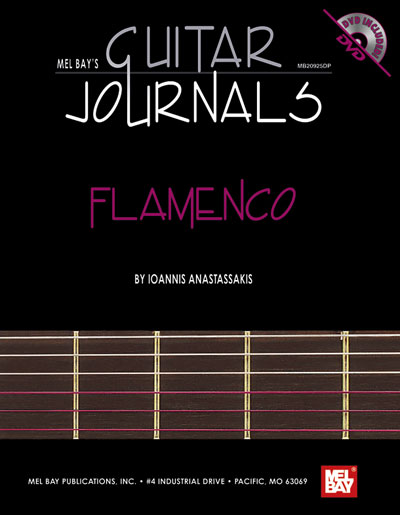
GUITAR JOURNALS FLAMENCO Ioannis Anastassakis DVD TABLATURE MEL BAY CHITARRA SPARTITI TABLATURE


GUITAR JOURNALS... FLAMENCO. DVD TABLATURE

Product Description:
This 176-page book/DVD package includes six full-length contemporary Flamenco guitar compositions by Ioannis Anastassakis, MA, best-selling Mel Bay author of the Art of Rasgueado and one of the few people to have obtained a Graduate Degree in Flamenco Guitar. Selections include Veridiana (Rumba Flamenca), Angelika (Granadinas), Maestro Serrano (Tangos), as well as 3 more solos based on the Flamenco forms of the Farucca, the Soleares and the Malaguena. Presented in standard notation and tablature, with extensive performance notes for each selection. DVD duration 64 min.

Format: Book+DVD
Series: Guitar Journals

It is no secret that interest in the flamenco guitar has grown very rapidly during the last 50 years. Flamenco guitar technique has evolved to extremely high standards, the compositions have matured beyond even the most optimistic expectations and the number of artists performing solo flamenco guitar music has risen to unprecedented heights; even the number of new flamenco guitar recordings has quadrupled in the last 5 years alone! There is, however, still one problem plaguing this continuous and multi-faceted progress: lack of performance repertoire. When compared to its classical guitar counterpart, flamenco guitar repertoire is found lacking indeed. Very few editions of performance pieces exist, most of them decades-old compositions that do not take into account the progress that has taken place in both the performance techniques and the compositional forms of flamenco guitar.

My intention with this collection of pieces is to tread the fme line between traditional flamenco guitar, firmly rooted in the inherited musical elements and the contemporary influences that have brought new levels of excitement to the music. All the compositions presented in this collection are based on traditional flamenco guitar forms. All of them, however, include additional elements from other musical cultures and styles. These compositions are meant to be performed live. I have performed most of them at least 200 times during the course of my flamenco guitar recitals and in just about every performance scenario from impromptu guitar gatherings to heavily publicized recitals, when teaching flamenco masterclasses or just playing for friends. The level of difficulty is usually upper intermediate with some parts drifting purposefully into advanced territory. Do not let that discourage you! I hope you have as much fun working with the compositions in this book as I had composing and recording them. Moreover, if you do enjoy them, do not hesitate and let me know. And while you are at it, check out. Finally, if you are interested in the subjects of flamenco and classical guitar, check out my Art of Rasgueado book, as well as my upcoming Art of Tremolo, Treasures of Flamenco Guitar and Flamenco Guitar Studies books, all published by Mel Bay Publications.


Companion CD Recording: All of the compositions in the book are recorded on the companion CD at performance speed. In addition, several of the key parts in each composition are recorded again at slow speed, in order to offer a more complete understanding of each phrase. Finally, I have included video files on the companion DVD that demonstrate the most difficult parts, as well as flamenco-specific techniques within these compositions. Fingering Notes: In order to simplify the visual complexity of the music, I have opted to avoid repeating obvious left-hand fingerings, especially in the case of basic major and minor chords played in open position and/or phrases repeated many times throughout the composition (eg. The basic rasgueado pattern in Soleares). This was done intentionally in an effort to give the music an uncluttered look, since there is a fair amount of rhythmic complexity as well as a large assortment of right hand techniques that need to be meticulously transcribed in the notation and tablature. As a personal fingering choice, I tend to use my left hand 4th finger (little finger) for a lot of phrases where most guitarists would use their 3rd (ring) fmger instead. I have found that with proper training, the little finger becomes even stronger than the ring finger, so I tend to use it a lot, sometimes to the point of favoring it. Still, this is a personal fingering choice. Feel free to substitute the 3rd finger in these instances. Keep in mind that a lot of flamenco falsetas (music phrases) are based on chord shapes that are held for either the complete duration or a significant segment of the phrase. This is especially prevalent in tremolo-based and arpeggio-based phrases. Try to identify these phrase segments and keep the maximum number of chord notes ringing while performing them. Depending on their specific context, trills are sometimes notated as appogiaturas and are sometimes given appropriate rhythmic value. The most basic, as well as the most usual, golpe is played with the ring finger hitting the golpeador of the flamenco guitar, right below the 1st string close to the bridge. However, there are two other special golpes used in the following compositions, which are explained in each piece's performance notes. The most distinctive techniques of the flamenco guitar are the various Rasgueados. These characteristic strumming techniques playa key part in creating the unique sound of the flamenco guitar. I have intentionally decided to use a very large variety of rasgueados, more than you would probably find in the actual playing of even an advanced flamenco guitar performer, in order to demonstrate a representative sample of the variety of flamenco rasgueado technique. If you are interested in learning more about the various rasgueado techniques used in flamenco, their history proper performance and context, I suggest you check out my instructional book The Art of Rasgueado, published by Mel Bay Publications.

Born on the Greek island of Crete, Ioannis Anastassakis studied at the Greek National
Conservatory and the Nakas Conservatory in Athens. He completed his bachelor's degree at the
American College of Greece, and subsequently studied at the distinguished Musicians Institute
in Las Angeles (GIT), where he was hired as an instructor after graduating in the top 1% of his
class. He continued his studies, specializing in solo flamenco guitar under the tutelage of Juan
Serrano at California State University, completing an MA in Guitar Performance and graduating
Magna cum Laude. Currently (2005), he is working towards a Doctorate in Education, with an
emphasis in Music in the UK.
Ioannis studied for several years with Juan Serrano. In addition, he has studied with Flamenco
guitar legends Manolo Sanlucar, Juan Martin, Paco Serrano, Jose Antonio Rodriguez and Manolo Franco.
Ioannis' list of teachers of electric guitar are no less impressive; the list reads like a "Who's
Who" of contemporary electric guitar legends including: Steve Vai (Whitesnake), Vinnie Moore (UFO), Marty Friedman (Megadeth), John Petrucci (Dream Theater), Frank Gambale (Chick Corea), Paul Gilbert (Mr. Big), Brett Garsed, Joey Tafolla, Scott Henderson, Mike Stern, Jean Marc Belkadi, Darren Householder, Tommy Tedesco, Ted Greene, Ron Echete, Sid Jacobs and Joe Diorio.
Ioannis has also performed and/or recorded in various settings with band members from
Whitesnake, Dio, Deep Purple, Ozzy Osbourne Band, Elton John Band, Santana, Celine Dion, Sara Vaughan, Tito Puente, Julio Iglesias, Tower of Power, Chick Corea Electric Band, Jeff Beck, Steve Vai Band, Badlands, Tribal Tech, Natalie Cole, Joe Cocker, Cher, Blood Sweat & Tears, Nina Hagen and others.
Ioannis has presented over 300 solo recitals in Europe and the United States and has been a
guest lecturer at several American colleges and universities including: The University of Southern
California, California State University Northridge, California State University Fresno, California
State University Fullerton, Musicians Institute, Fresno City College, and the American College of
Greece. In addition, he has won classical and flamenco guitar competitions and has been featured
a dozen times on American television programs.
In December 2000, he was the first guitarist ever to present a solo guitar recital at the Greek
National Opera House.
Ioannis' first solo flamenco guitar CD, Flamenco Live at Ioannina, was released by MP3.com
in August 2000 and immediately entered the company's flamenco category Top 10 chart, eventually
reaching the #1 spot worldwide in October 2002. The CD was re-mastered and re-released by
Wild Rose Angel Productions in 2003.
Ioannis' second and third solo flamenco guitar CDs, Traditional Flamenco Guitar Selections,
Vol.J & Vol.2 are scheduled for release by Wild Rose Angel Productions in 2006 and 2007
respectively.
Ioannis' instructional materials are published and distributed worldwide by Mel Bay
Publications. His first instructional book The Art of Rasgueado, achieved best-seller status within
months of its initial publication date. He is also a regular columnist in Mel Bay's Guitar
Sessions® magazine.

TABLE OF CONTENTS
Introduction
Acknowledgements
General Performance Notes
Notation Legend
A mi madre (Soleares) - About the Composition
A mi madre (Soleares) - Performance Notes
A mi madre (Soleares)
Recuerdos de Cordoba (Farruca) - About the Composition
Recuerdos de Cordoba (Farruca) - Performance Notes
Recuerdos de Cordoba (Farruca)
Angelika (Granadinas) - About the Composition
Angelika (Granadinas) - Performance Notes
Angelika (Granadinas)
Veridiana (Rumba) - About the Composition
Veridiana (Rumba) - Performance Notes
Veridian (Rumba)
Maestro Serrano (Tangos) - About the Composition
Maestro Serrano (Tangos) - Performance Notes
Maestro Serrano (Tangos)
Variations on Malaguefia (Malaguena) - About the Composition
Variations on Malaguefia (Malaguena) - Performance Notes
Variations on Malaguefia (Malaguena)
About the Author

DVD CONTENTS
This DVD contains specific sections from the songs chosen by the author to teach in greater detail. Each section is played at speed and then played again at a slower pace to offer greater instruction and insight into each piece. The audio tracks are located on the DVD. You can access them by selecting "Audio Only selections" from the main menu of the DVD. 

Song Title: Composer/Source:

Introduction
Acknowledgements
Performance notes
Notation legend

A Mi Madre - Ioannis Anastassakis
Angelika - Ioannis Anastassakis
Flamenco Variations on Malaguena - Ioannis Anastassakis
Maestro Serrano - Ioannis Anastassakis
Recuerdos De Cordoba - Ioannis Anastassakis
Veridiana - Ioannis Anastassakis

Price: €32,99
€32,99
Syndicate content