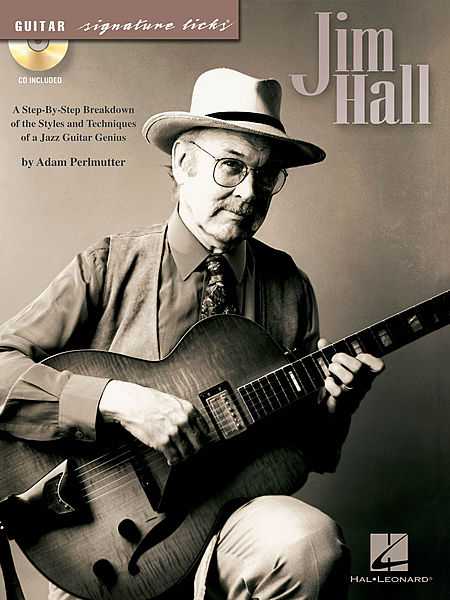
HALL JIM, A Step-by-Step Breakdown of the Styles and Techniques of a Jazz Guitar Genius, Signature Licks. CD TABLATURE
Series: Signature Licks Guitar
Softcover with CD - TAB
Author: Adam Perlmutter
Artist: Jim Hall
Discover the quiet elegance of one of jazz guitar's most renowned players with this Signature Licks book/CD pack. Each song chapter contains in-depth analysis and audio with slow demos. 80 pages
INTRODUCTION
Jim Hall (1930-) was steeped in classical music before he came to jazz. Hall attended the Cleveland Institute of Music, then moved to Los Angeles, California, where he studied nylon-string guitar with Vincente Gomez. While on the West Coast, he began to make a name for himself as a jazz guitarist, playing in the quintet of drummer Chico Hamilton, from 1955 to 1956, and in the trio of reed player Jimmy Giuffre, from 1956-1959. He also worked with modern improvisers such as pianist John Lewis and alto saxophonist Lee Konitz, and in 1960 toured South America (where he was exposed to bossa nova) with singer Ella Fitzgerald.
Around the same time, Hall moved to New York City, where through several intense collaborations, he was established as one of the world's most sophisticated jazz guitarists. From 1961 to 1962, he was a member of the tenor saxophonist Sonny Rollins's great quartet, with which he recorded the seminal album The Bridge. In the '60s Hall coled a quartet with trumpeter Art Farmer; he also recorded with the quartet of alto saxophonist Paul Desmond and found ideal duet partners in pianist Bill Evans and bassist Ron Carter. With Evans, Hall recorded two albums, Undercurrent (1962) and Intermodulation (1966), two of the most intimate and beautiful recordings in all of jazz. (From Intermodulation, see the transcription of "My Man's Gone Now," on page 34.) It was while performing in these fertile contexts that Hall found his own voice, an understated modern style characterized by melodic finesse, harmonic sophistication, and structural awareness-a logical extension of the language developed by such jazz-guitar pioneers as Charlie Christian, Wes Montgomery, and Django Reinhardt. This approach has been of profound influence to countless modern guitarists, including Hall's student Bill Frisell, who sounds radically different than Hall, but has a strikingly similar guitar conception. Hall's approach is best witnessed on the excellent albums he has recorded under his own name, including Concierto (1975), Jim Hall Live! (1976), and All Across the City (1989), transcriptions from all of which can be found on the following pages.
Besides being one of jazz's premier guitarists, Hall is a celebrated arranger and composer. In 1997, he won the New York Jazz Critics Circle Award for Best Jazz Composer/Arranger; his composition for jazz quartet and string quartet, "Quartet Plus Four," earned the Jazzpar Prize in Denmark, and his works for string, brass, and vocal ensembles can be heard on the albums Textures (1997) and By Arrangement (1998). In 2004, the Baltimore Symphony Orchestra debuted Hall's Peace Movement, a concerto for guitar and orchestra, dedicated to the cause of international harmony. That same year, for all his accomplishments as a composer, arranger, and performer, Hall was named a Jazz Master by the National Endowment for the Arts.
One of Hall's most recent projects, Hemispheres, was recorded with Bill Frisell and features one disc of duets and a second disc that adds the rhythm section of bassist Scott Colley and drummer Joey Baron. The album is available at Hall's Web site where a fan can catch of glimpse of what goes into the creation of the guitarist's recent projects. Meanwhile, when not composing or working with his own trio, Hall-ever the adventurous artist-has been playing with various modern improvisers, including saxophonists Joe Lovano and Greg Osby, and guitarist Pat Metheny. For now in the sixth decade of his career, Hall remains as vital a musician as ever.
DISCOGRAPHY
The selections on the accompanying CD are based on the following recordings:
ALL ACROSS THE CITY-Concord Jazz: "Big Blues"
ALONE TOGETHER-Milestone: "Autumn Leaves," "St. Thomas-
BALLAD ESSENTlAL-Concord Jazz: "Prelude to a Kiss"
CONCIERTO-CTI: "You'd Be So Nice to Come Home To"
(continua)
(All Of A Sudden) My Heart Sings - HAROLD ROME - 1941
Angel Eyes - MATT DENNIS - 1946
Autumn Leaves - JOSEPH KOSMA - 1947
Big Blues - JAMES S. HALL - 1978
My Man's Gone Now - GEORGE GERSHWIN - 1935
Prelude To A Kiss - DUKE ELLINGTON - 1938
St. Thomas - SONNY ROLLINS - 1963
Scrapple From The Apple - CHARLIE PARKER - 1957
Tangerine - VICTOR SCHERTZINGER - 1942
Things Ain't What They Used To Be - MERCER ELLINGTON - 1942
Without A Song - VINCENT YOUMANS - 1929
You'd Be So Nice To Come Home To - COLE PORTER - 1942
ANGEL EYES
(Jim Hall Live!, 1976)
Words by Earl Brent
Music by Matt Dennis
Figure 3-lntro, Head, and Solo (Chorus 1)
While many of Jim Hall's studio recordings show the guitarist to be thoughtful and
well-mannered, in concert he has been known to play with abandon. This side of Hall can
be heard on Jim Hall Live!, one of his finest live recordings, taken from a series of dates
in 1975 at Toronto's Bourbon Street. The recording finds Hall in top form, paired with
bassist Don Thompson and drummer Terry Clarke.
One of the highlights of the album is a Latin-tinged take of the jazz standard "Angel
Eyes," which was originally a 32-bar AABA song. Hall & Co. double the tune's harmonic
rhythm, so that the form is now 64 bars in length. (A chord that originally occupied two
beats now gets four beats, an entire bar.) Hall starts things off by moving a barred Am7
shape in parallel fashion against the open A string, resulting in some interesting polychordal
harmony, such as the m/A chord (voiced A-A~-m-F, low to high) on beat 1 of bar
2 and the B/A (A-F~-B-m) on beat 1 of bar 4. He also throws various dominant and
diminished chord voicings into the mix, including the partial E7#9 (A~/m-D-G) in the last
part of bar 2 and mo (A~-D-F) on beat 1 of bar 6.
After closing out the intro with the same Am7 chord with which he started, Hall
takes the head (beginning at bar 17). He sticks pretty close to the original melody, adding
his own idiosyncratic touches here and there. One such Hall-ism involves placing an
octave-based idea at the end of a phrase-a striking, broken-octave fill appears in bars
23-24; a variation of this, in bar 39; and, in bar 72, a semi-chromatic descending line
played in fully voiced octaves. Throughout, there's a strong blues feel, especially in bar
32's fill, which comes from the A minor pentatonic scale (A-C-D-E-G), albeit unpredictably
ordered. A subtler touch involves ending certain phrases with a 12th-fret harmonic
on string 5 (see bars 30, 46, and 78), which lends a nice timbral contrast to the fretted
notes.
Beginning in bar 49, Hall uses a neat trick that effectively separates the bridge
from the A-section: while holding selected melody notes (upstemmed), he adds chord
stabs (downstemmed), not unlike a pianist would do with two hands. Also, Hall ventures
a little farther from the melody in this section-in bar 53, check out the improvised, angular
line that begins with a major 7th (B~to A) leap. These unique details give the listener
a taste of what's to come in Hall's excellent solo.
In the first A-section of his first chorus, Hall introduces an A minor pentatonic idea,
and then sees it through various permutations. He keeps it simple here; the only noticeable
jazzy melodic content is the Am11 arpeggio (A-C-E-G-B-D) in bars 108-109.
Throughout, Hall interjects some of the same chord voicings as found in the intro, most
often the E7=9chord. At the same time, he uses space wisely; for example, see the rests
in bars 107-108 and 116-117.
Hall steps out melodically in the bridge of the first chorus. In bars 122-123, he
plays a 6th-based motif that reappears later in the solo, and in bars 125-127, he smoothly
hits a variety of interesting note choices: the 7 (F#) on the Gm7 chord (the absence of
a pianist gives Hall harmonic leeway), the #9 (E~/m) on C7, and the #11 (B) on Fmaj7.
Beginning in bar 128, Hall plays a fleetingly-fingered line involving chromatic lower-neighbor
tones. This leads directly into a witty reference to Duke Ellington's "Raincheck" in bars
129-131. Quotation is an indispensable improvisational tool, and Hall masterfully adjusts
the melodic contour of "Raincheck" to suit the changes at hand, sailing with ease into the
b7 (A) of the B7 chord and the 3rd (G#) of the Emaj7 chord.
THINGS AIN'T WHAT THEY USED TO BE (Jazz Guitar: Jim Hall Trio, 1957)
By Mercer Ellington
Figure 15-Head and Solo
While Jim Hall's style is strikingly modern, it is deeply rooted in the traditional
sound of the blues. This is especially apparent in Hall's interpretation of the Mercer
Ellington classic "Things Ain't What They Used to Be," from his 1957 debut album, Jazz
Guitar: Jim Hall Trio, on which "Tangerine" (see page 56) also appears.
"Things Ain't What They Used to Be" is based on a 12-bar blues in m major,
played here with a neat, overlapping pair of ii-Vs in bars 8-11 (F7-m7-Bm7-Ab7-m7).
Hall kicks things off by playing the head twice, the first time accompanied by bassist Red
Mitchell. The guitarist basically plays the melody as it was originally written but adds some
bluesy, grace-note flourishes: in the m7 bars, a whole-step slide, from B to the melody
note F; and on the double stops, a half-step approach tone to each lower note.
As Hall restates the head, beginning in bar 13, pianist Carl Perkins joins in on the
proceedings; notice the chromatically ascending 7~9 chords that Perkins substitutes in
bars 21 and 22. Hall starts his reiteration of the head the same way he originally played
it, but at the end of bar 20, he raises the intensity by playing the melody up an octave.
Then, beginning in bar 23, he sets up his three-chorus solo with a triplet-based line that
comes mainly from the m minor pentatonic scale (m-Fb-Gb-Ab-Cb).
In the first chorus, Hall improvises variations on the original melody. In bars 29
and 30, he plays major 3rd-based double stops from the m blues scale (m-Fb-Gb-Abb-
Ab-Cb), then, in bar 31, toys with both the b3rd(HIE) and 3rd (F) of the m7 chord using
single notes. In bar 35, over the m7-Bb7 change, Hall plays a series of dyads that actually
imply the progression m7-GI>-Gbm, with the 3rd (m and Bbbin the bass on the latter
two). Note the contrary motion between the lower and higher voices of the first two
chords.
Beginning at the end of his first chorus and extending through the first several
bars of his second, Hall has a conversation with himself, playing phrases that start and
stop on the first string's fourth-fret Ab, and are answered by phrases that start and stop a
perfect 5th lower, on the third string's sixth-fret m. In bars 40-43, Hall plays the note Eb
at two different positions-string 2, fret 4 and string 3, fret 8-requiring a large fret-hand
stretch, but the nice contrast in timbre is worth the effort. Hall begins to conclude his second
chorus in bar 44 with a predominantly pentatonic phrase.
In his third and final chorus, Hall makes the most out of a few simple phrases, the
first of which is stated in the first half of bar 49. Similar to one found in his first chorus, this
bluesy, ascending phrase contains both the b3 and 3, and is carried throughout the first
several bars. Bar 52 contains an interesting move: Hall slides, via a half step, into a dyad
(Cb-Eb)that implies a m9 chord (m-F-Ab-Cb-Eb), then plays a descending chromatic line
(Ab-Abb-Gb-F) that sets up a m9 chord partial (F-Cb-Eb). First appearing on beat 2 of bar
53, an eighth-note triplet line (Fb-m-B) is played (except for a break in bar 54) until the
beginning of bar 56, and answered in bar 57 by a time-honored, jazz-blues phrase.
Hall thinks more harmonically as he ends his solo, arpeggiating m (m-F-Ab) and
Gb (Gb-Bb-m) triads in bar 59, approaching each 3rd with a half-step grace note. Then,
on beats 1 and 2 of the final bar, Hall plays double stops, Ab-m and G-m, that imply mm7
(Bb-m-F-Ab) and Eb7 (Eb-G-Bb-m) chords, respectively, delaying the final ii-V
(Ebm7-Ab7) change by two beats.

 Italiano
 English