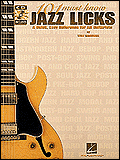
101 MUST KNOW JAZZ LICKS. CD TABLATURE
A Quick, Easy Reference for All Guitarists
Series: Guitar Educational
Format: Softcover with CD - TAB
Author: Wolf Marshall
Now you can add authentic jazz feel and flavor to your playing! Here are 101 definitive licks, plus a demonstration CD, from every major jazz guitar style, neatly organized into easy-to-use categories. They're all here: swing and pre-bop, bebop, post-bop modern jazz, hard bop and cool jazz, modal jazz, soul jazz and postmodern jazz. Includes an introduction by Wolf Marshall, tips for using the book and CD, and a listing of suggested recordings.
Inventory #HL 00695433
ISBN: 9780634013713
UPC: 073999315271
Width: 9.0"
Length: 12.0"
48 pages
Jazz is a musical language with a variety of dialects. To speak jazz on the guitar with authenticity
and eloquence requires more than finger dexterity, a facile mind, or a creative impulse. It requires
a sense of tradition and a seemingly endless well of ideas. In non-literary cultures, the act of communication
and the art of conversation are learned through what is known linguistically as "oral
tradition"-a practice passed down from generation to generation by listening, imitating, mastering,
and ultimately reinterpreting with personal expression. So it is with jazz. The great jazz players
of history have, largely by ear, studied, absorbed, and reassembled the contributions of their
forebears. Picture George Benson repeating Charlie Parker licks until they were part of his vocabulary.
Or imagine Barney Kesselstruggling to get Charlie Christian's phrases under his fingers. Pat
Martino memorized and reinterpreted Johnny Smith's and Howard Roberts' signature licks to formulate
his own innovative style. Joe Passemulated and respun the stylings of great jazz wind and
piano players. And new voices like RussellMalone, Ron Affif, and Jimmy Bruno currently lead
today's straight-ahead movement with inspired reinventions of Wes Montgomery, John Coltrane,
and Hank Garland. The process largely entails the learning and mastery of specific phrases, or
licks, that are akin to sentences in a spoken language. This can be a daunting task considering the
vast number of musicians and styles in the genre.
Enter 101 Must-Know Jazz Licks. This book is a lexicon of essential phrases in a wide variety of
styles within the jazz genre. Each lick is a self-contained phrase with a central idea or focal point
and is an indispensable piece of the jazz vocabulary. The 101 licks are presented in rough chronological
order beginning with the late 1930sand continuing to the present. If you're already a jazz
guitar aficionado, this book may revive some delightful memories and inspire you to take your
current playing down some familiar old paths. If you're coming to this guide with an interest that
outweighs your knowledge of the jazz genre, expect to be taken on a trip through musical
Americana, with a soundtrack to match, from which you will emerge a more conversant and passionate
player.
-Wolf Marshall
Introduction
This volume is designed for all guitarists. Arranged for quick, easy reference, it contains 101 stylistic
phrases, commonly known as "Iicks"-those essential, self-contained instrumental figures utilized
by the great masters. Licks are part and parcel of the jazz tradition and the jazz experience.
Charlie Parker used 'em, so did John Coltrane and Wes Montgomery, and so does virtually every
player on the current scene. Licks are short, meaningful passagesskillfully tucked into tunes and
riffs, and laced through the improvised solos of the repertory. The audience may not hear them
or even be aware of them, but they can always be felt. A well-turned lick can make the difference
between a cold, mechanical statement and a communicative, engaging performance; and
the right lick driven by the energy and conviction of a seasoned player can bring the audience to
its feet.
Now you can add an authentic jazz feel and flavor to your playing. Here are 101 definitive licks
from every major jazz guitar style neatly organized into easy-to-use categories. They're all here:
swing jazz, pre-bop, bebop, hard bop, modal jazz, cool jazz, soul jazz, postmodern jazz, free jazz,
chord licks, and more. Browse to your heart's content, and feel free to tap into the feeling of
each lick that speaks to you. As you do, you'll be taking that vital first step of reinvention that
connects you to the spirit and the essenceof America's most emotional and transcendent
art music.
Tips for Using this Book and CD
1. Play these licks allover the fingerboard. If a lick is positioned at the eighth fret, move it down
to the third fret and play it in that area; you will notice that the string feel, tension, and fret
distances have a bearing on how the lick feels. Then move it up chromatically as a drill, playing
it in every position from the third to the seventeenth fret. This will depend on the range of
your guitar's fingerboard. Note the key changes as you move the licks to different positions.
2. Put several licks into the same key. For example, if a lick is presented in C and another is in G,
place them both into C, and then into G. This is the musical equivalent of using all your linguistic
phrases in one conversation.
3. Take that collection of phrases into various keys. Once you have grouped a number of licks into
the same key, move that grouping to new positions.
4. Make notes, mental or written, about the feel of each lick. Your visceral, emotional reaction to
a lick is part of the ad-lib selection processwhen improvising. This processcould involve forming
a visual image of the lick's physical shape-how it sits on the fingerboard.
5. Add at least one new lick per week to your vocabulary. Memorize and use it in your current
musical situation-playing with a band, adding it to an existing solo or song, or when jamming
with your friends.
About the Recording
Each lick is played twice on the accompanying audio: first at the normal tempo and then, after a
two-and-a-half-second pause, at a slower tempo.
Licks 1-98 are found at the corresponding CD counter numbers. Licks99, 100, and 101 are presented
as a single track on number 99. Within that counter number (99), use the following time codes
to find the three licks: Lick 99 occurs at 0:00, Lick 100 occurs at 0:45, and Lick 101 at 1:04.
These licks were played using authentic Gibson archtop electric guitars and miked amplifiers
including vintage Gibson and Fender tube amps and modern Polytone amps. The sounds, settings,
and particular instruments are cited in the accompanying performance notes.
TF=Target figure. This three-note melody pattern typically approaches a selected (tar-
get) tone by beginning on its upper neighbor, jumping to its lower neighbor, and then
moving to the target. See Lick 20.
VLF=Voice leading figure. A specific four-note pattern endemic to bebop and modern
jazz styles. The all-important figure involves approaching a particular note first from a
half step above and then from below (always by two half steps in succession).See
Lick 20.
SUB=Substitution. This refers to an alternate scale or melody substituted for a primary
relationship. It is followed by a scale or chord name, such as "SUB Abm" (AI, minor
instead of a more typical Bbl scale or harmony). See Lick 27.
Q: and A:=Question and answer phrases.The "call-and-response" procedure is an
important aspect of applying licks to form a larger melody structure.
Every lick is defined by an overall context; this can be a "basic scale" or "basic tonality." Most jazz
licks are defined by their harmonic setting and use a variety of scalesto convey melodic motion
through chord changes. In this case,a single basic scale would not be a sufficient label and could
present an incomplete and erroneous picture. Melodies such as these are labeled as having a
"basic tonality" though they are comprised of single notes as in Lick 10. Many jazz licks have a
plural harmonic application. For example, Lick 1 can be thought of as originating from either the
AI, major scale or the AI, Mixolydian mode (dominant seventh sound) as it does not contain the
crucial seventh in its melody. Similarly, Lick 5 has a plural application and could be used over an
FmGor Bb9chord background.
A suggested tempo is provided for each lick-Fast Swing, Moderately, Slowly (Rubato), etc.-to
further guide you in applying these phrases in your music. All licks marked with a swing feel
(Fast Swing, Moderate Swing, etc.) are to be perceived as occuring against a triplet feel background
and are generally to be played with swing eighth-note rhythm. This means that each twoeighth-
note rhythm unit is to be played as a quarter-eighth grouping of an eighth-note triplet
After getting these licks under your fingers, try taking them apart by playing them in pieces,
inside out and backwards. Each lick can be thought of as having several melodic or harmonic
"cells" of varied sizes in its structure. Eachcell is akin to a thought or group of words in a sentence.
These can be grafted to other cells from other licks to form new phrases.This processof
developing original music from fragments is a viable strategy for building a new musical statements
of your own.
Finally, once you have grasped the essentials of these licks, begin your own investigations. To this
end, a list of suggested recordings is offered in the back pages of this volume. Pick your favorite
jazz improvisations, and listen for these devices at work in the music of the great players. Be on
the lookout for imitative procedures and sequential activity in melodies and riffs, question-andanswer
phrases, harmonic extensions and alterations, unique turnarounds, and other thematic
development strategies. This sort of listening and thinking opens the door to a deeper understanding
and assimilation of the jazz language.
About the Author
Wolf Marshall is the pre-eminent guitar educator-performer of our time. The founder
and original editor-in-chief of GuitarOne magazine, he is a highly respected and prolific
author and columnist who has been an influential force in music education since the early
1980s.Wolf has worked closely with Hal Leonard Corporation for the past decade,
authoring such highly acclaimed multimedia books asThe Guitar Style of Stevie Ray
Vaughan, Stevie Ray Vaughan, Blues Guitar Classics, The Beatles Favorites, The Beatles Hits,
The Rolling Stones, The Best of Carlos Santana, Guitar Instrumental Hits, Steve Vai: Alien Love
Secrets, Eric Clapton Unplugged, Eric Johnson, The Guitars of Elvis, Aerosmith 1973-1979 and Aerosmith 1979-1998, Acoustic Guitar of the '60s and '70s, Acoustic Guitar of the '80s and '90s, Mark Knopfler, The Best of Queen, The Best of Cream, and many more. His eight-volume seriesThe Wolf Marshall Guitar Method and Power Studies established new standards for modern guitar pedagogy in the early 1990s,as did his Guitar Jammin' authentic song books.
In 101 Must-Know Jazz Licks, and its predecessor 101 Must-Know Blues Licks, Wolf directs his
encyclopedic knowledge of modern guitar music at a unique series designed to improve the
vocabulary of all guitarists. The list of his credits is immense and can be found at his web site:
Swing and Pre-Bop
This group comes from the swing era of the late 1930sand early 1940s.Jazz was at
the height of its popularity in this period. Swing was a dance-oriented jazz style played predominately
in ballrooms by big bands of fourteen or more musicians. The music's harmony centered
around mildly dissonant chords like major and minor triads with added sixths, dominant sevenths,
and dominant ninths. These harmonies supported largely diatonic melodies set in riff-dominated
jazz tunes, 12-bar blues structures, and 32-bar pop tunes.
Swing's leading guitarist was Charlie Christian, who combined elements of earlier classicjazz traditions
as well as blues licks from the southern states and horn licks borrowed from wind players
like Lester Young and Roy Eldridge. The practice of emulating and adapting "horn licks" (largely
from saxophone and trumpet) has been a mainstay of jazz guitar since Christian's time. Christian's
pioneering use of the newly-designed Gibson Electric-Spanish (ES)guitar established the role of
the electric guitarist in jazz. Prior to his appearance, jazz guitarists were mainly confined to
strumming in the rhythm section or forced to play in smaller all-string combos such as Django
Reinhardt's Hot Club quintet.
Christian's work with the Benny Goodman Sextet set the standard for early combos that included
electric guitar. Jazz, blues, and pop guitarists who followed in the 1940swere under the spell of
Charlie Christian and sought to emulate his sound and style. In swing and pre-bop, this included
Oscar Moore, Barney Kessel,AI Casey,Herb Ellis, and others. Sweepingly influential, Christian's
licks were also heard in the subsequent wave of jump blues guitarists and early rock 'n' roll players.
Identifiers of the swing style include an eighth-note-dominated horn-like phrasing, extensive
use of the sixth degree of the scale and chromatic passing tones, blues riffs, and a strong swing
rhythm feel.
To maintain sonic authenticity, I played these licks on my Gibson ES-175/CCwith heavy-gauge
strings. This instrument is equipped with the early Gibson bar pickup (dubbed the "Charlie
Christian pickup") in the neck position. The volume and tone controls were both set at 8. The guitar
was played through a vintage 1952 Gibson GA-75 amp with one 15-inch speaker. The tone of
the amp was set for a warm and moderately clean sound with a hint of tube overdrive; in this
case,treble and bassat the midway point and the volume at just below halfway. This sound is
generally the norm for early jazz guitar, circa 1940s-1950s.
+Basic Scale: Ab Major/Mixolydian
Fast Swing Ab(6)
Contents
Introduction
Tips for Using this Book and CD
About the Recording
Lick Analysis and the Lick Legend
SWING and PRE-BOP
BEBOP
Bird: Charlie Parker
Post-Parker Bop Guitar
POST-BOPMODERN JAZZ
Trane: John Coltrane
HARD BOP and COOL JAZZ
MODAL JAZZ
SOULJAZZ
POSTMODERN JAZZ
JAZZ CHORD LICKS
Suggested Recordings
About the Author
Guitar Notation Legend

 Italiano
 English