HAL LEONARD

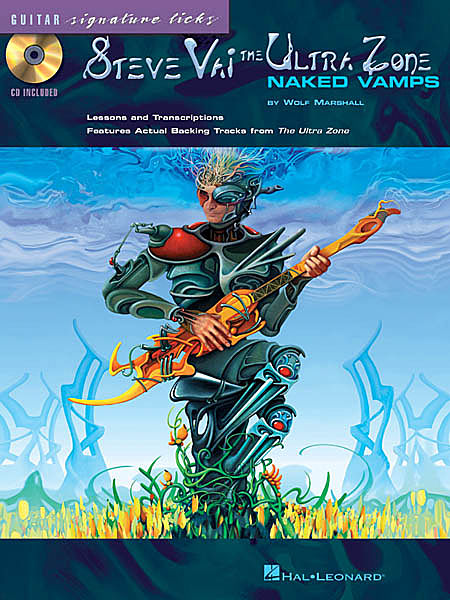
VAI STEVE-ULTRA ZONE NAKED VAMPS-Signature Licks Guitar CD TABLATURE LIBRO SPARTITI Jibboom

VAI STEVE, THE ULTRA ZONE NAKED VAMPS. CD TAB.

Series: Signature Licks Guitar
Softcover with CD - TAB
Author: Wolf Marshall

Learn the secrets behind the signature sounds of this guitar virtuoso, and then play along with the actual backing tracks from The Ultra Zone - mixed and produced by Vai himself! In this unique book/CD pack, Wolf Marshall teaches you everything you need to know to play exactly like Steve. Songs include:

The Blood & Tears
I'll Be Around
Jibboom
The Silent Within
The Ultra Zone
Voodoo Acid
Windows To The Soul

88 pages

Price: €29,99
€29,99

THE BEST OF BLUES GUITAR SIGNATURE LICKS Step-By Styles Techniques of Blues Legends LIBRO CD TABLATURE

THE BEST OF BLUES GUITAR, SIGNATURE. CD TAB.

A Step-By-Step Breakdown of the Guitar Styles and Techniques of the Blues Legends
Series: Signature Licks Guitar
Softcover with CD - TAB
Author: Dave Rubin

Learn the trademark riffs and licks of the blues masters with this informative book/CD pack. Features lessons on 12 classics:

All Your Love (I Miss Loving) (Otis Rush) - Boom Boom (John Lee Hooker) - Born Under a Bad Sign (Albert King) - Cross Road Blues (Crossroads) (Eric Clapton) - Pride and Joy (Stevie Ray Vaughan) - (They Call It) Stormy Monday (Stormy Monday Blues) (T-Bone Walker) -The Thrill Is Gone (B.B. King), and more.

All Your Love (I Miss Loving)
Boom Boom
Born Under A Bad Sign
Catfish Blues
Collins' Mix
Cross Road Blues (Crossroads)
I Smell A Rat
I'm Tore Down
It Hurts Me Too
Pride And Joy
(They Call It) Stormy Monday (Stormy Monday Blues)
The Thrill Is Gone

56 pages

Price: €21,00
€21,00

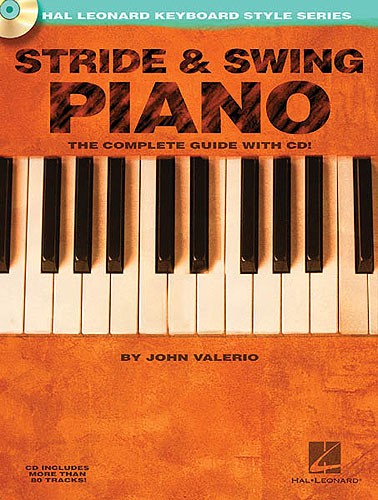
STRIDE & SWING PIANO John Valerio Hal Leonard Keyboard Style Series CD LIBRO PIANOFORTE BOOGIE WOOGIE

STRIDE & SWING PIANO. John Valerio. CD

Hal Leonard Keyboard Style Series
Series: keyboard instruction
Medium: Softcover with CD
Author: John Valerio

Focusing on styles such as classic ragtime, early blues & boogie woogie, New Orleans jazz, stride and swing, this new book/CD pack in the Hal Leonard Keyboard Style Series teaches left- and right-hand techniques including chords, bass runs, patterns and more. Key players of these styles Scott Joplin, Jimmy Yancey, Pete Johnson, Jelly Roll Morton, James P. Johnson, Fats Waller, Teddy Wilson and Art Tatum are prominently referenced. Includes 14 full songs to play, and an accompanying CD! 96 pages


INTRODUCTION
Welcome
to Stride and Swing Piano! This book is an in-depth look at early solo jazz
piano styles from the 1900s to the 1940s. Many pianists know the term stride as an accompaniment
technique in which the left hand alternates between a bass note and a
chord in an "oom-pah, oom-pah" manner. But stride was also the label given to a style of piano
music that emerged in the 1920s. This was an early form of jazz that evolved from predecessors like
ragtime, blues, and New Orleans style, and culminated in the swing style of the 1930s and' 40s.
Most of the early jazz piano styles up to and including swing piano feature this striding left-hand
motion.
This book traces the evolution of stride and swing piano styles-from their predecessors to their
fullest development; each chapter focuses on a particular style and player:
Classic Ragtime: Though not jazz per se, ragtime was an important forerunner, serving
as a model for styles like New Orleans and stride. Invented by Black Americans, ragtime
emerged during the 1890s and was a strictly written music with formal and rhythmic constraints.
Scott Joplin was its most famous composer.

Blues & Boogie Woogie: Also invented by Black Americans (in the 1800s), blues
was another important forerunner of stride and swing jazz styles. A looser music, blues had
its own melodic material, accompaniment style, and rhythmic feel. Jimmy Yancey was a premiere
blues pianist; Pete Johnson was a well-known player in the faster, boogie woogie style.

New Orleans Jazz: In the early 1900s, New Orleans pianists developed jazz, a style that
merged ragtime with blues, and added improvisation. Jelly Roll Morton was the most important
early jazz pianist. He loosened the "even subdivisions" of ragtime and made jazz swing.

Stride: Stride was a fast, virtuosic piano music born in Harlem during the 1920s and' 30s.
Early stride,
ala James P. Johnson, was more appropriately called "Eastern ragtime" than
later stride, which evolved into a lighter, smoother music, as played by Fats Waller.

Swing: Swing emerged during the mid '30s with jazz big bands. The driving accents of
stride were ironed out, and an even 4/4 pulse became the norm. Teddy Wilson best represented
the swing style; Art Tatum took it to its highest point.

The one element that all of these styles have in common is the almost continuous playing of the
pulse (on every beat) by the left hand. This was accomplished by: 1) bass note vs. chord alternation,
2) the playing of bass lines, or 3) the continuous playing of chords.
Modern jazz piano styles have done away with the left hand's time keeping role [or the most pat1,
and contemporary players are often at a loss when called upon to play the left hand in an older solo
style. Stride and Swing Piano offers an introduction to the usage of traditional left-hand devicesincluding
characteristic chord voicings and bass note intervals, such as octaves and tenths-as well
as right-hand techniques such as single-note lines, chord voicings, intervals, mns, and improvisation.
Each chapter culminates in one or more original tunes demonstrating the style and its techniques.
Practice suggestions are also included. The reader is encouraged to learn and study these
tunes, and to apply all of the techniques in the book to standard jazz and pop songs of the era.
About the CD
The accompanying CD features many of the examples in the book-including 14 original tunesperformed
on solo piano. Listen to the CD to better understand each style and to practice your
own solo playing.


Early jazz had always been evolving on two simultaneous fronts-as a small ensemble
music, and as a solo piano music. By the mid 1930s, ensembles were changing. Jazz
bands were growing larger, into "big bands"-essentially, hybrids of the jazz combos and
larger dance bands of the '20s. Along with the transition from smaller to larger groups, a
"smoothing out" process took place in the music, and a distinctly new piano style emerged.
One crucial defining characteristic of swing* music is the evenness of all four beats played by the
rhythm section. The rhythm sections of the big bands used a bassist who usually played on all
four beats of the measure, laying down an even 4/4. This was different from the tuba or bass
players of older New Orleans style, who usually played on beats I and 3, with occasional walking
fills. The epitome of a swing rhythm section was Count Basie's band; they played all four beats
of each measure with such evenness and precision they sound like one person.
Swing pianists were caught between two worlds. Still rooted in the stride/ragtime model, they
began exploring new ways to establish the 4/4 pulse while freeing up the left hand. Swing demanded
a lighter touch and a looser feel; the driving accents of stride piano were ironed out.
Although the left hand still relied on an oom-pah striding motion, dynamic levels became more
consistent for bass notes and after-chords. So-called "walking bass" lines became commonplace.
The consummate swing pianist was Teddy Wilson (1912-1986). His playing represents the highest
cultivation of the pure swing style. Balance and restraint characterize his approach. Classically
trained, Wilson had a refined sense of touch. His technique was supple, and his music, subtle.
One reason for the lighter touch of the swing pianists was the use of the microphone; the earlier
jazz pianists had to pound on the piano to be heard within a group setting. Wilson gained notoriety
when he teamed up with clarinetist Benny Goodman and drummer Gene Krupa to form the
Benny Goodman Trio. This group was historically important not only for the great music they
created but also for being the first publicized interracial jazz performing group. The fact that this
trio had no bass player is a testament to Wilson's astounding left-hand technique and conception.
Wilson played solo piano in much the same way as he approached playing with a group.
*The term swing as used here refers to the style of jazz that evolved from the mid 1930s to the mid' 40s. It should not be confused
with the more general use of the word denoting the rhythmic conception associated with most jazz.
Left-Hand Techniques
Most of the left-hand techniques used by swing pianists were already used by the late stride players.
As with earlier styles, the left hand mostly kept time by playing the quarter-note pulse.
Crucial differences were that now all of the beats were played with equal stress, the touch was
much lighter, and the feeling was more relaxed. The hard-driving left hand of the stride pianists
was replaced by a steady, relaxed groove. There was also a difference in when and how often the
swing pianists applied each left-hand technique. These newer approaches are described in the following
pages.


CONTENTS

1 CLASSIC RAGTIME .
Scott Joplin

2 BLUES & BOOGIE WOOGIE
Jimmy Yancey & Pete Johnson

3 NEW ORLEANS JAZZ .
Jelly Roll Morton

4 STRIDE PIANO I.
James P. Johnson

5 STRIDE PIANO II.
Fats Waller

6 SWING PIANO I .
Teddy Wilson

7 SWING PIANO II .
Art Tatum

Price: €18,99
€18,99

SMOOTH JAZZ PIANO CD HAL LEONARD KEYBOARD comping soloing scales chords harmony voicings

SMOOTH JAZZ PIANO. CD

Keyboard Style Series
Series: keyboard instruction
Medium: Softcover with CD
Author: Mark Harrison
Artist: Various

This comprehensive book and CD package will teach you the basic skills you need to play smooth jazz piano. From comping to soloing, you'll learn the theory, the tools, and the tricks used by the pros. The accompanying CD features many of the examples in the book performed either solo or with a full band. Specifically, you'll learn: scales and chords, harmony and voicings, progressions and comping, rhythmic concepts, melodies and soloing, characteristic stylings, the history of jazz, and more. THE HAL LEONARD KEYBOARD STYLE SERIES provides focused lessons that contain valuable how-to insight, essential playing tips, and beneficial information for all players. Comprehensive treatment is given to each subject, complete with a companion CD. 80 pages

Price: €19,99
€19,99

FLEETWOOD MAC THE BEST OF Guitar Recorded Version TABLATURE Don't Stop-Dreams-Gypsy-Hold Me-Sara

FLEETWOOD MAC, THE BEST OF. TAB

Series: Guitar Recorded Version TAB
Artist: Fleetwood Mac

Guitar transcriptions for 14 Fleetwood Mac classics, 136 pages

Don't Stop
Dreams
Everywhere
Gypsy
Hold Me
Landslide
Little Lies
Oh Well Part 1
Over My Head
Rhiannon
Sara
Say You Love Me
Seven Wonders
You Make Lovin' Fun

Price: €29,99
€29,99

BLUES GUITAR PLAY-ALONG 7 Eric Clapton-MUDDY WATERS-Willie Dixon Libro CD TABLATURE-Hide Away


BLUES GUITAR PLAY-ALONG VOLUME 7. CD TABLATURE

- All Your Love (I Miss Loving) - OTIS RUSH - Words and Music: OTIS RUSH - 1965

- Born Under a Bad Sign - ALBERT KING - Words and Music: Booker T. Jones, William Bell - 1967

- Hide Away - FREDDY KING - Words and Music: Freddie King, Sonny Thompson - 1961

- I'm Tore Down - ERIC CLAPTON - Words and Music: Sonny Thompson - 1962

- I'm Your Hoochie Coochie Man - MUDDY WATERS - Words and Music: Willie Dixon - 1957

- Pride and Joy - STEVIE RAY VAUGHAN - Words and Music: Stevie Ray Vaughan - 1985

- Sweet Home Chicago - VARIOUS ARTISTS - Words and Music: Robert Johnson - 1978

- The Thrill Is Gone - B.B. KING - Words and Music: Roy Hawkins, Rick Darnell - 1951

The Guitar Play-Along Series will help you learn to play your favorite songs quickly and easily! Just follow the tab, listen to the CD to hear how the guitar should sound, and then play along using the separate backing tracks. The melody and lyrics are also included in the book in case you want to sing, or to simply help you follow along. The audio CD is playable on any CD player. For PC and Mac computer users, the CD is enhanced so you can adjust the recording to any tempo without changing pitch! This volume includes 8 songs.

Blues
Guitar Play-Along Volume 7
Series: Guitar Play-Along
Format: Softcover with CD - TAB
Artist: Various
Inventory #HL 00699575
ISBN: 9780634056277
UPC: 073999995756
Width: 9.0"
Length: 12.0"
56 pages

Price: €17,99
€17,99

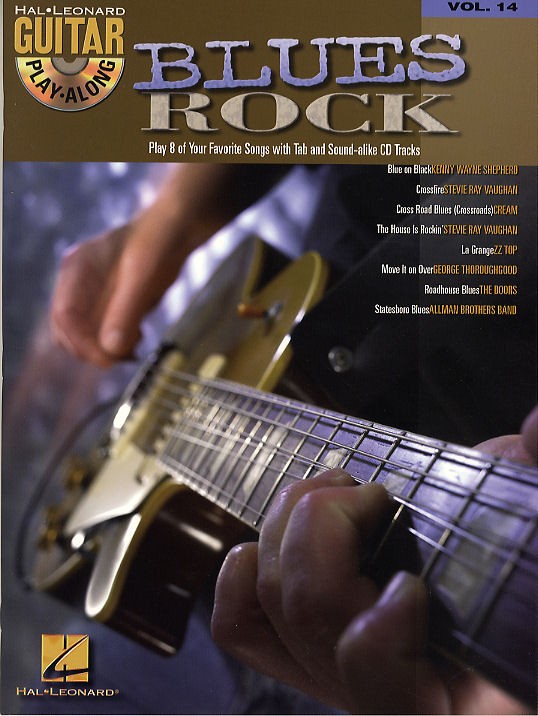
BLUES ROCK GUITAR PLAY-ALONG Vol 14 CD TABLATURE BASI LIBRO CHITARRA Roadhouse Blues-Doors

BLUES ROCK GUITAR PLAY-ALONG Vol. 14. CD TABLATURE

Blues Rock Guitar Play-Along Volume 14
Series: Guitar Play-Along
Format: Softcover with CD - TAB
Artist: Various

The Guitar Play-Along Series will help you play your favorite songs quickly and easily! Just follow the tab, listen to the CD to hear how the guitar should sound, and then play along using the separate backing tracks. The melody and lyrics are also included in the book in case you want to sing, or to simply help you follow along. The audio CD is playable on any CD player. For PC and Mac computer users, the CD is enhanced so you can adjust the recording to any tempo without changing pitch!

8 songs: Blue on Black • Crossfire • Cross Road Blues (Crossroads) • The House Is Rockin' • La Grange • Move It on Over • Roadhouse Blues • Statesboro Blues.

Inventory #HL 00699582
ISBN: 9780634056345
UPC: 073999186567
Width: 9.0"
Length: 12.0"
80 pages

- TITLE - ARTIST - WORDS & MUSIC - YEAR

- Blue on Black - Kenny Wayne Shepherd - Words and Music: Tia Sillers, Mark Selby, Kenny Wayne Shepherd - 1997

- Crossfire - Stevie Ray Vaughan - Written by: Bill Carter, Ruth Ellsworth, Reese Wynans, Tommy Shannon, Chris Layton - 1989

- Cross Road Blues (Crossroads) - Cream - Words and Music: Robert Johnson  

- The House Is Rockin' - Stevie Ray Vaughan - Written by: Stevie Ray Vaughan, Doyle Bramhall - 1989

- La Grange - ZZ Top - Words and Music: Billy F Gibbons, Dusty Hill, Frank Bear - 1973

- Move It on Over - George Thoroughgood - Word and Music: Hank Williams - 1947

- Roadhouse Blues - The Doors - Words and Music: The Doors - 1970

- Statesboro Blues - Allman Brothers Band - Words and Music: Willy McTell - 1929

Price: €22,99
€22,99

CARTER RON BUILDING JAZZ BASS LINES LIBRO CD CONTRABBASSO compendium techniques PLAY-ALONG

CARTER RON, BUILDING JAZZ BASS LINES. CD TAB.

Table of contents:

Eight
Little Waltz
Nearly

Series: Bass Builders
Medium: Softcover with CD

Artist: Ron Carter
In this book/CD pack, bass legend Ron Carter illustrates step by step the basic concepts of creating bass lines; constructing lines using non-harmonic tones and diverse rhythms; playing in fast tempos; and developing tone and pitch. Includes a play-along CD with an all-star rhythm section and isolated bass parts, so players can listen to Ron play the sample written lines, practice them with the CD, then create their own lines with the guitar, piano and drums backing them up. 48 pages.

Price: €23,99
€23,99

CASADY JACK, THE BASS GUITAR OF with Jorma Kaukonen TABLATURE DVD Jefferson Airplane-Hot Tuna-vibrato-Water Song

CASADY JACK, THE BASS GUITAR OF, with Jorma Kaukonen. TABLATURE DVD
THE BASS GUITAR OF JACK CASADY
Series: Homespun Tapes
Publisher: Homespun
Medium: DVD
Artist: Jack Casady
This DVD lesson is a treasury of the ideas and techniques of one of rock's legendary bassists. Jack Casady analyses his bass parts for classic tunes from the Hot Tuna repertoire and discusses the musical concepts that make up his unique style. 80-MIN. INCLUDES MUSIC + TAB EARLY INTERMEDIATE LEVEL

With Jorma Kaukonen

Jack Casady has been a mainstay
on the rock 'n roll scene
since the mid-60s, when he
helped found one of the seminal
bands of the era, Jefferson
Airplane. He and Jorma
Kaukonen left to form Hot
Tuna, still going strong after
well over twenty albums. In
addition to his work with the
Airplane and Hot Tuna, Jack
has worked with artists such as
Jimi Hendrix, David Crosby,
Warren Zevon, Country Joe
and The Fish, Rusted Root,
Gov't Mule and many others.
He has recently released his
first solo CD, "Dream Factor."
Jack and the other members of
Jefferson Airplane were
inducted into the Rock 'n' Roll
Hall of Fame in 1996.

HOMESPUN Woodstock, NY 12498

This lesson is a treasury of the ideas and techniques
of one of rock's legendary bassists. Jack Casady
analyses his bass parts for classic tunes from the Hot
Tuna repertoire and discusses the musical concepts
that make up his unique style. Long-time musical
partner Jorma Kaukonen sits in to provide vocals,
guitar parts and commentary.
In Ninety-Nine YearBlues and Blues in A, Jack contrasts
typical rhythm com ping with his own more
melodic approach to constructing bass lines. He
shows how the use of octaves, tonal variation, vibrato,
chord playing and moving up the neck add interest
and excitement to a bass part.
Jack uses San Francisco Bay Blues as a springboard
for understanding walking bass lines, while originals
such as Been So Long, Mann's Fate and Water Song
give the learning player access to his ideas on soloing,
arranging and playing in synch with another
musician. Through Jack's innovative style you'll learn
how to create your own grooves, explore your instrument
and become a truly creative player.
Music and tablature enclosed 80 minutes

HL00641816

Price: €34,00
€34,00

WHO, THE DEFINITIVE COLLECTION COMPLETE PACK, Four-Volume Anthology Guitar Recorded Versions

WHO, THE DEFINITIVE COLLECTION COMPLETE PACK, Four-Volume Anthology. Monumentale antologia in 4 volumi con oltre 150 titoli da 16 album, rare fotografie, discografia internazionale. Nei 4 volumi troverete l'intero "Quadrophenia" e "Tommy". Tra le altre vi segnaliamo: the real me -Dr. Jimmy -5:15 -love, reigh o'er me -the rock -quadrophenia -drowned -Baba O' riley (con la parte del violino trascritta per chitarra) -amazing journey (sparks) -I'm free -overture (it's a boy) -underture -pinball wizard -we're not gonna take it -Tommy can you hear me -see me feel me. TAB.

Price: €199,99
€199,99
Syndicate content