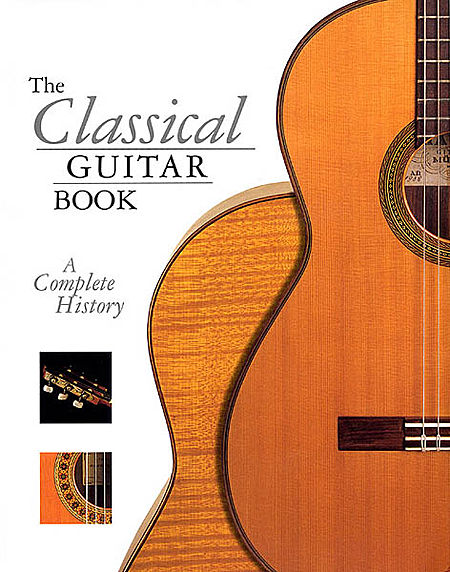
THE CLASSICAL GUITAR BOOK, A Complete History. John Morrish.
Serie: Book
Editore: Backbeat Books
Copertina morbida
Autore: John Morrish
The Classical Guitar Book
A Complete History
Series: Book
Publisher: Backbeat Books
Format: Softcover
Author: John Morrish
Inventory #HL 00330989
ISBN: 9780879307257
UPC: 073999309898
Publisher Code: 0879307250
Width: 10.0"
Length: 12.5"
126 pages
Hermann Hauser è considerato il più famoso produttore di chitarre classiche fuori Spagna che ha sviluppato le regole fondamentali della costruzione e design impostate da Torres, applicando a esse “i suoi principi teutonici di ingeneria” come li ha descritto Julian Bream. Ecertamente il fatto che le sue chitarre erano usate da Andres Segovìa più che favorito la reputazione di lutaio tedesco.
Hermann era il figlio di Josef Hauser, un musicista che suonava e faceva le cetre e altri strumenti musicali dall all'età di 18 anni: dal 1905 ha iniziato a produrre le chitarre i liuti. (Herman Hauser è chiamato come Herman I per distinguerlo dal figlio e nipote che anche portano il nome Hermann, anche loro fabricatori di chitarre.) Tutto questo tempo Hauser suonava in un quartetto è oltre a questa attivita, sperimentava nella costruzione delle chitarre alto e chitarre basso. Comunque lui attende il concerto di Miguel Liobet, uno dei più prominenti allievi di Francisco Tárrega, durante il tour del 1913-14. Llobet suonva la chitarra di Torres del 1859 e Hauser ha capito le potenzialità delle chitarre tradizionali di Torres. Così è iniziato il processo della costante ricerca. Secondo la ricerca di Franz Jahnel, pubblicato nel suo “Manuale delle Tecnologie Chitarristiche” del 1981, nel 1920 Hauser ha fatto una serie di conclusioni dopo lo studio degli effetti causate dal posizionamento assimetrico dei listelli. Nello stesso anno Hauser ha brevettato il progetto per il nuovo tipo di cassa armonica. Il top della sua chitarra veniva sostenuto con un listello trasversale e due listelli longitudinali, il listello trasversale sotto il top della corda MI con l'intenzione di rafforzare le note alte. Houser ha incontrato Andrés Segovia nel 1924 durante suo primo tournè in Germania e questo incontro ha aperto le future possibilità per il progresso. Per esempio, Segovia ha invitato il lutaio a esaminare e misurare la sua famosa chitarra di Manuel Ramírez/Santos Hernádez quale il chitarrista ha acuistato nel negozio di Ramírez a Madrid nel 1912 prima del suo debutto. A sua volta Segovia ha seguito il concerto di chitarristi che suonavano le migliori chitarre di Hauser come lui ha ricordato nelle memorie dedicate a Hauser e pubblicate nel 1954 nella revista “Guitar Review”.
“Le chitarre erano costruite dal Hauser”, scrive Segovia del concerto. “Le ho esaminato tutte e ho subito capito il potenziale di questo superbo artigiano, se la sua maestria potess essere applicata alla costruzione delle chitarre sui modelli spagnoli immutabilmente impostati da Torres e Ramírez come per il violino erano stabiliti da Stradivarius e Guarnerius.” Da quel momento Hauser ha iniziato a lavorare per crearequello, che Segovia avrebbe chiamato ”la più grandiosa chitarra dell'epoca”. Questo lavoro ha occupato alcuni anni, ma nel 1937 Hauser ha prodotto uno strumento che Segovia ha accettato con grande piacere. Josè Romanillos ha commentato tutta la complessita dello svilupo di Hauser I durante questi anni e l'influenza dei concetti spagnoli dopo il 1924. “Le chitare di Hauser subendo l'influenza spagnola sono divise in due categorie: una che segue il modello di Ramírez e altra che con un tocco ingenioso e innovativo ritorna al modello basilare di Torres. Nelle sue chitarre basate sul modello di Ramírez, si vede la sua influenza nella scelta del design della testa, largo posizionamento dei listelli e nelle dimensioni,” scrive Romanillos nel suo libro dedicato a Torres. “Houser ha provato diversi combinazioni e forme per i suoi strumenti anche dopo che ha prodotto per la Segovia la chitarra 1937. In alcune di queste chitarre intodotto un'amalgama di due maestri: forma arrotondata e e più armoniosa degli strumenti di Manuel Ramírez e alcune detagli che ricordano le forme delle chitarre di Torres come la testa, la lunghezza della scala e le decorazioni.”
Romanillos prosegue dicendo che prima del 1940 le chitarre di Hauser dimostravano ancor più forte affinità con le chitarre di Torres forse anche perchè proprio in questo periodo Hauser aquistò uno suo strumento creato nel 1960. Romanillos conclude che mentre non c'è alcun dubbio che la chitarra di Ramírez apartenente a Segovia ha avuto il ruolo principale nella crescita di questo grande produttore di chitarre....ma il sistema ortodossale di Torres che ha finalmente dato le basi per la costruzione delle chitarre di Segovia”. In questo modo Hauser ha incorporato i migliori elementi del design delle chitarre sviluppato in Spagna durante il dicianovesimo e al inizio del ventesimo secolo.
Libro di alta qualità da mettere in mostra, che propone testi dei più noti esperti del mondo ; il primo lavoro che racconta la storia completa della chitarra classica e del suo repertorio, degli artisti e produttori - dalle radici europei del 19 secolo alla moderna interpretazione internazionale. Questo bel libro con la copertina morbida è illustrata con le fotografie grandi delle chitarre classiche prodotte dai migliori lutai del mondo. Un'edizione addizionale parla del uso di chitarra classica nella musica pop, delle tecniche diverse di apprendimento e insegnamento; del mercato di collezionisti e la scienza della chitarra. Fa conoscere i profili di artisti famosi come Andrès Segovia, Julian Bream e John Williams; e in più, la, completa discografia, il glossario, l'indice, la biografia, tabella delle misure .
Offering essays by the world's top experts in a full-color, coffee-table quality book, this is the first work to tell the complete story of the classical guitar and its repertoire, players and makers - from its 19th century European roots to modern international interpretations. This handsome softcover volume features lavish photography of classical guitars made by the best luthiers in the world. Additional essays cover use of the classical guitar in pop music, different playing and teaching techniques, the collectors' market, and the science of the guitar. It also features profiles of legendary artists such as Andrés Segovia, Julian Bream and John Williams, plus a full discography, a glossary, an index, a bibliography, and a guitar measurement chart. 126 pages.
A more attractively presented pictorial book on the classical guitar I cannot imagine. It measures 32cm by 25cm, has 126 pages and is packed with beautiful colour pictures, with a small number in black and white; the main photographs being the work of Miki Slingsby. Selected guitars are presented on foldout pages, which display them to great effect. Unfortunately, it is a rather fiddly job to release the folded leaf out of the spine of the book as it is a close fit, trimming the page back a centimetre would have been most beneficial.
Based on the Russell Cleveland Collection, the book includes a brief history of the guitar starting with references as far back as Ancient Greece, through to the Renaissance, the Baroque and up to the small-bodied guitars as played by Fernando Sor (1778-1839) and Dionisio Aguado (1784-1849). It was these small-bodied guitars that were the predecessors of the modern guitar, upon which this book is mainly focused. There are also sections devoted to the anatomy of the modern guitar, with examples of various strutting, and a guitar, which is broken down into its constituent parts by the English luthier Paul Fischer, who is also an acting consultant on the book. The volume also covers woods favoured by the different makers, the science involved in construction, the future of the instrument - in fact all the aspects connected to the guitar in this form, are dealt with in a logical and informative way. There are biographies of the principal players and their association with certain makers. It is in this area that we are treated to Graham Wade’s insights into John Williams, and in particular Andrès Segovia, on whom Wade must rank as one of the foremost authorities. There is also a discography of recordings by a wide range of players.
One can tell from the foreword to the book, written by Russell Cleveland himself, that he is engaged in something of a love affair with the guitars in his collection. He describes their individual sounds and characters - the obvious joy of his life. This devotion is maintained throughout the book through the writings of the formidable array of scholars. These include Colin Cooper, editor of the Classic Guitar magazine, Brian Jeffery, author of probably the definitive book on Fernando Sor and Dr Bernard Richardson whose work in the field of the acoustics of stringed instruments is highly regarded, as well as the aforementioned Graham Wade. I name but a few, who have collaborated to impart their knowledge and, in many cases, their findings from lifelong study of the subject.
The core of the book concentrates on what is regarded today as the modern instrument as envisaged by the maker Antonio Torres (1817-1892), a guitar of greater power and projection. In doing this he more or less standardised, for subsequent luthiers, the body’s dimensions and string length. For the most part experimentation by the following generations of makers focused on the strutting of the top of the guitar, some improving on Torres’ original concepts, some not.
Starting with Torres, this book maps the progress of the luthier’s craft through its most significant makers from all over the world, including the family dynasty of Ramírez. It was Manuel Ramírez who in 1912 supplied the great Andrès Segovia with his first proper concert guitar. Also featured are the Hauser family, now into their third generation, as are the Fleta family. Both of these makers also produced guitars played not only by Segovia, but also by many of the other finest guitarists in the world.
The roll-call of great guitars and their makers continues down through the years, Simlicio 1925, Santos Hernánez 1933, Bouchet 1955, Rubio 1966, to mention only five of the thirty-four featured, up to a 1996 José Romanillos guitar. Romanillos made the guitar that Julian Bream used on many of his famous recordings and concerts. Each maker’s work is accompanied by a text outlining his life. Additional photos highlight the details of headstocks, labels, machine heads and rosettes. Also listed are the specifications (dimensions, weight and string lengths, etc) of many guitars.
To make a trumpet. said Mahler, you take a hole and you wrap a piece of tin around it. The guitar's construction is scarcely less simple: you take a hole and you build a wooden box around it. Across that box you stretch some strings. under which you attach a strip of wood so that you can press your fingers against the strings and so alter their pitch. Of course the process does not end there. Two highly skilled people are needed before your simple box can give out music. One is the player, who must devote years of study to finding out exactly how to activate those strings so that the sounds the box makes are musical sounds. The other is the builder, the luthier without whose expertise the full potential of the box cannot be realised by the player. The enthusiasm with which the guitar was taken up in the 1960s and 1970s has resulted in a proliferation of mature talent, both in building and playing. Possibly at no time in history have there been so many excellent instruments in existence, with equally excellent musicians to play them. The only drawback- and it is a serious one in economic terms - is that the guitar's audience has largely deserted it. A concert hall that was full for an inelifferent guitarist in 1967 may be. in 1997, only half full to hear a guitarist of acknowledged brilliance. It is possible that this decline in audience numbel's is linked with the gradual trivialisation of music. Music all too easily becomes muzak. a background noise ever present in supermarkets. restaurants and even five-star hotels. We cannot switch it off. but we can at least make no conscious effort to listen to it. That Quickly becomes a habit. and a bad one. so that when occasionally a piece by, say. Mozart comes out of the speakers. it merges almost imperceptibly into the mush that precedes and follows it. If someone should happen to notice the good Stuff among the trivia. the next step could lI'ell be to buy some Mozart and play it at home. But the quantum leap from the hi-fi to the concert hall is something that, given present levels of inertia, seems less and less likely to happen as electronic technology improves. It is ironic tllat the very technology that makes it so easy to listen to music at home should be the same as that which, by making it fully audible in a large hall, could in different circumstances be the guitar'S economic salvation. Without such amplification, the guitar is best suited to the intimate solo recital in a room containing no more listeners than can hear every nuance and every pianissimo, free from the constant fear of losing the musical narrative through a single inconsiderate cough. We call that a small audience. but the uncomfortable truth is that all audiences for classical music are small. When a John WiIIiams plays to 3000 Londoners. where are the other ten million or so? Eren if a Pavarotti sings to 20.000. that is still fewer than two persons in every thousand of the city's population. PR people. alll'ays imaginative. call this a 'mass audience'. All that can be accurately said is that Pararotti's minority audience is bigger than the minority audience of your are rage rirtuoso guitarist. Some have called for a new Segovia, a new Julian Bream, a new figure with the charisma to attract the general musical public. But behind this lie considerations that are more economic than musical. We are given to undrstand that the profile of the guitar will be changed, that people will begin to flock to the concert halls once more, and that all will be well with the guitar for another generation or two. Did not Segovia say: "It is the artist thal the people follow, not the instrument"? There is a lot of truth in that statement. Britten did not compose the Nocturnal for the guitar: he composecl it for Julian Bream. People, by and large, do not go to a guitar recital- if they go at all Jilin order to heal' Britten's Nocturnal: they go to hear Julian Bream play the Nocturnal. Nevertheless. a comparative lack of charismatic figures and the audiences to hear them are not in themselves indicators of terminal decline. The circle of guitar enthusiasts – and it is a very large circle - who keep the guitar going would in any case contradict you with considerable heat over the Question of charisma, pointing to David Russell. Manuel Barrueco, Eliot Fisk. Roberto Aussel and half a dozen other guitarists all capable of holding an informed audience spellbound for a couple of hours. What the critics are perhaps seeking is a guitarist who can hold an uniformed audience spellbound. That, though it would help the guitar's public image, can be termed an accident. Accidents do happen, but they cannot be relied upon. The absence of public charisma is certainly no way to judge the overall health of a musical instrument. Measured by the number of people who buy it and who play it, one would be justified in concluding that the guitar is in a state of mde health. Hundreds of thousands of classical guitars are made and sold erery year: where do they all go? A guitar is not a disposable object: it is not something that you renew every year: The only explanation is that large numbers of people are buying classical guitars - and. though the drop-out rate may be considerable. they surely do not buy them just to hang on the wall. An estimated two to three million people in Japan alone are believeed to play the guitar. They support a monthly magazine of 180 pages.The number of guitarists in China cannot eren be guessed at. The Shanghai guitar society alone is reported to have around 2000 members. In Beijing there is outstaneling guitar talent, with an enviable record of success in international competitions at the very highest level. Russia has a vast reservoir of guitar talent that neeeds only better teaching and better materials. The piano and the violin. with their long traditions. survived the decades of cultural isolation: the modern guitar depended too much on tile visit of Andrés Segovia in 1926. since when the message has become somewhat distorted. As in a game of Chinese whispers. That situation is being remedied. though slowly. In all the Scandinalian countries the guitar enjoys wide popularity. Even Iceland. with a population smaller than that of most cities, has mounted a guitar festival, Central European countries such as Poland, Hungary and the Czech Republic are rich in annual guitar festivals and competitions. Spain and Italy bothhave a number of important international competitions. Germany is particularly well endowed with guitar activity, and so is France. Some brilliant players from the Low Countrie. There is a new moviment to widen the guitar' scope in Turkey, which Venezueta and recently held ...
... dances, and for this they used a "Tist-based motion that involved the entire right hand. rather than a knuckle-based movement of the individual fingers. This simple and robust guitar technique is seldom encountered in the more refined repertoires of either the lute or the vihuela. In Spain, the status of the four-course guitar remained humble (its dubious associations with taverns and barbers' shops were already developing), but it soon began to acquire a serious repertoire in other countries, first in Italy, then more notably in France. The French king Henry II (who was held hostage in Spain from 1526 to 1530) developed a fondness for the instrument, and later employed several guitarists at his court. From 1550 onwards, books of music for the four-course guitar were regularly published in France,most of them by specialist guitar composers such as Guillaume Morlaye and Adrien Le Roy,but some by celebrated lutenists such as Alberto da Rippa,which suggeststhat the four-course guitar had come to be regarded in that country as a serious musical instrument. Several volumes of guitar music also appeared in London in the years around 1570, though these were mostly pirated from French publications. The heyday of the four-course guitar was undoubtedly the 16th century, but the instrument continued to be played throughout the 17th and 18th centuries. In Italy, it was mainly used to provide a strummed chordal accompaniment to popular songs and dances (often notated by means of chord charts similar to those used by today's pop and folk guitarists). and four-course guitars were manufactured in that country until at least the mid-seventeenth century. Indeed, small, strummed, four-course guitars persist to the present day as folk instruments in Spanish and PortugueseculLures (especially in South America). And, if the bordon is removed from the temple nuevos tuning suggested above by Bermudo, we are left with the standard pitches of the modern ukulele. Although the five-course guitar did not supersede the foure course version until well into the 17th century, depictions of fivee course instruments can be found in Italy from c.1500 onwards, while the earliest published music appeared in Spain in 1554, in the Libro se musica para I'ihuela by Miguel de Fuenllana. Many splendid fivee course instruments from the 16th and 17th centuries have survived, giving us a good idea of the typical design and dimensions: a flat peg box with ten tuning pegs inserted from the rear; elaborate inlaid designs on the neck, back. and table, often in ebony and ivory; an ornate rose; a string length of about 650-700 mm; and an overall length of about 900-950 mm. It is interesting to note that, although the guitar has generally been regarded as a quintessentially Spanish instrument, most of the finest extant five-course examples come from Italy, including several by Matteo Sellas of Veniceand two by the great violin-maker Antonio Stradivari of Cremona. The most remarkable feature of the five-course guitar was its 're-entrant' tuning, in which the sequence of open-string pitches does not follow a low-to-high pattern across the neck. To modern guitarists this can seem strange and even confusing. According to 16th century sources, a bordon should be used on each of the two lowest courses,giving a tuning recognisablysimilar to the top five strings of today's instruments (A/a - d/d' - g/g - b/b - e'). However, many 17th century guitarists chose instead to double the octave string and dispense with the bordon altogether, which meant that all five courses were devoted to the treble, and none to the bass (A/a - d'/d' - g/g - b/b - e'). So, where today's guitarists use their right thumb to play bass notes on the lmvest strings. many 17th century performers used their thumb and fingers to play interlocking notes of a scaleon the lower and upper courses (somewhatsimilar to the techniqueof a modern finger-style banjoist). The advantage of this was that players could create a striking bell-like effect (campanella) by letting several melody notes ring out simultaneously on different courses. so long as the music was composed with this technique specifically in mind. The use of tablature ensured that players would understand the composer's intentions, but it also explains why music written for the five-course guitar often sounds unconvincing and incoherent when performed on a modern classical instrument. The instrument was played in Italy at every level of society, and dozens of books containing simple strummed accompaniments to well-known songs and dance tunes were published throughout the 17th century. Many used a system known as alfabeto, in which letters of the alphabet were used to represent strummed chord sequences, encouraging players to think of the music solely as a succession of vertical harmonic progressions. But solo pieces by Italian guitar virtuosos like Francesco Corbetta and Lodovico Roncalli were generally performed using a more varied mixture of plucking and strumming, techniques often referred to as punteado and rasgueado respectively.Theinstrument was also widely played in Spain. perhaps the greatest 17th-century exponent being Gaspar Sanz, many of whose pieces (suitably modified) remain firmly in the repertoire of the modern guitar. Musicians in England and France were, however, initially even more sceptical about the artistic merit of the five-course guitar than they had been about the four-course. The lack of a true bass line offended many aesthetic sensibilities, and even Robert de Visee (the greatest French guitarist of the 17th century) lamented the inevitable deficiencies in the part-writing of his guitar music, weaknesses he never permitted in his more sophisticated lute compositions. He confessed that "the instrument itself is the reason".Nevertheless,it becamea favourite instrument of Louis XIV, who employed Corbetta as his court guitarist (and later de Visee). Charles II of England also became a keen player and patron. Although it was most successful playing solo music, or accompanyingsimple songs. the penetrating sound of the strummed guitar led to its widespread use as a continuo instrument. The popularity of the strummed style of alfabeto accompaniment led to the development of an instrument specifically intended for loud and simple rhythmic music: the chitarra battente. This instrument's origins remain somewhat uncertain (indeed, the name seemsnot to havebeen used until the 19th century), but it is thought to have been developed in Naples during the 1740s, at about the same time as the Neapolitan mandolin, with which it shares many characteristics. There are surviving 17th century chitarre battenti, but they seem to have started life as normal five-course guitars and been modified at a later date. The typical chitarra battente had a slightly rounded back, and five pairs of brass or steel strings, which were played with a plectrum. Metal strings had two principal advantages: they were louder than gut, and they held theil' pitch better when played outdoors in hot sun. But the greater strain that they imposed on the instrument demanded important modifications to the traditional guitar design. Bone or metal frets were used (tied gut frets being easily cut by the wire), and the table of the instrument was bent near ...
FOREWORD - RUSSEL CLEVELAND
INTRODUCTION - COLIN COOPER
ANATOMY OF MODERN GUITAR - JOHN MORRISH
THE GUITAR BEFORE TORRES - PAUL SPARKS
GUITAR METHODS - BRIAN JEFFERY
TORRES: LIVE & WORK - JOHN MORRISH
"TORRES" GUITAR
JOSÉ RAMIREZ I GUITAR 1897
ARIAS GUITAR 1906
MANUEL RAMIREZ GUITAR 1912
ANDRÉS SEGOVIAS - GRAHAM WADE
THE RAMIREZ BROTIIERS 1912
GARCIA GUITAR 1912
SIMIPLICIO GUITAR 1925
ESTESO GUITAR 1929
SANTOS HERNANDEZ GUITAR 1933
HAUSER I GUITAR 1935 - GRAHAM WADE
THE TRIUMPH OF THE SEGOVIA TECHNIQUE - GRAHAM WADE
GOMEZ RAMIREZ GUITAR 1936
VELAZQUEZ GUITAR – 1955
JOSE' RAMEREZ II GUITAR 1956
BOUCHET GUITAR 1961
ORIBE GUITAR 1965
RUBIO GUITAR 1966 - GRAHAM WADE
JULIAN BREAM
JOSE' RAMIREZ III GUITAR 1967 & 1969
SEGOVIA AND THE GUITAR MAKERS
WOOD AND THE GUITAR MAKER
HAUSER II GUITAR 1971
PENA FERNANDEZ GUITAR 1973
KOHNO GUITAR 1974
FLETA GUITAR 1975
THE FLETA FRATERNITY
RODRIGUEZ GUITAR 1976
RUCK GUITAR 1978
FRIEDERICH GUITAR 1981
CONTRERAS GUITAR 1983
UNCONVENTIONAL GUITARS
HAUSER III GUITAR 1988
BERNABE' GUITAR 1992
THE FUTURE OF THE INSTRUMENT
FLAMENCO: SETTING THE SCENE - BROOK ZERN
FLAMENCO: EVOLUTION OF AN ART FORM - BROOK ZERN
SMALLMAN GUITAR 1992 - TONY BACON
JOHN WILLIAMS
SCIECE AND THE GUITAR MAKER - BERNARD RICHARDSON
HUMPHREY GUITAR 1993
GILBERT GUITAR 1994 - RICHARD JOHNSTON
ROMANILLOS GUITAR 1996
THE MARKET: VISITING SPAIN
THE MARKET: A DEALER'S VIEW
THE MARKET: AUCTION HOUSES
THE MUSIC: COMPOSERS
THE MUSIC: ON THE RECORD - COLIN COOPER
THE MUSIC: IN THE STUDIO - COLIN COOPER
THE MUSIC: CLASSICAL CROSSOVER - PAUL FOWLES
GLOSSARY / INDEX / BIBLlOGRAPHY / ACKNOWLEDGEMENTS .
MEASUREMENTS / SPECIFICATIONS / CONVERSATIOS

 Italiano
 English