CHITARRA - GUITAR

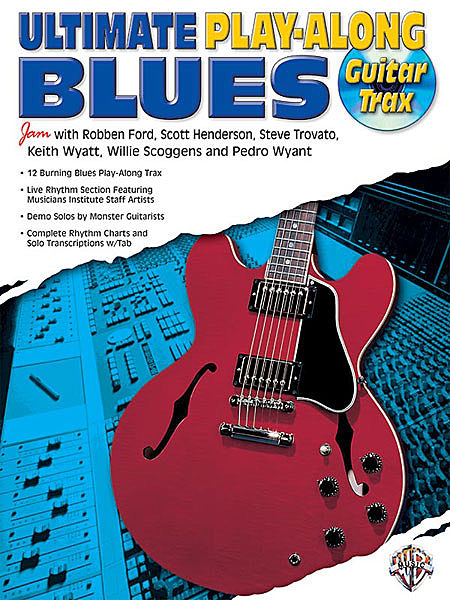
ULTIMATE PLAY-ALONG BLUES GUITAR TRAX Robben Ford-Scott Henderson-Steve Trovato CD TABLATURE

ULTIMATE PLAY-ALONG BLUES GUITAR TRAX. CD TABLATURE

JAM WITH Robben Ford, Scott Henderson, Steve Trovato, Keith Wyatt, Willie Scoggins, Pedro Wyatt.

Per ogni pezzo troverete nelle diverse tonalità, schemi della scala pentatonica maggiore, della scala pentatonica minore, della scala Blues, della variazione della scala pentatonica minore (Hybrid), con la tonica sulla sesta corda suonata con l'indice e suonata con il mignolo, sulla quinta corda, sulla quarta corda , sulla terza corda, sulla seconda corda. All'inizio di ogni titolo dopo la presentazione un Suggest Voicing con gli accordi da usare. Modelli dell'arpeggio di settima dominante. 


Ship, Captain, Crew - Ginger Pepper - Deja Blue - I Do What I Want - Funky Blues - 3's Wild - Never Ending Blues - Drop Dead Blues - Clear Road Blues - Vinda's Place - Bad Dog Blues - Sunset Saloon. 

12 Burning Blues play-along Trax
Live Rhythm section featuring Musicians Institute Staff Artists
Demo Solos by Monster Guitarists
Complete Rhythm charts and Solo Transcriptions with TABLATURE


The Musicians Institute, home of the Guitar Institute of Technology, is proud to introduce a new and different concept in "play-along" recordings. Drawing on over 15 years of experience as the leader in guitar education, MI has developed Master Trax, the most dynamic, educational and entertaining series of its kind. The complete tape/cd series was conceived to provide the aspiring guitarist with the opportunity to play-along with some of the finest musicians in the world. The combination of a live rhythm section made up of MI staff artists, and demo solos recorded by GIT specialists such as Steve Trovato. Keith Wyatt. Nick Nolan, and Paul Hanson plus guest artists like Paul Gilbert, Albert Lee. Jeny Donahue, Scott Henderson and Robben Ford make this the most exciting, authentic and useful play-along series ever created.

The accompanying books contain both an analyses of each progression and a transcription of each demonstration solo. Fingerings for some practical scales are diagramed and located nearby for easy access. To maximize your efforts we suggest that you spend some time practicing all of the scale patterns presented. We hope you enjoy this series and above fun !


The Authors

Steve Trovato is one of the premier educators at the Musicians Institute in Hollywood, CA. He has authored and produced several instructional books and videos. Steve performs regularly at night clubs, also doing clinics, seminars and TV dates. He is currently working on a solo album. Steve currently holds a position as lecturer at the University of Southern California.

Paul Famen has been on the BIT faculty since 1981 and has held the Department Chairman position since 1986. His album credits include both jazz and R & B and has written and performed on several documentary films (HBO) and commercials. He has also been involved in clinics in the U.S., Japan (Yamaha and T.C.A.) and Europe.


The Players

Robben Ford has played with everyone from Joni Mitchell to Miles Davis, with his new group The Blue Line, featuring Roscoe Beck and Tom Brechtlein, Robben has established himself as one of the premier blues guitarists of our era. Robben has several videos and books w/audio available from CPPlBelwin, Inc.


Keith Wyatt, the Department Chairman at GIT,is credited with three instructional videos, two book/cassette instructional collections, and is a bi-monthly columnist for "Guitar School Magazine." Keith has performed with Ginger Baker, Jack Bruce, Tim Bogert, Albert Collins, Harvey Mandel, Mick Taylor, and has toured extensively in Japan and Sweden.


Willie Scoggins, originally from Ft. Worth, Texas, has been playing blues for 2S years and has played numerous blues gigs in the Los Angeles area for the last 10 years. Willie says" ...go ahead and learn the licks on this tape because they're the only ones I know (well... sorta'). He now makes his home in Austin, Texas.


Scott Henderson has performed and recorded with Jean -Luc Panty, Chick Corea, Joe Zawinul, Players, and Jeff Berlin. He has recorded six albums with his own group Tribal Tech. Scott is the author of two instructional videos and one song book. He is a columnist for Guitar Player, Guitar World and Guitar For The Practicing Musician. Scott's latest album is "Blues for Dogs."


Pedro Wyant has recorded with Lou Rawls, The Beach Boys, David Axelrod, Joe Sample, Howard Roberts, Earl Palmer, and Carol Kaye. He has also performed with Albert Collins, Lonnie Brooks, Buddy Guy, Big Jay McNelly,Joe Houston, Joanie Sommers and Willie Dixon Blues Band.


Gary Hess, the drummer for this session, is a freelance musician. He has performed in clubs all over the U.S. and Canada, on television with John Davidson, and is also the author of PIT Sight Reading Curriculum.


Henry Brewer, the keyboardist for this session, is a working L.A. Professional. He has worked on mm soundtracks, recorded jingles, and can be seen on Earth, Wmd and Fire bassist Verdine White's instructional video. He teaches at KIT and authored KIT's Voicings curriculum. He is currently working with The Emotions.


Ship, Captain, Crew - STEVE TROVATO - SOLO BY ROBBEN FORD - 1994

Ginger Pepper - STEVE TROVATO - 1994

Deja Blue - STEVE TROVATO - SOLO BY ROBBEN FORD - 1994

I Do What I Want - STEVE TROVATO - SOLO BY KEITH WYATT - 1994

Funky Blues - STEVE TROVATO - SOLO BY KEITH WYATT - 1994

3's Wild - STEVE TROVATO - SOLO BY WILLIE SCOGGINS - 1994

Never Ending Blues - STEVE TROVATO - 1994

Drop Dead Blues - STEVE TROVATO - SOLO BY ROBBEN FORD - 1994

Clear Road Blues - STEVE TROVATO - SOLO BY KEITH WYATT - 1994

Vinda's Place  - STEVE TROVATO - SOLO BY SCOTT HENDERSON - 1994

Bad Dog Blues - STEVE TROVATO - 1994

Sunset Saloon - STEVE TROVATO - SOLO BY PEDRO WYATT - 1994

Price: €29,99
€29,99

COUNTRY GUITAR JAMMIN' BOOK CD TABLATURE BASI LIBRO SPARTITI CHITARRA HAL LEONARD

COUNTRY GUITAR JAMMIN'. 10 basi di musica country. CD TAB.

Price: €25,99
€25,99

BEBOP BLUES BY COREY CHRISTIANSEN BOOK CD GUITAR TABLATURE SPARTITI CHITARRA LIBRO

BEBOP BLUES. 29 tracce audio, 80 pagine. CD TABLATURE

Price: €49,99
€49,99

ACOUSTIC FUSION-GUITAR SCORE TABLATURE MEDITERRANEAN SUNDANCE MEOLA SPARTITI CHITARRA

ACOUSTIC FUSION. 14 Titoli. Rio funk (Ritenour) -rainbow (Ritenour) -sun Juan sunset (Ritenour) -living inside your love (Earl Klugh) -Catherine (Earl Klugh) -dance with me (Earl Klugh) minute by minute (Carlton) -mediterranean sundance, per due chitarre (Al di Meola) -Rene's theme (Coryell) -early autumn (Mezzoforte) columbia (acoustic alchemy) e altri. TAB.

Price: €99,99
€99,99

101 MUST KNOW JAZZ LICKS CD GUITAR TABLATURE SWING-PRE-BOP-BEBOP-HARD BOP-COOL JAZZ-CHORD

101 MUST KNOW JAZZ LICKS. CD TABLATURE

A Quick, Easy Reference for All Guitarists
Series: Guitar Educational
Format: Softcover with CD - TAB
Author: Wolf Marshall

Now you can add authentic jazz feel and flavor to your playing! Here are 101 definitive licks, plus a demonstration CD, from every major jazz guitar style, neatly organized into easy-to-use categories. They're all here: swing and pre-bop, bebop, post-bop modern jazz, hard bop and cool jazz, modal jazz, soul jazz and postmodern jazz. Includes an introduction by Wolf Marshall, tips for using the book and CD, and a listing of suggested recordings.

Inventory #HL 00695433
ISBN: 9780634013713
UPC: 073999315271
Width: 9.0"
Length: 12.0"
48 pages


Jazz is a musical language with a variety of dialects. To speak jazz on the guitar with authenticity
and eloquence requires more than finger dexterity, a facile mind, or a creative impulse. It requires
a sense of tradition and a seemingly endless well of ideas. In non-literary cultures, the act of communication
and the art of conversation are learned through what is known linguistically as "oral
tradition"-a practice passed down from generation to generation by listening, imitating, mastering,
and ultimately reinterpreting with personal expression. So it is with jazz. The great jazz players
of history have, largely by ear, studied, absorbed, and reassembled the contributions of their
forebears. Picture George Benson repeating Charlie Parker licks until they were part of his vocabulary.
Or imagine Barney Kesselstruggling to get Charlie Christian's phrases under his fingers. Pat
Martino memorized and reinterpreted Johnny Smith's and Howard Roberts' signature licks to formulate
his own innovative style. Joe Passemulated and respun the stylings of great jazz wind and
piano players. And new voices like RussellMalone, Ron Affif, and Jimmy Bruno currently lead
today's straight-ahead movement with inspired reinventions of Wes Montgomery, John Coltrane,
and Hank Garland. The process largely entails the learning and mastery of specific phrases, or
licks, that are akin to sentences in a spoken language. This can be a daunting task considering the
vast number of musicians and styles in the genre.
Enter 101 Must-Know Jazz Licks. This book is a lexicon of essential phrases in a wide variety of
styles within the jazz genre. Each lick is a self-contained phrase with a central idea or focal point
and is an indispensable piece of the jazz vocabulary. The 101 licks are presented in rough chronological
order beginning with the late 1930sand continuing to the present. If you're already a jazz
guitar aficionado, this book may revive some delightful memories and inspire you to take your
current playing down some familiar old paths. If you're coming to this guide with an interest that
outweighs your knowledge of the jazz genre, expect to be taken on a trip through musical
Americana, with a soundtrack to match, from which you will emerge a more conversant and passionate
player.
-Wolf Marshall


Introduction
This volume is designed for all guitarists. Arranged for quick, easy reference, it contains 101 stylistic
phrases, commonly known as "Iicks"-those essential, self-contained instrumental figures utilized
by the great masters. Licks are part and parcel of the jazz tradition and the jazz experience.
Charlie Parker used 'em, so did John Coltrane and Wes Montgomery, and so does virtually every
player on the current scene. Licks are short, meaningful passagesskillfully tucked into tunes and
riffs, and laced through the improvised solos of the repertory. The audience may not hear them
or even be aware of them, but they can always be felt. A well-turned lick can make the difference
between a cold, mechanical statement and a communicative, engaging performance; and
the right lick driven by the energy and conviction of a seasoned player can bring the audience to
its feet.
Now you can add an authentic jazz feel and flavor to your playing. Here are 101 definitive licks
from every major jazz guitar style neatly organized into easy-to-use categories. They're all here:
swing jazz, pre-bop, bebop, hard bop, modal jazz, cool jazz, soul jazz, postmodern jazz, free jazz,
chord licks, and more. Browse to your heart's content, and feel free to tap into the feeling of
each lick that speaks to you. As you do, you'll be taking that vital first step of reinvention that
connects you to the spirit and the essenceof America's most emotional and transcendent
art music.


Tips for Using this Book and CD
1. Play these licks allover the fingerboard. If a lick is positioned at the eighth fret, move it down
to the third fret and play it in that area; you will notice that the string feel, tension, and fret
distances have a bearing on how the lick feels. Then move it up chromatically as a drill, playing
it in every position from the third to the seventeenth fret. This will depend on the range of
your guitar's fingerboard. Note the key changes as you move the licks to different positions.
2. Put several licks into the same key. For example, if a lick is presented in C and another is in G,
place them both into C, and then into G. This is the musical equivalent of using all your linguistic
phrases in one conversation.
3. Take that collection of phrases into various keys. Once you have grouped a number of licks into
the same key, move that grouping to new positions.
4. Make notes, mental or written, about the feel of each lick. Your visceral, emotional reaction to
a lick is part of the ad-lib selection processwhen improvising. This processcould involve forming
a visual image of the lick's physical shape-how it sits on the fingerboard.
5. Add at least one new lick per week to your vocabulary. Memorize and use it in your current
musical situation-playing with a band, adding it to an existing solo or song, or when jamming
with your friends.

About the Recording
Each lick is played twice on the accompanying audio: first at the normal tempo and then, after a
two-and-a-half-second pause, at a slower tempo.
Licks 1-98 are found at the corresponding CD counter numbers. Licks99, 100, and 101 are presented
as a single track on number 99. Within that counter number (99), use the following time codes
to find the three licks: Lick 99 occurs at 0:00, Lick 100 occurs at 0:45, and Lick 101 at 1:04.
These licks were played using authentic Gibson archtop electric guitars and miked amplifiers
including vintage Gibson and Fender tube amps and modern Polytone amps. The sounds, settings,
and particular instruments are cited in the accompanying performance notes.


TF=Target figure. This three-note melody pattern typically approaches a selected (tar-
get) tone by beginning on its upper neighbor, jumping to its lower neighbor, and then
moving to the target. See Lick 20.
VLF=Voice leading figure. A specific four-note pattern endemic to bebop and modern
jazz styles. The all-important figure involves approaching a particular note first from a
half step above and then from below (always by two half steps in succession).See
Lick 20.
SUB=Substitution. This refers to an alternate scale or melody substituted for a primary
relationship. It is followed by a scale or chord name, such as "SUB Abm" (AI, minor
instead of a more typical Bbl scale or harmony). See Lick 27.
Q: and A:=Question and answer phrases.The "call-and-response" procedure is an
important aspect of applying licks to form a larger melody structure.
Every lick is defined by an overall context; this can be a "basic scale" or "basic tonality." Most jazz
licks are defined by their harmonic setting and use a variety of scalesto convey melodic motion
through chord changes. In this case,a single basic scale would not be a sufficient label and could
present an incomplete and erroneous picture. Melodies such as these are labeled as having a
"basic tonality" though they are comprised of single notes as in Lick 10. Many jazz licks have a
plural harmonic application. For example, Lick 1 can be thought of as originating from either the
AI, major scale or the AI, Mixolydian mode (dominant seventh sound) as it does not contain the
crucial seventh in its melody. Similarly, Lick 5 has a plural application and could be used over an
FmGor Bb9chord background.
A suggested tempo is provided for each lick-Fast Swing, Moderately, Slowly (Rubato), etc.-to
further guide you in applying these phrases in your music. All licks marked with a swing feel
(Fast Swing, Moderate Swing, etc.) are to be perceived as occuring against a triplet feel background
and are generally to be played with swing eighth-note rhythm. This means that each twoeighth-
note rhythm unit is to be played as a quarter-eighth grouping of an eighth-note triplet

After getting these licks under your fingers, try taking them apart by playing them in pieces,
inside out and backwards. Each lick can be thought of as having several melodic or harmonic
"cells" of varied sizes in its structure. Eachcell is akin to a thought or group of words in a sentence.
These can be grafted to other cells from other licks to form new phrases.This processof
developing original music from fragments is a viable strategy for building a new musical statements
of your own.
Finally, once you have grasped the essentials of these licks, begin your own investigations. To this
end, a list of suggested recordings is offered in the back pages of this volume. Pick your favorite
jazz improvisations, and listen for these devices at work in the music of the great players. Be on
the lookout for imitative procedures and sequential activity in melodies and riffs, question-andanswer
phrases, harmonic extensions and alterations, unique turnarounds, and other thematic
development strategies. This sort of listening and thinking opens the door to a deeper understanding
and assimilation of the jazz language.


About the Author
Wolf Marshall is the pre-eminent guitar educator-performer of our time. The founder
and original editor-in-chief of GuitarOne magazine, he is a highly respected and prolific
author and columnist who has been an influential force in music education since the early
1980s.Wolf has worked closely with Hal Leonard Corporation for the past decade,
authoring such highly acclaimed multimedia books asThe Guitar Style of Stevie Ray
Vaughan, Stevie Ray Vaughan, Blues Guitar Classics, The Beatles Favorites, The Beatles Hits,
The Rolling Stones, The Best of Carlos Santana, Guitar Instrumental Hits, Steve Vai: Alien Love
Secrets, Eric Clapton Unplugged, Eric Johnson, The Guitars of Elvis, Aerosmith 1973-1979 and Aerosmith 1979-1998, Acoustic Guitar of the '60s and '70s, Acoustic Guitar of the '80s and '90s, Mark Knopfler, The Best of Queen, The Best of Cream, and many more. His eight-volume seriesThe Wolf Marshall Guitar Method and Power Studies established new standards for modern guitar pedagogy in the early 1990s,as did his Guitar Jammin' authentic song books.
In 101 Must-Know Jazz Licks, and its predecessor 101 Must-Know Blues Licks, Wolf directs his
encyclopedic knowledge of modern guitar music at a unique series designed to improve the
vocabulary of all guitarists. The list of his credits is immense and can be found at his web site:


Swing and Pre-Bop
This group comes from the swing era of the late 1930sand early 1940s.Jazz was at
the height of its popularity in this period. Swing was a dance-oriented jazz style played predominately
in ballrooms by big bands of fourteen or more musicians. The music's harmony centered
around mildly dissonant chords like major and minor triads with added sixths, dominant sevenths,
and dominant ninths. These harmonies supported largely diatonic melodies set in riff-dominated
jazz tunes, 12-bar blues structures, and 32-bar pop tunes.
Swing's leading guitarist was Charlie Christian, who combined elements of earlier classicjazz traditions
as well as blues licks from the southern states and horn licks borrowed from wind players
like Lester Young and Roy Eldridge. The practice of emulating and adapting "horn licks" (largely
from saxophone and trumpet) has been a mainstay of jazz guitar since Christian's time. Christian's
pioneering use of the newly-designed Gibson Electric-Spanish (ES)guitar established the role of
the electric guitarist in jazz. Prior to his appearance, jazz guitarists were mainly confined to
strumming in the rhythm section or forced to play in smaller all-string combos such as Django
Reinhardt's Hot Club quintet.
Christian's work with the Benny Goodman Sextet set the standard for early combos that included
electric guitar. Jazz, blues, and pop guitarists who followed in the 1940swere under the spell of
Charlie Christian and sought to emulate his sound and style. In swing and pre-bop, this included
Oscar Moore, Barney Kessel,AI Casey,Herb Ellis, and others. Sweepingly influential, Christian's
licks were also heard in the subsequent wave of jump blues guitarists and early rock 'n' roll players.
Identifiers of the swing style include an eighth-note-dominated horn-like phrasing, extensive
use of the sixth degree of the scale and chromatic passing tones, blues riffs, and a strong swing
rhythm feel.
To maintain sonic authenticity, I played these licks on my Gibson ES-175/CCwith heavy-gauge
strings. This instrument is equipped with the early Gibson bar pickup (dubbed the "Charlie
Christian pickup") in the neck position. The volume and tone controls were both set at 8. The guitar
was played through a vintage 1952 Gibson GA-75 amp with one 15-inch speaker. The tone of
the amp was set for a warm and moderately clean sound with a hint of tube overdrive; in this
case,treble and bassat the midway point and the volume at just below halfway. This sound is
generally the norm for early jazz guitar, circa 1940s-1950s.
+Basic Scale: Ab Major/Mixolydian
Fast Swing Ab(6)


Contents
Introduction
Tips for Using this Book and CD
About the Recording
Lick Analysis and the Lick Legend
SWING and PRE-BOP
BEBOP
Bird: Charlie Parker
Post-Parker Bop Guitar
POST-BOPMODERN JAZZ
Trane: John Coltrane
HARD BOP and COOL JAZZ
MODAL JAZZ
SOULJAZZ
POSTMODERN JAZZ
JAZZ CHORD LICKS
Suggested Recordings
About the Author
Guitar Notation Legend

Price: €21,99
€21,99

LARRY & LEE RITENOUR & CARLTON GUITARS TABLATURE SPARTITI CHITARRA TRASCRIZIONI BOOK

LARRY & LEE RITENOUR / LARRY CARLTON. SHEET MUSIC BOOK WITH GUITAR TABLATURE.


BOOK OF JAZZ / FUSION MUSIC.

SHEET MUSIC FOR GUITAR WITH CHORDS, TRADITIONAL NOTATION, TABLATURE. 

2 LINES OF TRADITIONAL NOTATIONS & 2 LINES OF GUITAR TABLATURE. 

103 PAGES.

SUPER TRANSCRIPTIONS !

LARRY CARLTON e LEE RITENOUR
(YEAR ALBUM: 1995)

Crosstown Kids - MUSIC BY LEE RITENOUR.
Low Steppin' - MUSIC BY LEE RITENOUR and LARRY CARLTON.
L.A. Underground - MUSIC by LEE RITENOUR.
Closed Door Jam - MUSIC BY LARRY CARLTON.
After the Rain - MUSIC by LEE RITENOUR.
Remembering J.P. - MUSIC by LARRY CARLTON.
Fun in the Dark - MUSIC by LEE RITENOUR.
Lots About Nothin' - MUSIC by LARRY CARLTON.
Take That - MUSIC by LEE RITENOUR.
Up and Adam - MUSIC by LARRY CARLTON.
Reflection of a Guitar Player - MUSIC BY LARRY CARLTON.  

Price: €259,99
€259,99

BYRD CHARLIE BLUES SONATA & JAZZ STANDARDS FOR GUITAR BOOK CD TABLATURE LIBRO CHITARRA METODO

BYRD CHARLIE, BLUES SONATA & JAZZ STANDARDS FOR GUITAR. SHEET MUSIC BOOK WITH CD & GUITAR TABLATURE.

LIBRO METODO DI MUSICA JAZZ CON CD.

SPARTITI PER CHITARRA CON: 

ACCORDI, PENTAGRAMMA, TABLATURE. 

Price: €99,99
€99,99

CARLTON LARRY GUITAR PLAYER TABLATURE CHITARRA LIBRO SPARTITO Room 335 sleepwalk

CARLTON LARRY, PLAYER. Anche per due chitarre. Room 335 -nite crawler -point it up -Rio samba -(it was) only yesterday -strikes twice -midnight parade -song for Katie -sleepwalk -blues bird -south town -blues for T.J. -crusin'. TAB.

Price: €98,00
€98,00

CARLTON LARRY TABLATURE ROOM 335-NITE CRAWLER-POINT IT UP-RIO SAMBA DON'T GIVE IT UP-(IT WAS) ONLY


CARLTON LARRY, LARRY CARLTON. TABLATURE

Room 335 - Carlton
Nite Crawler - Carlton
Point It Up - Carlton
Rio Samba - Carlton
Don't Give It Up - Carlton
(It Was) Only Yesterday - Carlton


A longtime Nashville resident, Larry Carlton will perform a special hometown show at the Schermerhorn Symphony Center on Friday, September 30. Carlton spoke to Examiner.com about the upcoming show, his long career, playing with Michael Jackson and Dolly Parton, his continuing passion for music and more in the following interview.

Special thanks to Larry Carlton, and to Laurie Davis of the Nashville Symphony for arranging this interview.


You're playing at the Schermerhorn on Friday. Is this in conjunction with the Larry Carlton Plays the Sound of Philadelphia project?

That will be part of the show. The show I'm putting together is . . . I don't know if you'd call it the landscape of my career, but I'm going to do some things that I haven't done before, and the people are gonna be excited. They're gonna go, "Wow, I didn't know he played on that," or "Really? He was involved in that?"

I want to do a special show that night. It won't be just me and a sax player. (Laughs).

How did this come about? Did they approach you, or were you looking around for an appropriate venue for a particular type of show?

I was approached. I guess they finally got around to me. (Laughs). No, I was excited when I got the call. It's hometown for me, and the venue, if you will. I'm really excited.

I saw on your web site that you're going to be appearing with Steely Dan in New York City. Did you see them when they were in town?

No, I was actually out of town. Last year, or a year and a half ago they invited me to do seven shows with them. So I did a couple of nights in New York, one in Chicago, a couple of nights in LA. It was the first time . . . well, I'd never played live with them, and it was the first time in 35 years, since we cut The Royal Scam, that I went back and learned my solo from "Kid Charlemagne."

What's it like going back and re-visiting a part of your own career like that? Is it strange for you?

They're great memories. The weirdest thing for me is, I've never learned one of my own solos. (Laughs). I knew I had to play it note-for-note, and when I did, I got a standing ovation. People wanted to hear Larry play that solo.

After the long career you've had and all the various things you've done, what is it that keeps you active and excited about music?

That's a difficult question in that, at four years old I was fascinated with the guitar. At six years old I started taking lessons. I was passionate about it through the next fifty years, and that passion still exists.

Do you still keep an active practice regimen? Do you have the guitar in your hand every day?

No, normally I do about 125-150 a year touring around the world. So when I come home - and this is not new to me, I did this way back in the seventies - it's not unusual for me to not touch the guitar for a month, and just live my life; go horseback riding, go fishing.

I find that's good for my soul, good for my mind, and then when I come back to the guitar it's time to go again. It's a balance, I think.

You came up in an era where everything about the business was different. With all the changes in recording and distribution, do you think it's easier or harder for an artist in your position than it used to be?

Well, I have a unique situation, so I'm going to say it's easier. I have my own label now, and for the last four-and-a-half years. It was the first time in 17 years that I wasn't on a major label, and it was by choice. With the Internet I can talk to, play for, make music for the whole world, not just the US. When I was on a major they were very focused on the US.

Of course my albums were distributed overseas, and I have a great career in Japan and Europe. But now, I get an idea for a project . . . maybe it'll come from someone on Facebook saying, "Larry, have you ever thought of something with strings?" It could happen like that. So I'm enjoying the freedom of getting to make those choices.

What about the downside of the Internet, which is illegal downloading. Has that impacted you in the same way that it has rock and pop acts?

Well, of course. My numbers are down, like most artists, because everybody's exchanging files back and forth. That affects not only your record royalties, but your publishing and writing royalties. But it's just a new day, and I'm going with it. On my web site I'm sharing how I learned the guitar, how I play it . . . I want to be part of this new scene, and not avoid it and resent it.

You've obviously done a ton of recording, but two names jumped out at me from all that you've done that I wanted to ask you about, one of which is Michael Jackson. What did you do with Michael Jackson?

Quincy [Jones] called and said, "Larry, I have a special song, and it's got to be you." Because I wasn't doing a lot of dates, I'd already discontinued doing a lot of dates back then. So I went in and recorded what became a single, "She's Out of My Life."

In fact I'm looking at a three-foot plaque in my office right now that says, "Michael Jackson Off The Wall, over five million albums sold. We got all the marbles on this one, thanks for your help, Quincy." And there's four marbles in the bottom of it. It has a picture of Michael and the album cover. So yeah, I played on one cut on that album as a favor to Quincy.

The other one that popped out at me was Dolly Parton. I didn't know you'd done anything with her.

I don't remember the date, to tell you the truth. Whoever was producing her in LA in probably the early-to-mid seventies called me as the guitar player. So I know that I played on some stuff for Dolly, but I don't know what it was. (Laughs).

When you're doing that many different dates in so many different styles as you used to, is there any rational way to prepare for that, or do you just walk in and do it?

You walk in cold.

Versatility has served me well, and I think one of the reasons that I'm so versatile as a musician is because of the era and time that I was brought up. You figure, I was born in 1948, so by the time 1958 came around I'm ten, and I'm listening to doo-wop music on the radio. And that transitioned into the sixties, and rock and roll became very big.

So I'm part of that whole history, and I was playing the guitar the whole time. Every time something new came out in a style, I was aware of it. It was part of my hunger to learn how they did that. I wanted to learn the solo on an Elvis Presley record, and then The Beatles came along. So I lived through that transition, and the one thing that really made me a little bit different is that I fell in love with jazz when I was 14, but I didn't neglect pop music.

Back then every genre lived side by side, whereas now it's become divided and everything is micro-marketed to a very narrowly defined target demographic. How has that impacted you?

Obviously because I'm an instrumentalist, I was very happy in the mid-eighties when that format came along called the quiet storm, which transitioned into smooth jazz. All of a sudden there was a place on the radio for those of us that don't sing.

But I think it's run its course, I think it's boring now, and most of the stuff on those stations all sounds the same. You can't tell one sax player from another. But it was a neat thing that happened, and it exposed a lot of us to people that otherwise wouldn't have known us.

Are you finding that there's any good that's coming to you from any of the various alternatives, like satellite radio?

Yeah, I think so. You know, my songs are on those stations, and I'm sure there are people at home that keep those on sometimes, and listen to them while they're living their lives in their house or car, so it's just a nice place where someone might discover an artist.

You're offering interactive lessons on your web site. What gave you the idea to do that?

I was doing a guitar seminar in New York, and a producer was there who produces teaching DVDs. He has the largest Internet site, called True Fire. Anyway, he was impressed with my seminar and the way I communicate, so he approached me and said, "I'd like to produce a teaching video with you. It's been twenty years since you've done one." So that's how it started, and it still continues. I'm flying out tomorrow to speak to him about another project. So having a great producer helps me expose what I want to give to the guys out there.

What do you think is the most important thing to know for a kid who wants to play guitar?

I think what you just said: if a kid wants to play. I think motive is really important. What's your motive to play the guitar? Mine was always to make music. I can say this honestly: I never thought about being a star. It never entered my mind. I wanted to play the guitar. My dream as a teen was to be like my jazz heroes and play jazz in smoky clubs my whole life. I didn't know I was gonna become a session guy or any of that stuff.

So it's motive. Are you doing this because you want to be a star, or do you want to be a musician? If you're doing it because you want to be a star, then you'll go that direction, and that's okay. Both avenues are fine, but I think you've got to be honest, because I think truthfulness comes out of you when you're playing your music.

I read this online; is it correct or incorrect that your niece is Vanessa Carlton?

Nope. Incorrect! (Laughs).

I suspected that.

I have no idea where Wikipedia got that information. I've never met her.

Your son Travis is a bass player. Is it something that gives you pause, to see him go into the business? Because you have a decades-long bird's eye view of how difficult it can be.

All I can tell you is that he's gifted with music, and then he worked very, very hard as soon as he got out of high school. He went to GIT, graduated top of the class, Best Performer . . . he's a gifted, gifted musician who's worked very hard, and now he's reaping the rewards of that.

When he was a little boy sitting on my lap, and I'd be mixing a song in my studio, his body was always in time with the song. As a little kid. The stuff you can't teach, Travis got. I'm very proud of him. He plays in my band, he plays in Robben Ford's band, and he plays in Scott Henderson's band. People like grooving to Travis. It's a beautiful thing.

I wanted to ask you about Christianity and the music business. Do you ever find that being a Christian and being in the music business are at fundamentally cross purposes?

Personally, I have never had a struggle. When I became a reborn Christian in 1983, the Holy Spirit never told me, "Change what you're doing, Larry. Don't do that anymore." I mean musically. I was never called to that, "All right, now you only play religious songs." So I'm very comfortable with my relationship with God, and I just make my music, and my testimony is my music, and how I live my life.

I know some other Christian musicians that have been called to do it a different way, a more aggressive way, a more out-front way. I haven't been called to that, so I'm just growing where I was planted.

Is there anything else you want to say about the Schermerhorn show or whatever else is coming up?

I'm just excited to play at the Schermerhorn in my hometown, and I plan on bringing the best show I can.

Price: €139,99
€139,99

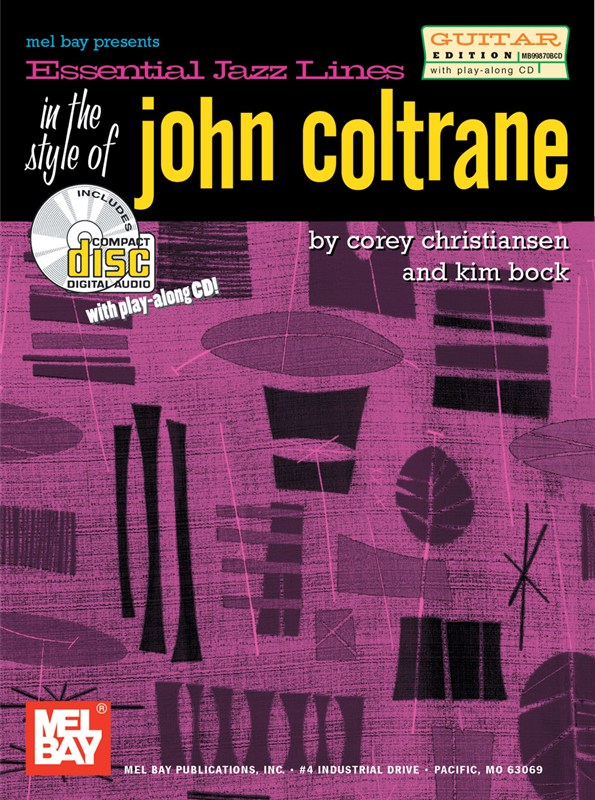
COLTRANE JOHN-ESSENTIAL JAZZ LINES IN THE STYLE OF BOOK CD LIBRO SPARTITI CHITARRA

COLTRANE JOHN, ESSENTIAL JAZZ LINES IN THE STYLE OF. CD TAB.

by Corey Christiansen & Kim Bock

Product Description:
Saxophonist John Coltrane was one of the most innovative, creative, and influential jazz artists of the 20th Century. Both stylistically and harmonically, he opened doors for others to follow. This book will focus on the first period of Coltrane's career, when he was with Miles Davis, and the jazz vocabulary he used. First, to help the student better understand Coltrane's bebop style of improvising, the authors discuss the use of guide tones, bebop scales, three to flat nine, targeting, and other techniques. Then the text presents numerous one-, two-, and three-measure jazz lines in Coltrane's style in notation and tablature grouped by the harmony over which they can be used. The accompanying play-along CD provides the rhythm parts for each section, including a track for each section that modulates through the cycle of fourths, helping you master the phrases in all keys. By combining various lines, musicians will be able to mix and match numerous combinations of these lines to play over ii-V-I progressions, turnarounds, and other harmonic situations. Incorporate these essential jazz lines into your vocabulary and you will be able to create your own lines in the style of John Coltrane.

Contents:

John Coltrane
The Style of John Coltrane
Jazz Language
Guide Tones
Bebop Scales
Mixolydian Bebop
Major Bebop
Minor Bebop
Scalar Patterns
3-9
Augmented Dominant
Playing the Upper-Structure of Chords
Targeting
Substitutions
John Coltrane's Style
Summary
Minor Chord Material
Track 1: Tuning
Track 2: Minor Chord Vamp
Track 3: Minor Moving in Fourths
Dominant Seventh Chord Material
Track 4: Dominant Seventh Vamp
Track 5: Dominant Seventh Moving in Fourths
One Measure ii-V (Short ii-V) Material
Track 6: Short ii-V Vamp
Track 7: Short ii-V Moving in Fourths
Two Measure ii-V (Long ii-V) Material
Track 8: Long ii-V Vamp
Track 9: Long ii-V Moving in Fourths
Major (I) Chord Material
Track 10: Major Vamp
Track 11: Major Moving in Fourths
Minor ii-V Material
Track 12: Minor ii-V Vamp
Track 13: Minor ii-V Moving in Fourths
Play Along Recordings
Track 14: Short ii-V-I Vamp
Track 15: Short ii-V-I Moving in Fourths
Track 16: Long ii-V-I Vamp
Track 17: Long ii-V-I Moving in Fourths
Track 18: Minor ii-V-i Vamp
Track 19: Minor ii-V-i Moving in Fourths
Turnarounds
Track 20: Turnaround Vamp
Track 21: Turnaround Moving in Fourths
Creating Solos
Track 22: Creating Solos
Track 23: Progression Similar to Pent Up House
Coltrane Changes/Giant Steps
Practicing Coltrane Changes
Track 24: Long ii-V-I with Coltrane Changes Vamp
Track 25: Long ii-V-I with Coltrane Changes Moving in Fourths
Track 26: Eight Measure Giant Steps Vamp
Track 27: Progression Similar to Giant Steps
Superimposing the Coltrane Changes
Track 28: Blues for a Giant
Track 29: Snap Shots
Conclusion
Selected Discography
About the Authors

Price: €26,99
€26,99
Syndicate content