LIBRO CON CD

GUITAR SECRETS SYMMETRICAL SCALES REVEALED Diminished Scale DON MOCK CD LIBRO TABLATURE SPARTITI

GUITAR SECRETS: SYMMETRICAL SCALES REVEALED, (Diminished and Whole Tone Scales). Don Mock. CD TAB.

CATEGORY: Guitar Method or Supplement
FORMAT: Book & CD
Learning how to play and use scales has always been a large part of every guitar player's practice schedule. Written from a player's perspective, this book doesn't get too in-depth into the history and classical theory of the scales, but focuses on their uses in contemporary styles such as blues, rock, fusion, and jazz. Includes tons of diminished and whole-tone lines, licks, and music examples; soloing and scale substitution from a player's perspective; and new sounds and ideas. Written in standard notation and Tablature.

Foreword
Welcome to Symmetrical Scales Revealed. Learning how to play and use scales has always been a large
part of every guitar player's practice schedule. Playershave spent countless hours practicing scales up
and down all over the guitar, sometimes with great success and sometimes with frustration as the end
result.
Thoseof you who know me from my books and videos or years at the Guitar Institute of Technology (Gin
know I've been involved in guitar education for a long time. I've seen hundreds of students struggle with
the same problems that I faced when going through the process of learning how to play and use scales.
After many years of experience, both playing and teaching, I've become a big believer in cutting through
the nonsense and getting to the point of it all, which is playing music.
The presentation and ideas in this book are definitely from a player's perspective. We're not going to get
too in-depth into the history and classical theory of the diminished and whole-tone scales. We'll focus more
on their usesin contemporary styleslike blues, rock, fusion, and jazz. Don't get me wrong: there will be no
shortcuts here when it comes to modern music theory. As far as I'm concerned, all guitar players must
have a good working knowledge of harmony and theory and the ability to read music, even if it's only simple
chord charts.
Three Steps to Success
Learning to improvise can be thought of as a three-step process. The first step istypically the learning of
scales. Usingeither the key center approach or the modal approach, students should learn at least a few
useful fingerings of the major scale and be able to play them in all keys.Also, in this first step, players need
to learn about harmony and theory to help understand which scale fits over which chord. Armed with
some theory knowledge, students can immediately begin playing over even difficult chord changes by
simply switching to the correct scale or key center for the given chord.
Most players after a period of time will begin to find this first step limiting. They may say that they can't
seem to make their solossound like the chords, that they sound too scalar. Moving on to step two, we
introduce arpeggios as a tool to create chord sounds. Mixing arpeggios with our scales starts making our
solos more harmonically intelligent.
Step three isthe final frontier of improvising, as we now start really learning music. So far we've been using
scales and arpeggios but may not been able to make our solossound melodic. Now it's time to learn
melodies. Most of us need to learn a repertoire of melodic lines to use when we improvise. Almost every
one of our favorite players has, at one time or another, learned linesby copying recordings or transcriptions.
I've met many students who tell me they don't want to sound like anyone else and feel they shouldn't
copy other players. They soon realize that the road to originality goes through the land of copying licks,
phrasing, and concepts used by favorite players. Eventually, these influences merge together into your
own original style.
One last thing: A common misconception about improvising isthe phrase "playing what you hear." Many
players say they do this, leading students to think that they simply make up music on the spot. What they
are really saying isthat they are playing what they know.
Improvising isthe spontaneous performance of ideas that come to you in the midst of soloing. You may
not know ahead of time what you are going to play, but armed with scales, arpeggios, melodic ideas,
and theoretical concepts, you can playa creative and spontaneous improvised solo.


Introduction
This book deals with the two most used symmetrical scales-the diminished and whole-tone. Symmetrical scales are best defined as having repetitive or equal-note spacing that repeats throughout the octave. For example, the whole-tone scale is exactly what the name indicates; it's a scale built entirely of whole tones The symmetry of a diminished scale is a pattern of alternating whole steps and half steps, four times per octave.
One great thing about symmetrical scales is that they are very guitar-friendly and easy to memorize. The fingerboard is a visual, graphic instrument similar to a slide-rule. In most cases, you can get by with just one fingering for each of these scales and then repeat the same fingering every two frets (whole-tone) or three frets (diminished) up or down the fingerboard, Guitar players can easily discover hundreds of unique melodic and harmonic ideas that are not as obvious on other instruments like keyboards, reeds, or brass.
Both of these scales are very useful and creative tools used by improvisers. Their simplicity can be deceptive; it's almost surprising how these simple scales can provide such a complex sound. In traditional jazz, they provide a contrasting flavor against functional dominant chords, Modern players exploit these scales to add an outside sound to contemporary jazz, rock, and even blues. In Symmetrical Scales Revealed you'll learn the most useful scale patterns and explore sequences and arpeggios within the scales. Next we'll learn the secrets of how to best use the scales, followed by several of my favorite melodic lines.
We'll begin each of the two sections by first learning some good fingerings for each scale. If you already know a fingering or two, stick with them or feel free to modify any of the fingerings here to suit your technique and style. The ultimate goal isto be able to play the particular scale anywhere on the guitar in any key.
One more thing about the fingerings: You are limited only by the lowest and highest notes on the guitar. Think of scales as having no beginning and no end. Don't be too concerned with the bottom or top notes of each individual pattern, You'll find that each has a different starting and ending note because of the natural range of the strings.
SCales are simply a row of notes, and you should learn to control the scale by being able to start and end on any note. Eventually, individual scale fingerings will begin to blend together into larger patterns until finally the whole fingerboard is under your control!
How to Get the Most Out of This Book
The best way to get the most out of this book is to scan through each chapter first. Get a feel about where and what the various topics are and if they contain information you already know. You should read every page carefully, but it's okay to start with any section in the book that interests you


Guitar Secrets - Symmetrical Scales Reveale
Contents:

SECTION I: INTRODUCTION
Tuning Notes

Unit 1: Modes of the Diminished and Whole-Tone Scales
Examples 

Unit 2: Static and Functioning Dominant 7ths 
Examples 

SECTION II: THE DIMINISHED SCALE
Unit 3: Fingerings of the Diminished Scale 
Examples 

Unit 4: How to Learn and Practice the Diminished Scale
C7 Practice Track

Unit 5: Diminished Scale Sequences 
Examples 

Unit 6: Diminished Arpeggios,
Examples 

Unit 7: Using the Diminished Scale,
Examples 

Unit 8: Six-Note Diminished Shapes 
Examples 

Unit 9: Major Triads in the Diminished Scale 
Examples 

Unit 10: Using the Diminished Scale Over Static Chords ..
Examples 

SECTION III: THE WHOLE-TONE SCALE

Unit 11: Fingerings of the Whole-Tone Scaie,
Examples 

Unit 12: Whole-Tone Scale Sequences
Examples 

Unit 13: Whole-Tone Arpeggios
Examples 

Unit 14: Using the Whole-Tone Scale
Examples 

Unit 15: Modern Uses of the Whole-Tone - Static Chords 
Examples 

Unit 16: The Fingerboard - Symmetrical Scales Geometric Playground ,
Examples 

Unit 17: Diminished and Whole-Tone Lines 
Examples 


Price: €26,99
€26,99

MELODIC ARPEGGIOS FOR LEAD GUITAR MARK GALBO LIBRO CD TABLATURE SPARTITI SOSTITUZIONI ACCORDI

MELODIC ARPEGGIOS FOR LEAD GUITAR, M. Galbo. CD TAB.

An arpeggio is simply playing the notes of a chord, one after another, in a melodic fashion. Piano, bass, string, and horn players routinely find the study of arpeggios a staple of their learning process. But, somehow, guitarists often manage to skip over this essential musical building block.
This book is designed to demystify arpeggios and demonstrate their application in a musical and easy-to-understand format. All of the material is presented within the context of various 'Jam Tracks' which allow students to immediately apply new knowledge and hear for themselves why arpeggios are essential to their playing.

All of the music examples are presented in standard notation and tablature so there is no need to read music. Also includes a special demonstration and playalong CD.

Price: €26,99
€26,99

MODES FOR GUITAR-MUSICIANS INSTITUTE Tom Kolb CD TABLATURE dorico-frigio-misolidio-eolio-locrio

MODES FOR GUITAR, MUSICIANS INSTITUTE Tom Kolb. CD TABLATURE

Publisher: Musicians Institute Press

In this one-on-one lesson, MI instructor Tom Kolb unravels the mystery of the modes, giving guitarists a complete approach to soloing and a thorough, hands-on explanation of Ionian, Dorian, Phrygian, Lydian, Mixolydian, Aeolian and Locrian. He also covers: melodic minor, harmonic minor and the blues scale; soloing over diatonic and modal progressions; superimposing modes; patterns, progressions, licks; and much more. The accompanying CD includes 83 full-band tracks.


The modes of the major scale have long been a fascinating subject for guitarists. But at the same time, they can be a great source of confusion and misunderstanding. The purpose of this book is to unravel the mysteries of the modes and to guide you through the world of their applications. We'll take an in-depth look at how modes can be used in various soloing situations, as a source for creating riffs, and as tools for writing unique chord progressions. Each chapter contains suggested fretboard patterns, licks, and musical examples, as well as valuable insights into each mode's unique application. Each example is demonstrated on the accompanying CD. There is also a jam track featuring a "play-along progression" for each mode, so you can practice applying the modes in an improvisational setting. As a special bonus, in the final chapter, we'll explore some of the modes of other popular scales. Although it's highly recommended that you start at the beginning of this book and work your way through to the end, if you prefer, you can jump in anywhere, especially if you're already familiar with a mode or two. You can always refer back to the first chapter, "Theory of the Modes," if you find yourself getting confused. Every musical example in this book is demonstrated on the accompanying CD. Tracks with a full rhythm section are played twice-once at normal speed and then again at half speed. For the normal-speed examples, the featured guitar is mixed hard right. This allows you to play along either with the entire mix, or, by adjusting the balance to the left, with just the rhythm section. Don't forget-there's a jam track for each mode, so you can practice applying what you've just learned in an improvisational setting. You can work on soloing all over the neck with the various finger patterns provided, experiment with the musical examples presented in the text, and apply the concepts presented in the "Odds and Ends" section at the end of each chapter. Use Track. of the CD to tune your guitar.

Price: €18,99
€18,99

PENTATONIC SCALES FOR GUITAR The Essential Guide Chad Johnson CD TABLATURE HAL LEONARD


PENTATONIC SCALES FOR GUITAR. The Essential Guide. CD TABLATURE

Pentatonic Scales for Guitar

The Essential Guide
Series: Guitar Educational
Format: Softcover with CD - TAB
Author: Chad Johnson

This book provides the pentatonic scale fingerings, diagrams, lessons and licks that every guitarist needs to know. It covers: major and minor pentatonic scale patterns in all positions; licks in the styles of Chuck Berry, Eric Clapton, Jimi Hendrix, B.B. King, Jimmy Page and other great artists; and much more.

The CD includes 90 full-band demos for listening and/or play-along. 
Each example is played twice: once at normal tempo and once slower for closer examination. The book is in standard notation and tablature.

Inventory #HL 00695699
ISBN: 9780634046469
UPC: 073999956993
Width: 9.0"
Length: 12.0"
40 pages

Price: €18,00
€18,00

THE ART OF SOLO GUITAR 2 Jody FISHER LIBRO CD TABLATURE CHITARRA LIBRO METODO SPARTITI

THE ART OF SOLO GUITAR 2, J. Fisher. CD TAB.

By Jody Fisher

In this two-book series, popular clinician and author Jody Fisher clarifies and simplifies the art of creating an arrangement and improvising as a solo guitarist. In his easy-to-understand and enjoyable style, this master of solo guitar teaches all of the theory, technique and arranging skills students need to start a lifelong journey as a solo guitarist. Book 2 focuses on more advanced arranging techniques and adding the element of improvisation to your solo work. There is also lots of information about ornamentation, various musical and stylistic feels, and many aesthetic considerations.

Price: €139,99
€139,99

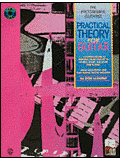
THE PROGRESSIVE GUITARIST PRACTICAL THEORY Latarski LIBRO CD TABLATURE METODO MUSICA

THE PROGRESSIVE GUITARIST PRACTICAL THEORY. Latarski. CD TAB.

Practical Theory for Guitar
By Don Latarski
ITEM: 00-F3339GTXCD
UPC: 029156059700
ISBN 10: 0898986923
ISBN 13: 9780898986921
SERIES: The Progressive Guitarist Series
CATEGORY: Guitar Method or Supplement
FORMAT: Book & CD

--------------------------------------------------------------------------------
A guitar player's guide to music theory. This book is a complete theory course with recorded examples that put everything in an applicable, musical context. The recording includes all the musical examples and play-along tracks.

Price: €34,99
€34,99

1000 GREAT GUITARISTS LIBRO CD RY COODER-SEGOVIA-STEVE VAI-JIM HALL-DICK GAUGHAN-BENSON

1000 GREAT GUITARIST. Biografie, strumentazione, discografia, critica, notizie, fotografie a colori di mille guitar hero. Nel CD: Julian Bream, Jim Hall, George Benson, Martin Carthy, B.B. King, Buddy Guy, Ry Cooder, Steve Vai, e altri, non contine pagine di musica. CD

Price: €34,99
€34,99

GUITAR F/X COOKBOOK Chris Amelar Hal Leonard LIBRO CD TABLATURE-pick scraping-EFFETTI

THE GUITAR F/X COOKBOOK. Trucchi, suggestivi effetti, ricette al doppio plettro, sirene, elicotteri roteanti, Jet, slide fantasma e impostori, bottleneck nevrotici, country-stracci, barriti elefantini, nitriti cavallini, albatros solitari, gatti in gennaio, feedback; e altre rumorose delicate paradisiache stramberie. Una schiaffone a tutti i pedanti professoroni "non si suona così", che inibisce e blocca subito qualunque spirito creativo. Disegnate senza cancellare; niente è sbagliato! Inventare, liberare la fantasia, basta con l'effetto comprato pronto, perché in ferramenta o in soffitta c'è quello nascosto per la vostra chitarra. CD TAB.

Series: Guitar
Publisher: Hal Leonard
Medium: Softcover with CD
Author: Chris Amelar

The ultimate source for guitar tricks, effects, and other unorthodox techniques. This book demonstrates and explains 45 incredible guitar sounds using common stomp boxes and a few unique techniques, including: pick scraping, police siren, ghost slide, church bell, jaw harp, delay swells, looping, monkey's scream, cat's meow, race car, pickup tapping, and much more. 56 pages

Price: €23,99
€23,99

DOD presents 100 SUPERSTAR GUITAR SOUNDS ON A STOMPBOX BUDGET BOOK & CD LIBRO EFFETTI

DOD presents 100 SUPERSTAR GUITAR SOUNDS ON A STOMPBOX BUDGET. Come clonare i pedali dei velocisti del suono, e "pedalare" come: Malmsteen, Beck, Clapton, Hammet, Hendrix, Johnson, Satriani, Korn, Led Zeppelin, Van Halen, Stevie Ray Vaughan, Foo Fighters, Pantera, Rush, Brian Setzer, Kiss, Nirvana, R.E.M., A. in Chains, Def Leppard, Queensryche, ZZ TOP, Mr. Big, Pink Floyd, Tool, Dokken, Motley Crue, Zakk Wilde, e molti altri. CD

Series: Book
Publisher: Cherry Lane Music
Medium: Softcover with CD
Author: Various Authors

Learn how you can use affordable effects pedals to duplicate the sounds of rock's greatest guitarists! Straight from the -Sound F/X columns in Guitar magazine are the effects settings and setups for great songs from artists such as AC/DC, Jeff Beck, Eric Clapton, Foo Fighters, Jimi Hendrix, Korn, Led Zeppelin, Metallica, Nine Inch Nails, Pantera, Pink Floyd, Joe Satriani, Van Halen, Stevie Ray Vaughan and many more! Each effects setting is accurately illustrated on the accompanying CD using DOD pedals. 112 pages.

Price: €39,99
€39,99

101 MUST-KNOW ROCK LICKS. CD TABLATURE Early Rock era '50s '60s '70s '80s '90s Wolf Marshall


101 MUST-KNOW ROCK LICKS. CD TABLATURE

A Quick, Easy Reference for All Guitarists
Series: Guitar Educational
Softcover with CD - TAB
Author: Wolf Marshall

Now you can add authentic rock licks to your vocabulary. Here are 101 definitive phrases, plus a demonstration CD, from every major rock guitar era, neatly organized into easy-to-use categories. They're all here! Includes licks from the Early Rock era, and the '60s through the '90s, plus a listing of suggested recordings. 48 pages.

Inventory #HL 00695432

ISBN: 9780634013706
UPC: 073999142921
Width: 9.0"
Length: 12.0"
48 pages

Price: €16,00
€16,00
Syndicate content