LIBRO CON 2 CD

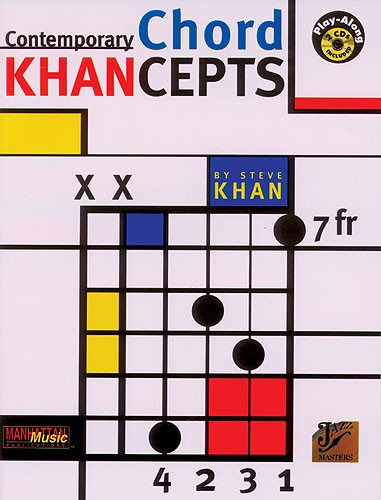
KHAN STEVE-CONTEMPORARY CHORD KHANCEPTS 2 CD LIBRO SPARTITI CHITARRA ACCORDI METODO

KHAN STEVE, CONTEMPORARY CHORD KHANCEPTS. SHEET MUSIC BOOK WITH 2 CD & GUITAR TABLATURE.  

LIBRO METODO DI MUSICA JAZZ FUSION, CON 2 CD. 

SPARTITI PER CHITARRA CON: 

ACCORDI E PENTAGRAMMA. 

CATEGORY: Guitar Method or Supplement
FORMAT: Book & 2 CDs

In this book, Steve Khan shares his approach to chord construction on guitar, an area in which he has become famous. He has taken a complex subject and broken it down into simple building blocks and small study units: players will learn to extend their sense of harmony by the superimposition of chord forms which are familiar, as well as a world of new ones. With two CDs full of performed examples, play-along tracks, and five completely new compositions by Steve Khan available only in this package.

Contemporary Chord Khancepts presents information for guitarists of all styles-from Rock, Latin, and Funk to Country, Jazz, and Alternative. Steve shares his approach to chord construction, an area he has become known for on guitar.

In this book, he has taken a complex subject and broken it down into simple building blocks and small study units. You will learn to extend your sense of harmony by the superimposition of chord forms which are familiar, as well as a world of new ones. Your ability to express yourself and create textures and musical moods will improve immediately.

The text is accompanied by two CD's full of performed examples, play-along tracks, and five completely new compositions by Steve only available in this package.

Prezzo: €32,99
€32,99

GIPSY GUITAR RUMBAS FLAMENCAS... Y MAS Graf-MARTINEZ libro 2 CD TABLATURE golpe abanico legati

GIPSY GUITAR, RUMBAS FLAMENCAS... Rumba Styles of the Flamenco Guitar. GERHARD GRAF-MARTINEZ. 2 CD TABLATURE

LIBRO DI MUSICA, SPARTITI PER CHITARRA CON 2 CD E TABLATURE. 

Series: Schott
Publisher: Schott
Medium: BOOK W/CD
Guitar
Composer: Gerhard Graf-Martinez

Flamenco is once again incredibly popular and modern Flamenco groups like the Gipsy Kings are topping the charts with international hits like "Rumba flamenca." In Gipsy Guitar the author shows guitarists how to enter the world of the rumba flamenca, and demonstrates the techniques necessary for solo playing and accompaniment. The publication contains printed music (staves and tablature) and two excellent companion CDs. German/English text. 92 pages.

Flamenco is once again incredibly popular and modern Flamenco groups like the ‘Gipsy Kings’ are topping the charts with international hits like ‘Rumba flamenca’. In ‘Gipsy Guitar’ the author shows interested guitarists how to enter the world of the RUMBA FLAMENCA, and demonstrates the techniques necessary for solo playing and accompaniment. The publication contains printed music (staves and tablature) and two excellent companion CDs.

Contiene

  - Vorwort
  - Der Autor
  - Grundbegriffe
  - Kompositionen dieses Buches
  - La Rumba
  - Rhythmus-Muster 1
  - Rhythmus-Muster 2
  - Caballos Blancos
  - Tresillos I
  - Golpe mit Mittelfinger
  - Rhythmus-Muster 3
  - La Habana de ida
  - Tresillos II
  - La Habana de vuelta
  - Rhythmus-Muster 4
  - La Morita
  - Rhythmus-Muster 5
  - Rhythmus-Muster 6
  - Sierra Blanca
  - CD Inhalt
  - Index

Prezzo: €39,99
€39,99

MISSISSIPPI JOHN HURT STEFAN GROSSMAN'S EARLY MASTERS OF AMERICAN BLUES GUITAR 2CD TABLATURE

MISSISSIPPI JOHN HURT, STEFAN GROSSMAN'S EARLY MASTERS OF AMERICAN BLUES GUITAR. 2CD TABLATURE

26 titoli di blues acustico. 2CD TABLATURE, Curato e trascritto da Stefan Grossman. 

 I libri della serie "I primi maestri americani della chitarra Blues" offrono l'opportunità unica di studiare le vere radici del blues moderno. Stefan Grossman, noto chitarrista e musicologo, ha compilato questa affascinante collezione di 26 canzoni del leggendario chitarrista Blues Mississippi John Hurt. Oltre alle esperte trascrizioni di Stefan, il libro include un CD contenente le registrazioni originali di John Hurt, in modo da poter sentire la musica come era originariamente eseguita. Mississippi John Hurt ha avuto una carriera affascinante, in origine registrò una manciata di canzoni alla fine del 1920, e dopo essere stato dimenticato per quasi 30 anni, fu riscoperto da una nuova generazione di musicisti che comprendeva Bob Dylan, Joan Baez, e Stephen Sills. Ritrovato nel 1963, mentre viveva in una piccola città del Mississippi, da un ammiratore che lo ha rintracciato attraverso i testi del suo singolo "Avalon Blues" del 1928, Mississippi John Hurt è stato convinto ad andare a Washington, DC e iniziare una nuova carriera. E ha trascorso i successivi tre anni suonando e registrando. Oltre a trascrivere tutte le canzoni di questa raccolta, Stefan Grossman è stato anche allievo di John Hurt.

Contenuto:

Shake that Thing
Spike Driver's Blues
Casey Jones
Got the Blues, Can't Be Satisfied
Joe Turner Blues
Stocktime
Hey Baby, Right Away
Ain't Nobody But You babe
Make Me a Pallet on your Floor
Nobody's Dirty Business
Richlands Women Blues
Louis Collins
Blessed Be the Name
Praying On the Old Camp Grounds
Let the Mermaids Flirt With Me
Corrinna, Corrinna
Oh Mary Don't You Weep
Avalon Blues
Sliding Delta
Coffee Blues
Monday Morning Blues
Candyman
Trouble I've Had All My days
See See Rider
Stack O'Lee Blues
Big Leg Blues


Registrazioni originali VINTAGE, trasferite su CD dal 78 giri.

La musica di Mississippi John Hurt, trascritta da Stefan Grossman. Guitar Songbook tablature e CD esempi per chitarra acustica.

Serie: "i primi maestri di chitarra Blues americano" di Stefan Grossman. 96 pagine.

Con tablature per chitarra, notazione standard, la melodia vocale, i testi, i nomi degli accordi e diagrammi degli accordi di chitarra. Blues e Country Blues.


INTRODUCTION by Stefan Grossman
This collection has been a pleasure to put together. I first
heard the records of Mississippi John Hurt when I was
15years old. He had recorded 20 sides for the OKeh
record company in 1928of which 12 had been released.
During the folk revival ofthe 1960s,reissue albums began
to appear and many old blues recordings found their way
to the grooves of LPs. John Hurt's arrangements for "Spike
Driver Blues," "Frankie," "Stagolee," "Nobody's Dirty
Business," Candyman," "Louis Collins," and "Got the Blues
Can't Be Satisfied" became necessary ingredients to any
young fingerpicker's repertoire.
John Hurt's old recordings had a magnetic atmosphere
and a strong lyrical contents that made them attractive
to both players and listeners. His guitar style was easily
recognizable. The alternating bass pattern evoked the
piano sounds of turn-of-the-century America and against
this a melody line was interweaved. The same approach
was explored during the mid-1950s by White guitarists
such as Merle Travis and Chet Atkins. By the 1960s,this
guitar technique was completely embraced by folksingers
as far afield as Bob Dylan, Dave Van Ronk, and Stephen
Stills to Joan Baez.
Then in 1963,miracle of miracles occurred when Tom
Hoskin decided to try to locate the "legendary" Mississippi
John Hurt. John had recorded a song during his 1928
sessions titled "Avalon Blues." The current maps of
Mississippi did not show a town called Avalon, but in an
1878atlas, Avalon was shown as a small dot between
Greenwood and Grenada, Mississippi. Tom headed south
from Washington, D.C.and two days later pulled into
Stinson's store, an old combination gas station, general
store, and post office, which, with the owner's house,
comprised the entirety of Avalon. Tom asked several men
if they had ever heard or knew about a singer called
Mississippi John Hurt and was amazed when the pointed
down the dirt road and said, "'bout a mile down that road,
third mail box up the hill. Can't miss it."
Tom brought John up to Washington, D.C.to record and
perform and almost immediately Mississippi John Hurt was
a hit on the folk music scene. He performed at folk clubs,
The Newport Folk Festival, college campuses, and even the
Johnny Carson Tonight Show!
I met Mississippi John at his first concert in New York City.
Tom was a friend of mine and the chance to hear, as well
as meet, Mississippi John Hurt was almost too much for
me to imagine. The concert presented John and Doc Boggs
(another folk legend, but in this case in the story of white
five-string mountain banjo playing). After the concert, I
went backstage to say hellos and Tom insisted that I play
guitar for John and Doc. I picked a few of John's tunes that
I had transcribed from his 1928recordings. John started to
dance while Doc laughed and banged out time on his banjo
skin. This began my friendship with John Hurt that lasted
until his death.
Mississippi John Hurt was a wonderful teacher. He
patiently showed me his arrangements and licks as well
as giving me insight into life itself. John Hurt was a unique
man. He had a gentleness that could penetrate walls and
a voice that could relax your soul while your feet danced
to his guitar rhythms.
This collection brings together 26 great songs and
guitar arrangements. All the keys that John played in are
presented. On first listening, John Hurt's playing seems
deceptively easy, but to master his sound is quite a
challenge. He used three fingers to play. His ring and little
finger rested on the face of the guitar while he picked.
The source of John's unique sound can be found in his
thumb strokes. Basically, an alternating bass is used
throughout John's playing. The sound that is produced
can be described as "bum-chick." The first beat hits the
bass note with commitment but the second beat hits the
string hard enough to have the other strings vibrate. As a
result, a "chick" is created. This is fundamental to John's
style. The bass can stand by itself without any melody
lines and still sound musical. When the treble lines
are added, these act almost as embellishments. The
"John Hurt sound" is all in yourthumb.
Fortunately, there is some footage of John that comes
from Pete Seeger's Rainbow Quest. Seeing John play
will help you to better understand the power and
eloquence of his playing and singing. I have included
these performances in my video series Country Blues
Guitar Parts 1,2, & 3(Stefan Grossman's Guitar Workshop). I strongly recommend these.

MISSISSIPPI JOHN HURT by Jas Obrecht
Songster and bluesman, John Hurt had a beautifully
syncopated fingerpicking style and a gentle, guileless
voice. After making a handful of 78s, he faded from view
during the Depression and then arose phoenix-like during
the 1960s.Throughout his career, his music provided an
aural passport to a bygone age of cakewalks and rags,
parables and polite society.
Hurt was 35 years old when he journeyed alone from the
Mississippi hill country to Memphis for his first session.
It was Valentine's Day, 1928,and the experience was not
entirely pleasant: "A great big hall with only Mr. Rockwell,
one engineer, and myself," John remembered. "I sat on
a chair and they pushed the microphone right up close
to my mouth and told me not to move after they found the
right position. Oh, I was nervous, and my neck was sore for
days after." Eight songs were cut that day, but only a single
OKeh 78 was issued-"Nobody's Dirty Business" backed
by "Frankie," one of his few songs in open tuning. Hurt was
paid about $20 per song, a good fee for unproven talent.
The original note on Columbia's file cards for the matrixes"
old time music"-was later changed to "race."
Hurt headed home and worked another season; under his
sharecropping arrangement atthe time, half of the corn
and cotton he grew on 13 acres was turned over to the land
owner. In November, IJ. Rockwell wrote Hurt inviting him to
record again. John's December 21st session in New York City
produced usable version of "Ain't No Tellin'" (essentially new
words set to the "Make Me Pallet On the Floor" melody),
the murder ballad "Louis Collins," and "Avalon Blues." On
December 28, 1928,Hurt was back in the studio for his final
and most fruitful prewar session, cutting three spirituals
and five blues. Of all Hurt's prewar sides, the one he
composed his first day in New York, "Avalon Blues,"
proved to be the most important. Nearly four decades
after its release, it would lead to his rediscovery:
"Avalon my home town,
always on my mind,
Avalon my home town,
always on my mind,
Pretty mama's in Avalon,
want me there all the time"
During the 1920s,when its population was less than a
hundred, Avalon, Mississippi was little more than a
ramshackle rail settlement between Greenwood and
Grenada. Born in nearby Teoc on July 3, 1893,John Smith
Hurt spent most of his life living there in poverty. He had
seven older brothers and two sisters. He made it through
the fifth grade at St. James School, and around this time
began teaching himself guitar. "I always tried to make my
strings say just what I say," he'd explain. "I grab it and go
my way with it. Use my melody with it." By age 12,John
was singing "Good Mornin' Miss Carrie," "Satisfied,"
Frankie and Johnny," and other non-blues songs at house
parties, sometimes working with a fiddler. His gentle voice,
relaxed feel, and light, idiosyncratic fingerpicking made
his music far better suited for front-porch listening than
cornfield stomps. Some nights, he remembered, he and a
pal would awaken the neighbors with their playing. "We go
along to people's private homes, way in the night, midnight,
one o'clock. 'Serenadin" we call it. We knew you well, we
tip up on the porch and we'd wake you up with music. Well,
you might lay there and listen, you might not get up and ask
us in. Sometimes you'd get up and say come on in."
Once, when he was asked about the first blues he'd learned,
Hurt played "Lazy Blues," a simple, original arrangement
in E major that had more in common with Memphis players
than Delta musicians such as Robert Johnson:
"Wake up in the morning, a towel tied round her head,
When you speak to her, she swear she almost dead"
During "Talking Casey," Hurt used a slide to imitate bells
and quote familiar melodies-a technique similar to Blind
Willie McTell in Atlanta-while thumbing train rhythms on
his bass strings. He composed in many keys-E, A, 0, and
G,which was especially convenient for a strong alternating
bass-but unlike many Delta musicians seemed to prefer C.
Much of his music was probably a souvenir of his childhood.
Asked by a white landlord how he created melodies,
Hurt responded, "Well, sir, I just make it sound like I think it
ought to."
After his father passed away, John helped his mother
raise cotton, corn, and potatoes. To make ends meet, he
sometimes hired himself out to a neighboring farm, while
his mother washed clothes and cooked. During 1915,Hurt
worked for the Illinois Central jacking up and leveling...

EARLY MASTER'S of AMERICAN BLUES GUITAR Rev. Gary Davis
Book & CD (F3176GTA)

EDITED AND TRANSCRIBED BY STEFAN GROSSMAN
The Early Masters of American Blues Guitar series provides the unique opportunity to study the true roots of modern blues. Stefan Grossman, noted roots-blues guitarist and musicologist, has compiled this amazing collection of 26 songs, transcribed exactly as performed by blues great Mississippi John Hurt. In addition to Stefan's expert transcriptions, the book includes 2 CDs containing John Hurt's original recordings so you can experience the music as it was originally performed.

Each book in the Early Masters series contains the original artist's performances, transferred
from vintage 78s. These original recordings are apiece of musical history, and the only way to
hear and appreciate the powerful feel and impact of these pivotal, early music giants.

ALSO AVAILABLE IN THE EARLY MASTERS OF AMERICAN BLUES GUITAR SERIES 

Prezzo: €27,99
€27,99

2000 MASTER OF ANTHOLOGY OF BLUES GUITAR SOLOS VOL.1-2CD LIBRO SPARTITI CHITARRA

2000 MASTER OF ANTHOLOGY OF BLUES GUITAR SOLOS VOL.1. SHEET MUSIC BOOK WITH 2 CD & GUITARA TABLATURE. 

LIBRO DI MUSIC BLUES, CON 2 CD. 

SPARTITI PER CHITARRA CON: 

ACCORDI, PENTAGRAMMA, TABLATURE. 


Muriel Anderson-Blues For Macedonia; Duck Baker -Still Staggerin'; Mickey Baker -Alley Music; Carlos Barbosa -Lima-St. Louis Blues; William Bay -Blue Dawn, Russel Street; Larry Bolles -Icicle Blues; Ben Bolt -Gardenia Blues; Dan Bowden -Rosenannon Blues; Dix Bruce -Frogs For Snakes; Buddy Fite -Low Down; Mike Christiansen -June Rag, Oscar's Blues, Ya Da Ya Da; Alan De Mause -Blues For Phyllis, You Have Your Basic Bebop Blues; Craig Dobbins -Au Contraire; Steven Eckels -Deep River Blues; Jim Ferguson -Intro Blues; John Griggs-Try Me Blues; Tommy Flint -Memories Of Mose, Blues For Amos Johnson; Stefan Grossman-A Heart Much Obliged; Ole Halen -Blues For Paavo; Al Hendrickson -Blues Lite; Roger Hudson -Blue Stairway; Jean-Felix Lalanne -Sweet Sadness; Paul Lolax -Joblues; Larry Mccabe -Eight Hour Shift; Franco Morone -Fat Boy Blues; Dale Miller -Dale's Boogie Blues, Tampa Red; Ronald Muldrow -Down Bay The Bijou; Paul Musso-Bird Blues, Jazz Blues; Bill Piburn -Frankie & Johnny; John Òbuckyó Pizzarelli-Over And Over Blues; Paul Rishell -Blues For Tampa Red; Vincent Sadovsky -Chicago Joe; Felix Schell -Emma; Jay Umble -Blue Line; Jerry Silverman -Been In The Pen So Long, Memphis Blues, Yellow Dog Blues; Martin Simpson -New Kitchen Blues; Fred Sokolow -Furry's Train, Mississippi Jump Time; Stanley Solow -Long Island Expressway Blues; Tim Sparks -Blues On Bartok Street; Phil Upchurch-B's Shuffle; John Standefer -What A Friend We Have In Jesus; Paul Yandell -Clear Spring Blues; John Zaradin -Dubuque Blues. 2 CD. TAB.

Prezzo: €36,99
€36,99

SPLITTING THE LICKS Janet Davis Improvising Arranging Songs on the 5-String Banjo BOOK 2CD TABLATURE

SPLITTING THE LICKS, Davis. 2CD TABLATURE

LIBRO PER BANJO CON 2 CD E TABLATURE

Splitting the Licks Book/2-CD Set
Improvising and Arranging Songs on the 5-String Banjo
by Janet Davis   

Product Description:
Leads the banjo player step-by-step through working out songs for the five-string banjo from basic melodies in both Scruggs/bluegrass style and melodic/chromatic style. Each section contains exercises and examples for improvising. Furthermore, this book teaches how to arrange music based on concepts of combining rolls and licks. Janet Davis' books are praised because they teach so well! This is one of her finest. In tablature. Includes a CD.

Song Title: Composer/Source:
Banjo Joe
Bill Cheatham
Blackberry Blossom
Bury Me Beneath The Willow
Cripple Creek
Cumberland Gap
Devil's Dream
Fire On The Mountain
Goin' Down That Road Fellin' Bad (Aka Lonesome Roa
Grandfather's Clock
Hamilton County Breakdown
Jesse James
John Hardy
Nine Pound Hammer
Old Joe Clark
Red Haired Boy
Red River Valley
Roll In My Sweet Baby's Arms
Sailor's Hornpipe
Salt River
The Eighth Of January
Train 45
Turkey In The Straw
Under The Double Eagle
Wabash Cannonball
Walking Cane
Whoa Mule
Wildwood Flower
Worried Man Blues


Mel Bay Presents

Improvising and Arranging Songs on the 5-String Banjo
by Janet Davis

Cover photo is a picture of a handcrafted Liberty Banjo. Use of the photo is courtesy of The Liberty Banjo Company,
CD Contents

Disk 1

Introduction
Accent Patterns
Rhythm Patterns
Roll Patterns
Begnning Licks
Fill-in Licks-G Chord
G Chord Licks
C Chord Licks
D Chord Licks
A Chord Licks
F, B, & Em Chord Licks

Worried Man Blues
Forward Roll
other Rolls
Fill-In Rolls
Left-Hand Tech.
with Backup

Bury Me Beneath the Willow
Forward Roll
other Rolls
Fill-In Rolls
left-Hand Tech
with Backup

Red River Valley
Forward Roll
other Rolls
Fill-In Rolls
left-Hand Tech
with Backup

Roll in My Sweet Baby's Arms
Forward Roll
other Rolls
Fill-In Rolls
left-Hand Tech
with Backup

Goin' Down That Road Feelin'
Forward Roll
other Rolls
Fill-In Rolls
left-Hand Tech
with Backup

Walking Cane
Forward Roll
other Rolls
Fill-In Rolls
left-Hand Tech
with Backup

Wildwood Flower
Forward Roll
other Rolls
Fill-In Rolls
left-Hand Tech
with Backup

Cripple Creek
Forward Roll
other Rolls
Fill-In Rolls
left-Hand Tech
with Backup

Cumberland Gap
Forward Roll
other Rolls
Fill-In Rolls
left-Hand Tech
with Backup

Jesse James
Forward Roll
other Rolls
Fill-In Rolls
left-Hand Tech
with Backup

Grandfather's Clock
Forward Roll
other Rolls
Fill-In Rolls
left-Hand Tech
with Backup


Disk 2
Circular Scale
G Major Scale
C Major Scale
D Major Scale
A, F,& E Minor Scale
G Chord Licks
C Chord Licks
D Chord Licks
A Chord Licks
F Chord& E Minor Licks
Ending Licks- G-D-
Ending Licks- D-
Ending Licks- A-D-F, C-D-G

The Eighth of January
-with Backup

Banjo Joe
-with Backup

Bill Cheatham
-with Backup

Devil's Dream
-with Backup

Blackberry Blossom
-with Backup

Sailor's Hornpipe
-with Backup

Red Haired Boy
-with Backup

Turkey in the Straw
-with Backup

Fire on the Mountain
-with Backup

Cripple Creek
-2nd Variation
-with Backup

John Hardy
-Melodic Variation
-with Backup

Old Joe Clark
-with Backup
-Melodic Variation
-with Backup
Exercise
Advanced G Chord Licks
2 Measure Licks in G
Advanced C Chord Licks
2 Measure Licks in C
Advanced D Chord Licks
2 Measure Licks in 0
Ending Licks- G-D-G

Worried Man Blues
-with Backup
-2nd Variation
-with Backup
-3rd Variation
-with Backup

Roll in My Sweet Baby's Arms (2nd)
--with Backup
-3rd Variation
--with Backup
-4th Variation
--with Backup

Goin' Down That Road Feelin' Bad
-with Backup
-3rd Variation
-with Backup
-4th Variation
-with Backup

Whoa Mule (2nd)
-w.h Backup
-3rd Variation
-with Backup
-4th Variation
-with Backup

Wabash Cannonball (2nd)
-with Backup
-Advanced Licks
-with Backup

Nine Pound Hammer (2nd)
-with Backup
-3rd Variation
-with Backup

Train 45 (2nd)
-with Backup
-3rd Variation
--with Backup
-4th Variation
-with Backup
-5th Variation
-with Backup

Salt River (2nd)
-with Backup
-3rd Variation
-with Backup

Hamilton County Breakdown
-with Backup
-3rd Variation


TABLE OF CONTENTS
INTRODUCTION.
EXPLANATION OF TABLATURE & RHYTHM.
RHYTHM EXERCISES.
BLUEGRASS-STYLE-Discussion Of .
Standard Roll Patterns .
Fill-in Licks.
Arranging Songs-Steps To Follow.
Songs- Exercises on Improvising:
WORRIED MAN BLUES.
BURY ME BENEATH THE WILLOW .
RED RIVER VALLEY.
ROLL IN MY SWEET BABYS ARMS.
GOIN' DOWN THAT ROAD
FEELIN' BAD
WALKING CANE
WILDWOOD FLOWER. .
CRIPPLE CREEK . .
CUMBERLAND GAP. .
JESSE JAMES
GRANDFATHER'S CLOCK. .
MELODIC STYLE-Discussion Of. .
Scale Patterns. .
Fill-In Licks . .
Arranging Songs-Steps To Follow.

Songs- Exercises on Improvising:
THE EIGHTH OF JANUARY. .
BANJO JOE. .
BILL CHEATHAM. .
DEVIL'S DREAM. .
BLACKBERRY BLOSSOM
SAILOR'S HORNPIPE. RED HAIRED BOY.
TURKEY IN THE STRAW. .
FIRE ON THE MOUNTAIN . .
CRIPPLE CREEK .
COMPARISON OF SCRUGGS-STYLE & MELODIC-STYLE.

Songs-One Arrangement in Each Style:
JOHN HARDY. .
OLD JOE CLARK. (See also "Cripple Creek", p. 35 & 67.)
COMBINING STYLES OF PLAYING.
Advanced Fill-In Licks. .
Arranging Songs-Steps To Follow. .

Songs Using Advanced Licks:
WORRIED MAN BLUES. .
ROLL IN MY SWEET BABYS ARMS. .
GOIN' DOWN THAT ROAD FEELIN' BAD. (also LONESOME ROAD BLUES).
WHOA MULE.
WABASH CANNONBALL
NINE POUND HAMMER
TRAIN 45.
SALT RIVER. .
HAMILTON COUNTY BREAKDOWN
UNDER THE DOUBLE EAGLE. . .
BUILDING ENDINGS FOR SONGS. .
Tag Endings. .
Two Measure Endings
CHORDS-Discussion Of.

Chord Charts:
Moveable Chord Chart for Major Chords
Major Chords
Minor Chords
Locating Chord Positions Without A Chart


FOREWORD
This book takes you through step hy st('p instructions on working out song for the 5-string banjo ii'om basic melodies in Bluegrass-style and in Melodic/Chromatic tyle. Each section also contains exercises and examples for improvising.
The first section and the second section deal with working out the basic arrangement of
a song. The exercises involve replacing the x's around the melody with notes. The last section
in the book deals with refining the arrangement of a song using advanced technique. This
section includes examples of songs showing how entire measures or licks can be replaced
with licks fi'om a sheet of suggested alternate, advanced licks.
All of the steps to arranging a song for the banjo discussed in this book, are based on the
fact that banjo arrangements are actually combinations of specific patterns, (rolls, or licks),
which moe played according to the chords in the song. This method of arranging songs has
worked well with my banjo students, and Ihope it will work for you also. Happy Pickin'
Janet Davis

P.S. 1983: SPLITTING THE LICKS has now been
expanded to include over twice as much material as was
contained in the-first edition, which was published in
1977. This edition could easily serve as a supplement to
the earlier edition, for those who have that edition. The
following pages include many new licks and many
additional songs which demonstrate the process of
building an arrangement of a song to be played on the
banjo. Also, the instructional material has been expanded
to include answers to questions from people who
studied the first edition of the book.


ITRODUCTION
To playa song on the 5-string banjo, you actually play combinations of finger pattern (also
referred to as rolls or licks). To improviseo or arrange a song on the banjo, you must work the
melody into these finger patterns, according to the chords of the song.
Before attempting to arrange a song on your own, you should be able to play several
arrangements (from tablature) of songs in the style you will use, in order to familiarize yourself
with the rhythm, the finger patterns, and the overall feeling of playing in this style.
This book will deal with two very popular styles of picking the banjo with three fingers:
1.) Bluegrass-Style-where the melody is surrounded by background notes.
2.) Melodic-Style (Chromatic)-where each note picked is essentially a melody note.
These styles can be combined within one song, or one song can be played entirely in one of
these styles.
One noticeable difference between each style of playing is the rhythm ... where the accent
(melody) or stress falls.

Comparison of Accent of the Two Styles

BLUEGRASS-STYLE
1st 4th 7th

MELODIC/CHROMATIC
1st 3rd 5th 7th

Note: stress the notes indicated with arrows. Generally your melody notes are these notes.
In learning these styles, it is best to learn them one at a time, so that you will become
familiar with the finger patterns particular to that style.

To improvise generally implies arranging on the spur of the moment. One musical dictionary
defines "improvise" as - to arrange, however. For the purposes of this book, the terms
"improvise" and "arrange" will refer to the same things.

TABLATURE -- The tablature format used in this book is fairly standard:
t, i, m, r, p= Left hand fingering: t=thumb; i=index; m=middle; r=ring; p=pinky.
It means to repeat (play again) what has just been played. (Return
to the previous 1/: if there is one. Otherwise, return to the beginning
and repeat the section.)

The five lines represent the five strings; the top line is the first string, and
the bottom line is the 5th string, (the short string).
The number tells you which fret to push down with your left hand. (0 means
open- -don't push the string down with the left hand when picking it with the
right hand).

The rhythm used in this book is based upon standard notation. If you already
understand rhythmic notation, all of the music in this book can be counted in
4/4 time, with each eighth note ( ) receiving 1/2 count. Each X equals an eighth
rest, and also receives 1/2 count. (Each measure contains eight 1/2 counts.)

The following explanation is for those who do not already know how to play the
rhythm of the notes. (For the sake of simplicity, it is explained in ~ time,
with each eighth note equaling 1 count.)
Each measure consists of 8 counts.
The measures are divided by bar lines.

H, P, Sl, Ch = are left hand techniques used for sounding the strings with the left hand; (the
right hand picks the note preceding them). -- ---
H means to hammer the fret indicated, by pushing down the string with the
left finger, hard enough to sound the tone.
-Emeans to pull off of the string from the fret before the one to be sounded by
the pull off, therefore sounding the tone indicated above the P.
SL means to sound the tone by sliding to the fret number above the Sl with the
-left finger(s) from the number before it.
Ch means to bend the string with the left finger, (do not pick the string with
the right hand, just bend it). (Ch=choke)

The STEMS under the notes (or numbers) tell you how long to let each note
ring:

= 1 count. Each eighth note receives one count. Eighth notes are written alone,

= 2 counts. Hold the tone played for the duration of two tones.
= ½ count. Play two sixteenth notes in the same amount of time you play one
eighth note:

= 1 count. (An eighth) rest indicates silence for the indicated duration.
(Pause for one count.)
Repeat sign.

OR- means to stress or accent this tone ... play it louder.

x = pause, do not play, for that count. (An x is a rest.)

NOTE: For more complete explanations of the above indications, refer to a beginning
banjo book.

T, I, M = are fingering indications for the right hand. M means pick the string with the
middle finger;-l means index finger; T meansthumb.

EXPLANATION OF TABLATURE AND RHYTHM
 

Prezzo: €29,99
€29,99

MASTER ANTHOLOGY OF MANDOLIN SOLOS VOL.1 2CD TABLATURE SPARTITI LIBRO MANDOLINO

MASTER ANTHOLOGY OF MANDOLIN SOLOS, VOL.1. 2 CD. SHEET MUSIC BOOK WITH TABLATURE .

LIBRO DI MUSICA CON 2 CD. 

SPARTITI PER MANDOLINO CON: 

ACCORDI, PENTAGRAMMA, TABLATURE. 


Product Description:
Mel Bay's Master Anthology of Mandolin Solos Volume One is designed to enhance the repertoire of the intermediate to advanced mandolinist with a generous collection of challenging pieces. Contributors include Alan Bibey, Bud Orr, Simon Mayor, John McGann, Jody Stecher, Joe Carr, Dan Gelo, Matt Flinner, Seth Austern, Ray Valla, Jethro Burns, Rob Haines, Ely Karasik, Terry Pender, Carlo Aonzo, Eugene Hayth, Butch Baldassari, Robert Bancalari, and many others. Standard notation and tablature are offered for most of the pieces (a few are notation only), along with a biographical sketch of the performer. A set of 2 CDs is included, making this an ideal sourcebook for serious students and professionals alike. The CDs contain performances of most of the pieces in the book.
Format: Book/2-CD Set

Song Title: Composer/Source:
Angel Dance Dan Gelo
Bale Of Hay Rag Ken Edison
Beaumont Rag Ray Valla
Belfast Chris Moore
Black's Fork Matt Flinner
Blackberry Blossom Clyde Moon;Transcribed By John Mcgann
Brandenburg Concerto No 2 Js Bach; Arranged By Eidson
Brew House Reel Robin Bullock
Brighton Beach Waltz Seth Austen
Chinese Breakdown Eugene Hayth
Choro For Shadow Trans. By Ron Thompson And John Reischman
Cloverleaf Rag Sam Bush; Transcribed By John Mcgann
Concerto 1, Op.113 R Calace
Dark Eyes Arr. By David Peters
Dill Pickle Rag Cl Johnson
Fisher's Hornpipe Wayne Erbsen
Golden Slippers Rob Haines
Gordon Mcgregor Alan Bibey
Hearts And Flowers Joe Carr-Gerald Jones
Hot Nickels 2 Mike Marshall
Ireland's Green Shores Tim O'brien; Transcribed By John Mcgann
Jesus Loves His Mandolin Player #16 Frank Wakefield
Jethro's Tune Jethro Burns
Kathi's Waltz Dix Bruce
Largo Vivaldi Ray Bell
Little Sadie Jimmy Ryan; Trans. By John Mcgann
Mandolin Joy Arranged By Bud Orr
Mandolopin' Johnny Gimble
Mary's Rag Ken Edison
Maxwell Street Blues Arranged By Rich Delgrosso
Message From Home John Mcgann
Minuet #4 Js Bach
Mr. Ambassador Tony Williamson
Non Ti Scordar Di Me Ernesto De Curtis;Arranged By Evan J Marshall
Pan Handle Rag John Carlini
Presto Hienrich Franz Biber, Arranged By Robert Bancalari
Reuben Sandwich Jethro Burns
Saint Anne's Reel Arranged By Niles Hokkanen
Sally Ann Wayne Benson
Sally Goodin' As Played By Jody Stecher
Shetland Jumper Transcribed By John Mcgann
Softly And Tenderly Arranged By Steve Kaufman
Soldiers Joy Niles Hokkanen
Song For Two Pamelas David Grisman
Southern Complextion Ely Karasik
Swingin Bridge Petri Hakala 1998
The Brooklyn Waltz Terence M Pender
The Dark And Slender Boy Arranged By Simon Mayor
The Peddler Russian Folk Song
The Peddler Solo By Jozef Scales
The Wayfaring Stranger Arranged By Dix Bruce
Tobacco Patch Aubrey Haynie; Transcription Martin Norgaard
Turn Of The Century David Grisman
Twin Peaks Radim Zenkl
Waiting On You R Kriehn
What's Doin' Butch Baldassari
Whiskey Before Breakfast Charlie Provenza
Wise Up, Grumpy John Mcgann

264 PAGES

Prezzo: €44,99
€44,99

BLUEGRASS BANJO PETER WERNICK Eric Weissberg BOOK & 2 CD TABLATURE SPARTITI LIBRO BASI JAM

BLUEGRASS BANJO PETER WERNICK & Eric Weissberg. SHEET MUSIC BOOK WITH 2 CD JAMTRAX. 

Basi. Con Duelling Banjo e altri 13 titoli. 2 CD TABLATURE.

LIBRO DI MUSICA BLUEGRASS CON 2 CD. 

CD DI BASI PER BANJO.

SPARTITI PER BANJO CON: 

ACCORDI, PENTAGRAMMA, 


Music Minus one Banjo

Includes Slower tempo

Practice Version Disc 2

Recorded with banjo on right channel for easy study. 14 Classic banjo selections are included.

24 page booklet with banjo Tablature plus basic techniques and pointers for playing bluegrass banjo. Join "country cooking" - fiddle, guitar, banjo, mandolin, bass and vocals ... as solo banjo.

This album, filled with some of the greatest banjo classics, is designed to help musicians develop basic bluegrass techniques, based on the styles of groups such as Bill Monroe and the Blue Grass Boys, Flatt and Scruggs, the Foggy Mountain Boys, the Stanley Brothers and the Clinch Mountain Boys. The banjo solos on the CD, featuring such classics as 'The Ballad of Jed Clampett,' 'Salty Dog Blues' and Jesse James' are written out note-for-note in easy-to-follow tablature notation in the booklet enclosed with the album. You listen to the complete version with soloist, then you step in as soloist with the great 'Country Cookin' bluegrass band, featuring fiddle, guitar, mandolin, bass and vocals!


14 Classic banjo selections are included in a 24-page booklet with banjo tablature plus basic techniques and pointers for playing bluegrass banjo. Includes a compact disc with all 14 selections in split-channel stereo, with the banjo part on the right channel for easy removal: the left channel contains the accompaniment minus you, the soloist.

only Tablature, no standard notation.

Composer / Artist Composition / Title

Paul Henning - The Ballad of Jed Clampett
Earl Scruggs - Foggy Mountain Breakdown
Traditional - It's In My Mind to Ramble
Traditional - Salty Dog Blues
Traditional - Dark Hollow
Traditional - Late Last Night
Eric Weissberg - Duelling Banjo
Traditional - Mountain Dew
Traditional - Lonesome Road Blues
Traditional - Little Maggie
Traditional - All the Good Times Are Past and Gone
Traditional - Roll on Buddy
Walter Vinson - Sitting on Top of the World
Traditional - Jesse James

Prezzo: €35,99
€35,99

BACK-UP BANJO JANET DAVIS 2 CD BOOK TABLATURE LIBRO METODO

BACK-UP BANJO, Janet Davis. 240 Pagine. SHEET MUSIC BOOK WITH 2 CD & TABLATURE.

LIBRO METODO DI MUSICA. 

SPARTITI PER BANJO : 


Back-up Banjo è un libro completo per l'accompaniamento con banjo, grazie alla ricchezza dell'informazione su come applicare la tecnica con molto gusto. Sicome i musicisti che suonano il banjo nei gruppi dedicano almeno 75%  del suo tempo al accompaniamento, è estremamente importante di perfezionarsi. Janet Davis offre le speciali proposte per accompagnare i cantanti i vasta quantità di stili - e fornisce degli esempi musicali che illustrano le sue idee.  Janet divide i suoi concetti in componenti base faccendoli diventare cristalmente chiari. Vari tecniche del back-up sono suddivise in categorie determinate dal tempo della canzone, dallo strumento di accompaniamento, e dallo spazio sulla tastiera dove vengono suonati gli accordi. Con pentagramma e tablatura, 240 pagine


Contiene 2 CD con le dimostrazioni delle canzoni. 

Product Description:
With its wealth of information on how technique can be tastefully applied, Back-Up Banjo is the definitive book on the subject of banjo accompaniment. Since a banjo player in a band plays accompaniment at least 75% of the time, it is extremely important to master playing in this style. Janet Davis offers specific suggestions for accompanying a vocalist or instrumentalist in a variety of styles-- and then provides musical examples illustrating her points. Janet breaks her concepts down into their basic components, making them crystal clear in lay terms. The various back-up techniques are separated into categories determined by song tempo, by lead instrument being accompanied, and by the area of the fingerboard in which the chords are being played. In notation and tablature. 240 Pages.

This set includes a companion 2-CD set which demonstrates the examples in the book.

Song Title: Composer/Source:
John Hardy --
Battle Hymn Of The Republic --
New River Train --
Salt River --
Swing Low, Sweet Chariot --
Cumberland Gap --
Down In The Valley --
East Virginia --
May I Sleep In Your Barn Tonight, Mister? --
Wreck Of The Old 97 --
Gray Eagle --
Blackberry Blossom --
Reuben --
Soldier's Joy --
Cripple Creek --
Bury Me Beneath The Willow --
Jesse James --
Stone's Rag --
Tom Dooley --
When The Saints Go Marching In --
All The Good Times Are Past --
Banks Of The Ohio --
Cotton Patch Rag --
John Henry --
Sally Goodin' --
Wabash Cannonball --
Little Maggie --
Long Journey Home --
Red River Valley --
She'll Be Comin' Around The Mountain --
John Hardy --
Battle Hymn Of The Republic --
New River Train --
Salt River --
Swing Low, Sweet Chariot --
Cumberland Gap --
Down In The Valley --
East Virginia --
May I Sleep In Your Barn Tonight, Mister? --
Wreck Of The Old 97 --
Gray Eagle --
Blackberry Blossom --
Reuben --
Soldier's Joy --
Cripple Creek --
Bury Me Beneath The Willow --
Jesse James --
Stone's Rag --
Tom Dooley --
When The Saints Go Marching In --
All The Good Times Are Past --
Banks Of The Ohio --
Cotton Patch Rag --
John Henry --
Sally Goodin' --
Wabash Cannonball --
Little Maggie --
Long Journey Home --
Red River Valley --
She'll Be Comin' Around The Mountain


FOREWORD

The primary aim of this book is to present, explain, and exemplify the basic techniques commonly used on the five string banjo to accompany vocalists and/or instrumentalists. "BACK-UP" is simply another term for "ACCOMPANIMENT'.
This book is designed so that a beginning student of back-up can become accomplished at playing back-up for many different songs, using the techniques commonly used by many professional banjo players. The basic outline of the book separates the various back-up techniques into categories. These are determined by the tempo of the song being played, by the lead instrument being accompanied, and by the area of the fingerboard in which the chords are being played. The first section of the book deals with general back-up techniques, which can be used as back-up for songs played at ANY tempo (speed), and which can be used as back-up for ANY lead instrument playing the melody. As the book progresses, each style of back-up becomes more specialized Each section of the book is also designed so that it first discusses the basic techniques and uses for a particular style of back-up, and then goes into some of the means for adding polish to that style of back-up. Thc guidelines and the back-up patterns offered throughout this book are based upon common practice among professional banjo players, and will, hopefully, provide you with the tools for playing effective back-up for many different songs.
Happy Pickin' Janet Davis


INTRODUCTION
What Is Back-Up?
A banjo player normally plays accompaniment at least 75% of the time when he is playing with a band or with another musician, orwhen he is singing, while only about 25% of his effort involves playing the melody of the song. Therefore, an important aspect of playing the banjo is the art of playing back- up.
"BACK- UP" is simply another term for" ACCOMPANIMENT".
Back-up played on the banjo consists essentially of a combination of two elements: CHORDS & RHYTHM. For most styles of back-up, the left hand works from chord positions, while the right hand plays specific fingering patterns. The same patterns can be used as back-up for many different songs.
Which patterns are used for a specific song will be determined primarily by the tempo of the song, and by which instrument is playing the melody.
The art of playing back-up on the banjo can, in many respects, be compared to the art of building a structure with a set of blocks of various shapes and sizes. The same set of blocks can be used to build many different structures. All of the blocks might be used for one type of building, whereas only a few blocks of a specific shape might be required for another building. Certain blocks might be more useful for foundation purposes (i. e. for support), while other blocks might serve more ornamental functions. Each style of back-up contains a definite set of patterns which can be used over and over as back-up for many different songs. How the patterns are used. where they are placed in the context of the songs, when
embellishment techniques are used,--all of these things work together to determine the overall effectiveness of the back-up for a specific song.


VAMPING
VAMPING is a commonly used back-up technique which involves playing
rhythm and chords. This technique can be used as back-up for any song, to
accompany any lead instrument or vocalist. It can be used as the only backup
technique throughout an entire song, or it can be combined with other
styles of back-up. The vamping technique can be used with any chord, or
with every chord in a song. You can't go wrong using the vamping technique
as a style of back-up. Although vamping is often treated as a beginning back
-up technique, its' use is by no means limited to beginners. Many great
back-up artists use this technique frequently! The vamping style of backup
is particularly effective for breakdowns and for other fast instrumentals,
such as "Foggy Mountain Breakdown", "Earl's Breakdown", and "Flinthill
Special". It is also effective for up-tempo vocals such as "Footprints In
the Snow" and "Salty Dog", as well as for slower paced songs such as "I
Wonder Where You Are Tonight". Jazz tunes are frequently supported by
vamping. The vamping style of back-up is often used as the primary style
of accompaniment for guitar and dobro lead breaks.
"Vamping" is effective ONLY if it is played correctly. It is NOT simply
picking chords to the rhythm of a song. Vamping also involves
DAMPENING the strings with the left hand, after each chord is plucked
with the right fingers.
STE PI: Hold a chord position with the left hand.
(Hold the full position--all four strings. ) G

STEP 2: Pick the 1st, 2nd, & 3rd strings
with M, I, & T of the right hand
(simultaneously). * This should sound the chord.

STEP 3: Now, partially release the pressure on the strings with the left
hand. This should STOP the tones from sustaining. DON'T LET
THE CHORD RING AFTER THE RIGHT HAND PLAYS IT. Release
the pressure of the left fingers, but DO NOT lift the fingers from
the strings. The left fingers deaden the sound in this manner.
(The 5th string is not used with this technique.)
NOTE: When chording up-the-neck, on the higher pitched tones of the banjo,
the right hand should pick the strings in the area of the banjo where the
fingerboard joins the head, well away from the bridge, ("Y" position).
*The early style of vamping involved picking only the first two strings with
the right hand. The third string was added sometime later, giving the backup
a fuller sound, and providing stronger harmonic support for the lead
instrument.


TABLE OF CONTENTS
Foreword .
Introduction .
Definitions .
General Guidelines .
Explanation of Tablature & Rhythm .
Chords - Discussion of .
Moveable Chord Position Chart .
Exercises .
Locating Chords Without a Chart .
Basic Back-Up Techniques .
Vamping
Basic Vamping Patterns .
Vamping Pattern Variations
Embellishment
Two Positions of the Same Chord .
Using the Slide .
Passing Tones .
Fill-In Licks .
Examples .
Additional Functions .
Songs: lead plus back-up using basic techniques .
Wabash Cannonball .
John Hardy .
Cripple Creek .
Cumberland Gap .
Salt River. .
Scruggs-Style Back-Up - Discussion Of. .
Standard Roll Patterns .
Using the Deep Tones - Open through 5th Fret. .
Roll Patterns & Variations .
Commonly Used G, C, & D Chord Patterns .
Embellishment
Passing Tones .
Roll Patterns Using Passing Tones .
Licks Using Passing Tones .
Fill-In Licks .
Rhythmic Embellishment .
Songs: Back-Up .
Wabash Cannonball .
John Hardy .
East Virginia (lead plus back-up) .
New River Train (lead plus back-up) .
Long Journey Home (lead plus back-up) .
Wreck of the Old 97 (lead plus back-up) .
Up-The- Neck Back-Up - 5th through 22nd Frets .
Roll Patterns & Variations .
Fill-In Licks - Discussion Of .
Patterns .
Licks for Specific Chords .

Songs: Back-Up .
Wabash Cannonball .
John Hardy .
New River Train .
Wreck of the Old 97 .
Long Journey Home .
East Virginia .
Endings .
Guidelines For Using Back-Up Styles and Techniques .
Songs (Complete) .
Little Maggie .
Red River Valley .
Jesse James .
Bury Me Beneath The Willow .
Back-Up In Any Key- Discussion Of. .
Songs (Complete) .
Battle Hymn Of The Republic (key of C) .
Banks Of The Ohio (key of C) .
John Henry (key of D) .
She'll Be Coming Around The Mountain (key of D) .
May I Sleep Tn Your Barn Tonight, Mister? (key ofBb) .
When The Saints Go Marching In (key of F) .
Soldiers Joy (C Tuning) .
Reuben (D Tuning) .
Fiddle Tune Back-Up - Discussion Of. .
Songs: Lead plus Back-up
Sally Goodin' .
Gray Eagle .
Blackberry Blossom .
Cotton Patch Rag (key of C) .
Stones Rag (key of D) .
Slow Song Back-Up - Discussion Of .
Licks .
Songs:
Wabash Cannonball (Back-Up) .
Swing Low, Sweet Chariot (lead plus back-up) .
Tom Dooley (lead plus back-up) .
Waltz Time (~) Back-Up- Discussion Of .
Patterns .
Licks .
Songs: Lead plus Back-up
All The Good Times Are Past. .
Down In The Valley .
Current Trends In Back-Up - Discussion Of .
Chord Charts: include uses in Advanced Back-up
Major Chords .
Minor Chords .
Diminished Chords .
Augmented Chords .
Dominant Seventh Chords .

Prezzo: €44,99
€44,99
Condividi contenuti