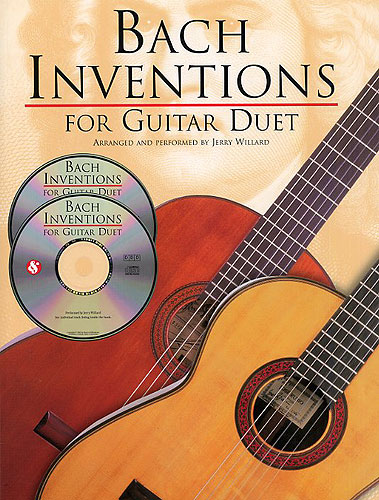
BACH, INVENTIONS FOR GUITAR. Willard. Per duo. SHEET MUSIC BOOK WITH 2CD & GUITAR TABLATURE.
LIBRO DI MUSICA CLASSICA CON 2 CD.
SPARTITI PER CHITARRA :
PENTAGRAMMA, TABLATURE.
BACH INVENTIONS
for Guitar Duet
Series: Music Sales America
Publisher: Music Sales America
Format: Softcover with CD – TAB
Composer: Johann Sebastian Bach
Arranger: Jerry Willard
Since their introduction, Bach's Two-Part Inventions have been an essential resource for developing hand independence and ornamentation technique. Keyboard players have enjoyed these etudes for centuries and now this body of work is available to guitarists in this collection of fifteen pieces. They have been transcribed and arranged for the classical guitar duet by Jerry Willard, and are presented in notation and tab. The title is accompanied by two CDs, the first of which features demonstration recordings of all inventions. The second CD offers single guitar recordings so you can play along.
Inventory #HL 14002913
ISBN: 9780825628290
UPC: 752187978459
Publisher Code: AM978450
Width: 9.0"
Length: 12.0"
64 pages
This collection contains fifteen of Bach's 2-part inventions. These fifteen inventions have been transcribed and arranged for the classical guitar duet by Jerry Willard, and are presented in notation and Tab. The title is accompanied by two CDs, the first of which features demonstration recordings of all inventions. The second CD offers single guitar recordings with which you may play along by means of solo rehearsal.
Johann Sebastian Bach (1685-1750) penned his inventions as a formal method of study, originally for his eldest son Wilhelm Friedemann, and subsequently, refined the collection for his young pupils. These musical gems are the finest examples of music ever written for the sole purpose of instruction, and also serve as preparation for his larger works.
This folio contains all 15 Two Part Inventions arranged for guitar duet by Jerry Willard. Each invention is presented in standard notation and tablature with suggested fingerings and ornamentation. In addition, the accompanying CDs provide the opportunity to study each invention, as well as each part, separately or together. Disc 1 presents each invention played by both guitars while Disc 2 demonstrates each part individually. Disc 2 additionally provides a count-in click giving the student the opportunity to perform the invention with the CD or simply to follow along and study each part individually.
The Editors
Bach Inventions for Guitar Duet is a collection of short pieces penned by Johann
Sebastian Bach for his young pupils. These musical gems are the finest examples of
music ever written for the sole purpose of instruction, and also serve as preparation
for his larger works.
This folio contains all fifteen Two-Part Inventions arranged for guitar duet. It is
believed that Bach's intention was to bring them together as a single work along with
his three-part pieces known as the Sinfonias, confirmed by the way that they are presented
in a manuscript penned in his own hand in 1723.These inventions demonstrate
contrapuntal technique and explore musical expressions while developing motifs in a
logical fashion.
Bach uses the term invention as a play on words. In today's musical parlance, invention
pertains directly to this body of work; however, Bach uses it to describe an idea
that could be used as a compositional theme with the intention that this type of technical
exercise could inspire those who studied these pieces to develop a more musical
approach.
Mr. Willard has arranged these pieces for study and performance as guitar duets.
Each invention is presented in standard notation and tablature with suggested fingerings
and ornamentation. In addition, the accompanying CDs provide the opportunity
to study each invention, as well as each part, separately or together. Disc 1 presents
each invention played by both guitars while Disc 2 has each part performed individually.
Disc 2 additionally provides a count-in click giving the student the opportunity to
perform the invention with the CD or simply to follow along and study each part individually.
Please note that these pieces were performed with minimal ornamentation in order to
provide the student with an accurate representation of the themes. The choices of
embellishments are quite simply too vast to incorporate in this folio and are of a personal
preference left up to the performer.
The following description of Bach's infamous Two-Part Inventions is taken from the
autograph fair copy in the Staatsbibliothek zu Berlin:
Straightforward instruction, in which amateurs of the keyboard, and especially the eager ones, are
shown a clear way not only:
1. of learning to play cleanly in two voices, but also, after further progress,
2. of dealing correctly and satisfactorily with three obbligato parts;
at the same time not only getting good inventions, but developing the same satisfactorily, and above
all arriving at a cantabile manner in playing, all the while acquiring a strong foretaste of composition.
Provided Anno Christi 1723.
By Johann Sebastian Bach:
Capellmeister to his Serene Highness the Prince of Anhalt-Cothen.
Jerry Willard was born in Cleveland, Ohio and began studying the guitar with his father Jeff Willard who was a guitarist. The guitar pedagogue Sophocles Papas recognized his talent and invited Mr. Willard to study with him in Washington, D.C. Subsequently Mr. Willard studied with guitarists Richard Lurie and Alirio Diaz. Mr. Willard's performances on guitar and lute range from performances of 16th-century work from the original tabulature to his own transcriptions of music from the 18th, 19th, and 20th centuries. He has appeared in Alice Tully Hall and Carnegie Hall in New York City, and he has concertized extensively throughout Europe and The United States. Well known as an ensemble player, he has performed with the Cleveland Orchestra, The New York Opera Company, The New York Consort of Viols, and The Long Island Baroque Ensemble. He has published many transcriptions for guitar including "The Complete Lute Music of J.S. Bach" available through Music Sales Corp.
Invention 1
Invention 2
Invention 3
Invention 4
Invention 5
Invention 6
Invention 7
Invention 8
Invention 9
Invention 10
Invention 11
Invention 12
Invention 13
Invention 14
Invention 15

 Italiano
 English