JOHN FAHEY

JOHN FAHEY GUITAR ANTHOLOGY RECORDED VERSION TABLATURE HAL LEONARD CHITARRA LIBRO SPARTITI

JOHN FAHEY, GUITAR ANTHOLOGY. GUITAR RECORDED VERSION. SHEET MUSIC BOOK WITH GUITAR TABLATURE.

LIBRO DI MUSICA. 

SPARTITI PER CHITARRA CON: 

ACCORDI, PENTAGRAMMA, TABLATURE. 

SERIES: GUITAR RECORDED VERSION
Format: Softcover - TAB
Artist: John Fahey

Inventory #HL 00150257
ISBN: 9781495036033
UPC: 888680084431
Width: 9.0"
Length: 12.0"
114 pages

18 songs in note-for-note transcriptions with tab from the man who was considered the grandfather of instrumental acoustic fingerstyle guitar. Includes: America • Brenda's Blues • Desperate Man Blues • In Christ There Is No East or West • John Henry • Poor Boy, Long Ways from Home • Some Summer Day • Steamboat Gwine 'Round De Bend • Tell Her to Come Back Home • When the Springtime Comes Again • and more. Includes a biography and discography.

Song List :

America
Assassination Of Stephan Grossman
Brenda's Blues
Dance Of The Inhabitants Of The Palace Of King Philip Of Spain
Desperate Man Blues
In Christ There Is No East Or West
Jaya Shiva Shankarah
John Henry
Poor Boy, Long Ways From Home
Sligo River Blues
Some Summer Day
Spanish Dance
Steamboat Gwine 'Round De Bend
Sun's Gonna Shine In My Backdoor Someday Blues
Sunflower River Blues
Tell Her To Come Back Home
When The Springtime Comes Again
The Yellow Princess


Prezzo: €29,99
€29,99

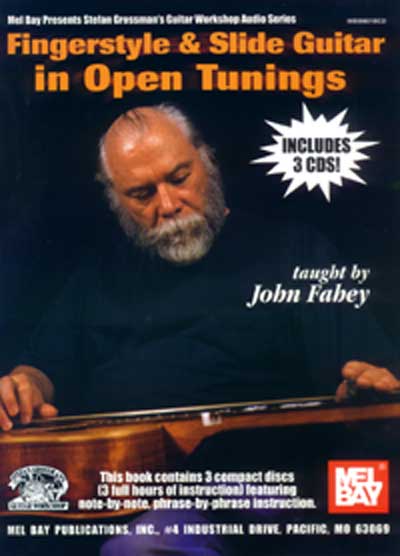
FINGERSTYLE & SLIDE GUITAR IN OPEN TUNINGS BOOK 3-CD TABLATURE JOHN FAHEY St. Louis Blues-Silent Night, Holy Night

FINGERSTYLE & SLIDE GUITAR IN OPEN TUNINGS BOOK/3-CD SET TABLATURE
BY JOHN FAHEY 

Product Description:
John Fahey was a pioneer in composing and arranging guitar solos in open tunings. In this lesson series for the intermediate guitarist, John teaches a wide variety of techniques, musical textures and styles. The book includes the notation and tablature for the lessons plus 3 compact discs featuring phrase-by-phrase instruction. LESSON ONE: Open G tuning: On the Sunny Side of the Ocean, Spanish Two Step and It Came Upon A Midnight Clear. St.Louis Blues played in a dropped D tuning. LESSON TWO: In this lesson John explores the possibilities of playing in an open C tuning. The Union Pacific has a distinct blues quality, Requiem For John Hurt has an "Eastern" feel. Simplicity often creates beauty and John does this with his version of Auld Lang Syne. LESSON THREE: This lesson concentrates on John's slide guitar playing. Steamboat Gwine Round The Bend played in open G demonstrating many of John's unique technical ideas. The Christmas carol Silent Night is presented in the slide style. John's popular arrangement of Poor Boy A Long Way From Home played in open D tuning finishes the series.

Product Number: 99801BCD
Format: Book/3-CD Set


Contents:

Book Contents:
CD Track Listings
John Fahey by Mark Humphrey
An Interview with John Fahey
A John Fahey Discography
Explanation of the Tab System
On the Sunny Side of the Ocean
Spanish Two Step
It Came Upon a Midnight Clear
St. Louis Blues
The Union Pacific
Requiem for John Hurt
Auld Lang Syne
Steamboat Gwine 'Round the Bend
Silent Night, Holy Night
Poor Boy a Long Way From Home

CD Track Listings
Lesson One
Track 1: Introduction to Open G tuning
Track 2: Tuning to Open G tuning (D G D G B D)
Track 3: Discussion of chords in Open G tuning and introduction to On the Sunny Side of the Ocean
Track 4: Performance of On the Sunny Side of the Ocean
Track 5: Teaching of first section of On the Sunny Side of the Ocean
Track 6: Plays slowly first section of On the Sunny Side of the Ocean
Track 7: Teaching of second section of On the Sunny Side of the Ocean
Track 8: Plays slowly second section of On the Sunny Side of the Ocean
Track 9: Teaching of third section of On the Sunny Side of the Ocean
Track 10: Introduction to Spanish Two Step
Track 11: Performance of Spanish Two Step
Track 12: Teaching of first section of Spanish Two Step
Track 13: Plays slowly first section of Spanish Two Step
Track 14: Teaching of second section of Spanish Two Step Track 15: Plays slowly second section of Spanish Two Step
Track 16: Teaching of third section of Spanish Two Step
Track 17: Introduction to It Came Upon a Midnight Clear
Track 18: Performance of It Came Upon a Midnight Clear
Track 19: Teaching of complete arrangement of It Came Upon a Midnight Clear
Track 20: Plays slowly It Came Upon a Midnight Clear
Track 21: Tuning for Dropped D tuning (D A D G B E)
Track 22: Performance of St. Louis Blues
Track 23: Teaching of first section of St. Louis Blues
Track 24: Teaching of second section of St. Louis Blues
Track 25: Plays slowly second section of St. Louis Blues
Track 26: Plays again slowly second section of St. Louis Blues
Track 27: Closing thoughts on playing St. Louis Blues

Lesson Two
Track 1: Introduction to The Union Pacific
Track 2: Performance of The Union Pacific
Track 3: Tuning in Open C tuning (C G C G C E)
Track 4: Discussion of right hand technique for The Union Pacific
Track 5: Teaching of first section of The Union Pacific
Track 6: Plays slowly first four bars of The Union Pacific
Track 7: Plays slowly again first four bars of The Union Pacific
Track 8: Teaching from end of fourth bar to end of first section of The Union Pacific
Track 9: Plays slowly first section of The Union Pacific
Track 10: Teaching of second section of The Union Pacific
Track 11: Plays slowly complete arrangement of The Union Pacific
Track 12: Performance of Requiem for John Hurt
Track 13: Introduction to first section of Requiem for John Hurt
Track 14: Plays slowly first section of Requiem for John Hurt
Track 15: Teaching of first eight bars of first section of Requiem for John Hurt
Track 16: Teaching from ninth bar of first section of Requiem for John Hurt
Track 17: Plays slowly first section of Requiem for John Hurt
Track 18: Teaching from seventeenth bar of first section of Requiem for John Hurt
Track 19: Plays slowly first section of Requiem for John Hurt
Track 20: Teaching of second section of Requiem for John Hurt
Track 21: Plays slowly picking pattern for second section of Requiem for John Hurt
Track 22: Teaching of variations for second section of second section of Requiem for John Hurt
Track 23: Plays slowly second section of Requiem for John Hurt
Track 24: Teaching of third section of Requiem for John Hurt
Track 25: Teaching of fourth section of Requiem for John Hurt
Track 26: Plays slowly from second section to end of Requiem for John Hurt
Track 27: Discussion of variations in Requiem for John Hurt
Track 28: Introduction to Auld Lang Syne
Track 29: Performance of Auld Lang Syne
Track 30: Teaching of Auld Lang Syne
Track 31: Introduction to Joy To the World
Track 32: Performance of Joy To the World

Lesson Three
Track 1: Introduction to using slide in open tunings
Track 2: Tuning to Open G tuning (D G D G B D)
Track 3: Performance of Steamboat Gwine ’Round the Bend
Track 4: Discussion of slide technique of play guitar on lap
Track 5: Teaching of first section of Steamboat Gwine ’Round the Bend
Track 6: Plays slowly first section of Steamboat Gwine ’Round the Bend
Track 7: Teaching of second section of Steamboat Gwine ’Round the Bend
Track 8: Plays slowly second section of Steamboat Gwine ’Round the Bend
Track 9: Teaching of third (middle) section of Steamboat Gwine ’Round the Bend
Track 10: Plays slowly third (middle) section of Steamboat Gwine ’Round the Bend
Track 11: Plays slowly first section and into second section of Steamboat Gwine ’Round the Bend
Track 12: Discussion of variations in Steamboat Gwine ’Round the Bend
Track 13: Discussion of slide vibrato technique and introduction to Silent Night, Holy Night
Track 14: Performance of Silent Night, Holy Night
Track 15: Teaching of introduction of Silent Night, Holy Night
Track 16: Plays slowly introduction of Silent Night, Holy Night
Track 17: Teaching of first four bars of verse of Silent Night, Holy Night
Track 18: Plays slowly first four bars of verse of Silent Night, Holy Night
Track 19: Teaching from fifth bar to end of Silent Night, Holy Night
Track 20: Plays rift at end of verse of Silent Night, Holy Night
Track 21: Plays slowly verse of Silent Night, Holy Night
Track 22: Teaching of Outro of Silent Night, Holy Night
Track 23: Plays slowly Outro of Silent Night, Holy Night
Track 24: Introduction to Open D tuning (D A D F# A D) and Poor Boy a Long Way From Home
Track 25: Performance of Poor Boy a Long Way From Home
Track 26: Tuning to Open D tuning (D A D F# A D)
Track 27: Teaching of verse of Poor Boy a Long Way From Home
Track 28: Plays slowly verse of Poor Boy a Long Way From Home
Track 29: Teaching variation of verse of Poor Boy a Long Way From Home
Track 30: Teaching of Bridge of Poor Boy a Long Way From Home
Track 31: Plays slowly opening bars of bridge of Poor Boy a Long Way From Home
Track 32: Discussion of origins of arrangement of Poor Boy a Long Way From Home
Track 33: Plays slowly complete arrangement of Poor Boy a Long Way From Home
Track 34: Discussion of Open D tuning
Track 35: Recent instrumental in Open D tuning
Track 36: Closing thoughts on Open D tuning
Track 37: Performance of Steel Guitar Rag

Prezzo: €29,00
€29,00

FAHEY JOHN AMERICAN PRIMITIVE GUITAR 3CD TABLATURE LIBRO Indian Pacific Railroad Blues

FAHEY JOHN, AMERICAN PRIMITIVE GUITAR. In Christ There Is No East Or West -Take A Look At That Baby -Some Summer Day -Indian Pacific Railroad Blues -The Last Steam Engine Train -When The Springtime Comes Again -The Approaching Of The Disco Void. SHEET MUSIC BOOK WITH 3CD & GUITAR TABLATURE. 

LIBRO DI MUSICA ACUSTICA, CON 3 CD. 

SPARTITI PER CHITARRA CON :

ACCORDI PENTAGRAMMA, TABLATURE. 

... in roots music as a living, breathing thing rather than a museum piece. Industrial guitar grind dominates City Of Refuge, bathyspherelike booms echo through Womblife. White gamelan sounds reverberate through The Epiphany Of Glenn Jones. Such experimentation might have isolated him from his peers through most of the last 30 years, but in the 90s he has discovered an affinity with the ever expanding global underground communitY. "I didn't know there was an alternative movement going," Fahey admits, "so I just kept trying to create similar things to the old. I was aware that there had been an experimental movement in the 60s with John Cage and his followers, but thought they had all gone. Then some friends introduced me to Sonic Youth. Until then I didn't know what was going on.
"As defined by Sonic Youth's Thurston Moore, this "alternative movement" was out of a desire for music resistant to "commodification", be it noise, lo-fi, 20th century experimental music and improv, or global and rediscovered American roots musics like bluegrass, folk and blues.
John Fahey's work feeds the new underground spirit on a number of counts, while Revenant - the label Fahey co-owns with his manager, the Nashville-based attorney Dean Blackwood - alerts new audiences to a hidden history of American music, retrieved from the tiny regional labels scattered across its rural hinterlands.
The surprising success of the six CD box set reissue of rogue archivist Harry Smith's Anthology Of American Folk Music (for which Fahey supplied award-winning sleevenotes) attests to a desire for music that emerges from and addresses real experiences rather than a marketing man's business plan. The Revenant archive releases, meanwhile, vividly recast the past not as nostalgia but as American Primitive or Raw Music. "It was Dean's idea to do that," Fahey modestly states, "but I provided most of the information, together with this collector called Gayle Dean Wardlow. Now that the American Primitive thing is catching on we'll do more. People love the title" The range of his enthusiasms combined with the breadth of his own music make Fahey a vital link connecting today's underground with a century of raw and experimental musics. For his part, he is only too pleased to be working within his newly adopted alternative music 'community'. His instant conversion has already produced one of its finest works in The Epiphany Of Glenn Jones, which teamed John with the Massachusetts post-rockers Cui De Sac, led by Glenn Jones. The title refers obliquely to the project's unpromising start as a "retro lounge music" session - quickly aborted - which Jones's sleeve notes describe as being akin to taking part In some "hellish sensory deprivation experiment". Was working with Fahey really that bad?
The guitarist chuckles mischievously: "Glenn told me after the Epiphany that he had got on a power trip. It had happened to him before, only he hadn't realized it. He did things like not letting me meet the other members of the band until the recording sessions, all kinds of tricks, so that he could remain ultimate dictator of Cui De Sac and the project. But that's an old battle, Glenn's a friend of mine and it came out OK."

AMERICAN PSYCHO
When Fahey was venting his disgust for his 60s recordings earlier on, he went at them with a ferocity out of all proportion to the quality of music. His negative attitude hinted that something deeper was going down than a mature reappraisal of his youthful endeavours. Eventually, his hostility relents, and the negativity lets up long enough to reveal the pain at its source.
"Mainly it's a parental situation:' Fahey explains, washing down more popcorn with gulps of sweet iced tea. "I was writing these things as an escape, as a possible way to make money. The sentiments expressed come out of a messed up situation. I was creating for myself an imaginary, beautiful world and pretending that I lived there, but I didn't feel beautiful. I was mad but I wasn't aware of it. I was also very sad, afraid and lonely. By presenting this so-called beautiful facade I looked good to myself and my audience.
"This went on for years," he continues. "I always tried to put a peaceful element into the music, but it was false because I was not at peace. I didn't know what 1was doing and felt pretty phony. I didn't understand any of this until I had psychoanalysis."
Entering psychoanalysis in the mid-80s helped him exorcise the past. "Before psychoanalysis:' Fahey recalls, "I used to accidentally get so high on prescription drugs and booze that, sometimes, I wouldn't show up for a show. Or I'd be there and not know it. For a while I thought 1was going insane. People would tell me I did these crazy things, but I didn't attribute it to the Quaaludes I was taking so that the memories of my father abusing me as a child wouldn't come back."
In taking Fahey back to the source of his traumas psychoanalysis invested the innocent symbols he had carried over from his childhood with sinister new meanings. Out of a boy's fascination with turtles and tortoises, he had elaborated a personal mythology based on the reptiles, using them as a repeat motif anchoring his art and discography in his childhood.
Under analysis he recalled how he burst out screaming when he first saw a turtle. "When I was about four or five years old I saw what I thought was a penis walking across the front lawn:' he shudders. "It was just a box turtle, but it kind of upset me ..."
Analysis related the encounter to the memory of being sexually molested by his father. "The obsession comes from the psychic meaning of turtles, reptiles and amphibians. In dreams they symbolize genitalia. That's why I went to a psychoanalyst because I had all these repressed memories." The unifying visual motif of his personal mythology and extensive discography turned out to be the corrupting agent of their potential destruction all alone. Remarkably, coming to terms with the full horror of such a revelation marked the beginning of Fahey's 90s regeneration.

AMERICAN PRIMITIVE
John Fahey was born on 28 February 1939 and spent most of his childhood in Takoma Park, Maryland, a small town on the outskirts of Washington DC. His early musical training was at once formal and frustrating. His parents occasionally took him to see 50s bluegrass stars like The Stanley Brothers, whose early recordings Fahey would later reissue on Revenant. But though he grew up with Country & Western and bluegrass, his first instrument was a clarinet. He abandoned it at 14 when he bought his first guitar, a $17 Sears And Roebuck special, with money earned from his newspaper round. After teaching himself to pick his way through the Eddy Arnold songbook, the young, lonely and slightly crazy guitar player decided it was time to start writing his own material. The year was 1954, and Elvis Presley was just beginning to make waves in America. If the young Fahey readily embraced the ...

Prezzo: €35,99
€35,99

FAHEY JOHN, THE GENIUS OF WITH LIBRO CD TABLATURE

FAHEY JOHN, THE GUITAR OF. CD TABLATURE


Prezzo: €19,00
€19,00
Condividi contenuti