Ed Friedland

PENTATONIC SCALES FOR BASS, FINGERINGS, EXERCISES FIVE-NOTE SCALES. Ed Friedland. CD TABLATURE

PENTATONIC SCALES FOR BASS, FINGERINGS, EXERCISES AND PROPER USAGE OF THE ESSENTIAL FIVE-NOTE SCALES. Ed Friedland. CD TABLATURE

Ogni scala è mostrata in 3 modi: I posizione, a posizione fissa, in movimento.

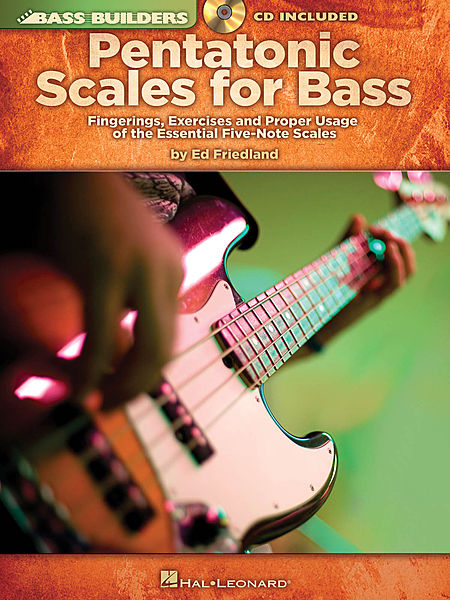
Pentatonic Scales for Bass

Fingerings, Exercises and Proper Usage of the Essential Five-Note Scales
Series: Bass Builders
Format: Softcover with CD - TAB
Author: Ed Friedland

The pentatonic is one of the most widely used scales in music. This book teaches fingerings for these essential five-note scales all over the neck, and how to use them to create solid, functional bass lines. The CD contains 56 tracks and features full-band demonstration examples. Covers: major and minor pentatonic scales; one- and two-octave scale patterns; pentatonic modes and their applications; soloing with pentatonic scales; and much more ! 64 pages

By definition, a pentatonic scale is simply a group of five consecutive notes within the
range of an octave. With this loose framework, there can be many variations of five-note

patterns that fit this description. Throughout this book, we will focus on the two most

common variations: the major pentatonic (1-2-3-5-6-S) and minor pentatonic (1-h3-4-

5-~7-S). These pentatonic scales are undoubtedly the most commonly used musical

elements in the world. Cultures as far-flung as Africa, Europe, Asia, the South Pacific,

and the North and South Americas use these five-note patterns as the basis of their

musical traditions, and their influence on contemporary music is just as far-reaching. As

the primary building blocks of the rock and roll musical vocabulary, the pentatonic scale

can be traced directly to West Africa, Ireland, and Scotland. When African captives were

brought to the Western world, they carried with them a deep musical tradition whose

rhythmic basis morphed over time into shuffle and swing feels. Melodically, the minor

pentatonic scale (1-h3-4-5-h7-S) was at the core of their music-eventually evolving into

the blues scale (1-h3-4-#4-5-h7-S), the melodic foundation of the blues. The journey from

the blues to rock and roll has been well-documented.

But the pentatonic scale's influence on popular music can also be traced back to the music of

Ireland and Scotland. As Celtic people settled in the New World, they brought their

songs, reels, jigs, and sea shantys-many of which were based on the pentatonic scale.

This music became the seed of the Appalachian folk tradition, which over the years

evolved into Old Timey, Bluegrass, and Country. Between the late 1940sand 1950s,these

styles crossbred with the emerging "boogie" genre to create rockabilly as well as rock

and roll. When you look at this crosscurrent of influence, the differences between artists

like Muddy Waters and Hank Williams seem less significant.

The pentatonic scale (in its major form) is simply a major scale without scale degrees 4

and 7. The interval created between the 4th and 7th scale degrees is known as the tritone, and it

is the principle source of dissonance in Western music. By removing these two degrees,

we have a scale that is void of any potential dissonance. German composer Carl Orff

(best known as the composer of Carmina Burana) devised a system of music education

for children based on the use of pentatonic scales for this very reason. Since there are no

"bad" notes, children can improvise freely on pentatonic-based instruments to develop

their creativity. It has been said that in medieval times, the use of the tritone in musical composition

was banned due to its disharmonious quality. It is documented that the tritone was once

referred to as Diablo en Musica, or the "Devil in Music," and considering most music of the

time was composed for use in church, it is not hard to see why the pentatonic scale might

have been favored.


Introduction

 Using the CD

 Learning the Pentatonic Scale
 Minor Pentatonic

 Major Pentatonic

 Two-Octave Pentatonic Scales

 Technical Exercises

 Pentatonic Modes
  - Using Pentatonic Modes

 Common Out-of-Scale Chords

 Other Chord Movements

 Soloing with Pentatonic Scales
 - Major 7th Chords
 - Minor 7th Chords
 - Dominant 7th Chords

 In Closing

Prezzo: €20,99
€20,99

BLUES BASS, A GUIDE TO THE ESSENTIAL STYLES AND TECHNIQUES, Ed Friedland. CD TABLATURE

BLUES BASS, A GUIDE TO THE ESSENTIAL STYLES AND TECHNIQUES, Including 20 great songs, Ed Friedland. B.B. King, Stevie Ray Vaughan (Tommy Lee Shannon), Muddy Waters, Freddie King, Albert King, The Allman Brothers, Otis Rush, T-Bone Walker, Louis Jordan, e molti altri: Born Under a Bad Sign - Hideaway - Hoochie Coochie Man - Killing Floor - Pride and Joy - Sweet Home Chicago - The Thrill Is Gone e molte altre. CD TABLATURE

LIBRO METODO DI MUSICA BLUES PER BASSO, CON CD

SPARTITI PER BASSO CON : ACCORDI, PENTAGRAMMA E TABLATURE. 


Hal Leonard Bass Method Stylistic Supplement
Series: Bass Method
Softcover with CD - TAB
Author: Ed Friedland

The Hal Leonard Blues Bass Method is your complete guide to learning blues bass. This book and CD package uses classic blues songs and standards to teach you how to lay down your own solid blues bass lines. Learn to play by studying the songs of famous bluesmen such as B.B. King, Stevie Ray Vaughan (Tommy Lee Shannon), Muddy Waters, Freddie King, Albert King, The Allman Brothers, Otis Rush, T-Bone Walker, Louis Jordan, and many more. Learn actual riffs from blues classics including: Born Under a Bad Sign - Hideaway - Hoochie Coochie Man - Killing Floor - Pride and Joy - Sweet Home Chicago - The Thrill Is Gone , and more. 80 pages

Buon metodo per Basso di musica Blues, per imparare e migliorare senza annoiarsi.

It's important to remember the role of the bass in blues. You are the foundation, the pulse, and the glue that holds it together. The lines and information in this book are what you need to know to do the job the way people expect it to be done, but it's still up to you to approach this style with an effective attitude. The blues is not about the bass player being the center of attention (unless you're Singing too). The singer and soloists are the main focus, and it's best for you to leave the glory to them. Where we derive our greatest thrill in blues is the feeling we create when we lock in with the drums and make everyone play better than they ever imagined they could. It's the feeling of the energy coming back to you from the other band members and the audience. It's the satisfaction you get from knowing you played the style authentically and with feeling. Notice the word "feeling" comes up a lot. Well, the blues ain't nothin' but a feelin'-that's right! Ed Friedland has written many well-received instructional books for bass, including the Hal Leonard Electric Bass Method, Second Edition. He wrote for Bass Player Magazine from 1992 to 2005. He is currently Senior Editor of Guitar World's Bass Guitar Magazine. He has taught at Berklee College of Music, Arizona State University, and Boston College, as well as privately since 19S0. He has played with many great artists in jazz, rock, blues, theater, classical, Latin, country, and just about every style. His blues credentials include performances with Robert Junior Lockwood, Mighty Sam McClain, Robben Ford, Linda Hopkins, Johnny Adams, Paul Rishell, Annie Raines, Bruce Katz, Jim Kelly, David Maxwell, and Mike Williams, among others, as well as leading his own group, Lazy Ed & The Stratoloungers.

BASS METHOD

INTRODUCTION

About the CD

Equipment

THE BLUES SCALE

THE 12-BAR BLUES FORM

THE SHUFFLE RHYTHM

TURNAROUNDS

LAYING DOWN THE ROOT

BOX-SHAPE PATIERNS

Dyna Flow

Messin' with the Kid

BOOGIE LINES ..

Big Boss Man – Jimmy Reed

Kidney Stew – Big Joe Turner

SLOW BLUES

Stormy Monday – T-Bone Walker

RHUMBA BLUES

Mardis Gras in New Orleans

Crosscut Saw

INTROS

ENDINGS

STOPS, HITS, AND KICKS

ALTERNATE FORMS

My Babe – Willie Dixon

Key to the Highway – Big Bill Bronzy, Eric Clapton

I Hear You Knockin' – Lazy Lester

BLUES STANDARDS

Hideaway – Freddie King

I'm Tore Down – Freddie King

Born Under a Bad Sign – Albert King

Killing Floor – Howlin Wolf

Pride and Joy – Tommy Lee Shannon bassista di Stevie Ray Vaughan

Hoochie Coochie Man – Muddy Waters

The Thrill Is Gone - B.B. King

All Your love (I Miss loving) -Otis Rush

Farther up the Road

Sweet Home Chicago

THOUGHTS ON BLUES BASS PLAYING

ABOUT THE AUTHOR

Prezzo: €21,99
€21,99

JAZZ BASS, BASS BUILDERS BY ED FRIEDLAND 72 Pages CD TABLATURE LIBRO PER BASSO

JAZZ BASS, BASS BUILDERS, BY ED FRIEDLAND. 72 Pages. CD TABLATURE

LIBRO PER BASSO CON CD E TABLATURE.

Medium: Softcover with CD
Author: Ed Friedland

This book/CD pack features over 50 examples covering walking bass, the two feel, 3/4 time, Latin, and ballads. It covers soloing, performance protocol, and includes seven complete tunes. 72 pages.

Prezzo: €15,00
€15,00

JAZZ UPRIGHT BASS Ed Friedland TABLATURE DVD SPARTITI BASSO METODO LIBRO TABLATURE

JAZZ UPRIGHT BASS, Ed Friedland. BOOKLET WITH BASS TABLATURE DVD

DVD VIDEO DI MUSICA JAZZ, LATIN-JAZZ. 

SPARTITI PER BASSO CON: 

ACCORDI, PENTAGRAMMA, TABLATURE.

VIDEO DIDATTICO, STUDIO, TECNICA, 

DVD VIDEO LEZIONE PER BASSO 

Series: DVD
Publisher: Hal Leonard
Medium: DVD
Author: Ed Friedland

In this information-packed DVD, bassist Ed Friedland reveals the technical and stylistic details behind professional jazz upright performance. Through live band demonstrations and detailed, step-by-step analysis, Ed shows you how to: develop stylistic left and right-hand techniques for maximum tone and sustain; arrange scale and arpeggio patterns for greater range and efficiency whether walking or soloing; deal with typical live performance challenges – performance protocol, stock intros, endings, trading fours and more; play classic stylistic variations including Latin jazz, up-tempo tunes, the two-feel, ballads, 3/4 time and more. Ed's practical, direct teaching style offers easy-to-understand explanations and methodical demonstrations of each topic. The accompanying booklet includes notated versions of each example for added clarity.

Prezzo: €27,99
€27,99

BASS METHOD COMPLETE EDITION 1-2-3 ED FRIEDLAND 3 CD TABLATURE rake-Scale-Right-Hand Technique

BASS METHOD COMPLETE EDITION 1, 2, 3. BY FRIEDLAND. 3CD TABLATURE

Hal Leonard Bass Method - Complete Edition
The critically acclaimed Hal Leonard Electric Bass Method – Second Edition in a handy composite edition! Contains 3 books and 3 CDs for Levels 1, 2 and 3.

Inventory #HL 00695074
ISBN: 9780793563838
UPC: 073999950748
Width: 9.0"
Length: 12.0"
144 pages

HAL LEONARD

Books 1, 2 and 3 Bound Together in One Easy-to-Use Volume!
Series: Bass Method
BOOK W/CD - TAB
Author: Ed Friedland

The critically acclaimed Hal Leonard Electric Bass Method - Second Edition in a handy composite edition! Contains 3 books and 3 CDs for Levels 1, 2 and 3. 144 pages,


TUNING
TUNING TO THE CD
To tune your bass, adjust the tuning pegs. Tightening a peg will raise the pitch
of a string, loosening a peg will lower it.
On CO Track 1, each string is played four times. The first string you'll hear is
the G (1st) string. Check your string with the CD; if it sounds lower than the
recording, tighten the tuning peg until you get closer to the pitch on the CD. If
your string is higher, then loosen the peg. Once the G string is in tune, repeat
this process with the 0, A, and E strings (2, 3, and 4).

USING AN ELECTRONIC TUNER
Electronic tuners have become very affordable, so it's a good idea to have one.
There are generally two types available: a "bass" (or "guitar") tuner, which will
only read the open strings of your instrument, or a "chromatic" tuner, which
will read any pitch. Either will do the job. Plug your bass into the input of the
uner and play your open G string. The tuner will read the pitch and tell you if
he string is sharp (too high) or flat (too low). Adjust the tuning peg until the
tuner indicates you are in tune. Repeat the process with the 0, A, and E strings.

TUNING TO A KEYBOARD
Use the appropriate key on a piano/keyboard to check your open strings.

G 4th string
D 3rd string
A 2nd string
E 1st string

RELATIVE TUNING

Here's another way to tune your bass. It is less accurate, as it assumes that your starting string is in tune-and it is harder for
he ear to hear the low pitch of the bass as well as a tuner can-but this method works when there are no other alternatives.
It's also a good way to check your tuning.
• Start with your open G string. If there is an accurate G available, use it; otherwise, assume the G string is tuned to
the correct pitch.
• Play the 0 string at the 5th fret, and see if that note matches the open G. Tune the 0 string up or down until the
two notes match.
• Play the A string at the 5th fret; compare it to the open O. Tune the A string up or down until the two notes match.
• Play the E string at the 5th fret; compare it to the open A. Tune the E string up or down until the two notes match.
nut 5th fret
This is called relative tuning because the strings are tuned relative to one another.


BOOK 1

The Electric Bass
The Bass Amp
Tuning
Playing Positions
Musical Symbols
Right-Hand Technique
Fingerstyle
Pick Style
left-Hand Technique
The 1-2-4 Fingering System
Open-String Exercises
The Rake
Notes on the E String
Little Rock
Kinda Folky
More Notes on the E String
lookin' Sharp
The Shift
Notes on the A String
You Go, Slav
Repeat Sign
One More Time
Cattle Crossing
More Notes on the A String
The Finger Roll
Roll It
Rolly
12 -Bar Blues
A Little Heavy
Notes on the D String
Private Eye
Minor league
D-Lite
More Notes on the D String
Three-String Review
Crossin'Three
The Octave
Octa Gone
Notes on the G String
Gee Whiz
All Right
More Notes on the G String .
All Four One .
FiX .
More Octaves .
Octave Blues .
Ties .
Taiwan On .
3/4 Time & the Dotted Half Note .
Three's a Crowd .
Tell It. .
Changin' Times .
Rests .
Rock 'n' Rest .
D.C. al Fine .
Three Play .
Eighth Notes .
Movin' 8's .
Eight Ball .
Eighth Rests ,
Rok Gruv ,
Bop Bop ,
D.C. al Coda ,
Coda Pendant. .
Dee Dee .
Using a Metronome .
The Classic Rhythm .
Down Home .
Raitt On .
Minor's Tale .
A Classic Variation .
Classic Blues .
Petty Thief .
Third Posi~on .
3rd Watch .
Flying leap .
oand 3 .
Shifty .
Shift-Crazy Blues .
Stones-y .
Etude Brute .


BOOK 2
The Box Shape
E.A & B Box
Box Lunch
Box-E Blues
Movable Boxes
Your Move
Move It
Movie Star
5th Position
On the G String
Shift Practice
Shifty Henry
On the D String
Dee Gee
5-3-1
Dig It.
On the A String
Introducing Tablature
Tab Hunter
Pay the Tab
On the E String
Open/Closed
Da Blues
All Together Now
Swing lime
One Finger Per Fret
The Major Scale
Scale Sequence #1
Scale Sequence #2
Key Signatures
Universal Fingerings
Scale Sequence #3
Scale Sequence #4
Pasta Mon
D-Lish
A-Flat lire
Open E
G3
B-Flat Jump
The Classic Blues Line
Gee Blues
Aay, Blues! .
Low Down
Understanding Bass Lines
Syncopated Eighth Notes
Off Beat.
Funky Soul Groove
That '70s Thing
The Major Triad .
Tri Again
Funky Li'l Blues .
The Minor Scale .
Minor Scale Sequence .
Relative Minor and Major
House 0' Horror
Noir
Jazz Minor
Modulation
Minor Modulation .
Mod Crazy
Minor Triads
Bogey Man
Roots
Gypsy Swing
Room-ba with a View
Eighth-Note Triplets
The '50s
12/8 Time
Bumpin' .
The Shuffle Rhythm
Old Days
One- and Two-Measure Repeats
Bad Bone
Uptown Down
Classic Flat 7
Rollin' .
Go On


BOOK 3
The Chromatic Walkup
Open Up
Staccato
Double Up
Rez-Q.
Curtis
Kickin' It.
Sixteenth Notes
One Drop
Dada Dadat
Jog Wheel
Sixteenth Rests
Layin' Back
Nazz-T
Plutonic
Funky16th-Note Syncopation
Ookachu Wha?
Groove
Combo
Minor Glitch
Do It Now
Soul Groove
D-Troit
Seventh Chords
Floaty
Vanilla
L'il Thing
Funk lime
Little M
Shufflin'
Middle Man
On the Verge
Slides
Slippin' & Slidin'
Minor Pentatonic
Venture Forth
Deja View
Hammer-Ons & Pull-Offs
Hammer Head
X-Tender
Major Pentatonic
Just Like My Girl
N' awlins Beat
Playing Off Chord Symbols .
Just Roots .
Roots & 8ths .
Jumping Octaves .
Your Turn .
Adding the 5th .
Use the 5 .
5By8 .
Root-5-8 .
You Got It .
Chromatic Approach .
Chromatic R-5-8 .
It's Up to You .
Scale Approach .
Scale R-5-8 .
All Yours .
Dominant Approach .
Dominant to the 5th .
You Go, Hugo .
Using Triads to Create Bass Lines .
Walking Triads .
Walk This Way .
Simple Triads .
On Your Own .
Triads & Dotted Quarters .
Uh Huh .
Locking In to the Groove .
Groove Jam .
lime 2 Groove .
Slap Funk .
Slap This .
Pent Up .
The Pop .
Combining Slap and Pop .
Octave Slap .
Chromatic Octaves .
Gritty .
The Pressure Roll .
Dead Notes .
Dead End .
Keep It Together .
It's an Eyeful! . 

Prezzo: €23,99
€23,99

EXPANDING WALKING BASS LINES Ed Friedland BASS BUILDERS HAL LEONARD CD LIBRO BASSO JAZZ TRIO

EXPANDING WALKING BASS LINES.

LIBRO PER BASSO CON CD

Expanding Walking Bass Lines
BASS BUILDERS

Series: Bass Instruction
ormat: Softcover with CD
Author: Ed Friedland


A follow-up to Building Walking Bass Lines, this book approaches more advanced walking concepts, including model mapping, the two-feel, several 'must know changes,' and other important jazz bass lessons. CD includes a jazz trio for practicing standard tunes.

Inventory #HL 00695026
ISBN: 9780793545865
UPC: 073999950267
Width: 9.0"
Length: 12.0"
56 pages


- PRE-RECORDED JAZZ TRIO FOR PRACTING STANDARD TUNES
- SCALES TONES, CHROMATIC PASSING TONES AND NON-CHORD TONES
- INTERPRETATION OF CHORD SYMBOLS WITH TENSIONS
- PLAYING OVER MODAL TUNES
- PEDAL POINTS 
- EXPANDING THE ''TWO'' FEEL
- RHYTHM ESSENTIALS


Preface
In the first book of this method, Building Walking Bass Lines, we learned many of the basic skills needed to create good, solid lines from a set of chord changes. The techniques discussed were: finding the root motion, adding the fifth, approach techniques (chromatic, dominant and scale), scale wise motion, resolving to chord tones other than the root, arpeggiation, indirect resolution, and chromatic motion.
If you are not familiar with these concepts, I recommend you use Building Walking Bass Lines before attempting to work through the material in this book. It is crucial to your understanding to have a good foundation with the rudiments of walking. The information presented in this book will be most useful to those who have a firm grasp of these basic skills.

Goal Statement
This book will expand on your knowledge of the basics by focusing on some of the finer points of walking bass lines. You will be exposed to some practical concepts to help you become more functional in a jazz rhythm section. We will branch out from the "straight ahead" and learn to stretch the boundaries of tonality.
It is also a goal of this method to provide you with an opportunity to experience some "real world" situations and develop the skills to cope with them.

Acknowledgments
Thanks to my family. Sonia, LeeEllen and Aimee Friedland, and David Taylor. Thanks also to Jim Roberts Bat Bass Player Magazine, Larry Fishman of Fishman Transducers, Bill Brinkley, Michael Merrill, Tom Hamilton, Athena, Lu Ann, Ed Siegfried, Dave Flores, and everyone at Carvin, and GHS strings.

About the Author
Ed Friedland is a graduate of the High School of Music and Art in
New York City, and a former faculty member of Berklee College of
Music and Boston College. He is a frequent contributor to Bass
Player Magazine. His performance credits include Larry Coryell,
Michal Urbaniak, Robben Ford, Mike Metheny, Johnny Adams,
Linda Hopkins, Robert Junior Lockwood, Barrence Whitfield and the
Savages, Martha and the Vandellas, The Drifters, Brook Benton, the
Boston and Tokyo productions of Little Shop of Horrors, the Opera
company of Boston, and the Boston production of A Closer Walk with
Patsy Cline. Ed is involved in producing and arranging with Bass
Station Music. He has a M.Ed. from Cambridge College, Cambridge,
Massachusetts. He uses Carvin basses, GHS strings and Fishman
transducers. Ed resides in Tucson, Arizon. Photo: Jean Hangarter


Using the Audio
The audio portion of this method is of equal importance to the text, since learning to walk without the
opportunity to hear the lines is an incomplete experience. In view of the scarcity of clubs around the world
where you can go sit in and experiment, I have provided an alternative. However, if you have the opportunity
to play at a jam session, or do a jazz gig, by all means take it. There is no replacement for the actual experience
of playing in a live rhythm section. I hope you will get to play with players as great as the ones I hired for this recording, Brad Hatfield on piano and Jim Lattini on drums.
This method's audio uses a split-stereo mix with piano and drums on the left channel, and bass and drums on the right channel. This configuration will allow you to turn off the bass track and play with the piano and drums. It will also make it easier to hear the bass track when learning the lines by ear, and transcription.
The examples in the book marked with a CD.
icon have a number that corresponds to the number on the audio. The example number is given and then counted off with a click. The click is a two measure count off, two half notes, and three quarter notes, leaving beat four of measure two blank. For example: 1. .. 2 ... 1, 2, 3, ... (play).
There are many opportunities in the book to create your own lines. These are the examples with chord symbols and slashes without a specific written bass line. It is more common for the bass player to encounter this type of reading in the real world, so these examples are very important. The bass lines for these examples are not written in the book, so they provide an excellent opportunity to practice learning by ear. Go the extra mile and transcribe these bass lines. Writing music on paper is one of the best ways to improve your ability to read music. Remember, you can use any of the chord progressions presented to practice any technique learned. If you want to practice fingered triplets with a progression from another part of the book, go ahead.
The last section of the book, the Appendix, includes ten jazz progressions. The last three progressions have no chord changes written. These "mystery tunes" are included to provide you with the challenge of learning a song completely by ear, with no prior iMormation given. As difficult as this may seem, thousands of bassists do it all the time. "Faking" tunes is an important skill that bass players must have to survive in the real world. It is not my intention to have this book become a full-scale primer of all the background information one needs to develop this skill; that comes from years of experience. There are suggestions given to help you develop an awareness of the process, things to listen for, hints about form, but nothing concrete.
This process is more like sorcery than science.
This book will not guarantee your ability to swim when you're thrown into the deep end of the pool, but it may save you from drowning! Stick with it, give it time, and keep your ears open!


Table of Contents
Preface .
Goal Statement .
Acknowledgements .
About the Author .
Using the Audio .
Fine Tuning Your Time Feel .

Part One
Overview .
A Disclaimer .
Introducing Rhythms .
Eighth Note Triplets .
Rests .
Combining Rhythms and Rests .
Adding Rhythmic Embellishment .
More Practice with Skips ,
Skips with Dead Notes .
Lift-off Dead Notes ,
Putting It Together .
Using Triplets .
Even More Triplets .
Triplets with Dead Notes .
Expanding the "Two" Feel .

Part Two
Overview .
Targeting Non-chord Tones .
U sing Scale Tones as Targets .
U sing Chromatic Passing Tones as Targets .
Interpreting Chord Symbols with Tensions .
Playing Over Modal Tunes .
Create Your Own Modal Map .
Pedal Points .
A Listening Assignment .
Walking Open: The Art of Implied Harmony .
A Closing Word .

Appendix
U sing the Appendix .
Tune 1: ABAC form .
Tune 2: "Rhythm Changes" A section .
Tune 3: Several Key Centers in A section .
Tune 4: "Expanded Two Feel" .
Tune 5: Modal .
Tune 6: Bridge Modulations .
Tune 7: Repetitive A section .
Three Mystery Tunes .
Things to Consider .
Things You Should Know .
Things You Can Do .
Notation Legend .
 

Prezzo: €22,99
€22,99

BUILDING WALKING BASS LINES Ed Friedland CD LIBRO SPARTITI METODO BASSO ACCORDI LATIN

BUILDINDG WALKING BASS LINES. LIBRO CD CD

LIBRO DI MUSICA, METODO PER CHITARRA BASSO CON CD.
ACCORDI E PENTAGRAMMA.

Building Walking Bass Lines

Series: Bass Instruction
Format: Softcover with CD
Author: Ed Friedland

A walking bass line is the most common approach to jazz bass playing, but it is also used in rock music, blues, rockabilly, R&B, gospel, Latin, country and many other types of music. The term 'walking' is used to describe the moving feeling that quarter notes create in the bass part. The specific goal of this book is to familiarize players with the techniques used to build walking bass lines and to make them aware of how the process works. Through the use of 90-minutes' worth of recorded rhythm tracks, players will have the opportunity to put the new learning directly into action. This book literally gives bassists the tools they need to build their own walking bass lines.

Inventory #HL 00695008
ISBN: 9780793542048
UPC: 073999950083
Width: 9.0"
Length: 12.0"
64 pages

Prezzo: €26,99
€26,99
Condividi contenuti