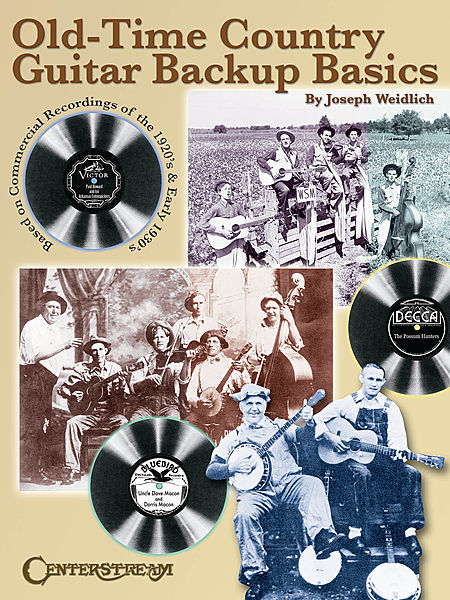
OLD TIME COUNTRY GUITAR BACKUP BASICS, Joseph Weidlich. Based on commercial recordings of the 1920's & early 1930's. TABLATURE
Old Time Country Guitar Backup Basics
Series: Guitar
Publisher: Centerstream Publications
Author: Joseph Weidlich
This instructional book uses commercial recordings from 70 different “sides” from the 1920s and early 1930s as its basis to learn the principal guitar backup techniques commonly used in old-time country music. Topics covered include: boom-chick patterns • bass runs • uses of the pentatonic scale • rhythmic variations • minor chromatic nuances • the use of chromatic passing tones • licks based on chords or chord progressions • and more.
Inventory #HL 00000389
ISBN: 9781574241488
UPC: 073999501247
Width: 9.0"
Length: 12.0"
84 pages
In the rural setting of the South the singing of old songs was often unaccompanied. When music was played away from the home it tended to be for dancing or some kind of contest. The" core" instruments used were usually the fiddle and banjo, where the banjo "seconded" the fiddle. This style goes back to the early 19th century minstrel show [ca. 1843] whose standard instrumentation were the fiddle, banjo, bones and tambourine.
Fiddle. The principal instrument of the old-time music genre was the fiddle, seemingly always the lead instrument. The fiddle served several functions: to provide dance music, to provide accompaniment to the voice, or solo fiddle music without a particular social function, e.g., for their own enjoyment. The fiddle was particularly important in accompanying vocal music as it could be used to imitate, i.e., "double" the vocal line, thereby reinforcing the primary contours of the melody or to provide ornamentation, based on the melodic line. As the melodies of the songs became simpler, in the sense of using less vocal ornamentation, the fiddle style likewise became simpler. This transition was aided by the addition of the banjo and guitar, which provided additional decorative elements, thus freeing the fiddle to focus primarily on lead melodic functions.
Banjo. Besides the fiddle, the mountain banjo was the most important ensemble instrument, as it was used to reinforce the main notes of the melodies played by the fiddle. The banjo introduced a steady, strong rhythm to maintain the beat, so important when playing for dances. In fact, the clawhammer banjo style, in particular, was, and still is, highly regarded for this role. While the 19th century minstrel banjoists traditionally used two basic tunings (what today would be equivalent to the natural C tuning and open G tuning) an interesting feature of the Southern mountain banjo was the development of several additional tunings to suit the modal character of the traditional melodies being sung and played. Scholars seem to think that these systems of altered tunings HLP 8005 may have been worked out by the turn of the 19th century, perhaps influenced by open guitar tunings needed for playing certain parlor guitar songs (e.g., the Spanish fandango) and the beginning of the African-American blues guitar styles. These modal melodies would then be accompanied on the banjo so that the principal melodic notes could be played without the need to play harmonic chords or shift up and down the fingerboard, whose chord voicings would not be practical most of the time playing in these altered tunings (the newly introduced guitar would now supply this harmonic accompaniment). Occasionally, the banjo was used as a solo instrument on early commercial recordings (e.g., by Charlie Poole using fingerstyle techniques); however, its usual role was to support the fiddler. Guitar. While guitars had been available in the United States for most of the 19th century, principally in urban industrialized areas, e.g., by c.P. Martin, Ashborn, 55. Stewart, and Washburn, by the end of that century guitars were beginning to become available in even greater numbers, aided in part by a much improved mass transportation system, the advent of the industrial revolution, and mail-order houses like Sears Roebuck. In the last decade of that century the guitar was gaining rapidly in mass popularity due to its usage in mandolin bands, glee clubs, and university banjo bands, thus not just for use in its traditional 19th century environment, the parlor.
String Bands. From the 1920s, with the introduction of the guitar into the string band ensemble, the emphasis, at least in terms of recording, shifted from providing music for dances to the accompaniment of vocal songs and fiddle tunes. That necessarily changed the function of the string band instruments, freeing up the ensemble for various duties. The guitar was now used to mark out the...
TABLE OF CONTENTS
Biography .
A Brief Introduction To "Old-Time Music" .
Introduction to Old-Time Country Guitar Backup Basics .
PART ONE: BACKUP BASICS .
Lesson 1 Boom-Chick Patterns .
Lesson 2 Alternating Between Root and Fifth of a Chord .
Lesson 3 6-7-8 Bass Run Connectors .
Lesson 4 Golden Age Lick ,
Lesson 5 Third of the Chord in Back-Ups .
Lesson 6 3-2-1 Bass Run Connector .
Lesson 7 Pentatonic Scale .
Lesson 8 Ascending and Descending Triad Usage .
Lesson 9 Reinforce Melodic Line .
Lesson 10 Scales .
Lesson 11 Chord Progression Lick .
Lesson 12 5-6-7-8Bass Run Connector .
Lesson 13 Varied Golden Age Lick .
Lesson 14 Leading Tone Usage .
Lesson 15 Concluding Thoughts .
PART TWO: .
Variations On Backup Basics
Transcribed from Commercial Recordings of the 1920s and Early 1930s
Epilogue.
Song Reference List .

 Italiano
 English