Juan Martin

MARTIN JUAN ANDALUCIAN SUITE NO. 1 LIBRO CD TABLATURE CHITARRA SPARTITI FLAMENCO BULERIAS

MARTIN JUAN, ANDALUCIAN SUITE, NO. 1. CD TABLATURE

Product Description:
Four exciting concert solos for flamenco guitar from Juan Martín’s best-selling album ‘The Andalucian Suites’. This is the first of the four suites on the album. These suites are transcribed into standard notation and flamenco tablature (cifra), with introductory playing notes by Juan Martín. The four solos on the accompanying CD are performed by Juan.

The complementary and contrasting variety of styles and rhythms of the four solos provide a brilliant display of Juan’s artistry and the expressive capabilities of the flamenco guitar. Each solo is complete in itself. A powerfully evocative Zambra Mora is followed by the much-requested rumba ‘La Feria’, then a gently melancholic Milonga and finally a thrilling Bulerías, which combines modern elements with pure gypsy falsetas from Moron del la Frontera. These solos provide an exceptional opportunity to learn and enjoy the music of a master flamenco guitarist, whose two volumes of graded ‘Solos Flamencos’ are already Mel Bay best-sellers.
Format: Book/CD Set 48 pages


ANDALUCIAN SUITE No.1 THE FOUR SOLOS

These four solos are played as a sequence (or suite) to provide an interestingly varied group of pieces which show a range of flamenco guitar styles. Each solo stands as a complete composition which can be played by itself or in any chosen order. La Feria is particularly featured as a much-requested and popular solo.


EVOCACION DE LA INVASION ARABE AD 711

The opening movement of the suite recalls the Moorish invasion of Spain, when a small army arrived from North Mrica in the year 711 A.D. and landed at Gibraltar. The leader of the Moors was Jabal Tariq - 'he of the rock' - from whose name Gibraltar is derived. This small but efficient army, which arrived in Andalucia with its now famous Arab horses and brilliant horsemanship, took over much of Spain, a conquest which was to last nearly eight centuries. Cordoba and, larer, Granada were to become the Islamic capitals, dominating Spain until 1492. The music is based on the form of the Zambra Mora, flamenco's most Moorish dance form. It evokes that original menacing invasion and also reflects the beauty of the Moors' legacy in their art and architecture, with palaces such as the Alhambra in Granada and the great mosque at Cordoba.


Playing Notes

The 6th string is tuned to 0 for this piece, and no cejilfa (flamenco capo) is used. It starts wirh a free form (toque libre) cadenza in the style of the Moorish oud (a lute-shaped instrument with unfretted neck) with passages of ligado in which the nores are sounded by the left hand. The profusion of notes on the page may look daunting at first, bur the music lies quite easily under the fingers. In such a free and expressive passage without a definite rhythmic metre, the timing of the written notes has to be somewhar approximate. Listening to the CD will help to convey rhe correcr phrasing and emphasis. On the second page, the music changes to a regular 2/4 rhythm, which persists to the end of the piece, with later passages of rasgueo (strumming) and alzapua (a rapid three-srroke technique using down- and up-strokes of the thumb). Playets of classical guitars which are not fitted with golpeadores (tapping-plates) can omit the golpe taps. The solo concludes with a passage of continuous rasgueo (see Key to Symbols, following). The golpe on the penultimate beat is made with the middle finger striking the golpeador on the near side of the strings before the finger travels on to sound the strings with a down-stroke. The transcription is dedicated to the distinguished classical guitarist Eleftheria Kotzia, who incorporated the piece into her concert repertoire, as was heard in her virtuoso performance at London's South Bank Centre.


LA FERIA

In the same year, 1492, that Ferdinand and Isabella forced the Moors to leave Spain, Cristobal Colon (Christopher Columbus) sailed from the small port of Palos on the west coast of Andalucia on his voyage of discovery to Ametica. That voyage forged a cultural link with the Americas which has its effect within flamenco music. South American rhythms have returned to Spain with soldiers and musicians and have been absorbed into flamenco, undergoing a change in identity yet retaining an obvious Latin-American aire (atmosphere and feeling). It is clearly evident in this Rumba, an immensely popular style today. The solo is named The Fair, a time of uninhibited celebration.

Playing notes

The 6th string of the guitar is tuned to E. The cejilfa is placed at the second fret. The Rumba starrs with rhythmic strumming, using the characteristic slapping rechniques (see Key). For the first 8 bars the strings are damped with the fingers of the left hand so that they provide a percussive sound without musical vibration. The approximate positions of the left hand fingers as they damp the strings are shown in the music and cifra (flamenco tablature), initially in a chord shape over the lower frets and then over higher frets. The notes of the chord are not sounded, but the change in hand position alters the pitch of the percussive sound made by the damped strings. The piece also includes passages of alzapua, left and right hand apagado damping to cut short the sound of chords and, at the end, a repeated three-stroke rasgueo of thumb up-stroke followed by middle finger and thumb down-strokes. middle finger golpes on the near-side golpeador are used before a final up-stroke with the thumb ends the solo.

Contents:

Biographical Note
The Four Solos, with playing notes
Key to Symbols and Notation
Evocación de la Invasión Árabe AD 711 (Zambra Mora)
La Feria (Rumba)
Alborada (Milonga)
Gitanos (Bulerías)

Prezzo: €25,99
€25,99

MARTIN JUAN PLAY SOLO FLAMENCO GUITAR VOL2 LIBRO CD DVD TABLATURE SPARTITI CHITARRA

MARTIN JUAN, PLAY SOLO FLAMENCO GUITAR VOL.2. CD DVD TABLATURE

LIBRO DI MUSICA CON CD E DVD, SPARTITI PER CHITARRA. ACCORDI, PENTAGRAMMA E TABLATURE. 

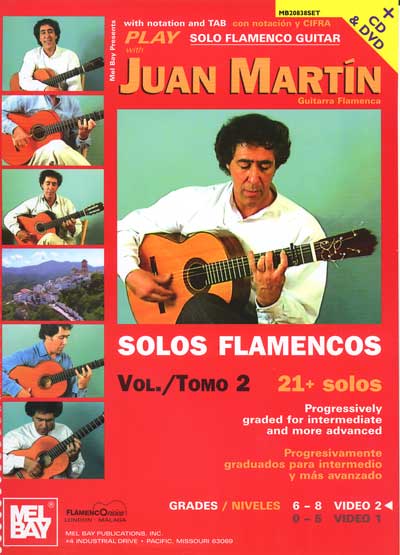
SOLO FLAMENCOS TOMO VOL. 2

Progressively graded for intermediate and more advanced GRADES 6 - 8

This second volume, of a two-part series, contains a book, CD and DVD by internationally recognized flamenco guitarist, Juan Martin. Provided are more than 21 solos, progressively graded in the three higher grades, 6 to 8, to suit players at intermediate and more advanced stages, who already have some experience of the instrument and techniques of flamenco. The music for all these is accurately written in notation and flamenco tab (cifra) and (except for the two final solos) is also included on the companion CD. The DVD contains over 60 minutes of music. All text is provided in both English and Spanish.
 

INTRODUCTION

Welcome to the second volume of Solos Flamencos!

I hope you will find it meets your needs for more technically demanding music which can help you to feel that you are really beginning to master the challenges of the solo flamenco guitar. The tremendous success of the first volume has greatly encouraged us in the preparation of this second volume. Messages of appreciation from players in all parts of the world have brought us great pleasure and satisfaction. The main content of this volume follows the format of the first volume, with seven solos demonstrated at each of the grades 6 - 8. In addition there are four recorded extras on the CD and DVD; these consist of two brief sequences of Solea, a Garrotin (an easier solo which could help you to get started) and more falsetas for Bulerias. Finally, as a further extra in the book, there are two of my solo compositions presented only in music notation and cifra tablature, which are not demonstrated on the CD or the DVD. There is a separate introduction and explanation for these. It is not always easy to rate music at the higher grades in terms of its relative difficulty but I hope you will recognise a progressive trend as you advance from Grade 6 to Grade 8. Many factors are relevant to the grading (with which not all players will be able to agree), but I have taken into account not only considerations of technical difficulty and speed, but also those more fundamental considerations of musical expressiveness, summed up in the two fundamental concepts of compas and aire. The player should aim for an interpretation in which the difficulty of the solo is not apparent to the listener - what matters, of course, is whether it is musically satisfying and whether it can move the emotions. Technical skill is always only a means to an end. Certainly there are occasions when the bravura of a virtuoso technique is absolutely right, especially in the lighter styles (Rumbas, Bulerias, etc.). Even so, the good flamenco guitarist always tries to play with expressive aire and, if it's possible, with that magical spirit of duende, rather than exciting the audience just because he or she can. What I am aiming for here is music for the player whose technical skills are developing to the point where the basic elements are assured. For this reason I have not included the lists of technical requirements at each grade level which are a feature of Volume 1. There are new techniques introduced in the solos but most of the basic elements are illustrated in that volume. At this level, the choice of music continues further the approach adopted previously. I have included here my own compositions and also fundamental elements and solos that pay homage to the great masters of the recent past, particularly Sabicas and Nino Ricardo. Following Ramon Montoya, these two giants of the art were largely responsible for the establishment of the flamenco guitar as a solo instrument, and the value of their genius cannot be overstated. Both of them were exceptionally creative in their melodic and rhythmic originality. I also acknowledge, particularly in a solo Bulerias that evokes the impetuous aire of his first recordings, the incomparable contribution of Paco de Lucia. Today the flamenco guitar embraces other musical traditions such as jazz and pop music, and you will want to discover and pursue your own creative pathway and musical tastes. The aim of these two volumes is to help you establish a solid foundation in the art of flamenco solo playing which acknowledges the history of its evolution and the possibilities for further development and exploration that will take it still further. For me, the flamenco guitar is both a melodic and a percussive instrument, capable of intense beauty of sound and also of powerfully exciting rhythmic drive. Its music arises within a broader and still evolving tradition of flamenco artistry, a unique cultural heritage comprising the cante, the baile and the guitar. A basis of rasgueo rhythm in palos a compas is the uniquely flamenco heart-beat of the music which gives its pulsation and structure. If this is ignored or relegated to insignificance, and the music lacks strong melodic themes intensified by the amazingly expressive sounds of the guitar, I think flamenco guitar-playing can be in danger of deteriorating into aimless and unmusical doodlings or empty technical dazzle. But this is my philosophy and you will want to develop your own! I hope these volumes can help and direct you towards achieving your goals. iViva el arte - y vamos a tocar!

Contents:

Grade 6
La Cana --
Farruca --
Colombianas --
2 Sevillanas --
Sevillana II --
Bulerias (de Sabicas) --
Granadinas (Lorca's Dream) --
Garrotin (Noche de San Juan) --

Grade 7

Solea --
Seguiriya y Cabales --
Bulerias (de Paco) --
Tarantas --
Milonga (del Recuerdo) --
Tangos --
Zambra Mora --

Grade 8

Solea (de Ricardo) --
3 Sevillanas (Sevillana 1) --
Sevillana 2 --
Sevillana 3 --
Solea por medio (Esencia) --
Rondena -- Aurora
Rumba (Rumba nostalgica) --
Serranas (de Ricardo) --
Bulerias (con metronomo) --

Solea A (Another falseta Orta falseta) --
Solea B -- Ritmo Falseta 
Garrotin -- de Sabicas
Bulerias (Ritmpo y falsetas) --
Solea (por escrito) --
Harlequin (Arlequin) Rumba

Prezzo: €37,99
€37,99

MARTIN JUAN PLAY SOLO FLAMENCO GUITAR VOL. 1 CD DVD TABLATURE CHITARRA METODO LIBRO

MARTIN JUAN, PLAY SOLO FLAMENCO GUITAR VOL. 1. SHEET MUSIC BOOK WITH GUITAR TABLATURE + CD + DVD. 

LIBRO METODO DI MUSICA FLAMENCO CON CD E DVD. 

SPARTITI PER CHITARRA CON: PENTAGRAMMA, TABLATURE. 


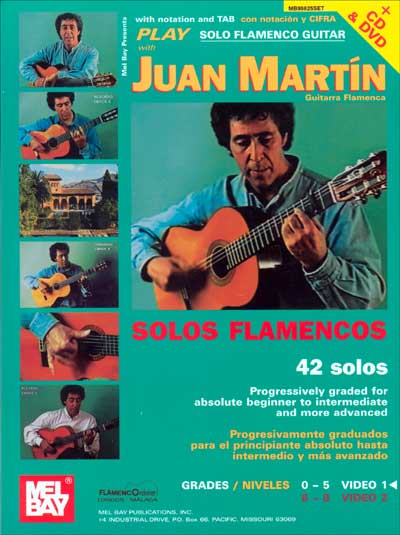
with notation and TAB    PLAY SOLO FLAMENCO GUITAR with

JUAN MARTiN


Guitarra Flamenca

SOLOS FLAMENCOS


42 solos

Progressively graded for absolute beginner to intermediate and more advanced

GRADES 0 - 5

con notacion y CIFRA

Progresivamente graduados para el principiante absoluto hasta intermedio y mas avanzado

CD Contents

Primera  Solea  First Solea

Tientos   Anhelo (Yearning)

Sevillana   Copla tradicional

Verdiales   Malaga, mi tierra

Alegrias en Mi   Alborozo (Jubilation)

Tangos   Festejo (Celebration)

Guajira   Fiesta cubana

Solea La base

Fandango de Huelva

Alegrias en mi con silencio

Bulerias por arriba

Rumba Rumba del dia nueve

Malaguelia Velez

Granadinas Albaicin

Solea para acompaliar

Tientos de Ricardo a Paco

Seguiriyas Sabicas y ritmeo

Alegrias Melocotones de Ronda

Verdiales Coplas malaguenas

Bulerias Diego en menor

Guajiras from Cania raja

Solea Solea gitana

Seguiriyas Falsetas clasicas

Zapateado Taconeos

Rumba Cancion popular, more advanced (mas avanzada)

Solea por Bulerias Raices

Tarantas Aires de La Union

Alegrias Tema inicial (Opening theme)

Sevillana   Mi copla

Solea   Falseta tradicional

Alegrias en la

Tarantos   Toque de las minas

Zorongo

Cantilias   Luz y sombra (Light and shade)

Seguiriya   Lamento

Rumba   Rumba flamenca

Solea Falsetas sencillas (Simple falsetas)

Fandango de Alosno

Rumba Cancion popular

Tangos Impulso

Carcelero

Farruca Ritmo del baile (Rhythm of the dance)


FLAMENCOVISION AND PATRICK CAMPBELL 

MEL BAY PUBLICATIONS, INC., PACIFIC, MO 63069. MADE AND PRINTED IN U.S.A.


Designed as a comprehensive multimedia teaching set, this book, CD, and DVD present 42 solos, progressively graded in 6 levels from absolute beginners to more advanced, to suit players of all levels. It contains examples of eighteen different palos (rhythmic forms) of flamenco, with a wealth of melodic falsetas and rhythms. The music for all these is accurately written in notation and flamenco tab (cifra) in the book, and is also recorded on the companion CD. The DVD video contains over 57 minutes of solo music, and also includes introduction by Juan Martín and brief scenes of Andalucia today, which help to place this profoundly exciting and deeply felt music in the landscape of its origins. Juan Martín has succeeded here is showing how even music which is simple and very easy to start with can express the essential sound and emotion of flamenco, to build step by step the skills necessary for the performance of concert solos. Written in English and Spanish.


INTRODUCTION

Welcome to my new video series! It can help you to play flamenco guitar whatever your present level of skill. Many people who would like to play flamenco on the guitar tell me they are discouraged by the apparent difficulty of the techniques required. I want to try to change that, because the marvellous art of flamenco is much more about feeling and rhythm, those essential components of aire and compas, than always about sheer speed or amazing technique. The exciting challenge for me has been to arrange and compose music which includes classic elements with more modern sounds and rhythms that will capture for the student the true essence of flamenco guitar right from the very start, without sounding too simplified or lacking that characteristic flamenco sound.

The solos in this project are in a progressive series of grades, from an initial Grade a up to grade 8. This book, CD and video, the first of two sets, contain the pieces for grades a to 5. The grades are intended to be in line with the levels of musical advancement required for the grade examinations of music colleges for any musical instrument. This is a new kind of challenge for flamenco, but the art is now becoming so international that I believe it is time to see flamenco guitar as an art that can be learned in a progressive way by anybody who has the necessary devotion, understanding and determination. To many devotees of flamenco the idea of a formal graded approach, possibly subject to examination, may seem quite alien and even unwelcome. I want to look to the future, however, and to join with others who now nurture the growing world-wide interest in this precious art and the need for systematic methods of teaching. The essence of flamenco is so strong and distinctive that I do not believe its future is threatened by the increasing numbers of people who find in its soul what they want to express and to enjoy in music, any more than the music of the Mississippi Delta has been impoverished by the world-wide interest in the art of the Blues. There are no formal standards or guidelines in flamenco that are widely established to mark the student's stages of progress. In this project, therefore, I have given much thought to what I believe should be the appropriate levels of skill and musicianship necessary for achievement of the grades which can mark the advancement of technical ability and musical understanding. The book contains more details about the contents and requirements of each grade.

I have been greatly encouraged in this project by my young son Carlos, whose need for interesting music to play from the start of his learning the guitar has given me a valuable purpose and focus in preparing the music, particularly with the earliest grades.

There is bound to be disagreement about whether a piece is right for the grade assigned, or whether it is too easy or too difficult. I think that sort of argument is both unavoidable and not really very helpful. I have tried to present a logical development of musical understanding and of techniques for the right and left hand, but the important thing is not to be too rigid about the sequence of grades. Students and players have to differ in their capacities and needs. The music always matters more than anything else! More advanced players will be able to incorporate the music of the video in their own arrangements, and they should find things worth learning at any grade.

My aim is to give the student music which he or she will enjoy playing and which will reward the effort to practise and learn. This is not primarily a project to explain technique, but I have included some brief notes about the individual pieces. I hope you will share in the enjoyment I have had in undertaking this project with my good friend and former student Patrick Campbell who has again worked hard to communicate my playing through video, the CD and the printed page. I would also like to thank Bill Bay and his team for their invaluable advice and encouragement with what we believe to be a new advance in learning methods for flamenco. Viva el arte - y vamos a tocar!


Contents:

CONTENIDO / CONTENTS
Introduction By Juan Martín
Introducción Por Juan Martín
The Elements of Flamenco Guitar-Playing
Los Elementos del toque de la guitarra flamenca
Symbols and Notation
Símbolos y Notación

GRADE / NIVEL O Notes and Requirements/Notas y requisitos
PRIMERA SOLEÁ First Soleá
TIENTOS Anhelo (Yearning)
SEVILLANA Copla tradicional
VERDIALES Málaga, mi tierra
ALEGRÍAS EN MI Alborozo (Jubilation)
TANGOS Festejo (Celebration)
GUAJIRA Fiesta cubana

GRADE / NIVEL 1
Notes and Requirements/Notas y requisitos
SOLEÁ Falsetas sencillas (Simple falsetas)
FANDANGO DE ALOSNO
RUMBA Canción popular
TANGOS Impulso
CARCELERO
FARRUCA Ritmo del baile (Rhythm of the dance)
SEVILLANA Mi copla

GRADE / NIVEL 2
Notes and Requirements/Notas y requisitos
SOLEÁ Falseta tradicional
ALEGRÍAS EN LA
TARANTOS Toque de las minas
ZORONGO
CANTIÑAS Luz y sombra (Light and shade)
SEGUIRIYA Lamento
RUMBA Rumba flamenca

GRADE / NIVEL 3
Notes and Requirements/Notas y requisitos
SOLEÁ La base
FANDANGO DE HUELVA
ALEGRÍAS EN MI con silencio
BULERÍAS POR ARRIBA
RUMBA Rumba del día nueve
MALAGUEÑA Vélez
GRANADINAS Albaicín

GRADE / NIVEL 4
Notes and Requirements/Notas y requisitos
SOLEÁ Soleá gitana
SEGUIRIYAS Falsetas clásicas
ZAPATEADO Taconeos
RUMBA Canción popular, more advanced (más avanzada)
SOLEÁ POR BULERÍAS Raíces
TARANTAS Aires de La Unión
ALEGRÍAS Tema inicial (Opening theme)

GRADE / NIVEL 5
Notes and Requirements/Notas y requisitos
SOLEÁ PARA ACOMPAÑAR
TIENTOS de Ricardo a Paco
SEGUIRIYAS Sabicas y ritmeo
ALEGRÍAS Melocotones de Ronda
VERDIALES Coplas malagueñas
BULERÍAS Diego en menor
GUAJIRAS from Caña rajá

APPENDIX: PUBLICATIONS BY/PUBLICACIONES DE IUAN MARTÍN

Prezzo: €32,99
€32,99

MARTIN'S JUAN GUITAR METHOD EL ARTE FLAMENCO DE LA GUITARRA CD TABLATURE RASGUEADO GOLPE

MARTIN'S JUAN GUITAR METHOD, EL ARTE FLAMENCO DE LA GUITARRA. 170 pagine fitte di musica, spiegazioni, interessanti fotografie delle diverse posizioni delle mani. SHEET MSUIC BOOK with GUITAR TABLATURE and 60' CD. 

LIBRO METODO DI MUSICA FLAMENCO CON CD.

SPARTITI PER CHITARRA CON :

ACCORDI, PENTAGRAMMA, TABLATURE.

A book and CD set for those wishing to learn the marvellous art of the flamenco guitar, presented by one of the most celebrated performers.

This comprehensive method assumes no knowledge of flamenco or music on the part of the beginner. 168 pages.

Juan Martin's playing of his music on the CD, along with many photographs and details in the text, vividly demonstrates the essential techniques, rhythms and toques of Flamenco. His Method also contains longer solos, daily exercises for developing tee and invaluable information about the flamenco guitar and its music. The Method has been designed for the player of any standard.

Prezzo: €49,99
€49,99
Condividi contenuti