SPARTITI PER CHITARRA DI MUSICA FLAMENCO

DE LUCIA PACO-ALMORAIMA-TABLATURE SPARTITI LIBRO CHITARRA RIO ANCHO FLAMENCO MUSICA

DE LUCIA PACO, ALMORAIMA. BOOK WITH TABLATURE

LIBRO DI MUSICA FLAMENCO. 

SPARTITI PER CHITARRA CON: 

ACCORDI, PENTAGRAMMA, TABLATURE. 

Transcripción por el maestro Enrique Vargas, director de la colección "Biblioteca Grandes Guitarras Flamencas de Hoy", quien ha afrontado la tremenda dificultad de transcribir de forma fiel y pormenorizada una obra de tamaña complejidad e importancia.

Paco de Lucía, emplea en "Almoraima" varias innovaciones sin precedentes hasta la fecha: Cada uno de los ocho temas del disco tienen más de una, y a veces hasta cinco pistas de guitarra; bajo eléctrico; percusión; una pista de guitarra tapá y, de vez en cuando, laúd y cante. Todos estos elementos han dificultado tremendamente la tarea de la transcripción. A pesar de ello, el maestro Enrique Vargas ofrece en cada tema diferentes soluciones siempre con la máxima fidelidad al original.

Todas las piezas son perfectamente ejecutables tanto para un solo como para un dueto (con excepción de la rumba y sevillanas que sólo son aptas para dueto). Cada tema viene además precedido por anotaciones explicativas bilingües castellano/inglés. Las partituras están presentadas en solfeo y en cifrado. Tanto las digitaciones de ambas manos como los matices dinámicos y técnicos se presentan de la forma más pormenorizada posible.

A continuación, una descripción técnica de cada partitura de esta obra.

Almoraima, (Bulerías)
En esta pieza se han transcrito las partes más importantes de la segunda guitarra y el bajo. Donde la segunda guitarra se limita a tocar acompañamiento genérico se ofrecen símbolos armónicos. La pista de laúd, interpretada por el maestro Paco de Lucía ha sido transcrita íntegramente. Esta pieza es apta para solo y dueto.

Cueva del Gato, (rondeña)
La parte de la guitarra de acompañamiento interpretada por Ramón de Algeciras está transcrita íntegramente lo que hace la pieza ideal tanto para un dueto como para un solo.

Cobre, (sevillanas)
Este tema es un dueto donde la guitarra principal interpreta cada sevillana en una tonalidad y, a veces, afinación distinta. La segunda guitarra mantiene la misma afinación sin cejilla, es decir, al aire. En la tercera copla de cada sevillana el maestro Paco de Lucía grabó la segunda pista del solo haciendo una especie de contrapunto con la guitarra principal. Esta segunda pista también ha sido transcrita íntegramente.

A la Perla de Cádiz, (cantiñas)
En esta pieza se han transcrito las partes más importantes de la segunda guitarra. Donde el acompañamiento es genérico se suministran símbolos armónicos. En la parte final el maestro Paco de Lucía desarrolla una brillante improvisación sobra la salida del cante por cantiñas . La melodía de esta salida ha sido transcrita para que sirva de referencia y también por si se desea interpretarla utilizando voces u otros instrumentos musicales. Apto tanto para solo como para dueto.

Olé, (jaleos)
A pesar de ser un dueto con las dos guitarras transcritas íntegramente, esta pieza es perfectamente ejecutable como un solo de guitarra.

Plaza Alta, (soleá)
Al final de este tema entra la segunda guitarra cuyas partes más importantes han sido transcritas íntegramente y en las partes genéricas se ofrecen símbolos armónicos. Puede ser interpretada como solo y como dueto.

Rio Ancho, (rumba)
Esta conocidísima rumba se presenta en el siguiente formato: la guitarra principal; las partes más importantes de la segunda guitarra y los símbolos armónicos.

Llanos del Real, (minera)
En la parte final de esta pieza entran la segunda y tercera guitarra que han sido transcritas íntegramente.

Formato A4
307 Páginas

At last, a long-awaited transcription book of the emblematic CD Almoraima by Paco de Lucía published by Gestión de Lucía (the artist management company) has arrived. This time the author of these charts has been no other than maestro Enrique Vargas, also the director of the collection The Great Flamenco Guitars of Today Library, who had to face the tremendous difficulty of transcribing accurately every little detail of this historic work of art.

In the process of an intense search for a new expressive melodic, structural and harmonic forms in flamenco, the genius guitarist from Algeciras implements in Almoraima various innovations unprecedented for the times: every one of the eight cuts of the CD has more than one - and some times up to five - guitar tracks; electric bass; percussion; a muted guitar track, and, sometimes, oud and singing. All of these elements made the task of transcribing this work tremendously difficult. In spite of this, maestro Enrique Vargas offers in every piece the solutions based on maximum fidelity to the original.

All of these pieces are perfectly playable by solo guitar and a duo (with the exception of the rumba and sevillanas than are only suitable for a duo). Every piece is preceded by annotations in Spanish and English. The charts are presented in notation and tab. The fingerings for both hands and dynamic and technical characteristics are explained in the smallest detail.

Contents:

"Almoraima" (bulerias)
In this piece the most important parts of the second guitar and the bass have been transcribed entirely. Where the second guitar plays generic accompaniment the chord symbols are provided. The oud track recorded by maestro Paco de Lucía has been transcribed entirely. This piece is playable as a solo as well as a duo.

"Cueva del Gato" (rondeña)
The guitar accompaniment played by Ramón de Algeciras has been transcribed entirely, which makes this piece ideal for a duo as well as a solo.

"Cobre" (sevillanas)
This piece is a duo where the main guitar interprets each sevillana in a different key and, sometimes, different tuning. The second guitar maintains the same tuning without a capo. In the third copla of each sevillana maestro Paco de Lucia recorded a second solo guitar track which does a sort of counterpoint with the main guitar. This track is also been transcribed.

"A la Perla de Cadiz" (cantiñas)
In this piece the most important parts of the second guitar have been transcribed. Where the accompaniment is generic chord symbols are supplied. In the final part of this piece maestro Paco de Lucía plays a brilliant improvisation over a sang melody that has been transcribed to be used as a reference or played by some other musical instrument if so desired. Can be played as a solo as well as a duo.

"Ole" (jaleos)
Despite this piece being a duo with both guitars completely transcribed, is perfectly playable as a solo, too.

"Plaza Alta" (soleá)
In the final part of this piece enters the second guitar whose more important parts have been transcribed entirely. In the generic parts chord symbols are supplied. Can be played as a solo as well as a duo.

"Rio Ancho" (rumba)
This famous rumba is presented as a guitar duo with the accompaniment explained and transcribed in its most important parts. Chords symbols are supplied throughout the whole piece.

"Llanos del Real" (minera)
In the final part of this piece enter the second and third guitars that also have been transcribed.


Thirty five years have passed since I saw for the first time on a black and white screen of an ancient TV set a
young man, almost a teenager with a face of angel who, with the exuberance of youth, was doing the unthinkable on the guitar. Those brief moments impacted my life forever, making me embark on a journey I still pursue.
Since then I've known other styles of music; have enjoyed the enormous genius of Bach and cool elegance
of Miles Davis, beauty and sophistication of Indian raga .... Nevertheless, the music of the genius maestro
from Algeciras impacts me today as it impacted me for the firs time, those many years ago. Time left its white marks in my hair and changed the expression of the maestro's eyes, transfonning the youthful exuberance of his music into quiet and somewhat sad wisdom (what kind of wisdom isn't somewhat sad?) of maturity.
ow, by the Providence of the Lord, the time has come for me to render my homage to the maestro with this
humble work, thanking him for so much joy and so many tears, so many sleepless nights with a good Rioja
and the sound of his guitar, whether solo or with a group, or with another immortal genius from Cadiz, Jose
onge Cruz, Camaron de la Isla.
Every genre, every field of human activity renders every now and then an incomparable genius who, with his
arrival to the scene, changes everything and after that nothing is the same anymore. Their work transcends
the confines of space-time continuum and becomes immortal, blending itself into the endless Sea of the
beauty and harmony of the Creator. I've been fortunate enough to share the planet with one of them.
Francisco Sanchez Gomez. Paco de Lucia.
The sound in the Eternity ... The Eternity in the sound ... The great poet Joseph Brodsky dedicated the
following laconic but beautiful words to Bach:
Good morning, says Bach
Good morning, says God
I like to think that the poet could have said something like that about the guitarist form Algeciras:
Paco de Lucia played, inspired
God and Bach were moved,
They were teary-eyed
Enrique Vargas Molina, Madrid, 2008
Prezzo: €79,99
€79,99

DE LUCIA PACO FUENTE Y CAUDAL TABLATURE CHITARRA SPARTITI LIBRO Entre dos aguas FLAMENCO

DE LUCIA PACO, FUENTE Y CAUDAL. SHEET MUSIC BOOK WITH GUITAR TABLATURE . 

LIBRO DI MUSICA FLAMENCA. 

SPARTITI PER CHITARRA : 

ACCORDI, PENTAGRAMMA E TABLATURE. 
 

Partitura en nota y cifra transcritas por Juan Manuel Cañizares.
Temas:

FOREWORD

This book is the transcription of the work "Fuente y Caudal" of the master Paco
de Lucia, in which the rhythms, harmonies and melodies are gathered of deep
way. Basically it is written for guitar but not for that reason exclusively for
guitarists. Instrumentalist of different instruments and styles they could also use
it, since when containing harmonic coding, the themes songs could be
interpreted by different musicians in formation instrumental.
One of my priorities when transcribing these works has been to be most faithful
possible to the interpretation that the master Paco de Lucia made in the
recording of "Fuente y Caudal". In order to obtain this intention I have used
myself new symbols that at its moment I will explain widely. I believe that these
symbols and the concept that there is behind such, will help the guitarists what
is passing in both hands when making different musical passages. In certain
way this book could be considered a hidden "treaty" of flamenco technique.
At no moment I have tried to reflect in the stave the soul of musical notes (it
would be an impossible work) but I think to have approached myself enough to
the dynamic movement of both hands in its flight by the mast.
Music is a language and as so it is learned by imitation. I firmly recommend
imitating the shades of meaning (not only the notes) of the master Paco de
Lucia in the original recording. To play jointly with the disc is an excellent
method to obtain this intention.
In the "free" touches as taranta "Fuente y Caudal" and the granafna "Reflejo de
la Luna" is advisable to imitate the rhythmical space, to give character and
structure to these touches. There are things that musically cannot be written
and single they are had outside the score, in these cases of listening to the
recording is indispensable.
The education of the musical ear is of a high importance for a musician. A good
exercise which I advise is that before reading the score, to try to remove from
ear one melody or any part that wishes of the original recording, to make their
own transcription and soon they compare it with the transcription of this book.
I want to thank to the teacher Ramon de Algeciras and my friend Juan Estrada
to make this great project and for his patience. Also, thanks to Mariko Ogura to
copy and to order all the manuscripts and to design and to organize all the
material contained in this book.
Special thanks to the master Paco de Lucia for entrusting totally me to
transcribe this work. From very young I began to play its music, soon I had the
honour to share during many tours, scenes and recordings next to him. Thanks
to all those wonderful experiences I have learned many things that have
enriched my musical life for better.
June 2005
Juan Manuel Caiiizares
 

Product Description:
Third in a series of OFFICIAL chronological transcriptions of the recordings of renowned flamenco guitarist Paco de Lucia, this book presents eight pieces from his album, Fuente y Caudal de Paco de Lucia. Meticulously transcribed in standard notation and tablature, selections include: Entre dos agues; Aires choqueros; Reflejo de Luna; Solera; Fuente y caudal; Cepa andaluza; Los Pinares and Plaza de San Juan. A foreword, explanation of notation symbols, helpful tips and generous performance notes are provided in English, Spanish and French.

Entre dos aguas (Rumba)
Aires choqueros (Fandangos de Huelva)
Reflejo de luna (Granaína)
Solera (Bulerías por Soleá)
Fuente y caudal (Taranta)
Cepa andaluza (Bulerías)
Los pinares (Tangos)
Plaza de San Juan (Alegrías).

Formato A4
220 Páginas

Prezzo: €79,99
€79,99

SANLUCAR MANOLO MUNDO Y FORMAS DE LA GUITARRA FLAMENCA VOL.1 BOOK CD TABLATURE

SANLUCAR MANOLO, MUNDO Y FORMAS DE LA GUITARRA FLAMENCA VOL.1. SHEET MUSIC BOOK WITH CD & GUITAR TABLATURE .

LIBRO DI MUSICA FLAMENCA CON CD.

SPARTITI PER CHITARRA CON : PENTAGRAMMA E TABLATURE. 

1 Andares gaditanos Zapateado
2 Fandangos de Onuba Fandango
3 Colombianas de Bajo Guía Colombiana
4 Taranto del Santo Rostro Taranto
5 Bulerías de las gitanas marquesas Bulerías
6 Herencia oriental Zambra
7 Sevillanas de las cuatro esquinas Sevillanas
8 Alegrías de la Torre Tavira Alegrías

Introduction in Spanish and English
Tab and musical score
A4 format
124 pages

The transcription of the first volume of the "Mundo y Formas de la Guitarra Flamenca" -the world and forms of the flamenco guitar-, one of the most important works by the great guitarist Manolo Sanlúcar. A veritable treasure of Spanish music which has been concealed for too long from both flamencos and guitarists worldwide, thus comes into reach for anyone who wishes to become acquainted with it.

The originality, authenticity and undeniable flamenco flavour of the music in this work which has transcended eras, fashions and trends. Becoming submerged in this magical document means crossing the threshold, that was inaccessible until now, of one of the most interesting chapters of the history of the flamenco guitar.

Prezzo: €65,99
€65,99

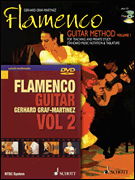
FLAMENCO GUITAR METHOD VOL. 1. Graf-Martinez. DVD TABLATURE

FLAMENCO GUITAR METHOD VOL. 1. Graf-Martinez. TABLATURE DVD

Book/CD/DVD Pack
Series: Schott
Publisher: Schott
Book & CD & DVD Package - TAB
Guitar
Author: Gerhard Graf-Martinez

Gerhard Graf-Martinez is a passionate flamenco guitarist and teacher. The wealth of his knowledge is captured in this two-volume work, which also reflects valuable experience gained from his activities as a tutor at national and international seminars and workshops. The CD included with volume 1 contains all the pieces and musical examples for Volumes 1 and 2. Besides being a pure pleasure to listen to -Flamenco puro, it also conveys the authentic sound and the pulsating "compás" of this music. This is the only way to learn to play the music properly yourself. The DVD will take you to the passionate world of Flamenco, and you will quickly immerse yourself in this Spanish musical phenomenon. 112 pages

Prezzo: €49,99
€49,99

FLAMENCO GUITAR METHOD VOL 2 Graf-Martinez LIBRO TABLATURE DVD compás

FLAMENCO GUITAR METHOD VOL. 2. Graf-Martinez. TABLATURE DVD

LIBRO DI MUSICA PER CHITARRA CON DVD E TABLATURE


Book/DVD Pack
Series: Schott
Publisher: Schott
TAB

Author: Gerhard Graf-Martinez
Gerhard Graf-Martinez is a passionate flamenco guitarist and teacher. The wealth of his knowledge is captured in this two-volume work , which also reflects valuable experience gained from his activities as a tutor at national and international seminars and workshops.

The CD included with Volume 1 contains all the pieces and musical examples for Volumes 1 and 2. Besides being a pure pleasure to listen to - Flamenco puro - it also conveys the authentic sound and the pulsating "compás" of this music. This is the only way to learn to play the music properly yourself.

The DVD will take you to the passionate world of Flamenco, and you will quickly immerse yourself in this Spanish musical phenomenon. Please note that this item (49033066) contains only the book 2 and DVD 2. Audio tracks for book two are available only on the CD included for book 1. 136 pages.

Prezzo: €62,99
€62,99

SANLUCAR MANOLO MUNDO Y FORMAS DE LA GUITARRA FLAMENCA VOL.3 BOOK CD TABLATURE

SANLUCAR MANOLO, MUNDO Y FORMAS DE LA GUITARRA FLAMENCA VOL.3. 112 Pagine. SHEET MUSIC BOOK WITH CD & GUITAR TABLATURE .


LIBRO DI MUSICA FLAMENCO CON CD.

SPARTITI PER CHITARRA :

PENTAGRAMMA, TABLATURE. 


Product Description:
The decision to publish the transcription of The World of the Flamenco Guitar and its Forms is the decision to disseminate a major work . Now, all those who wish to learn about and explore this gem of Spanish music that has laid unnoticed for too long are able to do so. Manolo Sanlúcar's album trilogy is not only apt for flamenco or Spanish musicians but for guitarists worldwide since it constitutes the greatest of the many master classes this maestro has given in his long career.

The original, authentic and unmistakably flamenco music in this work has stood the test of time , transcending fashion and trends. Immersing oneself in this magical document is to cross the erstwhile unreachable threshold of one of the most dazzling chapters in the history of the flamenco guitar.

Introduction in Spanish and English

A Don Ramon Montoya Manolo Sanlucar, Trans. by Claude Worms
Amanecer Malagueno Manolo Sanlucar, Trans. by Claude Worms
Barrenero Manolo Sanlucar, Trans. by Claude Worms
Garrotin Del Calzonzillo Manolo Sanlucar, Trans. by Claude Worms
Noches De La Ribera Manolo Sanlucar, Trans. by Claude Worms
Recreaicon Manolo Sanlucar, Trans. by Claude Worms
Romero Y Jara Manolo Sanlucar, Trans. by Claude Worms
Solea Pa Mi Pare Isidro Manolo Sanlucar, Trans. by Claude Worms .

Content:

Introduction in English and Spanish
Music Score and Tablature.
Format A4
112 Pages

Transcription of the third and last volume of the "Mundo y Formas de la Guitarra Flamenca" trilogy, one of the most important works by the great guitar player Manolo Sanlúcar. A treasure of Spanish music made available to flamenco enthusiasts and guitar players a last after many years in obscurity.
CD
1 Amanecer malagueño Malagueña
2 Soleá pa mi padre Isidro Soleá
3 A Don Ramón Montoya Rondeña
4 Noches de la ribera Alegrías
5 Barrenero Minera
6 Garrotín del calzoncillo Garrotín
7 Romero y Jara Serrana
8 Recreación Tientos

Prezzo: €64,99
€64,99

MASTERY OF THE FLAMENCO GUITAR SERIES VOLUME 1 Guillermo Rios DVD

MASTERY OF THE FLAMENCO GUITAR SERIES VOLUME 1. Guillermo Rios. Booklet, no Tablature. DVD

Here are 16 sessions explaining and demonstrating how to practice and master the essential flamenco guitar techniques. You will learn how to develop your natural reflexes and train your fingers to move with speed, precision and the perfect touch for the music. Techniquesfor Alegrias, Tangos, Bulerias, Siguiryas and other forms are included: Relaxations and your natural reflexes; Relaxing the right hand; Relaxing the wrist and thumb; The Alzapua thumb technique; Speed without tension; Consistency of accent and tempo; Developing strength and endurance; The 12-beat compas; Using the 12-beat compas in Alegrias; "Zapateado Elegante" - a challenging piece for your repertoire; Tremolo and the effective bass lines; Tremolo study; The Juan Maya "Marote" rasqueado; The Guillermo Rios rasqueado; The Pepe Habichuela rasqueado and The 3-fingered picado and conclusion.

Format: DVD
Date Published: 7/20/2005

Song Title: Composer/Source:
01) Relaxation and your natural reflexes
02) Relaxing the right hand
03) Relaxing the wrist and thumb
04) The Alzapua thumb technique
05) Speed without tension
06) Consistency of accent and tempo
07) Developing strength and endurance
08) The 12-beat compas
09) Using the 12-beat compas in Alegrias
10) "Zapateado Elegante" - a challenging piece for your repertoire
11) Tremolo and the effective bass line
12) Tremolo study
13) The Juan Maya "Marote" rasqueado
14) The Guillermo Rios rasqueado
15) The Pepe Habichuela rasqueado
16) The 3-fingered picado & conclusion

Prezzo: €35,99
€35,99

MASTERY OF THE FLAMENCO GUITAR SERIES VOLUME 2 Guillermo Rios DVD

MASTERY OF THE FLAMENCO GUITAR SERIES VOLUME 2. Guillermo Rios. DVD

In this volume, Guillermo Rios presents the quintessential flamenco form of Soleares and its cousin, Alegrias. He investigates and explains rhythmic structure, harmonic structure and compositional possibilities. With the aid of a specially programmed drum machine and the visual aid of a split television screen. Guillermo explains how syncopation is typically used, some of the choices possible in developing a solid melodic line supported by logical harmony. He seeks to educate and inspire and is successful in making Soleares and Alegrias accessible to beginners and professionals alike. He performs some of his own beautiful arrangements here as well. A booklet is also included.

Prezzo: €35,99
€35,99

MASTERY OF THE FLAMENCO GUITAR SERIES VOLUME 3 Guillermo Rios DVD VIDEO CHITARRA FLAMENCA

MASTERY OF THE FLAMENCO GUITAR SERIES VOLUME 3. Guillermo Rios. DVD

VIDEO METODO DI MUSICA FLAMENCA

DVD PER CHITARRA FLAMENCO

In an artistic and enormously informative program, Guillermo Rios takes us into the magic world of the "Toques Libres". The absence of a metered pulse in these forms in no way limits their potential musical medium to serve the artist the fullest expressive possibilities. Malaguenas, Mineras, Rondenas, Granadinas, Tarantas are all discussed. The split screen increases clear views of both Guillermo's hands and includes performances of his own exquisite arrangements in these beautiful flamenco forms.

85 minutes. 

Prezzo: €35,99
€35,99

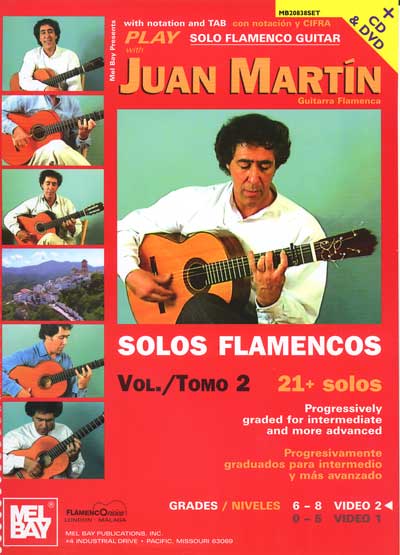
MARTIN JUAN PLAY SOLO FLAMENCO GUITAR VOL2 LIBRO CD DVD TABLATURE SPARTITI CHITARRA

MARTIN JUAN, PLAY SOLO FLAMENCO GUITAR VOL.2. CD DVD TABLATURE

LIBRO DI MUSICA CON CD E DVD, SPARTITI PER CHITARRA. ACCORDI, PENTAGRAMMA E TABLATURE. 

SOLO FLAMENCOS TOMO VOL. 2

Progressively graded for intermediate and more advanced GRADES 6 - 8

This second volume, of a two-part series, contains a book, CD and DVD by internationally recognized flamenco guitarist, Juan Martin. Provided are more than 21 solos, progressively graded in the three higher grades, 6 to 8, to suit players at intermediate and more advanced stages, who already have some experience of the instrument and techniques of flamenco. The music for all these is accurately written in notation and flamenco tab (cifra) and (except for the two final solos) is also included on the companion CD. The DVD contains over 60 minutes of music. All text is provided in both English and Spanish.
 

INTRODUCTION

Welcome to the second volume of Solos Flamencos!

I hope you will find it meets your needs for more technically demanding music which can help you to feel that you are really beginning to master the challenges of the solo flamenco guitar. The tremendous success of the first volume has greatly encouraged us in the preparation of this second volume. Messages of appreciation from players in all parts of the world have brought us great pleasure and satisfaction. The main content of this volume follows the format of the first volume, with seven solos demonstrated at each of the grades 6 - 8. In addition there are four recorded extras on the CD and DVD; these consist of two brief sequences of Solea, a Garrotin (an easier solo which could help you to get started) and more falsetas for Bulerias. Finally, as a further extra in the book, there are two of my solo compositions presented only in music notation and cifra tablature, which are not demonstrated on the CD or the DVD. There is a separate introduction and explanation for these. It is not always easy to rate music at the higher grades in terms of its relative difficulty but I hope you will recognise a progressive trend as you advance from Grade 6 to Grade 8. Many factors are relevant to the grading (with which not all players will be able to agree), but I have taken into account not only considerations of technical difficulty and speed, but also those more fundamental considerations of musical expressiveness, summed up in the two fundamental concepts of compas and aire. The player should aim for an interpretation in which the difficulty of the solo is not apparent to the listener - what matters, of course, is whether it is musically satisfying and whether it can move the emotions. Technical skill is always only a means to an end. Certainly there are occasions when the bravura of a virtuoso technique is absolutely right, especially in the lighter styles (Rumbas, Bulerias, etc.). Even so, the good flamenco guitarist always tries to play with expressive aire and, if it's possible, with that magical spirit of duende, rather than exciting the audience just because he or she can. What I am aiming for here is music for the player whose technical skills are developing to the point where the basic elements are assured. For this reason I have not included the lists of technical requirements at each grade level which are a feature of Volume 1. There are new techniques introduced in the solos but most of the basic elements are illustrated in that volume. At this level, the choice of music continues further the approach adopted previously. I have included here my own compositions and also fundamental elements and solos that pay homage to the great masters of the recent past, particularly Sabicas and Nino Ricardo. Following Ramon Montoya, these two giants of the art were largely responsible for the establishment of the flamenco guitar as a solo instrument, and the value of their genius cannot be overstated. Both of them were exceptionally creative in their melodic and rhythmic originality. I also acknowledge, particularly in a solo Bulerias that evokes the impetuous aire of his first recordings, the incomparable contribution of Paco de Lucia. Today the flamenco guitar embraces other musical traditions such as jazz and pop music, and you will want to discover and pursue your own creative pathway and musical tastes. The aim of these two volumes is to help you establish a solid foundation in the art of flamenco solo playing which acknowledges the history of its evolution and the possibilities for further development and exploration that will take it still further. For me, the flamenco guitar is both a melodic and a percussive instrument, capable of intense beauty of sound and also of powerfully exciting rhythmic drive. Its music arises within a broader and still evolving tradition of flamenco artistry, a unique cultural heritage comprising the cante, the baile and the guitar. A basis of rasgueo rhythm in palos a compas is the uniquely flamenco heart-beat of the music which gives its pulsation and structure. If this is ignored or relegated to insignificance, and the music lacks strong melodic themes intensified by the amazingly expressive sounds of the guitar, I think flamenco guitar-playing can be in danger of deteriorating into aimless and unmusical doodlings or empty technical dazzle. But this is my philosophy and you will want to develop your own! I hope these volumes can help and direct you towards achieving your goals. iViva el arte - y vamos a tocar!

Contents:

Grade 6
La Cana --
Farruca --
Colombianas --
2 Sevillanas --
Sevillana II --
Bulerias (de Sabicas) --
Granadinas (Lorca's Dream) --
Garrotin (Noche de San Juan) --

Grade 7

Solea --
Seguiriya y Cabales --
Bulerias (de Paco) --
Tarantas --
Milonga (del Recuerdo) --
Tangos --
Zambra Mora --

Grade 8

Solea (de Ricardo) --
3 Sevillanas (Sevillana 1) --
Sevillana 2 --
Sevillana 3 --
Solea por medio (Esencia) --
Rondena -- Aurora
Rumba (Rumba nostalgica) --
Serranas (de Ricardo) --
Bulerias (con metronomo) --

Solea A (Another falseta Orta falseta) --
Solea B -- Ritmo Falseta 
Garrotin -- de Sabicas
Bulerias (Ritmpo y falsetas) --
Solea (por escrito) --
Harlequin (Arlequin) Rumba

Prezzo: €37,99
€37,99
Condividi contenuti