SPARTITI PER CHITARRA DI MUSICA GYPSY JAZZ, SWING, MANOUCHE

DJANGO'S RHYTHM, MICHAEL DUNN DVD Reinhardt Pick Picking-Double Whammy-tango-Tremolo-Shuffle

DJANGO'S RHYTHM, MICHAEL DUNN. DVD

Guitar Solos: DON OGILVIE

In the world of Gypsy Jazz, the original Quintette of the Hot Club of France achieved an energy output seldom equaled or surpassed for 7 decades or so. Django wanted to have two rhythm guitars behind him when he soloed to give him a full sound. Then when Grappelli soloed, Django would interject himself between Grappelli and the rhythm guitar section. From this vantage point, he would "push" Grappelli with a series of well placed shots, shuffles, and turnarounds that would have the effect of driving the group to a greater energy output as the song approached its conclusion. In this DVD, the classic 4-to-the-bar rhythm is broken down into four separate unsable styles. After that, Django’s syncopated rhythm shots are analyzed and presented by example from a simple backbeat to 2-bar long syncopated strums. My own philosophy is that the rhythm guitar section is the most important component of the Gypsy Jazz group. The rhythm guitar should be in a position to drive and not follow the group. The information contained in this DVD will give you the rhythmic tools to infuse the sound with the energy that this genre of music deserves. Remember that rhythm guitar is NOT "second fiddle".

Song Title:

Intro
Shuffle Rhythm
The Pick and Picking
Basic Rhythms & Variations
Ballads
Concepts of Rhythm Guitar
Advanced Rhythm: Hiccup
Double Shuffle
Tremolo
Half Whammy
Short Whammy
Double Whammy
Triple Whammy
Tango Rhythm

Prezzo: €21,99
€21,99

GYPSY SWING & HOT CLUB RHYTHM FOR GUITAR BY D. BRUCE. CD TABLATURE

GYPSY SWING & HOT CLUB RHYTHM FOR GUITAR BY D. BRUCE. CD TAB.

Product Description:
Learn 12 great swing standards recorded by Django Reinhardt, Stephane Grappelli, and the Quintette of the Hot Club of France. Play along with a great Gypsy Swing Rhythm Section and learn chords, comping, and melodies, then let the band back you up as you practice chords and soloing. You play all the leads while the band backs you up. Beginners can practice basic skills while more advanced players can hone their improvisation chops, each at their own individual learning pace.

Includes standard notation, tablature, chord diagrams, lyrics, playing tips, and more. Each song is presented on the CD at slow and regular speed. First you'll hear the melody played at a slow speed with just guitar backup, then it's repeated at regular speed with the band. Split track mixing on the recording allows the student to hear just the melody (while reading along in the book) or just the rhythm section, or both for maximum flexibility and specific study. Finally the band plays several choruses and you play all the leads. Songs may be repeated, at slow or regular speed, as many times as you wish in order to perfect phrases, melodies and solos in a band context.

Includes special section on how to play rhythm back up chords and get that swing pulse on guitar. Potential for improvement is unlimited. Mandolin version also available. We'll jam all night long!

Song Title: Composer/Source:
After You've Gone Creamer & Layton
Avalon Jolson & Rose
Baby Won't You Please Come Home? C. Williams & C. Warfield
Chicago F. Fisher
China Boy D. Winfree & P. Boutelje
Dark Eyes
Rose Room A. Hickman & H. Williams
Some of These Days Sheldon Brooks
St. Louis Blues W.C. Handy
Swing in Minor Dix Bruce
Swingin' Like '42 Dix Bruce
The Sheik of Araby T. Snyder, H. Smith & F. Wheeler

Prezzo: €15,95
€15,95

EARLY JAZZ AND SWING SONGS FOR GUITAR Acoustic Guitar Method Songbook CD TABLATURE LIBRO

EARLY JAZZ AND SWING SONGS FOR GUITAR, Acoustic Guitar Method Songbook. CD TABLATURE

LIBRO DI MUSICA JAZZ SWING CON CD.

SPARTITI PER CHITARRA.

ACCORDI, PENTAGRAMMA E TABLATURE. 

Series: String Letter Publishing
Publisher: String Letter Publishing
Softcover with CD - TAB
Artist: Various Artists

Editor: Jeffrey Pepper Rodgers

Author Photograph: Stephen Hunt

Add to your repertoire with this collection of early jazz and swing standards! The companion CD features a two-guitar recording of each tune, and the book includes full guitar parts in standard notation and tab with chord diagrams, plus detailed notes on the song origins and arrangements.

Includes 15 songs: After You've Gone - Avalon - Baby, Won't You Please Come Home - Ballin' the Jack - Hindustan - I Ain't Got Nobody (And Nobody Cares for Me) - Indiana (Back Home Again in Indiana) - Limehouse Blues - Poor Butterfly - Rose Room - Saint James Infirmary - St. Louis Blues - Tain't Nobody's Biz-ness If I Do - Till the Clouds Roll By - Whispering. 38 pages


EARLY JAZZ AND SWING SONGS FOR GUITAR INTRODUCTION

Early jazz refers to a period in American popular music that lasted from the late 'teens through the 1920s; the swing era basically refers to the 1930s. These periods overlap, of course, since musicians from the '20s continued playing throughout the 1930s and beyond, and the swing players of the '30s likewise continued to perform and record into the subsequent decades. With one exception, the 15 songs in this book were composed by professional songwriters in the first quarter of the 20th century. They were written as popular songs, to be sung in theatrical shows and revues and to be sold as sheet music, which at the time was still a bigger business than the sale of recordings. By the mid-1920s, as Louis Armstrong was hitting his stride with his Hot Five and Hot Seven sessions, recorded music was having its first big boom, and the interpretations of jazz musicians like Armstrong began to create a whole second life for certain popular songs. Jazz groups recorded these tunes with looser, more swinging interpretations of the melodies, new chord voicings, and a jazz pulse, generally using the songs as vehicles for improvisation. This fresh approach served to pull the songs in this book into what was then just becoming the jazz repertoire. By the 1930s the swing orchestras of Fletcher Henderson, Count Basie, and Benny Goodman were streamlining and refining the innovations made by Armstrong, Jelly Roll Morton, and others. Having cut their teeth on the music of the 1920s, Henderson, Basie, Goodman, and their peers and sidemen naturally gravitated toward reinterpreting those tunes, even as they composed new pieces and chose current show music to arrange. So we get Basie's and Goodman's versions of "Royal Garden Blues," Goodman's and Henderson's versions of "Rose Room," Basie's and Fats Waller's versions of "I Ain't Got Nobody," Goodman's and Jimmy Lunceford's versions of Introduction and Tune-Up: "Avalon"-all songs written a good 15 to 20 years before and given new life in the latest popular style. History exerts a winnowing effect on the music of the past-the 1960s' reputation as a golden era of rock 'n' roll, for instance, rests as much on forgetting the work of the Archies as on remembering that of Beatles and Bob Dylan. With the jazz age, too, certain songs have emerged as standards while countless other topical, novelty, and sentimental songs lie crumbling in the dust where they probably belong. In terms of the jazz repertoire, a standard is simply a song still in circulation because at some point an artist with sufficient influence saw fit to treat it as jazz material, and enough others subsequently ratified that first musician's judgement by recording and performing the song themselves. Early Jazz and Swing Songs includes the melody and chords to 15 standards in the public domain. The Cdincludes a two-guitar recording of each arrangement, but to really learn how to play these tunes, especially the melodies, I suggest tracking down at least one original recording of each song. I have stayed close to the published sheet-music versions of the melodies found in Hal Leonard's Early Jazz Standards, and more than a few of the tunes sound somewhat square when played that way. I did so, however, because even by the 1930s, many jazz musicians' renditions of these tunes were loose interpretations of the original theme, and if you want to understand the kind of improvisors they were, there are few better places to start than observing how they ornamented and re-created the melodies. I hope you have fun learning to play these tunes. Like fiddle tunes or classic rock songs, early jazz and swing standards are a great meeting ground for casual jamming with friends and fellow musicians. So once you've got a few of these under your fingers, don't hesitate to try them out the next time you're doing some picking. Good luck!


THE RHYTHM STYLE

I've arranged the chord progressions in this book in what guitarists call the Freddie Green style, after the rhythm guitarist who reportedly took only one recorded solo in his five decades with the Count Basie orchestra. While such nobility may not be your cup of Darjeeling, Green nevertheless perfected a comping (as in, ac-comp-animent) style that lays down just the right groove for a swing interpretation of the melody. There are two components to this style: what chords to play and how to play them. Let's look at each one before we get into the tunes themselves.


THE CHORDS

Jazz guitarists tend to use four-note chord voicings, but Green's style trimmed each chord down to the three notes found on the sixth, fourth, and third strings, as shown below in the second row. (Note that there is no commonly used fournote version of the G/D, so just the three-note version is shown.) You can play all 15 arrangements in this book using just these nine chord shapes.

Four-Note Voicings. Several of these chords have the third or the fifth of the chord on the lowest string, rather than the root. You may also have noticed that the Gm6, G7/D,and Gdim chords all have the exact same shape. These chords are meant to be played with a bassist, who is presumably playing the root of the chord on the first beat of each measure. Heard out of that context, these chords may not sound right at first, which is another good reason to spend some time with original recordings of these tunes and even to try and play along with them. Wherever possible, I've arranged these songs in the keys in which they were first published. While jazz musicians usually stick to the original key, sometimes another key becomes a popular alternative-for example, "Indiana" is just as frequently played in the key of F as in the original key of AJ,. And standards are frequently moved to another key to accommodate a vocalist.


STRUMMING

In the swing era, the guitarist was usually part of a four-piece rhythm section that also included piano, bass, and drums. Keeping good time meant providing a steady flow of quarter notes, four per bar, by playing a downstroke on every beat and possibly emphasizing beats 2 and 4 somewhat. Ifyou let your fretting fingers mute the fifth, second, and first strings, you can do a big, percussive strum across all six strings and just hear the notes you want to hear, on the sixth, fourth, and third strings. Relaxing your grip at the end of each quarter note dampens the strings and creates a little space between each stroke. At slower tempos, the four strums in a bar tend to come out relatively evenly, as in Example 1. At a moderate tempo (Example 2), the second and fourth beats start to get more clipped. And at faster tempos (Example 3), the second and fourth beats tend to become just a percussive backbeat.  


After You've Gone

Avalon
Baby, Won't You Please Come Home
Ballin' The Jack
Hindustan
I Ain't Got Nobody (And Nobody Cares For Me)
Indiana (Back Home Again In Indiana)
Limehouse Blues
Poor Butterfly
Rose Room
Saint James Infirmary
St. Louis Blues
Tain't Nobody's Biz-ness If I Do
Till The Clouds Roll By
Whispering

Prezzo: €18,99
€18,99

BASIC JAZZ RHYTHM GUITAR comping in the FREDDIE GREEN style CHRISTIANSEN COREY DVD CHITARRA

BASIC JAZZ RHYTHM GUITAR, comping in the FREDDIE GREEN style. Corey Christiansen. DVD

Product Description:
Every jazz guitarist needs to be familiar with the accompaniment style of Freddie Green. Freddie Green was the guitarist for the Count Basie orchestra for decades and his sound and comping technique were defining aspects of this legendary group. Four-to-the-bar strumming, essential chord voicings and voice leading ideas are covered in this informative 58-minute DVD and accompanying chart. A must have for any aspiring rhythm guitarist.

DVD CONTENTS
The Beginning
Introduction and Tuning
Freddie Green History
Diagram Explanation
3 Note Voicings
4 to the Bar Rhythm
Press & Lift Method
Approach Chords
Using Approach Chords (Song)
Inversions
Using Inversions (Song)
Developing Good Time
Drawing Upon Inversions
Example of Inversion Comping (Song)
How to Move Inversions
Common 4 Note Chords / Inversions
Diatonic Substitutions
Using Diatonic Substitutions (Song)
Common Blues Walks
Using Blues Walks (Song)
Summary
Closing Blues

CHART CONTENTS
Chord Spelling Chart

Freddie Green Chords
Lowest Note on 6th String
Maj7, Major, Maj6, 7, m7, minor, m6, m7b5, dim7

Lowest Note on 5th String
Maj7, Maj6, 7, m7, m6, m7b5, dim7

Basic Blues
Approach Chord Examples
Chord change with approach chords

Chord Inversions

I to IV Motion

Prezzo: €122,99
€122,99

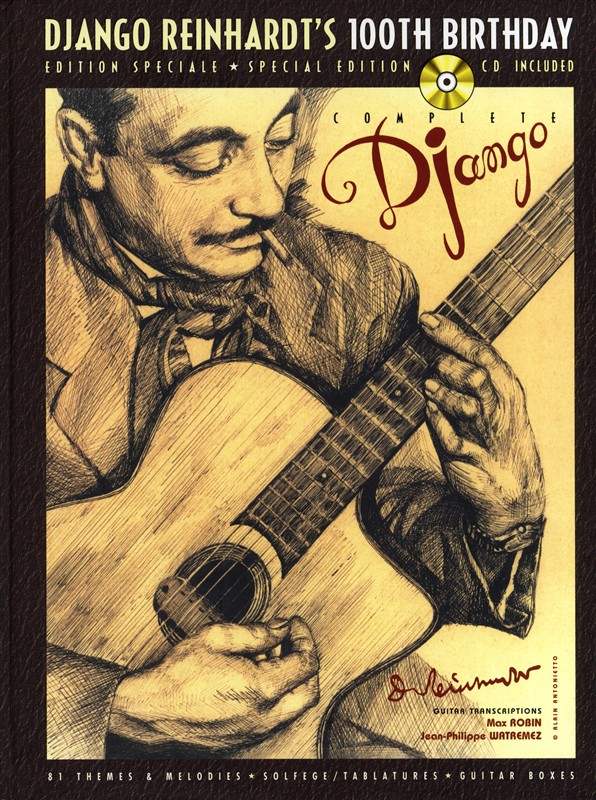
REINHARDT DJANGO COMPLETE BOOK TABLATURE CD LIBRO SPARTITI CHITARRA MANOUCHE Daphne

REINHARDT DJANGO, COMPLETE DJANGO. SHEET MUSIC BOOK AND CD WITH ORIGINAL RECORDINGS, 248 Pages GUITAR TABLATURE

SPECIAL EDITION - EDITION SPECIALE 

LIBRO DI MUSICA GYPSY JAZZ, MANOUCHE, CON CD.
CD CON LE REGISTRAZIONI ORIGINALI DI DJANGO REINHARDT CON STEPHANE GRAPPELLI. 

SPARTITI PER CHITARRA CON : ACCORDI PENTAGRAMMA E TABLATURE. 

GUITAR TRASCRIPTIONS : 
MAX ROBIN 
JEAN-PHILIPPE WATREMEZ
 
EDITED & PRODUCED BY PATRICK MOULOU .
 
weight: Kg.1,300

Description
For the first time, all of the 81 themes and melodies composed by legendary Jazz guitarist Django Reinhardt have been assembled in one sumptuous celebratory volume.

The Hot Club sounds of Reinhardt forged the very basics of modern Jazz guitar. Alongside Charlie Christian, Reinhardt has long been regarded as a key innovator and charismatic ambassador of the guitar, developing a vocabulary that remains strong and vibrant today.

This very special publication, compiled by two of the world's most revered Reinhardt specialists, boasts anecdotes, performance notes, biographical landmarks, previously unreleased photographs and much more. 248 pages.

TiToLi :

Anouman
Appel Indirect
Are You In The Mood
Artillerie Lourde
Babik (Bi-bop)
Belleville
Black And White
Blues Clair
Blues D'autrefois
Blues For Ike
Blues Primitif
Bolero
Bricktop
Cavalerie
Crepuscule
D.R. Blues
Danse Nuptiale
Daphne
Deccaphonie
Del Salle
Diminushing
Dinette
Djangology
Django's Tiger
Double Scotch
Douce Ambiance
Duke And Dukie
Feerie
Festival 48
Fleche D'or
Fleur D'ennui
Folie A Amphion
Gaiement
H.C.Q. Strut
Hungaria
Impromptu
Lentement Mademoiselle
Mabel
Manoir De Mes Reves
Melodie Au Crepuscule
Mike
Minor Blues
Minor Swing
My Serenade
Mystery Pacific
Nocturne
Nuages
Nuits De Saint-germain-des-près
Nympheas
Oiseaux Des Iles
Oriental Shuffle
Oubil
Paramount Stomp
Peche A La Mouche
Place De Brouckere
Porto Cabello (Il Mexicano)
Pour Que Ma Vie Demeure
R. Vingt-six
Rythme Futur
Souvenirs
Speevy
Stockholm
Stompin' At Decca
Stop
Sweet Chorus
Swing 39
Swing 41
Swing 42
Swing 48
Swing From Paris
Swing Guitars
Swingtime In Springtime
Tears
Troublant Bolero
Twelve Years
Ultrafox
Vamp
Vendredi 13
Vette
Webster
What Kind Of Friend


2010 est l'année du 100ème anniversaire de la naissance de Django Reinhardt. Retrouvez l'intégrale des 81 thèmes et mélodies composés par Django Reinhardt en édition spéciale, réunis dans un seul recueil et retranscrits en solfège et tablatures (avec les diagrammes d'accords exacts joués par le Maître), par deux des meilleurs spécialistes de Django: Jean-Philippe Watremez & Max Robin! Inclus une page avec tous les accords utilisés, des anecdotes, des repères biographiques, chronologiques, photos et illustrations inédites, et en plus un CD avec 22 chansons originales de Django Reinhardt (01 Djangology / 02 Sweet Chorus / 03 Minor swing / 04 My Serenade / 05 Black and White / 06 Nuages / 07 Rythme futur / 08 Swing 42 / 09 Belleville / 10 Douce ambiance / 11 Manoir de mes rêves / 12 Duke and Dukie / 13 Crépuscule / 14 Swing Guitars / 15Tears / 16 Swing 39 / 17 Webster / 18 Impromptu / 19 Vamp / 20 Troublant Boléro / 21 Flèche d’or / 22 Anouman). couverture rigide pelliculée et vernis.

Titres :

Anouman
Appel Indirect
Are You In The Mood
Artillerie Lourde
Babik (Bi-Bop)
Belleville
Black And White
Blues Clair
Blues D'Autrefois
Blues En Mineur (Minor Blues)
Blues For Ike
Blues Primitif
Boléro
Brick Top
Cavalerie
Crépuscule, Daphné
Del Salle
Deccaphonie
Diminushing (Black Night Or Diminushing Blackness)
Dinettte
Django's Tiger
Djangology
Double Scotch
Douce Ambiance
D.R. Blues
Duke And Dukie
Féérie
Festival 48
Flèche D'Or
Fleur D'Ennui
Folie A Amphion
Gaiement
H.C.Q Strut
Hungaria
Impromptu
Lentement Mademoiselle
Mabel
Manoir De Mes Rêves
Mélodie Au Crépuscule (Love's Melody)
Mike (Micro Or Swing Dynamique)
Minor Blues
Minor Swing
Mopp'in The Birde (Danse Nuptiale)
My Serenade
Mystery Pacific
New York City
Nocturne
Nuages
Nuits de Saint-Germain-des-Près
Nymphéas
Oiseau Des Iles
Oriental Shuffle
Oubli
Paramount Stomp
Pëche A La Mouche (Lancer Léger)
Place De Brouckère
Porto Cabello (Il Mexicano)
Quequefois (Pour Que Ma Vie Demeure)
Rythme Futur
R-26
Souvenirs
Speevy
Stockholm
Stompin' At Decca
Stop
Sweet Chorus
Swing From Paris
Swing Guitars
Swing 39
Swing 41
Swing 42
Swing 48
Tears
This Kind Of freind (What Kind Of Freind)
Troublant Boléro
Twelfth Year
Ultrafox
Vamp
Vendredi 13
Vette
Webster
What Kind Of Friend 

Prezzo: €99,99
€99,99

REINHARDT DJANGO IMPROVISATIONS 1935-1949 BOOK & CD GUITAR TABLATURE SPARTITI CHITARRA LIBRO

REINHARDT DJANGO, IMPROVISATIONS 1935-1949. Incisioni originali. SHEET MUSCI BOOK WITH CD & GUITAR TABLATURE. 

LIBRO METODO DI MANOUCHE CON CD .
SPARTITI PER CHITARRA CON:
ACCORDI, PENTAGRAMMA, TABLATURE.


TRANSCRIPTIONS pour GUITARE de ROMANE & DEREK SéBASTIAN

BLUE DRAG
Enregistrée en avril 1935
Sur ce 32 AABA, le thème mélodique est exposé par le violon, la guitare de Django intervenant
sous forme de contre-chant. Le maître produit ensuite un solo dynamique et virtuose
(cf. mesure 43) qui comprend nombre de torsions de cordes, manouches et bluesy, ainsi que
des octaves puissamment marquées. Notez aussi que l'introduction est utilisée comme coda
de fin, à l'issue d'un exposé final qui reprend la section A seulement.

IMPROVISATION 2
Enregistrée le 10 septembre 1938

A l'écoute, la première version d'Improvisation 2 ayant manifestement servi à Django de« mise en
doigts », nous avons choisi de transcrire la version B, identique, à cette différence que les thèmes y
sont développés, les idées abouties. Cette« pièce » se compose d'arpèges et de modulations qui
ne sont pas sans rappeler certaines oeuvres de Claude Debussy. On y trouve aussi, dans le pont et la
coda, d'étranges phrasés« shuffle ». A la toute fin, observez le désaccordage en ré grave de la sixième
corde ... désaccord age d'autant plus surprenant qu'on n'entend absolument pas Django l'opérer,
même en tendant l'oreille au maximum - un pur mystère !

IMPROVISATION 3
Enregistrées le 26 février 1943

Là, quoique l'une et l'autre reposent sur les mêmes ingrédients - tonalité mineure,
arpèges -, ces deux versions sont dignes d'intérêt. La première, au tempo assez rapide,
présente une structure AABACA, une coda qui reprend l'intro et une fort belle modulation
terminale. La seconde version, plus assise question tempo, est dépourvue
d'intro et de section C ; et l'on trouve dans la section B des passages mélodiques
virtuoses. L'accord final y est majeur.

IMPROVISATION 4
Enregistrée en février 1949
Courte et sur tempo lent, faisant peu appel à la technique et beaucoup aux cordes à vide, cette improvisation est plus facile à étudier. Elle est faite d'une abondante suite d'accords roulés, entrecoupés de quelques arpèges, tout ceci en forme métrique de type AABA.

IMPROVISATION 5
Enregistrée le 21novembre 1947
A l'inverse de la précédente, l'Improvisation 5 est ardue sur le plan technique. C'est une suite d'arpèges et d'accords, rehaussés de traits mélodiques virtuoses dont la couleur rappelle volontiers la musique flamenca (cf. partie terminale). Par ailleurs, il convient d'observer que cette improvisation a sans doute servi d'inspiration au pianiste John Lewis pour composer son thème Django .

Improvisation 6
Enregistrée le 1er décembre 1945
Difficile également sur le plan technique, reposant sur les mêmes ingrédients que la précédente - arpèges, accords roulés, traits mélodiques - l'Improvisation 6 n'offre cependant pas, à notre sens, de développements aussi maîtrisés. En cela, c'est une véritable improvisation au sens propre du terme. Elle contient cependant de remarquables passages en cadences d'accords et fait usage, elle aussi, de colorations mélodiques hispanisantes.

VALSE MANOUCHE
Enregistrée par la BBCen 1935
Enfin, voici une valse jouée en duo piano/guitare, dont le guitariste est très probablement Django, alors aux tout premiers moments de sa carrière. De forme métrique 112 AABA, cette valse séduisante présente une étrange cadence sur les sections A (mesures 13-16),dans lesquelles Django produit une montée chromatique très reconnaissable de son style. Est également reconnaissable le choix de certaines harmonies du pont, très hardies pour l'époque, à caractère hispanisant, des accords parfaits majeurs placés sur une note de pédale.

- Blue drag

- 6 improvvisazioni

- valse manouche. 

Prezzo: €30,99
€30,99

MODERN SWING GUITAR MIKE CHRISTIANSEN TABLATURE BOOK & CD CHITARRA LIBRO SPARTITI

MODERN SWING GUITAR, MIKE CHRISTIANSEN. SHEET MUSIC BOOK WITH CD & GUITAR TABLATURE .

LIBRO DI MUSICA SWING CON CD. 

SPARTITI PER CHITARRA :

ACCORDI, PENTAGRAMMA, TABLATURE. 


The guitarist in a swing band can provide interesting and driving rhythm backups, be a soloist, or interject fills and riffs in much the same way a horn section would function. The material in this superb new book presents concepts and techniques used in playing background elements (strumming, comping and bass riffs), and soloing in this popular modern swing guitar style. Contains information on swing rhythm, barre chords, strum patterns, chord progressions, power chords, comping, riffing, bass-string chords, boogie bass lines, solo performance, breaks, fills and some great modern swing solos. A companion CD featuring the performance of Mike Christiansen and Corey Christiansen is included. In notation and tablature. 72 Pages. Format: Book/CD Set.

Prezzo: €157,99
€157,99

SWING & BIG BAND GUITAR THE STYLE OF FREDDIE GREEN LIBRO CD ACCORDI MUSICA JAZZ SPARTITI

SWING & BIG BAND GUITAR, the style of FREDDIE GREEN. C. Johnson. Con disegno degli accordi. CD

LIBRO DI MUSICA JAZZ CON CD

SPARTITI PER CHITARRA

ACCORDI, PENTAGRAMMA, 

Series: Guitar
Medium: Softcover with CD
Author: Charlton Johnson

This book/CD pack for teaching jazz rhythm guitar in swing & big band styles includes: sample songs, patterns, progressions and exercises; essential chord voicings, inversions and substitutions; info on time and groove, reading charts, chord reduction and expansion; a chord reference library; and over 50 full-demo samples on the accompanying CD. 80 pages.

Prezzo: €26,99
€26,99

SWING FAVORITES GUITAR-Big Band Play-Along Volume 1 CD LIBRO CHITARRA JAM BOOK-April In Paris

SWING FAVORITES GUITAR, Big Band Play-Along Volume 1. BOOK WITH CD

LIBRO DI MUSICA JAZZ SWING, CON CD.

CD DI BASI PER CHITARRA. 

SPARTITI PER CHITARRA CON ACCORDI.


Composer: Various Composers

With the 10 fantastic big band charts in this book/CD pack, instrumentalists can play along with their favorite swing tunes! Includes:

Table of contents

April In Paris
I've Got You Under My Skin
In The Mood
It Don't Mean A Thing (If It Ain't Got That Swing)
Route 66
Speak Low
Stompin' At The Savoy
Tangerine
This Can't Be Love
Until I Met You (Corner Pocket)

23 pages

Prezzo: €21,99
€21,99

CHRISTIAN CHARLIE SWING TO BOP: The Music of, Pioneer of the Electric Guitar by Stan Ayeroff 2CD

CHRISTIAN CHARLIE, SWING TO BOP: The Music of, Pioneer of the Electric Guitar. Stan Ayeroff. 2CD

LIBRO DI MUSICA JAZZ, CON 2 CD .

SPARTITI PER CHITARRA : 

ACCORDI, PENTAGRAMMA.  


Product Description
Countless musicians have been inspired upon hearing Charlie Christian for the first time. In this exciting book, the author has compiled 39 precise solo transcriptions (in notation only), as well as a thorough analysis of each. There is also a complete "how to" section that is a book in itself. The author has recorded each transcription in slow and fast versions on two CDs. The book contains some of Charlie's best work including the Jam Sessions at Minton's, John Hammond's Spirituals to Swing concert and the Celestial Express Blue Note Recordings. Charlie Christian was the first to popularize the use of the electric guitar in jazz. He was the pioneer who led the way.

Format: Book/2-CD Set

240 PAGES.

Song Title: Composer/Source:
Ad Lib Blues
Good Morning Blues Jimmy Rushing, Count Basie and Ed Durham
Guy's Got to Go
Honeysuckle Rose I Thomas "Fats" Waller
Honeysuckle Rose III Thomas "Fats" Waller
I Got Rhythm George Gershwin and Ira Gershwin
I Never Knew Ted Fiorito
I'm Confessin' Al Neiburg, Doc Daugherty and Ellis Reynolds
I've Found A New Baby I Palmer Williams and Spencer Williams
I've Found A New Baby II Palmer Williams and Spencer Williams
Ida, Sweet as Apple Cider Eddie Leonard
Jammin' in Four Meade Lux Lewis
Lips Flips
Oh, Lady Be Good George Gershwin and Ira Gershwin
On the Alamo Gus Kahn and Isham Jones
Pagin' the Devil Milton Gabler and Paige Walter
Poor Butterfly Raymond Hubbell
Profoundly Blue I Meade Lux Lewis
Profoundly Blue II Meade Lux Lewis
Riffin' Around
Rose Room I Art Hickman
Rose Room II Art Hickman
Rose Room III Art Hickman
Royal Garden Blues I Clarence Williams and Spencer Williams
Royal Garden Blues II Clarence Williams and Spencer Williams
Royal Garden Blues III Clarence Williams and Spencer Williams
Swing to Bop
Tea for Two Vincent Youmans
The Sheik of Araby I Ted Snyder
The Sheik of Araby II Ted Snyder
The Sheik of Araby III Ted Snyder
These Foolish Things I Jack Strachey
These Foolish Things II Jack Strachey
These Foolish Things III Jack Strachey
Untitled Tune I
Untitled Tune II
Up On Teddy's Hill
Way Down Yonder in New Orleans Turner Layton

Prezzo: €39,99
€39,99
Condividi contenuti