SPARTITI PER CHITARRA DI MUSICA GYPSY JAZZ, SWING, MANOUCHE

JORGENSON JOHN INTRO TO GYPSY JAZZ GUITAR LIBRO CD DVD TABLATURE SPARTITI ACCORDI

JORGENSON JOHN, INTRO TO GYPSY JAZZ GUITAR. CD DVD 2-hour.
SHEET MUSIC BOOK WITH CD and DVD 2-hour with GUITAR TABLATURE. 

LIBRO DI MUSICA MANOUCHE GYPSY JAZZ, CON CD E DVD. 

SPARTITI PER CHITARRA CON: 

ACCORDI, PENTAGRAMMA, TABLATURE. 

LIBRO DI MUSICA JAZZ CON CD E DVD.

SPARTITI PER CHITARRA. ACCORDI, PENTAGRAMMA E TABLATURE.


In this first of three volumes of Flatpicking Guitar Magazine's new Gypsy Jazz Guitar instructional series, "Intro to Gypsy Jazz Guitar," Jorgenson provides the foundational information and practice material necessary for you to gain an understanding of the Gypsy jazz guitar style. The first half of this volume addresses the important element of Gypsy jazz rhythm. The second half of this first volume addresses soloing. Each volume of this three-part series includes a 2-hour instructional DVD, an audio CD with practice audio tracks, and a full format book which presents all of the theoretical information, chord charts, fret board diagrams, music notation, and tablature for the material presented on the DVD.

Song Title: Composer/Source:
1-4-5 Blues Progression
A Minor Pattern
Adding C#dim7
Adding the A and E& chords
Adding the Daug
Adding the G9
An Interview with John Jorgenson
Appendix
Audio CD Contents/Forward
Basic Strum Patters
C Major Note Map
C Minor 6
Changing the C7 to C6
Chromatic Pattern 1
Chromatic Pattern 2
Chromatic Pattern 3
Chromatic Scale
Chromatic Scale moving up the neck
Chromatics
D augmented Arpeggio
D Major
D Major Pattern 1
D Major Pattern 2
D Major Pattern 3
Downstroke Exercise

DVD Contents
F Major
F Major Pattern 1
F Major Pattern 2
G Major
G Major Arpeggio
G Major Pattern 1
G Major Pattern 10
G Major Pattern 2
G Major Pattern 3
G Major Pattern 4
G Major Pattern 5
G Major Pattern 6
G Major Pattern 7
G Major Pattern 8
G Major Pattern 9
G Minor
G Minor 6
G Minor 6 Pattern 1
G Minor 6 Pattern 2
G Minor 6 Pattern 3
G Minor Pattern
Gypsy Jazz Rhythm Details
In-between Notes
Introduction/Acknowledgements
Lead Playing
Minor Blues Progression
Minor Blues with 3-Note Chords
Open Strings, Unison, & Dissonance
Rhythm Example #1
Rhythm Example #2
Rocking the bass on C7 & D7
Simple Minor Blues Progression

John Jorgenson is perhpas best known as a founding member of the Desert Rose Band, for his dazzling fretwork with the super guitar trio The Hellecasters, from his six-year stint as a member of Elton John's band, and his session work with a diverse range of artists including rock icons Elton John, Bob Dylan, Bonnie Raitt and Bob Seger, country legends Willie Nelson, Johnny Cash, Emmy Lou Harris and Hand Williams Jr., and international superstars like Barbara Streisand and Luciano Pavarotti. Even though he has made his living playing primarily rock, country, and pop music John's love for jazz and swing music dates back to his youth when his father, James, was conductiong for Benny Goodman. John, who idolized Goodman, actually got to play with his hero while his father led the way. As accomplished on clarinet as he is on guitar, Jorgenson's first swing recording After You've Gone was a tribute to both his heroes, Django Reinhardt and Benny Goodman. Released in 1985, John played Django style Gypsy jazz ont he first side of the LP and recreated the sound of the Benny Goodman Quintet, playing both Charlie Christian's electric guitar parts and Goodman's swinging clarinet style, on the other. His 2004 release Franco-American Swing, which primarily features John's original swing music, has received rave reviews. In the world of Gypsy jazz music, John Jorgenson has long been known as one of the true American masters of the Django Reinhardt guitar style. In 2003, when the musical director for John Duigan's film Head In The Clouds was looking for someone who could faithfully re-record two tracks from the Quintet of the Hot Club of France for use in the film Guitar Player Magazine's editor recommended Jorgenson. John not only transcribed and recorded the Hot Club's "Blue Drag" and "Minor Swing" for use in the film, he also played the role of Django Reinhardt in the movie. John has also performed with leading European Gypsy jazz artists Bireli Lagrene and Romane, appeared on recordings with Babik Reinhardt and Angelo Debarre, and has written many articles and lessons for national and international guitar magazines. Three guitar virtuosos: John Jorgenson, Jerry Donahue, and Will Ray - collaborated for a one-time-only performance which eventually grew into a 10-year partnership.

AUDIO CD CONTENTS
1: G chord rhythm
2: G chord rhythm with alternate right hand pattern (upstrokes added)
3: Simple 1-4-5 blues progression
4: Final blues progression (with all added chords)
5: Rhythm Example 1
6: Rhythm Example 2
7: F chord rhythm
8: D chord rhythm
9: C chord rhythm
10: 1-4-5 progression
11: C7 chord rhythm
12:D7 chord rhythm
13: Minor Blues Progression

FORWARD
Flatpicking Guitar Magazine is proud to present the first in a three-part instructional series on Gypsy jazz guitar. We are honored to have John Jorgenson, one of the true American masters of the Gypsy jazz style, as the instructor in this series. As you will see on the DVD, John's great enthusiasm for this style of music is infectious and he presents the material in such a systematic and easy to follow manner that anyone who spends time practicing what John teaches here will not only gain valuable insights into the Gypsy style of guitar playing, but will also greatly expand his or her knowledge of the fret board and increase their improvisational skill level. I feel that John's inclusion of Brad Davis as the "student" on the DVD brings a casual and entertaining atmosphere to the visual portion of this instructional package. The addition of an extensive and detailed book as a companion to the 2-hour DVD allows John the opportunity to present much more theoretical knowledge, and address each section of the course in greater detail, than time or space allowed on the DVD itself. Lastly, the inclusion of a practice-along audio CD adds a very practical aspect to the instructional package. It provides the viewer with a valuable practice tool that will continue to be useful for years after the viewer has assimilated the basic material here. No matter how advanced a player becomes, practice tracks can always be useful.
Because the majority of the information here is theoretical in nature and is aimed at providing the student with a strong musical foundation, its principles can be explored far past the specific information and examples that are outlined here. For instance, in the soloing section John spends a great deal of time with the G major arpeggio and G major patterns. Understanding that all of this information can be transposed and applied to any key and at any position on the neck gives the student the opportunity to then take the initiative to explore all of the patterns in a variety of keys and positions. Additionally, John's emphasis in this course on taking time to practice free-form improvisation of every position, pattern, and arpeggio that is demonstrated provides the student with a tremendous practice tool for improving improvisational skills. If the student follows John's system of starting with short four or five note patterns and working to improvise over a rhythm bed with just those notes before moving on to add more complex note patterns and ornaments, even beginning level students can start to gain knowledge and experience that will naturally begin to unlock the mysteries of improvisational playing. I hope that you enjoy the material presented here, learn a lot, and have fun! Dan Miller Editor and Publisher Flatpicking Guitar Magazine


INTRODUCTION/ ACKNOWLEDGEMENTS

Over the years, I have been approached many times to write instructional books and make instruction video material. I opted not to do them for many reasons, but largely because there was already so much material available to the learning guitarist. With the recent growth of interest in the Gypsy Jazz style of music in America, I felt there was room, and even need for a teaching tool that could help guitarists start to unravel the mysteries of this enchanting and complex style. Pioneered in the 30's by the phenomenal Gypsy guitarist Django Reinhardt, this style of music incorporates techniques and concepts that are unique, many which likely Django himself invented. To the American guitarist who has developed by learning rock, blues, country, bluegrass or jazz this is an often baffling and overwhelming style to grasp, especially at the beginning. I first heard and was captivated by Django's playing in 1979, after I had been playing the guitar for 12 years. Although obviously not a beginner, I felt like I was attempting to learn a whole new language just by ear. Over the years I have continued to study and play the style, and continue to learn new elements now. In this DVD series my intention is for the students to be able to piggyback on those years of studying, performing and jamming so that progress can be attained at a more rapid pace. I feel that theory is an important aspect of the learning, and also serves to give a language to speak about harmonic movement, chord progressions, etc. I grew up in a musical household, and have an innate understanding of theory as well as having studied theory as part of my musical education so it is natural for me explain harmonic and improvisational concepts in a theoretical sense. All the theory in the world, however, will not make a great performer. The ears must be trained to hear the different chords, arpeggios, etc., which then can be translated into shared feelings and emotions, which of course are the ultimate goal of any musical performance. I want to thank Brad Davis for participating in this series, and being such a willing and enthusiastic "student." As I have a personal aversion to the "one guy talking to a camera for an hour" type of instruction DVD, Brad's presence made the whole filming aspect of this project relaxed and easy. Plus, he is a great player and learned the concepts very quickly! Don't get discouraged if you don't learn as quickly as Brad does, after all he is an experienced professional guitarist. I also need to thank Brance Gillihan for his camera work, and his creative and diligent editing. I don't even want to know the technical aspects of his work on the authoring of this DVD! Rusty Russell's excellence behind the still camera produced the cover shots for the intermediate and advanced volumes, and Brance supplied the photo for the intro volume. Most of all I need to thank Dan Miller for making this all happen. His countless hours transcribing the musical examples, creating tab and notation, editing text and layouts show an enormous commitment to creating a product that is of as high a quality as possible, and one that will give the buyer an incredible amount of information. To say that Dan is dedicated is an understament; he has gone to great lengths physically, creatively and literally to present this project to you, and I give him kudos, thanks, and congratulations! John Jorgenson July 2004 Nashville, Tennessee

AN INTERVIEW WITH JOHN JORGENSON
What is Gypsy jazz?
Gypsy jazz in general is music in the style of Django Reinhardt, Stephane Grapelly and the Quintet of the Hot Club of France. The lineup of this group that first recorded in 1934 consisted of guitar an violin as the lead instruments, with 2 more guitars and a string bass as the rhythm section. This was highly unusual for the time, as jazz had been played more with horns for lead instruments, and drums, piano and/or banjo and string bass or tuba as the rhythm section. To have a jazz ensemble made up entirely of string instruments was innovative and elegant, and Reinhardt and Grapelly were the first non-American jazz musicians to really be recognized and influential. Reinhardt and Grapelly were influenced some by the American violin/guitar duo of Joe enuti and Eddie Lang. But the biggest influence on Django musically was Louis Armstrong. Django was already a prodigiou musician with un anny skill on the banjo-guitar at an early age, and earned money as a teenager accompanying Musette accordionists live and on recordings. After injuring his left hand in a fire in his caravan in 1928 at age 18, Django developed a whole new technique on the guitar while recuperating, mainly using his index and middle fingers, as the others were permanently pulled ba - by the burned tendons. In a relatively short period of time Django was again out playing, sometimes with his brother Joseph accompanyinc him, and caught the attention of Emile Savitry who played for him a 78 record of Armstrong's "Dallas Blues". Django was fascinated with this new American jazz, and quickly adapted many of Armstrong's phrases and rhythmic feels to his guitar. Django's gypsy heritage had already imbued his music with a firey passion, and the addition of the jazz elements created a whole new style of music, now called Gypsy jazz. Grappelly's influence on the development of this style is equally important. His flawless intonation, highly melodic improvisational style and elegant swing perfectly balanced Reinhart's wildly virtuosic playing and the natural competition between these two soloists drove each of them to new heights. In many early reviews of the QHCF's recordings and concerts, Grapelly often got more kudos than Django.
The music that the QHCF made was heard around the world thanks to the 78 records of the day and of course radio. This exotic, swinging combo caught the attention of many future guitar and violin stars and showed that swing could be played on string instruments as well as on horns. Influences for the QHCF can be easily heard in the music of Bob Wills and his Texas Playboys, seminal electric jazz guitarist Charlie Christian, pop guitarist and inventor Les Paul, Nashville stalwart Chet Atkins, bluegrass guitarist Clarence White, mandolinist David Grisman, champion fiddler Mark O'Connor. the list could go on and on-nearly every guitarist and violinist since owes a big debt of gratitude to the pioneering work of Django, Stephane and QHCF. Today Gypsy jazz music is still very much alive, and has had a thriving scene in Europe for years, thanks to artists like The Rosenberg Trio, Bireli Lagrene. Romane, Angelo Debarre, Dorado Schmidt, Fapy Lafertin, Rafeal Fays, Serge Krief. Boulou and Elios Ferret and Jimmy Rosenberg. There are many festivals in Germany, England, Holland, Norway and France featuring Gypsy jazz music. In London there is a club called Le Quecumbar that features Gypsy jazz every night. The American scene is a little behind Europe, but coming on strong in the last few years. Now there are Django festivals in New York, San Francisco, Chicago, Philadelphia, and Seattle, and lots of gypsy jazz players and bands. Seattle has a thriving scene including Pearl Django and Micheal Horowitz, and other pockets around the country are cropping up including Alphonso Ponticelli in Chicago, Raul Reynoso, Club Django and the Hot Club of San Diego in Southern California, the Hot Club of San Francisco in Northern California, The Hot Club of Philly, Arizona, Minnesota- you name it and there is probably a Hot Club of... and lest we forget our neighbor to the North, there are also big contingents in Montreal and Toronto. Once you know the sound of Gypsy jazz, you will start hearing it often in films and television. It seems to always lend a light, swinging elegance to the ambience whenever it is played, and if the current interest level is any indication this mu i will always be bringing new recruits to the fold! From a musician's perspective, what are some characteristics of the Gypsy jazz style that help define it? (In other words, if a musician from a different genre had never heard Gypsy jazz, what would you tell them about it rhythm, chords, soloing, etc. that would help him understand what it is all about?) Gypsy jazz is characterized in part by the rhythmic feel, which is more of a 2 beat feel in faster songs and a 4 beat in the slower ones, but the rhythm is always driving and insistent. The style that the rhythm guitar plays is called "Le Pompe" and always has a strong back-beat. The melodies are very romantic and rhapsodic, with vituosic flourishes from both the guitar and violin. The solos stay mostly in the Swing-era harmonic content, in other words they don't use a lot of the altered extensions but stay a little more "inside" than bop, which came next in the jazz evolution. The gypsy element is especially prominent and more obvious in minor key songs like "Dark Eyes" which comes from an old gypsy folk melody. Minor 6th and diminished chords and arpeggios are used liberally, and one rarely hears a minor 7th chord unless it is used as a passing chord.

Prezzo: €69,99
€69,99

JORGENSON JOHN INTERMEDIATE GYPSY JAZZ GUITAR CD DVD TABLATURE CHITARRA METODO MANOUCHE

JORGENSON JOHN, INTERMEDIATE GYPSY JAZZ GUITAR. SHEET MUSIC BOOK WITH CD and DVD 2-hour with GUITAR TABLATURE. 

LIBRO DI MUSICA MANOUCHE GYPSY JAZZ, CON CD E DVD. 

SPARTITI PER CHITARRA CON: 

ACCORDI, PENTAGRAMMA, TABLATURE. 

Now that you have laid a foundation by completing the material in Intro to Gypsy Jazz Guitar, the second volume Intermediate Gypsy Jazz Guitar, also presented in the DVD/CD/Book format, continues by presenting you with characteristic Gypsy style licks and techniques that are based on the arpeggios and patterns taught in the first volume. Once again Jorgenson presents a very systematic learning method by first teaching simple licks and techniques and then gradually building to more complex material. In studying the left and right hand techniques and ornamentations presented in the second volume, the student will gain an understanding of how to play the guitar with the Gypsy "accent."

Jorgenson also begins the study of Django Reinhardt's playing here by teaching an improvised chorus that Django played on a recorded version of the song "Undecided." Two other songs, Raul Reynoso's "Waneta's Waltz" and Jorgenson's "Snowflake Waltz" are also studied.
Introduction/Acknowledgements
An Interview with John Jorgenson

Hello everyone, welcome to Volume 2 (Intermediate Gypsy Jazz Guitar)! Guitarists have been asking me
since Volume 1 (Intra to Gypsy Jazz Guitar) came out last year when the next one would be ready, and it
is finally here. Over the past year I have had the chance to get out around the country (and world!) and
meet so many others like me who love Gypsy jazz. I want to thank all of you for helping spread the word
about this cool music, and for all the encouragement I have gotten about this DVDseries. I am very happy
to share what I have learned over the years, and am excited to see where all the young guitarists will take
Gypsy jazz in the future.
Thanks go again to Brad Davis, who learned how to play this music so quickly that he toured with
me last year and did a great job. Brance Gillihan shot the instructional footage, and edited the opening
video clip of "]'Attendrai" as well as authoring and editing the whole DVD, and what a great job he did
too. Rusty Russell took the cover shot, and Dan Brick shot the footage from Paris when I still had dark hair
from playing Django in Head in the Clouds.
Major, major thanks go to Dan Miller for his tireless efforts, compiling, editing the text, layout
work, and gentle prodding for me to get my parts finished. This entire series would not happen without
Dan's hard work and dedication to the readers. Thanks is also due to Richard Hendlin, of Solana Beach,
California, for his proofreading work.
I would also like to thank Kristy Wiehe, Jim Cowan, Adrian Bagale and David Gartland from Saga,
Alain Cola from Dell'Arte, Rick Shubb, Nick Lehr, Chris Middaugh from Schertler, Trish Galfano, and my
excellent bandmates Charlie Chadwick, Stephan Dudash, Gonzalo Bergara, Brad Davis, Doug Mattocks,
Raul Reynoso, Dick Hardwick, Bryan Sutton, Andy MacKenzie, John Wheatcroft, Tania and Sandra
Differding, The Nashville Chamber Orchestra, Don Hart, Paul Gambill, and all the others who helped
make the last year one of the best. John Jorgenson June 2005 Nashville, Tennessee 

When did you first hear Gypsy jazz?
I got my first recording by Django and the Quintet of the Hot Club of France in about 1979, and just couldn't believe how amazing the sound of the group was, how much they swung, and what a tone Django got from his guitar-unlike any other I had heard!

What was it about the music that led you to dive into it with such enthusiasm?
I think what captured me most was that Django played the acoustic guitar in a way that made it seem limitless, and almost more like the electric guitar in terms of sustain and expression. Again the tone of his guitar was amazing, and the way that the whole Quintet sounded so fresh and alive, as if had been recorded last week instead of 50 or 60 years ago! As I had originally played the electric guitar, I wanted to learn how to play the acoustic guitar with the same sort of drive and virtuosity as Django, and I thought it would be an amazing vehicle to express myself through this high-energy acoustic chamber jazz. Plus it is always challenging, and constantly stretches my abilities and imagination.

What is it about Django's guitar playing that makes it stand out from all of the other guitar playing, guitar players, and guitar music that you have been exposed to?
Django's guitar playing always has so much personality in it, and seems to contain such joy and feeling that it is infectious. He also pushes himself to the edge nearly all the time, and rides a wave of inspiration that sometimes gets dangerous. Even the few times he does not quite make his ideas flow out flawlessly it is still so exciting and innovative sounding that mistakes don't matter! Django's seemingly never-ending bag of licks, tricks and colors always keep the song interesting, and his intensity level is rarely met by any guitarist. Django's technique was not only phenomenal, but it was personal and unique to him due to his handicap. It is very difficult to achieve the same tone, articulation, and clarity using all 5 left hand fingers. It is possible to get closer with only 2 fingers, but again is quite challenging. Probably the thing about this music that makes it always challenging and exciting to play is that Django raised the bar so high, that it is like chasing genius to get close to his level of playing.

In this DVD/book series you chose to start the first DVD without presenting songs. Instead, you started with the rudiments of Gypsy jazz rhythm and then, when moving on to lead playing, you focused on teaching arpeggios and patterns that would familiarize the viewer with various playing positions on the neck as they relate to different chords. Could you talk about this approach, why you chose to present your material this way, and what the advantages of learning this way would be as opposed to starting out by simply learning songs?
I chose to start out my instructional DVD by teaching the building blocks of the music; rhythmic feels, chord progressions, chord "additions" or substitutions, and arpeggios. These can be applied to any song, and are much more useful for the learning musician than simply learning a song. If a player understands how theory works, even at the most fundamental level, it will make learning other songs and licks much easier. To learn arpeggios all over the fingerboard will help get the player familiar with the possibilities that exist on the guitar, and with basic theory the player will find that all the licks that they have learned in one key can be easily transposed to be used in other keys, just by knowing what the "root" note is, or what scale degree a note is in one key, which then give a "target note" for the new key. Music notation and theory are so often mystifying to the learning player, and even often to the very skilled player. I aim to take away that mystery and show that theory and how it works is very logical, and can be utilized without having to sacrifice any spontaneity or soul. It is simply a tool to help to train the fingers and ears where to go to express the musician's ideas and feelings. Once these skills become second nature, there is little to impeded the flow of emotion-to idea-to phrase-to fingers- to sound-to audience; and that, of course is the final goal of any musician. 

In this Gypsy Jazz Guitar instructional series John Jorgenson has designed and presented one of the most complete acoustic guitar instructional methods available on the market today. Each volume of this three-part series include~ a 2-huur instructional DVD, an audio CD with practice audio tracks, and a full format book which presents all of the theoretical information, chord charts, fret board diagrams, music notation, and tablature for the material presented on the DVD. In the first volume Intra to Gypsy Jazz Guitar, Jorgenson provides the foundational information and practice material necessary for you to gain an understanding of the Gypsy jazz guitar style. The first half of this volume addresses the important element of Gypsy jazz rhythm. Aher discussing correct right hand rhythm technique, Jorgenson teaches the closed chord forms of a basic blues progression and then systematically introduces new chords into that progression to add "color" and "spice" while also introducing you to the characteristic "moving chord" style of Gypsy rhythm. Aher addressing the basic blues progression, Jorgenson then transitions into the more Gypsy sounding minor blues progression and introduces the "three-note" chords which are prominent in Gypsy style rhythm guitar. The second half of the first volume addresses soloing. Here Jorgenson not only lays the groundwork of Gypsy jazz soloing, but in the process also presents you with a method which serves to greatly enhance your understanding of the fingerboard and improvisational playing. Jorgenson teaches arpeggios, note maps, lead patterns, and Gypsy techniques in every area of the fingerboard and in various keys. Additionally, he masterfully shows how the arpeggios and patterns relate to one another. Once you have laid a foundation by completing the material in the first volume, the second volume Intermediate Gypsy Jazz Guitar, also presented in the DVD/CD/Book format, continues by presenting you with characteristic Gypsy style licks and techniques that are based on the arpeggios and patterns taught in the first volume. Once again Jorgenson presents a very systematic learning method by first teaching simple licks and techniques and then gradually building to more complex material. In studying the leh and right hand techniques and ornamentations presented in the second volume, the student will gain an understanding of how to play the guitar with the Gypsy "accent." Jorgenson also begins the study of Django Reinhardt's playing here by teaching an improvised chorus that Django played on a recorded version of the song "Undecided."
Once you have completed the foundation work in the first volume, and the study of Gypsy jazz guitar techniques and ornamentations presented in the second volume, you are now ready to dive into the intricacies of Django Reinhardt's solo guitar playing. In the third volume, Advanced Gypsy Jazz Guitar, Jorgenson teaches three complete Reinhardt solos. He presents the songs "Minor Swing", Limehouse Blues", and "Dinah", but does not simply layout the solo for you to memorize. Jorgenson presents a complete study of these solos by analyzing Django's phrasing and note choices. The goal here is to take you beyond solo memorization. In studying the choices that Django made in constructing his solos, you will learn how to best create your own arrangements and improvisations in this style. 

Licks 1 Amp; 2
Licks 3, 4 Amp; 5
Lick 6
Licks 7 Amp; 8
Lick 9
Licks 10 Amp; 11
Licks 12, 13 Amp; 14
Licks 15 Amp; 16
Licks 17 Amp; 18
Licks 19, 20 Amp; 21
Lick 22
Licks 23, 24 Amp; 25
Licks 26, 27 Amp; 28
Licks 29 Amp; 30
Lick 31
Licks 32 Amp; 33
Lick 34
Licks 35, 36 Amp; 37
Licks 38, 39 Amp; 40
Licks 41, 42 Amp; 43
Licks 44, 45 Amp; 46
Licks 47 Amp; 48
Undecided Melody
Undecided
Undecided (cont.)
Undecided Chord Forms
Licks 52 Amp; 53
Licks 54 Amp; 55
Licks 56 Amp; 57
Snowflake Waltz Introduction
Snowflake Waltz
Snowflake Waltz (cont.)
Snowflake Waltz Chord Shapes
Snowflake Waltz Chord Shapes (cont.)
D minor voicings Amp; Lick 58
Appendix

DVD Content
Jorgenson in Paris (J'Attendral)
Introduction
Welcome
Lick 1-Lick 48
Undecided
Lick 49-Lick 51
Waneta's Waltz
Lick 52-Lick 57
Snowflake Waltz
Lick 58
Closing

Audio CD Contents
1: G diminished rhythm
2: Am Rhythm
3: Am/Dm Rhythm
4: Am Blues Progression Rhythm
5: Straight Blues Rhythm
6: "Undecided" Rhythm
7: "Waneta's Waltz" Rhythm
8: Alternate C and G Chord Progression
9: "Snowflake Waltz" Rhythm

Prezzo: €139,99
€139,99

DJANGO REINHARDT Original Play-Along Recordings VOL.1 LIBRO CD TABLATURE Minor Swing-Nuages

DJANGO REINHARDT, with Original and Play-Along Recordings, VOL.1. SHEET MUSIC BOOK WITH CD & GUITAR  TABLATURE

LIBRO DI MUSICA MANOUCHE CON CD.

SPARTITI PER CHITARRA CON:

ACCORDI, PENTAGRAMMA, TABLATURE. 

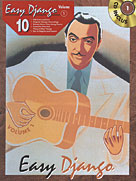
For Guitar TAB with Original and Play-Along Recordings. Django Reinhardt. For Guitar. This edition: Guitar/TAB. Guitar Method or Supplement. Jazz. Book & CD. This amazing compilation is the ultimate way to study the great Django Reinhardt! It includes TAB transcriptions, play-along tracks, and the ORIGINAL Django recordings! Each book contains 10 songs carefully selected for their medium tempos and "easier" chord progressions. Each melody is written out in notation and TAB, and the first full guitar solo is fully transcribed. Learn by listening to the ORIGINAL recordings and then play along with the slowed-down, sound-alike, play-along recordings.


Easy Ojango ou l'ceuvre de Ojango "tout en douceur" ...
Meme si la virtuosite et l'inventivite du maltre sont
quelque peu en contradiction avec le terme "Easy",
ce recueil vous propose de decouvrir ou de redecouvrir
"tout en douceur", dix morceaux de Ojango
qui com portent les enchalnements harmoniques,
les themes et certains chorus de difficulte "facile"
6 "moyenne".
Et pour la premiere fois reunis sur un meme CO,
les enregistrements originaux vous permettront
d'entendre comment cela "doit sonner" et les playback
vous donneront la possibilite de jouer 6
vitesse reduite [vitesse d'execution "sous-tempo" ;
plus lente que le tempo original].
Travaillez en premier lieu l'accompagnement
la fameuse "pompe", pour vous familiariser avec
les accords specifiques au Jazz Manouche. O'abord
sur le playback (plus lent), puis une fois les
positions bien en mains, sur la version originale ...
pour accompagner le maltre.
Ensuite, selon votre niveau, apprenez "6 votre
rythme" les differents themes pour vous chauffer
les doigts, puis travaillez telle ou telle phrase qui
vous plalt en prenant soin de bien comprendre comment
elle s'articule ... avant de passer 6 l'etude des
chorus de Ojango [seuls certains chorus ont ete
retranscrits en fonction de leur accessibilite] et de
travailler votre improvisation (quelques pistes vous
sont donnees en fin de recueil. .. ).
Mais le genie du Grand Manouche etait tel que
chaque phrase, chaque intervention, si courte soitelle,
est devenue un "plan" universel joue par tous
les guitaristes du genre.
Et les travailler en ecoutant le maltre, c'est prendre
un cours avec Ojango lui-meme ...
 
Easy Ojango or Ojango's work "all smooth .....
Even if the master's virtuosity and inventiveness
are somewhat in contradiction to the term
"Easy", this collection offers you to discover
or rediscover, "all smooth", ten of Ojango's pieces
that contain the harmonic connections, the themes
and some choruses of "low" to "medium" difficulty.
And for the first time gathered on one and the
same CO, the original recordings wi11allow you to
hear how it "should sound", and the playbacks wi11
give you the opportunity to play at reduced speed
["under-tempo" execution speed; slower than the original tempo).
Work first on the accompaniment; the famous
"pump", in order to become familiar with the
chords that are specific to Manouche Jazz. First
on the playback (slower), and then, once you have
the feel of the positions, on the original version ... to accompany the master.
Then, according to your level, learn "at your own
pace" the various themes to warm up your fingers,
then work on this or that phrase that you like,
taking care to understand well how it is articulated
... before going on studying Ojango's choruses
[only some choruses have been retranscribed
according to their accessibility] and working on
your improvisation (a few leads are given you at the end of the collection .. .).
But the genius of the Great Manouche was such
that every phrase, every intervention, however
brief it may be, has become a universal "lick"
played by all the guitarists of the genre.
And to work on them while listening to the master,
is like taking a lesson with Ojango himself ...


Songs: Belleville - Blues clair - Daphne - Douce ambiance - Les yeaux noirs (Black Eyes) - Manor de mes reves - Minor Swing - Nuages - Swing 42 - Troublant Bolero

Prezzo: €38,99
€38,99

DJANGO REINHARDT with Original and Play-Along Recordings VOL.2 CD TABLATURE LIBRO SWING GUITARS

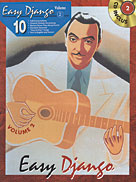
DJANGO REINHARDT, with Original and Play-Along Recordings, VOL.2. CD TABLATURE

Easy Ojango ou l'ceuvre de Ojango "tout en douceur" ... Meme si la virtuosite et l'inventivite du maltre sont
quelque peu en contradiction avec le terme "Easy", ce recueil vous propose de decouvrir ou de redecouvrir
"tout en douceur", dix morceaux de Ojango qui com portent les enchalnements harmoniques,
les themes et certains chorus de difficulte "facile" 6 "moyenne".
Et pour la premiere fois reunis sur un meme CO, les enregistrements originaux vous permettront
d'entendre comment cela "doit sonner" et les playback vous donneront la possibilite de jouer 6
vitesse reduite [vitesse d'execution "sous-tempo" ; plus lente que le tempo original].
Travaillez en premier lieu l'accompagnement la fameuse "pompe", pour vous familiariser avec
les accords specifiques au Jazz Manouche. O'abord sur le playback (plus lent), puis une fois les
positions bien en mains, sur la version originale ... pour accompagner le maltre.
Ensuite, selon votre niveau, apprenez "6 votre rythme" les differents themes pour vous chauffer
les doigts, puis travaillez telle ou telle phrase qui vous plalt en prenant soin de bien comprendre comment
elle s'articule ... avant de passer 6 l'etude des chorus de Ojango [seuls certains chorus ont ete
retranscrits en fonction de leur accessibilite] et de travailler votre improvisation (quelques pistes vous
sont donnees en fin de recueil. .. ). Mais le genie du Grand Manouche etait tel que chaque phrase, chaque intervention, si courte soitelle, est devenue un "plan" universel joue par tous les guitaristes du genre. Et les travailler en ecoutant le maltre, c'est prendre un cours avec Ojango lui-meme ...
 
Easy Ojango or Ojango's work "all smooth ..... Even if the master's virtuosity and inventiveness
are somewhat in contradiction to the term "Easy", this collection offers you to discover
or rediscover, "all smooth", ten of Ojango's pieces that contain the harmonic connections, the themes
and some choruses of "low" to "medium" difficulty.
And for the first time gathered on one and the same CO, the original recordings wi11allow you to
hear how it "should sound", and the playbacks with give you the opportunity to play at reduced speed
["under-tempo" execution speed; slower than the original tempo).
Work first on the accompaniment; the famous "pump", in order to become familiar with the
chords that are specific to Manouche Jazz. First on the playback (slower), and then, once you have
the feel of the positions, on the original version ... to accompany the master.
Then, according to your level, learn "at your own pace" the various themes to warm up your fingers,
then work on this or that phrase that you like, taking care to understand well how it is articulated
... before going on studying Ojango's choruses [only some choruses have been retranscribed
according to their accessibility] and working on your improvisation (a few leads are given you at
the end of the collection .. .). But the genius of the Great Manouche was such
that every phrase, every intervention, however brief it may be, has become a universal "lick"
played by all the guitarists of the genre. And to work on them while listening to the master,
is like taking a lesson with Ojango himself ... 
 
DESCRIPTION
Après le succès du premier volume, voici 10 autres hits du grand maître de la guitare manouche. Toujours accompagné d'un cd playback ET de versions originales.
Titres :
 
- Artillerie lourde
- Dinette
- Mélodie au crépuscule
- Minor Blues
- Stomping at Decca
- Sweet chorus
- Swing 39
- Swing 41
- Swing Guitars
- Tears
Prezzo: €36,99
€36,99

HOT CLUB SESSION BASIC ACOUSTIC SWING JAZZ GUITAR Felix Schell LIBRO CD TABLATURE

HOT CLUB SESSION BASIC ACOUSTIC SWING JAZZ GUITAR. Felix Schell. 7 Pezzi completi, e 5 basi complete, arpeggios, scales, symetrical scales, melodic embellishments. CD TABLATURE

LIBRO DI MUSICA, SPARTITI PER CHITARRA CON CD E TABLATURE.

Product Description:
Finally, a great method which will show you how to play the acoustic jazz guitar in the style of players like Django Reinhardt, Oscar Alleman and Eddie Lang - their style is characterized by a powerful rhythm guitar and a vital swinging single-note solo line. Due to the fact that it can be very hard to master the original transcriptions, this book simplifies this style without losing the essence of the original sound. Written in standard notation and TAB, the material can be played by students and players that master the easy to intermediate level on plectrum style jazz guitar. All titles are included on CD, as well as some play along tracks which offer a great possibility to improvise on typical gypsy chord changes and rhythms.

Format: Book/CD Set

Song Title: Composer/Source:

Arpeggios
Blues of the Gypsys - Felix Schell
Chromatic Line - Felix Schell
Dark Eyes - Felix Schell
Improvisation
Le Reve - Felix Schell
Major & Minor Scales
Melodic Embellishments
Minor Stomp (1) - Felix Schell
Minor Stomp (2) - Felix Schell
One Note Rhythm (1) - Felix Schell
One Note Rhythm (2) - Felix Schell
One Note Rhythm (3) - Felix Schell
Special Effects
Symmetrical Scales
Waltz for Django - Felix Schell

Prezzo: €18,99
€18,99

RANGER DOUG RIDES THE RHYTHM RANGE DVD SWING RHYTHM TABLATURE LEZIONE CHITARRA LIBRO

RANGER DOUG, RIDES THE RHYTHM RANGE. EXPAND YOUR TECHNIQUE ON SWING RHYTHM. 45 Minuti. TABLATURE. DVD

DVD LEZIONE DI MUSICA SWING.

PER CHITARRA.


Series: Guitar
Publisher: Centerstream Publications
Medium: DVD
Artist: Riders in the Sky

Swing rhythm never left, but it's getting harder to find someone to teach it! Noted swing rhythm guitarist Ranger Doug of Riders in the Sky takes you step-by-step through the process of expanding your technique on swing rhythm. Whether you play in a swing band, a cowboy quartet like Riders in the Sky, or gypsy jazz, this DVD offers you an absolutely unique and up-close look at chord forms, patterns, right and left hand technique, and insider tips by a swing rhythm master who has been playing this style for over 30 years. In addition, two western classics, "Wah Hoo" and "Tumbling Tumbleweed", are not only broken down and explained in detail, but are performed by 2-time Grammy winners Riders in the Sky in a mini-concert, so that the lesson on those two tunes is exemplified in live performance. Saddle up, saddle pal, and ride the Rhythm Range with Ranger Doug! Includes transcription booklet.

Prezzo: €26,99
€26,99

REINHARDT DJANGO THE BEST OF GUITAR STYLES AND TECHNIQUES OF A JAZZ GIANT SIGNATURE LICKS CD TABLATURE

REINHARDT DJANGO, THE BEST OF, STYLES AND TECHNIQUES OF A JAZZ GIANT. Ain't Misbehavin' -Belleville -Daphne -Dinah -Djangology -Honeysuckle Rose -Limehouse Blues -Marie -Minor Swing -Nuages -Old Folks At Home (Swanee River) -Rose Room -Stardust -Swing 42 -Swing Guitar -Tiger Rag (Hold That Tiger). CD TABLATURE

LIBRO DI MUSICA PER CHITARRA CON CD E TABLATURE.

The Best of Django Reinhardt A Step-by-Step Breakdown of the Guitar Styles and Techniques of a Jazz Giant
Series: Signature Licks Guitar
Format: Softcover with CD - TAB
Artist: Django Reinhardt
Author: Joe Charupakorn

Explore the groundbreaking style of one of the most unique and influential guitarists in jazz! This book/CD pack explores 16 of his signature tunes: Ain't Misbehavin' - Belleville - Daphne - Dinah - Djangology - Honeysuckle Rose - Limehouse Blues - Marie - Minor Swing - Nuages - Old Folks at Home (Swanee River) - Rose Room - Stardust - Swing 42 - Swing Guitar - Tiger Rag (Hold That Tiger). The CD includes full demos of each.
Inventory #HL 00695660
ISBN: 9780634034312
UPC: 073999549607
Width: 9.0"
Length: 12.0"
96 pages 
 

INTRODUCTION
Just about a half century after his death, Django Reinhardt still remains a towering
figure in the annals of jazz guitar. To this day, his incendiary playing stands up to that
of later virtuoso jazz guitarists such as Joe Pass, Pat Martino, and George Benson. Author
James Lincoln Collier, in his book The Making of Jazz, calls Django "the most important
guitarist in the history of jazz"; when you take into account the hordes of jazz guitarists he
has influenced, he may very well be. His groundbreaking style of playing-marrying
European-influenced scales and harmonies with jazz rhythms-was unheard of during his
time. He was among the first of the European jazz musicians who could cop the jazz feel
correctly, and he left an indelible stamp on the world of jazz guitar. His major influence was
session guitarist Eddie Lang (the first major jazz guitarist). He absorbed Lang's Europeanbased
harmonic concepts and took them one step beyond.
Born Jean Baptise Reinhardt to LaBelle Reinhardt and Jean Vees (his assumed
father) on January 23, 1910 in Liverchees, Belgium near the French border, Django was
raised in true gypsy fashion, travelling around in a caravan and living like a vagabond. He
spent much of his formative years travelling across Europe, eventually settling just outside of Paris.
Django did not attend school and was illiterate-he could neither read nor write.
He did, however, have a passion and a gift for music and eventually received a banjo from
a neighbor named Raclot when he was twelve. He never took formal lessons, but learned
from his father and other musicians in the area, and shortly thereafter began playing with
his father in cafes. By age fourteen he had become a fixture on the Parisian club scene,
and by age eighteen he recorded his first session as a sideman, accompanying an accordion on banjo.
On November 2, 1928, tragedy struck. Django heard some noise and thought it
was a rat scurrying around his wagon. He grabbed a candle, which unexpectedly fell out
of the candleholder and onto a pile of highly flammable artificial flowers that immediately
burst into flames, setting the wagon on fire. Django used a blanket to carry his wife out of
the burning caravan, but his exposed legs and left hand were severely burned. Because
of the severity of the burn, doctors suggested amputating Django's legs, but he vehemently
refused. He would later regain the use of both legs.
His left hand did not have the same good fortune, and his music career appeared
to be doomed. Django was resilient, however, and trudged along, trying to play guitar
again while in the hospital. He eventually regained the use of his thumb, index, and middle
fingers, but never the full use of the ring and pinky fingers. Over a year later, he was
able to play again using his functioning left-hand fingers.
In 1928 Django met Stephane Grapelli, a violinist with whom he would have a
career-long relationship. They were both struggling young musicians trying to make their
way in the jazz scene. In 1933, they finally had the chance to play together in the Quintet
of the Hot Club of France (which also featured Django's brother Joseph on rhythm guitar),
an incarnation of the Hotel Claridge Orchestra. The Ultraphone Record Company gave the
group a record deal in 1934, and their first recording sent shockwaves throughout the
European jazz scene. This spawned a series of group recordings that would elevate the
group's popularity and allow them to play concert halls.
When World War II started, the group was on tour in London. Django and company
retreated to Paris, but Grapelli chose to stay behind in London. As a result of the
German invasion of France, Django became a god in the eyes of the French. He was a national hero who represented a unique and free spirit that stood tall against the repressive, stifling nature of the German invaders.

AIN'T MISBEHAVIN' Words by Andy Razaf
Music by Thomas "Fats" Waller and Harry Brooks
Django Reinhardt's solo on "Ain't Misbehavin' ,"with its motivic and rhythmic development,
is an exemplary model of solo construction. After the opening quote of the theme,
Django weaves through the chord changes with primarily scalar runs based on the D
major scale (D-E-F#-G-A-B-C#). In measure 7 he introduces a triplet motive that is
repeated for three consecutive measures. The motive begins on the root and hammers
and pulls back and forth up a half step. This lick is transposed up a perfect 4th in measure
8 to correspond to the chord change (Bm-Em). In measure 9 the pattern begins on the
9th of the D chord and hammers onto the minor 3rd (Fq), creating a bluesy effect. Notice
how the pattern gets rhythmically displaced in the following measures, starting on beat 3
in measure 7, beat 2 in measure 8, and back to beat 3 in measure 10. This figure is recalled in
measures 39-40.
Another motive is introduced in measure 25, comprised of a note followed by a
higher note, which is bent up a half step. Django leaps from A to E and bends up to Fq,
the bluesy b3rd of the D chord. This is followed by a bend from G# to A, the 5th of the D
chord. Some arpeggiated lines follow in measures 30-32, and in measures 33-36 Django
continues to develop the bending motive, this time starting with a bend from E#to F#, the 3rd of the D chord.
Chromaticism is abundant throughout the solo and used primarily in one of two
ways: as neighbor tones and passing tones. For example, the triplet motive (mentioned
above) in measures 7-9 uses a chromatic upper neighbor trill. In measure 58, chromatic
passing tones fill the gap from A down to F#.Measure 59 has an A# passing tone between
A and B, measure 61 also has an A# passing tone between A and B (this time an octave
lower), and in measure 62 there are chromatic passing tones from A# to ct


Table of contents:

Ain't Misbehavin'
Belleville
Daphne
Dinah
Djangology
Honeysuckle Rose
Limehouse Blues
Marie
Minor Swing
Nuages
Old Folks At Home (Swanee River)
Rose Room
Stardust
Swing 42
Swing Guitar
Tiger Rag (Hold That Tiger)

96 pages

Ain't Misbehavin' - WORDS: RAFAZ - MUSIC: WALLER, BROOKS - 1929
Belleville - DJANGO REINHARTD - 1944
Daphne - DJANGO REINHARDT - 1938
Dinah - WORDS: LEWIS, YOUNG - MUSIC: HARRY AKST - 1925
Djangology - DJANGO REINHARDT, STEPHANE GRAPELLI - 1937
Honeysuckle Rose - WORDS: ANDY RAFAZ - MUSIC: FATS WALLER - 1929
Limehouse Blues - WORDS: FURBER - MUSIC: BRAHAM -
Marie - IRVING BERLIN - 1928
Minor Swing - DJANGO REINHARDT, STEPHANE GRAPELLI - 1938
Nuages – DJANGO REINHARDT, JACQUES LARUE -
Old Folks At Home (Swanee River) - STEPHEN C. FOSTER -
Rose Room – WORDS: HARRY WILLIAMS - MUSIC: ART HICKMAN -
Stardust – WORDS: PARISH – MUSIC: CARMICHAEL - 1928
Swing 42 – DJANGO REINHARDT - 1941
Swing Guitar - DJANGO REINHARDT, STEPHANE GRAPELLI - 1937
Tiger Rag (Hold That Tiger) - WORDS: HARRY DECOSTA - MUSIC: DIXIELAND BAND -

Violin arranged for guitar
 

Prezzo: €25,99
€25,99

REINHARDT DJANGO, THE MUSIC OF Tiger Rag-After You've Gone-Avalon-Swannee River-Charleston-chicago

REINHARDT DJANGO, THE MUSIC OF. The Music of Django Reinhardt. Forty-Four Classic Solos by the Legendary Guitarist with a Complete Analysis by Stan Ayeroff. 272 Pages.

Product Description:
The solos of Django Reinhardt are an endless source of inspiration and amazement for any musician. In this exciting book, the author has compiled precise solo transcriptions (in notation only), as well as a thorough analysis of each. There is also a complete "how to" section that is like a book in itself. This book contains some of Django's best work. It covers a period of 17 years, from Django's first trio and quintet recordings to one of his last bop-influenced sessions, "Live at the Club St. Germain." Multiple versions of many solos are included to show Djangos' musical development over his long career. Studying the music of the master of Gypsy Jazz can help lay a solid foundation for your own sound and style.

Format: Book

Contents:

A Note About Django Reinhardt
Preparation for The Complete Analysis of Django's solos
Symbols and Abbreviations
Scales
Arpeggios
Ornamentation
Chord Substitutions
Chord Progressions
Putting it All Together
Melodic Ideas and Devices
Exercises
Introduction to the Analysis Section

A Complete Analysis of the Solos
Tiger Rag I
After You've Gone I
Tiger Rag II
Avalon I
Swannee River I
Swannee River II
The Sheik of Araby I
Avalon II
Some of These Days
St. Louis Blues I
Limehouse Blues I
After You've Gone II
Limehouse Blues II
Shine
Charleston
Chicago
Hot Lips
Rose Room
Runnin' Wild
The Sheik of Araby II
Limehouse Blues III
Japanese Sandman I
St. Louis Blues II
Baby Won't You Please Come Home I
Baby Won't You Please Come Home II
Farewell Blues
My Melancholy Baby I
Limehouse Blues IV
Japanese Sandman II
My Melancholy Baby II
Tiger Rag III
My Melancholy Baby III
Japanese Sandman III
Limehouse Blues V
A Pretty Girl Is Like a Melody
Margie I
Tiger Rag IV
Dark Eyes I
Improvisation on Tiger Rag V
The World is Waiting for the Sunrise
After You've Gone III
Dark Eyes II
St. Louis Blues III
Darktown Strutter's Ball
Margie II

The Solos
Tiger Rag I
After You've Gone I
Tiger Rag II
Avalon I
Swannee River I
Swannee River II
The Sheik of Araby I
Avalon II
Some of These Days
St. Louis Blues I
Limehouse Blues I
After You've Gone II
Limehouse Blues II
Shine
Charleston
Chicago
Hot Lips
Rose Room
Runnin' Wild
The Sheik of Araby II
Limehouse Blues III
Japanese Sandman I
St. Louis Blues II
Baby Won't You Please Come Home I
Baby Won't You Please Come Home II
Farewell Blues
My Melancholy Baby I
Limehouse Blues IV
Japanese Sandman II
My Melancholy Baby II
Tiger Rag III
My Melancholy Baby III
Japanese Sandman III
Limehouse Blues V
A Pretty Girl is Like a Melody
Margie I
Tiger Rag IV
Dark Eyes I
Improvisation on Tiger Rag V
The World is Waiting for the Sunrise
After You've Gone III
Dark Eyes II
St. Louis Blues III
Darktown Strutter's Ball
Margie II

Discography
Links
Composer Credits
Stan Ayeroff Biography

Prezzo: €33,99
€33,99

L'ESPRIT MANOUCHE GIPSY GUITAR by ROMANE and Derek SEBASTIAN LIBRO CD TABLATURE

L'ESPRIT MANOUCHE. GIPSY GUITAR. ROMANE and Derek SEBASTIAN. Périple au pays de la guitare jazz 

LIBRO DI MUSICA PER CHITARRA CON CD E TABLATURE

336 Pagine, 14 titoli completi di accordi, linee melodiche; arpeggi e scale diminuite, ritmi swing, il voicing e l'armonia, 98 midi files sul CD, partiture complete con contrabbasso di "valse à Django" di Reinhardt, e altri due pezzi. CD TABLATURE

Song Title: Composer/Source:
Arc-En-Ciel Romane
Chassés Croisés Derek Sébastian
Dans Le Regard De Laura Romane
Destinée Romane
Gypsy Fire Romane
Jo's Remake Romane
Manège Romane
Monticello Romane
My Foolish Heart arr. by Romane & Derel Sébastian
Ombre Romane
Pour Trois Pas Romane
Swing For Ninine Romane
Valsa à Patrimonio Romane
Valse à Django Django Reinhardt

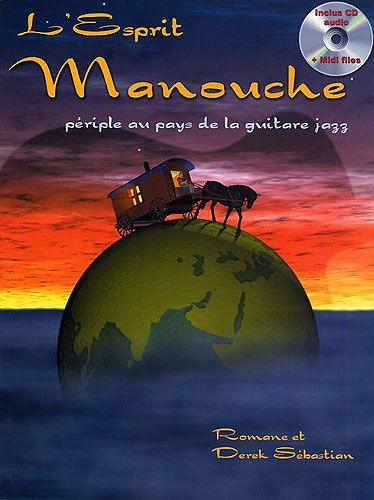
This massive book offers a comprehensive study of the Gypsy jazz or Manouche guitar style as perceived by French guitarists Derek Sebastian and Romane, two of the finest modern day practitioners of the Django Reinhardt style.

Each of the book’s thirty-six progressive chapters consists of four parts: A.) Technique developed through exercises, chord progressions/diagrams, and illustrations of fingerboard positions; B.) A harmony lesson with leads in the Manouche style; C.) Soloing techniques based on the harmonic structure of a given theme; and D.) Self-testing materials with answers provided at the close of the book.

The companion CD for L’Espirit Manouche is unique in that it provides 98 play-along MIDI files that exactly parallel the order of the exercises, examples and pieces in the book as well as audio tracks of excerpts from eighteen Romane favorites from the Gypsy jazz repertoire. The MIDI tracks, which can be accessed via most audio players on PC or Macintosh computers, allow the student to play along with both short phrases and extensive rhythm tracks- at any desired tempo; The audio tracks on the companion disc can be played on any CD player.

L’Espirit Manouche not only makes Gypsy jazz accessible; it offers an opportunity to master the Manouche style. While many exercises and tunes appear in both standard notation and tab, not to mention chord or fretboard diagrams, standard notation is predominant.

LESPRIT MANOUCHE
A Comprehensive study of Gypsy Jazz Guitar

INTRODUCTION
L'Esprit Manouche consists of 36 chapters, containing 6 to 8 pages each. The degree of difficulty . increases progressively. You can expect to finish each chapter in about one to two weeks, depending on your speed of study. Each chapter is divided into three sections.

PART A
In section A you will develop your guitar technique with the aid of exercises, specifie chord progres sions /diagrams and illustrations of fingerboard positions.
Practice these exercises and the melodies for about 30 minutes. Then, while going through each chapter ,put them together with the other exercises given in this book.
This way, rather than doing the same thing 200 times, you get into the habit to put ail your exercises and melodies together, thus ending up with one single melody that can last as long as you want.

PART B
1) Section B1 should, reasonably, take approximately 45 minutes. Here we will study the theory of various chord progressions and how to use these most of the time, such as the Il - V - 1 major and minor progressions, the anatole, etc. In other words, we will study harmony.
While doing this. you should neverforget to learn these chord progressions weil,so that you can develop your own improvisations and compositions. For instance, you can learn many ways how to use various triads, arpeggios and scales with the Vl-Im progression.
With this in mind, 1 strongly suggest that you first record the rhythm guitar track (while using a metronome!) so that you can practice with it. This way you will, ideally, learn to keepgood time.

2) Section B2 should take about 15 to 45 minutes to finish. Here we will include the proper leads, in the style of Manouche, and look at its harmony. This is done with the use of chord diagrams. This section lets you automatically master the indispensable style of Manouche.

PART C
ln the third part, we will practice solos. Here we will put together and apply the actual harmonie structure of a given theme. This will include technical diagrams, note embellishments, typical melodies, speed effects, virtuosity exercises, keeping in time, etc.
The study of this part takes between 1to 4 hours. It will mainly consist of guitar solos taken from the original compositions that you can find on my CDs. These are shown, note-for-note, in the traditional music notation and in tablature. These solos come complete with harmonie symbols that coincide with the improvised melodies.

TEST
ln the last chapter, you are given the opportunity to test yourself by taking a comprehensive test (answers located in the back of the book). Here you can test your newly acquired skills. Wehope that you can correct any hidden mistakes that may appear while playing. Remember it doesn't matter at which level you play, mistakes will always be a handicap. Derek Sebastian and 1 encourage you to study, and wish you great success. 


Arc-En-Ciel Romane
Chassés Croisés Derek Sébastian
Dans Le Regard De Laura Romane
Destinée Romane
Gypsy Fire Romane
Jo's Remake Romane
Manège Romane
Monticello Romane
My Foolish Heart arr. by Romane & Derel Sébastian
Ombre Romane
Pour Trois Pas Romane
Swing For Ninine Romane
Valsa à Patrimonio Romane
Valse à Django Django Reinhardt

Romane and Derek Sebastian have put together a fine collection which is an excellent comprehensive study of gypsy jazz guitar. It is a book to be savored, and enjoyed.
Complete with a play-along CD, the book contains illustrations and photographs. The English translation is by Vincent Michael.

The glossary and introduction are followed by thirty-six chapters that run the gamut of what gypsy jazz guitar is about. The index offers ready reference points.

As a reference book, this is something you may also want to have your local Public Library order for its jazz patrons, and for those interested in jazz guitar.

This is a fine collection, one of the best around. There is much to learn about gypsy jazz guitar, and this is the book to learn it from!

Prezzo: €34,99
€34,99

GYPSY JAZZ JAM FRANK VIGNOLA DVD Besame Mucho-Dark Eyes-Tico Tico-Nuages-Limehouse Blues

GYPSY JAZZ JAM FRANK VIGNOLA DVD

This footage is a backstage look at what Frank Vignola and his friends do best: Jam. Some of the world’s foremost gypsy jazz guitarists let it all hang out on this very special DVD.

01) Warm-Ups 1-3
02) Pent-Up House - Sonny Rollins
03) Besame Mucho - Consuelo Velazquez
04) Exactly Like You - Jimmy McHugh and Dorothy Fields
05) Tico Tico - Zequinha Abreu
06) Czardus
07) Nuages - Django Reinhardt
08) Besame Mucho - Consuelo Velazquez
09) It Don't Mean A Thing Duke - Ellington and Irving Mills
10) Endless Love - Josef Myrow
11) Gypsy Traditional Waltz
12) Limehouse Blues - Philip Braham and Douglas Furber
13) Dark Eyes
14) Credits

Prezzo: €29,00
€29,00
Condividi contenuti