INSIDE THE BLUES

8-BAR BLUES The complete guide for guitar Dave Rubin LIBRO CD TABLATURE boogie-shuffle-jazz-blues progressions

8-BAR BLUES, Inside the Blues Series, Dave Rubin. SHEET MUSIC BOOK with CD & GUITAR TABLATURE .

LIBRO DI MUSICA BLUES, CON CD .

SPARTITI PER CHITARRA , 

ACCORDI, PENTAGRAMMA e TABLATURE .


The complete guide for guitar
Series: Guitar Educational
Softcover with CD - TABLATURE
Author: Dave Rubin

Although the term "12-bar" is usually the first form one thinks of when hearing the word "blues," a surprising number of songs make use of another popular form: the 8-bar. This book/CD pack is solely devoted to providing you with all the technical tools necessary for playing 8-bar blues with authority. Includes: a CD with 45 full-band tracks; a history of the 8-bar blues form; instruction on boogie, shuffle, and jazz-blues progressions, including minor keys; rhythm patterns and solos; and much more. 56 pages


8-BAR BLUES The Complete Guide for GUITAR

By Dave Rubin


Description

8-Bar Blues: A Select History

8-Bar Boogie

8-Bar Shuffle

8-Bar Minor Blues

8-Bar Jazzy Shuffle

8-Bar Slow Jazzy Blues

8-Bar Boogie Solo

8-Bar Shuffle Solo

8-Bar Minor-Blues Solo

8-Bar Minor-Key Solo

8-Bar Jazzy Shuffle Solo

8-Bar Jazzy Slow-Blues Solo

Tuning


INSIDE THE BLUES


8-Bar Blues The Complete Guide for GUITAR.

Though the 12-bar is usually the first form one thinks of when

hearing the word /'blues," a surprising amount of songs make use

of another popular form: the 8-bar. This book and CD package is

solely devoted to providing you with all the technical tools

necessary for playing 8-bar blues with authority.


- CD Includes 44 Full-Band 1racks

- History of the 8-Bar Blues Fonn

- Boogie, Shuffle, and Jazzy Blues Progressions, Including Minor Keys

- Rhythm Patterns and Solos


A Select History
8-BAR BLUES: A SELECT HISTORY

Eight-bar blues became popular in the era of the "classic women blues singers," in the Twenties,
long before 12-bar blues became the norm, in the Thirties. It appears that 8-bar blues existed in the
South years before the first commercial blues recordings and possibly during the formative years of both blues and jazz, in the 1890s. By extension, American popular music, particularly prior to rock 'n' roll in the Fifties, was often based on 8-measure progressions that were arranged into 32-measure song forms.
In a spoken introduction to a live performance of "Sc James Infirmary" at Louis Armstrong's Town
Hall concert in New York City in 1947, jazz trombonist Jack Teagarden referred to the song as the "oldest blues I ever heard." Not coincidentally, it contains an 8-bar progression:
Dm A7 Dm Gm A7

"Gamblers Blues," a song that can be traced back to 1899, seems to be a precedent for "St. James
Infirmary," though the original derivation possibly goes back even further, to old English ballads. Note that measures 1 and 2 contain the I chord (because the chord is minor, it's a i chord, while the A 7 is just a quick V-chord substitution), a common occurrence in many 8-bar blues.
An early recorded 8-bar blues, and a subsequent classic, is Bessie Smith's "Taint Nobody's Bizness
If We Do" from April 1923. The last four measures of the arrangement reflect elements that are not only common to future 8- and 12-bar blues, but jazz as well:

G7
III7
A b 7 I A07 I E b 7 C7
IV7 #Ivo7 17 VI7
F7 B b 7IE b 7 A b 7IE b 7 B b 7II
II7 V7 17 IV7 17 V7


Sylvester Weaver, the first African-American blues guitarist to record with vocalist Sara Martin, in
November 1923, waxed a clever instrumental ditty in April 1927 called "Damfino Stomp" (pronounced
"damn if I know"), which contains several eight-bar verse variations:

Lonnie Johnson, arguably the most influential guitarist of the 20th century, recorded an eight-bar
duet with a pianist in October 1927 named "6/88 Glide":
 

Prezzo: €99,99
€99,99

ROCKIN' THE BLUES-The Best American and British Blues-Rock Guitarists: 1963-1973 CD TABLATURE SPARTITI

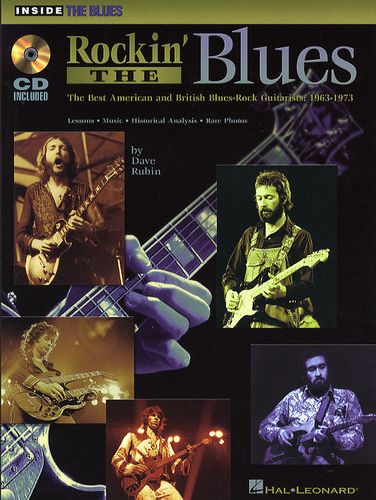
ROCKIN' THE BLUES, The Best American and British Blues-Rock Guitarists: 1963-1973. BOOK WITH CD & GUITAR TABLATURE

LIBRO METODO DI MUSICA BLUES, CON CD. 

SPARTITI PER CHITARRA CON: 

ACCORDI, PENTAGRAMMA, NOTE, TABLATURE. 

METODO, MANUALE, STUDIO, TECNICA. 


Lessons - Music - Historical analysis - rare Photos
Series: Guitar Educational
Softcover with CD - TABLATURE
Author: Dave Rubin

Take a journey inside the blues with Dave Rubin's latest book, Rockin' the Blues: 1963-1973. This seminal 10 years produced some of the most influential blues-rock guitarists of all time. Learn about the lives of these trail-blazing guitarists, their individual styles, accomplishments, and techniques, then play along with the accompanying CD and taste the magic yourself. Each chapter delves into the world of a key blues-rock guitarist from this period, with rare photos, historic insights, interviews, and guitar solos written in standard notation and tablature and performed by a full band on the included audio CD. Explore this exciting time in music history with a book that covers it like no other. Artists covered include: Duane Allman, Jeff Beck, Roy Buchanan, Eric Clapton, Alvin Lee, Keith Richards, Robbie Robertson, and others. 104 pages

ROCKIN' THE BLUES: From the U.S. to the U.K.

The history of the blues is laced with irony. The national tragedy of the transatlantic slave trade begun in the 1600s sought to deprive Africans of their culture, but inadvertently exposed them to European musical traditions and instruments that led to the birth of the blues in the American south circa 1890. Some in the Anglo population had their ears open early on as evidenced by a white man, Arthur Seals, beating W.e. Handy to the distinction by just two months with the first published blues, "Baby Seals' Blues" in 1912. After "Crazy Blues" by Mamie Smith was recorded in 1920 there began a lengthy period of the blues as an integral component in the African-American community until it was superseded by soul music in the early 1960s. Throughout this entire period of time most, though certainly not rdl, white listeners in America applied basically benign neglect to the blues. By the early 1950s, however, white country musicians in the South began incorporating blues licks and phrasing into a new, embryonic form of music as yet unnamed. Often they learned directly from their black neighbors or family employees out in the sticks. Merle Travis, Chet Atkins, and Scotty Moore were some of the earliest and most prominent, with Moore applying his seamless blending of country and blues licks to the music of an ambitious young man in the summer of 1954. The greasy, astoundingly charismatic singer Elvis Presley was joined by Moore and upright, "doghouse" bassist Bill Black at Sun Studios in Memphis, and their revolutionary hybrid of hillbilly boogie and blue would eventually come to be called rockabilly a few years later. In fact, it was the official, if not absolute, beginning of rock 'n' roll as a style of music and as an unprecedented youth movement. Other white cats like Carl Perkins, Jerry Lee Lewis, Dale Hawkins (whose 1957 recording of "Suzie-Q" featured James Burton's seminal blues-rock licks), Roy Orbison, and even Johnny Cash would build on Presley's success. Meanwhile, Chuck Berry was concurrently combining blues with country and western music and swing jazz (by way of jive-talking shuffler Louis Jordan) to create a distinct style that rocked and swung, and his influence on rock is inestimable. In addition, the chugging boogie blues of Jimmy Reed would also exert a considerable effect on both future American and English blues-rockers. It took some time for the I-IV-V progressions of 1950s rock 'n' roll to give way to a new form of rocked up blues in the early 1960s. Roy Buchanan in the Washington, D.e. area, Robbie Robertson in Toronto, and Lonnie Mack in Cincinnati, to name three of the most prominent, began bringing an edge and energy to their version of the blues rarely found outside of black blues guitarists like Lafayette "Thing" Thomas and Auburn "Pat" Hare. Keenly aware of the potential contained in the right combination of axe and amp, they were the sonic pioneers who would fry their vacuum tubes in order to achieve the thick, overloaded sound that would thrill fans and fellow musicians alike. The blues-based San Francisco bands like Big Brother and the Holding Company, Creedence Clearwater Revival, Quicksilver Messenger Service, the Steve Miller Band, and the early Santana band that arose in the mid-1960s (and contributed so much to the music of the counterculture movement in the latter part of the decade) also understood that the "medium (loud, distorted guitars) was the message." Technology played a significant part because as the amps got bigger, so did the sound, and savvy guitarists got hip to the fact that they could riff and solo with the expressiveness and power that had previously been the domain of honking tenor saxophonists. Perhaps no one delivered this powerful, earth-shaking message better than Jimi Hendrix, at once a true hluesman and blues-rock icon. The Allman Brothers Band with dual axemen Duane Allman and Dicky Betts were arguably the most important American group to bring all the elements together in an accessible style also steeped in authentic blues roots. Still at it after thirty-five years, they spawned a new genre known as Southern Rock that was in fact, blues-rock with a Dixie accent. Lynyrd Skynyrd, the Marshall Tucker Band, 38 special


TABLE OF CONTENTS


Introduction

John McVie Interview 

Scales for Blues-Rock Guitar 

Duane Allman

Jeff Beck

Roy Buchanan

Eric Clapton

Rory Gallagher

Billy Gibbons

Peter Green

Bugs Henderson

Alvin Lee

Steve Miller

Jimmy Page

Keith Richards

Robbie Robertson

Mick Taylor

Mick Taylor Interview

Leslie West

Guitar Notation Legend 

Prezzo: €31,99
€31,99

BLUES TURNAROUNDS inside the blues phrases for guitar Dave Rubin and Rusty Zinn BOOK CD TABLATURE

BLUES TURNAROUNDS. Inside the blues. A compendium of patterns & phrases for guitar. 76 tracks. Dave Rubin and Rusty Zinn. SHEET MUSIC BOOK WITH CD AND GUITAR TABLATURE .


LIBRO DI MUSICA BLUES CON CD.

SPARTITI PER CHITARRA : 

ACCORDI, PENTAGRAMMA, TABLATURE .  

CD CON 76 DEMOSTRATION TRACKS,

LIBRO METODO.


Series: Guitar Educational
Softcover with CD - TAB
Author: Dave Rubin
Author: Rusty Zinn

Written by blues expert Dave Rubin and Rusty Zinn, one of the finest young guitarists and singers on the contemporary blues scene, this book/CD pack provides the beginning to advanced blues guitarist with all of the essential turnarounds and so much more! The CD includes 76 demonstration tracks. 40 pages.


The art of The Turnarounds

W.e. Handy, known as the "Father of the Blues" due to his early efforts at promoting the form, published "Memphis Blues" in 1912, a song containing the first written solo, or "jass (zz)" break. A series of 12-bar verses with a 16-bar bridge, the last verse contains an end turnaround resolving to the I chord (see Fig. 1). It appears to be the first hard copy of the descending, diminished blues turnaround pattern (I-I7-Io-iv6-I) that, in the hands of Lonnie Johnson in the late twenties, and particularly Robert Johnson a decade later, would become the template for virtually all subsequent blues turnarounds.


The idea of ending a verse of music on the V (dominant) chord and resolving back to the I chord is suggested in twelve-measure, modal folk tunes from the mid-1500s in England. Music from this period did not have tonality (chord changes); however, the direction of the vocal line and musical accompaniment could be seen to imply changes. Roughly 100 years later music starts to appear with I-V-I implied changes in measures 11 and 12. It would take until the time of the Civil War in the 1860s and just after, however, for 12-bar, I-IV-V blues to take shape, and even longer for resolution to the V chord in measure 12 to become the norm.

Both W.e. Handy and Big Bill Broonzy, among others, have frequently cited "Joe Turner Blues" from the 1890s as the first recognized 12-bar blues. Indeed, it fits the format but does not include a verse or end turnaround. In fact, it would take Handy's "St. Louis Blues" (1914) to contain a i-II7-V-V7 turnaround (see Fig. 2) in the minor key "tango section" that begins, "St. Louis woman, with your diamond ring ... "

Prezzo: €59,99
€59,99

BIRTH OF THE GROOVE R&B SOUL FUNK GUITAR 1945-1965 DAVE RUBIN LIBRO CD TABLATURE Steve Cropper

BIRTH OF THE GROOVE, R&B SOUL AND FUNK GUITAR 1940-1965. DAVE RUBIN. LIBRO CON CD E TABLATURE

LIBRO METODO DI MUSICA R&B, SOUL, FUNK, CON CD

SPARTITI PER CHITARRA CON ACCORDI, PENTAGRAMMA E TABLATURE. 

La musica di Steve Cropper, Curtis Mayfield, Ike Turner, Mickey Baker, Billy Butler, Cornell Dupree, Tiny Grimes, Jerry Jemmott, Johnny Moore, Jimmy Nolen, Clif White, Robert Ward, e tanti altri. CD TABLATURE

Series: Guitar Educational
Softcover with CD - TAB
Arranger: Dave Rubin

The years 1945-1965 saw a radical and exciting shift in American popular music. Blues and swing jazz helped to produce a new musical form called rhythm and blues, which in turn set in motion the development of soul and funk, not to mention rock 'n' roll. What united these genres was an emphasis on the beat, or the groove, over the melody that would culminate in the syncopated monochord workouts of funk. Along the way, some of the greatest electric guitarists of the postwar years explored the boundaries of the new instrument with a rich array of hot licks. This book/CD pack explores everything from the swinging boogie of Tiny Grimes, to the sweaty primal funk of Jimmy Nolen, to the styles of Mickey Baker, Billy Butler, Steve Cropper, Cornell Dupree, Jerry Jemmott, Curtis Mayfield, Ike Turner and everyone in between. Includes in-depth lessons, historical analysis, rare photos, and a CD with 33 full-band tracks. 88 pages.


PREFACE
Thehistory of R&B, soul, and funk guitarists has been largely ignored when compared with that of blues guitarists. However, though they have tended to labor in obscurity in the shadow of vocalists, these unsung heroes have contributed significantly to the legacy of postwar electric guitar.
Inasmuch as the three genres have a far more varied selection of rhythmic and harmonic accompaniments than blues, the innovation and creativity has naturally occurred in the realm of backup, rather than soloing. Exceptions to this statement are to be found in the cerebral and emotional soloing of Billy Butler and Cornell Dupree, to name only the most obvious. It should be of interest to guitarists whose ears are mostly attuned to the sound of single-note lines, though, to understand the art form that Curtis Mayfield, Steve Cropper, and Robert Ward have made from the well-placed fill and chordal pattern.
The years 1945-1965 were chosen because it was the era where the most original advances were
made. That is not to say that great guitar music was not made after that date, only that the initial root source of the blues started to diminish in favor of more commercial influences. Perhaps a Volume II will be in order, particularly in the area of seventies funk.
I hope you will enjoy playing this remarkable music as much as I have, and that the history and biographies provide some sense of acknowledgement for the exceptional artists covered.
Dave Rubin New York City, 1999

DEDICATION
Iwould like to dedicate this book to my daughter, Michelle ("Cookie") and my wife, Cheryl.
Without their love and encouragement, I would "have the blues" more than playing and studying them.

ACKNOWLEDGMENTS
Iam indebted to, Edward Komara, Nick Koukotas, Darrell Bridges, Ira Bolterman, Steve Kirkman,
and all at Hal Leonard Corporation for their invaluable help and suggestions.


TABLE OF CONTENTS

Preface .
Dedication and Acknowledgments .
Introduction .
Scales and Chords for R&B, Soul, and Funk Guitar .
Tiny Grillles .
Johnny Moore .
Mickey Baker .
Ike Turner .
Billy Butler .
Clif White .
Curtis Mayfield .
Cornell Dupree .
Jerry Jemmott .
Steve Cropper .
Robert Ward .
Jimmy Nolen .
About the Author .
Guitar Notation Legend .

Prezzo: €34,99
€34,99

12-BAR BLUES complete guide for guitar-Dave Rubin BOOK CD TABLATURE SPARTITI CHITARRA METODO

12-BAR BLUES. Inside the blues. The complete guide for guitar. La chitarra ritmica blues, all'interno delle 12 battute. Esempi di Boogie woogie, shuffle, swing, riff, jazzy blues, Chicago blues, bebop blues, turnarounds, intros, 1 soloing, tutto sotto una luce "blues". Con 24 jam pronte di D. Rubin. CD TABLATURE


LIBRO METODO DI MUSICA BLUES CON CD. 

SPARTITI PER CHITARRA CON: 

ACCORDI, PENTAGRAMMA, TABLATURE.


Series: Guitar Educational
Softcover with CD - TABLATURE
Author: Dave Rubin

The term "12-bar blues" has become synonymous with blues music and is the basis for an incredible body of jazz, rock 'n' roll, and other forms of popular music. This book/CD pack is solely devoted to providing guitarists with all the technical tools necessary for playing 12-bar blues with authority. The CD includes 24 full-band tracks. Covers: boogie, shuffle, swing, riff, and jazzy blues progressions; Chicago, minor, slow, bebop, and other blues styles; soloing, intros, turnarounds, accompanying keyboards and more. In standard notation and tablature. 64 pages.

nel CD comprese 24 basi complete

Slow 12/8, swinging shuffle, moderate boogie shuffle, chicago riffs blues, slow minor blues, jazzy minor blues, riff blues, boogie woogie blues, jazzy blues, jazzer blues, bebop blues, accompanying kayboards, Turnarounds, intros, soloing over a 12 bar blues. 


INTRODUCTION

The Origin of 12-Bar Blues By Dave Rubin and Edward Komara


The 12-bar blues is a musical building block that can be used to provide moving and exhaustive performances. With an elegant logic unique to the blues genre, the I, IV, and V changes guide the feet and arms from one dance step to another. When words are added and sung, they can acquire from these changes an ironic inflection that can be humorous or sarcastic. With a shuffle beat mimicking the beating of the human heart on adrenaline, the 12-bar progression can become the basis of a self-perpetuating cycle well-suited for vivid narratives or exuberant frolics. The I chord (meas. 1-4) presents the initial melody, and the IV chord (meas. 5-6) resets it with some degree of harmonic tension before the I chord reappears with sweet relief (meas. 7-8). The V chord (meas. 9) breathtakingly caps the momentum and then the turnaround (meas. 11-12) closes the chorus while at the same time preparing for the next installment of twelve bars.


The 12-bar blues as we know it, with three melodic phrases of four measures each and the second phrase starting on the IV chord, has its roots back in England during the time of Henry VIII. There, in the mid 1500s, twelve-measure modal folk tunes with three phrases were reported for the first time. It would be another 150 years or so before this "note per syllable" singing would give

way to figured bass and eventually tonality (chord changes) by way of opera. Example

1, "I Have Been a Foster," is a modal composition typical of the period. Note, however, that though it mostly centers on F, it ends (presciently?) on C, the V chord. If we strictly adhere to the notated key of C, it could also be seen as IV (F) resolving to I (C). Admittedly, this is looking at this example from modal antiquity through the high-resolution tonal lens of the late twentieth century, but the implied motion of either I-V or IV-I is there.

Just across the Irish Sea, from England, Irish fiddlers were developing twelve-measure ditties, also sans harmonic changes, as early as 1620

Prezzo: €26,99
€26,99

ART OF THE SHUFFLE FOR GUITAR Inside the blues Dave Rubin Hal Leonard CD TABLATURE CHITARRA METODO

ART OF THE SHUFFLE FOR GUITAR. Inside the blues. Dave Rubin, Hal Leonard. SHEET MUSIC BOOK WITH CD & GUITAR TABLATURE.

LIBRO METODO DI MUSICA BLUES, CON CD.

SPARTITI PER CHITARRA CON :

ACCORDI, PENTAGRAMMA, TABLATURE.  


An exploration of shuffle, Boogie and Swing rhythms.

Inside the blues. E' proprio vero che l'incisivo accompagnamento ritmico della musica blues uscì dai tasti del pianoforte, e che la chitarra poi imitò soltanto? Questa edizione sulle varie forme ritmiche blues, approfondirà le radici delle vostre conoscenze fino ai torrenti sotterranei della regione del Delta, delle aride pianure rocciose del Texas, della polverosa Kansas City, delle foreste di New Orleans, dell'asfalto e delle pozzanghere di Chicago. CD. TABLATURE

Shuffle
1: A dance step of indefinite Southern African-American origin, perhaps dating from the eighteenth century, in which the feet are moved rhythmically across the floor without being lifted (as in a minstrel show-author).

2: A rhythm derived from the dance step. The term is onomatopoeic, "sh" describing its characteristic smoothness (and especially its sound when played on the snare drum). The alternation of long and short syllables (shuffle, shuffle) evokes its distinguishing rhythm, a subdivision of the beat into uneven triplets, which is more specific than the fundamental swing or boogie woogie rhythm only in that it is usually played legato and at a relaxed tempo.

The term "shuffle," as applied to a type of musical rhythm, appeared around 1917. One of the earliest published songs to use it in its title was "Riverboat Shuffle" by Hoagy Carmichael. Though the recorded version by comet legend Bix Beiderbecke and Wolverines (1924) is both hot and cool, the rhythm is pure 4/4 dixieland. In 1921 a musical revue called "Shuffle Along" was produced with music by Eubie Blake and Noble Sissle. It included, but was not restricted to, the shuffle dance step. However, like the multitude of tunes before the mid~thirties that alluded to a "shuffle," the rhythms on parade were in the style of ragtime, dixieland and the blues. A number of rhythmic strains, including one from the unlikeliest of sources, would need to coalesce to create the true shuffle pattern. To trace this development is to traverse the glorious history of the blues and jazz. From the breakdowns, stomps and hollers of the post~Civil War South to the swinging shuffles of Louis Jordan and Tbone Walker in the forties, the accent has been on the body language of rhythm. Boogie woogie music, with its walking and moving bass lines, undoubtedly provided the driving propulsion behind shuffle rhythms. Though associated almost exclusively with the piano and especially its great solo practitioners, it is generally agreed that guitarists laid the groundwork for this blues-based idiom. The anthropologist and writer, Zora Neale Hurston, described the entertainment in the late 1800s juke joints as thus: "One guitar was enough for a dance. To have two was considered excellent. Where two were playing, one man played the lead and the other seconded him. The first player was "picking" and the second was "framming," that is, playing chords while the lead carried the melody by dexterous finger-work. Sometimes a third player was added, and he played a tom-tom effect on the lower strings." As the century wore on, pianos took the place of guitars in the lumber, mining, railroad and turpentine camps. Though it is conjecture, the practicality of employing one musician versus two or three, plus the sheer increase in volume afforded by pianos in rowdy barrelhouses (as opposed to acoustic guitars), makes sense of this change. There is less ambivalence, though, about the music performed. Quite simply, patrons wanted to hear the same raucous, rolling rhythms, so piano players devised left-hand patterns analogous to rhythm guitar parts while embelli hino and oloing with the right.


Series: Guitar Educational
Softcover with CD - TABLATURE
Author: Dave Rubin

This method book explores shuffle, boogie and swing rhythms for guitar. Includes tab and notation, and covers Delta, country, Chicago, Kansas City, Texas, New Orleans, West Coast, and bebop blues. Also includes audio for demonstration of each style and to jam along with. 64 pages.

Traces the roots of Shuffle, boogie and swing rhythms from the late 1800s to the late 1940s. Delta, country, Chicago, Kansas City, Texas, New Orleans, West Coast, and Bebop Blues styles are explored in-depth with numerous music examples. The accompanying CD demostrates each example with a complete rhythm section, includes rare photos. 

Prezzo: €30,99
€30,99
Condividi contenuti