Italiano
 English
FLAMENCO GUITAR SOLOS Luigi MARRACCINI LIBRO CD TABLATURE CHITARRA
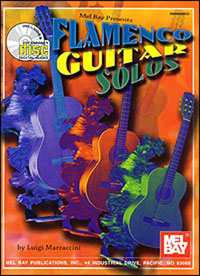
FLAMENCO GUITAR SOLOS. Luigi Marraccini. CD TABLATURE
Product Description:
This book and CD are made for all aficionados of flamenco guitar and for guitarists of any other style who enjoy variety in their musical sources. They present ten pieces composed and recorded in the traditional forms of flamenco music, written in notation and tablature. The author explains the form and characteristics of each piece in introductory notes, helping the player understand the differences between an Alegrías, and a Soleares, or among any of the traditional flamenco forms. The demonstration recording will give players an example of the interpretation of the pieces. These pieces capture the energy, technical prowess, grace, and depth of feeling that give flamenco music its unique magic.
ABOUT THE BOOK
This book and CD are made for all the "aficionados" of flamenco guitar and for the guitarists of·any other style who are searching for different musical sources.
In this book I present you ten pieces of flamenco guitar, which I wrote and recorded with full respect to the traditional forms of flamenco music.
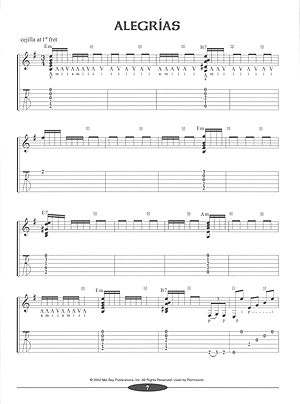
The fIrst song is the Alegrias, which I played in the style of Cordoba, in the key ofE minor. As in all Alegrias, the rhythm is a 3/4 time. Every "Compas" (four measures) has a total of twelve beats, with the accents falling on the 3rd, 6th, 8th, 10th and 12th beat.
The Zapateado, usually played in C major key, has a very happy character. The rhythm is in 4/4 time and alternates between slow and fast passages.
The Seguiriya is of a very dramatic and emotional melodic nature. It is played in A Phrigian mode. The rhythm is an alternation of a 3/4 time measure and a 6/8 time measure.
Fandangos de Huelva, the popular songs from the city of Huelva. The rhythm is in 3/4 time. Mostly played in E Phrigian mode, often switches into A major or C major key.
The Sevillanas is a very popular dance from Seville. It is composed of four different songs, each divided into three different steps (Introducci6n, Salida and Copla). The rhythm (a 3/4 time) and speed are the same for all the four songs, but the key can be changed.
Farruca. The rhythm is of 4/4 and is played in A minor key. It is traditionally danced by a male dancer. It has a particular musical character, alternating slow and sweet melodies with vigorous rhythmical passages.
The Rumba, originally coming from Cuba, has a lively rhythm of 4/4 time. It can be played in any key. I adapted to this style a famous old spanish romance for guitar, which is my favorite and whose composer is unknown. The result of my arrangement is a combination of a beautiful melody with a soft rumba rhythm.
The Guajira, coming from Cuba as well, is played in A major key. As in the Alegrias, Bulerias and Soleares, the rhythm has twelve beats, but the counting starts from the 6th beat.
Bulerias. Written here in 3/8 time, has the same accents as in the Soleares and Alegrias (twelve beats every Compas, with the accents on the 3rd, 6th, 8th, 10th and 12th beat), but is played faster and syncopated. It can be played into different keys. This Bulerias is in D minor, using the A Phrigian mode.
The last song is a Soleares, mostly played in E phrigian mode with a rhythm of 3/4 time. The Soleares is one of the oldest flamenco styles and very profound sentiments are expressed in its melodic nature. Alegrias and Bulerias are originally derived from Soleares and for this reason their rhythmical structure and accents are the same. As the Alegrias, also the Soleares usually ends with a fast "por bulerla" rhythm. Enjoy!
Luigi Marraccini
CONTENTS
Introduction
About the Book
The Cejilla
How to Read Tablature
Fingering Symbols
Alegrias
Zapateado
Seguiriya
Fandangos de Huelva
Sevillanas
Farruca
Rumba
Guajira
Bulerias
Soleares
Format: Book/CD Set
Contents:
Introduction
About the Book
The Cejilla
How to Read Tablature
Fingering Symbols
Alegrías
Zapateado
Seguiriya
Fandangos de Huelva
Sevillanas
Farruca
Rumba
Guajira
Bulerías
Soleares