Italiano
 English
HOWE STEVE, GUITAR PIECES. Mick Barker - CLAP - RAM - MOOD FOR A DAY - SURFACE TENSION
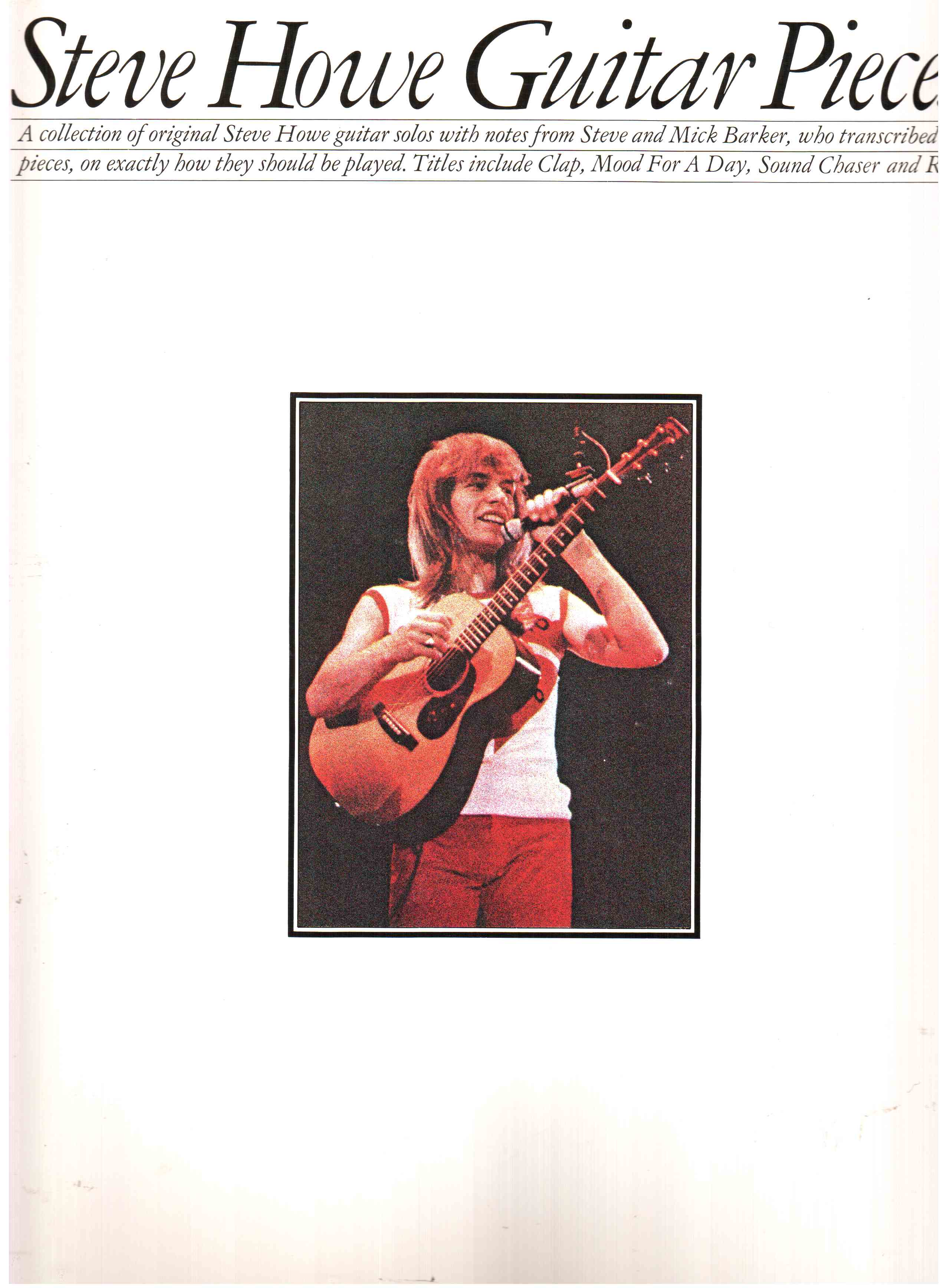
YES, HOWE STEVE, GUITAR PIECES.
Steve Howe
Guitar Piece
A collection of original Steve Howe guitar solos with notes from Steve and Mick Barker, who transcribed the pieces, on exactly how they should be played Titles include: Clap, Mood For A Day, Sound Chaser, Ram, and more.
Steve Howe is internationally recognisedas one of the finest guitarists of our time. His talent is acknowledged byfellow musicians, who listen to his playing with respectand in order to learn. For thefirst time ever, a guitarist of the stature of Steve Howe has published a collection of his own solos and shows exactly how they should beplayed. Long time associate Mick Barker, who has transcribed all of the pieces in this collection, has added notes clarifying technica! points in the pieces. Steve Howe has also included some notes of his own, which give an insight into his attitude towards his music. Titles included are:
Clap
Mood For A Day
The Ancient
Sound ChaserDiarY'Of A Man Who Vanished
Surface Tension
Meadow Rag
Ram
Every guitarist today should have this book in his library. It represents contemporary guitar music at its best and most exciting. Steve Howe originally made his name with res. Since then his interes,tin guitar has widened to coverall its vast possibilities: jazz, country, classical, ragtime. His unique musicianship has placed him in the ore/ron! of his profession, and in the Melody Maker e was votea world's best guitarist twice (for two years) and best overall guitarist in Guitar Player Magazine for 5 years consecutively from 1977-1981.
In doing these transcriptions, I have tried to write them in such a way that even a player who is not familiar with a piece should, after some practice, be able to produce a reasonable facsimile of the original. The pieces are for the most part unaccompanied. Steve plays them as he feels them, laying back on some sections and pushing others. Capturing these variations has led to the use of fairly complex time signatures, but persevere with them, they work! You will find much use made of the tenuto or as it is normally abbreviated 'ten'. For those unfamiliar with the phrase it comes from the Italian and means 'held' or 'sustained'. Thus, notes so marked should be held on for a little longer than their written value. It allows the writer or transcriber to keep the normal time signature, but put the correct 'feeling' into the phrase. I have only resorted to use of the ubiquitous 'cadenza' on two occasions and even then the relative note values are correct and should not present any problems. A lot of the phrases are played in chord positions and the player should let notes ring. This is normal in much guitar music and. I have tied notes over in sections where I felt it was not clear what was intended, but for the most part 'let em ring'. The chord symbols are only to help find the chord shape for a phrase and do not take into account passing notes and other embellishments which must be read from the notation. When notes are doubled on different strings they are marked Thus, the G would be played on the open G string and also the 4th string (5th fret). All numbers refer to strings and not fingering. Clap was the first of Steve's work that I transcribed and I realized just writing it down in notation would not be enough. In many chords the same note sounds on different strings at the same time. Giving positions would be confusing as sometimes the top note of the chord is not played on the top string. This is why I decided to signify which strings notes were sounding on. This not only shows notes sounding twice it also gives you the position. If this is still not clear a good example is in bar 84. Using this method I hope you will be able to find the right shapes for this interesting piece. Ram is played in the 1st (C Major) position except where indicated. The chords marked with an asterisk in the ad lib banjo section were ninths on the original recording but Steve now prefers sharp ninths. In the G Major section where I've cued the bottle neck solo, you can combine the written melody with the chord symbols and play it as a solo. I find it easier to play the first two bars as is and then bring the melody down the octave and play in the 1st position. The pause just before the end is actually 8Y2 beats so to be exactly like the record count eight and kick in to the 5/4 bars. In Mood For A Day the listesso changes between 3/8,12/8 and 3/4 need not create any problems. Just keep your foot tapping and remember that in the 12/8 and 3/8 bars it is three quarters per beat and in the 3/4 and 2/4 bars, two quarters per beat. The bracketed notes about midway through the piece ...