LIBRI DI LIUTERIA

MORE GUITAR SETUP & BASIC MODIFICATIONS, COVERING ELECTRIC & ACOUSTIC, Denny Rauen. DVD

MORE GUITAR SETUP & BASIC MODIFICATIONS, COVERING ELECTRIC & ACOUSTIC, Denny Rauen.

Liutaio personale di Keith Richards (ROLLING STONES), Buddy Guy, Leo Kottke, Roger Glover (DEEP PURPLE) e molti altri. DVD

Series: Instructional/Guitar/DVD
Format: DVD
Author : Denny Rauen

Denny Rauen is a nationally acclaimed master luthier whose clients include many top musicians and collectors from around the world - Keith Richards, Buddy Guy, Leo Kottke, Roger Glover and many others. Located in Milwaukee, Wisconsin, Rauen guitars specialized in the restoration, repair, and modification of new and vintage acoustic and electric guitars, basses, harp-guitars, mandolins and Banjos. In this must-have instructional DVD, Denny personally teaches: 

installing a pickup;

shielding a guitar (taming the single coil hum);

wiring modification (Telecaster);

adjusting the truss rod;

adjusting intonation;

tools of the trade;

tech secrets;

and more.

Includes printable wiring schematics! 1 hr. 57 min.

Prezzo: €31,99
€31,99

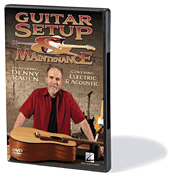
GUITAR SETUP & MAINTENANCE COVERING ELECTRIC & ACOUSTIC. Denny Rauen. DVD

GUITAR SETUP & MAINTENANCE COVERING ELECTRIC & ACOUSTIC. Denny Rauen. DVD

Series: Instructional/Guitar/DVD
Format: DVD
Author : Denny Rauen

Denny Rauen is a nationally acclaimed master luthier whose clientele includes many top musicians and collectors from around the world - including Keith Richards, Buddy Guy, Leo Kottke, Roger Glover and many more. In this must-have instructional DVD, Denny personally teaches: acoustic guitar setup; electric guitar setup; jazz guitar setup; slide guitar setup; Floyd Rose setup; adjusting the truss rod; adjusting intonation; and many trade secrets! 1 hr, 58 min.
Run Time: 1:58:00

Some of Clients of Rauen:

Rob Able - Bassist
David J. Aiello - Bassist
Janet Aiello -Guitarist
Al Anderson - Bassist
Martin Barre - Guitarist, Jethro Tull
Johanne Beauchamp - Guitarist, DJ Lite 97
Jerry Becker - Guitarist
Dan Beimborn - Mandolin
Jeff Benski - Guitarist
Cal Bergendahl - Bassist
DR Berkowitz - Bassist
Ron Berry - Guitarist
Mike Bieser - Bassist, Ale House
Pete Billman - Guitarist
Mai Bloomfield - Cello & Guitarist
Rob Blue - Guitarist
Ken Bohannon - Guitarist
LJ Booth - Guitarist
Henry Brengle - Mandolin
Bill Brenkle - Guitarist
Tom Bukovac - guitarist "the session man"
Larry Burrus - Guitarist
Glen Burtnic - Guitarist - Styx
Bill Camplin - Guitarist
Joey Carini - Guitarist
Paul Cebar - Guitarist - The Milwaukeans
Dylan Chernov - Guitarist
Ellen Clipsham - Celtic violin
Charlie Collins - Guitarist
Skip Collins - Guitarist
Brennan Cornwell - Guitarist
David Cox - Guitarist
Evan Cranley - Bassist - Stars
Anne Curtis - Violin
Steve Cushman - Guitarist
Jeff Dagenhardt - Guitarist
Malachi Delorenzo - Guitarist
Victor Delorenzo - Violent Femmes
Freddie Dobrinski - Guitarist - Heartsfield
Joey Drada - Guitarist
Dave Drake - Guitarist
Randy Dritz - Bassist
Scott Dubois - Guitarist
Al Eck - Guitarist
John England - Guitarist
Duke Erikson - Guitarist - Garbage
Ramie Espinoza- Recording studio, producer, engineer
Maureen & John Finagan - Guitarist
Bradley Fish - Guitarist
Pino Forastiere - Guitarist
Mel Ford - Guitarist
Ken Fought - Guitarist
Mike Fredrickson - Bassist - The Mosleys
Dylan Fuller - Guitarist
Jennifer Geigel - Guitarist
Rob Gjersoe - Jimmy Dale Gilmore, Robbie Fulks
Glen Geremia - Guitarist
Ron Gilbert - Bassist
Roger Glover - Bassist - Deep Purple
Tom Good - Bassist
Joe Goodfich - Bassist
Tim Goss - Bassist, producer
Jack Grassel - Guitarist
Charles Gray - Guitarist
Tom Green - Elvis impersonator
Don Griffen - Guitarist
Mike Gruber - Guitarist
Buddy Guy - Guitarist
Jeff Hale - Guitarist
Royce Hall - Guitarist - The Mosleys
Steve Hall (aka Dane DeForest) - Banjo & autoharp
Marc Halberg - Guitarist
Jeff Hamilton - Guitarist
Kris Hennum - Mandolin
Don Hensiak - Guitarist
Kent Herman - Guitarist
Sean Hulet - Guitarist
Rick Holmes - Bassist
Bruce Illig - Guitarist
Joe Italiano - Guitarist
Mark James - Guitarist
Jeff Jaskowviak - Guitarist
Susan Jeske-Dermody - Frogwater/fiddle
Jimmy Johnson - Blues
Ben Kammin - Guitarist
Lee Kelm - Guitarist
Raymond Kane - Slack key guitar
Kraig Kenning - National Champion Dobro
Bruce King - Mandolin
Jason Klagstad - Guitarist
Patricia King - Guitarist
Steve Kleiber - Bassist
Steve Klimczak - Acoustic instruments
Greg Koch - Guitarist
Brian Kopper - Guitarist
Ken Kottke - Bassist
Leo Kottke - Guitarist
Sarah Kozar - Riverwest Accordion Club
Paul Kucharski - Guitarist
Dejan Kralj - Bassist - The Gufs
Cheryl Kuharpt - Guitarist
Gene Liccardi - Guitarist
Don Linke - Guitarist
Ken Lonquest - Guitarist
Jim Lorino - Bassist
Pat Love - Bassist
Pat MacDonald - Bassist
Ken MacDonnell - Bassist
Janet Macklin - Guitarist
James Madsen -Guitarist
Phil Maggini - Shadowfax
Luis Maldonado - Guitarist
Pete Markowski - Mandolin, Western swing
Monica Marshall - Guitarist
Warren Mazza - Guitarist
Hans Mayer - Singer/songwriter
Jim McClellan - Rock 'n Roll hack
Andy McKee - Guitarist
melaniejane - Guitarist
Tony Menzer - Bassist, booking agent
Amy Millan - Guitarist - Stars
Bryan Mir - Bassist
John Moss - Guitarist
David Moynihan - Mandolin
Ryan Mueller - Guitarist
Don Mulder - Guitarist
Peter Mulvey - Singer/Songwriter
Kurt Neumann - Guitaris - The BoDeans
John Nicholson - Guitarist
Jonathan Noyce - Bassist - Jethro Tull
Colin O' Brien - Guitarist
Brian O'Conner - Guitarist
Bob Ockenden - Guitarist
Jim Olschmidt - Guitarist
Jon Olson - Guitarist
Thomas Pechota - Guitarist
Todd Petrowski - Bassist - Buzzhorns
Peter Pivonka - Guitarist
Robert Preston - Guitarist
Rob Poland - Candy Rat Records
Willy Porter - Singer/Songwriter
Chaska Potter - Guitarist
Keith Pulvermacher - Guitarist
Rodney Ramos - Bassist
Joe Rauen - Bass
Josh Rauen - Guitarist
Scott Reed - Guitarist
Lil Rev - Old time/Acoustic instruments/Frogwater
Keith Richards - Rolling Stones
John Richey - Fiddle Player
Kristian Riley - Guitarist - Citizen King
Brian Ritchie - Bassist - Violent Femmes
Tom Robinson - Guitarist
Peter Roller - Ethnomusicologist, Blues & Fingerstyle
Meredith Root - Banjo
Martin Jack Rosenblum - Harley poet, Guitarist
Don Ross - Guitarist
Amelia Royko - Guitarist
Julie Roys - Guitarist
Paul Ruppa - Milwaukee Mandolin Orchestra
David Rutherford - Guitarist
Greg Rzab - Bassist - Jimmy Page, Buddy Guy, Black Crows
Noel Sabine - Mandolin/guitar
Matt Schroeder - Guitarist
Tom Schwark - Mandolin
Dan Schwartz - Guitarist
Scott Sharrard - Guitarist
Tom Sharrard - Guitarist
Paul Silbergleit - Guitarist
Brett Simons - Bassist, Brian Wilson
Joe Sinopoli - Mandolin
Annalee Skully - Guitarist
Dan Small - Guitarist/Outdoor Wisconsin
John Smith - Guitarist
Ean Spanic - Guitarist - The Spanic Boys
Carl Staling - Guitarist
Michael Standal - Guitarist
Brook St. James - Guitarist
Bill Stone - Guitarist
Dave Stone - Guitarist
Mike Struck - Guitarist
Rick Stubbs - Composer
Bruce Springsteen and The E Street Band
John Stropes - American fingerstyle, instructor
Paul Tadder - Guitarist
Kirk Tatnall - Guitarist
Harvey Taylor - Singer/songwriter, poet
Paul Terrien - Guitarist
Frank Tisonis - Guitarist
Bret Teuvson - Bassist
John Tyler - Guitarist
Ken Vallow - Guitarist
Dave Vartanian - Engineer, recording studio
Terry Vitone - Guitarist, songwriter
John Waldron - Bassist - Spirit Creek
Keith Watling - Guitarist
Jim Waller - Banjo/guitar
Tony Walzak - Guitarist
Mark Watson - Singer/songwriter
Michael Wegner - Bassist
Sandy Weisto - Guitarist
Dean Werner - Guitarist
Brad Whitford - Aerosmith
Ben Woolman - Guitarist
Joe Wilke - Guitarist
Jim Williams - Bassist - Crossfire
Paul WIlliams - Guitarist
Jimmy Wybel - Guitarist - Bob Wills, Barney Kessel

Prezzo: €31,99
€31,99

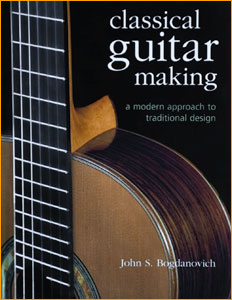
BOGDANOVICH JOHN-CLASSICAL GUITAR MAKING-A MODERN APPROACH TO TRADITIONAL DESIGN

JOHN BOGDANOVICH, CLASSICAL GUITAR MAKING: A MODERN APPROACH TO TRADITIONAL DESIGN.

LIBRO DI LIUTERIA PER COSTRUIRE UNA CHITARRA CLASSICA. 

GUITAR BUILDING USES a combination of many talents and skills, including an eye for aesthetics, an ear for musical tone, woodworking ability, and an organized and methodical approach to the work. With diligence and practice, many of these assets can be developed and honed. Each of us also brings to this endeavor our own set of skills and experience. My own experience prior to building guitars proved to be a valuable asset in the pursuit of building the ultimate guitar. Initially, it was not my intention to make guitar building a career. Having returned to playing after an extended break, I was in need of a guitar but could not afford to purchase one that suited me, so I decided to try to build one myself. That first guitar turned out well and attracted a couple of local musicians to contract instruments from me. Guitar making felt so right that I put aside all other pursuits and earnestly began to make guitars professionally. A quest for purpose had ended and a new journey had begun. Before making guitars, there were a number of things that I felt passionate enough about to pursue, yet there would always seem to come a point where I would hit a wall and could go no further. Music became a big part of my life at the age of ten, and at twelve I took up the guitar. After high school, I majored in music at what is now part of The College of Staten Island. During this time, I was introduced to classical guitar and studied with Julio Prol in New York City. My intent was to become a performer, though I had difficulty performing in front of an audience. After having a few terrible experiences on stage, I realized that I needed to find something else to do, so I decided to follow another passion of mine, woodworking. As an apprentice cabinetmaker in a New York cabinet shop, I received a great woodworking education at the hands of a small group of old-world European craftsmen. Once my apprenticeship was completed, I decided go back to college rather than continue as a journeyman. I enrolled in the electrical engineering program at Pratt Institute in Brooklyn, New York. AT &T Bell Laboratories recruited me off-campus in my senior year to work in their research and development facility in Holmdel, New Jersey, where I was employed as a hardware designer. Taking part in their one-year on-campus graduate school program, I was able to get my master's ...

Recently I was informed by the publisher that the book has gone into second print, and this is rare for a book of this type. So thank you all once again for helping to make this book a resounding success. It is truly gratifying that I continue to hear from readers all over the world with thank you notes, encouraging comments and questions regarding the book. And, as one reader suggested I have included a page on the site with a selection of questions that have been sent to me, along with my replies, which may help to clarify some things for others in their guitar building attempts.

Since the book has been out I have heard from many of you that have sited errors or needed clarification in the first edition. These errors have been noted along with some additional text here and there for clarification and sent to the publisher for correction in the second printing. a PDF document containing all known errors can be downloaded in the errata section.
 The book has been out for a couple of years now and it still amazes me how many of you out there are interested in building classical guitars, either for yourselves or in launching a guitar building career. The book has enabled me to launch a few new endeavors of my own such as holding classes in the shop, a line of guitar building products, and a DVD series due to be released in the fall. I am very fortunate that this has all come from my love of the classical guitar. The truth is, I never intended to write a book at all. The project just sort of fell into my lap.
 In December, in the midst of planning to move the shop to Asheville, I was approached by Sterling Publishing and asked if I would like to write a book on guitar making. As I thought about it the prospect of undertaking such a huge project the challenge of producing something that I would be proud of became the focus of my enthusiasm. I had been given a rare opportunity - a vehicle to share my techniques and thoughts about something I love.
For the next year, nearly every day was a combination of building guitars, writing, and photo shoots. The book chronicles the building of a classical guitar from a stack of boards to putting on the strings and tuning it up. WIth almost 600 photos and drawings and over 300 pages of detailed text I attempted to recreate as accurately as possible the building process.
 If you have never built a guitar and are planning your first attempt consider using this book as a guide. Only some basic woodworking skills and a minimally equipped shop are required. Due to the large amount of information necessary to cover the topic explanations of woodworking related techniques have been omitted and it is assumed the reader is already proficient in some basic woodworking techniques, or will consult the references listed in the bibliography of the book and in the reference section of the links page on this site. Alternative methods are presented to facilitate the availability of tools and equipment. The book was written with the first time builder in mind, but no doubt anyone with some building experience could benefit from some content, I know I am always looking for better ways to do things. Also, be sure to check out the guitar making classes being offered. Classes are being held in the shop that cover various aspects of the building process.
 The guitar I am building in my shop today is very loosely based on the Hauser/Torres guitar design. The design has evolved in search of improved sound and playability. The plantilla is all that remains of the original 1937 Hauser from which this design began.
 The sound of Segovia's 1937 Hauser always appealed to me, even with the less than ideal sound quality of the old recordings. Therefore, when I began making guitars I started trying to reproduce this sound with the Hauser/Torres design. The more conscious I became of the sound of the guitar in general, the more open I became to other influences and my concept for the ideal sound began to evolve and my design began to change. The design of my guitars has changed slowly over the years.
 It is difficult at best to describe sound with words due to the fact that sound, and language, are both so subjective. So I will limit my words to those I typically hear other people use to describe the sound of my instruments. The phrase I hear most often is that they have a traditionally Spanish sound. I would not disagree with this statement. Additionally, they have character, a full tonal palette, and power. Enough said, I invite you to come and listen to one yourself.

Life as A luthier has been made possible for me only with the help of many people. First and foremost, I would like to thank my parents, Marion and Stan, for always supporting me, even when they may not have agreed with me. Without their support, none of this would have been possible. When I was a small boy, I had asked for a carpentry tool set long before it would be appropriate or safe for a child to play with. I was so insistent that my parents finally caved in and bought me one. While I was playing with the tools, set up under a tree in my grandparents' backyard, my grandfather watched from a window. Impressed with how intently I was able to amuse myself for such a long period of time, he told my mother, "That boy is going to do something with his hands." The time I spent in the Fine Woodworking Program at the College of the Redwoods actually changed my life. I was fortunate to have made some lifelong friends while at the school and will be forever indebted to the outstanding faculty. I would like to thank James Krenov, Jim Budlong, Michael Burns, and David Welter for their guidance, skill, and friendship, and for putting up with me during my time there. I would like to especially acknowledge James Krenov, whose book A Cabinetmaker's Notebook inspired me long ago, only to be eclipsed by later studying with him at the school. As one of his students, I could not help but admire his aesthetic, his approach to the craft, his keen observation of nature around him, and how all of this is evident in his work. I can only hope to follow his example. And thank you,]im, for your friendship. There are a few guitar builders who have both inspired and helped me in my journey as a luthier. I would like to thank Jeff Elliott, Cindy Burton, Greg Byers, John Gilbert, and Charles Fox for their generosity in sharing their knowledge of guitar building, and for their friendship. I would also like to thank the many guitarists who have provided feedback, which is invaluable to making a better instrument. In putting together this book, I called upon a few people to assist in one way or another. I would like to thank Cindy Park for all her help and support. She has helped with this project in more ways than she is probably aware of. I would like to thank Mariah Grant for doing a great job on the bulk of the photography. I would also like to thank Larry White at the University of North Carolina at Asheville for recommending her. In addition, I would like to thank Lacey Haslam and Franzi Charen for their help with the photography. And I would like to thank all the folks at Iris Photo/Graphic for keeping everything straight.  

Contents

Acknowledgments

Foreword by James Krenov

Foreword by Jeffrey Van

Preface

Introduction

PART ONE—Preparation


CHAPTER 1. The Guitar

Anatomy of the Guitar

Sound

Choosing to Build or Buy


CHAPTER 2. The Wood

Types of Wood

Moisture Content

Cuts, Grain, and Selection


CHAPTER 3. The Shop

What You Need in Your Shop

Jigs You Will Need to Make

Hand Tools

Vises and Clamps

Bench Tools to Make

Specialty Items

Humidity Control


CHAPTER 4.

Templates and Molds

The Plantilla

A Transparent Template

Side Mold

Lining Mold

The Solera

Headpiece Template and Drilling Jig

Back Workboard


CHAPTER 5.

Layout and Planning

Choosing the Color and Design Scheme

Materials and Parts

Plans and Layout


PART TWO—Construction


CHAPTER 6. The Neck

The Neck Blank

The Headpiece

The Heel


CHAPTER 7. The Sides

Bending and Laminating the Sides

Linings

Assembling the Neck and Sides

CHAPTER 8. The Details

Bindings, Purflings, Back and Butt Strips

The Wheat Motif


CHAPTER 9. The Top

Selecting a Top 162

Jointing and Thicknessing

The Rosette

Bracing and Patches

CHAPTER 10. The Back

Jointing and Thicknessing

Bracing


CHAPTER 11.

Assembling the Body

Before Gluing on the Top

Gluing the Top

Preparing to Glue on the Back

Bindings and Purflings

Heel Cap and Butt Strip


CHAPTER 12.

The Fingerboard

Making and Installing the Fingerboard

Before Fretting

Fretting

Shaping the Neck


PART THREE—Final Touches


CHAPTER 13. Finishing

Understanding Finish

Final Touches and Prepping for

Finishing

French Polishing

Lacquering


CHAPTER 14. The Bridge

Bridge Design

Building the Bridge

Installing the Bridge


CHAPTER 15. The Setup

The Nut, Saddle, and Tuning Machines

Strings and Final Setup

Care of Your Guitar

The Gallery

Bibliography

Metric Equivalents

Index    

Prezzo: €99,99
€99,99

RAMIREZ JOSÉ III PARLANDO DI CHITARRE In italiano CHITARRA DIECI CORDE VERNICE GOMMA LACCA

RAMIREZ JOSÉ III, PARLANDO DI CHITARRE. LIBRO In italiano.

LIBRO DI LIUTERIA, SCRITTO DAL PIU' FAMOSO COSTRUTTORE DI CHITARRE CLASSICHE IN SPAGNA.

222 PAGINE. IN ITALIANO

"Questo libro non è niente altro che la raccolta di tutti i miei scritti degli ultimi anni, che nella maggior parte dei casi sono stati il frutto di richieste diverse provenienti a volte da riviste specializzate di differenti paesi, a volte dagli stessi autori di libri sulla chitarra o addirittura in alcuni casi, sono serviti a rettificare tesi universitarie. Così sebbene scrivere non sia uno sport per il quale mi senta particolarmente portato, ho sempre cercato di compiere, come ho potuto quello che considero un dovere, soprattutto se si pensa alla grande ignoranza sull'argomento e le conseguenze che questo può avere sul buon trattamento dello strumento, sulla sua conservazione, sulla sua storia passata e presente e sullo stesso valore ultimo."

(José Ramirez III)

Dedicato a Angelita.

Questo piccolo libro non è niente altro che la raccolta di tutti i miei scritti
degli ultimi anni, che nella maggior parte dei casi sono stati il frutto di richieste
diverse provenienti a volte da riviste specializzate di differenti paesi, a volte
invece dagli stessi autori di libri sulla chitarra o addirittura in alcuni casi, sono
serviti a rettificare tesi universitarie. Così sebbene scrivere non sia uno sport per il
quale mi senta particolarmente portato, ho sempre cercato di compiere, come ho
potuto, quello che considero un dovere, soprattutto se si pensa alla grande
ignoranza sull'argomento e le conseguenze che questo può avere sul buon
trattamento dello strumento, sulla sua conservazione, sulla sua storia passata e
presente e sullo stesso valore di quest'ultimo.
Ho spesso sentito una sana invidia per l'abbondante letteratura che esiste
sugli strumenti ad arco, specialmente sul violino, dato che diversi liutai, col
trascorrere degli anni, hanno lasciato scritte le loro esperienze o si sono
preoccupati di informare fedelmente scrittori specializzati sul tema, e questo
mediante inventari, certificati di autenticità, valutazioni, ossia tutta una serie di
documentazioni sulle quali è possibile studiare seriamente. Per disgrazia la
chitarra è quasi completamente orfana di tutto ciò. Non vi sono praticamente
opere che trattino della sua costruzione e riparazione, dato che se ne esistessero le
conoscerei sicuramente, quindi sebbene questo libro sia più che altro diretto al
suo trattamento ed alla sua conservazione, ho la speranza che sia l'inizio di una
più ampia trattatistica simile a quella già esistente sul violino. I libri editi fino ad
ora sulla chitarra, si riferiscono più che altro a collezioni, a volte ne narrano la
storia, tra l'altro in maniera piuttosto inesatta, e solo di rado ne affrontano il tema
delle riparazioni, in questi casi si tratta dello sforzo, degno di lode, di un qualche
appassionato che vi si è dedicato nel tentativo di fare ciò che io stesso pretendo in
questa occasione.
Approfitterò dell'occasione a me offerta dalla pubblicazione di questi
scritti, per smentire alcuni degli sgradevoli pettegolezzi che· corrono per il mondo
sulla mia persona, come per esempio quello che non mi trovi più nel mondo dei
vivi. Molto bene allora sono un fantasma che scrive senza troppe difficoltà.
Do quindi testimonianza, in queste righe, della mia esistenza, oggi.
quattordici novembre dell'anno di grazia 1990, a sessantotto anni di età.
 
La Bionda e la mora.
Ramirez III espone il suo sapere in legni per chitarra, la Cedrela Odorata del centroamerica, perché preferisce la "mora" del cedro rosso del pacifico, con le sue marcate linee di crescita regolari, che vibreranno insieme alle corde, alla bioda europea Picea Abies. Il palissandro chiamato dagli inglesi Rosewood; la Jacaranda del Brasile, il Cocobolo. L'ebano.
La sega radiale e l'angolo di taglio del tronco.  
Il suo grande rammiaro quando in Giappone per scoprire i suoi segreti segarono a metà una sua riuscita chitarra da concerto. 
L'importanza dell'umidità dell'aria.
I facsimile delle lettere di Tarrega, Segovia dall'Hotel Steigenberger di Frankoforte, Yepes, 
Numerose fotografie delle varie fasi di costruzione 
Il differente action tra le corde altre e le basse.  
Il diapason della chitarra di Stradivaro 740mm. del museo di Oxford !
Ci racconta come dopo aver visto una Viola d'amore (che vedete nella fotografia) a Ramirez viene l'idea di costruire una chitarra con altre corde all'interno della cassa armonica che scorrono internamente al manico vuoto, e suonano per simpatia, ma Segovia non è soddisfatto perché confondono la melodia, così José pensa di costruire un pedale simile a quello del pianoforte per smorzare suoni non voluti, allora Narsiso Yepes gli telefona e gli dice che ha studiato la cosa e che deve solo aggiungere 4 corde basse accordate in: DO, LA#, SOL#, FA# (C, A#, G#, F#), e avrà lo stesso effetto di risonanza, mentre le corde si interrompono appongiandoci semplicemente la mano, evitando macchinazioni pedalistiche. Poi ci fu la grande prova, stando lontano Ramirez pensava che Yepes come Segovia gli inveisse violentemente contro, invece gli disse "in che stupendo pasticcio mi hai cacciato !",  così naque la chitarra a 10 corde che accompagnò da 1964 in poi tutte le incisioni e i concerti di Yepes. 
La chitarra da camera o meglio con camera è uno strumento che ha all'interno della cassa armonica una piccola stanza interna che la divide in un "bilocale" uguale, per fare musica da camera. Questo per eliminare le note "lupo", dopo averle individuate spargendo limature di ferro sulla tavola armonica.  
Il volume di aria della cassa armonica, 
Il cipresso della chitarra Flamenca, e suoi voluti ronzii dell'action bassa, Sabicas.
Il trucco per evitare lo screpolarsi della tavola a fianco la tastiera, per la diversità di dilatamento. 
Il sistema dei listelli a ventaglio 
La vernice a gomma lacca all'alcool, grassa, copale, dammar, mastice, sandracca, ambra. olio essenziale, acqua di vetro, chiara d'uovo, Urea, a pennello, tampone, aria compressa, 14 mani di vernice.  
la pulizia delle meccaniche 
le grandi mani di Segovia, la chitarra deve suonare come "un'orchestra lontana", mentre "Questa chitarra è acuta e stridula come una signorina isterica ! "
La Hauser con i suoi bassi profondi e pieni di sfumature, gli acuti potenti e duraturi. Fu la chitarra di Segovia pr ben 25 anni, dalla metà del 1934-37.
La Hauser e la Fleta: Classiche, potenti, gravi, bassi profondi.

SCEGLIERE UNA CHITARRA
Sebbene la chitarra abbia raggiunto un livello praticamente omogeneo
sotto il punto di vista della potenza e della qualità sonora (parlando però sempre
di quelle di alto livello), esistono delle differenze di sfumature, che le faranno
sempre distinguere le une dalle altre, dovuto soprattutto alla struttura del legno,
dato che non esiste un legno che sia uguale ad un altro. I cerchi di crescita
circolari impediscono che le tavole che devono formare la tavola ed il fondo siano
uguali, sebbene siano state ricavate dallo stesso tronco, se non addirittura dello
stesso tavolone, e questo pur cercando in ogni modo di ottenere lo stesso taglio
mediante la sega radiale.
A questo si somma l'infinita varietà di relazioni che ci possono essere tra
le due parti della cassa della chitarra, ossia la tavola ed il fondo, ognuna con le
proprie caratteristiche.
Bisogna anche considerare i differenti diapason o le differenti lunghezze
delle corde, che le chitarre possono avere, oltre che la chiara influenza sul suono o
la varietà di strutture interne che ogni liutaio "inventa", facendo proprio il detto:
"Ogni sacrestia ha la propria liturgia".
Come conseguenza di tutto ciò, si produce una grande varietà di timbri e di
sfumature nel suono che fanno sì, che ogni chitarra abbia una propria "personalità"
differente da quella delle altre. Vi sono chitarre il cui suono è grave e profondo, ed
altre che invece lo hanno alto e brillante, e tra questi due punti la gamma è piuttosto
vasta. La stessa cosa avviene con le chitarre che emettono il suono facilmente e che
da vicino sembrano essere molto potenti, mentre invece questo diminuisce a
distanza e al contrario altre che sembrano avere un suono meno attraente, hanno
una proiezione sonora relativamente grande. Oppure vi sono chitarre che
prolungano a lungo il suono delle note acute, facilitando cosÌ l'espressività della
voce di colui che canta, ed altre che, invece, possiedono dei bassi profondi e potenti,
e che arricchiscono cosÌ gli accordi. Infine vi sono chitarre che hanno una grande
ricchezza di armonie e che producono un suono estremamente bello, ma con
l'inconveniente di confondere alquanto il discorso musicale.
Vorrei però sottolineare, che i suoni sopra descritti, sono molto rari; con
questo non voglio dire che non si possano produrre in una qualche chitarra, ma ....
 

Yepes tuning F#G#A#CEADgbe for 10-strings Classical guitar (65-66 cm scale)


INDICE

PREFAZIONE

IL CEDRO ROSSO (THUJA PLICATA)

IL PALISSANDRO

LA CHITARRA E IL LABORATORIO ARTIGIANALE TRADIZIONALE

RONZIO DELLE CORDE (STRING BUZZ)

UMIDITA' E SECCHEZZA

LA SUDDIVISIONE DELLA TASTIERA

UNA DINASTIA DI COSTRUTTORI DI CHITARRE RAMIREZ

LA CHITARRA A DIECI CORDE

LA CHITARRA DA CAMERA

LA LUNGHEZZA DELLA CORDA (DIAPASON) NELLE CHITARRE

LA REGOLAZIONE DELL'ALTEZZA DELLE CORDE SUI TASTI ACTION

LA CHITARRA FLAMENCA

CATENE E RAGGIERE

LA VERNICE

LE MECCANICHE

MANUEL RAMIREZ

A. S.. LA CHITARRA EDID

LE MODE E QUALCOSA DE PIÙ SULLE VERNICE

SCEGLIERE UNA CHITARRA

DISCEPOLI  


Prezzo: €34,99
€34,99

THE ELECTRIC GUITAR HANDBOOK A Complete Course in Modern Technique and Styles. Rod Fogg. 256 pagine. CD

THE ELECTRIC GUITAR HANDBOOK A Complete Course in Modern Technique and Styles. Rod Fogg. 256 pagine. CD

Medium: Hardcover with CD
Author: Rod Fogg

Backbeat's successful Handbook format applied to the world's most popular instrument.

The Electric Guitar Handbook is the latest entry in Backbeat's best-selling handbook series, combining a two-part book and an audio CD in a practical lay-flat binding for ease of reference when playing.

Part one of the book examines how different types of electric guitars are made, and why varying construction methods influence the way guitars sound. It also looks at the role of various pieces of guitar hardware, including pick-ups, tremolo set-ups, and bridges.

Part two is a comprehensive, user-friendly course in playing the electric guitar, from the basics of posture and hand positioning to music and tab reading and advanced performance. Newly written exercises - presented in the book and also on the accompanying CD - take the learner through each step in the process, covering styles including rock, country, blues, soul/funk, indie/alternative, and metal. Author Rod Fogg also offers practical advice on everything from simple scales to complex chords, alongside short features introducing key performers and styles. 256 pages

Prezzo: €32,99
€32,99

LUTHIERS GLOSSARY SIMINOFF'S Roger Siminoff 206 pagine LIBRO LIUTERIA CHITARRA

LUTHIERS GLOSSARY SIMINOFF'S, Roger Siminoff. 206 pagine.

LIBRO CON SPIEGAZIONE DI OLTRE 800 TERMINI CHE RIGUARDANO LA LIUTERIA.


SIMINOFF'S LUTHIERS GLOSSARY
First Edition
Series: Book
Publisher: Hal Leonard
Medium: Softcover
Author: Roger Siminoff

Siminoff's Luthier Glossary is a first-edition compendium of more than 800 technical terms used in the design, construction, and production of string musical instruments. The handy softcover text is intended for all levels of builders from beginners to advanced, and features descriptions of parts, techniques, tools, adhesives, finishes, machinery, woods, stains, acoustics, and legal terms.

The Appendix includes numerous valuable data tables along with two dozen color plates to help recognize the tonewoods and decorative woods used in luthierie. 206 pages

Prezzo: €34,99
€34,99

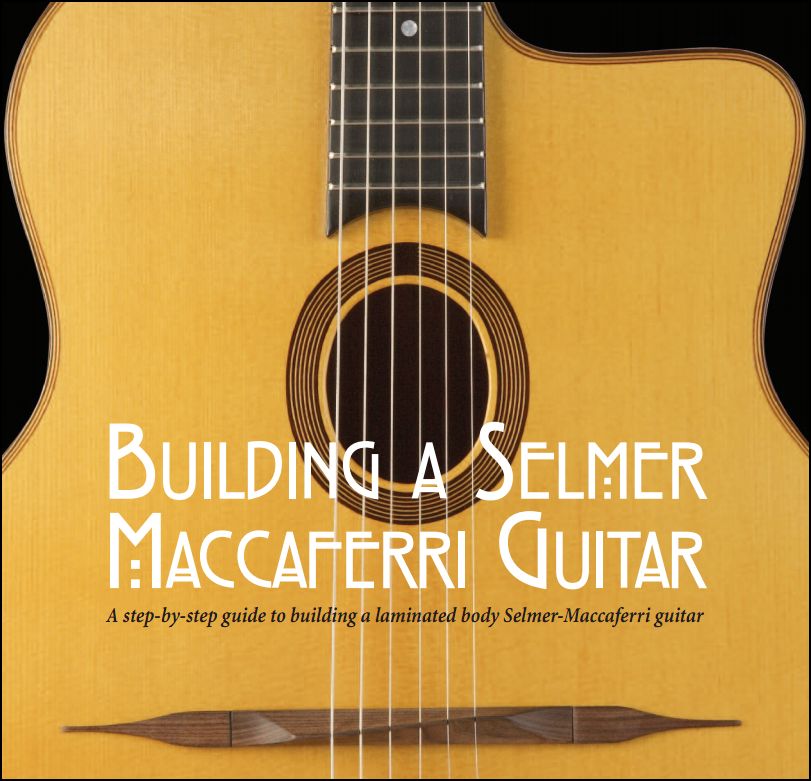
BUILDING A SELMER MACCAFERRI GUITAR Michael Collins LIBRO LIUTERIA CHITARRA Django Reinhardt

BUILDING A SELMER MACCAFERRI GUITAR, Michael Collins.

LIBRO DI LIUTERIA ILLUSTRATO.

PAGINE 288 . 

BUILDING A SELMER-MACCAFERRI GUITAR
by Michael Collins
Author: Michael Collins
Design: Wayne Nakamura/HyperHip
Photography: Wayne Nakamura/HyperHip
Cover Photography: Dieter Hessel

Building a Selmer Maccaferri Guitar details the step-by-step construction of the laminated European style Jazz guitar, made famous by the great gypsy jazz guitarist, Django Reinhardt.

Topics covered include:

- Wood - Gluing the Body - Tools - Binding - Sharpening - The Fingerboard - Molds - The Neck - Lamination - Finishing - Rim Assembly - Bridge - Liners - Hardware - Bracing the Back - Set-up - The Soundboard - Pickups

From producing the "pliage", to inlaying the rosette, preparing the laminate, carving the neck, to applying the finish, each topic is discussed in great detail.

Construction techniques for both the short-scale D-hole instrument and the long-scale Oval-hole guitar are covered.

Over 275 photographs and 75 diagrams positioned throughout the text to help even the novice builder understand and complete each process. The book is 8.5" x 11", perfect bound, laminated cover.

Prezzo: €199,99
€199,99

GET TO KNOW YOUR ACOUSTIC GUITAR, builder repair specialist Marty Lanham. ACUTAB VIDEO DVD

GET TO KNOW YOUR ACOUSTIC GUITAR, Marty Lanham. 120 minuti. DVD


Millions of people own acoustic guitars, but not many know much about how they generate tone, how they are built and maintained, or how they can be adjusted to improve tone, responsiveness or playability. Many guitarists have questions about proper care - or whether and when their instrument needs a visit to the repair shop - but don't have access to skilled luthiers to ask such questions.

Marty Lanham is Nashville's "go to guy" when delicate repair or restoration is needed on fine acoustic guitars. Prominent guitarists in country and bluegrass music rely on Marly for regular maintenance, and many use his handmade guitars on stage and in the studio. On this DVD, Marly shares his many years of experience as a luthier to help you get to know, and understand the acoustic guitar.


Marly provides an overview of the many component parts of the steel string guitar, describing what each contributes to the overall sound. You'll get to see the body of a guitar before it is assembled, and a number of disassembled guitars in the shop for repair. He then describes some of the most common guitar maintenance and repair issues, and how you can both spot and prevent them.


Symptoms of fret wear, loose braces, bridge plate wear, bride pulling up, and neck twist and warpage are among the topics covered in detail, with many close ups. He goes over neck relief, temperature and humidity, tuning machines, intonation, finish issues and when a guitar's neck may need to be reset. Causes (and fixes) for high or low action are also discussed and demonstrated.


The final section has Marly explaining what to look for when buying a guitar. He first covers what a novice player - or someone choosing a guitar for a beginner – should consider. Then, he describes the important considerations when moving up to a better quality instrument, and what to be aware of when shopping for used, or vintage guitars.


2008 AcuTab Video Publications  

Prezzo: €39,00
€39,00

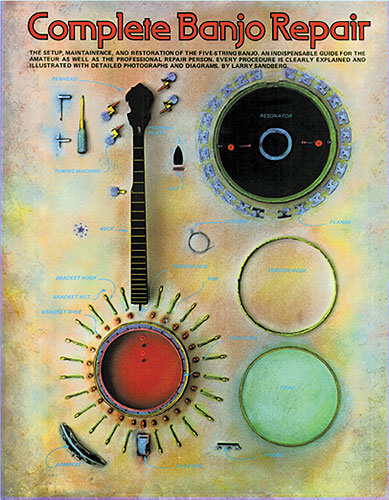
COMPLETE BANJO REPAIR, Larry Sandberg.

COMPLETE BANJO REPAIR, Larry Sandberg.

Larry Sandberg. The set-up, maintenance, and restoration of the 5-string banjo. Clear instructions and detailed photographs and diagrams. Indispensable for amateur and professional.

Prezzo: €24,95
€24,95

HOW TO SET UP THE BEST SOUNDING BANJO Roger H. Siminoff LIBRO LIUTERIA HAL LEONARD BOOK

HOW TO SET UP THE BEST SOUNDING BANJO, Roger H. Siminoff. BOOK

LIBRO DI LIUTERIA
 

How to Set Up the Best Sounding Banjo
Series: Book
Publisher: Hal Leonard
Format: Softcover
Author: Roger H. Siminoff

This renowned author walks banjo players through masterful techniques to maximize the performance of their instrument. Step-by-step instructions cover: tone chamber fit, tailpiece angle, bridge selection, neck angle and heel fit, head adjustments, air chamber tap-tuning and resonator adjustments, string gauge selection, head selection, and much more. Each chapter provides a detailed background and analysis of the parts to be adjusted and explores the differences between archtop, flattop, tube-and-plate, and one-piece flange banjos. More than 100 photos, illustrations and charts make this technical guide easy to follow. To round out this already unique text, amplifications tips are provided by legendary banjo player extraordinaire Earl Scruggs, considered the father of bluegrass music. 80 pages, 9″ x 12″. 

Inventory #HL 00330367
ISBN: 9780793589982
UPC: 073999303674
Width: 9.0"
Length: 12.0"
72 pages

Prezzo: €59,99
€59,99
Condividi contenuti