SPARTITI PER CHITARRA DI MUSICA BOSSA NOVA, LATIN

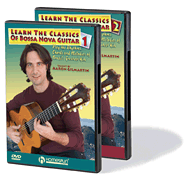
LEARN CLASSICS BOSSA NOVA GUITAR PLAY RHYTHMS CHORDS MELODIES BRAZIL HITS 2-DVD TABLATURE

LEARN THE CLASSICS OF BOSSA NOVA GUITAR PLAY THE RHYTHMS, CHORDS AND MELODIES OF BRAZIL'S GREATEST HITS. 2-DVD TABLATURE

DVD VIDEO METODO DI MUSICA BOSSA NOVA, LIBRETTO E 2 DVD.

SPARTITI PER CHITARRA CON: 

ACCORDI, PENTAGRAMMA, NOTE, TABLATURE.

Series: Homespun Tapes
Publisher: Homespun
Format: DVD - TAB
Author: Aaron Gilmartin

These two DVDs provide an in-depth immersion into the lush jazz chords, seductive Latin rhythms and haunting melodies of bossa nova's greatest hits. Measure-by-measure guitar instruction brings a rich learning experience to any player wanting to conquer these timeless songs. DVD One: O Barquinho (Little Boat) • One Note Samba • Wave (1 hr., 36 min.) DVD Two: The Girl from Ipanema • Corcavado • Manha De Carnival (Black Orpheus) (1 hr., 15 min.) LEVEL 4 • INCLUDES MUSIC + TABLATURE PDF ON DISC
Run Time: 2:51:00

Prezzo: €69,99
€69,99

JOBIM Antonio Carlos Jazz Classics for Classical Guitar SPARTITO DESAFINADO The Girl From Ipanema-Corcovado

Jazz Classics for Classical Guitar

LIBRO PER CHITARRA.

composer: Antonio Carlos Jobim
arranger: Thomas G. Wagner - Rolf Toennes

Instrumentation: guitar

Difficulty: intermediate to advanced
Series: Jazz Classics for Classical Guitar
18 Pages - Saddle stitching
ISMN: 979-0-001-08368-3
ISBN: 978-3-7957-5055-8
 

Content

Preface
Corcovado (Quiet Nights)
Desafinado
How Insensitive
One Note Samba
The Girl From Ipanema
Antonio Carlos Jobim
Notes
Recommended Recordings 

Prezzo: €19,99
€19,99

BRAZILIAN GUITAR SOLOS Paolo Mari CD TABLATURE Manha De Carnaval-Água De Beber-Desafinado-O Pato

BRAZILIAN GUITAR SOLOS, Paolo Mari. SHEET MUSIC BOOK WITH CD & GUITAR TABLATURE . 

LIBRO DI MUSICA BRASILIANA CON CD .

SPARTITI PER CHITARRA :

ACCORDI, PENTAGRAMMA, NOTE, E TABLATURE,

IN ITALIANO


10 Brasilian Standards arranged for solo guitar. LEARN & PLAY

- A Banda - CHICO BUARQUE DE HOLLANDA - 1966

- Água De Beber - ANTONIO CARLOS JOBIM, VIVICIUS DE MORAES - 1961

- Chega De Saudade - ANTONIO CARLOS JOBIM, VIVICIUS DE MORAES - 1958

- Desafinado - ANTONIO CARLOS JOBIM, NEWTON MENDONCA - 1959

- Manha De Carnaval - A. MARIA, L. BONFA' - 1959

- Maria Ninguém - CARLOS LYRA - 1960

- Mas Que Nada - JORGE BEN - 1963

- O Pato - J. SILVA, N. TEIXEIRA - 1960

- Só Danço Samba - ANTONIO CARLOS JOBIM, VIVICIUS DE MORAES - 1963

- Tristeza - HAROLDO LOBO, NILTINHO - 1966


PREFAZIONE
Questo libro contiene gli arrangiamenti in chord-melody di dieci brani classici della musica brasiliana, realizzati per chitarra fingerstyle. Chord-melody significa "la melodia dentro l'accordo"; la chitarra è, in questa situazione, autosufficiente, svolge cioè da sola i compiti che normalmente vengono suddivisi tra più strumenti.

La musica si compone essenzialmente di tre elementi: melodia, linea del basso, armonia, il tutto tenuto insieme dallo "scheletro", senza il quale tutto crollerebbe, cioè il ritmo. Negli arrangiamenti in chord-melody realizziamo contemporaneamente questi elementi, tenendo ben presente alcuni punti fondamentali:

- la melodia (altrimenti detta canto) è l'"ingrediente" fondamentale, caratterizza e distingue ogni brano musicale, ed è quindi da privilegiare, è l'elemento che non deve mai mancare o essere lasciato in secondo piano;

- la linea del basso è il motore, il fondamento della musica; nel nostro caso, cioè nella bossa nova, viene eseguita quasi sempre in battere, alternando la tonica (sul 1° e sul 3° quarto) e la quinta dell'accordo (sul 2° e sul 4° quarto). Quando la tonica si trova sulla sesta corda, possiamo mantenerla per tutta la battuta, evitando l'alternanza con la quinta. Troviamo un'eccezione a questa regola nel brano Maria Ninguem, in cui il basso suona una nota in levare nell'ultimo ottavo di ogni battuta.

- l'armonia (che possiamo definire anche accompagnamento) può essere realizzata in diversi modi:

a) per riempire gli spazi lasciati dalla melodia (es. Desafinado); in queste situazioni è preferibile non utilizzare note nel registro acuto, per non "disturbare" il canto;

b) per armonizzare le note della melodia, aggiungendo ad esse una o due delle note più gravi facenti parte dell'accordo (es. A banda);

c) per creare una introduzione (es. Só danço samba) o una coda (es. Tristeza).

Ecco ancora qualche considerazione riguardo alla melodia:

- una caratteristica della bossa nova è che spesso la melodia viene eseguita in lieve anticipo o ritardo rispetto alla notazione sul pentagramma; ogni interprete ha il dovere di applicare questo concetto secondo il suo gusto personale, e sarebbe necessario ascoltare tante versioni di ogni brano, per arrivare ad un'esecuzione appropriata del brano stesso.

- la melodia si sviluppa normalmente sulle corde più acute; un'eccezione si trova nell'introduzione di Mas que nada, dove invece sono le corde gravi a svolgere questa funzione. In questo caso, l'indice e il medio della mano destra suonano nella zona normalmente destinata al pollice, cioè le tre corde gravi (quarta, quinta e sesta).

Nella scelta delle tonalità, si è deciso di privilegiare le situazioni in cui le corde a vuoto possono facilitare il lavoro del chitarrista: ecco quindi che i brani sono stati trascritti in RE (A banda, Tristeza, Desafinado, O pato), MI (So danço samba), SOL (Maria Ninguem), MIm (Mas que nada), LAm (Manha de carnaval), SIm (Agua de beber), REm (Chega de saudade).

Si consiglia di utilizzare uno strumento con corde di nylon, per ottenere un suono più "caldo", e quindi più adatto a questo stile, e anche perchè la tastiera più larga consente una miglior pulizia di esecuzione.

Auguro a tutti gli amici chitarristi buono studio e buon divertimento, nell'affascinante mondo della chitarra brasiliana!


INDICE
Preface (english) .
Prefazione (italiano) .
Preficio (portugues) . 

Prezzo: €39,99
€39,99

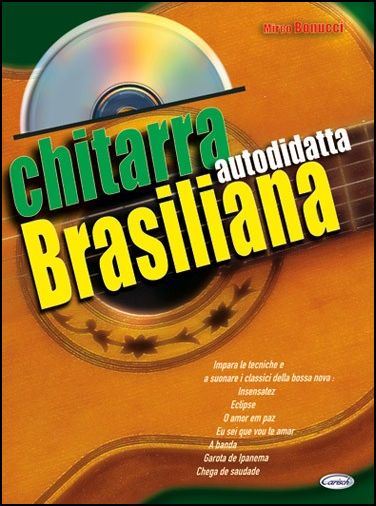
CHITARRA BRASILIANA AUTODIDATTA MIRCO BONUCCI CD TABLATURE Garota de Ipanema-Chega de saudade

La CHITARRA BRASILIANA AUTODIDATTA. Mirco Bonucci. CD TABLATURE

IN ITALIANO

LIBRO METODO DI MUSICA BRASILIANA PER CHITARRA CON CD E TABLATURE
SPARTITI CON ACCORDI, PENTAGRAMMA E TABLATURE. 

Questo metodo si propone di guidare l'autodidatta nel mondo della chitarra brasiliana. Il libro è accompagnato da un cd che con esercizi graduali porta all'esecuzione di alcuni tra le composizioni più famose dalla musica brasiliana.Insensatez - O a paz - Eu sei que vou te amar - A Banda - Eclipse - Chega de saudade

INTRODUZIONE
Lo strumento che esprime più efficacemente l'animo musicale
del popolo brasiliano è senza dubbio la chitarra.
La vastità del territorio brasiliano ed il carattere multietnico della
sua popolazione hanno favorito lo sviluppo di tecniche
chitarristiche che variano da regione a regione e che non
consentono di parlare di una "sola" chitarra brasiliana.
Ma nella loro diversità tutti gli stili del presente e del passato di
questo strumento in questo paese, hanno un elemento comune:
IL RITMO.
Il ritmo, che è uno degli elementi principali di un evento
musicale, sembra assumere nella musica brasiliana una valenza
superiore.
Qualsiasi chitarrista avrà osservato che per suonare musica
brasiliana è indispensabile avere un buon senso ritmico.
Partendo da questa semplice considerazione ho deciso di
strutturare un libro con esercizi che insegnino ad eseguire
correttamente il ritmo di alcuni fra gli stili più popolari della
musica brasiliana.
Il libro è consigliato a coloro che abbiano già una minima
conoscenza di accordi.
Nel CD allegato sono contenuti tutti gli esempi riportati nel libro.
Nel volume troverete le trascrizioni di alcune tra le composizioni
brasiliane più conosciute.
Buon Lavoro

INDICE
Introduzione
Note e pentagramma
Valori musicali
Alterazioni
Notazione e simbologia
Accordi ed armonia
La formazione degli accordi
Voicing 1
Voicing 2
Voicing 3
Esercizi con i voicings
La mano destra
La mano destra di Joao Gilberto
Nozioni fondamentali di ritmo
Primi esercizi
Modulo N°i
Modulo N°2
Modulo N°3
Brega
Modulo N°4 "II 3/4" (Esercizio)
Modulo N°S
Arpeggi
Sineta
Il pollice si oppone alle altre dita
Saude
L'anima ritmica della chitarra brasiliana
Frevo
Um pouco por dia
Baiao
Choro
Samba
Bicicleta
Trascrizioni
Appunti sulle canzoni trascritte
Suggerimenti per lo studio
Insensatez
Eclipse
O amor em paz
Eu sei que vou te amar
A banda
Garota de Ipanema versione Joao
Garota de Ipanema versione Jobim
Chega de saudade


Track
Titolo
Accordatura
Esercizio N° 1
Esercizio N° 2
Esercizio N° 3
Modulo N°1
Applicazione N°1
Modulo N°2 ("Estrangeiro")
Modulo N°2 ("Paisagern da janela")
Modulo N°3
Esercizio
"Maria Ninguém"
"Ho bà-là-là''
Brega
Modulo N°4 "II 3/4"
Esercizio
"Chovendo na roseira"
"Vaisinha"
Modulo N°5
"Por isso eu corro demais"
Arpeggio
Esercizio
"Agua negra da lagoa"
"Farolito"
"A paz"
Sineta
Esercizio
"Coisinha de pai"
"Aos pes da Santa Cruz"
Saude
"A felicidade"
"Clandestino"
"Branquinha"
Um pouco por dia
"Aza bianca"
Ritmo
Tango brasileiro esempio 1
Tango brasileiro esempio 2
Bicicleta
Insensatez
Eclipse
O amor em paz
Strumentale di "O amor em paz"
Eu sei que vou te amar
A banda
Garota de Ipanema versione Joao
Chega de saudade 

TRASCRIZIONI DI BRANI CELEBRI
Insensatez
Eclipse
O amor em paz
Eu sei que vou te amar
A banda
Garota de Ipanema versione Joao
Garota de Ipanema versione Jobim
Chega de saudade


Alcuni suggerimenti per studiare le trascrizioni

Le trascrizioni in appendice sono tutte facilmente reperibili, in linea di massima ho privilegiato le versioni originali.
Prima di tutto ascoltate molto bene l'esecuzione originale, poi concentratevi sugli accordi, memorizzate le forme e non preoccupatevi del ritmo; potete utilizzare inizialmente un
pattern ritmico semplice e ripetitivo.
Una volta assimilate le armonie di base iniziate la lettura delle ritmiche.
Consiglio di affrontare prima "Insensatez" e "O amor em paz" che sono le più semplici ritmicamente e lasciate per ultima "Chega de saudade".
Data l'importanza del ritmo nella musica brasiliana non abbiate timore di perdere tempo insistendo su un paio di battute che risultino difficili, perché è proprio in questa diversità ritmica che sta uno dei caratteri predominanti della musica brasiliana.
Un discorso a parte merita "Eu sei que vou te amar" in quanto i pattern ritmico apparentemente semplice diventa invece o complesso se abbinato alla voce.

Appunti sulle canzoni Proposte

Insensatez
Una delle composizioni più conosciute di Jobim e V. de Moraes, qui nella versione
originale con l'arrangiamento di Jobim e la voce e la chitarra di Joao Gilberto.
Ispirata al preludio n024 di Chopin, ascoltare per credere, ha riscosso successo
anche come standard jazz ed in questo caso è stata chiamata "How Insensitive" ed
è suonata di norma in tonalità di Rem.

Eclipse
Questa canzone fa parte di una raccolta che Joao Gilberto ha dedicato alle canzoni
messicane.
L'arpeggio è molto semplice ma le sostituzioni armoniche sono come al solito di una
"elegante semplicità".
Ascoltate, tratta dallo stesso disco , "Besame mucho" e se possibile cercate le
armonie originali per poter valutare appieno la freschezza e la lucidità degli
arrangiamenti chitarristici di J. Gilberto.

oamor em paz
Sempre di Jobim, molto apprezzato anche nel jazz per le frequenti modulazioni;
a enzione al finale ed ai segni di ripetizione.

Eu sei gue vou te amar
a versione di Caetano Veloso è interessantissima per il ritmo imposto sulla voce.
e armonie sono semplici e non rivelano particolari sorprese.
Ho riportato le due varianti ritmiche che Caetano esegue ad un certo punto della
canzone perché sono degli ottimi esercizi sulla ritmica, in particolare la seconda con
il cambio in 3/4.

A banda
Tempo di Marcha-Rancho per una delle canzoni più famose di Chico Barque, cantata
anche in Italia da Mina con l'ottima traduzione di S. Bardotti che è stato uno dei più
importanti traduttori di testi brasiliani in Italia.
Il ritmo è simile ad una marcia e per questo di solito incontra il favore anche dei
chitarristi non troppo avvezzi a formule ritmiche complesse.

Garota de Ipanema
La canzone brasiliana più famosa nel mondo, una ragazza che non invecchia mai.
Questa versione è quella originale in Reb, poi Joao la suonerà sempre in Re maggiore.
Studiate con molta attenzione le ritmiche che ho trascritto; si tratta di una vera e
propria guida alle ritmiche moderne brasiliane.

Chega de saudade
Il brano che insieme a Desafinado è il manifesto della Bossa-nova.
Le covers di questa canzone sono innumerevoli soprattutto nel Jazz.
La forma del brano è A B con la prima parte in tonalità di Re minore e la seconda
invece in Re maggiore come accade spessissimo nello Choro.
Colgo l'occasione per sottolineare che spesso in queste composizioni la novità sta nel
contenuto lirico, nelle parole, così è per questo brano già dal titolo "Basta con la
saudade".


Prezzo: €19,99
€19,99

VIOLÃO LA CHITARRA BRASILIANA PAOLO MARI DVD TABLATURE Manha de Carnaval-Desafinado-A Banda

VIOLÃO, LA CHITARRA BRASILIANA, PAOLO MARI. DVD TABLATURE

LIBRO METODO IN ITALIANO DI MUSICA BRASILIANA, CON DVD . 

SPARTITI PER CHITARRA CON :

ACCORDI, PENTAGRAMMA, TABLATURE .

MANUALE, STUDIO, TECNICA, TEORIA. 

Il violao in brasiliano significa chitarra.

Modelli ritmici progressioni armoniche esempi e brani di repertorio.
Samba e bossa nova, ma anche choro, frevo e baião …un mondo affascinante, da scoprire o da approfondire. 30 stili ritmici, 49 progressioni armoniche, 4 brani originali, oltre alle trascrizioni in “chord melody” (bassi, accordi e melodia insieme) di ci come “A Banda”, “Manha de Carnaval”, “Desafinado”. Allegato un DVD di 55’ che illustra in modo preciso ogni passaggio, con immagini dettagliate sulle due mani.

MODELLI RITMICI
PROGRESSIONI ARMONICHE
ESEMPI E BRANI DI REPERTORIO

INTRODUZIONE
La musica brasiliana è il risultato della fusione di numerose culture:
dalle antiche tradizioni degli indios agli influssi europei portati dai
conquistatori portoghesi, dagli elementi - soprattutto ritmici - introdotti
dall'immigrazione forzata degli schiavi africani, fino al più recente
contributo della musica nordamericana, con iljazz e il funky; inoltre,
specie nel Brasile settentrionale, si ritrovano molte caratteristiche degli stili
arocubani (come salsa e reggae), tipici delle popolazioni caraibiche.
Ecco quindi un concetto su cui avremo modo di tornare nel corso
di questo libro: il Brasile come esempio di mescolanza delle razze. Noi
rivolgeremo la nostra attenzione alla musica, ai "frutti musicali" di questo
intreccio di culture e tradizioni.

SAMBA E BOSSA NOVA
Gli stili più importanti della musica brasiliana contemporanea sono il samba e la bossa
nova. Il samba ha carattere popolare, è ispirato dalla danza e rivolto principalmente ad essa
e deriva dalle radici folkloristiche brasiliane: è uno stile molto percussivo e dalle armonie
relativamente semplici. I ritmi di samba sono, tra l'altro, alla base della festa popolare più
famosa al mondo che è il Carnevale di Rio; ricordiamo che l'altra città brasiliana fondamentale
per il samba e per il carnevale è Bahia.
Nel samba la chitarra simula una sezione ritmica, con le corde basse, suonate col pollice,
quasi sempre sul battere, a riprodurre la pulsazione del tamburo basso (surdo), mentre il
resto dell'accordo è eseguito con le tre dita (indice, medio e anulare), che suonano i gruppi di
corde 2-3-4 (oppure 1-2-3), imitando l'effetto di percussioni della sezione ritmica del samba
come l'agogò, il pandeiro, il tamborim, la cuica.

Mentre il samba nasce agli inizi del Novecento, la bossa nova ha origini più recenti, che
risalgono agli anni '50, quando la musica tradizionale brasiliana viene a contatto con elementi
stilistici tipici del jazz (in senso melodico e soprattutto armonico). Bossa nova significa
tendenza nuova, è una musica più raffinata e 50ft rispetto al samba, ha una sezione ritmica
ridotta e un'armonia più complessa; nasce dall'esigenza, soprattutto di chitarristi e pianisti,
di contrastare lo "strapotere" sonoro dei percussionisti. Pensiamo che la batucada (cioè
l'insieme dei percussionisti di una scuola di samba che sfila durante il carnevale) è formata
in media da 350 elementi ... E infatti i principali esponenti di questo stile sono stati proprio un
pianista, nonché grande compositore, Antonio Carlos Jobim, e un chitarrista, J080 Gilberto.

Tutti i brani non originali che presentiamo in questo libro sono stati composti tra gli anni
'50 e '60. Questo perché, da un punto di vista chitarristico, lo stile brasiliano nasce proprio
in quegli anni. Nei decenni successivi si sono mischiati sempre di più i generi; abbiamo già
visto come una delle caratteristiche del popolo brasiliano, e quindi anche della sua musica,
sia tendenza a mescolare culture diverse. Musicisti delle ultime generazioni come Carlinhos
Brown, Daniela Mercury, Qjavan, Marisa Monte, solo per citare qualche nome, sono esempi
di musica molto contaminata, dove si incontrano tanti stili diversi (funky, rock, reggae, pop, rap.
Il Brasile di oggi ha una grandissima ricchezza musicale, ma la vera novità stilistica (la
bossa nova) risale agli anni Sessanta.

CONTENUTI SOCIALI DELLA BOSSA NOVA
La bossa nova non è stato solo un movimento musicale, ma ha avuto anche profonde
implicazioni sociali e politiche. Vinicius de Moraes, autore dei testi di molte delle più belle e
più famose canzoni brasiliane, così scrive nel 1970, nel pieno della dittatura militare:

"Bossa nova è pioggia fitta attraverso la finestra, è piu uno sguardo
che un bacio, è anche sofferenza di molti giovani del mondo intero che
cercano nella tranquillita della musica non la fuga e I'alienazione di fronte
ai problemi del loro tempo, bensì il modo più armonioso di configurarli.

Bossa nova è la nuova intelligentia, il nuovo ritmo, la nuova sensibilità,
nuovo segreto della gioventù brasiliana. Gioventu tradita dai più anziani,
padri ed educatori, che hanno voluto imporre i propri modelli, consunti e inaccettabili.

Bossa nova è la risposta semplice ed incorruttibile di questi giovani
ai loro padri e maestri: una struttura semplice di suoni ultrasublimati, di
parole nelle quali nessuno credeva e che affermano che I'amore è dolore
ma esiste, che è meglio credere che essere scettici, e che per quanto
buie possano essere Ie notti, c'è sempre I'alba dopo di esse."

SAMBA IN TEMPO DISPARI
Un altro esempio di infl uenza di culture diverse nella musica brasiliana è l’uso di tempi
dispari nel samba. Mostriamo qui di seguito due esempi ritmici, il primo in 12/8, il secondo
in 7/4, abbinati a nuove sequenze: ...

IL BAIÃO
Come il frevo, anche il baião è uno stile che ha le sue origini nel nord-est del Brasile, ed
è quindi, anche per motivi geografi ci, particolarmente infl uenzato dalla musica caraibica. Il
principale esponente di questo stile è considerato il fi sarmonicista Luiz Gonzaga, che divenne
popolare intorno agli anni Quaranta. Il frevo è caratterizzato da un’armonia semplice e una
linea di basso sincopata, che lo distingue dagli altri stili esaminati fi nora, dove il basso suona
prevalentemente in battere.
Presentiamo ora alcune sequenze armoniche, abbinate a modelli ritmici tipici di questo stile ... 

IL “TURNAROUND”
Il turnaround è una particolare progressione, molto comune nel jazz e nella musica
brasiliana, che è situata normalmente alla fi ne di una strofa; sviluppa l’armonia con l’aggiunta
di estensioni e sostituzioni, senza cambiare tonalità, preparando la frase successiva, che può
essere un ritorno alla strofa, oppure un movimento verso il ritornello.
Questa progressione si basa sui gradi I – VI – II – V.
Ecco quindi la sequenza fondamentale (esempio in G), che suoniamo col nuovo ritmo ... 


Il libro contiene 49 esempi armonici e 30 modelli ritmici dei principali stili brasiliani (samba e bossa nova) e di quelli meno conosciuti, come choro, frevo e baiao.
Sono presenti 4 brani originali, e le trascrizioni di classici come "Desafinado", "A banda", "Manha de Carnaval", "Night and day". 
Il dvd di 55 minuti permette di seguire gli esempi del libro, con immagini dettagliate delle due mani del chitarrista.


INDICE
INTRODUZIONE .
SAMBA E BOSSA NOVA .
LA SiNCOPE .
NOTAZIONE ORiZZONTALE .
MODELLI RITMICI E PROGRESSIONI ARMONICHE .
I BASS I ALTERNATI .
SIMULAZIONE DELL'AGOGO .
USO DELLE CORDE A VUOTO .
RIARMON IZZAZIONE .
CONTENUTI SOCIALI DELLA BOSSA NOVA .
SAMBA E BOSSA NOVA: NUOVI RITMI E PROGRESSiONI .
EVOLUZIONE DEL BASSO .
IL BASSO PROTAGONISTA .
MAS QUE NADA .
AGUA DE BENER.
IL BRASILE COME "LABORATORIO MUSICALE" .
JOGOS DE MENINOS .
IL "TURNAROUND" .
SAMBA IN TEMPO DiSPARI .
CORPO E ALMA .
LA CHITARRA "INDIPENDENTE" (CHORD MELODY) .
MANHA DE CARNAVAL .
BOSSA NOVA E JAZZ .
NIGHT AND DAY .
IL CHORO .
LA SAUDADE .
AQUI E AGORA .
INTERSCAMBIO ITALI A-BRAS ILE .
IL FREVO .
LA BANDA .
IL BAIAO .
ABACATEIRO .
IL "MANIFESTO" DELLA BOSSA NOVA .
DESAFINADO .
BIBLIOGRAFIA . 

Prezzo: €32,99
€32,99

TOTAL LATIN GUITARIST A Fun and Comprehensive of Latin Guitar Playing Doug Munro CD TABLATURE

The Total Latin Guitarist, A Fun and Comprehensive Overview of Latin Guitar Playing. BOOK WITH CD & GUITAR TABLATURE
By Doug Munro

LIBRO METODO DI MUSICA LATINA, CON CD. 

SPARTITI PER CHITARRA E BASSO CON : 

ACCORDI, PENTAGRAMMA, TABLATURE DELLA CHITARRA. 

BASSO SOLO IN PENTAGRAMMA.

Serie: The Total Guitarist
Categoria: Guitar Method or Supplement
Formato: Libro & CD
Instrumento: Chitarra

It’s time to infuse your playing with a little hot-blooded romance! The Total Latin Guitarist is an exciting journey into the world of Latin guitar playing. The book begins by teaching you soloing and accompaniment techniques used in all genres of Latin music, as well as the rhythmic backbone of many Latin styles, the clave. You'll learn to play in the Afro-Cuban styles of salsa, rumba, guaguancó, cha-cha-cha, mambo, and songo. You'll get a solid introduction to the Brazilian styles of choro, samba, batucada, partido alto, bossa nova, baião, and frevo. Other Latin styles featured are meringue (Dominican Republic); calypso, soca, and bachata (Trinidad); tango (Argentina); and ranchera, mariachi, norteño/conjunto, and tejano (Mexico). Aside from all of the important techniques involved with playing these styles, you will also learn all of the relevant theory. This book is for guitar players who are already familiar with the basics, but are looking to expand their vocabulary and repertoire in new and exciting ways. The CD features a full band demonstrating the examples in the book. 

This book is intended for the intermediate to advanced guitarist who hasan interest in exploring Latin guitar styles. To get the most out of this book, you should have a firm grasp on playing technique and theory, including scale theory, chord theory, and diatonic harmony. You should also be able to read standard music notation or tablature (TAB). For a refresher on some of these topics, refer to the Appendix on page 126.

The Total Latin Guitarist is a sampler of 23 different Latin music styles from six different countries. For every famous person mentioned in this book, there are many more that are not mentioned. In doing the research for this book, I found many contrasting explanations and points of view on musical and historical information. This book only includes material that musicians and historians are in general agreement about. Many of the common questions asked by musIcians studying Latin music are addressed in these pages. Concepts like the clave and specific rhythmic patterns are explained and demonstrated. All of the examples are hands-on, practical solutions for creating the distinctive sounds of each style. The Total Latin Guitarist, while not a history book, provides some background on each style of music played. Gaining a historical perspective on the music helps in interpreting and understanding the particular harmonic and rhythmic patterns intrinsic to each style. Every recording listed in this book is still available (at least at the time of this publishing). It is vital that you listen to the music that you study in this book. There are subtleties that can only be learned through immersing yourself in the music. Be sure to memorize the musical examples and play along with the recorded tracks on the CD. As you master the information in this book, it is vital that you go out and play it. Get together with like-minded musicians and play in these styles. There is a whole other education you get from playing and sharing this music with others. Most of all, it is so much fun to feel the groove and be a part of making this unique and exciting music. A compact disc is available with this book. Using the disc will help make learning more enjoyable and the information more meaningful. Listening to the CD will help you correctly interpret the rhythms and feel of each example. The symbol to the left appears next to each song or example that is performed on the CD. Example numbers are above the symbol. The track number below each symbol corresponds directly to the song or example you want to hear. Track I will help you tune your guitar to this CD.

Doug Munro is a critically acclaimed New York jazz guitarist. Since 1987, he has released I I albums as a bandleader and has appeared on over 50 recordings as a sideman, producer, and arranger, working with a diverse array of artists including Dr. John, Michael Brecker, and Dr. Lonnie Smith. Doug has over 75 published compositions and over 300 recorded arrangements by the finest players on the scene today. Doug has received two Grammy nominations and two NAIRD awards. Amazon.com picked Boogaloo to Beck, which Doug performed on, arranged, and co-produced, as one of its Top Ten Jazz CDs of 2003. Doug also did orchestration work on the Oscar-winning 1997 documentary When We Were Kings. Doug continues to actively perform with around 100 live dates per year.

As an educator, Doug created and was Director of the Jazz Studies Program at The Conservatory of Music at Purchase College from 1993-2002. He continues to teach there as Director Emeritus. This esteemed jazz program boasts a faculty that includes John Abercrombie, Todd Coolman, Jon Faddis, Eric Alexander, John Riley, and many other top jazz performers. Doug has written three books on jazz improvisation for Alfred Music Publishing: • Swing to Bebop (Alfred 00-0388B) (Winner of The Music and Sound Retailers' Instructional Book of the Year Award in 2000)

• Bebop and Beyond (Alfred 00-0609B)

• Organ Trio Blues (Alfred 00-0758B)

Acknowledgements

There are many people who helped make this book possible. I would first like to thank Aaron Stang, my longtime editor and friend, from back in the Warner Brothers days. After Alfred Music Publishing merged with Warner, it was Aaron who put me in touch with the people at Workshop Arts, who co-publish many instructional music books with Alfred. Thanks to Jason Shadrick for introducing me to everyone at Workshop Arts; he has always been very generous with his time and contacts, and his help and friendship has been invaluable to completing this project. Next up is Burgess Speed, my new editor; working with Burgess has been great, he has a solid view of the "big picture" but never loses sight of the small details involved in writing a meaningful book. I look forward to, hopefully, doing many more projects together. Thanks also to Gil Parris, a longtime friend and guitarist. His generosity in helping me with this, and pretty much every project I've ever done, is greatly appreciated. Lastly, I would like to thank the good Lord for his love and guidance and my wife, Kathleen, and my sons, Eugene and John, for their love and support.


About the Author

Introduction

Chapter I: Latin Accompaniment Techniques

Accompaniment Styles Without a Bass Instrument

Accompaniment Styles with a Bass Instrument


Chapter 2: Latin Soloing Techniques

Soloing Based on a Scale or Mode

Soloing Based on an Arpeggio

Voice Leading


Chapter 3: Clave

Son Clave

Rumba Clave

BossaClave


Chapter 4: Montuno/Guajeo


Chapter 5: Afro-Cuban 

Son 

Salsa 

Salsa solo

Rumba

Rumba Solo

Guaguancó

Guaguancó Solo

Cha-Cha

Cha-Cha solo

Mambo

Mambo Solo 

Songo

Songo Solo

Mozambique

Mozambique


Chapter 6: Brazil

Choro 

Choro Solo 

Samba 

Samba

Batucada 

Batucada Solo 

Partido Alto 

Partido A/to

Bossa Nova 

Bossa Nova Solo 

Baião .

Baião Solo .

Frevo .

Frevo Solo


Chapter 7: The Dominican Republic

Merengue

Merengue Solo

Bachata

Bachata Solo


Chapter 8: Trinidad

Calypso

Calypso Solo

Soca

Soca Solo


Chapter 9: Argentina

Tango

Tango Solo


Chapter 10: Mexico

Ranchera

Ranchera Solo

Mariachi.

Mariachi Solo

Norteño / Conjunto

Norteño Solo

Tejano

Tejano Solo

Conclusion


Appendix

Reading Tablature (TAB)

Scale Diagrams

Major Scale Theory

Intervals

Diatonic Harmony

Circle of 4ths/5ths

Extended Chords

Prezzo: €29,99
€29,99

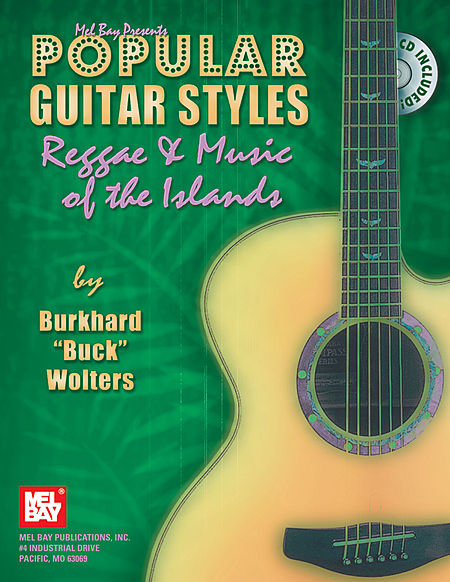
POPULAR GUITAR STYLES REGGAE & MUSIC OF THE ISLANDS Burkhard Buck Wolters CD TABLATURE

POPULAR GUITAR STYLES, REGGAE & MUSIC OF THE ISLANDS. Burkhard Buck Wolters. SHEET MUSIC BOOK WITH CD AND GUITAR TABLATURE .

LIBRO DI MUSICA REGGAE , LATINA, CON CD. 

SPARTITI PER SOLA CHITARRA CON : 

PENTAGRAMMA E TABLATURE. 

Popular Guitar Styles: Reggae and Music of the Islands reflects recent popular styles and transfers them to classical or fingerstyle technique. Guitar players who want to add reggae or Island music to their solo-repertoire will find an original and unique collection of compositions which will give joy to both players and listeners. The playing-level is intermediate to advance. Left-hand difficulties like barres and stretches are minimized as much as possible to make it easy to make the music groove. Written in notation and TABLATURE.

Series: Popular Guitar Styles

Buck Wolters belongs to the very small company of guitar players and composers who are familar with nearly every style. His authentic mix of jazz, world and latin music, combined with a mastery of classical guitar technique is very unique and outstanding. Born in 1961 in Dortmund, Germany, he began to play the guitar as an autodidact at the age of five. After hearing a recording of Big Bill Broonzy he took his first guitar lessons at the age of thirteen, digging into the blues for several years. At the age of sixteen he went to the conservatory in his hometown where he studied classical guitar. The music of Agustin Barrios, Heitor Villa-Lobos and David Qualey were his main influences. After leading the life of a busker in his twenties, he went to the School of Arts in Amsterdam to study jazz guitar and composition and spent most of his time then copying jazz solos from musicians like John Coltrane, Keith Jarrett, Pat Metheny and Wes Montgomery. He completed his studies as a bachelor with distinction. Today Buck Wolters is very busy performing, composing, recording and teaching throughout Europe. His greatest success belongs to his composition "Dshamilja" ordered in commission by the Opera of Frankfurt.

In the following I will give some brief explanations on the pieces that appear in this book and the popular Caribbean styles that they represent. Moreover some techinical and musical insight on how to produce special sounds on the guitar are given. Keep up the sunny Caribbean mood and have fun with it! Buck Wolters


Kingston Feet (Reggae)

The word "Reggae" was coined around 1960 in Jamaica to identify a "ragged" style of dance music, that melted New Orleans rhythm'n'blues and Caribbean music together. Later African elements were also included. The legendary Bob Marley (1944 -1981) made Reggae popular all over the world, and he is still one of the most active influences in recent popular music. Kingston Feet is to be played in even eights (straight, no shuffle). On the recording you will hear some percussion elements, which have been left out of the score for reading matters. Anyway, you should learn the piece first without percussion. If you want to add them later, here is an explanation: There are two sounds: a "bass drum" on count three, and a "rimshot" on count one (imitating the drumset). The "bassdrum" is produced by dropping the right-hand palm on the bridge. (It takes a little practice to drop the palm and hit strings at the same time.) The rimshot is produced by tapping a finger (preferably the little one) on the top. The "muffle" or "etouffe" is produced by holding the notes with the left-hand fingers without pressing them down to the fret.


Pan-Man-Limbo (Limbo)

The Limbo is also known as the "Under Stick Dance," a dance competition which was very popular at beach parties in Trinidad and Tobago, and is still alive today in Caribbean stage shows. The dancer moves under a stick, trying not to touch it, while being accompanied with Caribbean music, often played on the steeldrum ("Pan"). The harmonics in the beginning of the piece imitate the sound of the "Pan" and they are written as notes that would sound if you fingered them regularly.


Friendly Fritz (Reggae)

This Shuffle-Reggae is dedicated to Frit: Rossel, a very good friend of mine and a genius of a special kind. He is an excelent guitar builder, photographer, writer, salesman and last but not least an extraordinary musician. He plays keyboards, bass and guitar like no one I know. The highlight is when he starts to sing: he can imitate any singer from Harry Bellafonte to Mick Jagger, from Stevie Wonder to Bob Marley, that it makes you laugh until you cry. Again you will hear some percussion elements on the recording, which are produced in the same way on the guitar as in Kingston Feet.


Mentomania (Mento)

Mento is a style from Jamaican heritage, which had its beginnings in the 19th century and can be seen as the "grandfather" of Reggae. Mento had its golden age in the 1950s. Some of the famous mento musicians of that time were: Harold Richardson, Hubert Potter, and Monty Reynolds. Although Mentomania is notated in even eighths, it has a slight feeling of swing or shuffle. As in many Caribbean rhythms the 3/2 clave is featured. (see Popular Guitar Styles Vol. 1 - Latin & Salsa). To give the piece a light, typical Caribbean mood, I suggest you play it with the capo on the 3rd fret. Near the end of the piece (measures 103 through 124) you will hear the ...


Song Title: Composer/Source:

Children of St. Vincent - Buck Wolters
Friendly Fritz - Buck Wolters
Kingston Feet - Buck Wolters
Les Jardins d'Andre - Buck Wolters
Mentomania - Buck Wolters
Pan-Man-Limbo - Buck Wolters

Prezzo: €29,99
€29,99

BACHATA BEST OF FOR LEAD GUITAR Juan Pablo Pérez CD TABLATURE CHITARRA LIBRO SPARTITI

BACHATA BEST OF FOR LEAD GUITAR. Juan Pablo Pérez A. SHEET MUSIC BOOKE WITH CD & GUITAR TABLATURE. 

LIBRO CON CD E TABLATURE.

LIBRO DI MUSICA LATINA, CON CD.

SPARTITI PER VOCE E CHITARRA.

ACCORDI PENTAGRAMMA, TABLATURE.


Best of Bachata for Lead Guitar
Series: Guitar
Publisher: Professional Music Institute
Format: Softcover with CD - TAB
Arranger: Juan Pablo Pérez A.

''The Best of Bachata for the Lead Guitarist." In this book you will find those selections that have been the favorite titles of all time, in this style called Bachata. Where does Bachata comes from? Bachata is a musical style that was originated in the Dominican Republic. The vast majority of its musicians and composers mostly come from very humble roots. That could be one reason why Bachata lyrics denote the diverse feelings of the composer such as love, deception, non-reciprocated love and many times, prohibited love, which can be seen as a taboo in our society.

The typical Bachata ensemble consist of: lead electric guitar, second electric guitar, electric bass, bongos, cowbell, maracas and singers or soloist. Bachata takes many romantic influences from Bolero, Cha Cha Cha and the Dominican Merengue. Bachata's metric is 4/4 and with very bright tempos that may vary from 110to 138 bpm. The lead electric guitar is the most distinguished sound in this style. The lead guitarist uses sound effects such as chorus, reverbs and flangers. Musically speaking, the lead guitarist usesvery distinctive phrasings that resemble the mambos of the horn section in a Merengue band. Many of these phrases are played as intros to the songs and they are very repetitive. Usually Bachata songs are composed with the following form: intro by the lead guitar, verse, choruses, interlude by the lead guitar, second verse, chorus and outro by the lead guitar.

Throughout this book you will find the melody of the songs with chords, lyrics in Spanish, lead guitar in traditional notation and tablatures. The tablature is a tool designed to facilitate the location of the notes on the guitar fret board. Each number denotes the position of the fret and the lines are the strings that should be played by the guitarist. Also a CD is enclosed including tracks of the full songs with the melody recorded using accordion and electric guitar. This book is appropriate for both the novice musician as well as the expert guitarist. Without further introductions, I hope with the help of this book as a guide, you will enjoy, learn the songs and become one of the best guitar players who loves to play Bachata.

Ten songs in notes and tab with Spanish lyrics and a CD of recordings of each arrangement. Songs include: Mi receta de amor • Nada De Nada • No Es Una Novela • No Tengo Suerte En El Amor • Perdidos • Princesa • Quien Eres Tu • Tú eres ajena • Un Poco De Ti • Veneno .

1998 - Mi Receta De Amor
2002 - Nada De Nada
2006 - No Es Una Novela
2002 - No Tengo Suerte En El Amor
2006 - Perdidos
2006 - Princesa
2004 - Quien Eres Tu
1999 - Tu Eres Ajena
1998 - Un Poco De Ti
1997 - Veneno

56 pages

Prezzo: €29,99
€29,99

THE BRAZILIAN MASTERS 2ND EDITION Jobim-Bonfá for Solo Guitar-sheet music-SPARITI LIBRO

THE BRAZILIAN MASTERS 2ND EDITION, The Music of Jobim, Bonfá and More for Solo Guitar.

LIBRO DI MUSICA BRASILIANA. 

SPARTITI PER CHITARRA CON: PENTAGRAMMA.

Serie: Guitar Solo
Formatto: Copertina morbida
Compositore: Vari

16 samba e bossa nova dei grandissimi compositori di questo genere. Canzoni ordinate in base alla difficoltà, permetendo di migliorare la technica, l'espressività musicale e la comprensione di questa meravigliosa musica. Include le canzoni:

16 sambas and bossa novas by the genre's greatest composers. Songs appear in order of difficulty, allowing the player to improve their technique, musical expression, and understanding of this wonderful music. Songs include: Desafinado • Ebony Samba • Samba Triste • Little Boat • Sambalamento • So Nice • Solidao • and more. Also includes playing tips.

INTRODUCTION
 

There is no music more naturally suited to the guitar than Brazilian popular songs. The universal appeal of the music itself and the popularity of the guitar as an instrument join to make the bossa nova a favorite guitar style throughout the world. It is not surprising that Brazilian music is so natural to the guitar when one discovers just how important the instrument is in Brazil and to her bes t composers. Antonio Carlos Jobim, one of the world's most popular songwriters, composes on both guitar and piano. Luiz Bonféi and Baden Powell, authors of many international hits, are both virtuoso soloists on the guitar. And there is something in the intimate sound of the instrument itself that lends perfectly to the subtle syncopations of samba and bossa nova.

This book has been designed not only to give pleasure to guitarists from average to expert playing ability, but also to serve as a method through which a player can learn the Brazilian style and gain enough understanding of it to arrange, compose, and improvise his or her own musical ideas within il. Going through the book will improve your reading as well as your techniques and musical expression. Perhaps the greatest difficulty for players not famjliar with the style is to get the "Brazilian swing." The following rhythm patterns contain most of the elements upon which this feeling is based. You can observe from the examples that the more complicated patterns are merely

combinations of the basic ones. Play the basic examples until they feel natural and then go to the more difficult ones. Then as you go through the songs you will find it much easier to understand how they are to be played.


Another important thing to remember is that the basic beat is almost always a "two feel". (Note that most of the 4/4 pieces are marked in cut time ¢ and have two half notes per measure in the bass making for a 2/2 feel.) The bass is usually on the beat, but the melody is often on the off beats. If some of these more syncopated passages give you problems, try playing the melody and the chord part un-syncopated first and then anticipate the melody part until it makes sense musically as it is written. That plus listening to the original recordings should help you acquire a natural feel for the music. As with any music you wish to learn correctly, study the difficult passages slowly and thoroughly until they are "under your hands." Feel free to change the fingerings if you find a better way. Those given here follow the patterns typical of Brazilian players and can be useful for your own arranging, composing, or improvising. In this collection there is a lot of variety of mood and feeling. So in each piece you learn, try to understand its mood and emphasize it as you play. By paying attention to the feeling and technical aspects of each piece you will grow both as a musician and guitarist.  

Song List:

DESAFINADO (ANTONIO CARLOS JOBIM)  -  1959
EBONY SAMBA (LUIZ BONFA / MARIA TOLEDO)  -  1963
ENGANO (ANTONIO CARLOS JOBIM / LUIZ BONFA)  -  1954
ESPERANCA PERDIDA (ANTONIO CARLOS JOBIM / BILLY BLANCO)  -  1965
ILHA DE CORAL (CORAL ISLAND) (LUIZ BONFA)  -  1963
INCERTEZA (ANTONIO CARLOS JOBIM / NEWTON MENDONCA)  -  1966

LITTLE BOAT  -  ROBERTO MENESCAL  -  1963
MANHA DE CARNAVAL (A DAY IN THE LIFE OF A FOOL) (LUIZ BONFA)  -  1966
SAMBA DE DUAS NOTAS (LUIZ BONFA)  -  1963
SAMBA DO AVIAO (ANTONIO JOBIM)  -  1962
SAMBA TRISTE (B POWELL / BILL BLANCO)  -  1958
SAMBALAMENTO (LUIZ BONFA)  -  1963
SE TODOS FASSEM IGUAIS A VOCE (ANTONIO JOBIM)  -  1958
SILENCIO DO AMOR (LUIZ BONFA / MARIA TOLEDO)  -  1963
SO NICE (SUMMER SAMBA)  -  MARCOS VALLE PAULO, SERGIO VALLE  -  1965
SOLIDAO (ANTONIO CARLOS JOBIM / A FERNANDES)  -  1954


40 pagine

Prezzo: €15,99
€15,99

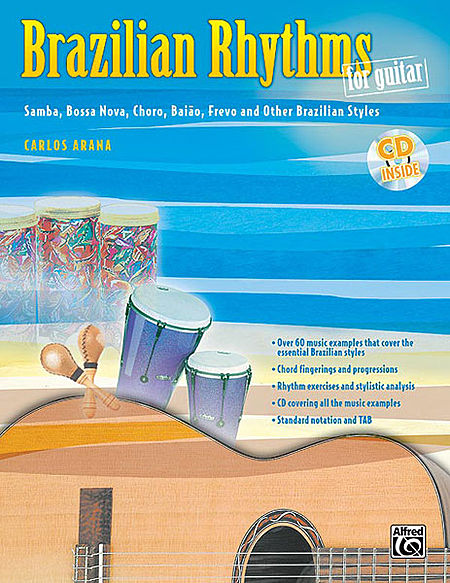
BRAZILIAN RHYTHMS FOR GUITAR, Samba, Bossa Nova, Choro, Baião, Frevo, Other Styles. Arana. CD TABLATURE


Brazilian Rhythms for Guitar, Samba, Bossa Nova, Choro, Baião, Frevo, and Other Brazilian Styles
By Carlos Arana
Series: Guitar Masters Series
Category: Guitar Method or Supplement
Format: Book & CD
Instrument: Guitar

Here we will look at a few additional characteristics of each of the styles, a bit of their history, and their typical formations. SAMBA is the style generally considered most characteristic and representative of Brazilian music. Since the end of the 1870s, samba parties were frequent events in the houses of the "Bahian Aunts," women that had moved from Bahia in the north to Rio de Janeiro, which at that time was the national capital.The actual samba style originated in 1917 at the house of "Tia Ciata" ("Aunt Ciata"), a candy vendor who was one of the famous "Bah fan Aunts." The first samba recorded was "Pelo Telefone" ("By Phone"), by Donga e Mauro de Almeida, also in 1917. Samba had several influences including lundu, la habanera, the max;xe, and even tango, bits of which remain in its unique sound. The first major proponents of the style, Donga and Ismael Silva from the group Estacio (which is also the first samba school in Rio de Janeiro), were largely responsible for defining its sound. By the 1930s, the middle class had caught on to the new music, and it transformed from music played by the poor people for Carnaval into a more popular style. The major figures in this second era were Enrique Forreis (0 Almirante), Joao de Barro, and Noel Rosa the last of whom was responsible for the development of the new style called urban samba. The duo of Ismael Silva oel Rosa defined the format that samba still uses today. Others who followed these original masters include Ataulfo Alves, Wilson Batista, and Geraldo Pereira. Each gave his own particular vision of what the style was to sound like and left a body of work that has been played countless times. During the 1930s, samba. influenced by the growth of radio as a medium of communication, enjoyed a surge of growth in terms of both popularity and variety of interpretation, many of which came to have distinctive characteristics and actually evolved into new styles in their own right such as samba cancao and samba de breque. In the 1950s, samba came into contact with the new style of music called bossa nova developed by Antonio Carlos Jobim and Joao Gilberto, two young men from middle-class upbringings who lived in the southern section of Rio De Janeiro. In order to survive, samba evolved once again, this time at the hand of Cartola, an excellent composer who had written a few songs for Noel Rosa. Beginning from the time that Cartola arrived on the scene, musicians such as Paulinho da Viola and Martinho da Vila began careers that continue on to this very day.These musicians began incorporating harmonies and sounds that were closer to bossa nova (it is interesting to note the cross pollination that occurred between these styles) in their use of alterations and chord extensions in composing, which was markedly different from that which was used in the classic compositions. From that moment on, many new artists began to appear, some banding together and forming different styles, while others worked to maintain the more traditional sound. From that point on, the progression was practically non-stop with new groups of artists appearing all the time. Some artists returned to the original format while others moved on to the urban sound of Noel Rosa and his followers (passing through the style of Antonio Carlos Jobim and Chico Buarque). Some of the more notable names include Beth Carvalho, Alcione, Zeca Pagodinho, Claudio Jorge, and Aragao.

Educator and performer Carlos Arana captures Brazil's rich musical heritage with impeccable stylistic, historic, and technical analyses. The first section of this book covers the fundamental rhythmic and harmonic characteristics of samba, bossa nova, and choro styles followed by practical applications on the guitar. The practical applications break each of the styles down to their historic and regional roots combined with examples that capture the essence of each style. The next section takes you to the northeast of Brazil with the rhythm figures of baião, toada, xote, afoxé, frevo, Marcha, and Marcha Rancho. Over 60 examples, written in standard notation and tablature, are demonstrated on the included CD. TABLATURE


I would like to begin this book by explaining a few basic facts that played a major role in shaping Brazilian music. Brazilian society is extremely easygoing and carefree, and musicians tend to place a great deal of emphasis upon artistic expression rather than on technical expertise and precision. The same holds true for other art forms, thus it is not surprising that Brazil is the home of the world's biggest party: Carnival in Rio! It is there, during Carnival, where you can experience some of the best examples of spontaneous artistic expression such as samba. The main influences on Brazilian music are the traditional Portuguese music brought by the Conquistadors, the exotic rhythms of the African slaves, and the native music of the indigenous inhabitants. Other influences such as American jazz also played a role in the way the music evolved. This can be seen, for example, in composer Antonio Carlos Jobim's use of harmonic structure. He often borrowed certain aspects of Claude Debussy's vertical harmony dating back to the late 19th century. Jobim's characteristic use of alterations and extensions created a kind of tonal complexity which, when combined with certain rhythmic patterns, defined the style of music that has come to be known as bossa nova. It is this fusion of styles which created the definitive sound of Brazilian music, and consequently left its mark on a variety of other musical genres which developed later. For a musician attempting to understand and assimilate the sound of Brazilian music, it is important to understand how all of these complex forces, so deeply rooted in Brazil's popular culture, worked together to form the music. This book uses a thoroughly tested method for providing the reader with a practical understanding of how to play Brazilian rhythms, so that over time the execution can become second nature and playful in terms of the general feel. The first portion of this book provides an in-depth look at the most common rhythmic patterns and syncopations used in samba and the other styles we will study. Following this, we will begin to look at the harmonic structure, including the typical chords and the characteristic chord progressions used by Brazilian guitarists that are unique to this kind of music. In Chapter 3, we will begin to look at practical applications of the chords and rhythms, in most cases using progressions from well-known songs which form the basis of the classic samba and its derivative repertoire. In Chapters 4 and 5, we will study baiao, frevo and other styles originating from the northeast of Brazil.l have recorded all of these examples on the CD so that you will be able to hear first-hand how the music should sound. As always, when learning to playa new style of music, it is highly recommended that you listen to as many different examples as possible in order to really begin to get a feel for the sound. Words and music notation are not always sufficient for describing music and there are many aspects that can only be understood by hearing them played. My goal in writing this book was to help guitarists understand and playa wonderful style of music that has not received the widespread popularity that it deserves. I sincerely hope it proves to be useful for you.


Contents

INTRODUCTION . 

Chord Symbol Notation 


SECTION 1: SAMBA, BOSSA NOVA AND CHORO 


CHAPTER 1: RHYTHM 

Example 1   

Example 2   

Rhythmic Independence Exercises   

Example 3   

Part I: Examples 4–5 .

Part 2: Examples 6–7

Part 3: Examples 8–9

Part 4: All Combinations 

Playing the Groove Components on the Guitar

Examples 10–11

Syncopating the Chord Changes   

Examples 12–13

Rhythmic Independence Exercises -Application 

Examples 14–15

Syncopating the Bass Line

Example 16 


CHAPTER 2:HARMONY 

Characteristic Chord Progressions of Samba, Bossa Nova, and Choro

Inverted Chords

Four-Voice Chords with Extensions andAlterations 

Open Chords

Characteristic Chord Progressions  

Major and MinorVamps with Line Clichés

IV – ivTurnaround to I 


CHAPTER 3: PRACTICALAPPLICATION OF RHYTHMIC PATTERNS

Examples 17–28: Samba Patterns 1–12 

Variations of the Samba Style 

Example 29: Samba Canção

Examples 30–31: Partido Alto Patterns 1–2

Examples 32–33: Samba-Rock/Funk Patterns 1–2

Example 34: Samba-Reggae   

Example 35: Samba Exercise 1 

Example 36: Samba Exercise 2

Page    CD Track

Bossa Nova  .

Examples 37–44: Bossa Nova Patterns 1–8 

Examples 45–46: Bossa Nova Exercises 1–2   

Chord Melody

Example 47: Chord Melody/“Gentle Rain”

Choro 

Basic Choro Pattern  

Choro Variations 1–5   

Examples 48–52: Choro Patterns 1–5

Example 53: Choro Exercise 

Final Considerations for Section I   


SECTION 2: RHYTHMS FROMTHE NORTHEAST OF BRAZIL   


CHAPTER 4: BAIÃO   

Basic Rhythm Patterns

Exercises 1–10                            

Application on the Guitar  

Example 54: Baião Pattern

BaiãoVariations:Toada,Xote andAfoxé   

Example 55: Baião Pattern 1 

Example 56: Baião Pattern 2 

Example 57: Xote Pattern 2

Example 58: Afoxé Pattern 


CHAPTER 5: FREVO

Basic Rhythmic Patterns

Exercises 1–7

Application on the Guitar

Example 59: Frevo Exercise  

    Example 60: Frevo Pattern 

    Example 61: Marcha Rancho Pattern 1

Example 62: Marcha Rancho Pattern 2


APPENDIX:Additional Style Considerations

Samba   

Bossa Nova 

Choro 

Baião

Frevo

Discography   

Bibliography

Prezzo: €22,99
€22,99
Condividi contenuti