Italiano
 English
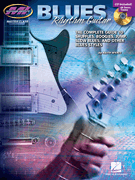
BLUES RHYTHM GUITAR Musicians Institute Keith Wyatt Libro CD TABLATURE Shuffles-Boogies-Jump

BLUES RHYTHM GUITAR, Mus. Inst. Keith Wyatt. SHEET MUSIC BOOK WITH CD & GUITAR TABLATURE.
LIBRO METODO DI MUSICA BLUES CON CD.
SPARTITI PER CHITARRA CON :
ACCORDI, PENTAGRAMMA E TABLATURE.
Series: Musicians Institute Press
Publisher: Musicians Institute Press
softcover with CD - TAB
Author: Keith Wyatt
Blues Rhythm Guitar concentrates on the heart of blues music: the rhythm. You'll learn the crucial elements of the style that no guitarist should be without, including blues changes and variations, several shuffle rhythms, slow and fast blues rhythms, how to combine different rhythm parts, and much more. The included CD demonstrates all the concepts and features rhythm tracks so you can try out your newfound skills with a full band. 112 pages
BLUES RHYTHM GUITAR
MASTER CLASS
The Complete Guide to Shuffles, Boogies, Jump, Slow Blues, and Other Blues Styles
by Keith Wyatt
Introduction
The heart of blues lies in the rhythm. Rhythm is not just a back-up part; it's the essential
glue that ties everything together, from the underlying beat of the drums to the vocals and
solos. With a great rhythm feel, you don't need much else. Conversely, without a great rhythm
feel, nothing else amounts to much. Ever since electricity unleashed the guitar as a blues solo
instrument, players have tended to focus the bulk of their time and effort on developing the
guitar's single-note voice, but two facts about guitar playing can't be ignored: First, most of
your career as a player is spent backing somebody up. Second, your solos will always be
inspired, or limited, by your sense of rhythm. Any attempt to separate great blues guitar playing
into "licks" and "rhythm" is ultimately meaningless-neither B.B. King nor Albert King play
many chords, but their phrasing is profoundly rhythmic. At the other extreme, you won't hear
many solos on a John Lee Hooker record, but he built an entire career on a distinctive rhythm
style. After a century of blues-guitar history, it's still the rhythm that holds it all together.
This book is specifically focused on blues rhythm guitar, but the principles of rhythmic
phrasing (e.g., how to capture a drum beat on the guitar, how to break down chords into
usable fragments, and how to mesh with other musicians) go beyond blues-specific vocabulary;
they apply to any groove or musical style. The blues developed during a period of time
in which the dance rhythms of American popular music were almost universally based on the
eighth-note triplet shuffle, and the bulk of this book is devoted to playing that rhythm at various
tempos. For decades, though, artists have been blending blues with other dance
grooves, from funk and R&B to Latin, rock, and disco. (Stevie Ray Vaughan made his debut
on a David Bowie dance-pop record, after all). Today, it's rare to find a blues band that doesn'
t incorporate a variety of grooves in its set, but the feel of the shuffle is still at the heart of it
all. In the end, this book is for anyone who wants to become a better guitar player-period.
How to Get the Most Out of This Book
To get started, you need to at least know the following:
1. The names of the notes on the sixth and fifth strings.
2. How to play major, minor, and dominant seventh chords in both open and barre chord
(movable) voicings.
If you don't have this knowledge under your fingers yet, practically any beginner guitar
method will provide it. (Check out Guitar Basics, by Bruce Buckingham [MI Press/Hal
Leonard], in particular). You might also want to pick up a basic theory book that explains
chord and scale construction (why a ninth chord is called a ninth chord, how scale tones are
numbered, and so on). A good (and admittedly biased) recommendation is Harmony and
Theory: The Essential Guide, by Keith Wyatt and Carl Schroeder (MI Press/Hal Leonard).
If you're a beginning guitar player or new to playing blues, Chapters 1 and 2 cover the
fundamentals of blues rhythm and chords. If you're a more advanced player or you want to
concentrate on expanding your blues rhythm vocabulary, you may want to start from Chapter
3, or just browse through the chapters and listen to the CD until something catches your
attention. The material is not arranged from "easy" to "difficult"-at any point along the way
you may find things that are challenging to your brain and to either, or both, hands. What I've
attempted to do is to break blues rhythm playing into segments, so that by learning how different
rhythm patterns are developed and how they relate to the other instruments in the
band, you can learn to create your own parts.
Table of Contents:
Introduction
How to Get the Most Out of This Book
How to Use the CD
Part I: Medium Shuffles and the 12-Bar Blues
Chapter 1: The Shuffle
Chapter 2: Blues Changes
Chapter 3: Medium Shuffle Part I: Low-range Rhythms
Chapter 4: Medium Shuffle Part II: Mid-range Rhythms
Chapter 5: Medium Shuffle Part III: High-range Rhythms
Chapter 6: 12-bar Variations
Chapter 7: Combining Rhythm Parts
Summary of Part I
Part II: Beyond the Medium Shuffle
Chapter 8: Slow Blues
Chapter 9: Fast Blues
Chapter 10: Beyond the 12-bar Form
Chapter 11: Beyond the Shuffle: Other Rhythms in Blues
Summary of Part II
Appendix
CD Track Listing
Suggested Listening
Guitar Notation Legend
Description
Straight Eighth Notes
Eighth-note Triplets
Triplet Shuffle
Accented Shuffle
Accented and Muted Shuffle
Boogie Pattern
Boogie with Accented Downbeats
Boogie with Accents and Muting
Turnaround in the Key of A
Turnaround in the Key of D
Ending in the Key of A
Ending in the Key of D
Adding the 7th
Separate, Sustained Notes
Adding Bass Notes with the Fourth Finger
Adding Bass Notes while Shifting Position
12-bar Walking Bass Pattern
Bass Riffs
Slapping/Muting Technique
12-bar Bass Riff
Upbeats
Chord Riffs
Riff-chord Variations
Riff Chord
Picking the Fourth String Separately
Sliding into Riff Chords
Legato and Staccato Phrasing Variations
Combined Legato, Staccato and Dynamics
Horn Riff Phrasing
Half-step Embellishment
Two-bar Riff with Whole-step Embellishment (R6)
Two-bar Riff with Whole-step Embellishment (RS)
12-bar Horn-section Riff with Embellishment
Robert Junior Ninth-chord Arrangement
Horn Riff with 13th Chords
Two-bar Horn Pattern Over a Slow Change
Two-bar Horn Pattern Over a Quick Change
B over A
Chicago Turnaround
Adding the IV Chord to the Turnaround
Adapting Two-bar Horn Pattern to the Turnaround
Four Turnaround Examples
Open-string Turnaround in the Key of E
"From the Turnaround" in the Key of G
Regular and Final Turnarounds
"Three Times Around" Ending
Boogie and Fill
Substituting the 4th
Expanding the Fill
Moveable Boogie and Fill
12-bar Moveable Boogie and Fill
Thumb-over Four-string Boogie
E Walking Line
Adding Upstrokes
Walking Line on A, with Upstrokes
V-IV (B-A) Walking Pattern and Turnaround
12-bar Shuffle in E
12-bar Combination Rhythm in G
Adding Chord Embellishments
Hybrid-picked Combination Rhythm
) Slow Blues Bass Riff
Quick-change 12-bar Blues in A
T-Bone-style Slow Blues Rhythm
Phrasing Combinations
12-bar Triplet Rhythm
Jump Blues Walking Line
Uptempo Boogie Pattern
Uptempo Mid-range Chord Riff
Organ-style Rhythm
Albert Collins-style Chord Voicings
Jump Horn Riffs w/ Variations
Two-note Horn-style Rhythm
Two-bar Repeating Riff
Bass Line Combined with Chord Punches
Bass Pattern combined with Two-note Chords
Boogie #1
Boogie #2
Boogie #3
Two-beat Bass Riff
Two-beat Bass Riff
Two-beat Bass Riff
Two-beat Accents and Fills
Eight-bar Progression, Version 1
Eight-bar Progression, Version 2
Sixteen-bar Progression
Blues Rumba Chord Pattern
Blues Rumba Bass/Chord Combination
R&B Combined Guitar/Bass Rhythms
"Chicks" in C
R&B Triplet Ballad
Minor Blues Rhythm with "Chicks & Fills"
Standard blues changes and form
Developing a strong shuffle feel
Useful rhythm parts in high, middle, and low ranges
Fast blues, slow blues, and beyond the 12-bar form
With a great rhythm feel, you don't need
much else. Conversely, without a great
rhythm feel, nothing else amounts to much.
This book is specifically focused on blues
rhythm guitar, but the principles of rhythmic
phrasing (e.g., how to capture a drum beat
on the guitar, how to break down chords
into usable fragments, and how to mesh
with other musicians) go beyond bluesspecific
vocabulary; they apply to any
groove or musical style.