LIBRO - BOOK

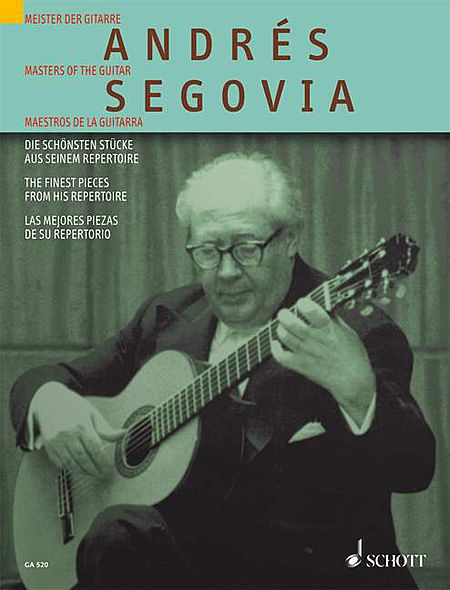
SEGOVIA ANDRES FINEST PIECES REPERTOIRE Frescobalda-Chaconne Bach-Burlesca Torroba LIBRO

SEGOVIA ANDRES, THE FINEST PIECES FROM HIS REPERTOIRE. Le famose trascrizioni di Segovia: La frescobalda -Bach, chaconne -Segovia, estudio -Chopin, mazurka, e molti altri pezzi.

LIBRO DI MUSICA CLASSICA,

SPARTITI PER CHITARRA CON PENTAGRAMMA.

ANDRÉS SEGOVIA The Finest Pieces from His Repertoire
Editor or Arranger: Andrés Segovia
Composer: Various Composers

Andrés Segovia (1893-1987) fu il più grande chitarrista del Novecento. Interprete, dunque, ma anche trascrittore e compositore. Il suo pezzo più bello e famoso è Estudio sin Luz, una malinconica canzone in Si minore.

Andreés Segovia (Linares, 1893 – Madrid, 1987)

Anche se il suo apporto come compositore fu modesto – e da lui stesso tenuto in scarsissima considerazione – Andrés Segovia, il più grande chitarrista del novecento, esercitò un possente influsso nella formazione di un nuovo repertorio di musiche originali per chitarra: una descrizione del lavoro che egli svolse in quest’area è premessa imprescindibile per la comprensione delle origini di quella che, non senza motivo, è stata chiamata la rinascita della chitarra. Andrés segovia nacque il 21 febbraio 1893 a Linares, cittadina della provincia andalusa di Jaén. in nessuno dei suoi scritti autobiografici si trova il minimo accenno alla figura paterna, completamente rimossa, mentre la madre è ricordata perché, quando il piccolo aveva cinque anni, lo affidò agli zii. Con questi, abitò dapprima a Villacarrillo e poi a Granada. nell’infanzia, imparò a suonare la chitarra flamenca. Ebbe la rivelazione della chitarra “classica” intorno ai dieci-dodici anni, ascoltando un dilettante granadino. Da quel momento, la sua vita fu segnata da un unico ideale e, non potendo contare su un’istruzione musicale regolare (allora la chitarra non era inclusa nei programmi delle scuole di musica) si formò come autodidatta. Com’egli amava ripetere negli anni della gloria: «Fui maestro e allievo di me stesso e, grazie agli sforzi di entrambi, nessuno dei due fu scontento dell’altro». Esordì con un concerto al Centro Artistico di granada nel 1909, lo stesso anno in cui Francisco Tárrega lasciava questo mondo. Cercò contatti con gli allievi del maestro valenciano, che però gli opposero i loro ottusi pregiudizi.

Fernando Sor

Essenzialmente nelle composizioni per chitarra sola e per due chitarre, il genere nel quale riuscì a esprimersi più congenialmente. La sua biografia – scritta dal musicologo britannico Brian Jeffery e validamente integrata dagli apporti di altri musicologi quali Josep María Mangado, Richard Long, Emili olcina, Matanya ophee – ci rivela un uomo dal carattere difficile e finanche conflittuale, affetto – almeno per quanto riguarda la sua presenza nel mondo della chitarra, allora fittamente popolato – dal complesso del primo della classe e acribiosamente impegnato nel dimostrare al mondo la propria superiorità. Questa era di per sé evidente nelle pagine per chitarra che egli andava scrivendo e non avrebbe avuto bisogno di alcun sostegno polemico: l’osservazione si rende necessaria di fronte al fatto che una considerevole parte della Méthode pour la Guitare, pubblicata a Parigi nel 1830, è spesa da sor nel difendersi dalle sciocche insinuazioni di chitarristi suoi coevi, dei quali non sapremmo nulla, se non fosse lui stesso a informarci della loro insignificante esistenza. sor era figlio di una famiglia della borghesia catalana ed era perciò destinato alla carriera nella pubblica amministrazione o nell’esercito. il padre, un impiegato, non incoraggiò, ma tollerò il suo spontaneo avvicinamento alla musica e, fin dall’infanzia, lo portò ad assistere alle rappresentazioni operistiche, quasi tutte di autori italiani. Alla prematura morte del genitore, il fanciullo, che cantava spontaneamente arie da opera, aveva ricevuto qualche lezione di violino e suonava la chitarra di suo, fu portato all’Abbazia di Montserrat, dove prosperava una famosa schola cantorum. L’istruzione musicale di sor ebbe quindi anche un’impronta polifonica, che più tardi si rivelerà chiaramente nella sua musica per chitarra.


Contents:

- Aria con Variazioni from La Frescobalda (Frescobaldi)

- Chaconne (Bach)

- Gavotte 1 e 2 dalla Suite per violoncello No. 6 in Re BWV 1012 (Bach) 

- Passacaglia (Couperin)

- Sonata from 8 Aylesforder Pieces (Händel)

- Sonata (D. Scarlatti)

- Sonatine (Benda)

- Cantabile (Vanhall)

- Minuetto (Vanhall)

- Variations on Das Klinget so herrlich from The Magic Flute (Sor)

- Bittendes Kind (Schumann)

- Fürchtenmachen from Kinderszene, Op. 15 (Schumann)

- Waltz, Op. 39, No. 8 (Brahms)

- Mazurka, Op. 63, No. 3 (Chopin)

- Tango, Op. 165, No. 2 (Albéniz)

- Sonata meridional (Ponce)

- Thème varié et Finale (Ponce)

- Tres Canciones Populares Mexicanas (Ponce)

- Hommaga à Tarrega (Turina)

- Fandanguillo (Turina)

- Serenata burlesca (Torroba)

- Suite castellana (Torroba)

- Mazurka (Tansman)

- Estudios (Segovia)

- Estudios sin luz (Segovia)

- Tonadilla auf den Namen Andrés Segovia, Op. 170, No. 5 (Castelnuovo-Tedesco).

94 pages

Prezzo: €29,99
€29,99

RIMSKY-KORSAKOV SHEHERAZADE FOR GUITAR LARRY CORYELL TABLATURE CHITARRA LIBRO SPARTITI

RIMSKY-KORSAKOV : SHEHERAZADE FOR GUITAR, ARRANGED BY Larry Coryell. SHEET MUSIC BOOK WITH STANDARD NOTATION AND GUITAR TABLATURE. 

LIBRO DI MUSICA CLASSICA.

SPARTITI PER CHITARRA CON :

PENTAGRAMMA E TABLATURE.


1ST MOV. - I THE SEA AND SINDBAD'S SHIP. 

2ND MOV. - II THE STORY OF THE CALENDER PRINCE. 

3RD MOV. - III THE YOUNGF PRINCE AND YOUNG PRINCESS

4TH MOV. - IV FESTIVAL AT BAGHDAD - THE SEA - THE SHIPWRECK

Prezzo: €199,99
€199,99

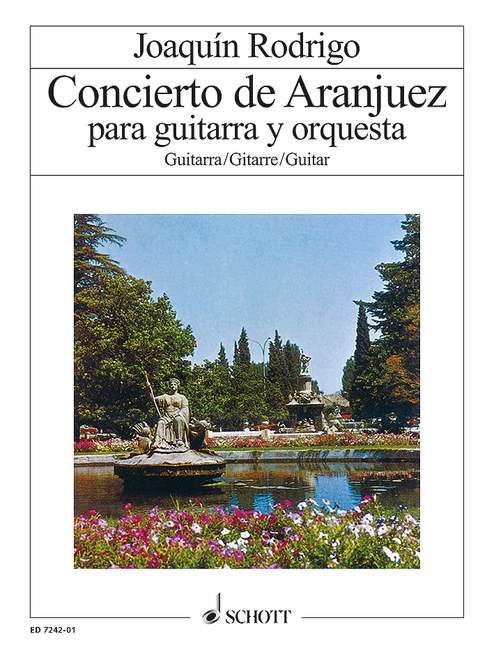
RODRIGO JOAQUIN CONCERTO CONCERTO DE ARANJUEZ ROMERO EDITION CHITARRA SPARTITI

RODRIGO JOAQUIN, CONCERTO DE ARANJUEZ. Ed. Romero, solo la parte della chitarra.

SHEET MUSIC BOOK FOR CLASSICAL GUITAR. 

LIBRO DI MUSICA CLASSICA .

SPARTITI PER CHITARRA CON PENTAGRAMMA. 

DITEGGIATURA ROMERO.

Rodrigo composed the Concerto de Aranjuez in 1940 on his return to Spain after the Civil War and debut performance of the work in Barcelona founded his international reputation. Concerto de Aranjuez is a musical reverie on the gardens of the Baroque summer palace of Aranjuez that only a blind composer, like Rodrigo, could have produced. This work immediately became the most recognisably Spanish work of the twentieth century.

This is the solo Guitar part, which has been edited by Angel Romero.


Content :

- I Allegro con spirito

- II Adagio

- III Allegro gentile

ISMN: 979-0-001-07585-5
Performance duration: 20'0"
9 November 1940 Palau de la Música Catalana, Barcelona · Dirigent: César Mendoza Lassalle · Regino Sainz de la Maza, Gitarre · Orquesta Filamónica de Barcelona
Year of composition: 1939
page number: 28

Prezzo: €19,99
€19,99

ERIK SATIE FOR GUITAR PETER CHARLES KRAUS CHITARRA SPARTITI LIBRO GYMNOPEDIES GNOSSIENNES

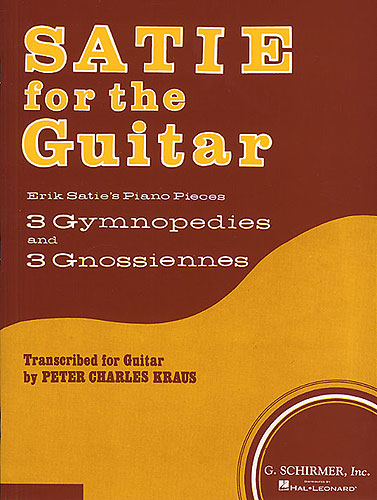
SATIE FOR GUITAR. Peter Charles Kraus. SHEET MUSIC BOOK FOR GUITAR. 

LIBRO DI MUSICA CLASSICA. 

SPARTITI PER CHITARRA CON: PENTAGRAMMA. 

Trascrizioni per chitarra classica di 3 Gymnopedies e 3 Gnossiennes, del compositore francese. Alfred Erik Leslie-Satie nacque a Honfleur nel 1866. Studiò in vari conservatori, ma il suo spirito ribelle non si adeguò alle regole tradizionali; (invece della frase che tempo fa' andava di moda alla televisione e tra la gente: "Non capisco ma mi adeguo"; Satie si sarebbe probabilmente espresso: "Capisco e non mi adeguo"). Le "3 Gymnopedie" sono del 1888, e il nome deriva da una danza dell'antica Grecia; mentre il termine delle "3 Gnossiennes" del 1890, è riferibile a Knossos, l'antica città dell'isola di Creta, ov'era situato il mitico labirinto del minotauro. Questi pezzi per piano fanno parte del primo periodo compositivo; senza divisioni di battute, basati su accordi complessi, di settime, none, undicesime. Terminata questa fase, il musicista oramai trentenne, si interessa alla musica dei café-concert; suona il piano nei cabarets, e diventa amico degli artisti bohemiens di Montmartre. In perenne contrasto con l'accademismo e l'impressionismo musicale di Debussy, Eric Satie combatterà la musica "dotta" a colpi di "musica da tappezzeria" e la sua trama musicale affine a un collage cubista, attirò l'attenzione di Picasso, Diaghilev, Cocteau, Picabia, diventando così il loro animatore. Con il gruppo dei 6, diede vita a rivoluzionari spettacoli e balletti. Liberatosi delle provocazioni e abbandonate le polemiche, l'opera nella quale Satie esprime la propria poetica è "Socrate" del 1918. Il neoclassicismo di Stravinsky risentirà poi delle sue sonorità. Satie morì a Parigi nel 1925 povero ma celebre.

Guitar Solo
Series: Guitar Collection
Publisher: G. Schirmer, Inc.
Editor: E Kraus
Composer: Erik Satie
Contains 3 Gymnopedies and 3 Gnossiennes. 24 pages

Prezzo: €13,99
€13,99

PUMPING NYLON GUITAR TABLATURE 120 STUDI GIULIANI FLAMENCO BACH DOUBLE TENNANT TREMOLO TAB

PUMPING NYLON, IN TAB. THE CLASSICAL GUITARIST'S TECHNIQUE HANDBOOK.

LIBRO DI MUSICA CLASSICA, 

SPARTITI PER CHITARRA CON:

PENTAGRAMMA, TABLATURE.

TECNICA, METODO, CLASSICA FLAMENCO

Manuale completo che comprende: i 120 studi per arpeggio di Giuliani, esercizi per di controllo della velocità, le scale, il tremolo, la tecnica del flamenco, il suono, le unghie della mano destra, con esempi da J.S. Bach. TABLATURE

Scott Tennant, world-class classical guitarist and well-respected guitar eduactor, has brought together the most comprehensive technique handbook for the classical guitarist. It is presented here in both standard music notation and TAB. In addition to technical information not available elsewhere, he has compiled selections from Giuliani's 120 Right-Hand Studies; musical examples by Bach, Turina, Rodrigo and others; Tarrega arpeggio studies; and original compositions by Andrew York and Brian Head. Essential information and a great sense of humor are effectively combined in this best-selling book.


Author Preface

Welcome! This is my little book about guitar technique. I want to make it clear from the start that the material in this book is meant to reflect my own way of doing things on the instrument. The exercises are those that have helped me, some of which I still practice every day.

The goal of Pumping Nylon is to offer ideas that will help solve various technical problems. The idea was to steer clear of assembling anything that resembled a method book. Rather, my intent was to focus only on specific technical issues which I felt had not been clearly explained elsewhere. Generally, the issues dealt with in this book are those that have been brought up time and time again by students in master classes and lessons over the past ten years or so.
The exercises and musical examples have been chosen because of their unique technical challenges. For instance, the Bach DOUBLE was taken from a solo guitar arrangement, stripped of all its bass notes and more comfortable fingerings, and transformed into a very effective string-crossing and scale study.
I don't pretend to have addressed every issue. (There are too many out there for one book!) The reader, however, is strongly encouraged to invent hislher own exercises whenever necessary, since all of our technical needs are so very different.
I hope you find a few answers to some of your questions. Go get 'em!

I would like to thank ...
Nat Gunod, for coaching me through this process for the last two years; Brian Head and Andy York for composing their wonderful "made-to-order" etudes; Billy Arcila for posing for the photos that were used to create the illustrations; Durmel DeLeon for the photography; John Dearman and Matt Greif for their technical assistance; an endless list of friends for their constant encouragement; and the students at the ational Guitar Summer Workshop, San Francisco Conservatory and the University of Southern California for being (not always voluntary) "guinea pigs" for much of the [I1aterial contained herein.
And special thanks to Ron Krown at Alfred Publishing for encouraging us to do this new edition.

Glossary of Signs
This list will help you to interpret the various markings in the music.
1, 2, 3, 4 Left hand fingers, numbered from index (1) to pinky (4).
p, i; m, a, Right hand fIngers: p = thumb, i = index, m = middle, a= ring finger.
The six strings of the guitar, numbered from low E 6 to high E 0.
IV, V, VII etc Roman numerals. Here is a quick review of these symbols: 1=1, 11=2, III=3, IV =4,
V=5, V1=6, VII=7, VIII=8, IX=9, X=IO, XI=11 and XII=12.
BII4 The B indicates a barre. The Roman numeral indicates the fret to be barred, and
the small subscript arabic numeral indicates the number of strings to be barred.
So, this symbol would indicate to barre four strings at the second fret.

-1, -2, -3, -4 A dash in front of a fingering indicates a guide finger shif . A shift is a movement
from one position to another. is a finger that can be used just before
and just after a shift. For instance, if the 4th finger has been used to play G on the
J st string. 3rd fret, and then moves to play A on the 1st string, 5th fret, it will be
marked -4.


Editor Preface
I hope you will enjoy this new edition of Scott's gratifyingly popular book. As a response to public
demand, we are happy to provide a version of the book that includes tablature. Hopefully, this will make the book useful to more guitarists. After all, everyone who plays the guitar has something to gain from learning some c1assical guitar technique, and something to learn from a great teacher.
This book evolved from a warm-up routine and technical regimen that Scott Tennant began teaching and writing about several years ago. It is this daily warm-up that has inspired the whimsical title.
Pumping nylon. But in the following pages Scott has done far more than merely map out an exercise routine.
He has provided a wealth of technical information not readily available elsewhere. He has also compiled a variety of both well- and lesser-known technical exercises such as the 120 Right Hand Studie" of Mauro Giuliani and some arpeggio studies by Francesco Tarrega, and has offered some exercises of his own as well. It is also through Scott Tennant that four great new studies. two by Brian Head and two by Andrew York, have been written and published.

But I think he has done a lot more than even those things.
What students and teachers alike will find inPumping Nylon is a joyful attitude toward problem-solving on the classical guitar. There is an underlying message that says if you are willing and able to look at an issue from a different perspective, and if you can bring the same creative powers that you bring to your music-making to your technical work, you can overcome obstacles. Furthermore. there's no law that says it can't be fun.
Anyone who has studied classical guitar is going to hnd ,lOl/lethùl.9 in this book that directly contradicts what you have been taught-or what you teach-about ,1olllethùl.q. This is inevitable. But ifyou dismiss this work for that reason. you will be missing much. I encourage you to read ono Take a look at ali the ideas presented here by this great player and teacher. You will come away better for it.
I expect that for years to come it will be commonplace to hnd well-worn copies of this book in students' hands. I am sure that for Scott Tennant, as for myself, that will be the biggest reward for this efrort.
Many thanks to the wonderful people at Alfred Publishing-especially the M.I. team-for helping to
make this and many other National Guitar Workshop books a reality.
Nathaniel Gunod Litchheld, Connecticut
July, 1997
How to Read Tablature
4th string,5th fret
An open C chord
T
A
B
An H over a slur - indicates a hammer-on.
A P over a slur - indicates a pull-off.
1st stringo 10th Fret ] __Played together
2nd string, l0th fret

Nathaniel Gunod has edited many guitar books including
Benjamin Verdery's by Howard \Vallach, and Play AIM. co-authored Benjamin Verdery's
instructional directed the video, is the author of Cla. Guitar. A recital·ist on Baroque. Classical period and modern c1assical guitars, he has taught students from ali over the world at the Peabody Conservatory of Music and the National Guitar Workshop. where he is Associate Director.
He is the founder of the NGSW Classical Guitar Seminar and the D'Addario Guitar Concerto Competition. Preface


Inspiration
Inspiration only lasts a relatively brief time. We alI eventually fìnd ourselves experiencing a "dry spell."
We get stuck on something in our practicing and can't seem to improve, and sometimes it may seem that we're getting worse. At times we may even think of just quitting. Have you ever felt that the joy you once had for playing is gone forever?
These are not emotions you're experiencing alone. They visit everyone now and then. OccasionalIy we need to give ourselves a break and put down the guitar for a day, a few days, or however long it takes to feel refreshed again. For those who play for a living and don't always have that luxury, some digging back into one's past might be the key. Why did you want to play the guitar in the fìrst piace? Try to recall the feelings you experienced when you fìrst decided that you really wanted to play. Perhaps recall the joy you felt when you heard that fìrst recording or concert that thrilled you. What qualities about the instrument first drew you to it?
As I have done for several circumstances in my life, it may make you feel better to jot down a few of these positive thoughts on a piece of papero Then, when you hit another rough period, you can read through them.

In Conclusion
Music is the most powerful of ali the arts. It instantly stirs up emotions, conjures visions, and offers
glimpses of other, higher dimensions. It arouses men to battle; kindles amorous passions in lovers; soothes a baby to sleep; comforts us when we grieve. It engages our hearts and our minds, and can bring out the best that we are. One can safely presume that not a single emotion, nor any human or natural event, has been left undocumented by music.
As musicians, our objective is to command the elements of music as best we can in order to tap into that other dimensiono It is our access into heaven, if only for a while. But while we are there we can take aH who are listening ith uso If just one person is uplifted by our playing and walks away feeling better than before he carne, we have made a difference. A healing has taken piace.
I very much hope that you have found at least one thing in this book that has helped you. I also hope that, as you work to improve your technique, you do not lose sight of the larger goals: to be able to express yourself freely on your instrument and to turn every note you play into great music. When you can do those things, you cease to be just a guitar player and become a healer and magician.


Table of Contents

Author' s Preface 
Glossary of Signs 
Editor' s Preface 
How to Read Tablature 
Some Do's and Don'ts 
About the Hands 
About the Body 
About Holding the Guitar- The Triangle 

The Left Hand 

Finger Placement and Accuracy 
Pressure and Release 
Pressure/Release Exercise 
Finger Exchange 
Ascending Slurs (Hammer-ons) 
Descending Slurs (Pull-offs) 
Finger lndependence 
 #3 - Opposing Motion 
#4 - Horizontal Character Builders 
#5 - Odair's Favorite Drill 
#6 - "The Spider" 

The Barre 
Weight vs. Pressure 
Being Selective 
Summing It AlI Up 
Quadrivial quadrary by Andrew York - 

A Four-Voice Study for the Left Hand : 
Fanfare by Brian Head-A Slur Study 

The Right Hand 
Tone Production 
Nail Length and Shape : 
Nail Length 
Nail rypes 
Shaping the Nails 
Angle and Placement 

Rest Stroke (Apoyando) 
Position 
The Movement 
Planting 
Press ure 
Release

Free Stroke (Tirando) 
Right-Hand Finger lndependence 
Walking 
Arpeggios from Tarrega's The Complete TechnicaL Studies 

The Thumb 
Shaping the Nail 
Develop That Thumb! 

Flamenco Techniques .
What Else Can the Thumb Do? .
Sofeare. Falseta ,
Alzapua .
Alzapua Falseta ,
Rasgueados .
Some Practical Applications .
from Turina's Sevillana .
from Turina's Rafaga .
from Rodrigo's Conciato de Aranjuez, 2nd Movement .

Daily Warm-Up Routine .
Left-Hand Walking-#l, #2 & #3 .
Ascending Slurs - #4 .
Descending Slurs - #5 .
Triplets - #6 .
Fixed-Finger Exercises-#7 & #8 .
Right-Hand Walking - #9 .
Two-Finger Rasgueados-#10 .

Tremolo .
Psychological Outlook 
Exercises .
Lopsided Tremolos .
Chant by Brian Head: A Tremolo Study .

Scales: Control and Velocity .
Misconceptions about speed .
Right-Hand Velocity .
Synchronization .
String Crossing .
Piecing Things Together .
Some Other Speed Aids .
Rhythmic Variations .
Speed Bursts .
Problem Solving in Scales .
Marking String Crossings .
Evolution of a Scale .
Scale Study - Double from the Courante, Partita No.1, BWV 1002, Johann Sebastian Bach .

Arpeggios .
Full Planting and Sequential Planting .
Giuliani's 120 Right-Hand Studies .
Practicing Tips .
Didactic Doodle by Andrew York .

Afterword .
Performance Anxiety .
Practice
Inspiration
In Conclusion 

Scott Tennant .
 

Prezzo: €24,99
€24,99

RAVEL MAURICE BOLERO GUITAR SOLO SPARTITO CHITARRA CLASSICA TABLATURE LIBRO FINGERSTYLE

RAVEL MAURICE, BOLERO, GUITAR SOLO. SHEET MUSIC FOR GUITARIST . 

LIBRO DI MUSICA CLASSICA. 

TRASCRIZIONE PER CHITARRA SOLA DEL FAMOSO BOLERO DI RAVEL. 

SPARTITO CON PENTAGRAMMA E TABLATURE. 


Maurice Ravel: Bolero For Classical And Fingerstyle Guitar

Ravel's Bolero for Classical Guitar by Maurice Ravel (1875-1937). Arranged by Jerry George. For guitar solo. Solo. Classical. Sheet Music. Text Language: English; Standard notation and tablature. 4 pages. 
With Text Language: English; Standard notation and tablature. Classical.

Though he was accused of imitating his predecessor Debussy, Maurice Ravel (1875-1937) is seen today as a successor. One critic compared the two saying that where Debussy shimmers, Ravel glitters. This is true. Ravel's clear-cut lines are quite spectacular and set apart from Debussy's hazy contours. Bolero is the perfect example of his uniqueness. As with many masterpiece themes, Ravel's Bolero was brought to life in modern day film as the musical backdrop to the comedic classic "Ten". This award winning film featured the most glamorous model of its day, Bo Derek and co-star Dudley Moore. Guitar players can experience this French composer's brilliant use of percussive Latin nuances by learning this famous piece. This fingerstyle classic published by Santorella Publications transcribed by Jerry George, includes standard notation, tablature and suggested fingerings.

Prezzo: €29,99
€29,99

RIMSKY-KORSAKOV SCHEHERAZADE FOR 2 GUITARS KAZUHITO YAMASHITA CHITARRA SCORE BOOK

RIMSKY-KORSAKOV SCHEHERAZADE FOR 2 GUITARS, KAZUHITO YAMASHITA. SHEET MUSIC BOOK FOR 2 GUITARS.


LIBRO DI MUSICA CLASSICA.

SPARTITI PER DUO DI CHITARRA  .

PENTAGRAMMA. 


Movimenti
Shahrazād è composta da quattro movimenti:

I. Il mare e la nave di Sinbad
Largo e maestoso – Lento – Allegro non troppo – Tranquillo (mi minore – mi maggiore)

Il primo movimento è formato da diverse melodie e si presenta in forma A B C A1 B C1. Il truce motivo al basso che apre il primo movimento rappresenta il tema del Sultano, formato da quattro note in scala discendente; subito dopo si sente il tema di Shahrazād, una dolce e sensuale melodia per violino solo accompagnato dall'arpa.

II. Il racconto del principe Kalandar
Lento – Andantino – Allegro molto – Vivace scherzando – Moderato assai – Allegro molto ed animato (si minore)

Il secondo movimento si presenta come un tema con variazioni in tre sezioni. Le variazioni cambiano solo in base all'accompagnamento orchestrale. All'interno della linea melodica generale, una sezione veloce evidenzia i cambiamenti di tonalità e struttura.

III. Il giovane principe e la giovane principessa
Andantino quasi allegretto – Pochissimo più mosso – Come prima – Pochissimo più animato (sol maggiore)

Anche questo movimento è in forma ternaria ed è il più semplice per forma e contenuto melodico. La sezione intermedia sembra basata su un tema di Tamara, mentre le sezioni esterne hanno un contenuto melodico cantabile.

IV. Festa a Baghdad — Il mare – Naufragio della nave sulle rocce sormontate da un guerriero di bronzo
Allegro molto – Lento – Vivo – Allegro non troppo e maestoso – Tempo come I (mi minore – mi maggiore)

L'ultimo movimento è legato a tutti i movimenti precedenti ed aggiunge alcune nuove idee, tra cui un'introduzione sia dell'inizio del movimento che della sezione Vivace basata sul tema del Sultano, una ripetizione del tema di Shahrazād al violino e una ripetizione di motivo di fanfara per rappresentare il naufragio della nave. Un'ultima relazione conflittuale tra il tema del Sultano alla sottodominante minore rispetto alla cadenza alla tonica del tema di Shahrazād si risolve in una conclusione fantastica, lirica e finalmente pacifica.


https://youtu.be/ktphsuOPHuA?si=fSOoMM6p290jWgRp

Prezzo: €79,99
€79,99

PUMPING NYLON INTERMEDIATE TO ADVANCED REPERTOIRE Scott Tennant CD GUITAR CHITARRA METODO LIBRO

PUMPING NYLON, INTERMEDIATE TO ADVANCED REPERTOIRE. SHEET MUSIC BOOK WITH CD. METHOD FOR GUITAR.  

LIBRO METODO DI MUSICA CLASSICA CON CD.

SPARTITI PER CHITARRA CON PENTAGRAMMA. 

Supplemental Repertoire for the Best-Selling Classical Guitarist's Technique Handbook

By Scott Tennant
Item: 00-18490
UPC: 038081174266
ISBN 10: 0739000748
ISBN 13: 9780739000748
Series: Pumping Nylon Series
Category: Classical Guitar Method or Supplement
Format: Book & CD
Instrument: Guitar
 
The pieces in this book are selected and designed around the various techniques addressed in the best-selling book Pumping Nylon. They are offered as an extension of the excercises presented in that book, and to provideconcert pieces in which to apply the various techniques discussed. The emphasis here is technique-building repertoire appropriate for study and concert performance.
 
Classic Works by Coste, Dowland, Narvaez, Giuliani, Luis Milan, eccetetera ... 
 
New compositions included are by Adam del Monte, Joe Diorio, Brian Head and Carlos Rivera.
 
Technique-building repertoire appropriate for study and concert performance.
 
Also included is the Cadenza from Rodrigo's Concierto de Aranjuez.
 
The CD is beautifully played by Scott Tennant and Adam del Monte.


“PRACTICE DOES NOT MAKE PERFECT.

PERFECT PRACTICE MAKES PERRFECT”

Welcome to the second installment of the repertoire supplements to Pumping Nylon. As the subtitle indicates, these pieces are more advanced than the repertoire in the previous installment. They are primarily concert pieces instead of the shorter, more pedagogical etudes presented in the wy to EarLy Intermediate book. Therefore, the pieces tend to be longer and much more substantial. Consider this book to be a brief representation of the types of pieces that contain specific technique-building elements (such as concentrated scales, left-hand slurs, arpeggios, tremolo and the like). When practiced correctly and with the proper intent, they will aid in developing your guitar-playing skills. In our continuing quest to serve you something new and tasty to consume, we have made an effort to put some newer pieces on your plate. We hope to not only help you enjoy significant progress, but to also open your eyes and ears to new, delightful concert pieces to perform for the enjoyment of others. A "checklist" of specific issues upon which to focus-such as technical and/or musical challenges, fingering and practicing tips-precedes each piece. If taken to heart, these pieces should be of great benefit to you. As always, it is a good idea to check your progress with a teacher when problems arise, as there is no ideal substitute for expert advice. As in Pumping Nylon, I encourage you to take the ideas presented in each piece and expand on them yourself. Find other pieces that will further help you overcome any obstacles. You have what it takes to play anything, and with some mindful practice, you will!

"Love overcomes fear. Fear cannot exist in the presence of love" Pepe Romero

About the Author

Scott Tennant's reputation as a performer and teacher is known worldwide. His accolades include becoming the first American ever to win the first prize in the Tokyo International Guitar Competition in 1989, and silver-medal performances in both the 1988 Concours International de Guitare of Radio France in Paris and the 1984 Toronto International Competition. He is recording the complete solo guitar works of Joaquin Rodrigo for GHA records, including the concertos with Leo Brouwer conducting the Cordoba Symphony Orchestra. His debut solo release for Delos, "Wild Mountain Thyme," is a recording of Celtic music for the classical guitar. Born in Detroit in 1962, Scott began playing the guitar at six years of age. During his junior high and high school years, he studied classical guitar with Lee Dyament and Joe Fava. Also while growing up in Detroit, he began taking flamenco lessons with Juan Serrano. When Maestro Serrano moved to California, Scott replaced him as the accompanist for the Maria del Carmen Dance Company. He also played the bass trombone in his high school concert band and the violin in the school orchestra. Scott moved to Los Angeles in 1980 to attend the University of Southern California, where he studied with Pepe Romero and James Smith. It was during this time that the Los Angeles Guitar Quartet was formed (then the U.S.C. Guitar Quartet), and he has been touring and recording with the group ever since. As a student there, he performed in the master classes of such luminaries as Joaquin Rodrigo and Andres Segovia. He now teaches as a member of the faculty at U.S.C. The Quartet can be heard on their recordings for GHA, Delos and Sony Classical.

There is a compact disc available for this book. It includes performances of all the pieces by Scott Tennant except Rasgueado Exercise in Solea and Alzapua and Thumb Study in Solea, which are performed by Adam del Monte. Use it to help insure that you are interpreting the rhythms correctly and capturing the style of each work. The symbol above will appear to the left of each piece. The track numbers below the symbols correspond to the piece you want to hear. Enjoy!


Preface

About the author

Glossary of Signs and terms

The Frog Galliard - John Dowland

Fantasia n.18 - Luis Milan - 1536

Fantasia n.16 - Luis Milan - 1536

Veintidos diferencias de Conde Claros - Luis de Narvaez

Variations sur les "Folies d'Espagne" Op. 45 - Mauro Giuliani

  Tema

  Variation I

  Variation II

  Variation III

  Variation IV

  Variation V

  Variation VI

Etude n.11 - Napoléon Coste

Fantasia Original, Capricho a imitation del Piano, tecnica del Tremolo - Jose Vinas

Rasgueado Exercise in Solea - Adam del Monte

Alzapua and Thumb Study in Solea - Adam del Monte

Ispired by Villa Lobos etude n.1 - Joe Diorio

Study n.1 - Carlos Rafael Rivera

Plainte - Brian Head

Concerto de Aranjuez, Cadenza from Adagio  2nd movement - Joaquin Rodrigo - 1939

Prezzo: €25,99
€25,99

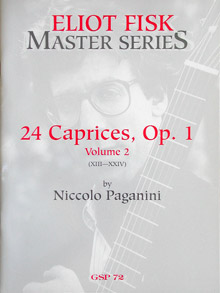
PAGANINI NICCOLO 24 CAPRICES for guitar VOL.2 The Eliot Fisk master series CHITARRA SPARTITI LIBRO

PAGANINI NICCOLO', 24 CAPRICCI OP.1. VOL.2. Dal n.13 al n.24. SHEET MUSIC BOOK FOR GUITAR, Trascrizione di Eliot Fisk. Caprices 13-24 . 

LIBRO DI MUSICA CLASSICA,

SPARTITI PER CHITARRA CON PENTAGRAMMA.


"These Caprices should be heard more often on guitar for the sake of the guitar. This is a musical feat well worth the effort&any one of the 24 could provide material for masses of practice&such a schedule should improve even the very best players. With comments, fingerings, exercises and advice from Fisk on these masterworks.&the editor has worked hard to present the reader with a solution&I can only recommend this sturdy issue to all of the Paganini devotees out there." Neil Smith, Classical Guitar Magazine

For me there are three great landmarks along the Gradus ad Parnassum of guitar technique: the
essential Etudes of Fernando Sor, the 12 Etudes of Heitor Villa-Lobos, and a final peak oftruly daunting
proportions, the 24 Cap ricci, Gp. 1, of Niccolo Paganini. John Williams opened the door to this final
possibility some years back when he showed so superbly that the Capriccio 24 could be played on the
guitar. I began to experiment with others in the set around 1977, and slowly became convinced that
a way could be found to play all 24 on the guitar in the original keys. I often felt like Dante at the start
of the Divina Commedia: lost in a dark wood with no idea how to get out: "mi ritrovai per una selva
oscura che la diritta via era smarrita."
At times this feeling approached that famous inscription over the gates of the same author's inferno:
"Lasciate ogni speranza, voi ch'entrate" ("Abandon all hope, ye who enter here!"). Nevertheless, little
by little I found ways of negotiating what had seemed impossible. Along the way a lot of people gave
encouragement. I would like to single out Antonio de Innocentis of Caserta, Italy, who, in addition
to his careful proofreading of the engravings for this edition shared with me some of his tricks of the
trade, particularly in Capricci 11, 15, and 17. Enormous artistic inspiration came from maestro
Ruggiero Ricci, who graciously shared the wisdom of over half a century's experience of performing
and living with these works of genius and who even made some specific practical suggestions on how
to transcribe some intransigent passages in parallel octaves in the first part of Capriccio 23!
At this writing, after 15 years of playing these pieces on the guitar, I can still say, time permitting, I
would happily spend an entire day practicing any single Capriccio of the 24. So rich are their
instrumental and musical possibilities. I'd like to share a few tips that have helped me along the way:
1) Isolate the difficulties: Even in the most difficult passages most of the notes are not hard to play.
It's the 10 - 20% that are truly hard to get to or from that can make an entire passage sound sloppy.
Therefore: Analyze through slow practice exactly where the difficulties lie. Practice what's difficult.
Don't be scared by what is not difficult! When you lose your fear, you play better.
2) Transpose difficult passages in the order of the cycle of fifths until you have played the difficult
passage in 12 keys. (A "passage" may be as short as 4 notes!)
3) Experiment with various rhythmic alterations of difficult passages.
 
 
24 CAPRICES, OP. 1

Volume 2

XIII Bb major: Allegro

XIV Eb major: Moderato

XV E minor: Posato

XVI G minor: Presto

XVII Eb major: Sostenuto; Andante

XVIII C major: Corrente; Allegro

XIX Eb major: Lento; Allegro assai

XX D major: Allegretto

XXI A major: Amoroso; Presto

XXII F major: Marcato

XXIII Eb major: Posato

XXIV A minor: Quasi Presto

Paganini originally divided the Caprices into three books: I - VI, VII - XII, and XIII - XXIV

Prezzo: €49,99
€49,99

PAGANINI 24 CAPRICES for Guitar VOL.1 ELIOT FISK master series SPARTITI CHITARRA LIBRO 1-12

PAGANINI NICCOLO', 24 CAPRICCI OP.1. VOL.1. L'opera completa dei 24 capricci trascritti per chitarra da Eliot Fisk. Dal n.1 al n.12. Vi ricordate la sfida tra Steve Vai e il giovane ragazzo nel film "crossroads" uscito in Italia con il titolo "Mississippi adventures"? Quelle scale e quegli arpeggi sono presi dal Capriccio n. 5.

SHEET MUSIC BOOK FOR GUITAR . 

LIBRO DI MUSICA CLASSICA .

SPARTITI PER CHITARRA CON PENTAGRAMMA . 

TRASCRITTO E DITEGGIATO DA ELIOT FISK.

PAGANINI, NICCOLO
24 Caprices, Volume 1 (Fisk)
Caprices 1-12
"These Caprices should be heard more often on guitar for the sake of the guitar. This is a musical feat well worth the effort&any one of the 24 could provide material for masses of practice&such a schedule should improve even the very best players. With comments, fingerings, exercises and advice from Fisk on these masterworks.&the editor has worked hard to present the reader with a solution&I can only recommend this sturdy issue to all of the Paganini devotees out there." Neil Smith, Classical Guitar Magazine

"I'm sure many of you were blown away when you listened to the Fisk CD of Paganini Caprices, but now the transcriptions of his arrangements are now published!" Guitar Magazine

"Finally, we have the book to accompany Fisk's wonderful CD. This publication is exemplary!" Gitarre & Laute Magazine

"Now with these transcriptions, the definition of a guitar virtuoso is at a new level." D.B., American String Teacher Magazine

ELIOT FISK
Since his first solo recital at the age of thirteen, Eliot Fisk has performed in major concert halls on four continents. He has devoted considerable energy to expanding the repertoire of the guitar-first through his transcriptions of literally hundreds of compositions by masters of the past (Frescobaldi, Froberger, Scarlatti, ].S. Bach, Soler, Haydn, Mozart, Schubert, Schumann, Mendelssohn, Paganini, Granados, and others) and second, through intense collaboration with contemporary composers such as Robert Beaser, Luciano Berio, Nicholas Maw, and George Rochberg, all of whom have written major works for him. In addition to his numerous recordings, he performs regularly in recital and as soloist with orchestra. Mr. Fisk has sustained a life long passion for chamber music, working frequently with flutist Paula Robison, and also performing with Victoria de los Angeles and Hermann Prey, cellist Steven Isserlis, double bassist Gary Karr, and violinists Gidon Kremer and Dmitri Sitkovetsky among others. Eliot Fisk is also active as a teacher. He has taught at Yale University (where he founded the guitar department upon earning his M.M.A. in 1977), the Hochschule fur Musik in Koln (where he was Professor from 1982 - 1990), and was recently appointed Professor of Guitar at the "Mozarteum" in Salzburg where he founded the Andres Segovia Institute, as a tribute to the great Spanish guitarist who was his teacher and mentor. The Institute seeks to develop new and creative solutions to problems in performance practice, instrumental technique, and career development facing young musicians today. Eliot's 1992 Music Masters release of Paganini's Caprices climbed to 18th place on the Billboard classical charts, and elicited awe and astonished praise from around the country.  

For me there are three great landmarks along the Gradus ad Pamassum of guitar technique: the

essential Etudes of Fernando Sor, the 12 Etudes of Heitor Villa-Lobos, and a final peak of truly daunting
proportions, the 24 Cap ricci, Gp. 1, of Niccolo Paganini. John Williams opened the door to this final
possibility some years back when he showed so superbly that the Capriccio 24 could be played on the
guitar. I began to experiment with others in the set around 1977, and slowly became convinced that
a way could be found to play all 24 on the guitar in the original keys. I often felt like Dante at the start
of the Divina Commedia: lost in a dark wood with no idea how to get out: "mi ritrovai per una selva
oscura che la diritta via era smarrita."
At times this feeling approached that famous inscription over the gates of the same author's inferno:
"Lasciate ogni speranza, voi ch'entrate" ("Abandon all hope, ye who enter here!"). Nevertheless, little
by little I found ways of negotiating what had seemed impossible. Along the way a lot of people gave
encouragement. I would like to single out Antonio de Innocentis of Caserta, Italy, who, in addition
to his careful proofreading of the engravings for this edition shared with me some of his tricks of the
trade, particularly in Capricci 11, 15, and 17. Enormous artistic inspiration came from maestro
Ruggiero Ricci who graciously shared the wisdom of over half a century's experience of performing
and living with these works of genius and who even made some specific practical suggestions on how
to transcribe some intransigent passages in parallel octaves in the first part of Capriccio 23!
At this writing, after 15 years of playing these pieces on the guitar, I can still say, time permitting, I
would happily spend an entire day practicing any single Capriccio of the 24. So rich are their
instrumental and musical possibilities. I'd like to share a few tips that have helped me along the way:
1) Isolate the difficulties: Even in the most difficult passages most of the notes are not hard to play.
It's the 10 - 20% that are truly hard to get to or from that can make an entire passage sound sloppy.
Therefore: Analyze through slow practice exactly where the difficulties lie. Practice what's difficult.
Don't be scared by what is not difficult! When you lose your fear, you play better.
2) Transpose difficult passages in the order of the cycle of fifths until you have played the difficult
passage in 12 keys. (A "passage" may be as short as 4 notes!)
3) Experiment with various rhythmic alterations of difficult passages. ... (continua)
 
24 CAPRICES, OP. 1,
Volume 1


I E major: Andante
II B minor: Moderato
III E minor: Sostenuto; Presto; Sostenuto
IV C minor: Maestoso
V A minor: Agitato
VI G minor: Lento
VII A minor: Posato
VIII Eb major: Maestoso
IX E major: Allegretto
X G minor: Vivace
XI C major: Andante; Presto; Primo tempo
XII Ab major: Allegro
VI (addendum)


Paganini originally divided the Caprices into three books: I - VII VII - XIII and XIII - XXIV
Prezzo: €69,99
€69,99
Condividi contenuti