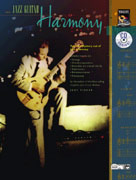
JAZZIZ CHRONICLES GUITAR. Interviste a: George Benson, Les Paul, Herb Ellis, Larry Coryell, Sonny Sharrock, Al Di Meola, Bill Frisell, Pat Martino, John Scofield, Jim Hall, Pat Metheny, Wes Montgomery, Lee Ritenour, Kenny Burrell, Joe Pass and a host of others. Discover the history of the jazz guitar and enjoy JAZZIZ's top picks from its second talent search on the companion CD - Brian Hughes, Michael Gulezian, Rick Zunigar, Randy Bernsen, James Vincent, Dave Lowrey, George Simon, John Paul, Dave Onderdonk, Dave Occipinti, Bill Mize and Christopher Cortez. Includes great photos throughout. Non contiene pagine di musica. CD
A COLLECTION OF INTERVIEWS & FEATURES FROM THE AWARD-WINNING MAGAZINE
Foreword
What isJazz?
One day, not so long ago, I was flying from Florida to New York, listening to my Walkman. A gentleman sitting next to me on the plane asked what I was listening to. "Jazz," I replied. "I hate jazz," he said. A while later, I offered him my headphones, which he willingly donned. He listened for a moment. "Oh, but I like this," he said, loud enough to hear himself over the music.
Jazz means different things to different people. 20years ago, I came up with the concept and the name for my magazine - JAZZIZ- in response to this realization. I thought it would be worthwhile to eliminate some of the forbidding barriers that seem to surround jazz and that keep people from entering the inner sanctums of the jazz world. I recognized that the first problem most people have with jazz is figuring out exactly what it is. And that's forbidding. Most people want everything in their lives to be firmly and reliably defined, including their music. People are uncomfortable entering a world without apparent solidity, a world, that is, where nothing is clearly defined. Well,that's jazz: an ever-changing world that always manages to elude the best efforts to contain and define it. After publishing JAZZIZfor20 years, convincing people to overcome their fear of an uncertain and unpredictable music remains a difficult barrier to overcome. Still, I'm certain there's a huge potential audience for jazz out there. The bulk of that audience, I contend, harbors a less-than-satisfactory idea of what this art form is all about. The rich heritage of jazz begins with the musicians who forged a new musical language from fragments of old and disparate forms. Where the story of jazz ends is anybody's guess, as new young artists continue to emerge, invigorating and extending the music's vital legacy. For20 years, we've featured, interviewed, reviewed, profiled, and celebrated jazz artists, from the most popular to the most undeservedly obscure. Our JAZZIZ Chronicles book series - produced in conjunction with the fine folks at Cherry Lane - takes some of our best pieces, categorized by instrument, and presents them in single compilations. Essentially, these books chronicle our own contributions to the history of jazz, which basically amount to offering our insights into the talent behind the real contributors. Jazz is rich because it has so many great stories to tell. At JAZZIZ, we've always kept a sharp eye on the current scene. But we've also been mindful of the music's vivid past, as well as its promising future. The CDthat accompanies this book underscores the latter point. Over the years, we've conducted talent searches that were judged by some of the brightest names in jazz. With the CD,we present the winners to you. Think of them as a glimpse of the future history of jazz. We hope you enjoy. Michael Fagien Publisher and Editor-in-Chief JAZZIZ Magazine
RITENOUR
seven and was a precocious, young player with an ear for jazz, classical, and pop music. He studied feverishly, taking lessons from such jazz heroes as Joe Pass, Howard Roberts, Barnie KesselI, and Kenny BurrelI. But the teacher to whom he credits his first burst of inspiration was the late Duke Miller, head of the guitar department at USC. A studious sort, Ritenour pursued guitar at USC partly because the great classical guitarist Christopher Parkening was there as a teacher. He had already taken private lessons from the American virtuoso when Parkening lived in the ValIey,in Studio City - not far from the Baked Potato. "I remember going over for lessons sometimes and Pepé Romero, from the Romeros [legendary family of classical virtuosi], would show up and Àngel [Romero] would show up in his pink Cadillac. There was anice, serious amount of musicians - heavy guitar players – floating around in those days. I got very serious about the classical guitar, but I was no Christopher Parkening. My weight was still toward the electric guitar." In fact, Ritenour's interest in classical guitar was eclipsed by his growing passion for jazz and, specificalIy, the inspiration he felt in hearing – and copping licks from - Wes Montgomery. Still, it was more than just technique that a young Ritenour admired. "Ofthe guitar players, Wes was the first one who crossed over into more of a pop area in a contemporary field," he points out. "He had that sound that permeated things and is still as viable today as it was in 1960." Long before Ritenour did, Montgomery took criticism for his pop ventures. Says Rit, "Alot of the records of his that Creed Taylor produced were highly arranged and showed some terrific arranging and guitar playing. But they were recording simple pop songs, and a lot of them had almost syrupy arrangements. He definitely got a lot of flak. Unfortunately, he got so much flak for doing those commerciai records that people began to miss that he was, indeed, the greatest jazz guitarist of the 20th century. He just had that magic. My father took me to hear Wes at the Lighthouse in Redondo Beach when I was 16,and I was sitting about 10 feet away. l'Il never forget it." Ritenour also remembers being wowed by early exposure to the Mahavishnu Orchestra, who he saw at the Roxy as a big-eared teenager. By the time Ritenour kicked off his own career as a leader, settling into the Baked Potato and turning out albums, he was locked into the funk-intlected groove going around town. But his interpretation was lent clarity by his own welI-developed sound and was fortified with trace elements of the edgier stuff he heard in Mahavishnu. They called him Captain Fingers, the title of his second album. It's easy to forget, now, how marginai this more pop-oriented, L.A.branch of jazz-rock was in the 1970Smarketplace, before NACradio was a gleam in anyone's eye. Ritenour recalIs, "When I handed in my first record to Epic in 1976, I remember I gave it to the A&Rwoman and she said 'What is this? What is this called and what are we going to do with it?'" He laughs. "She just wanted to give it back. I knew I was in trouble right then. There was no radio, and there was no support from the record companies. "That's why Dave Grusin and Larry Rosen started GRPrecords. They were completely frustrated that there was no sounding board, no outlet for this kind of sound. There was no doubt that the Crusaders, with Larry Carlton and Joe Sample, were the cutting edge of this sound. Tom Scott was in there, and certainly Lee Ritenour and Dave Grusin. Dave had a big influence on a lot of people," Ritenour says, "more so than most people know because he's always been such a subtle creator. I realIy have to cite Dave as the biggest influence for my producer and arranger chops." You can hear that influence in Ritenour's streamlined productions. A second wave of marketable energy entered Ritenour's story in 1991. He teamed up with Bob ...
AL DI MEOLA
"My connection with Astor was due to the fact that we were both Italian and we'd had extremely similar experiences. Napoli, where mine and Astor's families hail trom, is the artisti c center of Italy. AlI the great painters and musicians and singers are fram there. The arts still thrive there to this day. Piazzolla said the origins of tango are in Napoli. The sound of the accordion is very much a symbol of that region. You feel in the sentimentality of his music and even the melancholy atmosphere it creates that this comes fram a person of the motherland." Di Meola's own upbringing also fed into his development. Bom and raised in Bergenfield, New Jersey, a teenaged Albert Di Meola would often cut classes to make the train in time for the first set at a popular Manhattan salsa club. Drawn to the rhythmic tension of the clave, he was soon inspired to play the drums. The guitar of Larry CoryelI was an even greater fascination, and Di Meola quickly progressed through lessons with local guitar teacher Bob Aswanian. Enrolling at Berklee, Di Meola shared a three-room apartment where he spent alI his time practicing ("I got the closet to practice in; I smelled like mothbalIs for two years"). A tape of a drug-warped gig reached Chick Corea, and a 19-year-old Di Meola was soon the guitar star of a quartet perched on the cutting edge of jazz. "I carne onto the scene so young. I had a lot of developing to do quite fast to be in that kind of company," says Di Meola. "I had to leam to stay afloat. If you want to get better as a musician, surround yourself with guys who will kick your butto That band was like the dream band of alI time for a guitarist. Nothing carne close." Di Meola telIs an unusual tale of how he gamered that fateful position with Return to Forever. "I didn't replace Bill Connors. I replaced Earl Klugh, who was the replacement for Bill Connors. I went to an early show expecting to see Bill Connors and out comes this guy wearing a little golf cap with a little beany on top, and he had on this Playboy bunny tee-shirt. What is this? It was definitely out of context. I knew that was my chance. "A friend of mine gave Chick a tape of me playing on New Year's Eve with Barry Miles at some club called Richard's Lounge in New Jersey. l've never been into drugs, but that night I did a hit of mescaline, and that put me on a different planet. That tape got me the job with Chick." Along with Piazzolla and Corea ("Theme of the Mothership" gets the Grange and Blue treatment), Di Meola cites Brazilian artists like Milton Nascimento, Caetano Veloso, and Egberto Gismonti as influences on his current work. "Less and less it's guitarists that influence me," he says, "more musicians like Astor and Milton Nascimento. I had met Milton in Brazil in 1974.I had absorbed a lot of that music long before a lot of people had ever heard of him." Di Meola wrote a 1992Musician article entitled "Why Has Music Become WalIpaper?" In other publications, he has scorned, name by name, the major label producers who tumed a deaf ear to his soonto- be-successful Kiss My Axe album. An artist with less girth could have become a footnote by now, but Di Meola has not only prospered against the odds, he's triumphed, as Grange and Blue clearly shows. And Di Meola still envisions a national radio culture where music is foremost - not false demographics or advertising dollars. Di Meola believes in the mixed bag. "With radio in the 199°5, there shouldn't be any problem with having a format where Hendrix follows Joshua Redman. Then Sting and Peter Gabriel and Joni MitchelI, even k.d. lang and Kenny G can work. I can't believe there isn't a huge listening audience for a format with real music. It doesn't have to be a nostalgie blast; it's music that works."
FRISELL
Frisell decided to try something entirely different. He gathered together three acoustic players – a trumpeter, Ron Miles; a trombonist, Curtis Fowlkes; and a violinist, Eyvind Kang - and no rhythm section at all. "I didn't want to just get another drummer, and then always be thinking, 'Oh, Iwonder what Joey would be doing.' So the quartet was kind of perfect. 'I just won't have any bass or drums.''' Since all three of the other players were essentially lead voices, Frisell was constrained to build the role of "rhythm section" into the arrangements or act as bass-and-drums himself. This may sound terribly limiting, but the best art often arises in response to odd or severe limitations; Frisell's new quartet ended up making the music he had been refining openly since 1993'sHave a Little Faith better, perhaps, than any previous configuration. The 1996 album Quartet, with its fresh vision and odd make-up, may well be the best solo record he's made. Another project that presented itself around this time was the brainchild of Frisell's record company, Nonesuch. One imagines most players walk in dread of the moment when the suits say, "Hey, listen, we've got a great idea ..." It's usually a money thing - at best, a mixed blessing; more often, painfully obvious or obviously wrong. Here's the germ of the idea: People keep saying that Frisell has this traditional American-music thing going, that he has this country sound coming through. Why not take that idea head on, surround him with a bunch of great bluegrass players and see what kind of music comes out of the cross-pollination? Frisell liked the idea immediately, and the universe (through his label and network of musician friends) conspired to make it happen. So a month after recording Quartet, a time when he could have been enjoying a well-deserved break, he was back in the studio with vocalist Robin Holcomb, doing the preliminary recordings for this other album (eventually to be called Nashville). They recorded a number of tunes, and three of them - Neil Young's "One of These Days," Hazel Dickens' odd gospel gem "Will Jesus Wash the Bloodstains From YourHands?," and Skeeter Davis' "End of the World" - made it onto the final, mostly instrumental, recording. It was another year before Frisell could get all the other musicians together, but the result is something lovely and rare. It's not so much Bill Frisell doing country or bluegrass as it is bluegrass springing up in a space cleared by Frisell the composer, then tended by Frisell the guitarist. Frisell's Nashville is no place in particular, certainly not the center of commercial country music. Rather, the recording comes across as a postcard from some wistful utopia, the perfect home you never had but long for nonetheless. The pace and ambiance ofNashville is very comfortable. It sounds not pat, by any means, but like it had a good chance to ripen before the mics and recorders were turned on. The narrative of its development, you might think, could be this: Frisell takes some time to let the idea percolate, gradually writes some tunes for the personnel he has selected or imagines, picks the best, lets the others settle out, structures some fairly detailed arrangements, then pulls everybody together for rehearsals; finally, the whole crew rolls into the studio, and they perform their most gorgeous versions of the music they are already well familiar with. That scenario could hardly be further from the truth. In fact, Nashville was yet another of Frisell's launches into the unknown, another instance in which he set himself in the arms of Music (and great musicians) and trusted in his instincts and abilities to pull disparate voices together into something coherent and compelling. "The second thing someone will say about my playing is that there's this country influence," says Frisell, "but I never really played the real thing. ...
Table of
Contents
BADI ASSAD - The Girl from Ipanema She's Not
By Mark Holston
KENNY BURRELL - Soaring with the Mystics
By Steve Matteo
CRAIG CHAQUICO - The Four Corners Converge
By Jonathan Widran
LARRY CORYELL - Call and Response -
An Interview with Larry Coryell
By Lucy Tauss
STEVE KHAN - Catching a Wave
By Mike Bieber
PAT METHENY - In Search of Pat Metheny
By Josef Woodard
MARC RIBOT - Swimming Upstream to Cuba 22
By Josef Woodard
LEE RITENOUR - Captain Fingers ...
and the Fully Baked Potato 24
By Josef Woodard
JOHN SCOFIELD - Defender of the Groove 29
By Tom Moon
JOE MORRIS - Melodic Morris Code 34
By Sam Prestianni
PAT MARTINO - Real Time 37
By Josef Woodard
BILL FRISELL - On the Road to Bill Frisell 42
By William Stephenson
WILLIE NELSON - You Were Always on My Mind 47
By Bill Milkowski
JIM HALL - Why They All Want to Play
with Jim Hall.
HARRIET TUBMAN - Josef Woodard
Harriet Tubman: A Kinder, Gentler Skronk
By Josef Woodard
RONNY JORDAN - Ronny Jordan: Not an Acid Trip 57
By Jonathan Wid ran
JOE PASS - Joe Pass - The Logical Extension
of the Bop-Oriented Masters 59
By Scott Yanow
HERB ELLIS - Don't Take Herb Ellis for Granted 62
By Scott Yanow
AL DI MEOLA - After the Tango 65
By Ken Micallef
STEV TIBBETTS - Seductive and Inscrutable .
By Josef Woodard
The Critics Pick the First
String Guitarists .
By JAZZIZ critics
Anatomy of the Guitar & Bass .
By Scott Yanow
SONNY SHARROCK - Sonny Sharrock - Gone Too Soon .
By Hank Bordowitz
JEAN-PAUL BOURELLY - A Blues Grit Crossbred with
Hip hop and Hard bop .
By Josef Woodard
WES MONTGOMERY - Ritenour's Wes Bound for New Ears .
By Mark Holston
Historic Guitars .
By Hank Bordowitz
MIKE STERN - Mike Stern's Class Reunion .
By Josef Woodard
JEFF GOLUP - Bell-Bottom Blues .
By Jonathan Wid ran
MARC ANTOINE - Running Deep, Stretching for Miles .
By Jonathan Widran
WAYNE KRANTZ - Fed Up and Hungry
By Josef Woodard
GEORGE BENSON - The Original “G" Hits the Spot Again .
By David Okamoto
LES PAUL - Ingenious - Les Paul, Unpatented .
By Hank Bordowitz
Expanding the Universe
A Jazz Guitar Spectrum - Part 1... .
By Josef Woodard
Expanding the Universe
A Jazz Guitar Spectrum - Part II .
By Josef Woodard
35 Burnin' Up:
BRIAN HUGHES
MICHAEL GULEZIAN
RICK ZUNIGAR
RANDY BERNSEN (che ogni anno viene a suonare a Rimini)
JAMES VINCENT
DAVID LOWREY
GEORGE SIMON
JOHN PAUL
DAVE ONDERDONK
BILL MIZE
CHRISTOFER CORTEZ
JAZZIZ Presents Guitars on Fire .
By R.Dante Sawyer and Eric W. Moya
CD Jewel Case Art .
Readers Poll: The Public's
Favorite Jazz Guitarists .
Compiled by Albert W. Starkweather, Jr.
Find Your Favorite Players.
CD
1. Brian Hughes - Casa Magica
2. Michael Gulezian - Slugbug
3. Rick Zunigar - Rhum Boogie
4. Randy Bernsen - Hope
5. James Vincent - Peaks
6. Dave Lowrey - Bass Face
7. George Simon - Watching Angels
8. John Paul - Heads Up
9. Dave Onderdonk - Eight Is Enough
10. David OcchiNIpinti - David Leaves
11. Mill Mize - Miasma
12. Christopher Cortez - Different Samples
Produced by Michael Fagien
Special thanks to Lee Ritenour, John Patitucci, and Jim Hall
Exclusive CD available only with this book, JAZZIZ
Chronicles: The Guitarists JAZZIZMagazine

 Italiano
 English