SPARTITI PER CHITARRA DI MUSICA JAZZ

LIBRI DI TRASCRIZIONI DI MUSICA JAZZ, TABLATURE, SPARTITI,

DI MEOLA AL ELEGANT GYPSY GUITAR TABLATURE MEDITERRANEAN SUNDANCE CHITARRA LIBRO SPARTITI

DI MEOLA AL, ELEGANT GYPSY. SHEET MUSIC BOOK WITH GUITAR TABLATURE .

LIBRO DI MUSICA JAZZ FUSION.

SPARTITI PER CHITARRA : 

ACCORDI, PENTAGRAMMA, TABLATURE. 


Studio Album Recorded : December 1976 - January 1977 .
Released : April 1977 .


TITOLI : 

1 - Flight Over Rio
2 - Midnight Tango
3 - Mediterranean Sundance
4 - Race with Devil on Spanish Highway
5 - Lady of Rome, Sister of Brazil
6 - Elegant Gypsy Suite


MUSICIANS: 

Al Di Meola: Electric guitars, acoustic guitars, piano, synthesizer, percussion.
Paco de Lucía: Acoustic guitar (track 3).
Anthony Jackson: Bass guitar (tracks 1, 2, 4, 6).
Jan Hammer: Keyboards, synthesizer (tracks 1, 6).
Barry Miles: Piano, keyboards, synthesizer (tracks 2, 4).
Steve Gadd: Drums (tracks 1, 6).
Lenny White: Drums (tracks 2, 4).
Mingo Lewis: Congas, synthesizers, organ, percussion

Prezzo: €99,99
€99,99

DI MEOLA AL McLAUGHLIN PACO DE LUCIA FRIDAY NIGHT SAN FRANCISCO Mediterranean Sundance BOOK

DI MEOLA AL, JOHN McLAUGHLIN, PACO DE LUCIA, FRIDAY NIGHT IN SAN FRANCISCO. SHEET MUSIC BOOK IN STANDARD NOTATION. 

LIBRO DI MUSICA JAZZ, FUSION,
SPARTITI PER CHITARRA CON PENTAGRAMMA E ACCORDI. 
TRASCRIZIONE DI OGNI CHITARRA.

Questo irripetibile concerto del 5 dicembre 1980, ha aperto le strade al genere spanish-jazz-acustico.

LIBRO DI MUSICA JAZZ FUSION, TRASCRITTO da AL DI MEOLA !

SPARTITI PER 2 E 3 CHITARRE CON:

ACCORDI E PENTAGRAMMA.

DISCO PIù FAMOSO DEL TRIO CHITARRISTICO PATRONIMICO ( Di, Mc, De ) .  


Al Di Meola, Paco De Lucia: Mediterranean Sundance/Rio Ancho;
Al Di Meola, John McLaughlin: Short Tales Of The Black Forest;
Paco De Lucia, John McLaughlin: Frevo Rasgado;
Al Di Meola, Paco De Lucia, John McLaughlin: Fantasia Suite; Paco De Lucia, Al Di Meola, John McLaughlin: Guardian Angel.

Trascrizione di ogni chitarra.


Al Di Meola, John McLaughlin and Paco DeLucia - Friday Night in San Francisco

Artist Transcriptions
Series: Guitar Book
Artist: Al Di Meola
Artist: John McLaughlin
Artist: Paco Delucia

This famous trio of acoustic guitarists is captured live in this matching folio to the Grammy Award-winning album from a live concert in San Francisco. The book contains full transcriptions of every tune including: Short Tales of the Black Forest - Mediterranean Sundance/Rio Ancho - Fantasia Suite - and more.
Inventory #HL 00660115
ISBN: 9780793512461
UPC: 073999601152
Width: 9.0"
Length: 12.0"
96 pages


Series: Guitar Book
Artist: Al Di Meola
Artist: John McLaughlin
Artist: Paco Delucia
Artist Transcriptions 21st Century Publications

"Latin rhythms are the most interesting rhythms in the world," opines Al Di Meola, "and to write them you have to be able to play them." And Di Meola can certainly play them. The master altenate-picker and fusion pioneer has carried on a multi-decade love affair with the music of Spain and Central and South America while simultaneously leaving his imprint on the jazz and rock worlds. His two latest releases are The Guitar Trio with Paco de Lucia and John McLaughlin, and Di Meola Plays Piazzolla, a tribute to the great Argentinean tango composer Astor Piazzolla. Both albums are rich in Latin influences, and Di Meola has devoted his musical life to absorbing the subtle stylistic nuances of the various genres within his own playing. "Almost everything I do I kind of analyze to be some kind of percussion or drum pattern," says Di Meola. "I'm particularly interested in what's known as the 'clavé' rhythm. That's essential in Latin music, and some people just can't do it. But you'll hear Latin musicians say, 'Oh, he plays good clavé.' clavé is sometimes referred to as a rhythm, hut mostly in salsa music. When you play against the clavé, you're playing against the time, and that's what I do a lot when 1 play rhythmically on a guitar. We refer to clavé as the quarter note." A great example of this can be found in Di Meola's song "Beyond The Mirage," from The Guitar Trio (see Ex. 1). The opening arpeggios are composed in a classic clavé rhythm. "All three guitars tune the 6th string down to a low D," says Di Meola. "I use a little bit of my Roland GR synth in there, so you can hear that real low tone of a fretless bass sound." 

The picking pattern is not strictly alternating, but designed to fit over the specific string spread. Di Meola composed the picking pattern as much as the notes themselves. You must perform the pick strokes a certain way to achieve the proper ,"hythm. "The first note you hit is on the 6th string, the second note is on the high E string, the third on the D string, and so on," explains Di Meola. "So there's a lot of skipping around. It's down, up, down, up, up, up. But you have to do it this way or the rhythm won't sound just right. And if it's off a hair, the feel is ruined."
At this brisk tempo (q=200), it's quite a challenge to execute pattens accurately. But that's not the most difficult aspect of the passage, according to Di Meola: "It's more the rhythm that's going to mess people up. And what people need to get into is experimenting more with different rhythms, and keeping all of that locked into the clavé time." The rhythm and the placement of the accents brings to mind anothe," Latin-jazz standard, "Spain," by Chick Corea. "The whole thing in 'Spain' is the way those accents fall," says Di Meola. "It's off of the clavé without the clavé moving that will determine whether it's working or not. What 1love about Chick is that he writes and plays with so much clavé. I'm really drawn to his ability to use that in composition and playing." As a fitting homage to Corea-who helped launch Di Meola's career by hiring ti,e teenage,' to play in his band Return To Forever -Paco, John, and Al perform "Spain" as an encore. Note how close the rhythm and accents are in the opening of "Spain" to Di Meola's own tune. The difference is that "Spain" is melodic and "Mirage" is rhythmic. Both carry the clavé rhythm within their notes, and both capture the essence of Latin music. "The important tiling is the rhythm," stresses Di Meola. "Withont that you have nothing. Whether it's 'Spain' or 'Beyond The Mirage' or whatever, the rhythm is everything."


 Quando nella seconda metà degli anni '70 comparve il primo album dal titolo "Land Of The Midnight Sun", di un giovane chitarrista il cui particolarissimo stile esecutivo era stato già notato sulle produzioni di Chick Corea "No Mytery" e "Romantic Warrior", si ebbe occasione di ascoltarlo esterefatto in cuffia in un negozio di dischi. Il disco avrebbe fatto furore tra gli "insiders" dell'epoca; i giovani cultural-rampanti di allora ascoltavano jazz-rock, fusion, Zappa e art-rock sul tipo dei "Gentle Giant". I successori del chitarrista di Chick Corea potevano solo sognare di una carriera incredibile come quella che iniziò allora AI Di Meola: mentre oggi Scott Henderson e Frank Gambale suonano in piccoli Clubs, AI Di Meola riempiva già allora grosse sale, senza problemi. La sua seconda produzione, "Elegant Gypsy" fu votata jazz-album dell'anno nella classifica di Guitar Player e AI Di Meola stesso salì sul trono di migliore chitarrista jazz dell'anno. Tutti i suoi dischi di quel tempo hanno sufficiente fuoco ritmico, ma, almeno allora, AI Di Meola sembrava evitare come il diavolo l'acqua santa, shuffle, swing e tutto quello che avesse a che fare con grooves a terzine. "Mediterranean Sundance", un duetto col gigante del flamenco Paco De Lucia, è stato pubblicato su "Elegant Gypsy".Nella notazione di questa rubrica si trova la parte di Al Di Meola, dal tema fino alla fine del suo assolo; qui c'è dentro tutto ciò che mandava in pappa il cervello dei giovani chitarristi (aspiranti e non) di oltre 16 anni fa. Ancora oggi ci sorprende la velocità e la precisione tecnica per quanto riguarda la scelta del suono ed il fraseggio; l'entusiasmo è un po' diminuito. Praticamente tutto il brano è composto solo da note in MI- naturale; in alcuni punti spunta un RE# sul MI- armonico. Le salve di staccato tipiche di AI, sono ottenute con una percussione energica vicino al ponte ed un deciso smorzamento delle corde con la mano (p.m. = Palm Mute, sordina col palmo della mano). I passaggi ad altissima velocità sono composti fondamentalmente da una serie di segmenti di scala; ne sono stati influenzati chitarristi come Steve Lukather, Vinnie Moore e una serie di esecutori da "competizione e gran turismo". AI allora suonava delle Les Paul, le sue chitarre acustiche erano della casa Ovation.


Spaventosa, questa musica vive della sua velocità, esattamente come anche la musica classica. Per suonare musica strumentale interessante occorre essere padroni di una tecnica fenomenale. E' importante che l'ascoltatore colga la complessità della musica: lento, rapido, triste, allegro - sono tanti gli stati d'animo e gli aspetti della musica; non è solo rapidità esecutiva. Come compositore e musicista improvvisatore voglio anche poter tradurre in note reali quello che mi gira per la mente; e a questo scopo non posso fare a meno di una determinata tecnica. Solo così può funzionare. Ma la rapidità esecutiva credo non sia più un punto di discussione ... almeno per gli ultimi 6 o 8 albums.

Ancora qualche osservazione sulla biografia di questo musicista: Larry Coryell è uno dei chitarristi che hanno influenzato inizialmente Al Di Meola: lui ha definito Coryell come il vero e proprio padre della fusion. Al si recava regolarmente ai concerti del suo idolo. I due musicisti si incontrarono e si conobbero: Coryell ha invitato il sedicenne Al nella sua fattoria dove senz'altro gli ha insegnato qualche trucco. AI volle approfondire l'argomento e nel '71 si iscrisse al Berklee College di Boston. In questo periodo ha seguito soprattutto la musica di John McLaughlin, Miles Davis e John Coltrane. Il suo studio sembra avere riscosso successo: infatti Chick Corea si accorse ben presto di lui. Stava cercando un sostituto per Bill Connors e così a 20 anni Al Di Meola divenne il nuovo chitarrista dei Return To Forever, sicuramente uno dei passi più importanti e decisivi della sua carriera. Dieci anni più tardi pensò di intraprendere la carriera di solista e divenne uno dei musicisti di jazz-rock più popolari degli anni '70, una star della chitarra sia elettrica che acustica. D'altro canto mai virtuosismo tecnico e perfezionismo esecutivo è stato tanto criticato e considerato fine a sè stesso come nel caso di questo musicista; ma la re ponsabilità non fu esclusivamente dei critici musicali.

di musica aggressiva e ad alto volume è calata uotevolmente: non rifiuto certo questo aspetto della musica, ma la mia sensibilità musicale è cambiata nel corso degli anni. John McLaugh-Iin è una persona diversa, lui viene da un'altro pianeta. Senza voler stare a criticare, avevamo molti punti in comune qualche anno fa: tutto doveva essere il più forte, il più rapido possibile, un'energia illimitata, ecco cosa volevamo esprimere. E' una tendenza comune alla maggior parte dei giovani musicisti. Pat Metheny si è sviluppato in un certo modo alla rovescia negli ultimi tempi. Ho sentito che ha pubblicato un disco solo con rumori (ridacchia). Ma devo dire che non l'ho ancora ascoltato. Forse ha solo voluto esprimere la sua frustrazione di essere cacciato sempre nello stesso cassetto ..• che ne so .... Avrà pure avuto i suoi motivi.


Come come avete lavorato in studio sul tuo ultimo album "Orange And Blue"?

AD M: Ho registrato una quantità di basi Iive col mio tastierista Mario Parmisano, per il resto è un album molto "prodotto". Le parti di chitarra le ho registrate successivamente da solo. Ma lavoro anche con una quantità di altri musicisti; a dire il vero, a parte alcuni passaggi improvvisati, è stato un lavoro molto ben pianificato. Ma non mi dispiace neppure l'altro sistema: andare in studio con un'intera band e registrare tutto più o meno dal vivo. In questo caso la possibilità di inserire dei guest-musicians è quasi impossibile in quanto il prodotto, una volta registrato, è bell'e finito così com'è. Nel mio nuovo album ho avuto la possibilità di lavorare con quei musicisti che volevo per le mie composizioni: Peter Erskine, Manu Katchè, Marc Johnson, Pino Palladino - tutta gente con cui volevo lavorare già da sempre. E poi c'era ancora Steve Gadd che non aveva più suonato da lO - 11 anni sui miei dischi; è stato meraviglioso averlo di nuovo su una mia produzione. E' gente che contribuisce in modo veramente speciale alla mia musica.


Hai altri progetti?

ADM: Attualmente sto suonando anche con Jean Luc Ponty e Stanley Clarke in trio, musica puramente acustica. Tra non molto registreremo anche un album che comparirà l'anno prossimo.


Esistono nuovi dischi che ascolti volentieri?

ADM: Vuoi dire dischi di altri artisti?


Immagino che ami ascoltare anche le tue produzioni.

ADM: Sì, il mio nuovo album lo ascolto molto volentieri. (Riflette) Mmmmh, ci ho lavorato talmente tanto e con tanto impegno che ho quasi ascoltato altra musica (riflette) ..•Enigma!


Stai parlando del progetto di Michael Cretu?

ADM: Esatto, quel tipo che vive ad Ibiza.


Molta gente che si considera importante ed intelligente non ama questo genere di musica. Ma Cretu fa degli ottimi dischi, ha un suono inconfondibile. Dove hai sentito la loro musica?

ADM: Sai, la Jazz-Radio negli Stati Uniti è terribile, tutto quello che suonano è "bullshit easy Iistening" – spaventoso! Ecco perché le stazioni rock hanno sempre maggiore successo: loro almeno non trasmettono tanta spazzatura. E' lì che ho sentito uno spot del nuovo album degli Enigma, un brano con una voce indiana, un pezzo fatto molto bene. Non è certo una rivoluzione musicale, ma il suono è molto individuale, creativo; ecco perchè mi piace. Apprezzo in ogni caso le produzioni intelligenti e creative. Non vorrei però che ti facessi un'impressione sbagliata: Enigma non rappresenta il mio gusto musicale; amo molti tipi di musica tutti diversi.


Atmosfera e ambiente mi sembranoimportanti sia per l'ascoltatore che per il musicista. Evidentemente vuoi lasciare al tuo ascoltatore la possibilità di interpretazione, la libertà di feeling; lasciare che scopra sempre nuovi aspetti della musica. Questo è quanto mi è capitato all'ascolto di alcuni brani del tuo disco.

ADM: Ottimo, se riesci a cogliere la musi~a in questo modo; una reazione di questo genere mi dice che il mio disco per te ha qualcosa di particolare. Quando un disco mi piace così di primo acchito, me ne stanco anche rapidamente. Quando invece ad ogni nuovo ascolto scopro qualcosa di nuovo è un ottimo segno. Mi è capitato per esempio con i dischi dei Weather Reporto La combinazione tra atmosfera e stato d'animo è importante quanto tutti gli altri ingredienti musicali.


Un ottimo esempio è "Secret Story" di Pat Metheny. Conosci questodisco?

ADM: L'ho sentito una volta e mi è sembrato molto riuscito; un album molto "prodotto", come il mio. Pat Metheny a quanto ho sentito, ci ha investito un milione di dollari. lo non ho avuto nemmeno un decimo. Se una casa discografica mi offrisse tanti soldi per una produzione .•. (riflette sorridendo) ... accetterei subito!


Oltre alla musica e i soldi ci sono altre cose che ti interessano? Fare a maglia, indossatrici, films, politica, religione ...?

AD M: Jessica Lange è la mia attrice preferita. Religione e politica mi annoiano; organizzazioni come la "Scientology Church" mi fanno venire i brividi. La mia religione è la mia musica, anche se può sembrare ridicolo. Ma la musica mi permette di concentrarmi, mi dà forza. Conosco una quantità di musicisti che stanno tutt'altro che bene... fanno una vita schifosa, ma quando hanno il loro strumento in mano stanno bene; è come una religione, quello in cui credo esiste veramente, non me l'ha raccontato nessuno, ma ne ho fatto esperienza diretta io stesso. Questo tavolo qui lo posso toccare, lo vedo, sta di f ronte a me. La stessa cosa succede con la musica ed ecco perchè ci credo. Tutto il resto non funziona! La gente deve poter fare quello che vuole, deve poter essere libera sempre che non faccia del male ad altri. Ma questa è solo la mia opinione.


Mediterranean Sundance / Rio Ancho
Fantasia Suite (Al Di Meola)
Frevo Rasgado
Guardian Angel
Short Tales Black Forest

Prezzo: €35,99
€35,99

CORYELL LARRY, 12 FRETS TO ONE OCTAVE. CD

CORYELL LARRY, 12 FRETS TO ONE OCTAVE. Contiene: -allegra's ballerina song -Bartok eleven -dye me blue -flamenco flare up -light sweet crude -lotus revelation -murali's picture -night rain -trasparence. CD TAB.

Prezzo: €24,95
€24,95

CORYELL LARRY, JAZZ GUITAR, EXERCISES, SCALES, MODES & TECHNIQUES. CD TABLATURE

CORYELL LARRY, JAZZ GUITAR, EXERCISES, SCALES, MODES & TECHNIQUES. CD TABLATURE


Product Description:
Larry Coryell discusses and illustrates scales, modes, finger exercises, improvisation and chords. This book offers notation, tablature, and three audio CDs for the intermediate to advanced student.

Format: Book/3-CD Set

Contents:

One On One with Larry Coryell - An interview by Dr. Joe Barth

LESSON ONE:
The C scale and its ramifications
Aspects of fingering the C scale and variations
Modes: Ionian, Dorian, Phyrgian, Mixolydian, Aeolian and Locrian
Transposing of modes
Intervals and positioning of chords

LESSON TWO:
Artificial and real harmonics
Lenny Breau's ripple effect
Chromatic scale played with artificial harmonics to develop control
Fingering exercises to strengthen the left and right hands
The 2-4-1-4 Exercise
Japanese Gratitude Exercise
7/4 diminished exercise descending in whole steps

LESSON THREE:
Discussion of minor thirds
1+2 Scale (a more sophisticated expression of the diminished scale)
The melody, structure and improvisation potential of the original composition 1+2 Blues
Further explorations in modes

Prezzo: €26,00
€26,00

CORYELL LARRY, JAZZ GUITAR. CD TABLATURE

CORYELL LARRY, JAZZ GUITAR. 52 Esempi e pezzi, anche live. CD TABLATURE

Series: Book
Publisher: Backbeat Books
Medium: Softcover with CD
Author: Larry Coryell

This practical book with CD helps guitarists improve their ability to play over changes, better understand jazz harmony, and expand their jazz vocabulary. Using examples from his own experiences playing with many well-known musicians, top fusion guitarist Larry Coryell provides dozens of musical exercises - plus original compositions - that challenge guitarists to increase flexibility in their thinking and playing. Topics include: new approaches to playing accompaniment ("comping"); integrating chords and scales in jazz solos; interpreting chord changes; and improvising - the art of creating music spontaneously with other players. 96 pages.

Prezzo: €21,00
€21,00

CORYELL LARRY, THE DRAGON GATE. CD TABLATURE

CORYELL LARRY, THE DRAGON GATE. CD TABLATURE

Prezzo: €36,00
€36,00

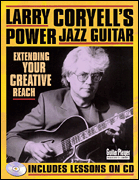
CORYELL'S LARRY, POWER JAZZ GUITAR. Extending Your Creative Reach. CD TABLATURE

CORYELL'S LARRY, POWER JAZZ GUITAR. Extending Your Creative Reach. 84 pagine. CD TAB.

Series: Book
Publisher: Backbeat Books
Medium: Softcover
Author: Larry Coryell

More than a method or exercise book, this guide challenges jazz guitarists to increase originality in their thinking and playing. Master player Larry Coryell takes readers deep inside the music to make connections between ideas and the guitar fretboard, helping them unlock their own creativity. This book/CD set builds logically from basic ideas to more advanced techniques, which Coryell explains in fine detail. He highlights musical ways to understand complex jazz concepts and presents his unique approach to improvisation by providing exciting new ways to play scales, intervals, arpeggios, melody and chords. Emphasizing group interaction and solos that sizzle, Coryell taps his decades of experience as a performer to offer insights into inventive, powerful ensemble playing.

"This book should open the door to a better understanding in our quest for advanced guitar playing." Al DiMeola.

80 pages.

Prezzo: €21,00
€21,00

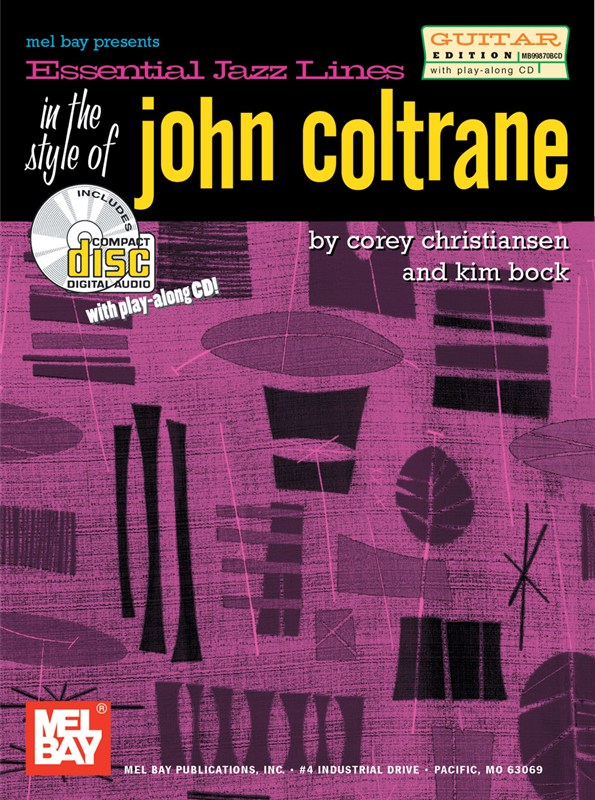
COLTRANE JOHN-ESSENTIAL JAZZ LINES IN THE STYLE OF BOOK CD LIBRO SPARTITI CHITARRA

COLTRANE JOHN, ESSENTIAL JAZZ LINES IN THE STYLE OF. CD TABLATURE

LIBRO METODO DI MUSICA JAZZ CON CD. 

SPARTITI PER CHITARRA CON:

ACCORDI, PENTAGRAMMA, TABLATURE. 

STUDIO, MANUALE, 

Saxophonist John Coltrane was one of the most innovative, creative, and influential jazz artists of the 20th Century. Both stylistically and harmonically, he opened doors for others to follow. This book will focus on the first period of Coltrane's career, when he was with Miles Davis, and the jazz vocabulary he used. First, to help the student better understand Coltrane's bebop style of improvising, the authors discuss the use of guide tones, bebop scales, three to flat nine, targeting, and other techniques. Then the text presents numerous one-, two-, and three-measure jazz lines in Coltrane's style in notation and tablature grouped by the harmony over which they can be used. The accompanying play-along CD provides the rhythm parts for each section, including a track for each section that modulates through the cycle of fourths, helping you master the phrases in all keys. By combining various lines, musicians will be able to mix and match numerous combinations of these lines to play over ii-V-I progressions, turnarounds, and other harmonic situations. Incorporate these essential jazz lines into your vocabulary and you will be able to create your own lines in the style of John Coltrane.


John Coltrane
The Style of John Coltrane
Jazz Language
Guide Tones
Bebop Scales
Mixolydian Bebop
Major Bebop
Minor Bebop
Scalar Patterns
3-flat9
Augmented Dominant
Playing the Upper-Structure of Chords
Targeting
Substitutions
John Coltrane's Style
Summary
Minor Chord Material
Track 1: Tuning
Track 2: Minor Chord Vamp
Track 3: Minor Moving in Fourths
Dominant Seventh Chord Material
Track 4: Dominant Seventh Vamp
Track 5: Dominant Seventh Moving in Fourths
One Measure ii-V (Short ii-V) Material
Track 6: Short ii-V Vamp
Track 7: Short ii-V Moving in Fourths
Two Measure ii-V (Long ii-V) Material
Track 8: Long ii-V Vamp
Track 9: Long ii-V Moving in Fourths
Major (I) Chord Material
Track 10: Major Vamp
Track 11: Major Moving in Fourths
Minor ii-V Material
Track 12: Minor ii-V Vamp
Track 13: Minor ii-V Moving in Fourths
Play Along Recordings
Track 14: Short ii-V-I Vamp
Track 15: Short ii-V-I Moving in Fourths
Track 16: Long ii-V-I Vamp
Track 17: Long ii-V-I Moving in Fourths
Track 18: Minor ii-V-i Vamp
Track 19: Minor ii-V-i Moving in Fourths
Turnarounds
Track 20: Turnaround Vamp
Track 21: Turnaround Moving in Fourths
Creating Solos
Track 22: Creating Solos
Track 23: Progression Similar to Pent Up House
Coltrane Changes/Giant Steps
Practicing Coltrane Changes
Track 24: Long ii-V-I with Coltrane Changes Vamp
Track 25: Long ii-V-I with Coltrane Changes Moving in Fourths
Track 26: Eight Measure Giant Steps Vamp
Track 27: Progression Similar to Giant Steps
Superimposing the Coltrane Changes
Track 28: Blues for a Giant
Track 29: Snap Shots
Conclusion
Selected Discography
About the Authors

Prezzo: €26,99
€26,99

COMPLETE BOOK OF JAZZ GUITAR LINES & PHRASES Sid Jacobs CD TABLATURE LIBRO SPARTITI

COMPLETE BOOK OF JAZZ GUITAR LINES & PHRASES. Sid Jacobs. CD TABLATURE

LIBRO METODO DI MUSICA JAZZ, CON CD.

SPARTITI PER CHITARRA.

ACCORDI, PENTAGRAMMA E TABLATURE, 

Product Description:
An important addition to the improvising jazz guitarist's library, this thoughtful blend of text and musical examples focuses on the vocabulary of modern jazz and some of the applications of modern harmony. With examples written in standard notation and tablature, Jacobs offers instruction on bebop style phrases, playing fourths, inside-outside playing, pentatonic, whole-tone and symmetrical scales, slash chords, polychords, hip lines, fingerings and much more. The companion CD presents the material in the text played with chord accompaniment.

Product Number: 95737BCD
Format: Book/CD Set
Series: Complete
160 PAGES


Introduction

It has been said that a great composer doesn't borrow, he steals. If this book dealt with memorizing rules, I would certainly place "steal from the best" as rule number one. Some might feel uncomfortable about imitation but there is little to fear if you are judicious in what you steal and don't just "loot one store:' We learn to speak by imitation. We use an existing language to express our thoughts. It is no different for the improviser, using and connecting phrases from an existing idiom. If we substitute the term "line" with sentence and "improvisation" with conversation, we de-mystify the process. The way a person puts his words and phrases together gives him his conversational style and consequently, the more vocabulary he has, the better equipped he is to express himself. Similarly,the way a player connects his musical phrases gives him his improvising style, and the more vocabulary he has, the better equipped he is. The idiomatic phrases of the Jazz language distinguish it from other music. Through use of examples, we hope to illustrate some ideas that are used to create jazz lines and phrases. Improvising is an art. The ability to articulate your ideas clearly is a craft. When you connect your ideas creatively and extemporaneously, the craft is elevated to art. Improvisation is the art of jazz. Observe your own speech patterns and phrasing. You will notice that no two or three words have exactly the same volume. What I'm pointing out is that in conversation, we naturally use one of the first learned and first forgotten lessons in music: dynamics. In good conversation, one idea naturally flows to another. With fluency we make connections. In jazz improvisation, where the subject of our conversation is the chord changes or modulations, we need the ability to melodically imply the chord we are playing over and at any given point in time, smoothly connect to a close available chord tone or note in the key center. (See Example 1.)In this example the modulations and chord changes are made by moving to the closest available note.


About the Author Sid Jacobs

Sid Jacobs grew up in Miami, Fla. and began guitar lessons at the age of seven. As a teenager he became serious about jazz playing and would study and practice by day and sneak into the jazz clubs at night. When the Jacobs family moved to Nevada, he obtained a position as guitar instructor at the University of Nevada, Las Vegas. This made him, at eighteen, the youngest faculty member in the school's music department. While living in Nevada, Sid found work in the hotel pit orchestras, and as touring accompanist to a number of celebrity singers and jazz artists. After moving to Los Angeles, he developed the curriculum for the Jazz Guitar elective at the Musicians Institute (GIT)and the Advanced Bebop and Jazz Guitar course at the Dick Grove SchooL In 1991the CD It's Not Goodnight was released featuring his original compositions and improvisations. Among the many jazz artists Sid has performed with are Eddie Harris, Harold Land, Buddy Montgomery, Red Holloway, Conte Candoli, and in duo concert settings with guitarist Joe Diorio. Through his involvement in education, his personal associations with jazz notables, and his discipline, Sid continues to gain recognition as an influential educator, composer, and performing artist. In reviewing a live performance, Los Angeles Times jazz critic Don Heckman characterized him in this way, "... a highly articulate improviser... Never at a loss for a new phrase his improvisations seemed to unfold with the ever-changing fascination of a set of Bach variations:' Sid currently divides his time among his pursuits as GIT instructor, musical equipment manufacturer's consultant, performance and recording artist, and jazz clinician. Sid jacobs plays a Borys guitar and usesThomastik-Infeld strings.


Table of Contents:


About the Author Sid Jacobs .

Preface 

Introduction .

The Craft .

More Diatonic Sequences .

Smokin' A Half Note (Etude) .

Idioms .

Idiomatic ii or ii - V Shapes .

Idiomatic V - I Resolution Shapes .

Idiomatic I Major Shapes .

Sample II or II - V Lines .

Sample Major Lines .

Sample II - V - I Lines .

Some Additional Notes On the Idioms .

Some Miscellaneous Bebop Style Phrases .

Major 7th Lines .

Miscellaneous Phrases Over Common Progressions .

Another Blues in F (Etude) .

May The Fourths Be With You .

Triads (Fourth Triads) .

The Pentatonic Scale & Fourths .

Some Pentatonic Fourth Shapes .

Fourths Contours and Permutations .

Pentatonic Scales .

Pentatonics Inside Out .

The Madness - The Method

Ideas & Examples Combining Pentatonic Sounds .

Diatonic Fourths & Fifths

Fourths & Intervallic Sequences .

Piccardy Fourths (Etude)

Quartal Harmony .

Symmetrical Scales .

The "Magic Scale" (Augmented) .

Major Triads from the Augmented Scale

Minor Triads from the Augmented ("Magic") Scale

Some Augmented Scale Harmonies .

The Diminished Scale .

Some Diminished Scale Melodic Patterns .

Diminished Scale Harmony .

Whole Tone Scale

Whole Tone Scale Fingerings .

Some Whole Tone Lines

The Chromatic Scale .

Octave Displacement .

Polychords & Slash Chords .

Blues 4 Poly (Etude)

Kernels of Tomorrow (Etude) .

Final Notes .

Acknowledgments .


MEL BAY'S COMPLETE BOOK OF JAZZ GUITAR LINES & PHRASES

By Sid Jacobs

I wholeheartedly recommend this book to anyone who is serious about playing jazz guitar. It is a thorough, comprehensive and organized approach that can only come from someone who is a great musician and teacher.

-Bruce Forman


The plethora of disorganized, trendy guitar "methods" is ultimately confusing and overwhelming even to the most dedicated and devoted of students. Jacobs has brought us back to the simple musical truths that must inform all of our studies and music making. Jacobs' text is simple, clear, concise, and complete-It's the only jazz guitar "method" you'll ever need! -Fa reed Haque, Blue Note Recording Artist, Professor NIU (Northern Illinois University)


The Complete Book of Jazz Guitar Lines & Phrases is a concise, thorough exploration of the modern jazz vocabulary. It takes the mystery out of jazz harmony while stressing its creative applications. The explanations are clear and easy to follow, and the notated examples are fun, challenging, and musically relevant. I highly recommend this book to anyone interested in the study and advancement of jazz guitar. -John Hart


CD CONTENTS

Idiomatic II or II-V Shapes /p. 21 (5:58)

Idiomatic V-I Resolution Shapes /p.24 (2:14)

Idiomatic I Major Shapes /p. 27 (2:07)

Sample Major Lines /p.35 (3:03)

Sample II-V-I Lines /p.39 (1:46)

Some Miscellaneous Bebop Styles /p.43 (2:54)

Major 7th Lines /p.48 (1: 11)

Miscellaneous Phrases Common Program /p.51 (1:23)

Another Blues in F (Etude) /p.54 (1 :06)

May the Fourths Be with You /p.56 (:26)

Triads (Fourth Triads) /p.60 (1:10)

The Pentatonic Scale & Fourths /p.62 (1:25)

Some Pentatonic Fourth Shapes /p.64 (1 :45)

The Madness-The Method /p.78 (:55)

Ideas & Examples Pentatonic Sounds /p.81 (4:32)

Symmetrical Scales /p.95 (3:31)

The Magic Scale /p.100 (1 :50)

Major Triads from Augmented Scale /p.104 (1 :41)

Major Triads from Augmented (Magic) scale /p.105 (3:29)

Augmented Scale Harmonies /p.109 (1 :48)

The Diminished Scale /p.110 (4:04)

Diminished Scale Melodic Patterns /p.114 (5: 12)

Diminished Scale Harmony /p.119 (3:48)

Whole Tone Scale /p.123 (:23)

Some Whole Tone Lines /p.127 (1 :55)

The Chromatic Scale /p.131 (2:26)

Octave Displacement / p.137 (:59)

Polychords & Slash Chords /p.139 (7:52)

Blues 4 Poly (Etude) /p.148 (1:04)

Prezzo: €31,99
€31,99

COOL BLUES & HOT JAZZ GUITAR Adrian Ingram CD TABLATURE CHITARRA LIBRO SPARTITO METHOD

COOL BLUES & HOT JAZZ GUITAR. Adrian Ingram. Esercizi, titoli. SHEET MUSIC BOOK WITH CD GUITAR TABLATURE, 

LIBRO METODO DI MUSICA JAZZ, BLUES, CON CD. 

SPARTITI PER CHITARRA : 

ACCORDI, PENTAGRAMMA, TABLATURE. 


Cool Blues & Hot Jazz has been written to introduce the most valuable jazz guitar techniques and present them in a clear and concise way with the beginning jazz guitarist in mind and for players with a rock or blues background. This tutorial covers an innovative combination of ideas and music to introduce you to the playing of great jazz and blues players such as Wes Montgomery, Joe Pass, Pat Martino, Kenny Burrell, Robben Ford, Duke Robillard, Larry Carlton and many others.
Whatever your level, or interest, Cool Blues & Hot Jazz breaks down the barriers to the normally confusing world of jazz. It will teach you step by step the most important (yet seldom explained) guitar techniques in an easily accessible but thorough way.

STAGES IN THE LEARNING CYCLE
Each lesson has been divided into three separate sections to help clarify the learning process:

STAGE 1.
The LESSON contains information you will need to know for the assignment, together with further material for clarification and future reference.

STAGE 2.
The ASSIGNMENT is where you will play along with the c.d.; where you take IIfrom the page to the guitar!

STAGE 3.
The CROSS-REFERENCING of what has been learnt in the assignment, with the information given in the lesson, completes the learnig cycle.

Contents:
Introduction .
Tuning Notes .
Notation Guide .
Chords and Scale Reference .
Lesson 1: The Dominant Seventh chord forms and substitutions.
Lesson 2: The Jazz / Blues Progression .
Lesson 3: "Minorizing" the Dominant .
Lesson 4: "Minorization" & Single-Line Soloing .
Lesson 5: Jazz Phrases .
Lesson 6: Single-Note Soloing on a Minorized Blues. Scale and arpeggio substitutions.
Lesson 7: The Tone-Below Principle .
Lesson 8: Coda:Putting it all Together . Cool Blues & Hot Jazz .

Prezzo: €99,99
€99,99
Condividi contenuti