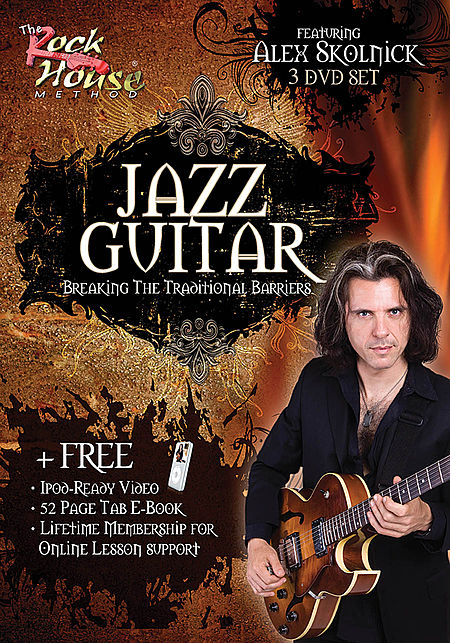
SKOLNICK ALEX, JAZZ GUITAR. BREAKING THE TRADITIONAL BARRIERS. 3 DVD
Series: Rock House
Publisher: Rock House
Format: DVD
Artist: Alex Skolnick
Alex Skolnick is world-renowned for creating an unprecedented blend of metal and traditional jazz. On his first-ever instructional program, Alex shares his perspectives and secrets for conquering jazz guitar. Using basic blues progressions, he guides you through jazz concepts and demonstrates how to follow progressions by targeting chord tones, triads, embellishments, modes and jazz patterns. Learn to apply techniques like upper chord extensions, chromaticism, jazz licks, and to add Bossa Nova, swing, 6/8 time and waltz rhythmic styles to your skill set. Alex reveals how he transforms rock songs like the Scorpions' “Still Loving You” into a jazz composition, as well as his approach to classic standards such as “Autumn Leaves.” Jazz, rock and metal guitaritsts will find that this program details jazz theory and concepts which will increase your music vocabulary, repertoire and overall fluency. Formatted for Zone 0 – playable on any DVD player.
Well, it's finally here. I need to recharge my batteries and escape from the wonderful but daunting task of coming up with a new instructional guitar article every month. However, I'm dreaming up lots of ideas for the future, and in all likelihood I'll return before you know it with loads of fresh ideas. In the meantime, a lot of things are going on which require more attention than I can give while still maintaining the quality you expect in this column. I'd like to take this opportunity to describe what's going on, then leave you with some closing advice. Right now I have a bunch of things in the works. My latest project features guitar, saxophone, bass, drums and percussion, and it's a far cry from anything I've done before. It's raw, funky instrumental music, a lot of it inspired by '70s crime/suspense theme songs. Although it is energetic enough for rock fans, the grooves make it perfect for jazz improvisation, with a lot of interplay between the instruments. It's a great opportunity to put to work a lot of the ideas I've presented here over the years. Will it become a national act? Who knows, but at the very least, this project has been getting a very positive response by those who have seen it so far. Even if it's destined never to break out of the Bay Area here in California, it's so enjoyable that it's still worth it. Current plans are to record a high-quality demo and release it independently. Keep an eye out for Alex Skolnick & The Skoltones you'll see an update with information and a mail-order address in these pages soon enough. The other thing going on, which may or may not come as a shock, is that I've been attending college part time. Now, before you think I'm giving up on music, relax. In fact, going to college is probably the best thing I can do for myself for several reasons. Many of you may be relieved to know you can earn a decent living from teaching and doing guitar clinics, but there's still the harsh reality of the music business: Many musicians are forced to get regular jobs that force them to scale back their practice schedules or quit their instruments entirely. I'd hate to be in that position, but as my name recognition subsides and the music industry becomes increasingly hostile toward serious musicians, there are no guarantees I will be able to continue making a living at this level. Of course, I hope I can, but at this point I have to be realistic. An advantage of going back to school is that it opens up a lot of possibilities; it's tough to get hired without a degree, no matter who you are. I'm taking formal music studies, which is new for me since I learned guitar through self-teaching and private lessons. I'm also studying literature and creative writing. Creativity comes in many forms, and writing this column has instilled in me the desire to expand this knowledge. (l hope it's done the same for you.) I've got some great ideas for stories and insight on the music business, as well as instruction books. So in the meantime, whether I end up with a record deal for the new project, a degree, or both, it feels like I'm on the right track. For the first time I'm making the most of myself as an artist, and I'm much happier than I've ever been. I'd like to close with some parting advice for all of you. Here are three fundamental problems I have noticed in students, whether at clinics or in private lessons. If any of these apply to you, you might want to consider my suggestions.
Bad Pitch
In many ways, the guitar is like the human voice. There are many references to making the guitar "sing," and it's a fitting analogy. And just as it is unpleasant to listen to a vocalist who is off key, the same is true of guitarists. One of the worst habits of guitarists is bending notes and chords out of tune unintentionally. Try holding a single note or a chord, and look at the strings. The space between them should be perfectly even, as ifyou weren't touching the guitar. When bending a note intentionally, you should always have a target note you're shooting for, matching the pitch of that note exactly. Practice by playing the target note first, and keep the pitch ingrained in your mind. It helps to play over a chord that is played by a friend or that you recorded on tape. It also helps to play along with an album, especially one with a good guitarist. Always make sure the guitar is in tune before practicing your bends.
Excess Vibrato
This one drives me nuts! Even many advanced players are guilty of it. Like pitch, vibrato applies to guitar in much the same manner as the human voice. The purpose of vibrato is to enhance a note that is held. In general, it is best not to vibrate a note as soon as it is struck, but to wait until it has had a chance to ring, even if for only a split second. If everything you play is laced with vibrato, it sounds ridiculous. For an exercise, play some licks with absolutely no vibrato, keeping all the notes in perfect pitch. If this is hard to do, you need to break the habit of excess vibrato. Vibrato can be an excellent way to enhance your notes, but you need to be in control of it.
Poor Sense of Timing
This point can't be emphasized enough. Many players spend countless hours practicing scales and licks, only to get stuck because they haven't developed their sense of timing. Metronomes, drum machines, and albums are all excellent sources of a pulse, and it helps to use them when you practice. Even if you can tap to a metronome perfectly, it is important to have an understanding of the possibilities that lie in between the basic 4/4 beats. It is a challenge to play eighth notes, 16th notes, triplets, quintuplets, and sextuplets with good timing. If you practice without a pulse, you may be playing incorrectly, and it is harder to gain control of your playing. Try analyzing the timing of the licks you learn, and make sure that you have them right before trying to use the licks in a song. Hopefully this advice will come in handy. I can't thank you enough for the support you've given me over the years. Your letters and kind words have been more than appreciated.
BROADENING
by Alex Skolnick
Alex Skolnick is currently working with his band, Exhihit A, as well as with Savatage. In addition to gaining notoriety as the author of this DVD, Alex was afounding member and drivingforce behind Testament.
It's time for a break from music
theory. This month, let's talk in detail
about guitar playing, in particular, developing
your own style. People often tell me
they can recognize my playing, and ask how I
developed my style. It's always flattering, and comes a bit
as a surprise, because style is not something I consciously work
on. Developing a style should happen naturally, but one of the
most important elements (aside from dedicated practice) is to
have broad horizons when it comes to listening to, learning, and
appreciating music. There are many steps you can take to broaden
your horizons. Here are a few of the most important ones:
1. Don't pay attention to just the popular guitarists. For one
thing, copying guitarists of the moment will make you sound
like many others, since they're all learning the same licks. Many
of the greatest guitarists are unknown to the music community
at large. Often there are really good local guitarists lurking
around town, especially if you live in a well· populated area. Also,
there is a whole slew of lesser known guitarists, with albums out,
who should not go unnoticed. Some personal favorites: Jimmy
Herring (Aquarium Rescue Unit), Birelli Lagrene, Danny Gatton,
The Hellecasters (Jerry Donahue, Will Ray, John Jorgenson),
Charlie Hunter, Bill Frisell, Scott Henderson, and Pat Martino.
You probably won't be seeing these guys on M1V anytime soon.
2. Listen to different styles of music. It's too easy to lose sight
of good music; for example, a lot of us grow up with the idea that
anything that's not "rock" (particularly jazz or classical) is boring,
that it seems like our parents' music. I too used to think this, and
the very reason I got into hard rock/heavy metal was that it represented
rebellion. There's nothing wrong with this. But if you
want to be a more serious musician, you're going to have to
learn to appreciate more serious music.
When you're young, music is often the force that unites an
entire social scene. Back in high school, most of my friends and I
had long hair, leather jackets, and listened to Judas Priest,
Scorpions, and a new group called Metallica. Today, a lot of high
schoolers hang out in the same type of social situations, except
they have short, spiked hair and baggy clothes, and listen to
groups like Green Day and Smashing Pumpkins. That's fine, but
it's important to step outside of your particular movement when
it comes to listening to music, even though you're subject to
peer pressure.
3. Go beyond your current favorite players. Guitar playing
didn't start with Van Halen, even though he inspired many of
us to pick the instrument up. While it's fine to be influenced by
'80s and '90s players, realize that most of them were inspired
by another set of players when they were growing up. One
thing that has definitely helped me is learning about the
influences of my favorite players, and their influences, and so
on. Many guitarists have inspired wider interest in other musicians
by citing them as influences. For example: Michael :g,
Schenker (Jeff Beck, Leslie West), Jimi Hendrix (B.B. King, Muddy Waters), Jeff Beck (Roy Buchanan, Les Paul), Al Di
Meola (John McLaughlin, John Coltrane), John McLaughlin (Miles Davis, Charlie Parker), etc. The list goes on.
4. Listen to players of other instruments. Many amazing
players don't play the guitar. So what? You can still get a lot of
licks, grooves and other ideas listening to bassists, keyboardists
and horn players. Following are a handful of recommendations:
Bass: Besides Flea and Les Claypool, check out players like
Otiel Burbridge (Aquarium Rescue Unit), Victor Wooten (Bela
Fleck & The Flecktones), Jaco Pastorius, Stanley Clarke, Marcus
Miller, Daryl Jones, John Patitucci, Michael Manring, and Stu
Hamm.
Keyboards/Piano: Before keyboards and piano took a PR
nosedive in the '80s with the advent of "pop" fusion and "lite"
metal, they were often found in rock, jazz and fusion as dynamic,
exciting musical tools. Check out Chick Corea (especially with
AI Di Meola in Return To Forever), Thelonious Monk (jazz legend
whose fans include Jeff Beck and Henry Rollins), Joe
Zawinul (Weather Report), Joey DeFrancesco (20-something virtuoso),
Herbie Hancock (Headhunters), Jan Hammer (with Jeff
Beck, John McLaughlin), John Lord (Deep Purple), and Rick
Wakeman (Yes).
Horns: Miles Davis (rock fans should start with Aura, We
Want Miles, and Decoy, which feature guitarists John
McLaughlin, Mike Stern and John Scofield, respectively), The
Brecker Brothers (funky and dynamic with the energy of hard
rock-coined the term "heavy metal bebop"), John Coltrane
(saxophone genius), and Wayne Shorter (especially with Weather
Report or Miles).
5. Copy others' phrases exactly. At first, this probably sounds
like it would be defeating the purpose of sounding original, but
it's not. Copying phrases helps develop your ear and your sense
of timing and feel for the music. In the long run it will help you
in the development of your own phrases. Most well-known
artists have practiced by learning the phrases of others, and
many still do it. Van Halen has professed to learning all of Eric
Clapton's Cream solos at one time or another. John Coltrane was
known to run through entire Charlie Parker solos as part of his
warm-up routine. Eric Johnson has said he still gets inspiration
from studying Jimi Hendrix's playing. The more players you
learn phrases from, the better. But just because you learn their
phrases doesn't mean you have to copy everything else about them.
It is one thing to learn the phrases of different artists, mix
and match, and use their influence to
develop your own voice. But it is
another thing entirely to copy someone'
s material, songwriting style, feel,
tone, gear, clothes, etc. One is innovation,
the other is imitation.

 Italiano
 English