PENTAGRAMMA - STANDARD NOTATION

TOWNER RALPH SOLO GUITAR WORKS VOLUME 2 LIBRO SPARTITI CHITARRA ACCORDI OREGON

RALPH TOWNER, SOLO GUITAR WORKS VOLUME 2. SHEET MUSIC BOOK FOR SOLO GUITAR. 

LIBRO DI MUSICA.

SPARTITI PER CHITARRA.

ACCORDI, PENTAGRAMMA. 

About Ralph Towner - Guitar Works, Volume 2
By Ralph Towner. For Guitar. Folk Rock. Level: Intermediate-Advanced. Instrumental Album. 52 pages.
Known as the founding member of the group Oregon, and the composer of Icarus, he is also regarded for his solo guitar compositions. The second volume of Towner's guitar works contains nine songs including Always By Your Side, The Hollows, Toledo, and more.

2005 - If - Album: TIME LINE
2005 - Toledo - Album: A CLOSER VIEW
2005 - Toledo (improvising chord changes) - Album: A CLOSER VIEW
2005 - Anniversary Song - Album: TIME LINE
2005 - Always By Your Side - Album: TIME LINE
2005 - The Hollows - Album: TIME LINE
2005 - Turning Of The Leaves - Album: TIME LINE
2005 - The Pendant - Album: TIME LINE
2005 - The Lizards of Eraclea - Album: TIME LINE
2005 - Mingusiana - Album: A CLOSER VIEW
2005 - Mingusiana (improvising chord changes) - Album: A CLOSER VIEW


Ralph Towner was born in Washington state in 1940, moved to Oregon state at age of five and grew up there. He began to improvise at piano at age of 4, imitating recordings from the WW II era. His mother was a piano teacher and church organist, and each member of the family played one or several musical instruments well.

He studied classical composition at theUniversity of Oregon, graduated in 1963 and went toVienna, Austria to study classical guitar, an instrument he discovered in his fourth year of university. He studied one year under the renowned Professor Karl Scheit, returned to the University of Oregon for graduate studies in composition with Professor Homer Keller, then returned for a second year of study in Vienna with Professor Scheit. He then moved to New York City in 1968 to continue his career as guitarist-pianist-composer in earnest.

Since 1970 he has recorded over forty albums under his own name and has collaborated in'concert and/or recording with Oregon, Keith Jarrett, Weather Report (Joe Zawinul and Wayne Shorter), Egberto Gismonti, Gary Burton, John Abercrombie, Gary Peacock, Jack Dejohnette, Jan Hammer, Eddie Gomez, Elvin Jones, Freddie Hubbard, Michel Portal, Dave Holland, Paul Winter consort, and many others. He has won numerous awards, including: two German 'Grammies' (Deutsche Shallplatten Preis) for the best jazz recording of 1976 world-wide, (Solstice, with Jan Garbarek, Eberhard Weber and Jon Christenson), and again in 1988 for Ecotopia with his group Oregon (Paul McCandless, Glen Moore, Trilok Gurtu); the Downbeat magazine poll for acoustic guitar: The New York jazz Award as best New York City acoustic guitarist; and a Grammy nomination in 2000 as best composer for Oregon in Moscow: He has performed in concert world-wide in Asia, Africa, South America, Eastern and Western Europe, Australia and New Zealand, Japan, Korea, Mexico, and North America; in jazz clubs and major concert halls such as Carnegie Hall, Lincoln Center, Berlin Philharmonic Hall, and Vienna's Mozartsaal.

Towner has recorded over two-hundred of his instrumental compositions. His works for orchestra

have been performed by the Philadelphia Orchestra, the Stuttgart Opera Orchestra, the St. Paul
Chamber Orchestra, the Indianapolis Symphony, the Freiburg Festival Orchestra and the Stavanger
Chamber Orchestra of Norway. He has been commissioned to compose large orchestra works
by the Cabrillo Festival Orchestra, where he was composer-in-residence, and by the AT&T-Rockefeller foundation. He received a WYNC/Aaron Copland commission to compose the piano
sonata Simulacrum in 1999; His film scores include Un' Altra Vita by Carlo Mazzacurati as well as
numerous documentary films. He has composed music for L'lsola Incandescente, a play adapted
from the writings of Vincenzo Consolo, and incidental music for Shakespeare's Midsummer Night's
Dream. His compositions have been used by numerous dance choreographers, including Alvin
Ailey, Pilobolus, and Murray Louis. He was honored by Apollo astronauts, who carried his music on cassette to the moon and officially named two moon craters after two of his compositions.
Towner is one of the most diversely talented musicians of the past half-century, having made notable recordings of classical, jazz, folk and world music. Following a classical-conservatory education, studying classical composition and guitar, Towner then joined world music pioneer Paul Winter's Consort ensemble in the late 1960s. Along with band members Paul McCandless, Glen Moore, and Collin Walcott, Towner left the Winter Consort in 1970 to form the group Oregon, which over the course of the 1970s issued a number of highly influential records mixing folk music, Indian classical forms, and avant-garde jazz-influenced free improvisation.

As well as collaborating in concert and/or recording with many artists, Towner has recorded over two-hundred of his instrumental compositions, with works being commissioned and performed by some of the world’s leading orchestras. Available here is the second volume of solo works for guitar, including Always By Your SideThe HollowsToledo and more. 

PHOTOS: Paolo Soriani
Prezzo: €59,99
€59,99

SERRANO JUAN & COREY WHITEHEAD FLAMENCO CLASSICAL GUITAR TRADITION 1 Method CD LIBRO SPARTITO

SERRANO JUAN & COREY WHITEHEAD, THE FLAMENCO CLASSICAL GUITAR TRADITION, VOLUME 1,
A Technical Guitar Method and Introduction to Music. 175 Pagine, 4 CD con 235 tracce audio. NO TABLATURE

LIBRO DI MUSICA FLAMENCO - CLASSICA CON 4 CD,
METODO, SPARTITI PER CHITARRA. CON ACCORDI E PENTAGRAMMA.

Product Description:
This beginning guitar method is written for aspiring classical or flamenco guitarists who want to learn how to read music up to the intermediate level. Music from the Spanish tradition such as Romanza, Pica-Pica, El Vito, Café de las Chinitas, Perfidía, La Virgen de la Macarena and flamenco music of Juan Serrano provides a technical and musical foundation that improves facility in playing scales, arpeggios, tremolo, and rasgueado.

Tablature is not included as the one of the primary aims of this book is to improve note reading and the comprehension of the fundamental elements of music. Performances of all musical examples are available online that includes one performance at tempo for each of the more than 230 musical examples. Short repertoire pieces from Gaspar Sanz, Dionisio Aguado, Fernando Sor, Mauro Guiliani, Ferdinando Carulli, and Mateo Carcassi are included at the end of the book and are repertoire studies that will prepare guitarists for further study in classical and/or flamenco guitar.

Product Number: 21029
Format: Book
ISBN: 0786674652
UPC: 796279100489
ISBN13: 9780786674657
Series: Non-Series
Publisher: Mel Bay Publications, Inc.
Date Published: 12/18/2008
176 PAGES


A Brief History of THE GUITAR

The guitar is a descendant of two different instruments, the Spanish instrument called the vihuela de mano, and the European lute that descended from the Arabian oud. The Arabic word oud translates in English as "wood." The oud has six courses with the lowest sounding string being a single course. The word course refers to a single string or a pair of strings placed closely together. The European lute and the vihuela had a single high string or single course on top. On the lute this string was called the chanterelle. The vihuela and the European lute appeared in six-course versions. Various configurations of the lute used many tunings and had as many as thirteen courses.

The vihuela had as many as ten courses and was tuned like the modern guitar with the exception of the third string, which was lower by a half-step from the modern guitar tuning. It was tuned, from lowest to highest sounding course: E A D F# B E. The six-course lute was generally tuned, from lowest to highest: G C FAD G. There was no absolute tuning pitch at that time and some treatises instructed the student to rune the 1st string as high as possible without it breaking. The lute is often tuned a whole step higher to (A D G B E A) to take advantage of its more brilliant and shimmering tone quality at that pitch. The earliest guitars date from around the middle of the 13th century in Spain and were mentioned in 1265 by Juan Gil of Zamora in the treatise called Ars Musica. In 1487 Johannes Tinctoris wrote about the four-course guitar being invented by the Catalans. The first music published for the four-course guitar was by Alonso Mudarra (1510-1580) in Treslibros de musica en cifraspara vihuela (1546). Nine books of tablature were published by Adrien Le Roy (1520-1598) between 1551-1555. These publications contain the first music for five-course guitar. Later in the same century Juan Bermudo (1510-15-) and Miguel Fuenllana (1525-1585) wrote music in tablature for the guitar. A treatise from the late 16th century in Spain refers to two techniques of playing the guitar; rasgueado (strumming) or punteado (picking with the fingers). The technique of alternate picking toward the palm of the right hand with two fingers, such as the index and middle fingers, was called dos dedos. There was a further explanation of a technique called dedillo that refers to a rapid up and down movement of the index finger to strike an individual string when playing scale passages.

The baroque guitar had five courses that were tuned to unison at the first, second, and third strings and to an octave at the fourth and fifth strings. The two exceptions are that sometimes the fifth string did not have me bourdon or lower octave string, and sometimes the first string was a single course like the chanterelle of the lute. The former would make the fifth string the highest sounding string on the instrument, many performers preferred the latter, and some performers employed both. The fifth string was the highest sounding string and me fourth was the lowest. On the modern guitar the fifth string is tuned an octave lower than the guitar of Gaspar Sanzo In 1674 in Italy, Francisco Corbetta (1620-1681) published Guitarre Royale, dedicated to King Luis XIV of France. In 1596 in Italy there was a school of guitar playing called the Alpha Beta School. The primary scholars of the school were Juan Carlos y Amat and Palumbi. They developed a system of chord notation that was noted .m letters to describe the chord to be played. They also used the terms "rasgueado" and "punteado" in their rreanse. Between 1770 and 1800, the six single-course guitar was commonplace and following this development composers such as Fernando Sor (1778-1839) Spain/France/England, The famous Mauro Giuliani (1781-1829) Italy, ... 


Contents:

A Note from the Authors
The Guitar - A Brief History
La Guitarra (poem)
Preface
Parts of the Classical Guitar
Parts of the Flamenco Guitar
Names of the Open Strings
Tuning
Metronome
Note Locations on the Fretboard
Sitting Position and Holding the Guitar
The Fingers of the Right and Left Hand
Fingernail Shape and Maintenance
Picados (Scales) - Apoyando (Rest Stroke) and Tirando (Free Stroke)
Arpeggios (Broken Chords)
Tremolo (Preparatory Exercise)
Rasgueado (Strumming)
Basic Elements of Music Notation
Musical Expression Symbols
The Musical Alphabet
Half Steps and Whole Steps
The Major Scale
The Open Treble Strings
Systematic Arpeggio Exercises
Alternating Index and Middle Fingers...
Sueño
The Open Bass Strings
Playing on the Bass and Treble Strings
Notes on the First String
Soleares
Notes on the Second String
Music in Two Parts
Playing Eighth Notes
Notes on the Third String
Sevillanas
Sevillanas I (Trio)
Sharps and Flats on the 1st, 2nd and 3rd strings
The Fifth Position on the First String
The Natural Sign
Romanza in A Minor
Romanza
Farrucas
Sixteenth Notes
Slurs
Estudio No. 2
Estudio No. 2 (Duet)
The Major Scale
The Natural (Relative) Minor Scale
The A Harmonic Minor Scale
The A Melodic Minor Scale
The Chromatic Scale
Notes on the Fourth String
Chords
Fandango
Fandango Duo
Notes on the Fifth String
Historia de un Amor
The Dotted Quarter Note
Perfidia
Notes on the Sixth String
Farrucas (Bass Line)
Farrucas
El Zorongo (Bass Line)
El Zorongo (Melody)
Playing the F Major Chord
Playing Two Notes Together (Double-Stops)
El Vito
Rasgueado
Sevillanas Intro
The Natural Notes
Sharps and Flats on the Bass Strings
The Chromatic Scale
El Rancho Grande
Alternating Bass and Chord Progression
El Rancho Grande (Duet)
Ascending and Descending Slurs: Ligados
Left Hand Agility Exercise
Chords in C Major and A minor
Las Mañanitas
Greensleeves
Scales and Chord Progressions
Rumba Rhythm
Scales and Chord Progressions cont
The House of the Rising Sun
Variations on a Theme from Asturias
Malagueña
Intervals
Chords
Triads
C Major Arpeggio and Chord Inversion
The A Minor Arpeggio and Chord
The G Major Arpeggio and Chord
The F Major Triad
Barré Chords
Chord Progressions
Petenera
Café de Chinitas
La Virgen de la Macarena
The High D and E on the First String
Pica-Pica Melody (Guitar I)
Pica-Pica Accompaniment (Guitar II)
Pica-Pica Accompaniment (Guitar III)
Pica-Pica Accompaniment (Guitar IV)
Pica-Pica (quartet)
Key
Chord Substitution
Key Signatures
The Circle of Fifths
Major and Minor Scales in the First Position
More Chords in the Circle of Fifths...
Allegro by Ferdinand Carulli
Allegretto by Carulli
Andante by Carulli
Allegro in E minor by Carulli
Etude in G Major by Carulli
Andantino by Carulli
Larghetto by Carulli
Romanza
Menuet by Robert de Visée
Lección 38 by Dionisio Aguado
Clarines de los mosqueteros del rey de Francia by Sanz
Allegro by Mauro Guiliani
Andante by Ferdinand Carulli
Conclusion
About the Authors

Prezzo: €27,99
€27,99

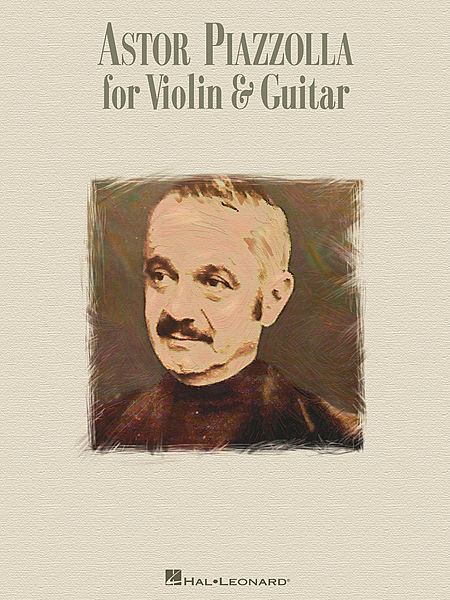
PIAZZOLLA ASTOR FOR VIOLIN & GUITAR HAL LEONARD LIBRO SPARTITI CHITARRA VIOLINO SHEET MUSIC BOOK

PIAZZOLLA ASTOR, FOR VIOLIN & GUITAR. SHEET MUSIC BOOK IN STANDARD NOTATION. 

LIBRO DI MUSICA. 
SPARTITI PER CHITARRA E VIOLINO, IN PENTAGRAMMA. 

Composer: Astor Piazzolla

Astor Piazzolla (1921-1992) was the foremost composer and ambassador of tango music, who carried the signature sound of Argentina to clubs and concert halls around the world. This folio gathers 35 of his finest and arranges them for violin and guitar duets. Includes bio. 80 pages
Titles include:

Astor Piazzolla (1921-1992) was the foremost composer and ambassador of tango
music, who carried the signature sound of Argentina to clubs and concert halls around
the world.
Piazzolla was born in 1921 in Mar del Plata, on the coast south of Buenos Aires, but
lived in New York City from 1924 to 1937. In New York the young Piazzolla tuned into the
vibrant jazz scene and bandleaders such as Duke Ellington and Cab Calloway. At age 12,
he received his first bandoneon, a type of button accordion that is the principal voice
of tango, and began playing music from the classical repertoire. Soon after his family
returned to Argentina in 1937, Piazzolla joined the popular tango orchestra of Anibal
Troilo and-while still a teenager-established himself as a talented bandoneon player
and arranger.
In Argentina, Piazzolla continued to study classical music, too, with the composer
Alberto Ginastera and others. In 1954, Piazzolla's composition "Buenos Aires" won
him a scholarship to study in Paris with Nadia Boulanger, who encouraged him to
find his own voice by tapping into his passion for tango. Back in Argentina in the
late 1950s, Piazzolla did just that, laying the groundwork for what become known as
tango nuevo-new tango.
In 1960 he formed his seminal group Quinteto Tango uevo, featuring bandoneon
alongside violin, guitar, piano, and bass. In the ensuing years Piazzolla's music increasingly
used dissonance, metrical shifts, counterpoint, and other techniques inspired
by modern classical composition and jazz orchestras. In Argentina, where tango is a
source of national pride and identity, some tango purists were incensed by these radical
departures from tradition, and in the late 1960s even Argentina's military government
criticized Piazzolla for being too avant-garde. Piazzolla left behind a huge body of music-more than 750 works-and classic recordings such as Adios Nonino and Tango:
Zero Hour, as well as collaborations with artists as diverse as poet/author Jorge Luis
Borges (El Tango), jazz vibraphonist Gary Burton (The New Tango), and the Kronos
Quartet (Five Tango Sensations). In 1986, Piazzolla's music was featured in the
Broadway hit Tango Argentino. In 2001 Amadeus Press published Astor Piazzolla: A
Memoir, the remarkable life story (as told to journalist Natalio Gorin) of one of the 20th
century's true musical iconoclasts.


1958 - Adios nonino  - Yves Paul Martial Puech, Asto Piazzolla
1957 - Boricua - Astor Piazzolla
1963 - Buenos Aires Hora Cero - Astor Piazzolla
1960 - Calambre - Astor Piazzolla
1960 - Decarisimo - Astor Piazzolla
1958 - Dernier lamento - Roger Auguste, Charles Desbois, Albert Abraham, Ben Soussan, Astor Piazzolla
1957 - Détresse - Astor Piazzolla
1962 - Extasis - Astor Piazzolla
1958 - Fièvre (Fiebre de Tango) - Albert Abraham, Ben Soussan, Albert Noel De Marigny Engeurrand
1963 - Fracanapa - Astor Piazzolla
1958 - Greenwich - Albert Abraham, Ben Soussan, Andre Psieto, Astor Piazzolla
1958 - Gulinay - Astor Piazzolla
1962 - Imàgines 676 - Astor Piazzolla
1963 - racundo - Astor Piazzolla
1960 - La Calle 92 - Astor Piazzolla
1962 - La fin del mundo - Oscar Nicolas Fresedo, Astor Piazzolla
1960 - Las Furias - Astor Piazzolla
1958 - Llueve Sobre Broadway - Raoul Cohzales, Astor Piazzolla
1961 - Los Poseidos -  Yves Paul Martial Puech, Astor Piazzolla
1960 - Made In USA  - Asto Piazzolla
1957 - Mi Exaltacion - Asto Piazzolla
1957 - Misteriosa VidaGuy Favreau, Astor Piazzolla
1957 - Nuevo Mundo - Astor Piazzolla
1957 - Presentania - Astor Piazzolla
1962 - Psicosis - Astor Piazzolla
1960 - Recuerdo New York - Astor Piazzolla
1963 - Revirado - Astor Piazzolla
1957 - Romantico Idilio (Sans ta presence) - Astor Piazzolla Gay Favreau, Albert Abraham, Ben Soussan, 
1964 - Se Termino (C'est fini) - Astor Piazzolla
1957 - Suavidad - Astor Piazzolla
1964 - Tango choc (Doudou) - Astor Piazzolla
1958 - Tanguisimo - Astor Piazzolla
1958 - Te quiero tango - Astor Piazzolla
1962 - Todo Fue - Diana Piazzolla, Astor Piazzolla
1958 - Yo canto un tango - Astor Piazzolla

Prezzo: €25,99
€25,99

PIAZZOLLA ASTOR HISTOIRE DU TANGO LATIN DANCE CLASSICS FOR FLUTE & GUITAR CD BASI

PIAZZOLLA ASTOR, HISTOIRE DU TANGO AND OTHER LATIN DANCE CLASSICS FOR FLUTE & GUITAR. CD

LIBRO DI MUSICA CON CD DI BASI.
SPARTITI PER CHITARRA E FLAUTO, IN PENTAGRAMMA. 
BASI PER FLAUTO

Series: Music Minus One

Publisher: Music Minus One
Medium: Softcover with CD
Composer: Astor Piazzolla
performed by Katarzyna Bury, flute
Accompaniment: Christian Reichert, guitar

Guitar and flute virtuosi Christian Reichert and Katarzyna Bury bring you this album featuring Argentina's most fabled 20th-century tango composer, Astor Piazzolla, who wrote this suite of tango pieces bridging a century of tango styles, drawn in a rich pallette for guitar and flute duet. Alongside this wondrous composition is a quartet of dance classics from such composers as Enrique Granados and Pablo de Sarasate. Sensational music and not to be missed! Includes an authoritative, newly engraved solo part printed on high-quality ivory paper, and a compact disc containing a complete version with soloist; then a second version in digital stereo of the orchestral accompaniment, minus the soloist. 77 pages


ASTOR PIAZZOLLA :

Histoire du tango

Bordel 1900

Café 1930

Nightclub 1960

Concert D'aujourd'hui


ENRIQUE GRANADOS :

Danza Espagnola Op.37

N. 5 Andaluza (Playera)


PABLO DE SARASATE :

Playera

Romanza Andaluza


Histoire du Tango: 1. Bordel 1900 Performed by Astor Piazzolla

Histoire du Tango: 2. Cafe Performed by Astor Piazzolla

Histoire du Tango: 3. Nightclub Performed by Astor Piazzolla

Histoire du Tango: 4. Concert d'aujourd'hui Performed by Astor Piazzolla

Spanish Dances, op. 37, H142: 5. Andaluza (Playera) Performed by Enrique Granados (arr. Reichert & Bury)

Romanza Andaluza Performed by Pablo de Sarasate

Playera Performed by Pablo de Sarasate

Prezzo: €41,99
€41,99

PACHELBEL CANON Per arpa solo, arpa duet, arpa e flauto o violino SPARTITI

PACHELBEL, CANON. Per arpa solo, arpa duet, arpa e flauto o violino. SHEET MUSIC BOOK FOR HARP SOLO, HARP DUET, HARP and FLUTE or VIOLIN.

LIBRO DI MUSICA .

SPARTITI PER ARPA, DUETTO DI ARPE, ARPA e FLAUTO o VIOLINO.  

PENTAGRAMMA. 

Series: Harp
Author: Johann Pachelbel

This popular piece is in great demand and is now available for folk harp. This book includes several arrangements: an easy solo version, an advanced solo version in the keys of G and D, and a duet version for harp and melody instrument.

Prezzo: €16,99
€16,99

BACH J.S. INVENZIONI MARCO DI NATALE Trascrizioni due BASSi a 4 corde LIBRO CD-ROM

BACH J.S., INVENTIONS, Transcriptions for 2 Four-String Electric Basses. MARCO DI NATALE. CD-ROM

SHEET MUSIC BOOK WITH BASS STANDARD NOTATION. 


LIBRO CON CD, CD ROM,

SPARTITI PER CHITARRA BASSO.

PENTAGRAMMA. 


trascrizione per :

DUE BASSI A 4 CORDE,

e,

UN BASSO A 6 CORDE.


The Bach Two-Part Inventions are among the most famous of Baroque keyboard pieces. Marco Di Natale has transcribed this music for two electric basses, making a Bach to Rock connection. Included are 5 pieces: Invention No. 1 in C Major, Invention No. 2 in C minor, Invention No. 6 in E Major, Invention No. 8 in F Major, Invention No. 13 in A minor. The score also comes with a CD-ROM, allowing a bass player to listen to the pieces, and play along with either of the two parts at any tempo. The CD-ROM also may be used in a conventional CD player, with each of the two parts on a separate stereo channel. This Italian publication is fully translated, with Italian and English text. 36 pages. 

Prezzo: €25,99
€25,99

CLASSICAL FAVORITES FOR GUITAR DUO by Nadal BOOK

CLASSICAL FAVORITES FOR GUITAR DUO, by Nadal. SHEET MUSIC BOOK in standard notation for 2 GUITARS.


LIBRO DI MUSICA CLASSICA.

SPARTITI PER DUE CHITARRE :

PENTAGRAMMA.

Spanning the Renaissance through the twentieth century, this original collection features The Harmonious Blacksmith, selections from Bach's Art of the Fugue and Two-Part Inventions, plus works by Beethoven, Schubert, Granados, and others. Perfect for beginners as well as advanced players, it features several teacher-student duets. Pages 144.

This new collection of duos for classical guitar brings together a wide variety of pieces for beginning, intermediate and advanced players. Musical styles represented include a sampling from the Renaissance, Baroque, Classical, and Romantic periods, as well as arrangements of several popular folk melodies. I have organized the selections into four groups:

Folk and Traditional Music includes many favorites arranged in an easy-to-play format. The majority of the parts are fingered to minimize shifts of the fretting-hand's position. The textures are all straightforward with the melody or soloist in the top part and the accompaniment below.

The Easy Music section consists of some repertoire arranged for the student and teacher as well as music for second- and third-year players. The selections include Elizabethan music (Dowland and Byrd), famous simple dances by Bach, a charming Valse by the great 19th-century guitar composer Fernando Sor, Beethoven's Ode to Joy theme, Schumann's Melodie from Album for the Young, Justin Holland's period arrangement of the theme to Auber's Fra Diavolo, and a simplified arrangement of the ever popular Foster song, My Old Kentucky Home.

Intermediate Music includes increasingly advanced music for third- through sixth-year players. Repertoire includes: Dowland's curious Galliard originally written for two to play on one lute; Bach Inventions and a Bourrt?e from his second English Suite; duos by Sor and Giuliani (the most important guitar composers of the early 19th century); two graceful Schubert Llindler, and an adaptation of his famous Stlindchen; arrangements of piano music by the Spanish nationalists, Albeniz and Granados; and Joplin's ragtime two step, The Entertainer.

Advanced Music contains three virtuosic selections. Handel's Harmonious Blacksmith (a posthumously bestowed nickname for a portion of his Fifth Harpsichord Suite) and Bach's Canon at the Octave from Art of the Fugue will present many challenges to the advanced player, but the rewards well surpass the difficulties. The famous Barber of Seville Overture is my own adaptation of Giuliani's arrangement of Rossini's Elisabetta. Try to seek out the original orchestral version (also published by Dover) to better mimic the orchestral timbres.

It is hoped that this new collection will bring you much joy in your music making. New York City 2005. Dedicated to my students, past and present-especially those who studied with me during the summer of 2005: Bernard Barisic, Michael and Rachel Edery, Matthew Linder, Ronnie Spiewak and my CUNY classes. Table of Contents for Classical Favorites for Guitar Duo Folk and Traditional Music

Amazing Grace - Tradizionale
Aura Lee - Tradizionale
Bill Boy - Tradizionale
Cradle Song - Tradizionale
Danny Boy, Londonderry Air - Tradizionale
Greensleeves - Tradizionale
The Kerry Dance - Tradizionale
The Rose of Tralee - Tradizionale
Remon - Creole Song
Thanksgiving Prayer - Colonial Congregational
The Wayfaring Stranger - Appalachian Lament
Easy Music
Sleep, wayward thoughts from the first booke of songs (John Dowland 1563-1626)
Lesson for Two Lutes from the Dowland lute book (Anonymous late 16th century)
Sellinger's Round from The Fitzwilliam Virginal Book (William Byrd 1542-1623)
Awake, sweet love (John Dowland 1563-1626)
When Phoebus... (John Dowland 1563-1626)
Minuet in G from The Little Notebook for Anna Magdalena Bach (Johann Sebastian Bach 1685-1750)
Bourrée from Suite for Lute, BWV 996 (Johann Sebastian Bach 1685-1750)
Musette in D (J.S. Bach)
Minuet in G from The Little Notebook for Anna Magdalena Bach (Johann Sebastian Bach 1685-1750)
Valse in C N.1 from six Valses puor Deux Guitares, Op. 44 (Fernando Sor 1778-1839)
Ode to Joy from Symphony N.9, Op.125 (Ludwig van Beethoven 1770-1827)
Melodie N.1 from 43 Clavierstucke Fur Die Jugend, Op. 68 (Robert Schumann 1810-1856)
My Old Kentucky Home (Stephen Foster 1826-1864)
Fra Diavolo from Auber's Opera Comique (Justin Holland 1819-1887)
Intermediate Music
My Lord Chamberlin's Galliard "for two to play upon one Lute" from the first Booke of songs (John Dowland 1563-1626)
Invention No. 4 from fifteen two-part inventions (Johann Sebastian Bach 1685-1750)
Invention No. 8 from fifteen two-part inventions (Johann Sebastian Bach 1685-1750)
Invention No. 13 from fifteen two-part inventions (Johann Sebastian Bach 1685-1750)
Bourrée I from English Suite N.2 (Johann Sebastian Bach 1685-1750)
Andante N. 1 from Trois Dous, Op. 55 (Fernando Sor 1778-1839)
Souvenir de Russie Op. 63 (Fernando Sor 1778-1839)
Polonese and Trio N.1 from The Polonesi Concertanti, Op. 37 (Mauro Giuliani 1781-1829)
Ländler N.1 from Eight Ländler, D.378 (Franz Schubert 1797-1828)
Ländler N.8 from Eight Ländler, D.378 (Franz Schubert 1797-1828)
Ständchen from Schwanengesag (Franz Schubert 1797-1828)
Capricho Catalan N.5 from Espagna: 6 Hojas de Album, Op.165 (Isaac Albeniz 1860-1909)
Tango N.2 from Espagna: 6 Hojas de Album, Op.165 (Isaac Albeniz 1860-1909)
Spanish Dance No. 1 from Twelve Danzas Espagnolas (Enrique Granados 1867-1916)
Spanish Dance No. 2 from Twelve Danzas Espagnolas (Enrique Granados 1867-1916)
The Entertainer A Ragtime Two step (Scott Joplin 1868-1917)
Advanced Music
The Harmonious Blacksmith Air and Five Variations from suite in E major, (HG II/i/5) (George Frideric Handel 1685-1759)
Canon at the Octave Contrapunctus XII from The Art of the Fugue (J.S. Bach 1685-1750)
The Barber of Seville - Overture dall'Opera il Barbiere di Sivilia (Gioacchino Rossini 29 febbraio 1792 - 13 Novembre 1868)

Prezzo: €23,99
€23,99

SCHUBERT FRANZ, ARRANGED FOR GUITAR, Javier Calderon. CD

SCHUBERT FRANZ, ARRANGED FOR GUITAR, Javier Calderon. CD

Product Description:
There have been few previous examples of guitar versions of Schubert' piano music, and practically no attempts to transcribe a complete set of pieces, as Caldern has done here with the six pieces of Schubert's Moments Musicaux. These pieces are superb examples of Schubert's mastery in the miniature form, true "musical moments" of mood and feeling. Two other pieces complete this collection, which also includ notes on the preparation and performance of the pieces in English, German, and Spanish. The music is in standard notation only with a CD of performances of the pieces by the arranger.

Prezzo: €18,00
€18,00

TWO TO TANGO AND MILLENNIUM DUET GUITAR DUETS COMPOSED Jorge Morel LIBRO CD SPARTITI

TWO TO TANGO AND MILLENNIUM DUET, COMPOSED by Jorge Morel. CD

LIBRO DI MUSICA CON CD, SPARTITI PER DUE CHITARRE. PENTAGRAMMA . 


Product Description:
These two pieces for classic guitar duo were composed for the Hanser-McClellan Guitar Duo. "Two to Tango" is a tango rhapsody for two guitars using mainly tango rhythm combined with that of the milonga, another Argentinean dance closely related to the tango. The interaction of the two guitars playing single lines at times and then changing roles between the melody and the rhythm makes it more interesting for both players. "Millennium Duet" was written as a homage to Chet Atkins. The piece opens with a brief reflection of country and western rhythmic ideas, with a melody of a different character. It later moves on to other patterns, at times combining some Latin American rhythms with a little touch of jazz harmony. This book includes two separate guitar parts and a combined score written in standard notation only. The companion CD features the premiere recording of the pieces by the Hanser-McClellan Guitar Duo.

Prezzo: €21,99
€21,99

A CHRISTMAS PASTORALE arranged Michael Newman & Laura Oltman CD DUO SPARTITI SILENT NIGHT

A CHRISTMAS PASTORALE, arranged by Michael Newman & Laura Oltman. SHEET MUSIC BOOK WITH CD & STANDARD NOTATION.

LIBRO DI MUSICA CLASSICA CON CD. 

SPARTITI PER DUO DI CHITARRE CON: PENTAGRAMMA.  

MUSICA SACRA, NATALE. 


Product Description:
Celebration of the Christmas holiday includes a rich musical tradition. For this score and accompanying CD, the internationally-renowned Newman & Oltman Guitar Duo presents a ravishing collection of sacred music written for Advent, Christmas, and Epiphany. The duo has chosen music from six centuries in a wide variety of musical styles, including familiar Christmas tunes, little-known gems, and interesting variations on familiar themes written by such composers as Bach, Handel, Pachelbel, Mendelssohn, and Brahms. Selections range from beautiful Renaissance tunes suitable for beginning guitarists to concert repertoire for advanced players.

From Canta No. 147, Jesu, Joy of Man's Desiring -- Johann Sebastian Bach, Arranged by Michael Newman and Laura Oltman
From Cantata No. 140, Wake, Awake -- Philipp Nicolai, Arr. by Michael Newman and Laura Oltman
From Cantat No. 140, Zion Hears the Watchmen Singing -- Johann Sebastian Bach, Arr. by Michael Newman and Laura Oltman
Chorale: Wake, Awake -- Philipp Nicolai, Arr. by Michael Newman and Laura Oltman
The Holly and the Ivy -- Arranged by Michael Newman and Laura Oltman
From William Ballet's Lute Book (Lulla, Lulla) -- Arranged by Michael Newman and Laura Oltman
I am so Glad each Christmas Eve -- Arranged by Michael Newman and Laura Oltman
Chorale: (Lo, how a Rose e'er blooming) -- Arranged by Michael Newman and Laura Oltman
Chorale Prelude: Op. 122 Lo, how a Rose e'er blooming -- Johannes Brahms, arranged by Michael Newman and Laura Oltman
The Son of Mary -- Edited by Michael Newman and Laura Oltman
Chorale: Dearest Emmanuel -- Arranged by Michael Newman and Laura Oltman
Chorale: A Child is born to us -- Johann Sebastian Bach, arranged by Michael Newman and Laura Oltman
From Christmas Concerto - Adagio-Allegro-Adagio -- Arcangelo Corelli, arr. by Michael Newman and Laura Oltman
From Christmas Concerto -- Arcangelo Corelli, Arr. by Michael Newman and Laura Oltman
O Come, O Come, Emmanuel -- Arranged by Michael Newman and Laura Oltman
There is No Rose -- Arranged by Michael Newman and Laura Oltman
Greensleeves (What Child is This?) -- Arranged by Francis Cutting, Trans. by Michael Newman and Laura Oltman
Chorale: A Boy born in Bethlehem -- Johann Sebastian Bach, Arr. by Michael Newman and Laura Oltman
Joy to the World! -- George Frideric Handel, Arr. by Michael Newman and Laura Oltman
Chorale: From Heaven Above -- Martin Luther, Arr. by Michael Newman and Laura Oltman
Chorale Prelude: From Heaven Above -- Johann Pachelbel. Arr. by Michael Newman and Laura Oltman
Hark! The Herald Angels Sing -- Felix Mendelssohn-Bartholdy, Arr. by Michael Newman and Laura Oltman
From Pageant of the Shearmen and Tailors Coventry Carol -- Arranged by Michael Newman and Laura Oltman
Chorale: The Newborn Child -- Melchior Vulpius, Arr. by Michael Newman and Laura Oltman
Chorale: In Sweet Jubilation -- Arr. by Michael Newman and Laura Oltman
Prelude: In Sweet Jubilation -- Arr. by Michael Newman and Laura Oltman
From Cantata No. 208 Sheep May Safely Graze -- Johann Sebastian Bach, Arr. by Michael Newman and Laura Oltman
From Messiah Pifa -- George Frideric Handel, Arr. by Michael Newman and Laura Oltman
Silent Night -- Arr. by Michael Newman and Laura Oltman

Prezzo: €29,99
€29,99
Condividi contenuti