Italiano
 English
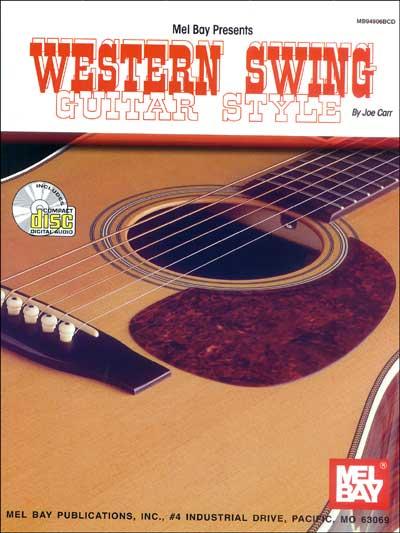
WESTERN SWING GUITAR STYLE by Joe Carr BOOK CD TABLATURE CHITARRA LIBRO SPARTITI

WESTERN SWING GUITAR STYLE. Joe Carr. La parola swing deriva dal verbo dondare, e in musica, è quel senso di oscillazione della parte ritmica, con accenti, anticipi, pause, ritardi, note staccate, e questo benchè il ritmo sia costante e uniforme. 40 accompagnamenti ritmici completi, con griglia degli accordi nello stile swing anni '30 '40 del musicista Bob Wills. SHEET MUSIC BOOK CD with GUITAR TABLATURE .
LIBRO DI MUSICA WESTERN SWING CON CD.
SPARTITI PER CHITARRA :
ACCORDI, PENTAGRAMMA, TABLTURE.
Product Description:
If you have ever heard the sound of rhythm guitar in a good western swing band, you may have wondered how the guitarist achieved that unique chordal sound. While the song might be a simple one--playable with only two or three chords--the western swing guitarist changes chords every two beats, providing a driving and harmonically interesting background for the singers and instrumentalists. This book is designed for intermediate players who have a basic understanding of open chords. It begins with study of the Texas fiddle back-up style and the chords used to enhance this music. The chords and progressions explained in this book can be used in many types of music in addition to western swing and would serve as an excellent transition from open-string folk chords to more of a jazz approach.
Format: Book/CD Set
Series: Texas Music and Video
If you have ever heard the sound of rhythm guitar in a good western swing band, you may have wondered what the guitarist was doing. While the song might be a simple one with only two or three chords, the guitarist changes chords every two beats, providing a driving and harmonically interesting background for the singers and instrumentalists. This book is designed for intermediate players who have a basic understanding of open chords. An accompanying video "Western Swing Guitar Styles, Volumes One and Two" which includes much of the material contained here, is available from Mel Bay Publications. The chords and progressions explained here can be used in many types of music in addition to western swing. The guitar style fits especially well with swing music of any type from the 1930's and 1940's. If you haven't heard this style before, check out recordings by Bob Wills, Asleep at the Wheel and Johnny Gimble. Many of these recordings feature the great Eldon Shamblin, Bob Wills' longtime guitarist and the undisputed master of this styIe. Wewill begin our study with what has been called the Texas fiddle backup style. The beginnings of this style are unclear, but it is my opinion that it was started by guitarists who heard and tried to copy the sound of Eldon Shamblin on the early Bob Wills records of the 1930's. Recordings of Texas fiddlers in the 1920's feature rhythm guitars played in the bass-strum pattern - the same pattern found on early recordings of southern Appalachian fiddlers. It is not until after Shamblin's first recording with Bob Wills in the mid 1930's that we hear the style on Texas fiddle records. Special thanks go to Slim Richey, Alan Munde, John Hartin, Buster Redwine and Kim Fagerstrom for their help in my understanding of swing rhythm and the development of this project. Western Swing guitar music was originally played on the large hollow body electric F-hole guitars of the 1930' sand 1940' s. The guitarists used medium or heavier gauge strings. In recent times, most players, including Eldon Shamblin, use solid body electrics which are easier to carry around, more versatile and are less prone to feedback. The neck position pickup is used to get a fatter, more mellow rhythm sound. If you play several styles, you can still get a good swing rhythm with light stings. Some players, including me, beef up the bass strings in a light set to help strengthen the rhythm sound. I use a set that is .10, .12, .16, .30, .40, .50. This allows me to bend strings on the lead pickup on twangy country music and still gets a good swing sound on the neck position. In the 1920's and 1930's, players like Eddie Lang, Django Reinhardt and Karl Farrrecorded swing music using acoustic guitars. Acoustic swing music is enjoying a surge of popularity today. Almost any type acoustic guitar will do and many players prefer medium strings for good tone and volume. Providing good swing rhythm on acoustic guitar is hard work and takes strong muscles and well-developed calluses on the fingertips. At Texas style fiddle contests across the nation, you will notice many guitarists with Gibson acoustic guitars. Their preference for this brand is similar to Bluegrass musicians' preference for Martins. Also unique to these musicians is their use of steel wrapped stings as opposed to the more common bronze wrapped strings used by most acoustic guitarists. Warning: DO NOT enter a jam session with a group of serious Texas Fiddlers with any of the following instruments: 12 string guitar, 5 string banjo, harmonica, autoharp. You may never be seen or heard of again!
Song Title: Composer/Source:
Ballad (:39) Arr. By: Joe Carr
Beaumont Rag (:37) Arr. By: Joe Carr
Blues (1:01) Arr. By: Joe Carr
Columbus Stockade Blues (1:07) Arr. By: Joe Carr
Corrina (:29) Arr. By: Joe Carr
Cowtown (:32) Arr. By: Joe Carr
Durang's Hornpipe (:26) Arr. By: Joe Carr
Dusty Miller (:29) Arr. By: Joe Carr
Ida Red (:26) Arr. By: Joe Carr
Kind Of Love (:38) Arr. By: Joe Carr
Leather Britches (:28) Arr. By: Joe Carr
Lily (1:09) Arr. By: Joe Carr
Pipeline (:38) Arr. By: Joe Carr
Sally Goodin 1,2,3 (:37) Arr. By: Joe Carr
Sally Goodin 4 (:28) Arr. By: Joe Carr
Sally Johnson (:28) Arr. By: Joe Carr
San Antonio Rag (:35) Arr. By: Joe Carr
South (1:06) Arr. By: Joe Carr
Sugar (1:03) Arr. By: Joe Carr
Time/Just A Closer (:36) Arr. By: Joe Carr
Wesphalia Waltz (:54) Arr. By: Joe Carr