MEL BAY

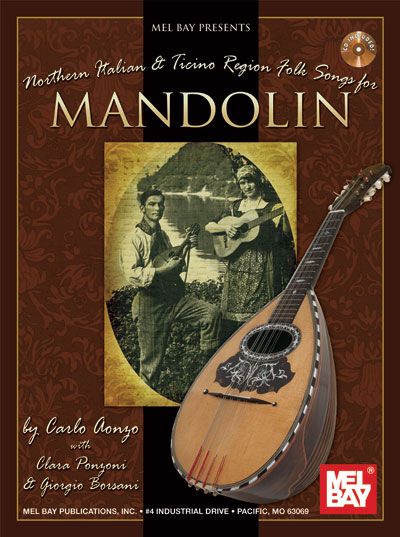
NORTHERN ITALIAN & TICINO REGION FOLK SONGS FOR MANDOLIN-Carlo Aonzo-Ponzoni-Borsani CD TABLATURE

NORTHERN ITALIAN & TICINO REGION FOLK SONGS FOR MANDOLIN. Carlo Aonzo, Clara Ponzoni, Giorgio Borsani. CD TABLATURE

LIBRO DI MUSICA DEL NORD ITALIA, CON CD.

SPARTITI PER MANDOLINO CON: 

ACCORDI, PENTAGRAMMA, TABLATURE. 

TESTO IN ITALIANO E INGLESE.

Ticino is a small area at the southernmost tip of Switzerland on the border with Italy. The Ticino region was actually part of Italy until a few centuries ago. The mandolin arrived in Ticino through immigrants and their music, and put down important cultural roots there. The mandolin style in Ticino is a link to the old Italian folk music tradition, which has been largely lost in Italy and throughout other parts of the world. This book is a collection of some of the most famous pieces from this vast historical repertoire. The collection includes lots of popular folk songs, virtuosic pieces by original mandolin composers, as well as an original Aonzo composition. The book is presented in English and in Italian while the music is in standard notation and mandolin tablature. 

INTRODUZIONE
In una piccola regione a sud della Svizzera, proprio al confine con l'Italia, c'è il Ticino.
Questo piccolo territorio fino a pochi secoli fa era parte dell'Italia, per cui ha mantenuto
svariate sfumature di cultura italiana, pur facendo parte della Svizzera.
Il Ticino (come il resto della nazione) ha avuto un grande sviluppo industriale ed economico
a partire dalla fine del 1800. Di conseguenza si è trasformato da terra di emigranti
(i ticinesi emigravano verso le Americhe) a terra di immigrazione. E probabilmente
è proprio grazie all'immigrazione di tanti italiani che il mandolino è arrivato in
Ticino, e qui ha messo delle importanti radici, essendo tra i principali rappresentanti
del patrimonio culturale locale. In Ticino infatti vi è un'alta densità di musicisti e di
orchestre a plettro.
La musica mandolinistica ha una grande tradizione come musica d'aggregazione e di
festa. Ancora oggi nasce in modo spontaneo tra musicisti ed appassionati che si trovano
per passare qualche momento in allegria, e viene arricchita con mandolini, chitarre,
contrabbasso, canto, fisarmonica e altri strumenti. Questo modo di suonare che si va
perdendo in Italia ed in altre parti del mondo, resta attuale in Ticino. Polche, canzonette,
valzer, mazurke, arie d'opera, serenate risuonavano e risuonano ancora fino a
tarda ora nei luoghi di ritrovo. Il tutto accompagnato da buon vino e cibo tradizionale.
Oltre alla musica spontanea, vi sono molte orchestre mandolinistiche, che affrontano
repertori scritti per questo tipo di formazione (di cui non è nostro obiettivo parlare in
questo libro).
Il repertorio spontaneo è piuttosto vasto, e legato all' abilità e alle conoscenze dei singoli
musicisti. Si va da canzonette popolari (molte delle quali di autore sconosciuto) a
compositori originali per mandolino, passando da musica tramandata per tradizione
orale (molti musicisti non sapevano leggere la musica) fino a repertorio di grande virtuosismo.
Fonti importanti sono state le riviste pubblicate in Italia da fine 1800 che
avevano cadenza di solito bisettimanale e che gli abbonati aspettavano con trepidazione
("Il plettro", "Il mandolino", e altre).
L'intento di questo lavoro e' quello di trasmettere agli appassionati mandolinisti di
tutto il mondo, la cultura musicale del Ticino e lo spirito allegro e cordiale che caratterizza
la Svizzera italiana.
NOTE DEGLI AUTORI
Nella musica popolare raramente l'esecutore legge la notazione musicale; i brani vengono
imparati, arrangiati ed eseguiti ad orecchio. Spesso accade, quindi, che le note
scritte siano solo una traccia e l'interpretazione sia ogni volta diversa.

CARLO AONZO
Concertista di fama internazionale si è affermato anche tra i principali divulgatori del mandolino classico italiano. Diplomato in mandolino con il massimo dei voti e la lode al Conservatorio di Padova, ha collaborato con numerose istituzioni musicali incluse la Filarmonica del Teatro alla Scala di Milano, e la Nashville Chamber Orchestra (Usa).
Ha vinto, tra gli altri, il primo premio speciale "Vivaldi" alla Vittorio Pitzianti National Mandolin Competition di Venezia, e il primo premio alla Walnut Valley National Mandolin Contest, Winfield, Kansas. Ha registrato per l'americana Mel Bay, un concerto-video sulla storia del repertorio per mandolino solo (Carlo Aonzo: Classical Mandolin Virtuoso) , i progetti discografici "Serenata" (Acoustic Music, Germania), "Traversata" (Acoustic Disc, Usa), "Antonio Vivaldi-Concerti per mandolino e orchestra" (Edt, Torino), nel 2007 l'album "Kazè", nel 2008 "Il mandolino italiano nel Settecento", e nel 2010 "Fantasia Poetica". E' titolare di un corso annuale a partecipazione internazionale a New York e nel 2006 ha fondato l'Accademia Mandolinistica Internazionale Italiana.
Come ricercatore si occupa delle origini e della storia del proprio strumento, ha collaborato con il New Grove Dictionary of Music and Musicians ed ha curato edizioni musicali per la casa editrice Bèrben.

GIORGIO BORSANI
Nato a Como (Nord Italia), ha intrapreso gli studi di chitarra classica all'età di 12 anni, diplomandosi presso il Conservatorio "Giuseppe Nicolini" di Piacenza. Ha all'attivo diverse collaborazioni con formazioni cameristiche, anche in qualità di solista, ed è membro di alcune orchestre a pizzico in Svizzera e Italia. Accanto all'attività concertistica affianca quella didattica, ha insegnato in diverse scuole di musica e si occupa dellaformazione strumentale in formazioni mandolinistiche in Svizzera e collabora nell'organizzazione di corsi di musica nazionali ed internazionali. Si occupa inoltre dell'organizzazione di concerti e rassegne musicali ed ha conseguito la Laurea in Economia per le Arti, la Cultura e la Comunicazione.

CLARA PONZONI BORSANI
Nata e cresciuta in Svizzera, ha iniziato da bambina 

lo studio del mandolino nell'ambito delle Orchestre
Mandolinistiche locali, proseguendo poi gli studi con Carlo Aonzo.
Suona in alcune Orchestre Mandolinistiche, in Du.
classico con chitarra (Duo Vivace) e in qualità di solista a
orchestre da camera.
nrepertorio spazia dalla musica popolare a quel!.
contemporanea. Tiene regolarmente concerti in Svizzera ed all'estero.
Oltre all'attività musicale, si occupa di insegnamento e di organizzazione di coro
di musica nazionali ed internazionali quale collaboratrice del Maestro Aonzo. 

POLCA E MARCIA
La polca è un ballo in 2/4. La musica è veloce e si danza in coppia.
Non è chiaro quale sia la sua origine. Si ritiene che, come indica il suo nome, derivi da una danza
polacca che si è diffusa velocemente in tutta l'Europa.
Nelle serate conviviali viene eseguita molto spesso proprio per il suo carattere allegro e vivace.
Anche la marcia è una composizione musicale in 2/4, che si differenzia dalla polca per l'origine.
Infatti, come suggerisce il nome, non è stata pensata per la danza ma per scandire il passo delle
sfilate delle bande militari. Anche il repertorio bandistico fa parte della cultura popolare ed è
t{uindi vicino alla musica mandolinistica.
E importante segnalare che spesso nella musica popolare la stessa melodia sia d'uso in diversi
luoghi ma con titoli ed attribuzioni diverse. Si tratta di musica tramandata oralmente la cui paternità
resta ignota o ambigua.

LA SISINA
In Ticino la composizione di questa di polca viene attribuita a Pasquale Sisini (Mendrisio/CH 1902-1997). Il
collegamento tra il titolo ed il presunto autore è evidente. Della stessa melodia sono presenti però delle tracce
nel nord-est d'Italia (Trentino), dove viene chiamata "Polka Gilardengo" (Libro a pagina 109: Giacomo
Sartori e l'Associazionismo Mandolinistico in Italia fra il XIX e il XX secolo, a cura di Antonio Carlini, Ed.
Akademos 1999).
Un collega musicista che ha conosciuto e suonato personalmente con Sisini conferma con orgoglio che la
musica è stata composta da lui.
Questo dimostra che è davvero difficile conoscere con esattezza la paternità di alcune melodie.

POLCA DEL DORIN
Questa polca è di autore ignoto. Viene chiamata "Polca del Dorin" per identificarla dalle altre polche, proprio
perché questo famoso mandolinista ticinese (Isidoro Frigerio, Riva San Vitale/CH 1908-1988) la suonava
molto frequentemente.

OH KATIA
Motivo popolare di origine sconosciuta, tra i più diffusi nella musica popolare.

AL GROTT DEL FIN
Remo Giambonini (Gandria/CH 1911-1997) è stato uno tra i più importanti compositori ed orchestratori
ticinesi di musica per mando lino.
Giambonini ha studiato armonia e contrappunto ed ha suonato in tante orchestrine in salotti, alberghi e
balere di tutta Europa, con un repertorio musicale immenso (operette, musica da ballo, classica e popolare).
Era un musicista poliedrico, negli strumenti e negli spartiti.
La sua grande preparazione musicale è evidente nelle sue composizioni popolari che contengono una grande
ricchezza musicale.
Nella musica popolare infatti, oltre a canzonette piuttosto semplici, sono presenti brani molto virtuosi.
La composizione è stata dedicata al grotto (osteria) del padre (Il Grott del Fin) che si trovava sulle rive del
lago di Lugano.

SCUGNIZZA
Il termine "scugnizzo" nel dialetto napoletano indica un bambino monello e dispettoso che passa le giornate
per le strade di Napoli.

NINAPANCHA
Brano popolare probabilmente di origine spagnola. Suonato sia in duo sia con orchestra.
 

Al Grott del Fin - Remo Giambonini

Carnevale di Venezia - Arr. Carlo Munier - CON ANCHE LA PARTE DELLA CHITARRA, NO TABLATURE. 
Cesarina - Cesare Pezzolo
Czardas - Vittorio Monti
Graziella - Pino Guerra
L’Alborela - Remo Giambonini
La Sisina - Traditional
Nina Pancha - José Garcia
Ninna nanna - Giuseppe Aonzo
Oh Katia! - Traditional
Polca del Dorin - Traditional
Scugnizza Remo - Giambonini
Speranze perdute - Alessandro Morelli
Tarantella - Raffaele Calace - CON ANCHE LA PARTE DELLA CHITARRA, NO TABLATURE.  
Tra veglia e sonno - Luigi Canora
Vulcano - Mario Cavallari

Prezzo: €32,99
€32,99

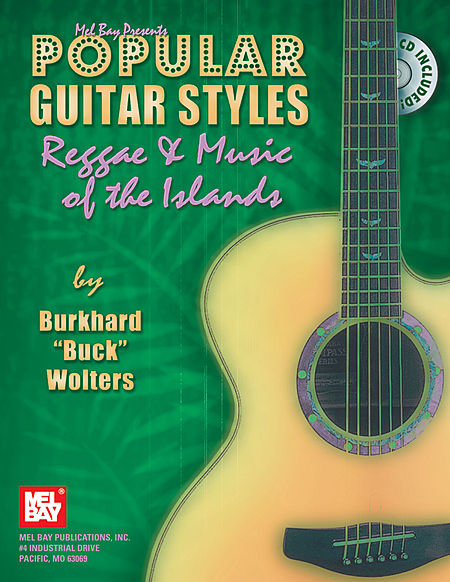
POPULAR GUITAR STYLES REGGAE & MUSIC OF THE ISLANDS Burkhard Buck Wolters CD TABLATURE

POPULAR GUITAR STYLES, REGGAE & MUSIC OF THE ISLANDS. Burkhard Buck Wolters. SHEET MUSIC BOOK WITH CD AND GUITAR TABLATURE .

LIBRO DI MUSICA REGGAE , LATINA, CON CD. 

SPARTITI PER SOLA CHITARRA CON : 

PENTAGRAMMA E TABLATURE. 

Popular Guitar Styles: Reggae and Music of the Islands reflects recent popular styles and transfers them to classical or fingerstyle technique. Guitar players who want to add reggae or Island music to their solo-repertoire will find an original and unique collection of compositions which will give joy to both players and listeners. The playing-level is intermediate to advance. Left-hand difficulties like barres and stretches are minimized as much as possible to make it easy to make the music groove. Written in notation and TABLATURE.

Series: Popular Guitar Styles

Buck Wolters belongs to the very small company of guitar players and composers who are familar with nearly every style. His authentic mix of jazz, world and latin music, combined with a mastery of classical guitar technique is very unique and outstanding. Born in 1961 in Dortmund, Germany, he began to play the guitar as an autodidact at the age of five. After hearing a recording of Big Bill Broonzy he took his first guitar lessons at the age of thirteen, digging into the blues for several years. At the age of sixteen he went to the conservatory in his hometown where he studied classical guitar. The music of Agustin Barrios, Heitor Villa-Lobos and David Qualey were his main influences. After leading the life of a busker in his twenties, he went to the School of Arts in Amsterdam to study jazz guitar and composition and spent most of his time then copying jazz solos from musicians like John Coltrane, Keith Jarrett, Pat Metheny and Wes Montgomery. He completed his studies as a bachelor with distinction. Today Buck Wolters is very busy performing, composing, recording and teaching throughout Europe. His greatest success belongs to his composition "Dshamilja" ordered in commission by the Opera of Frankfurt.

In the following I will give some brief explanations on the pieces that appear in this book and the popular Caribbean styles that they represent. Moreover some techinical and musical insight on how to produce special sounds on the guitar are given. Keep up the sunny Caribbean mood and have fun with it! Buck Wolters


Kingston Feet (Reggae)

The word "Reggae" was coined around 1960 in Jamaica to identify a "ragged" style of dance music, that melted New Orleans rhythm'n'blues and Caribbean music together. Later African elements were also included. The legendary Bob Marley (1944 -1981) made Reggae popular all over the world, and he is still one of the most active influences in recent popular music. Kingston Feet is to be played in even eights (straight, no shuffle). On the recording you will hear some percussion elements, which have been left out of the score for reading matters. Anyway, you should learn the piece first without percussion. If you want to add them later, here is an explanation: There are two sounds: a "bass drum" on count three, and a "rimshot" on count one (imitating the drumset). The "bassdrum" is produced by dropping the right-hand palm on the bridge. (It takes a little practice to drop the palm and hit strings at the same time.) The rimshot is produced by tapping a finger (preferably the little one) on the top. The "muffle" or "etouffe" is produced by holding the notes with the left-hand fingers without pressing them down to the fret.


Pan-Man-Limbo (Limbo)

The Limbo is also known as the "Under Stick Dance," a dance competition which was very popular at beach parties in Trinidad and Tobago, and is still alive today in Caribbean stage shows. The dancer moves under a stick, trying not to touch it, while being accompanied with Caribbean music, often played on the steeldrum ("Pan"). The harmonics in the beginning of the piece imitate the sound of the "Pan" and they are written as notes that would sound if you fingered them regularly.


Friendly Fritz (Reggae)

This Shuffle-Reggae is dedicated to Frit: Rossel, a very good friend of mine and a genius of a special kind. He is an excelent guitar builder, photographer, writer, salesman and last but not least an extraordinary musician. He plays keyboards, bass and guitar like no one I know. The highlight is when he starts to sing: he can imitate any singer from Harry Bellafonte to Mick Jagger, from Stevie Wonder to Bob Marley, that it makes you laugh until you cry. Again you will hear some percussion elements on the recording, which are produced in the same way on the guitar as in Kingston Feet.


Mentomania (Mento)

Mento is a style from Jamaican heritage, which had its beginnings in the 19th century and can be seen as the "grandfather" of Reggae. Mento had its golden age in the 1950s. Some of the famous mento musicians of that time were: Harold Richardson, Hubert Potter, and Monty Reynolds. Although Mentomania is notated in even eighths, it has a slight feeling of swing or shuffle. As in many Caribbean rhythms the 3/2 clave is featured. (see Popular Guitar Styles Vol. 1 - Latin & Salsa). To give the piece a light, typical Caribbean mood, I suggest you play it with the capo on the 3rd fret. Near the end of the piece (measures 103 through 124) you will hear the ...


Song Title: Composer/Source:

Children of St. Vincent - Buck Wolters
Friendly Fritz - Buck Wolters
Kingston Feet - Buck Wolters
Les Jardins d'Andre - Buck Wolters
Mentomania - Buck Wolters
Pan-Man-Limbo - Buck Wolters

Prezzo: €29,99
€29,99

EMMANUEL TOMMY AND FRANK VIGNOLA JUST BETWEEN FRETS LIBRO guitar TABLATURE Reinhardt SWING

EMMANUEL TOMMY AND FRANK VIGNOLA, JUST BETWEEN FRETS. TABLATURE

LIBRO PER DI MUSICA SWING MANOUCHE,

SPARTITI PER CHITARRA, 

ACCORDI, PENTAGRAMMA E TABLATURE

by Tommy Emmanuel & Frank Vignola ; transcribed by Vinney Raniolo

"Just Betweens Frets"  è l'ultimo risultato della collaborazione tra Tommy Emmanuel e Frank Vignola. Frank e Tommy prendono brani famosi e li trasformano grazie al loro virtuosismo e alla chimica unica che si crea dentro il loro duetto, creando una catena non stop di magici momenti musicali catturati in due spontanee sessions. Questo libro è la trascrizione dell'album e comprende la notazioni standard con tablature sia per la parte di Tommy, sia per la parte di Frank.  Include: Paper Moon, How High the Moon, Clouds e altri.

Just Betweens Frets is the latest collaboration of Tommy Emmanuel and Frank Vignola.
Frank and Tommy turn many a well known tunes inside out with their virtuosity and unique chemistry as a duo, creating a non-stop chain of magical musical moments that were captured in a couple of spontaneous recording sessions. This book is a transcription of the album and features standard notation and tablature for both Frank’s and Tommy’s parts. Tunes include: Paper Moon, How High the Moon, Clouds and many more.


1934 - Clouds - Walter Donaldson
1945 - Django’s Castle - Django Reinhardt 
1940 - How High the Moon - Morgan Lewis
1930 - I’ve Got a Crush on You/Young at Heart - George Gershwin & Ira Gershwin
2009 - Just Us for All - William Emmanuel
1947 - Nature Boy - Eden Ahbez
1933 - Paper Moon - Harold Arlen
1955 - Sweet Dreams - Don Gibson
2009 - Swing 09 - Tommy Emmanuel
1939 - Swing 39 / Swing 42 - Django Reinhardt & Stephane Grappelli
1946 - Tenderly - Walter Gross

Prezzo: €32,99
€32,99

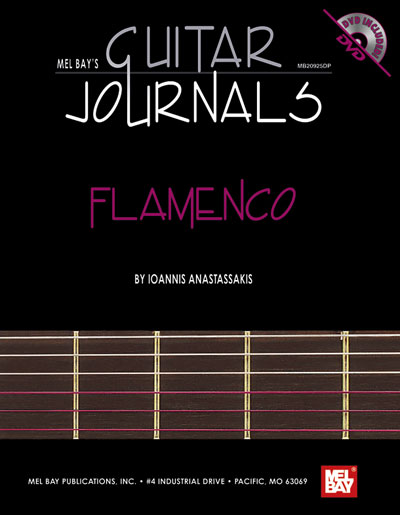
GUITAR JOURNALS FLAMENCO Ioannis Anastassakis DVD TABLATURE MEL BAY CHITARRA SPARTITI TABLATURE

GUITAR JOURNALS... FLAMENCO. SHEET MUSIC BOOK WITH DVD & GUITRAR TABLATURE. 

LIBRO DI MUSICA FLAMENCA CON DVD.

SPARTITI PER CHITARRA CON:

PENTAGRAMMA E TABLATURE.  

6 PEZZI COMPLETI.


Product Description:
This 176-page book/DVD package includes six full-length contemporary Flamenco guitar compositions by Ioannis Anastassakis, MA, best-selling Mel Bay author of the Art of Rasgueado and one of the few people to have obtained a Graduate Degree in Flamenco Guitar. Selections include Veridiana (Rumba Flamenca), Angelika (Granadinas), Maestro Serrano (Tangos), as well as 3 more solos based on the Flamenco forms of the Farucca, the Soleares and the Malaguena. Presented in standard notation and tablature, with extensive performance notes for each selection. DVD duration 64 min.

Format: Book+DVD
Series: Guitar Journals

It is no secret that interest in the flamenco guitar has grown very rapidly during the last 50 years. Flamenco guitar technique has evolved to extremely high standards, the compositions have matured beyond even the most optimistic expectations and the number of artists performing solo flamenco guitar music has risen to unprecedented heights; even the number of new flamenco guitar recordings has quadrupled in the last 5 years alone! There is, however, still one problem plaguing this continuous and multi-faceted progress: lack of performance repertoire. When compared to its classical guitar counterpart, flamenco guitar repertoire is found lacking indeed. Very few editions of performance pieces exist, most of them decades-old compositions that do not take into account the progress that has taken place in both the performance techniques and the compositional forms of flamenco guitar.

My intention with this collection of pieces is to tread the fme line between traditional flamenco guitar, firmly rooted in the inherited musical elements and the contemporary influences that have brought new levels of excitement to the music. All the compositions presented in this collection are based on traditional flamenco guitar forms. All of them, however, include additional elements from other musical cultures and styles. These compositions are meant to be performed live. I have performed most of them at least 200 times during the course of my flamenco guitar recitals and in just about every performance scenario from impromptu guitar gatherings to heavily publicized recitals, when teaching flamenco masterclasses or just playing for friends. The level of difficulty is usually upper intermediate with some parts drifting purposefully into advanced territory. Do not let that discourage you! I hope you have as much fun working with the compositions in this book as I had composing and recording them. Moreover, if you do enjoy them, do not hesitate and let me know. And while you are at it, check out. Finally, if you are interested in the subjects of flamenco and classical guitar, check out my Art of Rasgueado book, as well as my upcoming Art of Tremolo, Treasures of Flamenco Guitar and Flamenco Guitar Studies books, all published by Mel Bay Publications.


Companion CD Recording: All of the compositions in the book are recorded on the companion CD at performance speed. In addition, several of the key parts in each composition are recorded again at slow speed, in order to offer a more complete understanding of each phrase. Finally, I have included video files on the companion DVD that demonstrate the most difficult parts, as well as flamenco-specific techniques within these compositions. Fingering Notes: In order to simplify the visual complexity of the music, I have opted to avoid repeating obvious left-hand fingerings, especially in the case of basic major and minor chords played in open position and/or phrases repeated many times throughout the composition (eg. The basic rasgueado pattern in Soleares). This was done intentionally in an effort to give the music an uncluttered look, since there is a fair amount of rhythmic complexity as well as a large assortment of right hand techniques that need to be meticulously transcribed in the notation and tablature. As a personal fingering choice, I tend to use my left hand 4th finger (little finger) for a lot of phrases where most guitarists would use their 3rd (ring) fmger instead. I have found that with proper training, the little finger becomes even stronger than the ring finger, so I tend to use it a lot, sometimes to the point of favoring it. Still, this is a personal fingering choice. Feel free to substitute the 3rd finger in these instances. Keep in mind that a lot of flamenco falsetas (music phrases) are based on chord shapes that are held for either the complete duration or a significant segment of the phrase. This is especially prevalent in tremolo-based and arpeggio-based phrases. Try to identify these phrase segments and keep the maximum number of chord notes ringing while performing them. Depending on their specific context, trills are sometimes notated as appogiaturas and are sometimes given appropriate rhythmic value. The most basic, as well as the most usual, golpe is played with the ring finger hitting the golpeador of the flamenco guitar, right below the 1st string close to the bridge. However, there are two other special golpes used in the following compositions, which are explained in each piece's performance notes. The most distinctive techniques of the flamenco guitar are the various Rasgueados. These characteristic strumming techniques playa key part in creating the unique sound of the flamenco guitar. I have intentionally decided to use a very large variety of rasgueados, more than you would probably find in the actual playing of even an advanced flamenco guitar performer, in order to demonstrate a representative sample of the variety of flamenco rasgueado technique. If you are interested in learning more about the various rasgueado techniques used in flamenco, their history proper performance and context, I suggest you check out my instructional book The Art of Rasgueado, published by Mel Bay Publications.


Born on the Greek island of Crete, Ioannis Anastassakis studied at the Greek National
Conservatory and the Nakas Conservatory in Athens. He completed his bachelor's degree at the
American College of Greece, and subsequently studied at the distinguished Musicians Institute
in Las Angeles (GIT), where he was hired as an instructor after graduating in the top 1% of his
class. He continued his studies, specializing in solo flamenco guitar under the tutelage of Juan
Serrano at California State University, completing an MA in Guitar Performance and graduating
Magna cum Laude. Currently (2005), he is working towards a Doctorate in Education, with an
emphasis in Music in the UK.
Ioannis studied for several years with Juan Serrano. In addition, he has studied with Flamenco
guitar legends Manolo Sanlucar, Juan Martin, Paco Serrano, Jose Antonio Rodriguez and Manolo Franco.
Ioannis' list of teachers of electric guitar are no less impressive; the list reads like a "Who's
Who" of contemporary electric guitar legends including: Steve Vai (Whitesnake), Vinnie Moore (UFO), Marty Friedman (Megadeth), John Petrucci (Dream Theater), Frank Gambale (Chick Corea), Paul Gilbert (Mr. Big), Brett Garsed, Joey Tafolla, Scott Henderson, Mike Stern, Jean Marc Belkadi, Darren Householder, Tommy Tedesco, Ted Greene, Ron Echete, Sid Jacobs and Joe Diorio.
Ioannis has also performed and/or recorded in various settings with band members from
Whitesnake, Dio, Deep Purple, Ozzy Osbourne Band, Elton John Band, Santana, Celine Dion, Sara Vaughan, Tito Puente, Julio Iglesias, Tower of Power, Chick Corea Electric Band, Jeff Beck, Steve Vai Band, Badlands, Tribal Tech, Natalie Cole, Joe Cocker, Cher, Blood Sweat & Tears, Nina Hagen and others.
Ioannis has presented over 300 solo recitals in Europe and the United States and has been a
guest lecturer at several American colleges and universities including: The University of Southern
California, California State University Northridge, California State University Fresno, California
State University Fullerton, Musicians Institute, Fresno City College, and the American College of
Greece. In addition, he has won classical and flamenco guitar competitions and has been featured
a dozen times on American television programs.
In December 2000, he was the first guitarist ever to present a solo guitar recital at the Greek
National Opera House.
Ioannis' first solo flamenco guitar CD, Flamenco Live at Ioannina, was released by MP3.com
in August 2000 and immediately entered the company's flamenco category Top 10 chart, eventually
reaching the #1 spot worldwide in October 2002. The CD was re-mastered and re-released by
Wild Rose Angel Productions in 2003.
Ioannis' second and third solo flamenco guitar CDs, Traditional Flamenco Guitar Selections,
Vol.J & Vol.2 are scheduled for release by Wild Rose Angel Productions in 2006 and 2007
respectively.
Ioannis' instructional materials are published and distributed worldwide by Mel Bay
Publications. His first instructional book The Art of Rasgueado, achieved best-seller status within
months of its initial publication date. He is also a regular columnist in Mel Bay's Guitar
Sessions® magazine.

TABLE OF CONTENTS
Introduction
Acknowledgements
General Performance Notes
Notation Legend
A mi madre (Soleares) - About the Composition
A mi madre (Soleares) - Performance Notes
A mi madre (Soleares)
Recuerdos de Cordoba (Farruca) - About the Composition
Recuerdos de Cordoba (Farruca) - Performance Notes
Recuerdos de Cordoba (Farruca)
Angelika (Granadinas) - About the Composition
Angelika (Granadinas) - Performance Notes
Angelika (Granadinas)
Veridiana (Rumba) - About the Composition
Veridiana (Rumba) - Performance Notes
Veridian (Rumba)
Maestro Serrano (Tangos) - About the Composition
Maestro Serrano (Tangos) - Performance Notes
Maestro Serrano (Tangos)
Variations on Malaguefia (Malaguena) - About the Composition
Variations on Malaguefia (Malaguena) - Performance Notes
Variations on Malaguefia (Malaguena)
About the Author

DVD CONTENTS
This DVD contains specific sections from the songs chosen by the author to teach in greater detail. Each section is played at speed and then played again at a slower pace to offer greater instruction and insight into each piece. The audio tracks are located on the DVD. You can access them by selecting "Audio Only selections" from the main menu of the DVD. 

Song Title: Composer/Source:

Introduction
Acknowledgements
Performance notes
Notation legend

A Mi Madre - Ioannis Anastassakis
Angelika - Ioannis Anastassakis
Flamenco Variations on Malaguena - Ioannis Anastassakis
Maestro Serrano - Ioannis Anastassakis
Recuerdos De Cordoba - Ioannis Anastassakis
Veridiana - Ioannis Anastassakis

Prezzo: €32,99
€32,99

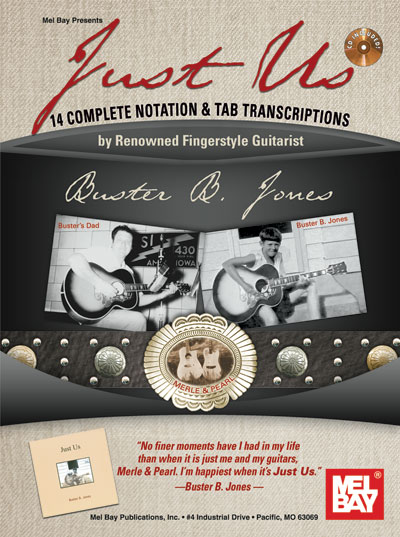
BUSTER B. JONES JUST US 14 Complete Notation & Tab Transcriptions CD TABLATURE LIBRO SPARTITI

BUSTER B. JONES, JUST US: 14 Complete Notation & Tab Transcriptions. SHEET MUSIC BOOK WITH CD & TABLATURE .

LIBRO DI MUSICA ACUSTICA, CON CD.

SPARTITI PER CHITARRA FINGERPICKING CON: 

PENTAGRAMMA E TABLATURE.

Product Description:
Although his scorching fingerpicking was most impressive at first glance, a closer look at "Just Us" reveals that he is equally adept at what many musicians consider as a more difficult task: playing fewer notes... ones that mean more, and say more with less, as he does on album opener "A Simple Gift", title cut "Just Us", and "One Sad Clown".

"Just Us" is an album consisting largely of his own compositions inspired by his two main guitars "Merle" and "Pearl". Along the way we are treated to a barn-storming version of "Alabama Jubilee" (it must be tunes like this that caused Chet Atkins to say of Jones "He plays like he's double-parked"), "Collage-a-Reed" and "Clawin'" (each inspired by mentor Jerry Reed), while "Let the Sun Shine In" sounds like an instant fingerpicking classic that you could swear you have heard before, but haven't. Including detailed notation on 15 of Buster’s songs from "Just Us", this Book/CD lesson will challenge even the best players. Presented in standard notation and tablature.

Biography Buster B. Jones was a master of the guitar styles of Chet Atkins, Merle Travis and Jerry Reed. He explored their music, styles and techniques, but developed his own unique style and depth. Buster was known as a blazing fast and dynamic player, and was given the nickname "The Machine Gun" by admiring fans in France, but his original compositions expose a lyrical and gentler side to his musical personality. Raised in Ames, Iowa, Buster began playing guitar and mandolin at an early age, following in the footsteps of his older brother Ron, who Buster idolized as the "best left-handed guitarist ever." It became apparent however that by Buster's mid-teens he would have a special gift for music, and his musical ability exploded. Buster never took formal lessons, but developed his mastery of the guitar through sheer trial and error, and by diligently trying to learn the complex styles of players like Chet Atkins and Jerry Reed. "I touch on many different styles and approaches to playing lead and rhythm guitar. My goal as a player is to expand these perimeters and express what I feel musically," says Buster, who often played for other guitar players at conventions like the CAAS in Nashville and NAMM. 'Playing to a bunch of guitar players and fans is like watching Dawn of the Dead on video. They just stare 'ou slack-jawed, looking like they want to eat your brain. It's a wonderful feeling!" Buster B. Jones has several early albums, which are out of print and three CDs, Fingers in Flight, Guts and Steel and Just Us. He also has produced 12 teaching videos for Stefan Grossman's Guitar Workshop. Buster B. Jones lived in Eugene Oregon and performed regularly across Canada and the United States. He was the 1990 winner of the National Fingerpicking Championship held yearly in Winfield, Kansas. Buster was not just a great guitar player but a teacher and a friend to many. He spent countless hours sharing his knowledge and skills with young players and I am grateful to have had the opportunity to work closely with Buster on this CD. Tom Redmond


As a child, I grew up listening to such greats as Hank Williams, Jimmy Rodgers, Hank Snow and Merle Travis. My father Buster Jones was a great entertainer; and with my mom and big brother Ron played polkas and square dances. Dad even had a radio show of his own. He would do the weather and time and then play some music. Although my dad's playing ability was somewhat limited, his ability to capture an audience was what intrigued me the most. Dad said "Talk to the folks like they are old friends and they'll become old friends." I live by those words. I've never met a stranger. My dad Buster, mom Allene and Ron were my first influences, although in time I had many others, like Chet Atkins, Jerry Reed, Thorn Bresh and Nokie Edwards. In the game of life, however, I admire none more than my family: Dad and Mom Jones, Ron Jones, Collene McGlenn, Darlene Sanchez, Kay Anderson, and Roger and Gary Jones. This recording is dedicated to them, because I love and miss them.

- Buster B. Jones (2007)

Song Title: Composer/Source:

A Second Glance
A Simple Gift
Alabama Jubilee
Be Like Dad
Collage-A-Reed
Flight Path
Just Us
Last Request
Let the Sun Shine In
One Sad Clown
Pierpaolo
Still Live Five
The Thoughts of One
Thom's Thumb

Prezzo: €39,99
€39,99

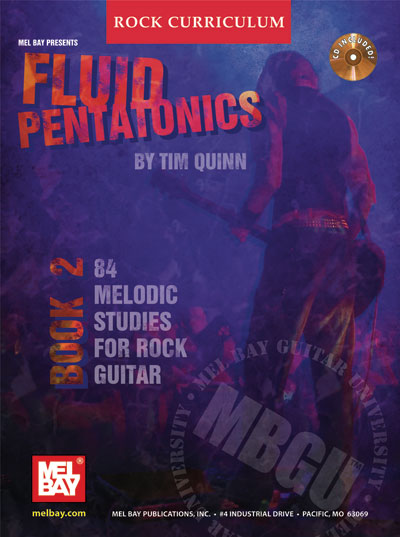
FLUID PENTATONICS Book 2. 84 Melodic Studies for Guitar Tim Quinn CD TABLATURE CHITARRA

FLUID PENTATONICS Book 2. 84 Melodic Studies for Guitar, Tim Quinn. CD TABLATURE

MBGU Rock Curriculum: Fluid Pentatonics, Book 2
84 Melodic Studies for Guitar
by Tim Quinn

Product Description:
Fluid Pentatonics for Guitar: 84 Melodic Studies for Rock Guitar is a comprehensive manual for developing blistering pentatonic motion that moves freely over the entire fretboard, using position-shifting slides, hammer-ons, and pull-offs for speed and fluidity. Emphasis is on overcoming the restrictive nature of traditional pentatonic "box" scale fingerings by developing pathways that continually shift between and connect the five pentatonic “boxes”. Complete whole-neck control is developed through an extensive series of repeating melodic exercises and etudes. Section One presents 35 sequential whole-neck studies, each of which spans the range of twelve frets, thus unlocking virtually every possible position shift. Section Two develops complete non-shifting control through a series of 15 interesting and useful sequential patterns, applied to each of the five pentatonic "boxes". Section Three presents 10 whole-neck/position-shifting studies that are non-sequential in design, in order to develop unpredictable melodic flow. Then, in Sections Four and Five, two vital extensions/variations of the pentatonic scale are fully explored; the Hexatonic and Dominant Pentatonic scales.

The result is a complete matrix of pentatonic moves and connections that allow the guitarist to float freely across the entire fretboard without being locked into any single particular pentatonic "box". The resulting sound is definitely NOT bluesy (very little string bending), but closer to a modern jazz-rock fusion style; fluid and unpredictable. Great for all guitarists in rock, jazz, fusion, blues, country, and pop styles who want to unlock complete whole-neck freedom and develop a fast, modern pentatonic sound. CD included. Presented in standard notation and tablature.

Aheartfelt thanks goes out to all the teachers who profoundly impacted my own playing and ~ learning ... thank you jack Petersen, Dan Haerle, Rich Matteson, and Tom johnson at the University of North Texas, as well as to my teachers at Berklee College of Music.To the musicians who have been so inspiring ... Steve Morse, Pat Martino. john Coltrane, Eric johnson, Chick Corea, jimi Hendrix, Frank Zappa, Barney Kessell, Wes Montgomery, Stevie Ray Vaughan, Albert King, jeff Beck, Steve Vai, Dexter Gordon, Cannonball Adderly, joe Satriani, Igor Stravinsky, EddieVan Halen, AI DiMeola, Greg Howe,joe Pass, Robben Ford, Vinnie Moore, Allan Holdsworth, and Carlos Santana; for the teachings of Paramahansa Yogananda; also to Bill Bay and the fine staff at Mel Bay Publications, Inc.;to Bruce Saunders for his caring engraving; to Dave Austin and George Sanchez for their generous assistance; to josquin DePres at Track Star Studios for much inspiration and guidance; to the many students who have been indispensable in helping me streamline these materials; to my parents who provided the music education and encouraged the young performer; and especially to my wife, Mari, who lovingly tolerated the thousands of hours with me at the guitar while I formulated these concepts ... thank you.

introduction

FLUID PENTATONICS is a scientific manual for developing fast and fluid pentatonic motion on the guitar that connects and constantly shifts between the traditional five pentatonic "box" scale fingerings, using position-shifting slides, hammer-ons, and pull-offs.Traditional pentatonic scales on the guitar consist of five "box-like" scale fingerings, each fingering having two notes on every string, which creates their box-like nature. These traditional patterns are extremely important and useful, but they can be very restrictive. This book is all about overcoming the restrictive nature of pentatonic boxes by developing fast and flowing whole neck fluidity and freedom that continually shifts between and connects the traditional five pentatonic box scale fingerings.

FLUID PENTATONICS develops fast pentatonic motion that defies stylistic categorization, which can be applied to all styles of music without sounding "bluesy". Blues-style pentatonic soloing is extremely useful, but it can also sound rather dated if that's all you do with pentatonic scales. This book unlocks an almost magical way of moving through pentatonic scales that is fast and flowing, which could perhaps be better described as "modern-age" pentatonic motion, because it is definitely NOT bluesy in its sound. In addition, FLUID PENTATONICS also has two chapters that develop interesting alternative takes on the pentatonic scale. These studies, in the sections on "Hexatonic" and "Dominant Pentatonic" soloing, offer two vital extensions/variations on the traditional pentatonic scale. These chapters present two collections of extremely powerful and practical melodic studies that are indispensable for developing a modern pentatonic sound. By playing the patterns and studies herein on a regular basis, for weeks, months, and years, the player's control over the instrument will continue to unfold and grow ever more ferocious and powerful. This book is the second book in the 'FLUID SOLOING SERIES',a unified set of four books that develops different aspects of whole neck fluid motion on the guitar. The two "Comprehensive" soloing etudes at the very end of this book are included to demonstrate some of the techniques from the other three books, as well as the techniques in this one, all used in combination to create an exciting soloing style that is flowing and varied in its melodic patterns. Ifyou like the content of this book, check out the other books in the series as well. Happy pentatonics, friends, and may the force be with you!

Contents:

Introduction

Section One: HORIZONTAL SHIFTING STUDIES
This section develops 7 different sequence patterns, showing each sequence pattern applied in 5 whole neck studies.

Section Two: NON-SHIFTING SEQUENCING
15 Non-shfiting sequence patterns for continual motion within a single "blues-box" pentatonic scale fingering.
How to Apply a Sequence to All Five Pentatonic Fingerings

Section Three:WHOLE NECK MOTION STUDIES
5 Side-Shifting Studies
5 Whole Neck Motion Studies

Section Four: HEXATONIC STUDIES
5 Melodic Etudes
5 Scale Sequencing Exercises

Section Five: DOMINANT PENTATONIC RUNS
Section Six: SOLOING ETUDES
Appendix: "Guide For Using This Book"
Tablature Symbols Key

86 PAGES.

Prezzo: €27,99
€27,99

EMMANUEL TOMMY THE MYSTERY C.G.P. Certified Guitar Player TRANSCRIPTIONS TABLATURE LIBRO

EMMANUEL TOMMY, THE MYSTERY. GUITAR TABLATURE

LIBRO DI MUSICA ACUSTICA PER CHITARRA .

SPARTITI PER CHITARRA CON:

ACCORDI, PENTAGRAMMA E CON TABLATURE.

Quanta italia in questo album, IL COMPLEANNO DI ANTONELLA, CANTINA SENESE, Ciao Emmanuele.


TOMMY EMMANUEL C.G.P. (Certified Guitar Player

Product Description:

The Mystery, Tommy Emmanuel's sixth US album, was inspired by Emmanuel's travels; each of the album's compositions is a musical snapshot or sojourn - a journey that brings us together with places and people - a journey into self discovery.

This transcription book shows all twelve tunes on the CD note-for-note in standard notation and tablature. Also included are detailed performance notes of each tune. 136 pages.

Product Number: 22000
Format: Book
ISBN: 0786681691
UPC: 796279109970
ISBN13: 9780786681693

INTRODUCTION

Tommy's compositions and aITangements cover many styles and techniques. If you have studied the Mel Bay books for Tommy's CD's Only and Endless Road, you already have a head start in learning his mu ic. The tunes for this project are heard on the CD The Mystery. Also you can study the Mel Bay project, Emmanuel Labor with Tommy's discussions of pieces from the above three CD's. From The Mystery Tommy play and discusses "The Mystery", "Gameshow Rag/Cannonball Rag", "The Diggers' Waltz", "Lewis and Clark", and "Antonella's Birthday". There will be some slight variations between the video performance and the recorded tunes. Although he may not playa tune in performance exactly the same way each lime, these transcription will allow you to learn the recorded version, and will give you insight into his methods. These tunes range in difficulty from intermediate to very difficult. There are a few difficult stretches and also Tommy's technique involves some innovative moves, such as fretting the 5th string with the thumb. But whether or not ou perform these tunes, most of the enjoyment comes from understanding them and playing them for their beaut). Some tunes are played with a thumbpick, and others are played without a pick, resulting in a softer sound. Others are played in a hybrid style, using a flat pick, allowing for strong rhythm and interwoven melody note With this style, the right-hand index finger is no longer available for melody. The melody is produced by the pick and the middle and ring fingers. This technique may be difficult for you if you are based in traditional fingerpicking, but it is well worth the effort to learn it. If you read musical notation, the tablature will still be helpful as it points toward left-hand position on the guitar neck. And if you are relying on tablature, remember that left-hand fingering is found in the notation. Learning the hybrid style requires understanding the information given in the tablature. I have tried to indicate the pick stroke directions that are most important, while trying to avoid repeating the stroke directions to reduce the amount of clutter in the tablature. In the hybrid tyle, the thumb and first finger hold the pick, and in accord with classical notation this is shown by a "p". The middle finger will be "m" and the ring finger will be "a". These letters will be stacked when the middle and/or the ring finger pluck notes at the same time as the pick. At other times the pick (thumb and first finger unit) and ... 


TOMMY EMMANUEL C.G.P.

photo by Sara Corwin

Two-time Grammy nominee Tommy Emmanuel has a professional career that spans over four decades and continues to intersect with some of the finest musicians throughout the world. A household name in his native Australia, Tommy has garnered hundreds of thousands of loyal fans worldwide. Tommy's unique style - he calls it simply "finger style" – is akin to playing guitar the way a pianist plays piano, using all ten fingers. Guitar legend Chet Atkins was one of the first to inspire Emmanuel to pick up the guitar as a child. Decades later Atkins himself became one of Emmanuel's biggest fans. In 1999, Chet honored Tommy Emmanuel with the title of "Certified Guitar Player" for his lifetime contribution to the instrument, a rare honor shared by only three other people in the world (Jerry Reed, Steve Wariner and John Knowles). Atkins eventually recorded with Tommy in 1996 on 'The Day the Finger Pickers Took Over the World", for which Emmanuel received his first Grammy award nomination. This was also Atkins last recording.

After a recent recuperative rest, resulting from an exhausting touring schedule, Tommy is now completely rejuvenated and embarking on a full tour schedule in 2008. A new double live CD and DVD, "Center Stage" filmed in High Definition and recorded at the Sierra Nevada Brewery in Chico, California will be commercially released in Spring '08. The DVD portion will also air on Public Television affiliates all over the United States. Every element of modern technology was used in the production of both the DVD and CD. Tomm's record producer, Kim Person, recorded and mixed the audio tracks, while long-time Sierra Nevada video producer/ director Peter Barlow tied the entire package together in state-of-the-art quality. It makes for a stunning package, both aurally and visually. The double disc Live CD "Center Stage" contains many fan show-stoppers, including Emmanuel's BeatIes Medley, Mombasa, and Initiation - the aboriginal tribute song that has evolved over the years and never sounds the same on any recording - or during any show. Tommy also introduces four never-before recorded tracks, "Ruby's Eyes", "Lenny Bro''', "The Jolly Swagman" and "Papa George" (inspired by George Harrison). Also, included are several arrangements of popular traditional tunes like "House of the Rising", "Nine Pound Hammer", "Amazing Grace" - and for his Japanese fans, "Sukiyaki" This new CD is a great mix of the rare, the new, the traditional and the favorites. Emmanuel's music and life are legendary in Australia. He began playing guitar at age 4, by learning to play by ear without any formal instruction. Emmanuel and his older brother Phil were child prodigies, starting their professional career in the 1960s. By the age of six, Tommy was already working as a professional musician. Shortly after his father's death in 1966, the Emmanuel family was approached by Australian country music star Buddy Williams, who took the family on the road until they were forced by the Australian child welfare department to stop traveling. The Emmanuel children were then sent to a regular school. During these years, Tommy was playing in "The Trailblazers" (with siblings Chris on drums and Virginia on slide guitar) on weekends. He also taught guitar and made numerous television appearances in musical competitions. Emmanuel's first brush with fame came when The Trailblazers won two televised talent contests and produced an EP. He and his siblings worked hard ... 


ANTONELLA'S BIRTHDAY
Antonella is one of my dearest friends from Soave, Italy and I wrote it early one morning as the golden sun
streamed through the windows onto my bed. Antonella was making breakfast downstairs and when I found out
it was her birthday, I dedicated it to her, with all my heart. She's a true friend.

Tune the 5th string down to G and the 6th string down to D. The tune is played with a flat pick in a hybrid
style, using the pick ("p") and the middle finger ("m"), and the ring finger ("a"). These letters will be stacked
over the corresponding strings in the tablature. Natural harmonics are used extensively. With your left-hand
finger lightly touch the string at the fret indicated in brackets, <7> for example. In the notation the notehead
will be diamond shaped. Then strike the string with the pick to obtain the harmonic or chiming sound.
Remember that the harmonics should always ring freely, creating a "cascade" effect. In order to notate the tune
correctly, the first note of the song is played as the last half of the last beat of the first measure. That is necessary in order to be in the right place when you play the last note of measure 9. That harmonic on the 5th string
could be considered the first real note of the melody, but it continues into the next measure with an eighth note
rest. There is another way to think of it. If you are tapping your foot, you start just after the first note of the
tune, and by the beginning of measure 10 you will be tapping on the the tied note, and the melody will fall in
place "in time" throughout the rest of the tune. As usual with this style, pay attention to the pick strokes, 
for downstroke and "V" for upstroke. Sometimes, as in measure 11, a downstroke can play many strings in a
strum motion. In measure 21, the right-hand finger letters are stacked over the notation in the first beat. meaning
that the pick plays the third string, the middle finger plucks the second string, and the ring finger pluck
the first string. For the last beat of that measure it is understood that the pick plays the slide on the fifth string.
and it is written that the middle and ring fingers play the other two strings. On the lowest string of a chord.
there is not always room to show the downstroke symbol. (And that is the case throughout the book.)
 

Song Title: Composer/Source:

And so it Goes - Tommy Emmanuel
Antonella's Birthday - Tommy Emmanuel
Cantina Senese - Tommy Emmanuel
Cowboy's Dream - Tommy Emmanuel
Footprints - Tommy Emmanuel
Gameshow Rag / Cannonball Rag - Tommy Emmanuel
Keep it Simple - Tommy Emmanuel
Lewis & Clark - Tommy Emmanuel
That's the Spirit - Tommy Emmanuel
The Digger's Waltz - Tommy Emmanuel
The Mystery - Tommy Emmanuel
Walls - Tommy Emmanuel


Every day we experience "The Mystery." It's in our love for each other, it's in our feelings ofr others, in our music, it's in the kindness of strangers, in the parade of people who seem to appear at the right moment to help or to encourage us through tough times, in the wonders we see around us when we travel or just the feeling we are doing something good for our brothers and sisters. It's all around us, in us, ahead of us and lighting our way. It's God's awesome love for his children. Get it? Got it? Good!

Prezzo: €37,99
€37,99

EMMANUEL TOMMY LABOR DVD Angelina-Train to Dusseldorf-Endless Road-The Mystery-Only CHITARRA

EMMANUEL TOMMY, EMMANUEL LABOR. Titoli dagli albums: Only, Endless Road e The Mystery. DVD
DURATA: 2 ORE E 46 MINUTI

VIDEO LEZIONE DI MUSICA ACUSTICA PER CHITARRA FINGERPICKING FINGERSTYLE. 

Product Description:
Emmanuel Labor provides a personal, one-on-one setting in which not only music aficionados can enjoy performances of some of Tommy’s best-loved tunes, but also offers guitar players instruction by one of the world’s best. Tommy Emmanuel, fingerstyle master and performer, shares his personal insight and technique to sixteen tunes. Pieces shown include cuts from his albums Only, Endless Road and The Mystery. As a bonus feature on the DVD a few sections are slowed down, with no compromise in pitch or video, to better see the exact execution that Tommy uses. DVD length: 166 minutes.

Contents:

Luttrell (Only)
Timberlake Road (Only)
Drive Time (Only)
Drive Time (Only)
Mombasa (Only)
Those Who Wait (Only)
Train to Dusseldorf (Only)
Angelina (Endless Road)
Endless Road (Endless Road)
The Man With The Green Thumb (Endless Road)
Old Town (Endless Road)
Tall Fiddler (Endless Road)
The Mystery (The Mystery)
Gameshow Rag Cannonball Rag (The Mystery)
Diggers' Waltz (The Mystery)
Lewis and Clark (The Mystery)
Antonella's Birthday (The Mystery)

Prezzo: €45,99
€45,99

TRADITIONAL SOUTHERN ITALIAN MANDOLIN AND FIDDLE TUNES JOHN LABARBERA CD TABLATURE

TRADITIONAL SOUTHERN ITALIAN MANDOLIN AND FIDDLE TUNES JOHN LABARBERA. CD TABLATURE

LIBRO METODO DI MUSICA CON CD.

SPARTITI PER MANDOLINO.

ACCORDI, PENTAGRAMMA E TABLATURE.


Product Description:
The first and foremost Italian mandolin book dedicated to the traditional music from Southern Italy. Written in standard notation and mandolin tablature with guitar and mandolin chord accompaniment, this book introduces the reader to the various authentic folk songs from the regions of Campagnia, Calabria, Puglia, Sicily and Sardinia. With detailed descriptions of the songs and dances, historical and technical information about tarantella and pizzica music, the book will increase the knowledge and repertoire of Italian folk music for both beginners and professional musicians alike.

The book provides an excellent foundation needed to play in the style of the music. With preparatory technical studies, the student will learn the Italian style of tremolo, picking, and rhythms that accentuate the music. Together with the accompanying CD, the student will be able to play along and follow the precise nuances that distinguish the music.

- The first and foremost Italian mandolin book dedicated to the traditional music from Southern Italy.
- Written in standard notation and mandolin tablature, with guitar and mandolin chords
- The reader will learn authentic folk songs, together with historical and technical information about tarantella and pizzica music
- For beginners and professional musicians who want to expand their repertoire of Italian folk music
. The first and foremost comprehensive mandolin book focusing on traditional Southern Italian folk music
- Teaches playing techniques and historical information about the mandolin, tarantella and Italian folk music
- An important asset for beginners to professional musicians interested in expanding their knowledge and repertoire of Italian folk music.

About the Mandolin
The eapolitan Mandolin, also known as the round back or bowled back mandolin, may have descended from the tenth century when similar instruments such as the Ud were first introduced through Arabic culture in Southern Italy. Throughout medieval and renaissance Europe, these instruments evolved and developed their own unique playing styles and various terms were used to describe them such as: lute, quintern, chitarra, and pandora. An instrument referred to as the mandola first appeared in Italian documents in Florence in the late sixteenth century. Manuscripts about the Italian Commedia dell'Arte also referred to it as an instrument used by .Scappino' , one of it's stock comic characters and the most musical of the Commedia troupe. Even the great violin maker, Antonio Stradivari, was also responsible for making an instrument called the mandolino, however at that time the instrument had five courses and gut strings and could be considered a soprano lute. B the sixteenth century, Naples was the cultural capital of Southern Italy and its style of music and instruments influenced all of Europe. The use of metal strung, plectrum instruments had already been popular in Naples with instruments such as the colascione and the chitarra battente and were used to accompany popular songs and dances. It was not until the major developments in construction made by Neapolitan luthiers in the eighteenth and nineteenth century, that the mandolin continued to be successful. One of these first important luthiers was Gaetano Vinaccia whose instruments were widely in use during the 1740's. However, his son Pasquale, could be credited for redesigning a mandolin around the 1830's which used eight metal strings, or four courses, was played with a plectrum made of tortoiseshell instead of a quill and was tuned in fifths, (g,d,a,e) similar to the violin. Because the mandolin was now fitted with steel strings, an influence that might have come from new innovations on the piano and violin, Vinaccia also changed the construction of the instrument in order to fit the tension of the strings and to produce more volume. Thus, the modem mandolin was born. The instrument became known as the Neapolitan Mandolin especially because of its popularity in and around Naples and it's success as quickly influencing the rest of the world. B the late 1800's, mandolins were very much in demand and with the rise of Italian immigration to America, mandolins were being manufactured in the United States. Italian luthiers were working for larger manufacturers uch as Lyon and Healy of Chicago and the C.P. Martin company in Nazareth, Pennsylvania. Some of these lutbiers tried to work on their own and set up shops in downtown New York City where the Italian population as the greatest. One of them was Angelo Mannello, who emigrated to New York from Naples in 1885. The standard Neapolitan design had not changed much since Vinaccia until 1898 when Orville Gibson, an inentor from upstate New York, came up with a successful design of a mandolin with a flat back. The idea of a flat back had been unsuccessful before and not very popular. Gibson finally got his patent in 1902 and the flat back mandolin began to flourish and seep into the mainstream of American music. There have been many debates since that time over the preference and sound of the two instruments. Whatever your preference, you will find the music in this book to be very rewarding as you enjoy playing authentic tunes from Southern Italy.


... As Lomax discovered in the 1950's, traces of every period in Italian history could still be heard in the folk music. The songs that have survived clearly have passed the test of time. Some of the songs such as the "Antidotum Tarantulae" and the Neapolitan villanelle we know are from the 1600's and have the characteristics of renaissance music. I was very fortunate to have learned many of these songs while living in Italy during the early 1970's, when there was a resurgence of interest in traditional music. At that time, the Neapolitan composer and director Roberto De Simone and his group, La Nuova Compagnia di Canto Popolare, had led the way by performing and recording songs from the region of Naples. With new arrangements he brought forward many unknown traditional songs based on his research. Many of the tunes in this book were taught to me as I sat down with my guitar and mandolin in an apartment in Florence with the street musicians who later formed the musical group Pupi e Fresedde. They were all from the south of Italy and began singing their traditional songs on the streets and piazzas of Florence, just as it might have been in the sixteenth century. Joining their original troupe and performing and touring with them all over Europe and on the east coast of the United States for several years, I began to realize the vast repertoire of songs that existed and how much of it had been past down by oral tradition. It also gave me an excellent opportunity to be part of the tradition itself and inspired me to continue researching more about this music as well as understanding how it was to be played with the right feeling and gusto. Upon my arrival back to the United States in 1979, I had felt so enriched by the experiences I had in Italy performing and recording with Pupi e Fresedde on the album La Terra Del Rimorso (Divergo-Polygram, DVAP 029), that I wanted to bring to American audiences these beautiful melodies and rhythms. (I was sure that my Italian grandparents would have been proud of
me). Also for the Italian-American community, I felt it was important to re-connect this music that many had forgotten upon their arrival in the new world. That year, I formed the group I Giullari di Piazza in New York City, (my home town) together with the Italian actor Claudio Saponi, from RIMINI, who was a highly trained actor in Italian theater especially the Commedia del'Arte, and with Alessandra Belloni from Rome, Italy. With all of the music I had learned in Italy, I began to teach musicians this repertoire while making my own arrangements as well as writing new compositions inspired on the traditional forms. At first the American audiences were not accustomed to this kind of Italian music and most people wanted us to play the standard Italian music that had already been absorbed into the I mainstream. The Tarantella was only known as an Italian wedding dance and no one had ever heard of a Pizzica or Tammurriata. However, the musicians that I photo: Colita, Barcellona (Spagna) first started to teach this music to were very supportive and eager to learn all about the music and traditions connected to it. During the early 1980's the group I Giullari di Piazza were beginning to make these songs heard to new audiences in New York and throughout the States, presented in theatrical productions which included music, theater and dance. In 1986, I had the great opportunity to work together and tour with one of the most famous singers of traditional Sardinian music, Maria Carta. Known throughout the world for her haunting and heart felt interpretation of Sardinian music she had often been described as Italy's Joan Baez. I had already been familiar with the unique guitar playing style while living in Italy, however working with her on a tour of just voice and guitar forced me to pay close attention to the fine articulation necessary for Sardinian music. She had also taught me so many beautiful songs during our rehearsals, that I cherish them like precious little jewels.


Product Number: 21488BCD
Format: Book/CD Set
ISBN: 078667783X
UPC: 796279106283
ISBN13: 9780786677832
Series: Non-Series
Publisher: Mel Bay Publications, Inc.
Date Published: 4/27/2009

Format: Book/CD Set


Contents:
Song Title: Composer/Source:
Abballati, Abballati
Alla Carpinese
Alziti Bbella
Angelare
Antidotum Tarantulae (part 1)
Antidotum Tarantulae (part 2)
Bo e la ri-bo
Cu Ti Lu Dissi
Danza Siciliana
Fasola Siciliana
Figghia di'n Massaru
Fischiettando
Fronni d'Alia
II Ritornello delle Lavandaie del Vomero
La Ndrezzata
La Palumella
La Procidana
La Sant Allegrezza
La Zita Passa
Marenaresca
Matajola
Motivo di Cantastorie
Pizzica-Pizzica
Pizzicarella
Pizzicarella Mia
Ricciulina
Serenata Amalfitana
Sonos E Memoria
Tammurriata
Tarantella dell 600
Tarantella di Ogliastro
Tarantella Nfuocata
Tarantella Paesana
Villanella Ch all Aqua Vai
Volumbrella
Vurria Addeventare

92 PAGES

Prezzo: €26,99
€26,99

GUITAR JOURNALS BLUES. Mel Bay CD TABLATURE

GUITAR JOURNALS BLUES. 120 pagine. CD TABLATURE

Product Description:
Mel Bay's latest series, Guitar Journals, is the ultimate eference guide of studies and solos in several different genres. This fantastic blues volume contains exercises on barre chords, power chords, progressions, strum patterns, hammer-ons, pull-offs, bends, double stops, scales, licks and also a wide variety of tunes. Perfect for the student to professional musician's everyday use! All music in notation and tablature. Hard cover, covered spiral binding and premium stock paper make this a volume so beautifully printed and bound and containing so much valuable information that you will treasure it for years to come!

- Ultimate guide of blues exercises and solos and perfect reference manual for everyday use
- Barre chords, power chords, progressions, strum patterns, hammer-ons, pull-offs, bends, double stops, scales, licks AND a wide variety of tunes
- Ideal for the student to professional musician
- Beautiful hard cover with covered spiral binding and premium paper
- Companion recording
- In notation and tablature


Format: Book/CD Set
Series: Guitar Journals

Contents:


Rhythm Guitar
The Blues Progression
Like A Shadow
Strum Patterns
Baby Don't Love Me
6/8 and 12/8 Blues
Barre Chords
Power Chords
Smithfield Boogie
Good Mornin Blues
Midnight Drive
Blues Comping
Why Do You?
Doubling The Bass Line
Turnarounds
The Tie
The Hammer-On
The Pull-Off
The Slide
The Bend
Double Stops
The Blues Scale
Mixolydian Mode
Blues Licks
The Easy Chair
Slow Blues Solo
Rhythm and Brews
Fingerpicking Solos
Steady Bass Solo No. 1
Steady Bass Solo No. 2
Alternating Bass Style
Blues In E
Boogie Woogie Bass Style
Boogie Woogie Solo
Frankie and Johnny
Bill Bailey
Franklin Blues
Bob's Blues
Frogs For Snakes
Hurt So Good
St. James Infirmary
Skip On Home
Slide Guitar
Motherless Children
Good Morning Little School Boy
Open G Tuning
Burning House
Jubilee Jamboree
Open E Tuning
Red and Blue
Still Staggerin
Black-Jack
L & N Blues
Kick Around Rag
Goin To Bullhead City
Tywhoppity

Prezzo: €24,95
€24,95
Condividi contenuti