MEL BAY

PAGANINI FOR ACOUSTIC GUITAR Ben Bolt BOOK & CD TABLATURE SPARTITI CHITARRA LIBRO CAPRICCIO

PAGANINI FOR ACOUSTIC GUITAR. Tutti i pezzi tranne i capricci sono sul CD. Caprice in e no.9, caprice in a minor no.24, allegro, 4 andantinos, 3 allegrettos, andante, 4 sonatas, 3 valtzes, andantino in c, allegretto in a, allegretto in a minor, valtz in c, rondo in a minor, rondoncino, valtz in e, sonata in a, sonata in c.

SHEET MUSIC BOOK WITH CD & GUITAR TABLATURE

LIBRO DI MUSICA CLASSICA.
SPARTITI PER CHITARRA CON: PENTAGRAMMA
 

Niccolo Paganini, was born in Genova October 27, 1782, and died in Nice on May 27, 1840, was an Italian violinist, guitarist, and composer. Other instruments he played included the viola and mandolin. He is considered to be the World's gift to the violin and his virtuosity and showmanship are legendary. Being a gambler, he was forced to pawn his violin to pay his debts. Perhaps it was his gambling instinct that led to his technical risk taking when performing Although he owned a Stradivarius, his favorite violin was a Guarnerius. Ironically, his Guarnerius was in fact the property of a wealthy merchant who loaned to him and which Niccolo refused to return. Paganini first performed outside Italy in Vienna and his legend spread throughout Germany, France, and England. Although the exact age he started playing the guitar is uncertain, he composed his first pieces for violin and guitar when he was 12. In later years he associated with the most notable guitarists of his day, including Giuliani, Carulli, and Legnani. Carulli remarked that "It is not generally known that Paganini was an excellent guitarist and that he composed most of his airs on that instrument, arranging and developing them on the violin according to his fancy." Niccolo's brother Carlo was also a guitarist. Niccolo once considered bringing his brother to Milan to play the guitar part for his quartets. Paganini lived during the Golden Age of the Guitar. Listed below are the names of great guitarists of the past, all born within a span of 32 years:
Fernando Carulli 1770-1841
Francisco Molino 1775-1847
Fernando Sor 1778-1839
Mauro Giuliani 1781-1829
Anton Diabelli 1781-1858
Niccolo Paganini 1782-1840
Dionisio Aguado 1784-1849
Luigi Legnani 1790-1877
Matteo Carcassi 1792-1853
Zani Ferranti 1801-1878

The dream of Andres Segovia (1893-1987) was to take the guitar out of the hands of the Spanish folklore
guitarists, who performed mostly in taverns and place it on the concert stage. He decided
that in order to have the guitar receive the respect that he felt it deserved, it would need to
be taught in the colleges, universities, and conservatories. Because of this intense concert
career and his mature years, for his dream to be fulfilled he had to train teachers, who he
called his disciples. Segovia accomplished his dream. Today the guitar has respect and
credibility because of his vision and work. Bravo to the maestro!
While my performing career began in Miami nightclubs, much like the Spanish folklore
guitarist, I went on to study with Segovia, who personally awarded me a scholarship that
he paid for. I have performed on the concert stage with symphonic orchestras, and I am now
a college professor. I have come to understand the significance of his dream.
Ironically, my dream is the complete opposite to that of Segovia. I believe that for the
acoustic classical style to flourish, it must be put back into the hands of the people. My vision
includes all guitarists, regardless of style or background, becoming familiar with the
classical guitar technique and repertoire. To see my dream fulfilled, I have had to make
learning fun and simple, without sacrificing the integrity of the information. By the mid
1980s my vision came to life in the form of a book entitled A Rock Player's Guide to Classical
Guitar. It was the first classical guitar book that included the notation/tablature/tape
format. I chose the rock market because at that time they were the only guitarists who were
genuinely interested and eager to learn" classical" from me. This, of course, didn't surprise
me, since I too began as a rock guitarist. It was obvious that when classical guitar was
accessible to all guitarists, more people would hear and enjoy the beauty of the pure guitar
style. Since my first publication, thousands of new classical guitarists have surfaced.
All of my books come in notation/tablature/CD format. The recordings prove that all of
my arrangements have been tested and do sound guitaristic. All of the great late composers
were fine musicians, as well as composers. They could play the music they composed.
you can also play the great classics! With the tablature and the recording, great music is
closer to your fingertips than you might imagine.

About the Author
Ben Bolt is credited with being the first classical guitarist to introduce thousands of new people to the classical style of guitar through his videos and books, which use a revolutionary format of learning. In the past, guitar students needed to learn to read music at the same time they were learning to play the guitar, which was complicated. Since the publication of Bolt's book/ recording packages, beginners are able to play immediately. The tablature, using lines and numbers to show where the notes are, and the recording, which is rhythmically self explanatory, empowers all students to play. Bolt's work has been mimicked throughout the publishing world. Because of his vision of making classical guitar accessible to all kinds of musicians, the classic guitar is being experienced by the masses.
Andres Segovia, the father of classical guitar, said, "Ben Bolt is an excellent guitarist with fine tone." Segovia personally paid for a scholarship so that Bolt could continue his studies at the Musica en Compostela, which Segovia had founded. During the Spanish Civil War Segovia had been in exile in Montevideo, Uruguay. He was not concertizing in Europe, due to World War ll. Because of extra time he took on one of this most talented students, Abel Carlevaro. Carlevaro took lessons every other day for over ten years in Uruguay. Because of this historic fact, Bolt sought out Carlevaro in order to attain more information about Segovia. In Paris Bolt studied with Maestro Carlevaro, who wanted to continue teaching Bolt in Brazil at the International Guitar Conservatory. There, under full scholarship Bolt was introduced to more Segovia information, but equally important, the Carlevaro school of technique. During the next several years he went on to Montevideo, Carlevaro's home town, and completed his music studies under the direction of Maestro Carlevaro and Guido Santorsola, the great late distinguished Italian composer and conductor. Several Ben Bolt books have appeared on the best seller list. His video, Anyone Can Play the Classic Guitar has been become a reference for college students as the authority on basic fundamentals concerning classical technique. He also appears in Mel Bay's video of the Modern Guitar Method Grade One, a huge commercial success, selling millions of copies. Bolt divides his time between publishing, performing with orchestras, and teaching at the college level. He believes anyone can play the guitar well, provided they have these three ingredients: a good instrument, a knowledgeable teacher, and music that holds the student's interest. Bolt's work is distri1?uted internationally and has been featured at the yearly NAMM show (National Association of Music Merchants) in California, as well as the International NAMM show in Germany. His influences include Mel Bay, Beatles and Segovia. Ben Bolt is available for concert and master classes.

Mel Bay Publications, Inc. has been a driving force in music performance, education and instruction since 1947. Our tradition of quality music, carefully arranged and edited for maximum ease in learning, has received international acclaim. We are dedicated to providing the best in all styles of guitar performance, acoustic instruments such as banjo, mandolin, dulcimer, harp, harmonica, recorder, tinwhistle, and fiddle, as well as keyboard, wind and percussion instruments. We also offer CDs, concert and instructional DVDsof all stylesand instruments. Mel Bay offers an extensive catalog covering most musical styles-from classical to jazz to celtic to bluegrass to blues.

Song Title: Composer/Source:

Allegro
Andantino
Allegretto Paganini Arr: Ben
Allegretto In A Paganini Arr: Ben
Allegretto In A Minor Paganini Arr: Ben
Allegro Paganini Arr: Ben
Sonata
Sonata
Allegro
Andante Paganini Arr: Ben
Andantino Paganini Arr: Ben
Andantino In C Paganini Arr: Ben
Andantino Paganini Arr: Ben
Sonata
Caprice In A Minor, No:24 Paganini Arr: Ben
Caprice In E, n.9 Paganini Arr: Ben
Rondo In A Minor Paganini Arr: Ben
Rondoncino Paganini Arr: Ben
Sonata Paganini Arr: Ben
Sonata In A Paganini Arr: Ben
Sonata In C Paganini Arr: Ben
Valtz Paganini Arr: Ben
Valtz In C Paganini Arr: Ben
Valz In E Paganini Arr: Ben
 

Prezzo: €21,99
€21,99

MELODIES OF SPAIN ACOUSTIC GUITAR BOOK CD LIBRO TABLATURE CHITARRA Recuerdos De La Alhambra-

MELODIES OF SPAIN ACOUSTIC GUITAR. SHEET MUSIC BOOK WITH CD & GUITAR TABLATURE . 

LIBRO DI MUSICA CLASSICA CON CD,

SPARTITI PER CHITARRA: 

GRIGLIA DEGLI ACCORDI, PENTAGRAMMA E TABLATURE.

Raccolta di musica spagnola, classica e flamenco. Contiene: pavan, Milan -fantasia, Mudarra -studio in SI minore, RE maggiore, MI minore, Sor -giuochi proibiti -Recuerdos de la Alhambra, lagrima, Tarrega -soleares -spanish lullaby -god is merciful -San Miguel -where shadows fall. 


Song Title: Composer/Source:

Fantasia - Alonso de Mudarra 
God Is Merciful - E. James Kalal
Lagrima - Franciso Tarrega
Pavan - Louis Milan 
Recuerdos De La Alhambra - Franciso Tarrega
Romance De Amor
San Miguel - E. James Kalal
Soleares - E. James Kalal
Spanish Lullaby - E. James Kalal
Study in B Minor - Fernando Sor
Study in D Major - Fernando Sor
Study in E Minor - Fernando Sor
Where Shadows Fall - E. James Kalal, Sue Renner, Robert Fraser  

Prezzo: €27,99
€27,99

BAROQUE MUSIC FOR ACOUSTIC GUITAR. Stephen C. Siktberg TABLATURE

BAROQUE MUSIC FOR ACOUSTIC GUITAR. TABLATURE

Product Description:
A comprehensive volume of musical selections from the masters of the Baroque period. Pieces chosen for this book required little alteration from the original manuscript and so do not stray from the composer's original musical intent. Left-hand fingering has been included extensively whereas right-hand fingering is left up to the performer. Requirements for altered tunings and suggestions for the use of capo are indicated at the beginning of each piece where applicable. Contains suggested barres, natural harmonics, and ornamentation. Written in standard notation with a separate tab selection. 294 PAGES


The musical selections in this book come from some of the greatest composers of the Baroque Period. Since none of these individuals wrote for the guitar, these pieces are arrangements of works originally intended for other instruments. In selecting material for this book, I was careful to choose pieces that could be played on the guitar without straying too much from the original versions. The most frequent alterations I made were either to change the key, change the register of the bass line, or occasionally revoice a chord. A very important aspect of the performance of Baroque music is the use of ornamentation. Though often represented by symbols in the score, ornaments are sometimes implied by the musical context. The most common types are trills, though there are many others. Their execution is flexible and open to the interpretation of the performer. For the purposes of this book (and after doing considerable research), I have written out all of the ornaments in conventional notation. As such, these realizations have been subject to my interpretation. In some cases, where a particular ornament is prohibitively difficult on the guitar, it has been either modified or omitted.About the Composers

Johann Pachelbel (1653-1706) was a German organist and composer who is best known today for his "Canon in D." The fugues that are included here were written for the organ but work well on the guitar. The early Baroque style of writing in these pieces is less chromatic than in the fugues of Bach, and is reminiscent of the ricercares and fantasies for lute that were popular in the Renaissance.

The most famous composer of late 17th-century England was Henry Purcell (1659-1695). His influence can be heard in the music of Handel, who spent the better part of his professional life in England. Purcell is perhaps best known for his choral works though he wrote music of all types. The pieces here are taken from his miscellaneous keyboard compositions.

Francois Couperin (1668-1733) was an internationally famous French composer and

harpsichord virtuoso. He was one of the first proponents of the rococo or "gallant" style which

was simpler and more elegant than mainstream Baroque music and ultimately helped pave the

way for the early Classical composers.

Like Couperin, Jean-Philippe Rameau (1683-1764) was a famous French composer who wrote in the "gallant" style. He is considered by many to be the father of the study of harmony because of his many writings on the subject. His three collections of harpsichord pieces are the source for the arrangements in this volume.

The keyboard sonatas of Domenico Scarlatti (1685-1757) have long been a favorite with guitarists. He wrote over five hundred of them, many of which fit well on the guitar. Though he was born in Italy, he spent his last years in Spain where the sonatas included here were written.

George Philip Telemann (1681-1776), was a very prolific and successful German composer who was friends with both Bach and Handel. The pieces here are taken from his 36 Fantasias for Harpsichord. The style of writing in these pieces varies from the Baroque to the Rococo.

Johann Sebastian Bach (1685-1750) and George Friedrich Handel (1685-1759) are often mentioned in the same breath as representing the pinnacle of Baroque music. Although Handel, like Bach, was born and raised in Germany, he spent most of his life in England where he became a citizen and wrote his most famous works. His keyboard pieces offer an interesting contrast to those of Bach and often fit nicely on the guitar.

Contents:

Foreword

Johann Pachelbel (1653-1706)
Fugue in C
Fugue in G
Fugue in G
Fugue in Dm
Fugue in D

Henry Purcell (1659-1695)
Air in Em
Hornpipe in Em
Prelude
Prelude
March in D
A Ground in G
Air in Em

Francois Couperin (1668-1733)
Le Petit-Rien (Rondeau)
Le Trophie
La Flore
La Morinete
Les Tambourins
La Badine (Rondeau)
Les Bacchanales
La Bourbonnoise (Gavotte)

Jean-Philippe Rameau (1683-1764)
Menuet en Rondeau
Menuet
Sarabande 1 & 2
Gavotte en Rondeau
Les Tendres Plaintes (Rondeau)
Menuet 1 & 2

Domenico Scarlatti (1685-1757)
Sonata in G (K 431)
Sonata in Dm (K 434)
Sonata in D (K 414)
Sonata in A (K 428)

George Philip Telemann (1681-1776)
Fantasia in Em
Fantasia in D
Fantasia in D
Fantasia in Dm
Fantasia in Am
Fantasia in C
Fantasia in Em

George Friedrich Handel (1685-1759)
Sonatina in C
Allemande
Sarabande (with variations)
Allegro (from Great Suite #7 for Harpsichord)
Sarabande (from Great Suite #7 for Harpsichord)
Passacaille (from Great Suite #7 for Harpsichord)
Allegro (from Partita in G major for Harpsichord)
Courante (from Partita in G major for Harpsichord)
Sonata in C

Johann Sebastian Bach (1685-1750)
Prelude (from Suite #1 for Violoncello)
Menuet 1 & 2 (from Suite #1 for Violoncello)
Gigue (from Suite #1 for Violoncello)
Gavotte 1 & 2 (from Suite #6 for Violoncello)
Gavotte en Rondeau (from Partita #3 for Violin)
Menuet 1 & 2 (from Partita #3 for Violin)
Bourée (from Partita #3 for Violin)
Sarabande & Double (from Partita #1 for Violin)
Tempo di Bourée (from Partita #1 for Violin)

Prezzo: €24,99
€24,99

BACH FOR ACOUSTIC GUITAR BEN BOLT LIBRO CD TABLATURE FUGA SARABANDA PRELUDIO GIGUE BOURRE

BACH, FOR ACOUSTIC GUITAR. Ben Bolt. SHEET MUSIC BOOK WITH CD & GUITAR TABLATURE .

LIBRO DI MUSICA CLASSICA CON CD,

SPARTITI PER CHITARRA :

PENTAGRAMMA E TABLATURE .


Product Description:
J. S. Bach is the most sought after composers of all time. He is everybody's favorite! Best selling author Ben Bolt has inked 12 solos for guitar in this book. Included are moderate to advanced solos in notation and tablature. All 12 solos are recorded in order like the book. The recording can easily stand on it's own for your listening pleasure, or can be used as an instructional tool. Professor Bolt also includes a copy of Bach's original manuscript of Partita No. 1 for cross-reference purposes. Includes the following pieces: Sleepers Awake! (from Cantata No. 140), Gavotte, Prelude (from 3rd Cello Suite), Courante (from 3rd Cello Suite), Corrente (from 1st Violin Partita), Bourrée (from 1st Violin Parita), Prelude in D (from 1st Cello Suite), Gigue (from 1st Cello Suite), Sarabande (from 2nd Lute Suite), Gigue (from 2nd Lute Suite), Courante (from 1st Lute Suite) and Fugue.

J. S. Bach was born in Germany in 1685 and died in 1750. His ancestors for over 100 years had been musicians. He was orphaned before he reached the age often and his brother, Johann Christoph Bach, raised him. Johann Christoph had been a pupil of Johann Pachelbel. When Bach was fifteen, he studied under two of the most important organists of that time, J. J. Lowe and Georg Bohm. Bohm has been considered a great influence on Bach's compositions for organ. While still a teenager, Bach began his professional career as a church organist in Amstacht. During that time he made a longjourney to Lubeck on foot to hear the great organist Dietrich Buxtehude. It is speculated that Bach considered applying for the succession to Buxtehude's post. The post, however, carried with it an obligatory marriage to Buxtehude's thirty year old daughter. Many scholars think that this deterred Bach from making the application. In 1708 Bach did accept a position as court composer to the Duke of Saxe-Weimer. While this post began a happy phase of his life, he seems to have been unable to avoid controversy regarding court politics. By 1717 he was again seeking a new appointment as the director of music at the court of Anhalt-Cothen. His release from Weimer was obtained only after persistent demands and a period of imprisonment for insubordination. It was in Cothen that Bach turned from religious music to secular music. This was because religious music did not have a place at the Calvinist Court of Cothen. It was during this period he produced the six Brandenburg Concertos, the six suites for unaccompanied cello, and the three sonatas and three partitas for unaccompanied violin. The complete autographed facsimile ofthe violin partitas have been included in this book. Bach made use of the material of Vivaldi, Corelli, and Frescobaldi in his own compositions. The borrowing of ideas was a common practice at the time. But he was not a mindless mimicker, he took their ideas to new heights, using his own genius. Bach's imagination continues to impress the greatest living composers centuries after his death. In spite of the large number of Bach compositions that exist, scholars believe they represent only about half of what he actually composed. Of the five Passions he wrote, only two are now known. In addition to the 200 cantatas, it is speculated that 100 have been lost. Bach is quoted as saying that anyone who had worked as hard as he had done, could have achieved as much. As we stand in awe of Bach's body of work and realize that he mastered both the intellectual and emotional sides of music, one wonders where his inspiration originated.

Ben Bolt is credited with being the first classical guitarist to introduce thousands of new people to the classical style of guitar through his videos and books, which use a revolutionary fonnat of learning. In the past, guitar students needed to learn to read music at the same time they were learning to play the guitar, which was complicated. Since the publication of Bolt's book/tape packages, beginners are able to play immediately. The tablature, using lines and numbers to show where the notes are, and the recording, which is rhythmically self-explanatory, empowers all students to play. Bolt's work has been mimicked throughout the publishing world. Because of his vision of making classical guitar accessible to all kinds of musicians, the classic guitar is being experienced by the masses. Andres Segovia, the father of classical guitar, said, "Ben Bolt is an excellent guitarist with fine tone." Segovia personally paid for a scholarship so that Bolt could continue his studies at the Musica en Compostela (circa 1987) summer masterclass and music festival, which Segovia had founded. In his zeal to pursue the Segovia technique and interpretive style, Bolt also studied with one of Segovia's most gifted students, Abel Carlevaro, who awarded him the coveted "Premio de Merito". While studying with Carlevaro in Montevideo, Uruguay, he was also the First Place winner of "Concurso International Aemus." His music studies were completed under the direction of Maestro Guido Santorsola, who bestowed him with an original composition for guitar entitled "Seis Bagatelas" as a graduation gift. After returning to the U.S., he became the first guitarist inducted as a National Patron of Delta Omnicron International Music Fraternity. Several Ben Bolt books have consistently appeared on Mel Bay's best seller list. His video Anyone Can Play the Classic Guitar has become a reference for college students as the authority on the fundamentals of classical technique. He also appears on Mel Bay's videos of the complete volumes of Modern Guitar Method, a huge commercial success, selling in the millions of copies. He is endorsed by Takamine Guitars and D' Addario Strings. Bolt divides his time among publishing, performing, and teaching at the college level. He believes anyone can play the guitar well, provided they have these three ingredients: a good instrument, a knowledgeable teacher, and music that holds the student's interest. Bolt's work is distributed internationally and has been featured at the annual NAMM show (National Association of Music Merchants) in California, as well as the International NAMM show in Germany.

Format: Book/CD Set
Contents:

Sleepers Awake! from Cantata No. 140 -- J. S. Bach; Arranged by Ben Bolt
Gavotte -- J. S. Bach; Arranged by Ben Bolt
Prelude from 3rd Cello Suite -- J. S. Bach; Arranged by Ben Bolt
Courante from 3rd Cello Suite -- J. S. Bach; Arranged by Ben Bolt
Corrente from Partita No. 1 for Violin -- J. S. Bach; Arranged by Ben Bolt
Bourree from Partita No. 1 for Violin -- J. S. Bach; Arranged by Ben Bolt
Prelude in D from 1st Cello Suite -- J. S. Bach; Arranged by Ben Bolt
Gigue from 1st Cello Suite -- J. S. Bach; Arranged by Ben Bolt
Sarabande from 2nd Lute Suite -- J. S. Bach; Arranged by Ben Bolt
Gigue from 2nd Lute Suite -- J. S. Bach; Arranged by Ben Bolt
Courante from 1st Lute Suite -- J. S. Bach; Arranged by Ben Bolt
Fugue -- J. S. Bach; Arranged by Ben Bolt

Prezzo: €29,95
€29,95

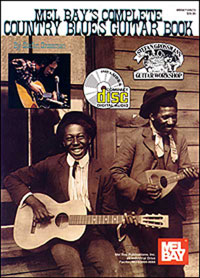
COMPLETE COUNTRY BLUES GUITAR BOOK GROSSMAN 2 CD TABLATURE LIBRI SPARTITI CHITARRA

COMPLETE COUNTRY BLUES GUITAR BOOK. STEFAN GROSSMAN. SHEET MUSIC BOOK WITH 2 CD & GUITAR TABLATURE

LIBRO DI MUSICA BLUES ACUSTICO, CON 2 CD.

SPARTITI PER CHITARRA CON: 

ACCORDI, PENTAGRAMMA E TABLATURE. 


260 pagine per chitarra, 57 classici di blues rurale, come "Crow Jane", "monday morning blues". Delta blues, ragtime blues, alternating bass & open tunings, Texas blues, bottleneck blues. 

Tutte le versioni strumentali delle famose canzoni di Blues Acustico registrate da Stefan Grossman.

Product Description:
Over 50 fingerpicking guitar solos in notation and tablature in country blues, Delta blues, ragtime blues, Texas blues and bottleneck styles. An extremely comprehensive blues solo collection. 2 CD's included.

Format: Book/2-CD Set
Series: Complete


INTRODUCTION

There are many ways to approach fingerpicking blues guitar and this is indeed what makes this study so interesting, challenging and exciting. I was lucky. In the early 1960s I began to hear various recordings by Rev. Gary Davis, Big Bill Broonzy, Brownie McGhee and Lightnin' Hopkins. I was hooked! Their energy, sound and feel made it obvious in what direction of guitar playing I was going to travel. I began to hunt for LPs of any bluesman. This expanded to searching for collectors of old 78s. The music of Robert Johnson, Charlie Patton, Son House, Willie Brown. Tommy Johnson, Blind Boy Fuller, Blind Willie Johnson, Blind Willie McTell and others could only be heard via their old 78s and these were quite rare, to say the least. During this exploration I made friends with other guitarists and blues lovers (Nick Perls, Steve Katz, Rory Block, John Sebastian, Marc Silber, John Fahey, ED Denson. Dick Waterman and Tom Hoskins). We jOined together into what Chris Strachweiz (owner of Arhoolie Records) dubbed "the Blues Mafia "!We hunted for old blues records. exchanged ideas on how these bluesmen played their guitars and even started to search for some of these legendary artists.

1963 and 1964 were important years for the country blues. Tom Hoskins, a "Blues Mafia" friend from the Washington, D.C., area, travelled down to Avalon, Mississippi. and rediscovered Mississippi John Hurt. Dick Waterman, Bill Barth and Nick Perls jumped into their old Volkswagen bug in New York City and began their search for Son House by travelling down to Mississippi, only to have his trail end up in Rochester. New York, where Son was alive and well. John Fahey and ED Denson sent a telegram to Aberdeen, Mississippi, addressed to Bukka White - "blues singer." Before long, they received a call from Bukka, who was living in Memphis, Tennessee. John Fahey, along with several friends, started to get tips regarding the whereabouts of Skip James, and after some searching they found themselves standing by Skip's bedside in a Mississippi hospital. Within a 12-month period the bfues exploded. The giants from the 1920s- 1930s were being rediscovered and presented to a new audience of blues lovers.

This was a time of country blues abundance. At a festival you could hear Rev. Gary Davis, Mance Lipscomb, Fred McDowell, Son House, Mississippi John Hurt, Skip James, Bukka White, Furry Lewis, Brownie McGhee, Robert Pete Williams, Lightnin' Hopkins, Jesse Fuller, Gus Cannon, Big Joe Williams, Lonnie Johnson and others. Many missing pieces of the blues jigsaw puzzle were being put together. I was in seventh heaven as far as learning blues guitar. I had been a student of the great Rev. Gary Davis since 1962. He had patiently guided me into blues and ragtime techniques and styles.

He was a master musician and a wonderful teacher. After spending two years with Rev. Davis I became very close to many of the newly rediscovered bluesmen, and they patiently explained and taught me their approaches to playing the blues. Fingerpicking blues guitar spans a wide area: from the gentle pulsating sounds of Mississippi John Hurt to the hard rhythmiC variations of Charlie Patton to the ragtime sportin' right hand of Blind Blake to the complexities of Rev. Gary Davis to the melodic ....


Shake That Thing --
Nobody's Dirty Business --
It Won't Be Long --
Fare Thee Well Titanic --
You Got the Pocketbook, I Got the Key --
Ragtime Mama Blues --
Salty Dog --
Blues Ain't Dry --
Old Country Rock --
Take A Whiff On Me --
A Tribute To Lonnie Johnson --
Crow Jane --
One Kind Favor --
Easy Rider Blues --
Ragged And Dirty --
Return To Little Rock --
Monday Morning Blues --
Spoonful --
Weeping Willow --
Mississippi Blues --
Just A Closer Walk With Thee --
Working On The New Railroad --
Juicy Lucy --
Easy Street --
Vestapool --
Kassie Jones --
John Henry --
Sitting On Top of the World --
Police Dog Blues --
New Pony Blues --
If You Haven't Any Hay Get On Down The Road --
Yonder Comes The Blues --
Moon Goin' Down --
Belzona Blues --
Special Rider Blues --
Hard Time Killin' Floor --
Buck Dancer's Choice --
Bill Bailey --
Ton of Blues --
Blake's Breakdown --
Franklin Blues --
Sister Kate --
Struttin' Rag --
Twelve Sticks --
Man of My Own --
Strange City Streets --
Come Back Baby --
Mourning Blues --
Charley James --
Country Line --
Tickle Dew --
Banty Rooster --
One Kind Favor --
Someday Baby --
Wake Up Mama --
Good Morning Little Schoolgirl --
God Moves On the Water --

Prezzo: €43,99
€43,99

UP THE NECK BANJO JANET DAVIS 2 CD TABLATURE BOOK SPARTITI METODO

UP THE NECK, BANJO, JANET DAVIS. 144 pagine. BOOK WITH 2CD & TABLATURE.

LIBRO METODO CON 2 CD,  

SPARTITI PER BANJO CON TABLATURE. 


A superb instructional text for five-string banjo dealing with the 5th through the 22nd fret. Included are chapters on roll patterns, chords, songs, licks, chord progressions, arranging songs, improvising, melodic style, chromatic style, chromatic style, back-up, and much more! Also included is an abundance of great Janet Davis solo tabs. Written in tablature.

The two CDs included in this package contain 144 tracks in stereo to accompany the book. Listen and play along with Janet Davis as she explains and plays each exercise.

Product Number: 94820BCD
Format: Book/2-CD Set
ISBN: 0786667338
UPC: 796279087728
ISBN13: 9780786667338
Series: Non-Series
Publisher: Mel Bay Publications, Inc.
Date Published: 7/18/2002 

"Up the neck" of the banjo involves playing between the 5th and the 22nd frets of the fingerboard. This book is intended to provide you with the basic principles and techniques for developing the ability to play any song in the three-finger style of playing in the up-the-neck area of the banjo. People often find it difficult to read the double-digit numbers involved in playing up the neck. However, just as it was difficult to read tablature for the first time, you will find that you will see the same numbers over and over, and you will begin to recognize the same patterns up the neck, just as you do when playing down the neck. Because these are related to chord positions, it will help to concentrate on°the numbers involved with playing each chord, particularly the G, C, and D chords from which the left hand will work. These will become familiar to you within a very short time, and will be easy to relate to the fingerboard. This book is divided into chapters, with each chapter building upon the information presented in the previous one. The songs presented in each section demonstrate the particular technique(s) discussed in that chapter. However, the songs are also intended as playable arrangements. The more you play up the neck using these techniques, the easier it will be to develop your own arrangements using these techniques. I have used these techniques for many years with my banjo students, and they seem to have worked well. I hope they will work well for you, also. Happy Pickin'! Janet Davis

The three-finger style of playing was popularized in the early 1940s primarily by Earl Scruggs and Don Reno, and has continued to be one of the foremost styles for playing the five-string banjo. In this style ofplaying, the melody notes for a song are surrounded by background notes, which are determined by the chords to the song. Patterns are involved in playing up the neck, just as they are involved with playing on the deeper tones of the banjo. Many of the same patterns (fo11sand licks) can be used in many different songs for the same chord. As you begin to work with these patterns in songs and learn how they are used, the fact that they are played in the up-the-neck area will begin to seem natura!. In fact, you should find it fairly easy to begin working out your own up-the-neck arrangements fairly early in the book. As this book progresses, you willlearn how to connect up-the-neck and down-the-neck licks smoothly, how to switch a lick for a lick for single chords, how to create variations, incorporate the melody, etc. The final sections of this book involve techniques developed by Bill Keith, Bela Fleck, Scott Vestal, and other influential banjo players of the 1990s. It is important to realize that the techniques which are used in the advanced sections are developed from the techniques covered in the earlier sections of the book. Therefore, it is important to understand the basics, first.

UP-THE-NECK ARRANGEMENTS
It will help to realize that up-the-neck arrangements are often played as second variations and, therefore, there is more freedom to deviate from the basic melody. (The first arrangement usually establishes the melody in the mind of the listener, so that he or she can appreciate the various techniques employed as the basic tune is expanded upon in subsequent variations.)
Up-the-neck arrangements are frequently of two basic types:
1. An arrangement with a strong sense of melody. This type of arrangement is generally based upon the standard roll patterns, where one finger of the right hand is used to pick the melody notes, while the other two right-hand fingers play background notes based upon the chords to the song. Licks are often used as fill, rather than as the basis for this type of arrangement. Songs which have words often fall within this category.
2. An arrangement which. deviates from the basic melody. This type of arrangement is comprised primarily of licks (patterns or motifs). Arrangements which are comprised primarily of licks can be absolutely void of the tune for the song and still work, as long as the licks are played for the correct chords to the song. Generally, these songs will have a specific motif which will serve as the identifying factor for a listener, such as the intro to "Bugle Call Rag." Breakdowns usually fall within this category.
The following chapters of this book will take you through the development of arrangements which fall within Type I and Type II, as well as arrangements which use a combination of these techniques.


Format: Book/2-CD Set

Contents:

Foreword
Introduction
Up-the-Neck Arrangements
The Y Position
Bluegrass Roll Patterns
The Standard Roll Patterns
"Bile 'Em Cabbage Down"
"Salty Dog Blues"
Summary: Roll Patterns
Chords: Introduction
Chords
The Standard Chord Patterns
"Cumberland Gap"
"Train 45"
"John Hardy"
"Little Maggie"
"Don't Let the Deal Go Down"
"Wildwood Flower"
"House of the Rising Sun"
Summary: Chords
Licks: Introduction
Basic Up-the-Neck Licks
"Train 45"
"Little Maggie"
"John Hardy"
"Mama Don't Allow"
"Crying Holy Unto the Lord"
The "Identity Factor"
Chord Progression #1
Chord Progression #2
Chord Progression #3
"Lonesome Road Blues"
"Roll in My Sweet Baby's Arms"
Additional Licks: Interchangeable Licks by Chord
Pick-Up Notes
G Licks
C Licks
D Licks
A Licks
F Licks
E Licks
B Licks
B-flat Licks
F-sharp Licks
Am Licks
Bm Licks
Cm Licks
Em Licks
Dm Licks
Chord Progression #1
Chord Progression #2
Chord Progression #3
"Lonesome Road Blues"
"Little Maggie"
"Salty Dog Blues"
"Roll in My Sweet Baby's Arms"
"Jesse James"
Summary: Licks
Incorporating the Melody
Harmony Notes
Accentuating the Melody
"Worried Man Blues"
"Red River Valley"
"Hand Me Down My Walking Cane"
"Wreck of the Old 97"
Improvising: Advanced Section
Advanced Expression: The X or the Y Position?
Connecting Links: Up and Down the Neck
"Lost Indian"
"Sitting on Top of the World"
Altered Roll Patterns
"Blackberry Blossom"
"Wildwood Flower"
"Sally Goodin"
Second Variations
"Sally Ann"
"Don't Let the Deal Go Down"
"Look Down, Look Down"
Melodic Licks
"Dixie"
"Cuckoo's Nest"
"Crazy Creek"
"Limerock"
"Gray Eagle"
Using Chromatic Licks
"Hamilton County Breakdown"
"Cumberland Gap"
"Lonesome Road Blues"
"Working on a Building"
"Salt River"
Single-String Licks
Moveable Licks: Fingerboard Patterns
"She'll Be Coming Around the Mountain"
"Dill Pickle Rag"
"Black and White Rag"
"Salty Dog Blues"
"Salt River"
Using Back-Up Licks for Up-the-Neck Lead Arrangements
"12-Bar Blues"
"Hear Jerusalem Moan"
"I Don't Love Nobody"
Summary: Improvising
Ending a Song
Chord Charts

Disc 1
Tuning
Bluegrass Roll Patterns
The Forward Roll Pattern
The Mixed Roll Pattern
The Forward-Reverse Pattern
The Backward Roll
"Bile 'Em Cabbage Down"
Forward Roll
Backward Roll
Forward-Reverse Roll
"Salty Dog Blues"
Backward/Alt. Forward Roll
The Standard Chord Patterns
F-Position Pattern
D-Position Pattern
Barre-Position Pattern
E-Minor Chord Pattern
"Cumberland Gap"
Alternate Part B
"Train 45"
"John Hardy"
Alternate Forward Roll
Variation
"Little Maggie"
Up-the-neck Arrangement
1st Arrangement
2nd Arrangement
3rd Arrangement
"Don't Let the Deal Go Down"
Variation #2
Variation #3
"Wildwood Flower"
"House of the Rising Sun"
Basic Up-the-Neck Licks
Lick #3, #4, #5, & #6
"Train 45"
"Little Maggie"
"John Hardy"
"Mama Don't Allow"
"Crying Holy Unto the Lord"
The "Identity Factor"
Chord Progression #1
Chord Progression #2
Chord Progression #3
"Lonesome Road Blues"
Substitute Licks
"Roll in My Sweet Baby's Arms"
Variation #2
Pick-Up Notes
G Licks
C Licks
D Licks - 1st-4th lines
D Licks - 5th-8th lines
A Licks
F Licks
E Licks
B Licks
B-flat Licks
F-sharp Licks
Am Licks
Bm Licks
Cm Licks
Em Licks
Dm Licks

Disc 2
Chord Progression #1
Alternate Licks
Chord Progression #2
Chord Progression #3
"Lonesome Road Blues"
Substitute (Alt.) Lick
Variation #2
"Little Maggie"
Substitute Licks
"Salty Dog Blues"
Variation #2
"Roll in My Sweet Baby's Arms"
Alternate Licks
"Jesse James"
Harmony Notes
"Worried Man Blues"
Forward Roll Pattern
Chord Positions
Other Roll Patterns
Substitute Licks
"Red River Valley"
Variation #1
Variation #2
"Hand Me Down My Walking Cane"
Forward Roll Pattern
Substitute Licks
"Wreck of the Old 97"
Alternate Forward Roll
Variation #2
Variation #3
The Ending
Connecting Links: Up and Down the Neck
"Lost Indian"
"Sitting on Top of the World"
Variation #2
Altered Roll Patterns & "Blackberry Blossom"
"Wildwood Flower"
Variation #2
"Sally Goodin"
Variation #2
Variation #3
"Sally Ann"
Variation #2
"Don't Let the Deal Go Down"
Variation #2
Variation #3
"Look Down, Look Down"
Variation #2
Melodic Licks
"Dixie"
"Cuckoo's Nest"
"Crazy Creek"
"Limerock"
"Gray Eagle"
Using Chromatic Licks
"Hamilton County Breakdown"
Variation #2
Variation #3
"Cumberland Gap"
Variation #2
"Lonesome Road Blues"
"Working on a Building"
Variation #2
"Salt River"
Moveable Licks
F-Position Licks
F-Position Licks Continued
Barre-Position Licks
"She'll Be Coming Around the Mountain"
"Dill Pickle Rag"
"Black and White Rag"
"Salty Dog Blues"
"Salt River"
Part B
Using Back-Up Licks for Up-the-Neck Lead Arrangements
"12-Bar Blues"
"Hear Jerusalem Moan"
"I Don't Love Nobody"
Endings-Group 1
Endings Continued
Group II

Prezzo: €34,99
€34,99

UP THE NECK BANJO JANET DAVIS BOOK & DVD TABLATURE LIBRO METODO SPARTITI LITTLE MAGGIE

UP THE NECK, BANJO, JANET DAVIS. 144 pagine. SHEET MUSIC BOOK & DVD - with BANJO TABLATURE.

LIBRO METODO PER BANJO CON DVD.

SPARTITI PER BANJO CON TABLATURE.


Janet Davis has created a superb instructional video for five-string banjo dealing with the 5th through the 22nd fret. Roll Patterns, chords, songs, licks, chord progressions, improvising, melodic style, chromatic style, and back-up are some of the exciting techniques included in this educational video.

Product Number: 94820DVD
Format: DVD
ISBN: 0786671963
UPC: 796279096324
ISBN13: 9780786671960
Series: Non-Series
Publisher: Mel Bay Publications, Inc.
Date Published: 12/31/2003 


"Up the neck" of the banjo involves playing between the 5th and the 22nd frets of the fingerboard. This book is intended to provide you with the basic principles and techniques for developing the ability to play any song in the three-finger style of playing in the up-the-neck area of the banjo. People often find it difficult to read the double-digit numbers involved in playing up the neck. However, just as it was difficult to read tablature for the first time, you will find that you will see the same numbers over and over, and you will begin to recognize the same patterns up the neck, just as you do when playing down the neck. Because these are related to chord positions, it will help to concentrate on°the numbers involved with playing each chord, particularly the G, C, and D chords from which the left hand will work. These will become familiar to you within a very short time, and will be easy to relate to the fingerboard. This book is divided into chapters, with each chapter building upon the information presented in the previous one. The songs presented in each section demonstrate the particular technique(s) discussed in that chapter. However, the songs are also intended as playable arrangements. The more you play up the neck using these techniques, the easier it will be to develop your own arrangements using these techniques. I have used these techniques for many years with my banjo students, and they seem to have worked well. I hope they will work well for you, also. Happy Pickin'! Janet Davis

The three-finger style of playing was popularized in the early 1940s primarily by Earl Scruggs and Don Reno, and has continued to be one of the foremost styles for playing the five-string banjo. In this style ofplaying, the melody notes for a song are surrounded by background notes, which are determined by the chords to the song. Patterns are involved in playing up the neck, just as they are involved with playing on the deeper tones of the banjo. Many of the same patterns (fo11sand licks) can be used in many different songs for the same chord. As you begin to work with these patterns in songs and learn how they are used, the fact that they are played in the up-the-neck area will begin to seem natura!. In fact, you should find it fairly easy to begin working out your own up-the-neck arrangements fairly early in the book. As this book progresses, you willlearn how to connect up-the-neck and down-the-neck licks smoothly, how to switch a lick for a lick for single chords, how to create variations, incorporate the melody, etc. The final sections of this book involve techniques developed by Bill Keith, Bela Fleck, Scott Vestal, and other influential banjo players of the 1990s. It is important to realize that the techniques which are used in the advanced sections are developed from the techniques covered in the earlier sections of the book. Therefore, it is important to understand the basics, first.

UP-THE-NECK ARRANGEMENTS
It will help to realize that up-the-neck arrangements are often played as second variations and, therefore, there is more freedom to deviate from the basic melody. (The first arrangement usually establishes the melody in the mind of the listener, so that he or she can appreciate the various techniques employed as the basic tune is expanded upon in subsequent variations.)
Up-the-neck arrangements are frequently of two basic types:
1. An arrangement with a strong sense of melody. This type of arrangement is generally based upon the standard roll patterns, where one finger of the right hand is used to pick the melody notes, while the other two right-hand fingers play background notes based upon the chords to the song. Licks are often used as fill, rather than as the basis for this type of arrangement. Songs which have words often fall within this category.
2. An arrangement which. deviates from the basic melody. This type of arrangement is comprised primarily of licks (patterns or motifs). Arrangements which are comprised primarily of licks can be absolutely void of the tune for the song and still work, as long as the licks are played for the correct chords to the song. Generally, these songs will have a specific motif which will serve as the identifying factor for a listener, such as the intro to "Bugle Call Rag." Breakdowns usually fall within this category.
The following chapters of this book will take you through the development of arrangements which fall within Type I and Type II, as well as arrangements which use a combination of these techniques.


Format: Book/2-CD Set

Contents:

Foreword
Introduction
Up-the-Neck Arrangements
The Y Position
Bluegrass Roll Patterns
The Standard Roll Patterns
"Bile 'Em Cabbage Down"
"Salty Dog Blues"
Summary: Roll Patterns
Chords: Introduction
Chords
The Standard Chord Patterns
"Cumberland Gap"
"Train 45"
"John Hardy"
"Little Maggie"
"Don't Let the Deal Go Down"
"Wildwood Flower"
"House of the Rising Sun"
Summary: Chords
Licks: Introduction
Basic Up-the-Neck Licks
"Train 45"
"Little Maggie"
"John Hardy"
"Mama Don't Allow"
"Crying Holy Unto the Lord"
The "Identity Factor"
Chord Progression #1
Chord Progression #2
Chord Progression #3
"Lonesome Road Blues"
"Roll in My Sweet Baby's Arms"
Additional Licks: Interchangeable Licks by Chord
Pick-Up Notes
G Licks
C Licks
D Licks
A Licks
F Licks
E Licks
B Licks
B-flat Licks
F-sharp Licks
Am Licks
Bm Licks
Cm Licks
Em Licks
Dm Licks
Chord Progression #1
Chord Progression #2
Chord Progression #3
"Lonesome Road Blues"
"Little Maggie"
"Salty Dog Blues"
"Roll in My Sweet Baby's Arms"
"Jesse James"
Summary: Licks
Incorporating the Melody
Harmony Notes
Accentuating the Melody
"Worried Man Blues"
"Red River Valley"
"Hand Me Down My Walking Cane"
"Wreck of the Old 97"
Improvising: Advanced Section
Advanced Expression: The X or the Y Position?
Connecting Links: Up and Down the Neck
"Lost Indian"
"Sitting on Top of the World"
Altered Roll Patterns
"Blackberry Blossom"
"Wildwood Flower"
"Sally Goodin"
Second Variations
"Sally Ann"
"Don't Let the Deal Go Down"
"Look Down, Look Down"
Melodic Licks
"Dixie"
"Cuckoo's Nest"
"Crazy Creek"
"Limerock"
"Gray Eagle"
Using Chromatic Licks
"Hamilton County Breakdown"
"Cumberland Gap"
"Lonesome Road Blues"
"Working on a Building"
"Salt River"
Single-String Licks
Moveable Licks: Fingerboard Patterns
"She'll Be Coming Around the Mountain"
"Dill Pickle Rag"
"Black and White Rag"
"Salty Dog Blues"
"Salt River"
Using Back-Up Licks for Up-the-Neck Lead Arrangements
"12-Bar Blues"
"Hear Jerusalem Moan"
"I Don't Love Nobody"
Summary: Improvising
Ending a Song
Chord Charts

Disc 1
Tuning
Bluegrass Roll Patterns
The Forward Roll Pattern
The Mixed Roll Pattern
The Forward-Reverse Pattern
The Backward Roll
"Bile 'Em Cabbage Down"
Forward Roll
Backward Roll
Forward-Reverse Roll
"Salty Dog Blues"
Backward/Alt. Forward Roll
The Standard Chord Patterns
F-Position Pattern
D-Position Pattern
Barre-Position Pattern
E-Minor Chord Pattern
"Cumberland Gap"
Alternate Part B
"Train 45"
"John Hardy"
Alternate Forward Roll
Variation
"Little Maggie"
Up-the-neck Arrangement
1st Arrangement
2nd Arrangement
3rd Arrangement
"Don't Let the Deal Go Down"
Variation #2
Variation #3
"Wildwood Flower"
"House of the Rising Sun"
Basic Up-the-Neck Licks
Lick #3, #4, #5, & #6
"Train 45"
"Little Maggie"
"John Hardy"
"Mama Don't Allow"
"Crying Holy Unto the Lord"
The "Identity Factor"
Chord Progression #1
Chord Progression #2
Chord Progression #3
"Lonesome Road Blues"
Substitute Licks
"Roll in My Sweet Baby's Arms"
Variation #2
Pick-Up Notes
G Licks
C Licks
D Licks - 1st-4th lines
D Licks - 5th-8th lines
A Licks
F Licks
E Licks
B Licks
B-flat Licks
F-sharp Licks
Am Licks
Bm Licks
Cm Licks
Em Licks
Dm Licks

Disc 2
Chord Progression #1
Alternate Licks
Chord Progression #2
Chord Progression #3
"Lonesome Road Blues"
Substitute (Alt.) Lick
Variation #2
"Little Maggie"
Substitute Licks
"Salty Dog Blues"
Variation #2
"Roll in My Sweet Baby's Arms"
Alternate Licks
"Jesse James"
Harmony Notes
"Worried Man Blues"
Forward Roll Pattern
Chord Positions
Other Roll Patterns
Substitute Licks
"Red River Valley"
Variation #1
Variation #2
"Hand Me Down My Walking Cane"
Forward Roll Pattern
Substitute Licks
"Wreck of the Old 97"
Alternate Forward Roll
Variation #2
Variation #3
The Ending
Connecting Links: Up and Down the Neck
"Lost Indian"
"Sitting on Top of the World"
Variation #2
Altered Roll Patterns & "Blackberry Blossom"
"Wildwood Flower"
Variation #2
"Sally Goodin"
Variation #2
Variation #3
"Sally Ann"
Variation #2
"Don't Let the Deal Go Down"
Variation #2
Variation #3
"Look Down, Look Down"
Variation #2
Melodic Licks
"Dixie"
"Cuckoo's Nest"
"Crazy Creek"
"Limerock"
"Gray Eagle"
Using Chromatic Licks
"Hamilton County Breakdown"
Variation #2
Variation #3
"Cumberland Gap"
Variation #2
"Lonesome Road Blues"
"Working on a Building"
Variation #2
"Salt River"
Moveable Licks
F-Position Licks
F-Position Licks Continued
Barre-Position Licks
"She'll Be Coming Around the Mountain"
"Dill Pickle Rag"
"Black and White Rag"
"Salty Dog Blues"
"Salt River"
Part B
Using Back-Up Licks for Up-the-Neck Lead Arrangements
"12-Bar Blues"
"Hear Jerusalem Moan"
"I Don't Love Nobody"
Endings-Group 1
Endings Continued
Group II

Prezzo: €31,00
€31,00

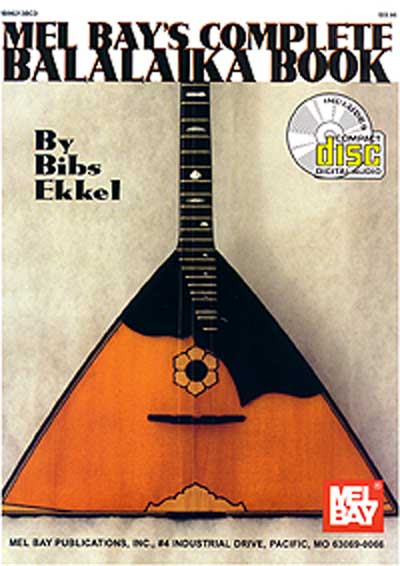
COMPLETE BALALAIKA BOOK Bibs Ekkel CD TABLATURE LIBRO SPARTITI METODO MUSICA PENTAGRAMMA

COMPLETE BALALAIKA BOOK. METHOD SHEET MUSIC BOOK WITH CD & TABLATURE.

LIBRO METODO DI MUSICA PER BALALAIKA, CON CD.

SPARTITI CON ACCORDI, PENTAGRAMMA, TABLATURE. 

TECNICA, FOTOGRAFIE, 

180 PAGINE

La Balalaika è molto spesso associata al Folklore Russo. In questo metodo completo, l'artista che si esibisce nei concerti e ha registrato molti dischi, Bibs Ekkel svela a noi la sua vasta conoscenza di balalaika come viene insegnata in Russia oggigiorno. Questo libro di 160 pagine è diviso in quattro parti: ampia Prefazione, Tutore, A Breve Storia di Balalaika, e parte del Repertorio. Diversamente dagli altri libri di Mel Bay, Metodo Completo di Balalaika non inizia dai rudimenti delle nozioni musicali. La prefazione di 20 pagine offre un panorama generale sulle accordature di tutta la famiglia della balalaika, posizioni delle mani, risorse delle accordature, aggiustamento dello strumento, settaggio della distanza tra le corde e le corde e la tastiera, ottimizzazzione, la forma degli accordi. L'autore descrive anche come fare il pletro per la balalaika bass con il cuoio da scarpe. Tutore o parte delle istruzioni è scritta  per la balalaika 'prima' che correttamente si suona solo con le mani senza usare il pletro. Gli esercizi ed intonazioni variano tra minime, semiminime, crome, biscrome, semi-biscrome, le note puntate occasionali e ritmo sincopato. Probabilmente metà di brani di questa parte è trascritta  con notazioni e tablature. Incluso un glossario dei caratteri musicali e terminologia russo. Una storia breve di Balalaika è ben scritto e illustrato. Rari libri di Mel Bay hanno cosi completo quadro generale dello strumento in questione. La sezione del Repertorio offre dei pezzi preziosi della musica folk dell'Est Europa. Tutti, tranne due selezioni di questa sezione sono scritte con notazioni, e tablature con i suggeriti accordi per la chitarra, ad eccezione di arragiamenti per balalaika e pianoforte e spartito per orchestra di balalaike.   Più che semplice spartiti di accordi melodiche, sono degli arrangiamenti d'autore dei accordi per balalaika solo e orchestra di balalaike. Il CD che contiene dei brani selezionati e eseguiti dal autore, completa questo altamente istruttivo pacchetto.

La Balalaika ha solo 3 corde, e le due più basse sono uguali, Mi, Mi, La. Ma fare le cose fatte bene e suonare meglio degli altri non è mai facile. Si suona con il plettro o con le dita. Questo libro molto completo con tutti i consigli e riferimenti precisi sulle dimensioni e distanze tra i vari modelli e la "sorella" Domra, anche lei a 3 corde, però con 3 note diverse Mi, La, Re. Non mancheranno certo i pezzi della tradizione Russa e quelli di repertorio, come "Slovyev Sedoi", dvie gitary, la csardas di Monti, il volo del calabrone,  tra le tecniche: il vibrato, il tremolo, pizzicato, per finire con la partitura di un pezzo completo per 5 Balalaike e 4 Domre. Molte le fotografie per aiutare meglio a conoscere il mondo di questo strumento.


Like some poor relative, the balalaika is all too often left out of encyclopedias and musical dictionaries and, when included, often dismissed as a "primitive, guitar-like instrument of limited range found in Eastern Europe". Such descriptions do no justice to this unique and very beautiful instrument that can, in the hands of a master, produce a range of sound and wealth of expression unrivalled by any other instrument.

One ofthe greatest problems directly affecting the balalaika's popularity is its almost total confinement to Russia and the non-availability in the West of literature, music, and teachers for the instrument. The purpose of this book is not only to provide the student with a precise description of all the various techniques available to the balalaika player, but also to contradict misconceptions about the instrument and how it is played. (Unfortunately, the lack of balalaika playing traditions and material in the West has led to the publication of some scurrilously inaccurate teaching methods. One widely available book, notwithstanding its superlative-sounding title, has, to the author's personal knowledge, caused more than one budding student to give up learning the instrument altogether. )

The playing methods described and illustrated here conform to standards as taught in Russia today and include minor additions and innovations stemming from the author's own practical experience. As with other instruments, disagreement exists as to certain playing techniques on the balalaika. Russia being the vast country it is, there are geographical differences in accepted playing norms. Passages can usually be played in more than one way and in different styles. Many players, becoming adept at certain styles over the years, find it difficult to accept alternatives to their own preferred style of playing: recognizing their own as being the only correct one. As every hand is slightly different both in shape and size, it is only natural that variations will occur between each hand's comfortable playing position.

One should always remember the immortal guitarist, Django Rheinhardt, who, with two fingers of his left hand missing, necessarily broke countless rules. He not only proved that devotion and determination come first on the list of requirements for becoming an able musician, but showed up many other musicians in the process. The author has endeavoured wherever possible to indicate where acceptable variations in method and style may occur. However, certain contentious issues should be cleared up straight away.


Product Description:

The balalaika is most often associated with Russian folklore. In this comprehensive method book, concert and recording artist Bibs Ekkel shares his extensive knowledge of the balalaika as taught in Russia today. This 160-page book is divided into four sections: an extensive Foreword, the Tutor, A Brief History of the Balalaika, and a Repertoire Section. Unlike many Mel Bay books, the Complete Balalaika Book does not begin with the rudiments of music notation. Rather, the 20-page Foreword offer insights on the tunings of all the instruments in the balalaika family, hand positions, string sources and height adjustment, and chord shapes. The author even describes how to make a bass balalaika pick from shoe leather. The Tutor or instruction segment is written for the 'prima balalaika' which is correctly played with the fingers only rather than with a pick. The Tutor jumps right in with exercises and tunes in quarter, eighth, and sixteenth-note values with occasional dotted notes and syncopation. Perhaps half of the music in this section is shown in both standard notation and tablature. A glossary of musical signs and Russian musical terns is included. A Brief History of the Balalaika is well written and nicely illustrated. Very few Mel Bay books contain such a comprehensive historical overview of the subject instrument. The Repertoire Section offers a valuable resource of Eastern European folk tunes. All but two selections in this section are written in both notation and tab with suggested guitar chords, the exceptions being an arrangement for balalaika and piano, and a balalaika orchestra score. More than simple melody chord leadsheets, these are the author's own arrangements of tunes for solo balalaika and balalaika orchestra. A companion CD with selections performed by the author completes this highly effective instructional package.

Exactly when the balalaika fIrst appeared isn't known. What is certain, however, is that the instrument is

native to Russia and probably stemmed from another, earlier Russian folk instrument - the domra. The round-bodied, two-stringed domra, reputedly the favorite instrument of the "skomorokhi" (the wandering minstrels in the Middle Ages) is believed to have been first brought to Russia from across the steppes in the 13th Century Tartar invasion. The earliest known reference to the balalaika is to be found in a document dated 1688 – an official report on the punishing of two men caught playing the instrument in flagrant defiance of the 1648 edict of Czar Alexei Mikhailovich, which banned the playing of all 'devilish' musical instruments. All instruments were to be confiscated and burned, and transgressors faced a public flogging and banishment to outlying regions of Russia (which is, in fact, where folk instrumental art eventually survived, far from official control). Back then, the instrument had a semi-spherical, oval, or triangular body and a long neck with 5 - 7 movable tied gut frets. Almost all instruments were home-made and their shape, number of strings and tuning tended to vary. However, two or three strings and a triangular body with a back made of four triangular wooden slats seems to have been most common. Balalaikas were played in rural communities, enjoying wide popularity until being superceded by foreign newcomers: first the accordion and then the 7-string guitar in the 19th Century. The balalaika had all but fallen into oblivion when it was "rediscovered" by a nobleman and amateur violinist, Vasili Vasilievich Andreyev, who chanced to hear the playing of a peasant (a certain Antip) on his family estate. Andreyev was eventually to be responsible for repopularizing the instrument, helping it gain respectability and placing it permanently on the concert platform. This tireless champion not only learned to play the balalaika well, but also initiated a number of changes and improvements to the instrument. Apart from permanent chromatically-arranged metal frets and changes in design to improve its acoustic qualities, he had different sizes made, so that when the balalaika reemerged, it was not only as a solo instrument, but as an orchestral one too - gaining immediate popularity for collective playing. Andreyev's first solo public performance in 1886 in St. Petersburg caused a sensation. Soon afterwards he formed a small circle of balalaika enthusiasts, playing the full range of newly improved instruments. Their fIrst public performance was in March 1888. Soon this group was expanded to form a larger ensemble called the Great Russian Imperial Balalaika Orchestra, incorporating the domra and gusli, which by then Andreyev had also redesigned and improved. He also composed several pieces for the balalaika. Of the luthiers Andreyev commissioned to make his redesigned models: Ivanov, Pasyerbsky, and Nalimov, it was with the latter that he formed the most permanent and productive relationship. Nalimov made and repaired instruments in the workshop on Andreyev's estate, producing instruments which were later emulated by all the best makers. At one stage, while money was short, Nalimov and Andreyev removed all the doors and window-sills at ... (continue)


Formato: Libro/CD Set
162 PAGINE

Contenuto:
Foreword
Finding the Right Strings
Tuning & Bridge Position
Bridge
Adjustment of Strings
Tuning of Orchestral Instruments
Strings for the Balalaika Orchestra
Picks for orchestral Instruments
Chord Shapes for Prima (and Alto) Balalaika
Balalaika Diagram

Tutor
Strings
Tuning
Holding The Balalaika
The Balalaika Fingerboard
The Left Hand
Strumming With The Thumb
Left Hand: Using The Thumb
Right Hand: Plucking With The Thumb
Strumming With The Index Finger
Annotation of Strokes
Tremolo
Tremolo on 2nd and 3rd Strings Only
Double Pizzicato
Single Pizzicato
Pizzicato & the Left Hand
Tremolo on One String
Vibrato
Tremolo With Vibrato
Rolls
Syncopation
Left Hand Pizzicato
Glissando
Harmonics
False Harmonics
Triads
"Guitar" Techniques
Guitar Tremolo
Guitar Pizzicato
Forward Guitar Pizzicato
Straight-Fingered Guitar Pizzicato
Guitar Picking
Tricks and Special Effects
Some Extra Difficult Strokes
General Advice on Practicing
Glossary of Musical Signs
Russian Musical Terms
Short Introduction to Timing 

A BRIEF HISTORY OF THE BALALAIKA

 
REPERTOIRE SECTION
 
Baa-Baa Black Sheep .
The Slender Rowan Tree .
God Save the Czar ,
In the Field a Birch Tree Stood .
The Ural Rowan Tree .
It's Not the Wind that Bends the Branch .
Dance, Dance .
Varyag .
Do Not Scold Me .
I Shall Go Down to the River .
I Loved You .
Goin' Home .
I Was in the Garden .
The Post Troika Hastens .
Moonshine .
Akh, Nastasya ,
Under the Apple Tree .
Polosynka .
Go Home You Gossips .
Dark Browed, Dark Eyed Lad .
Two Guitars .
Katiusha .
For Czar, Motherland and Faith .
A Cossack Crossed the Danube .
Leaf from an Album .
Daydreams
Prezzo: €43,99
€43,99

COMPLETE BLUEGRASS BANJO METHOD Neil Griffin BOOK CD TABLATURE 3-Finger Picking-rolls-slides-pull offs-hammers-choking

COMPLETE BLUEGRASS BANJO METHOD. Neil Griffin. CD TABLATURE

Product Description:
One of the very best G tuning five-string bluegrass banjo methods available! The book teaches how to pick out tunes single-string style (one note at a time), how to play chord accompaniment, and how to play solos in the full three-finger, bluegrass style. Topics include note and tab reading, chord background styles, traditional bluegrass techniques, fills and endings, use of the capo, rolls, slides, hammers, pull-offs, choking, harmonics, and up-the-neck playing. In notation and tablature. The CD includes acoustic bass, acoustic guitar, and a rhythm track as well as the 5-string banjo. All songs and most exercises are included in this teaching recording, performed at a tempo that the student should be able to maintain in short order.

Product Description:
One of the very best G-tuning five-string bluegrass banjo methods available. Contents include note reading, tablature, chord background styles, three finger picking, rolls, licks, runs, fills, and endings, use of the capo, easy solos, and advanced up-the-neck solos in three-finger style! CD is a stereo play-along recording.


Neil Griffin was born and still resides in Charlotte, North Carolina. Music has always been his prime interest, starting wtih clarinet instruction in the fifth grade and learning guitar on his own. He performed as a member of the Charlotte Symphony Orchestra at age 15 playing bass clarinet. He also began performing with area dance bands on saxophone, clarinet, and guitar.

He studied music at the Univeristy of North Carolina at Chapel Hill, playing First Chair Alto Sax as a freshman in the UNC Concert Band. Neil taught as Band Director at three county schools for several years and at the same time privately for Kidd-Frix Music Co. in their Charlotte accordion school. When the School was purchased by Music Inc. Neil went into management and retail music sales for them. At the same time, Neil played regularly with his own band for wedding receptions, office parties, etc., and gained valuable experience from playing summer theater for many well-known stars as well as being called on a regular basis to play banjo, guitar, and clarinet for traveling Broadway shows appearing in the area.

Neil was very active in the Charlotte Musicians Association and served as president for approximately 13 years as well as holding other executive offices.

Some of the first professional jobs Neil played were good old southern square dances, which at that time weren't as fancy as they are today but provided him with an appreciation for country and bluegrass music that was never forgotten. He enjoyed doin 5 radio shows and two TV shows per week at WBT and WBTV in Charlotte for over a year.

In the early 60's Neil was hired to manage Tillman Music Co. in Charlotte. There he helped in starting the Aria Pro II line of instruments. Neil and his brother Steve, who also writes for Mel Bay Publications, went into the music-school business tohether in the 70's and later expanded as a retail music store. During this period Neil met Mel Bay and began to write material for 5-string banjo which was pretty scarce at the time. He has thoroughly enjoyed writing and teaching.

Currently, Neil is a performing musician, band leader and co-owner of the Neil Griffin Studios of Music in Charlotte, North Carolina where his instructional books are field tested and proven effective with students of all ages. He has authored or co-authored several books for Mel Bay Publications on the subjects of 5-string banjo, rock guitar, and accordion.

THE AUTHOR
Neil Griffin is a performing musician and teacher with many years of experience. He is co-owner of Griffin Music Scene in Charlotte, North Carolina, where this method has been field-tested and proven with students of all ages. Neil is the author of Mel Bay Publications' Easiest Banjo Book, Anthology of 5-String Banjo Styles, The Complete Banjo Book, and several other publications from Mel Bay.

ABOUT PART ONE A WORD FROM THE AUTHOR
I have attempted to set forth a basic, "from-the-beginning" system of five-string banjo instruction in the G or bluegrass tuning for the use of both teachers and students. Through the use of this method, the student should expect to learn the following:

1. How to pick out tunes single-string style (one note at a time).
2. How to play chord accompaniment.
3. How to play solos in the full three-finger, bluegrass style that is so popular today.

All the songs and solos in Part One are written in two simple keys (Gand C). All the playing
is done in the basic position (the first few frets).
The student will learn to play rolls, slides, hammers, and pull-offs. Techniques such as choking, playing harmonics, and high solo playing up the neck are purposely omitted in Part One. These will be covered in Part Two, as I believe that a thorough knowledge and facility should be gained in the basic position before moving on.
All of the songs in the first part are written two ways - one simple version showing the single-note melody as well as the chord strums and words - one complete three-finger, bluegrass solo that matches. Ifyou have a friend who plays a few chords on the guitar, it will be fun to play the song together, swapping back and forth with one playing the melody and the other strumming the chords. Later, when you can handle full solos, the music will still work together.
Daily practice is essential in order to master the material in this method and is one thing you must discipline yourself to do. No one else can do it for you.
If you are not taking regular instruction from a banjo teacher or if there are no banjo teachers in your town and you feel you need extra help, any competent guitar teacher will understand the material in this book and willbe able to help you to understand the things that cause you trouble.
Good luck and, above all, have fun with your music!
Neil Griffin


PART TWO FOREWORD
Iwant to thank the many thousands of banjo enthusiasts who have purchased the Mel Bay books I have written. It is certainly gratifying to receive letters and phone calls from all over the world commenting on my books and requesting more advanced material for the fivestring banjo.
There is quite a bit of good music available now for the five-string banjo, but as I study all that I can obtain, my feeling remains the same as when I wrote my first book. There seems to be a lack of actual teaching material that systematically acquaints the aspiring banjo player with the techniques necessary to become an accomplished banjoist. A banjo player must utilize his or her own talents and imagination in playing exciting music. In order to achieve what your musical ear wants to hear, you must know just where to find the sounds that you are looking for on your instrument. I sincerely hope that this book will help those who use it correctly, not only just to play the songs as they are written here, but to learn your way around the banjo so well that you can extend the solos, improve upon them, and create your own versions.
Included in this part are information on chords and chord progressions, scales and keys, single-string picking, melodic or chromatic style, back-up, blues and boogie, various technical exercises, and standard tunes as well as some original material to help demonstrate their use. It is very important that you understand and can play the material in Part One of this method in order to get the most out of this volume. It would also be helpful if you would read through and play the supplementary material that I have written previously - Mel Bay's Easiest Banjo Book, Complete Banjo Book, and Anthology of 5-String Banjo Styles. Again, many thanks for your interest and support, and best wishes for many hours of 'Happy Pickin'

"MELODIC" OR "CHROMATIC" PICKING
THE NEXT FEW PAGES WILL INTRODUCE YOU TO THE "MELODIC" OR "CHROMATIC" STYLE OF BANJO PLAYING. THE MAJOR PART OF THE MATERIAL IS IN G BECAUSE YOU ARE SO FAMILIAR WITH THE KEY, BUT SEVERAL OTHER KEYS ARE SHOWN.
THIS STYLE IS SOMETIMES CALLED "FIDDLE SCALE PLAYING" BECAUSE IT IS DESIGNED TO ALLOW THE BANJO PLAYER TO PLAY RAPID RUNS AND FILL-INS AS WELL AS THE OLD-TIME FIDDLE AND MANDOLIN TUNES THAT HAVE SO MANY NOTES IN EACH MEASURE OF THE MUSIC. MOST OF THE OLD FIDDLE TUNES HAVE ABOUT EIGHT NOTES PER MEASURE AND DO NOT ADAPT WELL TO THE "SCRUGGS" STYLE.
MOST GOOD BANJO PLAYERS USE A MIXTURE OF THE TWO STYLES IN ORDER TO AVOID BEING MONOTONOUS.
IF YOU READ MUSIC AND HAVE A THOROUGH KNOWLEDGE OF THE MELODIC SCALE PATTERNS, YOU CAN READ FIDDLE AND MANDOLIN TUNES DIRECTLY FROM FIDDLE AND MANDOLIN MUSIC. THIS ABILITY ALONE WILL OPEN UP THE OPPORTUNITY TO PLAY LITERALLYTHOUSANDS OF TUNES YOU ARE NOT FAMILIAR WITH. YOU WILL NOTICE THAT IN THIS STYLE OF PLAYING THE RIGHT-HAND FINGERING REQUIRES YOU TO PICK THE SECOND STRING WITH THE MIDDLE FINGER. THIS TAKES SOME PRACTICE BUT WILL ENABLE YOU TO PLAY RUNS THAT WERE VERY DIFFICULT TO FINGER BEFORE.
BE PATIENT, AS YOU WILL PROBABLY FEEL LIKE AN AWKWARD BEGINNER FOR A WHILE. BUT DON'T GIVE UP - IT'S WORTH THE EFFORT .... MEMORIZE ONE SCALE PATTERN AT A TIME AND DON'T MOVE ON TO THE NEXT ONE UNTIL YOU CAN PLAY IT QUITE SMOOTHLY.
 

ADVANCED SOLO SONG SECTION
BE SURE TO READ THE NEXT FOUR PAGES ON "CHORD DIAGRAMS," "CIRCLED TAB NUMBERS," "THE CHOKE," AND "CHIMES" BEFORE YOU START PLAYING THE SOLOS. THIS INFORMATION WILL HELP YOU TO UNDERSTAND THE SOLOS MUCH BETTER.
INCLUDED IN THIS SECTION IS A WIDE VARIETY OF MATERIAL.
THERE ARE SEVERAL SONGS THAT YOU LEARNED IN PART ONE IN THE BASIC POSITION THAT ARE PRESENTED HERE IN THE HIGHER OCTAVE (UP THE NECK). THESE MAY BE CONNECTED TO THE PREVIOUS SOLOS YOU HAVE LEARNED TO EXPAND THE NUMBER OF CHORUSES YOU CAN PLAY.
MANY OF THE SONGS HAVE BOTH LOW AND HIGH VERSIONS WITH A MIXTURE OF "SCRUGGS" AND "MELODIC." THERE ARE SEVERAL ORIGINAL TUNES INCLUDED. IN SOME INSTANCES THE STYLE USES THE HOLDING OF COMPLETE CHORDS WHERE I OBVIOUSLY COULD HAVE MADE THE PlAYING MORE FLOWING AND OPEN TO SUIT MORE ADVANCED PlAYERS, BUT I DID NOT SET OUT TO WRITE JUST ANOTHER "SOLO BOOK. " IT IS MY HONEST HOPE THAT YOU WILL, THROUGH THE USE OF THIS BOOK, REALLY BEGIN TO SEE WHERE THINGS ARE COMING FROM THAT YOU DID NOT UNDERSTAND BEFORE. STUDYING THIS MATERIAL THOROUGHLY WILL ENABLE YOU TO READ AND UNDERSTAND SOLOS WRITTEN BY MUCH GREATER BANJO PLAYERS THAN MYSELF.

INDEX OF ADVANCED SOLOS II
ARKANSAS TRAVELER
BANJO BLUES
BICENTENNIAL BREAKDOWN
BILL BAILEY.
BlACK EYED SUSIE .
BLUE MOUNTAIN TRAIN
BLUEGRASS JOE
BUFFALO GALS (MELODIC STYLE)
BUFFALO GALS (3-FINGER STYLE) .
BULLY OF THE TOWN
BURY ME BENEATH THE WILLOW .
CARELESS LOVE .
CARRY ME BACK TO OLD VIRGINIA
CATFISH CREEK.
CHIME TIME
FRANKIE AND JOHNNY
GEORGIA GALLOP
GRANDFATHER'S CLOCK
HARD AND IT'S HARD
JOHN HARDY (HIGH CHORUS)
JOHN HENRY .
LONDONDERRY AIR
MAMA DON'T 'LOW
NINE POUND HAMMER
NUEGRASS
OLD TIME RELIGION (HIGH CHORUS)
PICKIN' AROUND
ST. ANNE'S REEL
SALTY DOG
STOCKADE BLUES
UNDER THE DOUBLE EAGLE
WABASH CANNONBALL
WILDWOOD FLOWER
WILL THE CIRCLE BE UNBROKEN
WRECK OF THE OLD 97 


MEL BAY'S COMPLETE BLUEGRASS BANJO METHOD
Cover photo courtesy of Liberty Banjo Company, Bridgeport, Connecticut.

CD CONTENTS:
1 Introduction (:21]
2 Tuning the Banjo/page 11 (:56]
3 Notes on the D String Plus 4 Songs/page 13 (1:38)
4 More Songs With Addftional Notes/page 18 (1:48)
5 G Major Songs/page 23 [1:01]
6 Chord Background & The Bugle-Call Pinch/page 31& 32 (:34)
7 Pinch Chords With Alternating Bass Notes in 4/4 Time/page 33 (:35)
8 Pinch Chords With Alternating Bass Notes in 3/4 Time/page 34 {:27]
9 Melody and Pinch Chords Together/page 35 {:40]
10 3-Finger Picking· Forward Rolls/page 44 (:52)
11 Backward Rolls/page 45 (:50]
12 Thumb-Alternating Rolls/page 46 {1:11]
13 Combination Rolls/page 47 {l:04]
14 Rolls on the D & D7 Chords/page 48 [:34]
15 Right-Hand Patterns/page 50 {l: 18]
16 County Line/page 51 (:32]
17 Frog Pond / page 52
18 Haystack/page 53 [:25)
19 Fiesta/page 54 (:31)
20 Backing Up/page 55 (:25)
21 Moving On/page 56 {:25]
22 Big Dipper/page 57 (:25]
23 The Basic Banjo Picking Effects· The Slide/page 60 {:54}
24 Slide and Pinch/page 60 {:26]
25 Slides and Rolls/page 61 {:40]
26 Hammering, Hammer & Pinch, Hammer & Roll / page 62 {:51]
27 The Pull-Off, Pulling Off, Pull-Off & Pinch, Pull-Off & Roll/ page 63 (:56]
28 Mixed Effects/page 64 (:59]

Solo Section
29 Fills& Endings/page 65 {2:15]
30 Bile 'Dem Cabbage Down/page 70 [:28)
31 Criple Creek /page 72 (:29]
32 Old Dan Tucker /page 74 (:52]
33 I've Got Peace Like a River /page 76 [:28)
34 Old Time Religion /page 78 {:27]
35 Hand Me Down My Walking Cane /page 80 {:28}
36 Careless love /page 82 {:56]
37 When the Saints GoMarching In / page 84 {:54]
38 This Train / page 90 {:30]
39 Banks of the Ohio / page 92 {:27]
40 The Yellow Rose of Texas / page 94 {:55]
41 Pickin' on the Old Banjo / page 98 [:30)
42 Li'l Liza Jane / page 100 (:29]
43 The lonesome Road page 102 [:29)
44 Mama Don't 'low / page 104 (:27]
45 She'll Be Coming 'Round the Mountain / page 106
46 Worried Man Blues / page 108 (:28)
47 Red River Valley / page 110 {:28]
48 Old Joe Clark / page 112 {:52]
49 John Hardy / page 114 {:33]
50 Pickin' Trip / page 116 {:30]
51 Oh Susanna / page 118 {:29]
52 Cindy / page 122 {:33]
53 The ER-I·E Canal / page 122 [:33]
54 Ballad of Jesse James /page 124 (:52]
55 Home Sweet Home /page 128 (:55]
56 Battle Hymn of the Republic /page 132 {:58]
57 Come and Gowdh Me /page 136 (:30]
58 Part 2·She'll Be Coming 'Round the Mountain / page 148 {:37)
59 Little Brown Jug /page 155 {:49]
60 Bile 'Dem Cabbage Down (:58]

Advanced Solo Section
61 Blue Mountain Train /page 182 {l:06}
62 Chime Time /page 184 [1: 16]
63 Georgia Gallop /page 186 [:52]
64 Pickin' Around /page 188 [:32]
65 Wabash Cannonball /page 189 {:30]
66 Bury Me Beneath the Willow/page 190 {:56}
67 Wildwood Flower/page 192 (1:00)
68 Will the Circle Be Unbroken/page 194 (:59]
69 Arkansas Traveler/page 196 {:31]
70 Wreck of the Old 91/page 191 {:30]
71 Nine Pound Hammer/page 198 (:56]
72 CarryMe Back to Old Virginia/page 200 (:57]
73 Banjo Blues /page 202 (:56)
74 Bluegrass Joe /page 204 [:43]
75 Mama Don't 'low /page 205 [:27]
76 Stockade Blues /page 206 [:53]
77 Salty Dog /page 208 [l:23]
78 Catfish Creek/page 210 [:54]
79 Gandlather's Clock/page 212 [1:20]
80 Frankie and JohnnJohnny / Page 214 [1:05]
81 Careless love/page 215 [:31)
82 Bill Bailey/page 216 [:56]
83 Hard and It's Hard/page 218 (:31)
84 Old Time Religion/page 219 [:31]
85 Bully of the Town/page 220 [1:06]
86 Bicentennial Breakdown/page 222 [2:01]
87 John Henry/page 226 [1:11]
88 londonderry Air/page 228 [l:21]
89 Under the Double Eagle/page 230 [1:42]
90 Outro [:33] 


Product Number: 93345BCD
Format: Book/CD Set
ISBN: 0786665211
UPC: 796279085458
ISBN13: 9780786665211
Series: Complete
Publisher: Publications, Inc.
Date Published: 11/4/2002

Contents:

Part One
About Part One
The Author
Left-Hand Position
Right-Hand Position and Fingering
The Picks
The Quickest Way to Learn
Music-Reading Section
The Rudiments of Music
Other Musical Signs and Terms
Tuning the Banjo
Reading Tablature
Time Values of Notes and Rests
Counting Time in Tablature
Counting Time
Playing Songs on the First, Second, and Fifth Strings
Playing a Song on the Second and Third Strings
Chord Background
The Chord Symbol
The Basic Chords
Down and Up Strumming
Pinching the Chords
Melody and Pinch Chords Together
Chromatics
Key Signatures
Counting Review
3-Finger Picking Section
Counting Bluegrass Style
The Basic Rolls
Forward Rolls
Backward Rolls
Thumb-Alternating Rolls
Combination Rolls Rolls on the D and D7 Chords
Daily Practice Patterns
Right-Hand Patterns
The Basic Banjo Picking Effects
Fills and Endings
The Capo
Solo Section
The Banjo and Its Parts

Part Two
Foreword
Chord Studies
Mixing the Major Chord Forms
The I, IV, and V Chords
The I, IV, V, I Progression
Other Movable Chord Forms
The Dominant Seventh Chord
The Diminished Seventh Chord
The Augmented Seventh Chord
Right-Hand Chord Background Patterns
Blues & Boogie Back-Up Section
Blues Rock Back-Up
5-String Boogie
Melodic Thirds and Sixths
Melodic Thirds and Sixths Mixed
Blues-Rock Chorus
"Melodic" or "Chromatic" Picking
Advanced Solo Song Section
Chord Diagrams for Solo Section
Circled Tab Numbers
The Choke
Chimes
Endings

Prezzo: €31,99
€31,99

GUITAR ARPEGGIO ENCYCLOPEDIA ANDY MARTIN TABLATURE LIBRO SPARTITI CHITARRA PENTAGRAMMA

GUITAR ARPEGGIO ENCYCLOPEDIA, Andy Martin. TABLATURE

Product Description:
Throughout this book you will be exposed to many different types of arpeggios, their families, a horde of fingerings, how to use them and much more. With practice and patience you will be able to have total control on the fingerboard and you will be able to execute arpeggios with fire and finesse like the best players do. By understanding arpeggios it will immensely improve your improvising for song writing and soloing as well as creating majestic melodies and hooks. All of the material is presented in notation and tablature. Throughout my book you will be exposed to many different types of arpeggios, their families, a horde of fingerings, how to use them and much more. First, I would like to define what an arpeggio is in the simplest form. An arpeggio is simply chord tones played seoarately. For instance, if you played an A minor barre chord at the 5th fret with the root note on the sixth string and instead of strumming the chord, try muting the string slightly with your picking hand (rest your picking hand slightly on the bridge of the guitar). Then, pick each note separately and use all down strokes as you ascend and all up strokes as you descend. This is one of the simplest ways to play an arpeggio. You can do this to all the chords you know and you also can experiment with muting the strings or letting the strings ring out as you play them. Arpeggios are also considered as tonal centers. A tonal center tells you what family you belong to and is the center of tonality. For exempIe:

If you take a major scale 1-2-3-4-5-6-7 the tonal center is the 1-3-5-7 and it is colored with 2-4-6.

If you look at a G major scale the notes diatonically are G-A-B-C-D-E-F#. G is the first degree, A is the second degree, B is the third degree, C is the forth degree, D is the fifth degree and so on.

The tonal center in a G major seventh arpeggio is G B D F#. You can play these notes in any order but traditionally they are played in succession with each other 1-3-5-7.

You should also look at arpeggios as the outline of a scale or chord and you can add your colors to enhance them with flavor. The best analogy I can provide you with is to think of an artist with his pallet. He starts his painting or drawing with an outline, our arpeggio and then he puts a splash of red, green, blue, etc, to make his painting more vibrant. We take our outline, the arpeggio and enhance it with our colors, modal degrees, the 2, 4, 6, 9, 11, 13 or altered colors, sharps or flats. This way we can paint a picture with audibles instead of visuals, then we compose a picture, a story with harmonic content. In my book you will learn how to learn and obtain total control of executing arpeggios and why it is important to have a strong bakground in them. By understanding arpeggios it will immensely improve your improvising for song writing and soloing as well as creating majestic melodies and hooks. Arpeggios are very vocal and lyrical so you can create melodic melody lines or use arpeggios with blistering sweeping speed, incorporating them into you solos, compositions or even as pick up lines. A pick up line is a part of a composition that is played in the present and targets the future. For example, if the solo was about to be approached in your composition, you can playa lick, run, or an arpeggio in the measure before the solo starts to enhance or build up to the solo . Many great guitarists use arpeggios in their compositions and in their soloing. With a lot of practice and patience you will be able to have total control on the fingerboard and you will be able to executed arpeggios with fire and finesse like the best players do. You should also listen to all styles of music even if some styles don't appeal to your ears. Just because you don't like a style of music, it does not mean that you won't learn something from just listening to it. Being musicians and learning our language is what makes a difference in players. We must educate our minds and ears to their fullest extremes. Here are some of my favorite guitarists and composers and their works that exhibit their Arpeggio playing techniques.
Steve Vai: Flexible, Eat Em and Smile, Skyscraper, Passion and Warfare, Alien Love Secrets, Fire Garden, Ultra Zone
Frank Gambale Thunder From Down Under, Passages, Noteworker
Shawn Lane Power of Ten, Tritone Fascination (I love this record)
Yngwie Malmsteen Trilogy, Marching Out, Fire and Ice, Facing the Animal. (When I first started to play, I was studying classical guitar and I heard some of Yngwie's work. I was attracted to the way Yngwie exhibited total control of his exotic 
arpeggios and was a major influence in my passion.)
Paul Gilbert Street Lethal, King of Clubs (Paul has an amazing picking technique that was showcased with Racer X)
Johann Sebastian Bach Goldberg Variations, Trio Sonatas, Piano Sonatas, Toccata and Fugue in D minor, Partita NO.2 in D 
minor, Suite for Lute in E Major, (too many to list!)
Ludwig Van Beethoven Fur Elise, Piano Sonatas Nos. I, 2 & 3, Piano Concertos Nos. 2 & 5 "Emperor"


Contents:
1) Acknowledgements
2) Introduction
3) How to Approach This Book
4) Arpeggios Fingerings
5) Arpeggios Families & Interval Formulas
Major Arpeggios
Minor Arpeggios
Diminished
Major 7th
Dominant 7th
Minor 7th
Minor 7th 5
Diminished 7th
Augmented
Major add 9
Minor add 9
Major 6th
Minor 6th
Major sus 4
Minor sus 4
Major 9th
Dominant 9th
Minor 9th
Dominant #9th
Major 7th add #11
Dominant 11th
Minor 11th
Major 13th
Dominant 13th
Minor 13th
Minor/Major 7th
Minor/Major 9th

6) Picking Techniques
7) Superimposing Arpeggios
8) Harmonizing Arpeggios
9) Parallel Harmonies
10) Modal/Diatonic Harmonies
11) Very Violent Riffs and Licks!

Prezzo: €31,99
€31,99
Condividi contenuti