MEL BAY

BACKUP TRAX: BASIC BLUES FOR GUITAR Dix Bruce BOOK & CD TABLATURE SPARTITI CHITARRA LIBRO

BACKUP TRAX: BASIC BLUES FOR GUITAR. SHEET MUSIC BOOK WITH CD & GUITAR TABLATURE. 

LIBRO DI MUSICA BLUES CON CD.

SPARTITI PER CHITARRA CON:

ACCORDI PENTAGRAMMA TABLATURE.

Learn to play 14 classic blues the best way--by doing! This book and CD provide your backup band as you explore Country and Urban, Acoustic and Electric, Delta, Texas, Chicago, Slide Guitar, Alternate Tuning, Traditional, and Modern styles in many different major and minor keys and in a variety of tempos. Melodies are first presented on the recording at a slow speed with just guitar, then repeated at regular speed with the band. Finally, you can play along with the hot blues rhythm section alone, and you’ve got the makings of a dynamite blues jam session. You’ll play all the leads and solos! Repeat a tune or passage as many times as you want at slow or regular speed. We’ll jam all night long! Beginners and intermediate players can practice basic skills. Advanced players can hone their improvisation chops. The split track recording allows you to hear either just the melody from one speaker, just the rhythm section from the other, or both for maximum flexibility and specific study. The book includes melodies, chord diagrams and guitar tablature.

Welcome to BackUp TRAX: Basic Blues - 14 pieces carefully chosen to represent a variety of tunes and keys encountered in the basic blues repertoire. BackUp TRAX: Basic Blues is a sampler of Country and Urban Blues, Acoustic and Electric Blues, Delta Blues,Texas Blues, Chicago Blues, Slide Guitar Blues, Traditional and Modem Blues in many different major and minor keys. Each tune is played by a crack backup band: guitar, bass, drums, keyboards and harmonica, which is sure to inspire you to play your best. Each tune is presented at the slow speed fIrst, followed by the regular speed version with melody, and fmally, the regular speed version where you supply all the leads. In each case the melody is panned to the right channel to allow you to isolate it as you study. The rhythm section is panned to the left channel (guitar on the slow versions, most of the band on the regular speed versions) so that you can also isolate it.Tuning tones are included at the beginning of the CD. Tips for working with BackUp TRAX: Basic Blues I designed BackUp TRAX to be a rhythm section for players of all abilities to jam along with and work out their soloing ideas. Though BackUp TRAX are not intended to be method books for improvising in the given style,! will offer suggestions here and there on how to approach the individual tunes. There are many good blues guitar methods on the market which examine the scales, chords and other elements that make up the style.The most important thing, though, is for you to play what you feel and discover your own voice in the process. This process is analogous to learning a new language: melodies, riffs, keys, and scales are your musical vocabulary, grammar and syntax. Along the way you'll experiment with different elements and discover how to combine them in ways that feel most natural to you and express your feelings best. The goal is to make the process second nature by training your head, fmgers, and soul in the mechanics of playing your instrument in your style. Ultimately it'll become as automatic as speech.Along the way, the most important thing is to have fun as you take the music wherever you want it to go. Here are a few suggestions for working with BackUP TRAX: Basic Blues. 1) Before you play, familiarize yourself with the melodies and chord progressions of each tune by listening and reading along. 2) Once you're acquainted with the tunes, memorize the melodies while playing along with the slow version of the piece. Gradually work your way up to the regular speed version. Knowing a song's melody and chord progression is essential in the improvisation process. Older blues and jazz players I know refer to improvisation as "takeoff," where the melody is the starting point for elaborating or "taking off" from the tune and inventing new melodic ideas. 3) Analyze the chords. All of the tunes are written with the classic chord progressions and in the various styles of basic blues. You'll find that the blues repertoire, literally thousands of tunes, is largely based on a very few distinct chord progressions combined in different ways to make up most of the tunes. Because of this simplicity of form, the blues genre is universal the world over. Recognizing these progressions is essential to understanding how a tune works and how it relates to other similar tunes. Note the number of measures in the form, for example, twelve bar blues, sixteen bar blues, or twenty four bar blues. Identify the key a tune is in and whether it's major or minor. Learn to recognize the elements of the progression and which chords are played where. For example, "two measures of I (one) followed by two measures of IV (four)." It's especially important to identify the chords by their Roman numeral names, which defIne a chord's function in a progression and key as opposed to their letter names which reveal much less.You'll also fInd that most professional musicians refer to chords in keys by their Roman numerals. It's a clear and concise way to communicate on stage and makes transposing from one key to another much easier. It all begins with the major scale. Look at the C major scale below with its notes (also called "scale degrees") numbered. Notice that we use Arabic and not Roman numerals. Generally Arabic numerals are used to name notes in a scale, Roman numerals to name chords in a key. "Wh" and "1/2" identify the whole and half step intervals between the notes of the major scale. Each major scale has seven different notes, "do" to "ti;' and seven different chords built on and named by them. This will remain the same for every key. 

Format: Book/CD Set
ISBN: 0786676698
UPC: 796279105545
ISBN13: 9780786676699
Series: Building Excellence Audio Series

Contents:

CD CONTENTS:
HOW BACKUP TRAX WORK:
FORWARD TO BACKUP TRAX
INTRODUCTION TO BACKUP TRAX: BASIC BLUES
CHORD, SCALE, & TRANSPOSITION CHART
MEMPHIS MINNIE BLUES (Uptempo Country Blues)
BORN TO DIE (Bottleneck/Slide)
WHEN I LAY MY BURDEN DOWN (Gospel/Country Blues)
KISSIN’ AIN’T NO CRIME (Medium 1950s R & B Rock Blues)
T-MODEL FORD BLUES (Shuffle)
C MINOR BLUES (Slow Modern/Urban Blues)
HONEY BABE (Uptempo Texas/Country Blues)
THE HIGHWAY BLUES (Slow Shuffle)
JUMP BLUES (Fast 1940s Rhythm & Blues)
FROGS FOR SNAKES (Very Slow Texas/Delta Blues)
G MINOR BLUES (Medium Modern/Urban Blues)
TUXEDO BLUES (Rock & Roll Rhumba)
ROCKABILLY BOOGIE (Very Fast Rockabilly)
CREAM IN MY COFFEE (Jazz Blues)
AFTERWARD
THE BAND
GUITAR CHORDS USED IN BACKUP TRAX: BASIC BLUES
BLUES GUITARISTS

Prezzo: €18,99
€18,99

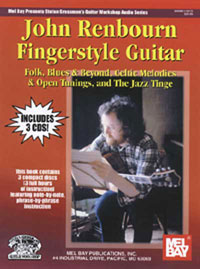
RENBOURN JOHN FINGERSTYLE GUITAR Folk Blues & Beyond Celtic Melodies & Open Tunings & The Jazz Tinge 3CD TABLATURE

RENBOURN JOHN, FINGERSTYLE GUITAR: Folk, Blues & Beyond; Celtic Melodies & Open Tunings; & The Jazz Tinge. SHEET MUSIC BOOK with 3CD & GUITAR TABLATURE . 


LIBRO DI MUSICA FOLK CON 3 CD.

SPARTITI PER CHITARRA CON GUITAR TABLATURE.

Product Description:
This comprehensive Guitar Workshop Audio Series book/3-CD set brings together a variety of fingerstyle arrangements featured in three of John Renbourn's video lessons. Illustrates unique and exciting fingerstyle techniques in the performance of traditional ballads and other tunes, using standard and several alternate tunings. In notation and tablature. Includes an extensive discussion about the tunes in the collection. 120 PAGES
Format: Book/3-CD Set

... memorized because I'd learnt the tune simply to find out how the parts were worked. So then once I'd got an idea of how you approached the harmonization I found I couldn't resist playing them on the guitar and it fitted OK in D. It probably fits in may other keys as well. And the same thing with Bunyan's Hymn. I tackled that because I liked the melody and the time changes in it and I kind of reharmonized it to fit in open G deliberately.

STEFAN: How about I Saw Three Ships?

JOHN: I Saw Three Ships is also a traditional English tune and a very charming one. It's very simple but it seems to have great appeal. I really like the tune and I know a lot of other people that have a great fondness for it. It seems to me to be a really old tune, I can't say how old but it could easily fit in with the concept of medieval dance tunes that I've come across without very much change and it flows very nicely. It has a little refrain to it and hat also fits very nicely in that same tuning. So I play the two together and I throw in an number of other tradition English tunes in that medley.

STEFAN: How did you find The English Dance?

JOHN: Well I think I must have heard that also a long time ago being played by a man named Francis Bain, who was involved pretty early on in the revival of early music. He was before David Monroe. Before the kind of better, more wide spread groups that specialized in early music. I think I liked The English Dance because it features a repetitive melodic tune in a major key. I think the instrument that Francis Bain played was the fiddelle which was an old type of bowed instrument larger than a violi. The English Dance has a real punch to it when it's played on a bowed instrument because you can get top string drones against the descending patterns and I happen to like that. I found that it fitted nicely on the guitar in the open G tuning.

STEFAN: On stage you joke that it's one of the few English dances from that period of English music.

JOHN; Well, there have been quite a lot of manuscripts supposedly of English music. Lots are lodged in The British Museum but how many of them are actually English manuscripts to start, with I don't know. I think in fact, a great deal of the early dance tunes are probably northern Italian, but I think there is a chance that this one is English. Not that it matters a great deal but there we are you know - there's a certain national pride I suppose.

STEFAN: Let's talk about how you found the open G minor tuning that you use for several Celtic melodies.

JOHN: OK. There were quite a selection of tunings in the Ggroup that were handy. I used to often use a tuning with the second string up to Cwhich meant if I was playing medieval dance tunes - I used to playa tune called Trotto and another titled Salterello that both fitted quite nicely in that tuning - you could play low drones and still keep he melody going. The G minor tuning is just a variation: the second string tuned to the minor third rather than the 4th or the 2nd or whichever you like. I can't remember what I first used it for. I have an arrangement of The Moon Shines Bright which is quite a long elaborate piece. This uses the tuning and later on I used it for Nine Maidens.

STEFAN: Where did you find Owen Roe O'Neill?

JOHN: Owen Roe O'Neill is noted in the O'Neal's collection under the Carolan tunes and I wouldn't be surprised if it in Bunting's as well. In fact, I think it's in Bunting's with a harmonization by Bunting, but I took mine from the op line and harmonized it. It fits pretty nicely on the guitar in the open G minor tuning.

STEFAN: And Mist Covered Mountains Of Home?


JOHN: Mist Covered Mountains Of Home is a tune I learned from a fiddle player who I think got it from Jody Stecher. It's a highland pipe tune and it's an unusual one. Someone some time back sent me a harmony part for a second bagpipe part. I don't know of many tunes that have two bagpipes in close harmony but apparently this one as been arranged that way. I've always imagined that it's was a song but I've never actually heard complete verses s ng to it. ...


Song Title: Composer/Source:

Abide With Me/Great Dreams From Heaven - John Renbourn
Anji - John Renbourn
Buffalo - John Renbourn
Bunyan's Hymn - John Renbourn
Cherry - John Renbourn
I Saw Three Ships - John Renbourn
Judy - John Renbourn
Lament For Owen Roe O'neill - John Renbourn
Lindsay - John Renbourn
Little Niles - John Renbourn
Lord Franklin - John Renbourn
My Dear Boy - John Renbourn
My Sweet Potato - John Renbourn
Sandwood Down To Kyle - John Renbourn
The Blarney Pilgrim - John Renbourn
The English Dance - John Renbourn
The Mist-Covered Mountains Of Home - John Renbourn
The Orphan - John Renbourn
The South Wind - John Renbourn
Tramps And Hawkers - John Renbourn
Transfusion - John Renbourn
Watch The Stars - John Renbourn
White House Blues - John Renbourn

Prezzo: €39,99
€39,99

D'AGOSTINO PEPPINO CONTEMPORARY FINGERSTYLE GUITAR DVD CHITARRA ACUSTICA Once Upon a Time in the West

D'AGOSTINO PEPPINO, CONTEMPORARY FINGERSTYLE GUITAR. DVD

DVD VIDEO LEZIONE DI MUSICA PER CHITARRA ACUSTICA.

VIDEO DIDATTICO, METODO, 


Product Description:
Fingerstyle guitar virtuoso Peppino D’Agostino (voted "Best Acoustic Guitarist" by readers in the 2007 Guitar Player magazine Reader’s Choice Awards) presents 14 tunes on this DVD. Filmed in Nashville in 2007, it features a collection of Peppino’s most requested concert pieces. One of the performances is a vocal piece from Peppino’s new CD Made in Italy on Mesa/Bluemoon Recordings. 72 MINUTES
Contents:

Beyond the Dunes -- Peppino D'Agostino and Alfredo Morabito
Running Wild -- Peppino D'Agostino
Mother's Tears -- Peppino D'Agostino
BellaDonna -- Peppino D'Agostino
Ancora un Istante -- Peppino D'Agostino and Alfredo Morabito
Pegasus' Journey -- Peppino D'Agostino and Corado Rustici
The Good, the Bad and the Ugly -- Ennio Morricone, Arr, Carlo Marchione
The Echo of Delphi Valley -- Peppino D'Agostino
Aleza's Eyes -- Peppino D'Agostino
The Blue Ocean -- Peppino D'Agostino
Once Upon a Time in the West -- Ennio Morricone, Arr, Carlo Marchione
Under the Same Sky -- Peppino D'Agostino
Dark Walters -- Peppino D'Agostino
Good Robbie -- Peppino D'Agostino

Prezzo: €69,99
€69,99

MARTIN JUAN ANDALUCIAN SUITE NO. 1 LIBRO CD TABLATURE CHITARRA SPARTITI FLAMENCO BULERIAS

MARTIN JUAN, ANDALUCIAN SUITE, NO. 1. CD TABLATURE

Product Description:
Four exciting concert solos for flamenco guitar from Juan Martín’s best-selling album ‘The Andalucian Suites’. This is the first of the four suites on the album. These suites are transcribed into standard notation and flamenco tablature (cifra), with introductory playing notes by Juan Martín. The four solos on the accompanying CD are performed by Juan.

The complementary and contrasting variety of styles and rhythms of the four solos provide a brilliant display of Juan’s artistry and the expressive capabilities of the flamenco guitar. Each solo is complete in itself. A powerfully evocative Zambra Mora is followed by the much-requested rumba ‘La Feria’, then a gently melancholic Milonga and finally a thrilling Bulerías, which combines modern elements with pure gypsy falsetas from Moron del la Frontera. These solos provide an exceptional opportunity to learn and enjoy the music of a master flamenco guitarist, whose two volumes of graded ‘Solos Flamencos’ are already Mel Bay best-sellers.
Format: Book/CD Set 48 pages


ANDALUCIAN SUITE No.1 THE FOUR SOLOS

These four solos are played as a sequence (or suite) to provide an interestingly varied group of pieces which show a range of flamenco guitar styles. Each solo stands as a complete composition which can be played by itself or in any chosen order. La Feria is particularly featured as a much-requested and popular solo.


EVOCACION DE LA INVASION ARABE AD 711

The opening movement of the suite recalls the Moorish invasion of Spain, when a small army arrived from North Mrica in the year 711 A.D. and landed at Gibraltar. The leader of the Moors was Jabal Tariq - 'he of the rock' - from whose name Gibraltar is derived. This small but efficient army, which arrived in Andalucia with its now famous Arab horses and brilliant horsemanship, took over much of Spain, a conquest which was to last nearly eight centuries. Cordoba and, larer, Granada were to become the Islamic capitals, dominating Spain until 1492. The music is based on the form of the Zambra Mora, flamenco's most Moorish dance form. It evokes that original menacing invasion and also reflects the beauty of the Moors' legacy in their art and architecture, with palaces such as the Alhambra in Granada and the great mosque at Cordoba.


Playing Notes

The 6th string is tuned to 0 for this piece, and no cejilfa (flamenco capo) is used. It starts wirh a free form (toque libre) cadenza in the style of the Moorish oud (a lute-shaped instrument with unfretted neck) with passages of ligado in which the nores are sounded by the left hand. The profusion of notes on the page may look daunting at first, bur the music lies quite easily under the fingers. In such a free and expressive passage without a definite rhythmic metre, the timing of the written notes has to be somewhar approximate. Listening to the CD will help to convey rhe correcr phrasing and emphasis. On the second page, the music changes to a regular 2/4 rhythm, which persists to the end of the piece, with later passages of rasgueo (strumming) and alzapua (a rapid three-srroke technique using down- and up-strokes of the thumb). Playets of classical guitars which are not fitted with golpeadores (tapping-plates) can omit the golpe taps. The solo concludes with a passage of continuous rasgueo (see Key to Symbols, following). The golpe on the penultimate beat is made with the middle finger striking the golpeador on the near side of the strings before the finger travels on to sound the strings with a down-stroke. The transcription is dedicated to the distinguished classical guitarist Eleftheria Kotzia, who incorporated the piece into her concert repertoire, as was heard in her virtuoso performance at London's South Bank Centre.


LA FERIA

In the same year, 1492, that Ferdinand and Isabella forced the Moors to leave Spain, Cristobal Colon (Christopher Columbus) sailed from the small port of Palos on the west coast of Andalucia on his voyage of discovery to Ametica. That voyage forged a cultural link with the Americas which has its effect within flamenco music. South American rhythms have returned to Spain with soldiers and musicians and have been absorbed into flamenco, undergoing a change in identity yet retaining an obvious Latin-American aire (atmosphere and feeling). It is clearly evident in this Rumba, an immensely popular style today. The solo is named The Fair, a time of uninhibited celebration.

Playing notes

The 6th string of the guitar is tuned to E. The cejilfa is placed at the second fret. The Rumba starrs with rhythmic strumming, using the characteristic slapping rechniques (see Key). For the first 8 bars the strings are damped with the fingers of the left hand so that they provide a percussive sound without musical vibration. The approximate positions of the left hand fingers as they damp the strings are shown in the music and cifra (flamenco tablature), initially in a chord shape over the lower frets and then over higher frets. The notes of the chord are not sounded, but the change in hand position alters the pitch of the percussive sound made by the damped strings. The piece also includes passages of alzapua, left and right hand apagado damping to cut short the sound of chords and, at the end, a repeated three-stroke rasgueo of thumb up-stroke followed by middle finger and thumb down-strokes. middle finger golpes on the near-side golpeador are used before a final up-stroke with the thumb ends the solo.

Contents:

Biographical Note
The Four Solos, with playing notes
Key to Symbols and Notation
Evocación de la Invasión Árabe AD 711 (Zambra Mora)
La Feria (Rumba)
Alborada (Milonga)
Gitanos (Bulerías)

Prezzo: €25,99
€25,99

POPULAR GUITAR STYLES LATIN & SALSA Burkhard Buck Wolters FINGERSTYLE CD TABLATURE LIBRO

POPULAR GUITAR STYLES, LATIN & SALSA. Burkhard Buck Wolters. BOOK WITH CD & GUITAR TABLATURE

LIBRO DI MUSICA LATINA E SALSA CON CD.

SPARTITI PER CHITARRA FINGERSTYLE CON:

ACCORDI, PENTAGRAMMA E TABLATURE.


FOR FINGERSTYLE GUITAR 

Product Description:
Popular Guitar Styles: Latin & Salsa reflect recent popular styles and transfer them to classical or fingerstyle technique. Guitar players who want to add Latin and salsa music to their solo-repertoire will find an original and unique collection of compositions which will give joy to both players and listeners. The playing-level is intermediate to advance. Left-hand difficulties like barrés and stretches are minimized as much as possible to make it easy to make the music groove. Written in standard and TABLATURE notation.
Format: Book/CD Set


Buck Wolters belongs to the very small company of guitar players and composers who are familar with nearly every style. His authentic mix of jazz, world and latin music, combined with a mastery of classical guitar technique is very unique and outstanding. Born in 1961 in Dortmund, Germany, he began to play the guitar as an autodidact at the age of five. After hearing a recording of Big Bill Broonzy he took his first guitar lessons at the age of thirteen, digging into the blues for several years. At the age of sixteen he went to the conservatory in his hometown where he studied classical guitar. The music of Agustin Barrios, Heitor Villa-Lobos and David Qualey were his main influences. After leading the life of a busker in his twenties, he went to the School of Arts in Amsterdam to study jazz guitar and composition and spent most of his time then copying jazz solos from musicians like John Coltrane, Keith Jarrett, Pat Metheny and Wes Montgomery. He completed his studies as a bachelor with distinction. Today Buck Wolters is very busy performing, composing, recording and teaching throughout Europe. His greatest success belongs to his composition "Dshamilja" ordered in commission by the Opera of Frankfurt.

Since latin music is very popular today, many fingerstyle or classical guitar players want to add it to their repertoire. These five compositions are intended for those players. Because of the complexity of latin rhythms, special attention should be placed on the independence between the right-hand thumb (bass pattern) and the other right-hand fingers (chord pattern or melody lines). So most of the focus is put on right-hand coordination, while left hand difficulties like stretches or use of the barre are minimized in the compositions. The introduction of each composition (first 4 to 16 bars of each piece) represents the typical rhythmic motion of the certain styles, which are characterized by three elements: 1. The clave (Spanish "key" or "code"), a rhythmic pattern of two bars, which must be kept up throughout the entire piece. Since the clave can be referred to rythmically as the "heart" of each latin style, it is mostly played on good, audible, high-pitched percussion instruments (e.g. woodsticks). Many styles can be recognized by an additional typical percussion pattern (e.g. Bolero and Merengue).

2. The bass pattern.

3. The piano or rhythm guitar pattern.

Practical advice on learning the pieces:

1. Listen to the cd several times.

2. Try to clap the clave of each piece along with the cd. (See the condensed rhythmic pictures on the following pages!)

3. Once you have the clave down try to add your feet tapping on beats "one" and "three".

4. Hit the rhythm of the bass pattern on your body. Once you have it down try to add your feet on "one" and "three".

5. Try the same with the piano/rhythm guitar pattern.

6. Learn the intro of each piece by heart before you start working through the entire piece. This guarantees your ability to keep up the rhythmic feeling of the piece while working through it.

7. Dance to the music and have fun.


Contents:

Luna Cubana -- Buck Wolters
Zapato Blanco -- Buck Wolters
El Alma de Agustin -- Buck Wolters
Bella Bailadora -- Buck Wolters
Merenguitis -- Buck Wolters

Prezzo: €21,99
€21,99

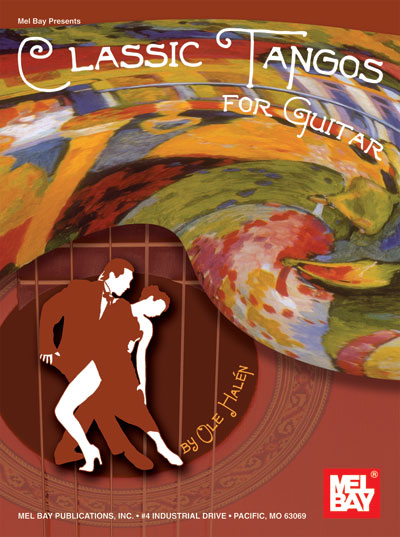
CLASSIC TANGOS FOR GUITAR Òle Halen Mel Bay TABLATURE SPARTITI CHITARRA 'O sole mio LIBRO

CLASSIC TANGOS FOR GUITAR. SHEET MUSIC BOOK WITH GUITAR TABLATURE . 

LIBRO DI MUSICA TANGO.

SPARTITI PER CHITARRA : PENTAGRAMMA E TABLATURE.  


Product Description:
Due to some deep-seated cultural irony known only to its native population, the Argentine tango has a profound grip on Finland where dance clubs and popular singers thrive on this particular style of music. In this collection, Finnish guitarist Òle Halen shares his enthusiasm for the genre by presenting tangos for solo guitar by some of the best Latin American and Spanish tango composer/guitarists, plus transcriptions and arrangements by such luminaries as Francisco Tárrega and Daniel Fortea of Spanish and Italian works originally composed for instruments other than the guitar. Written in standard notation and tablature. 128 Pages.

Product Number: 97066

Format: Book
ISBN: 0786646888
UPC: 796279061254
ISBN13: 9780786646883
Series: Non-Series
Publisher: Mel Bay Publications
Date Published: 6/20/2007


Contents:

Lagrima -- Francisco Tarrega
Danza Espanola No. 5 -- E. Granados
Don Perez Freire -- Agustin Barrios Mangore
Ayer se la IIevaron -- Daniel Fortea
Musa Argentina (Celebre Tango Argentino) -- Espiga - Fortea
Tango -- Francesco Tarrega
La Paloma -- S. Yradier and F. Tarrega
O sole mio -- Musica: Edoardo di Capua - Transcription by Francisco Tarrega - Lyrics: Giovanni Capurro - 1898
Del Ferrol a La Habana (Coll. of Tangos for Guitar) -- J. Parga
A ti solita...(Habanera) -- F. P. Spreafico
Clarita (Tango, Opus 3) -- Julian Ortiz
Anhelando -- Julian Ortiz
Junta al Farol (Tango Criollo) -- Vincente Caprino M.
Don Martin (Tango Criollo) -- Vincente Caprino M.
D. Juan Carlos (Tango Criollo) -- Vincente Caprino M.
Romero -- A. Galluzo
El Alero (Tango Pajuerano) -- Juan Maglio
Tango Espanol -- Isaac Alneniz
Tango No. 2 -- Agustin Barrios Mangore

 
Che bella cosa e' na jurnata 'e sole
n'aria serena doppo na tempesta!
Pe' ll'aria fresca pare già na festa
Che bella cosa e' na jurnata 'e sole
Ma n'atu sole,
cchiù bello, oje ne'
'O sole mio
sta 'nfronte a te!
'O sole, 'o sole mio
sta 'nfronte a te!
sta 'nfronte a te!
Quanno fa notte e 'o sole se ne scenne,
me vene quase 'na malincunia;
sotto 'a fenesta toia restarria
quanno fa notte e 'o sole se ne scenne.
Ma n'atu sole,
cchiù bello, oje ne'
'O sole mio
sta 'nfronte a te!
'O sole, 'o sole mio
sta 'nfronte a te!
sta 'nfronte a te!
Prezzo: €24,99
€24,99

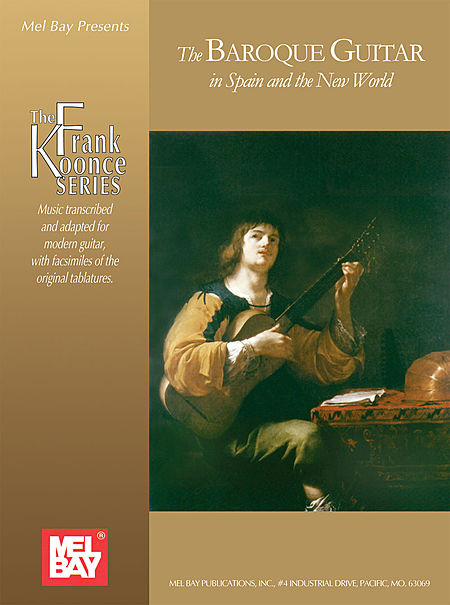
BAROQUE GUITAR IN SPAIN AND THE NEW WORLD BY FRANK KOONCE

THE BAROQUE GUITAR IN SPAIN AND THE NEW WORLD, BY FRANK KOONCE. 170 Pages.

LIBRO DI MUSICA BAROCCA .

SPARTITI PER CHITARRA : PENTAGRAMMA . 


Nel libro c'è anche una parte di storia sull'origine della chitarra ove troverete molte informazioni sulle accordature della vihuela e delle chitarre antiche a 5 corde doppie (non avevano il Mi basso), una guida per la lettura della Tablature italiana del 1500. La Tablature del 1732 di Santiago de Murcia, e quella di Giovanni Paolo Foscarini del 1629, avevano anche l'indicazione degli accordi per l'accompagnamento, lo strumming in giù e in sù, e gli accordi sono gli stessi che si usano nelle canzoni di oggi di Neil Young e Battioni, e poi i trilli e gli abbellimenti. Dopo 500 anni la Tablature italiana, quella che si usa nei libri di oggi, è ancora un sistema valido e immediato per la lettura della musica. Con 40 pagine di facsimile delle tablature originali.

Music transcribed and adapted for modern guitar, with facsimiles of the original tablatures.

Product Description:
A substantial amount of early music for the guitar remains unknown to modern performers and audiences. In recent years, however, musicologists, scholars and performers on period instruments have provided a wealth of accessible new source materials which players can now begin to interpret in convincing and effective ways. Nevertheless, many still feel intimidated by the prospect of sorting through and learning to use these resources for the first time. For the uninitiated, just knowing where to start can be difficult.

A substantial amount of early music for the guitar remains unknown to modem performers and audiences. In recent years, however, many fine musicologists, scholars, and performers of period instruments have provided a wealth of new materials - reprints of original manuscripts, translations of early treatises, scholarly transcriptions of tablatures, and other resources - with which players now can have access this music and begin to interpret it in convincing and effective ways. Nevertheless, many guitarists still may feel intimidated by the prospect of sorting through and learning to use these resources for the first time. For the uninitiated, just knowing where to start can be difficult. Scholarly transcriptions, for the most part, are not designed for easy use by guitarists. For example, many are in double-staff (keyboard) notation and, with regard to Renaissance vihuela and lute music, are not often transposed to guitar pitches. In other words, the open first string is usually written as G, not E. Guitarists who try to play from these editions essentially are faced with the task of transcribing the transcription! Furthermore, these editions sometimes do not offer realistic solutions - from a player's perspective - for voicing, note duration, and other considerations imposed by the technical limitations of an instrument. My idea to develop an anthology came about through my own need for easily accessible resource materials to teach repertoire or history/literature classes at the university level. I also wanted to help bridge the gap between scholarly editions and performance editions by providing a hands-on introduction to tablature transcription and to issues concerning historically informed performance on the modern guitar. I hope that my efforts may be of assistance to other teachers, as well as being simply an attractive collection of music for all to enjoy. The present collection contains representative selections from the publications and manuscripts of four important Spanish Baroque guitarists: Gaspar Sanz, Antonio de Santa Cruz, Francisco Guerau, and Santiago de Murcia. It must be emphasized, however, that this is only a sampling ofthe rich and varied repertoire from this era. The reader is strongly encouraged to seek out other sources, especially the many fine facsimile editions and other scholarly publications that are cited herein. Acknowledgements I am grateful to my friends, colleagues, and family who assisted in the preparation of this anthology: Michael Macmeeken, of Editions Chanterelle, shared images of original tablatures from Murcia's Resumen and Passacalles y obms; Brian Jeffery, of Tecla Editions, shared images from Guerau's Poema harmonico; Michael Lorimer shared images from his facsimile edition ofMurcia's Saldivar Codex No.4; and Richard Savino shared digital photographs of the unpublished Santa Cruz manuscript. James Tyler, Richard Long, Richard Savino, Kay Norton, Richard Troeger, Anthony Bez, Christopher Dorsey, Richard Brune, and Jan-OlofEriksson provided expertise on matters pertaining to the text and music. Babette Burns, Richard Burns, and Anne Loire assisted in translations and international communications. AlAbrams provided photographic services. Bernard Terlay, ofMusee Granet, provided the image for the cover portrait. Sylvain Lemay, of us Productions d'OZ, prepared the music engraving and text formatting, and patiently accommodated my many revisions. Leanne Koonce, my wife and partner, designed the cover, scanned and formatted all of the facsimile images, and provided her abiding love and support as always. Reading Baroque Guitar Tablature

Tablature and Transcription Anyone today who wishes to perform early music originally written for the guitar and other fretted instruments should learn to read tablature because it provides direct access to the original, unaltered, music. Performers also gain access to the vast majority of Renaissance and Baroque pieces that have not yet been transcribed. Those arguments notwithstanding, there are benefits to having tablature transcribed into modern notation: 1) Transcriptions facilitate the playing of music on instruments other than those for which it was written. 2) Modern notation enables performers to see functional aspects of the music such as pitch relationships, voicing, and harmonic structures. 3) Modern notation also provides an introduction to the performance of early music for those not yet accustomed to reading tablature. Nevertheless, the conversion of tablature into modern notation involves making many subjective choices on matters such as note sustain, voicing, and octave selection. Even the most conscientious transcriber cannot avoid imparting personal preferences into this process. The problem is compounded if a transcriber is also trying to take idiomatic differences between a period instrument and a modern instrument into account. Differences in tuning between a Baroque guitar and a modern guitar, for instance, make certain alterations unavoidable. I also must be understood that editors may have perspectives that fall anywhere between two diametric extremes. At one end, an editor may disregard information provided in the tablatures and try to "improve" the music by revising or even re-composing much of it. The result of such a process is a free arrangement, far removed from the original, not a true transcription. At the other end, an editor may try to represent an imagined ideal of performance that goes beyond the realistic technical capabilities of performance on the intended instrument. This often occurs in scholarly editions b musicologists who sometimes do not share the technical concerns of players. 16 In ummary, one must realize that any editorial solution may represent only one of many interpretative possibilities and may therefore may hinder the reader from exploring alternatives that are equally valid - or even more so. Given all of the ambiguities of tablature notation and the subjectivity associated with the transcription process, players should always consult the tablature for the most direct connection to the original music. 3.2. Punteado Notation Reading Italian Tablature, Baroque guitar music from Spain and Italy is written in "Italian" tablature. A five-line staff represents the five courses ofthe guitar, with the bottom line being the first course (the treble E). In this layout, the tablature projects a mirror image of the strings when the music is placed on a table for reading. Numbers placed on or between the lines indicate the frets that are to be stopped on a particular course. The number 0 represents the open course; 1 is for the first fret; 2 is for the second fret, and so on. The Roman numeral X represents the tenth fret instead of the Arabic 10 to avoid it being misread as two notes. Notes above this fret (although rare) (16 For an excellent article on the methods, philosophies, and evolution of transcription, see Matanya Ophee, "The History of Transcriptions of Lute Tablature - 1679 to the Present)

This anthology contains representative selections from the publications and manuscripts of four important Spanish Baroque guitarists: Gaspar Sanz, Antonio de Santa Cruz, Francisco Guerau, and Santiago de Murcia. In addition to being fun and entertaining music for all to enjoy, this collection is intended to help bridge the gap between scholarly editions and performance editions by providing a hands-on introduction to tablature transcription and to issues concerning historically informed performance on the modern guitar.

Contents:

Preface

Acknowledgements

Dedication

1. Evolution of the Five-Course Guitar

1.1. Transition from the Vihuela and Four-Course Guitar

1.2. Dominance of the Five-Course Guitar

2. Tuning of the Five-Course Guitar

2.1. Terms Pertaining to Stringing and Tuning

2.2. Different Tunings for the Baroque Guitar

2.3. Issues and Opinions on Tuning Practices in Spain

2.4. Relevance of Baroque Tuning Practices to Modern Performers

3. Reading Baroque Guitar Tablature

3.1. Tablature and Transcription

3.2. Punteado Notation

3.3. Rasgueado Notation

3.4. Mixed Tablatures

4. Interpretation and Performance

4.1. Octave Selection and Voice Leading

4.2. Punteado Ornaments

4.3. Campanelas

4.4. Meter and Tempo

4.5. Hemiola and Syncopation

4.6. Rasgueado Techniques

4.7. Rasgueado Ornaments

5. Editorial Procedures

5.1. Philosophy and Intent

5.2. The Voicing and Notation of Strummed Chords

5.3. Editorial Notation

6. Gaspar Sanz

6.1–9. La cavalleria de Napoles con dos clarines, Rujero, Paradetas, Folías, Las Hachas, Zarabanda, La Esfachata de Napoles,La Miñona de Cataluña, Canarios

6.10–14. Pavanas, Españoletas, Matachín, Villanos, Passacalles

7. Antonio de Santa Cruz

7.1–3. Jácaras, Villano, Canario

8. Francisco Guerau

8.1–4. Marionas, Villano, Canario, Passacalles in B minor

9. Santiago de Murcia

9.1. Resumen de acompañar

La Guastala, Menuet, Preludio in D minor

9.2. Códice Saldívar No. 4

Marionas, Fandango, Jácaras, Zangarilleja, Cumbées

9.3. Passacalles y obras

Passacalles in G minor, Suite in G Major, Suite in D minor

10. Facsimiles

Selected Bibliography


Music


Gaspar Sanz

La cavalleria de Napoles con dos clarines

Rujero

Paradetas

Folías

Las Hachas

Zarabanda

La Esfachata de Napoles

La Miñona de Cataluña

Canarios

Pavanas

Españoletas

Matachín

Villanos

Passacalles

Antonio de Santa Cruz

Jácaras

Villano

Canario

Francisco Guerau

Marionas

Villano

Canario

Passacalles in B minor

Santiago de Murcia

La Guastala

Menuet(s)

Preludio in D minor

Marionas

Fandango

Jácaras

Zangarilleja

Cumbées

Passacalles in G minor

Suite in G Major

Suite in D minor

Facsimile Reproductions

Gaspar Sanz

Instruccion de musica

Antonio de Santa Cruz

Libro donde se veran pazacalles

Francisco Guerau

Poema harmonico

Santiago de Murcia

Resumen de acompañar

Códice Saldívar No. 4

Passacalles y obras

Prezzo: €34,99
€34,99

WESTERN SWING GUITAR STYLE by Joe Carr BOOK CD TABLATURE CHITARRA LIBRO SPARTITI

WESTERN SWING GUITAR STYLE. Joe Carr. La parola swing deriva dal verbo dondare, e in musica, è quel senso di oscillazione della parte ritmica, con accenti, anticipi, pause, ritardi, note staccate, e questo benchè il ritmo sia costante e uniforme. 40 accompagnamenti ritmici completi, con griglia degli accordi nello stile swing anni '30 '40 del musicista Bob Wills. SHEET MUSIC BOOK CD with GUITAR TABLATURE .

LIBRO DI MUSICA WESTERN SWING CON CD.

SPARTITI PER CHITARRA : 

ACCORDI, PENTAGRAMMA, TABLTURE. 

Product Description:
If you have ever heard the sound of rhythm guitar in a good western swing band, you may have wondered how the guitarist achieved that unique chordal sound. While the song might be a simple one--playable with only two or three chords--the western swing guitarist changes chords every two beats, providing a driving and harmonically interesting background for the singers and instrumentalists. This book is designed for intermediate players who have a basic understanding of open chords. It begins with study of the Texas fiddle back-up style and the chords used to enhance this music. The chords and progressions explained in this book can be used in many types of music in addition to western swing and would serve as an excellent transition from open-string folk chords to more of a jazz approach.

Format: Book/CD Set
Series: Texas Music and Video

If you have ever heard the sound of rhythm guitar in a good western swing band, you may have wondered what the guitarist was doing. While the song might be a simple one with only two or three chords, the guitarist changes chords every two beats, providing a driving and harmonically interesting background for the singers and instrumentalists. This book is designed for intermediate players who have a basic understanding of open chords. An accompanying video "Western Swing Guitar Styles, Volumes One and Two" which includes much of the material contained here, is available from Mel Bay Publications. The chords and progressions explained here can be used in many types of music in addition to western swing. The guitar style fits especially well with swing music of any type from the 1930's and 1940's. If you haven't heard this style before, check out recordings by Bob Wills, Asleep at the Wheel and Johnny Gimble. Many of these recordings feature the great Eldon Shamblin, Bob Wills' longtime guitarist and the undisputed master of this styIe. Wewill begin our study with what has been called the Texas fiddle backup style. The beginnings of this style are unclear, but it is my opinion that it was started by guitarists who heard and tried to copy the sound of Eldon Shamblin on the early Bob Wills records of the 1930's. Recordings of Texas fiddlers in the 1920's feature rhythm guitars played in the bass-strum pattern - the same pattern found on early recordings of southern Appalachian fiddlers. It is not until after Shamblin's first recording with Bob Wills in the mid 1930's that we hear the style on Texas fiddle records. Special thanks go to Slim Richey, Alan Munde, John Hartin, Buster Redwine and Kim Fagerstrom for their help in my understanding of swing rhythm and the development of this project. Western Swing guitar music was originally played on the large hollow body electric F-hole guitars of the 1930' sand 1940' s. The guitarists used medium or heavier gauge strings. In recent times, most players, including Eldon Shamblin, use solid body electrics which are easier to carry around, more versatile and are less prone to feedback. The neck position pickup is used to get a fatter, more mellow rhythm sound. If you play several styles, you can still get a good swing rhythm with light stings. Some players, including me, beef up the bass strings in a light set to help strengthen the rhythm sound. I use a set that is .10, .12, .16, .30, .40, .50. This allows me to bend strings on the lead pickup on twangy country music and still gets a good swing sound on the neck position. In the 1920's and 1930's, players like Eddie Lang, Django Reinhardt and Karl Farrrecorded swing music using acoustic guitars. Acoustic swing music is enjoying a surge of popularity today. Almost any type acoustic guitar will do and many players prefer medium strings for good tone and volume. Providing good swing rhythm on acoustic guitar is hard work and takes strong muscles and well-developed calluses on the fingertips. At Texas style fiddle contests across the nation, you will notice many guitarists with Gibson acoustic guitars. Their preference for this brand is similar to Bluegrass musicians' preference for Martins. Also unique to these musicians is their use of steel wrapped stings as opposed to the more common bronze wrapped strings used by most acoustic guitarists. Warning: DO NOT enter a jam session with a group of serious Texas Fiddlers with any of the following instruments: 12 string guitar, 5 string banjo, harmonica, autoharp. You may never be seen or heard of again!

Song Title: Composer/Source:

Ballad (:39) Arr. By: Joe Carr
Beaumont Rag (:37) Arr. By: Joe Carr
Blues (1:01) Arr. By: Joe Carr
Columbus Stockade Blues (1:07) Arr. By: Joe Carr
Corrina (:29) Arr. By: Joe Carr
Cowtown (:32) Arr. By: Joe Carr
Durang's Hornpipe (:26) Arr. By: Joe Carr
Dusty Miller (:29) Arr. By: Joe Carr
Ida Red (:26) Arr. By: Joe Carr
Kind Of Love (:38) Arr. By: Joe Carr
Leather Britches (:28) Arr. By: Joe Carr
Lily (1:09) Arr. By: Joe Carr
Pipeline (:38) Arr. By: Joe Carr
Sally Goodin 1,2,3 (:37) Arr. By: Joe Carr
Sally Goodin 4 (:28) Arr. By: Joe Carr
Sally Johnson (:28) Arr. By: Joe Carr
San Antonio Rag (:35) Arr. By: Joe Carr
South (1:06) Arr. By: Joe Carr
Sugar (1:03) Arr. By: Joe Carr
Time/Just A Closer (:36) Arr. By: Joe Carr
Wesphalia Waltz (:54) Arr. By: Joe Carr

Prezzo: €27,99
€27,99

GETTING INTO GYPSY JAZZ GUITAR Stephane Wrembel CD TABLATURE CHITARRA LIBRO METODO SPARTITI

GETTING INTO GYPSY JAZZ GUITAR. Stephane Wrembel. SHEET MUSIC BOOK WITH CD & GUITAR TABLATURE.

LIBRO DI MUSICA MANOUCHE, CON CD.

SPARTITI PER CHITARRA : 

ACCORDI, PENTAGRAMMA, TABLATURE . 


Product Description:

This book focuses on the key elements of the Django Reinhardt Gypsy jazz or jazz Manouche guitar style. The information revealed here was gleaned from years of experience jamming with French Gypsies and studying with masters of the style. A native of France, Stephane Wrembel acquired his skills entirely by ear and has taught scores of musicians worldwide using the method that appears here in text and notation for the first time. Written in English, German and French with all musical examples in standard notation and tablature, Wrembel conveys his knowledge in a logical step by step manner, exposing the reader to the authentic Manouche style as it continues to evolve in France and Holland. Medium to advanced in difficulty, this method is designed for the guitarist who is already familiar with jazz harmony and note locations on the fretboard.

Format: Book/CD Set
Series: Getting Into

Le but de ce livre est de donner les clefs du style de Django Reinhardt, appelé: maintenant « Jazz Manouche ». Les informations fournies dans ce livre ont ete Ie fruit de plusieurs annees de patience et de travail, passees à jouer aver les gitans en France (mon pays natal), à apprendre avec les plus grands maitres de ce style (Ie tout de facon orale), à faire des concerts avec eux, dans Ie but d' organiser ce savoir en differentes etapes, logiques les unes par rapport aux autres. Cette methode a fait ses preuves de puis plusieurs annees, avec des dizaines de musiciens, de facon internationale. La plus grande difficulte pour moi a ete de transcrire ce savoir oral en un savoir ecrit, car dans l' ecrit, il manque toujours l'aspect « personnel » de la musique. En effet, des explications qui vont sembler claires à une personne, vom etre totallement floues pour une autre. J' a essaye d' ecrire Ie texte de la facon la plus generale qui soit, mais si vous ne comprenez parfois pas òu je veux en venir, jouez I'exercice, et essayez de comprendre par vous-meme, vous comprendrez Ie texte apres. Enfin, un livre en soi n'est qu'une partie de I'apprentissage de la musique, un recueil du savoir qui n'attend que VOUS pour prendre vie, et vous devrez aussi chercher par vous-memes vos informations, chacun ayant une maniere personnelle et unique d'ecouter et comprendre la musique. Je vous conseille done, en plus de ce livre, d'avoir un professeur (ou plusieurs), de jouer avec d'autres musiciens, transcrire les discs, et aller dans Ie pays ou Ie style que vous voulez jouer est developpe (pour Ie jazz manouche, la France et la Hollande), afin d' en sentir la saveur. Afin de naviguer facilement,je vous conseille d'avoir des bases en harmonie Jazz, et de savoir au moins trouver les notes sur votre manche. J' ai ecrit les exemples en solfege et tablature, c'est toujours la tablature que vous devez suivre, afin d'avoir les bons doigtes. Ne prenez pas d'initiatives de ce cote la! Enfin, rappelez-vous toujours que l'important n'est pas combien vous savez, mais ce que vous pouvez reellement faire avec ce que vous connalssez.

The aim of this book is to unveil key elements of Django Reinhardt's style, now called "Jazz Manouche" [Gypsy Jazz]. The information given in this book is the fruit of many years of patience and work - playing with Gypsies in France (my native land), learning from the greatest masters of this style, everything always by ear, giving concerts with them - all with the goal of organizing this knowledge in several logically related steps. This method has shown its worth for many years, with scores of musicians around the world. The most difficult thing for me was to transcribe this oral tradition into written insight, for in the written version, the 'personal' side of the nlUsic is always lacking. Indeed, some explanations, which will seem clear to one person, will be completely vague to another. I have tried to write the text in the most accessible manner possible, but if YOLl sometimes do not understand where I ain headed, play the exercise and trust your own instincts - you will comprehend the text later. Finally, a book such as this is only a part of the music learning process, a gathering of knowledge, which merely awaits YOU to come to life; you will also have to seek insights by yourself, as each individual has a personal and unique way of listening to and understanding music. I recommend that, in addition to learning from this book, you study with a teacher (or several), play with other musicians, transcribe recordings, and visit the countries where the Manouche style is evolving (France and Holland) to experience its feel. To facilitate your journey, I recommend having some basic knowledge of jazz harmony, and that you at least know where to find the notes on the fret board. I have written the examples using chord symbols and tablature. Always follow the tablature for proper fingerings. Do not take liberties in that respect! Finally, alwa s remember that it's not how much 'ou know that matters but what you can really do with what you know ....

Es ist das Ziel dieses Buches, die Schllisselelemente von pjango Reinhardts Stil, dem heute so genannten 'Jazz Manouche" [Gypsy Jazz]' sichtbar zu machen. Die Informationen, die in diesem Buch weitergegeben werden, sind die Friichte jahrelanger Geduld und Arbeit. Ich habe in dieser Zeit mit Zigeunern in Frankreich (meinem Heimatland) gespielt, von den groBten Meistern dieses Stils gelernt (alles immer nach Gehor) und gememsam mit ihnen Konzerte gegeben - all dies mit dem Ziel, dieses Wissen in mehrere, logisch aufeinander aufbauende Einzelschritte zu gliedem. Diese Methode hat in vielen Jahren mit einer groBenAnzahl Musikern liberall auf der Welt ihren Wert bewiesen. Das Sch"vierigste clabeiwar fur mich, diese mlindliche Tradition in schriftliche Erkenntnisse zu fassen, denn in der niedergeschriebenen Version fehlt inllner die 'personliche' Seite der Musik. Tatsachlich mogen manche Erklanmgen, die der einen Person vollig einleuchtend erscheinen,fur eine andere "viedemm ganzlich verschwommcn sem. Ich habe mich bemliht, den Text so leicht zuganglich wie moglich zu machen,aberwenn du deillioch manchmal nicht verstehen sol1test, woraufich hinaus will,dann spiele einfach die Obungen und versuche, dich auf deinen Instinkt zu verlassen - den Text wirst du clann spater schon verstehen. Letztendlich ist em Buch "vie dieses nur em Teil des musikalischen Lernprozesses, eine Ansanmuung von Wissen, das allein clarauf wartet, classDU zum Leben erwachst. Auch musst du selbst danach streben, Einblicke zu gewinnen, denn jeder Einzelne hat eine ganz persOnliche und unverwechselbareArt,Musik wahrzunehmen und zu verstehen. Ich empfehle, classdu zusatzlich zu diesem Buch bei einem (oder mehreren) Lehrer(n) Unterricht nimmst, Musikaufnahmen transkribierst und die Under besuchst, wo sich der Manouche-Stil entwickelt (Frankreich und Holland),damit du Erfahrungen mit dem Feel dieser Musik sanmIeln kannst. Urn dir deme Reise zu erleichtern, empfehle ich em Gnmdwissen der Harmonielehre und classdu zumindest weillt,wo auf dem GrifIbrett die Tone liegen. FUr die Beispiele habe ich Akkordsymbole und Tabulatur verwendet. Halte dich fur die korrekten Fingersatze inmIer an die Tabulatur. Erlaube dir m dieser Hinsicht keme Freiheiten! Denke schlieBlichinmIer daran, classes nicht zahlt, wie viel du weillt, sondern was du am Ende tatsachlich mit demem Wissen anfangen kannst ....


Contents:
CD Contents

Acknowledgements
Introduction
About the Author
Part One: Technique and Rhythm

esercizi con: ottavi, tezine, sedicesimi, quintine, sestine, settine, trentaduesimi, nonine
Chapter 1: Right Hand Technique and Warm-Up
Chapter 2: Voicings
minore 7 5b, diminuite, 

Chapter 3: Accompaniment
 Swing 
 Waltz
 Bolero
 Bossa Manouche 

Part Two: Improvisation
6 pattern per improvvisare
6 Basic Shapes for Improvisation
Expanding on the Subject Matter: Complete Shapes
A Plan of Approach Essential to Gypsy Jazz

Arpeggio Extensions: Adding Color
in 3 zone e su tutta la tastiera

Diminished Arpeggio - 7th Chord Arpeggio Mix
4 Measures Examples, V7 1 Progression
"Gypsy Swing in Minor"
Harmonic Minor Scale
Melodic Minor Scale
Whole-Tone Scale
Concepts in One or Two Notes Per String Groupings
The Chromatic Scale
Chromatic Approach and Three Notes Per String Grouping Concept
Combining Fingerings for 2 and 3 Notes Per String
Substitutions
Transcribing

Prezzo: €27,99
€27,99

JORGENSON JOHN INTRO TO GYPSY JAZZ GUITAR LIBRO CD DVD TABLATURE SPARTITI ACCORDI

JORGENSON JOHN, INTRO TO GYPSY JAZZ GUITAR. CD DVD 2-hour.
SHEET MUSIC BOOK WITH CD and DVD 2-hour with GUITAR TABLATURE. 

LIBRO DI MUSICA MANOUCHE GYPSY JAZZ, CON CD E DVD. 

SPARTITI PER CHITARRA CON: 

ACCORDI, PENTAGRAMMA, TABLATURE. 

LIBRO DI MUSICA JAZZ CON CD E DVD.

SPARTITI PER CHITARRA. ACCORDI, PENTAGRAMMA E TABLATURE.


In this first of three volumes of Flatpicking Guitar Magazine's new Gypsy Jazz Guitar instructional series, "Intro to Gypsy Jazz Guitar," Jorgenson provides the foundational information and practice material necessary for you to gain an understanding of the Gypsy jazz guitar style. The first half of this volume addresses the important element of Gypsy jazz rhythm. The second half of this first volume addresses soloing. Each volume of this three-part series includes a 2-hour instructional DVD, an audio CD with practice audio tracks, and a full format book which presents all of the theoretical information, chord charts, fret board diagrams, music notation, and tablature for the material presented on the DVD.

Song Title: Composer/Source:
1-4-5 Blues Progression
A Minor Pattern
Adding C#dim7
Adding the A and E& chords
Adding the Daug
Adding the G9
An Interview with John Jorgenson
Appendix
Audio CD Contents/Forward
Basic Strum Patters
C Major Note Map
C Minor 6
Changing the C7 to C6
Chromatic Pattern 1
Chromatic Pattern 2
Chromatic Pattern 3
Chromatic Scale
Chromatic Scale moving up the neck
Chromatics
D augmented Arpeggio
D Major
D Major Pattern 1
D Major Pattern 2
D Major Pattern 3
Downstroke Exercise

DVD Contents
F Major
F Major Pattern 1
F Major Pattern 2
G Major
G Major Arpeggio
G Major Pattern 1
G Major Pattern 10
G Major Pattern 2
G Major Pattern 3
G Major Pattern 4
G Major Pattern 5
G Major Pattern 6
G Major Pattern 7
G Major Pattern 8
G Major Pattern 9
G Minor
G Minor 6
G Minor 6 Pattern 1
G Minor 6 Pattern 2
G Minor 6 Pattern 3
G Minor Pattern
Gypsy Jazz Rhythm Details
In-between Notes
Introduction/Acknowledgements
Lead Playing
Minor Blues Progression
Minor Blues with 3-Note Chords
Open Strings, Unison, & Dissonance
Rhythm Example #1
Rhythm Example #2
Rocking the bass on C7 & D7
Simple Minor Blues Progression

John Jorgenson is perhpas best known as a founding member of the Desert Rose Band, for his dazzling fretwork with the super guitar trio The Hellecasters, from his six-year stint as a member of Elton John's band, and his session work with a diverse range of artists including rock icons Elton John, Bob Dylan, Bonnie Raitt and Bob Seger, country legends Willie Nelson, Johnny Cash, Emmy Lou Harris and Hand Williams Jr., and international superstars like Barbara Streisand and Luciano Pavarotti. Even though he has made his living playing primarily rock, country, and pop music John's love for jazz and swing music dates back to his youth when his father, James, was conductiong for Benny Goodman. John, who idolized Goodman, actually got to play with his hero while his father led the way. As accomplished on clarinet as he is on guitar, Jorgenson's first swing recording After You've Gone was a tribute to both his heroes, Django Reinhardt and Benny Goodman. Released in 1985, John played Django style Gypsy jazz ont he first side of the LP and recreated the sound of the Benny Goodman Quintet, playing both Charlie Christian's electric guitar parts and Goodman's swinging clarinet style, on the other. His 2004 release Franco-American Swing, which primarily features John's original swing music, has received rave reviews. In the world of Gypsy jazz music, John Jorgenson has long been known as one of the true American masters of the Django Reinhardt guitar style. In 2003, when the musical director for John Duigan's film Head In The Clouds was looking for someone who could faithfully re-record two tracks from the Quintet of the Hot Club of France for use in the film Guitar Player Magazine's editor recommended Jorgenson. John not only transcribed and recorded the Hot Club's "Blue Drag" and "Minor Swing" for use in the film, he also played the role of Django Reinhardt in the movie. John has also performed with leading European Gypsy jazz artists Bireli Lagrene and Romane, appeared on recordings with Babik Reinhardt and Angelo Debarre, and has written many articles and lessons for national and international guitar magazines. Three guitar virtuosos: John Jorgenson, Jerry Donahue, and Will Ray - collaborated for a one-time-only performance which eventually grew into a 10-year partnership.

AUDIO CD CONTENTS
1: G chord rhythm
2: G chord rhythm with alternate right hand pattern (upstrokes added)
3: Simple 1-4-5 blues progression
4: Final blues progression (with all added chords)
5: Rhythm Example 1
6: Rhythm Example 2
7: F chord rhythm
8: D chord rhythm
9: C chord rhythm
10: 1-4-5 progression
11: C7 chord rhythm
12:D7 chord rhythm
13: Minor Blues Progression

FORWARD
Flatpicking Guitar Magazine is proud to present the first in a three-part instructional series on Gypsy jazz guitar. We are honored to have John Jorgenson, one of the true American masters of the Gypsy jazz style, as the instructor in this series. As you will see on the DVD, John's great enthusiasm for this style of music is infectious and he presents the material in such a systematic and easy to follow manner that anyone who spends time practicing what John teaches here will not only gain valuable insights into the Gypsy style of guitar playing, but will also greatly expand his or her knowledge of the fret board and increase their improvisational skill level. I feel that John's inclusion of Brad Davis as the "student" on the DVD brings a casual and entertaining atmosphere to the visual portion of this instructional package. The addition of an extensive and detailed book as a companion to the 2-hour DVD allows John the opportunity to present much more theoretical knowledge, and address each section of the course in greater detail, than time or space allowed on the DVD itself. Lastly, the inclusion of a practice-along audio CD adds a very practical aspect to the instructional package. It provides the viewer with a valuable practice tool that will continue to be useful for years after the viewer has assimilated the basic material here. No matter how advanced a player becomes, practice tracks can always be useful.
Because the majority of the information here is theoretical in nature and is aimed at providing the student with a strong musical foundation, its principles can be explored far past the specific information and examples that are outlined here. For instance, in the soloing section John spends a great deal of time with the G major arpeggio and G major patterns. Understanding that all of this information can be transposed and applied to any key and at any position on the neck gives the student the opportunity to then take the initiative to explore all of the patterns in a variety of keys and positions. Additionally, John's emphasis in this course on taking time to practice free-form improvisation of every position, pattern, and arpeggio that is demonstrated provides the student with a tremendous practice tool for improving improvisational skills. If the student follows John's system of starting with short four or five note patterns and working to improvise over a rhythm bed with just those notes before moving on to add more complex note patterns and ornaments, even beginning level students can start to gain knowledge and experience that will naturally begin to unlock the mysteries of improvisational playing. I hope that you enjoy the material presented here, learn a lot, and have fun! Dan Miller Editor and Publisher Flatpicking Guitar Magazine


INTRODUCTION/ ACKNOWLEDGEMENTS

Over the years, I have been approached many times to write instructional books and make instruction video material. I opted not to do them for many reasons, but largely because there was already so much material available to the learning guitarist. With the recent growth of interest in the Gypsy Jazz style of music in America, I felt there was room, and even need for a teaching tool that could help guitarists start to unravel the mysteries of this enchanting and complex style. Pioneered in the 30's by the phenomenal Gypsy guitarist Django Reinhardt, this style of music incorporates techniques and concepts that are unique, many which likely Django himself invented. To the American guitarist who has developed by learning rock, blues, country, bluegrass or jazz this is an often baffling and overwhelming style to grasp, especially at the beginning. I first heard and was captivated by Django's playing in 1979, after I had been playing the guitar for 12 years. Although obviously not a beginner, I felt like I was attempting to learn a whole new language just by ear. Over the years I have continued to study and play the style, and continue to learn new elements now. In this DVD series my intention is for the students to be able to piggyback on those years of studying, performing and jamming so that progress can be attained at a more rapid pace. I feel that theory is an important aspect of the learning, and also serves to give a language to speak about harmonic movement, chord progressions, etc. I grew up in a musical household, and have an innate understanding of theory as well as having studied theory as part of my musical education so it is natural for me explain harmonic and improvisational concepts in a theoretical sense. All the theory in the world, however, will not make a great performer. The ears must be trained to hear the different chords, arpeggios, etc., which then can be translated into shared feelings and emotions, which of course are the ultimate goal of any musical performance. I want to thank Brad Davis for participating in this series, and being such a willing and enthusiastic "student." As I have a personal aversion to the "one guy talking to a camera for an hour" type of instruction DVD, Brad's presence made the whole filming aspect of this project relaxed and easy. Plus, he is a great player and learned the concepts very quickly! Don't get discouraged if you don't learn as quickly as Brad does, after all he is an experienced professional guitarist. I also need to thank Brance Gillihan for his camera work, and his creative and diligent editing. I don't even want to know the technical aspects of his work on the authoring of this DVD! Rusty Russell's excellence behind the still camera produced the cover shots for the intermediate and advanced volumes, and Brance supplied the photo for the intro volume. Most of all I need to thank Dan Miller for making this all happen. His countless hours transcribing the musical examples, creating tab and notation, editing text and layouts show an enormous commitment to creating a product that is of as high a quality as possible, and one that will give the buyer an incredible amount of information. To say that Dan is dedicated is an understament; he has gone to great lengths physically, creatively and literally to present this project to you, and I give him kudos, thanks, and congratulations! John Jorgenson July 2004 Nashville, Tennessee

AN INTERVIEW WITH JOHN JORGENSON
What is Gypsy jazz?
Gypsy jazz in general is music in the style of Django Reinhardt, Stephane Grapelly and the Quintet of the Hot Club of France. The lineup of this group that first recorded in 1934 consisted of guitar an violin as the lead instruments, with 2 more guitars and a string bass as the rhythm section. This was highly unusual for the time, as jazz had been played more with horns for lead instruments, and drums, piano and/or banjo and string bass or tuba as the rhythm section. To have a jazz ensemble made up entirely of string instruments was innovative and elegant, and Reinhardt and Grapelly were the first non-American jazz musicians to really be recognized and influential. Reinhardt and Grapelly were influenced some by the American violin/guitar duo of Joe enuti and Eddie Lang. But the biggest influence on Django musically was Louis Armstrong. Django was already a prodigiou musician with un anny skill on the banjo-guitar at an early age, and earned money as a teenager accompanying Musette accordionists live and on recordings. After injuring his left hand in a fire in his caravan in 1928 at age 18, Django developed a whole new technique on the guitar while recuperating, mainly using his index and middle fingers, as the others were permanently pulled ba - by the burned tendons. In a relatively short period of time Django was again out playing, sometimes with his brother Joseph accompanyinc him, and caught the attention of Emile Savitry who played for him a 78 record of Armstrong's "Dallas Blues". Django was fascinated with this new American jazz, and quickly adapted many of Armstrong's phrases and rhythmic feels to his guitar. Django's gypsy heritage had already imbued his music with a firey passion, and the addition of the jazz elements created a whole new style of music, now called Gypsy jazz. Grappelly's influence on the development of this style is equally important. His flawless intonation, highly melodic improvisational style and elegant swing perfectly balanced Reinhart's wildly virtuosic playing and the natural competition between these two soloists drove each of them to new heights. In many early reviews of the QHCF's recordings and concerts, Grapelly often got more kudos than Django.
The music that the QHCF made was heard around the world thanks to the 78 records of the day and of course radio. This exotic, swinging combo caught the attention of many future guitar and violin stars and showed that swing could be played on string instruments as well as on horns. Influences for the QHCF can be easily heard in the music of Bob Wills and his Texas Playboys, seminal electric jazz guitarist Charlie Christian, pop guitarist and inventor Les Paul, Nashville stalwart Chet Atkins, bluegrass guitarist Clarence White, mandolinist David Grisman, champion fiddler Mark O'Connor. the list could go on and on-nearly every guitarist and violinist since owes a big debt of gratitude to the pioneering work of Django, Stephane and QHCF. Today Gypsy jazz music is still very much alive, and has had a thriving scene in Europe for years, thanks to artists like The Rosenberg Trio, Bireli Lagrene. Romane, Angelo Debarre, Dorado Schmidt, Fapy Lafertin, Rafeal Fays, Serge Krief. Boulou and Elios Ferret and Jimmy Rosenberg. There are many festivals in Germany, England, Holland, Norway and France featuring Gypsy jazz music. In London there is a club called Le Quecumbar that features Gypsy jazz every night. The American scene is a little behind Europe, but coming on strong in the last few years. Now there are Django festivals in New York, San Francisco, Chicago, Philadelphia, and Seattle, and lots of gypsy jazz players and bands. Seattle has a thriving scene including Pearl Django and Micheal Horowitz, and other pockets around the country are cropping up including Alphonso Ponticelli in Chicago, Raul Reynoso, Club Django and the Hot Club of San Diego in Southern California, the Hot Club of San Francisco in Northern California, The Hot Club of Philly, Arizona, Minnesota- you name it and there is probably a Hot Club of... and lest we forget our neighbor to the North, there are also big contingents in Montreal and Toronto. Once you know the sound of Gypsy jazz, you will start hearing it often in films and television. It seems to always lend a light, swinging elegance to the ambience whenever it is played, and if the current interest level is any indication this mu i will always be bringing new recruits to the fold! From a musician's perspective, what are some characteristics of the Gypsy jazz style that help define it? (In other words, if a musician from a different genre had never heard Gypsy jazz, what would you tell them about it rhythm, chords, soloing, etc. that would help him understand what it is all about?) Gypsy jazz is characterized in part by the rhythmic feel, which is more of a 2 beat feel in faster songs and a 4 beat in the slower ones, but the rhythm is always driving and insistent. The style that the rhythm guitar plays is called "Le Pompe" and always has a strong back-beat. The melodies are very romantic and rhapsodic, with vituosic flourishes from both the guitar and violin. The solos stay mostly in the Swing-era harmonic content, in other words they don't use a lot of the altered extensions but stay a little more "inside" than bop, which came next in the jazz evolution. The gypsy element is especially prominent and more obvious in minor key songs like "Dark Eyes" which comes from an old gypsy folk melody. Minor 6th and diminished chords and arpeggios are used liberally, and one rarely hears a minor 7th chord unless it is used as a passing chord.

Prezzo: €69,99
€69,99
Condividi contenuti