MEL BAY

JORGENSON JOHN INTERMEDIATE GYPSY JAZZ GUITAR CD DVD TABLATURE CHITARRA METODO MANOUCHE

JORGENSON JOHN, INTERMEDIATE GYPSY JAZZ GUITAR. SHEET MUSIC BOOK WITH CD and DVD 2-hour with GUITAR TABLATURE. 

LIBRO DI MUSICA MANOUCHE GYPSY JAZZ, CON CD E DVD. 

SPARTITI PER CHITARRA CON: 

ACCORDI, PENTAGRAMMA, TABLATURE. 

Now that you have laid a foundation by completing the material in Intro to Gypsy Jazz Guitar, the second volume Intermediate Gypsy Jazz Guitar, also presented in the DVD/CD/Book format, continues by presenting you with characteristic Gypsy style licks and techniques that are based on the arpeggios and patterns taught in the first volume. Once again Jorgenson presents a very systematic learning method by first teaching simple licks and techniques and then gradually building to more complex material. In studying the left and right hand techniques and ornamentations presented in the second volume, the student will gain an understanding of how to play the guitar with the Gypsy "accent."

Jorgenson also begins the study of Django Reinhardt's playing here by teaching an improvised chorus that Django played on a recorded version of the song "Undecided." Two other songs, Raul Reynoso's "Waneta's Waltz" and Jorgenson's "Snowflake Waltz" are also studied.
Introduction/Acknowledgements
An Interview with John Jorgenson

Hello everyone, welcome to Volume 2 (Intermediate Gypsy Jazz Guitar)! Guitarists have been asking me
since Volume 1 (Intra to Gypsy Jazz Guitar) came out last year when the next one would be ready, and it
is finally here. Over the past year I have had the chance to get out around the country (and world!) and
meet so many others like me who love Gypsy jazz. I want to thank all of you for helping spread the word
about this cool music, and for all the encouragement I have gotten about this DVDseries. I am very happy
to share what I have learned over the years, and am excited to see where all the young guitarists will take
Gypsy jazz in the future.
Thanks go again to Brad Davis, who learned how to play this music so quickly that he toured with
me last year and did a great job. Brance Gillihan shot the instructional footage, and edited the opening
video clip of "]'Attendrai" as well as authoring and editing the whole DVD, and what a great job he did
too. Rusty Russell took the cover shot, and Dan Brick shot the footage from Paris when I still had dark hair
from playing Django in Head in the Clouds.
Major, major thanks go to Dan Miller for his tireless efforts, compiling, editing the text, layout
work, and gentle prodding for me to get my parts finished. This entire series would not happen without
Dan's hard work and dedication to the readers. Thanks is also due to Richard Hendlin, of Solana Beach,
California, for his proofreading work.
I would also like to thank Kristy Wiehe, Jim Cowan, Adrian Bagale and David Gartland from Saga,
Alain Cola from Dell'Arte, Rick Shubb, Nick Lehr, Chris Middaugh from Schertler, Trish Galfano, and my
excellent bandmates Charlie Chadwick, Stephan Dudash, Gonzalo Bergara, Brad Davis, Doug Mattocks,
Raul Reynoso, Dick Hardwick, Bryan Sutton, Andy MacKenzie, John Wheatcroft, Tania and Sandra
Differding, The Nashville Chamber Orchestra, Don Hart, Paul Gambill, and all the others who helped
make the last year one of the best. John Jorgenson June 2005 Nashville, Tennessee 

When did you first hear Gypsy jazz?
I got my first recording by Django and the Quintet of the Hot Club of France in about 1979, and just couldn't believe how amazing the sound of the group was, how much they swung, and what a tone Django got from his guitar-unlike any other I had heard!

What was it about the music that led you to dive into it with such enthusiasm?
I think what captured me most was that Django played the acoustic guitar in a way that made it seem limitless, and almost more like the electric guitar in terms of sustain and expression. Again the tone of his guitar was amazing, and the way that the whole Quintet sounded so fresh and alive, as if had been recorded last week instead of 50 or 60 years ago! As I had originally played the electric guitar, I wanted to learn how to play the acoustic guitar with the same sort of drive and virtuosity as Django, and I thought it would be an amazing vehicle to express myself through this high-energy acoustic chamber jazz. Plus it is always challenging, and constantly stretches my abilities and imagination.

What is it about Django's guitar playing that makes it stand out from all of the other guitar playing, guitar players, and guitar music that you have been exposed to?
Django's guitar playing always has so much personality in it, and seems to contain such joy and feeling that it is infectious. He also pushes himself to the edge nearly all the time, and rides a wave of inspiration that sometimes gets dangerous. Even the few times he does not quite make his ideas flow out flawlessly it is still so exciting and innovative sounding that mistakes don't matter! Django's seemingly never-ending bag of licks, tricks and colors always keep the song interesting, and his intensity level is rarely met by any guitarist. Django's technique was not only phenomenal, but it was personal and unique to him due to his handicap. It is very difficult to achieve the same tone, articulation, and clarity using all 5 left hand fingers. It is possible to get closer with only 2 fingers, but again is quite challenging. Probably the thing about this music that makes it always challenging and exciting to play is that Django raised the bar so high, that it is like chasing genius to get close to his level of playing.

In this DVD/book series you chose to start the first DVD without presenting songs. Instead, you started with the rudiments of Gypsy jazz rhythm and then, when moving on to lead playing, you focused on teaching arpeggios and patterns that would familiarize the viewer with various playing positions on the neck as they relate to different chords. Could you talk about this approach, why you chose to present your material this way, and what the advantages of learning this way would be as opposed to starting out by simply learning songs?
I chose to start out my instructional DVD by teaching the building blocks of the music; rhythmic feels, chord progressions, chord "additions" or substitutions, and arpeggios. These can be applied to any song, and are much more useful for the learning musician than simply learning a song. If a player understands how theory works, even at the most fundamental level, it will make learning other songs and licks much easier. To learn arpeggios all over the fingerboard will help get the player familiar with the possibilities that exist on the guitar, and with basic theory the player will find that all the licks that they have learned in one key can be easily transposed to be used in other keys, just by knowing what the "root" note is, or what scale degree a note is in one key, which then give a "target note" for the new key. Music notation and theory are so often mystifying to the learning player, and even often to the very skilled player. I aim to take away that mystery and show that theory and how it works is very logical, and can be utilized without having to sacrifice any spontaneity or soul. It is simply a tool to help to train the fingers and ears where to go to express the musician's ideas and feelings. Once these skills become second nature, there is little to impeded the flow of emotion-to idea-to phrase-to fingers- to sound-to audience; and that, of course is the final goal of any musician. 

In this Gypsy Jazz Guitar instructional series John Jorgenson has designed and presented one of the most complete acoustic guitar instructional methods available on the market today. Each volume of this three-part series include~ a 2-huur instructional DVD, an audio CD with practice audio tracks, and a full format book which presents all of the theoretical information, chord charts, fret board diagrams, music notation, and tablature for the material presented on the DVD. In the first volume Intra to Gypsy Jazz Guitar, Jorgenson provides the foundational information and practice material necessary for you to gain an understanding of the Gypsy jazz guitar style. The first half of this volume addresses the important element of Gypsy jazz rhythm. Aher discussing correct right hand rhythm technique, Jorgenson teaches the closed chord forms of a basic blues progression and then systematically introduces new chords into that progression to add "color" and "spice" while also introducing you to the characteristic "moving chord" style of Gypsy rhythm. Aher addressing the basic blues progression, Jorgenson then transitions into the more Gypsy sounding minor blues progression and introduces the "three-note" chords which are prominent in Gypsy style rhythm guitar. The second half of the first volume addresses soloing. Here Jorgenson not only lays the groundwork of Gypsy jazz soloing, but in the process also presents you with a method which serves to greatly enhance your understanding of the fingerboard and improvisational playing. Jorgenson teaches arpeggios, note maps, lead patterns, and Gypsy techniques in every area of the fingerboard and in various keys. Additionally, he masterfully shows how the arpeggios and patterns relate to one another. Once you have laid a foundation by completing the material in the first volume, the second volume Intermediate Gypsy Jazz Guitar, also presented in the DVD/CD/Book format, continues by presenting you with characteristic Gypsy style licks and techniques that are based on the arpeggios and patterns taught in the first volume. Once again Jorgenson presents a very systematic learning method by first teaching simple licks and techniques and then gradually building to more complex material. In studying the leh and right hand techniques and ornamentations presented in the second volume, the student will gain an understanding of how to play the guitar with the Gypsy "accent." Jorgenson also begins the study of Django Reinhardt's playing here by teaching an improvised chorus that Django played on a recorded version of the song "Undecided."
Once you have completed the foundation work in the first volume, and the study of Gypsy jazz guitar techniques and ornamentations presented in the second volume, you are now ready to dive into the intricacies of Django Reinhardt's solo guitar playing. In the third volume, Advanced Gypsy Jazz Guitar, Jorgenson teaches three complete Reinhardt solos. He presents the songs "Minor Swing", Limehouse Blues", and "Dinah", but does not simply layout the solo for you to memorize. Jorgenson presents a complete study of these solos by analyzing Django's phrasing and note choices. The goal here is to take you beyond solo memorization. In studying the choices that Django made in constructing his solos, you will learn how to best create your own arrangements and improvisations in this style. 

Licks 1 Amp; 2
Licks 3, 4 Amp; 5
Lick 6
Licks 7 Amp; 8
Lick 9
Licks 10 Amp; 11
Licks 12, 13 Amp; 14
Licks 15 Amp; 16
Licks 17 Amp; 18
Licks 19, 20 Amp; 21
Lick 22
Licks 23, 24 Amp; 25
Licks 26, 27 Amp; 28
Licks 29 Amp; 30
Lick 31
Licks 32 Amp; 33
Lick 34
Licks 35, 36 Amp; 37
Licks 38, 39 Amp; 40
Licks 41, 42 Amp; 43
Licks 44, 45 Amp; 46
Licks 47 Amp; 48
Undecided Melody
Undecided
Undecided (cont.)
Undecided Chord Forms
Licks 52 Amp; 53
Licks 54 Amp; 55
Licks 56 Amp; 57
Snowflake Waltz Introduction
Snowflake Waltz
Snowflake Waltz (cont.)
Snowflake Waltz Chord Shapes
Snowflake Waltz Chord Shapes (cont.)
D minor voicings Amp; Lick 58
Appendix

DVD Content
Jorgenson in Paris (J'Attendral)
Introduction
Welcome
Lick 1-Lick 48
Undecided
Lick 49-Lick 51
Waneta's Waltz
Lick 52-Lick 57
Snowflake Waltz
Lick 58
Closing

Audio CD Contents
1: G diminished rhythm
2: Am Rhythm
3: Am/Dm Rhythm
4: Am Blues Progression Rhythm
5: Straight Blues Rhythm
6: "Undecided" Rhythm
7: "Waneta's Waltz" Rhythm
8: Alternate C and G Chord Progression
9: "Snowflake Waltz" Rhythm

Prezzo: €139,99
€139,99

WELL-TEMPERED BLUES, 8 New Blues Tunes for Classical & Fingerstyle Guitar. William Beauvais. CD TABLATURE

WELL-TEMPERED BLUES, 8 new tunes for classical & fingerstyle guitar. William Beauvais. CD TABLATURE

Product Description:
The blues present an opportunity to be deeply expressive. Every note can be colored with pitch bends, slides, vibrato, and all manner of attacks. The style makes it easy to own the music, to close your eyes and play as if you wrote it. These pieces are designed to be fun and entertaining as they work through the sharp keys, which are most friendly to the guitar. By working through these keys however, they develop a player's awareness of the different tonalities and the way patterns may be altered to facilitate key changes. Written in notation and tablature.


Preface

Well Tempered Blues is a collection of twelve bar blues pieces. I have sometimes used the baroque style of notation: writing a single line to make the music and rhythms more obvious. In these cases, such as "Chicago Style Blues" and "Twisted Fingers," try leaving the bass notes down as long as possible, and let your ear tell you what sounds the best. Slides have not been indicated but have been left for the player to decide. Try sliding into various notes and choose what sounds the best. There is a great deal of room for flexibility in these pieces. Some people have also suggested that these pieces can be used for jamming, with an improviser adding a solo line over the guitar part.

Blues is a style that demands that the player be deeply expressive. Every note can be colored with pitch bends, slides, vibrato and all manner of attacks. In tastefully adding these nuances, a player begins to own the music, to make it their own, to play each piece as if they wrote it. These pieces are designed to be fun, and entertaining as they work through the keys that are most idiomatic to the guitar.

About the Author: William Beauvais has been commissioned to write for the Royal Conservatory Children's Choir, the Canadian Music Centre, Philip Candelaria, Jeffrey McFadden, the Evergreen Club, and the Echo Women's Choir. His music has been heard across Canada, the United States, Denmark, and most recently in Chile, Argentina and Uruguay. His guitar music is recorded on 2 compact discs: TRACES [1996] and bridges [1994]. An associate of the Canadian Music Centre and a member of the guitar faculty of The Royal Conservatory of Music, Beauvais is an accomplished classical guitarist. He won first prizes at the Canadian Music Competition, and at the Martinique world Centre for Guitar. He is presently developing curriculum for group based learning system at the Royal Conservatory in Toronto. His music is published by: Mel Bay, Frederick Harris, Editions d'Oz, and Tuscany Publications


Format: Book/CD Set
Song Title: Composer/Source:

Chicago Style Blues    William Beauvais
Cutback Blues        William Beauvais
Deep Down Blues     William Beauvais
Drinking Water Blues     William Beauvais
Gridlock Blues     William Beauvais
Rainy Weekend Blues    William Beauvais
Snaky Blue Line     William Beauvais
Twisted Fingers     William Beauvais

Prezzo: €15,99
€15,99

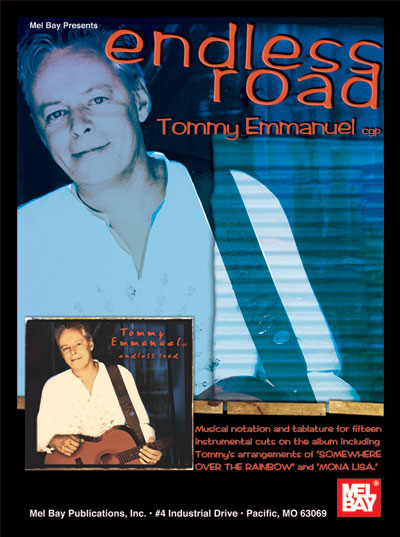
EMMANUEL TOMMY ENDLESS ROAD TABLATURE LIBRO SPARTITI MUSICA CHITARRA FINGERPICKING

EMMANUEL TOMMY, ENDLESS ROAD. TABLATURE

LIBRO DI MUSICA ACUSTICA.

SPARTITI PER CHITARRA CON: 

ACCORDI, PENTAGRAMMA E TABLATURE. 

15 instrumental cuts on the album including musical notation and Tablature.

Product Description:
Mel Bay Publications presents a collection of arrangements and original compositions from Australian guitarist Tommy Emmanuel's 2005 CD, Endless Road. Not for the faint of heart, this outstanding collection of intermediate to advanced solos includes two pop standards (Somewhere Over the Rainbow and Mona Lisa) plus thirteen of Tommy's incredible compositions.

You’ll gain insights into Tommy's playing style through note-for-note notation and tablature transcribed by Mark Pritcher who has added suggested chord progressions to each tune to serve as a harmonic guide to the player. In addition, detailed performance notes and select chord grid diagrams further enhance accessibility to the works of this masterful guitar tunesmith.

Tommy’s music incorporates thumbpicking, jazzy single lines, chord-melody arranging techniques, complex use of harmonics and more. Playing through this collection will give you a whole new appreciation for your guitar!


ENDLESS ROAD

This piece was written during a time of great change in Tommy's life and has many moods and movements. Tommy says, "This song is about ajourney. It tells us that as we go down the road we encounter problems and changes and we weather through them and then get back on track." The song is played with a flat pick, and uses"hybrid picking" to attain a form of fingerpicking using a flat pick instead of a thumbpick. Tommy gets a groove going from the beginning with a constant droning strum, interspersed with melody that is played both with the pick and fingers. The pick is held with the thumb and first finger, leaving the second and third fingers to help with the melody. As the song begins, you must target the melody notes with the pick. If that is hard for you, you can use your second and third fingers to pluck the melody notes. I have made some suggestions for the strum pattern. "p" refers to the thumb and first finger holding the pick. "mil indicates the middle or second finger. "i" indicates the ring finger. The bold bracket pointing down indicates a pick stroke in the down direction, towards the floor, and the "v" symbol indicates an up stroke with the pick. In the third measure for instance, the bracket over the bass note shows a down stroke with "p" and the third string is played with the ring finger. This general technique is used anytime there is a bass note and a separate melody note. The "X" indicates either a right hand percussive strike at the strings, or a percussive strum across strings that are dampened and muted by the left hand. In measure 17 the F#on the first string is part of a transitional D chord, although all you hear is the melody note. At measure 59, the second "movement" begins, with a lyrical dancing melody, and much pick work. At measure 101, the arrow pointing down indicates a strum from the high to the low strings, and the tension builds. By measure 107, there is more use of both middle and ring fingers on rolling chords. The big strum at the end of 119 takes us into the key change to E. At measure 130 there is the first of three almost identical ''Django" style chromatic runs, the last of which takes you back to the key of G. Hints of the opening theme are heard once more, and at measure 173 we are back to the main melody. Give it a try and if you are not comfortable with the flat pick, give it a try with a thumbpick.


TOMMY EMMANUEL

Tommy Emmanuel is a phenomenal guitarist. He has been recognized internationally for his virtuosity in playing all types of music on the guitar. Besides that, he is an entertainer, and he makes people happy. His audience is immediately aware that they are in the presence of a very gifted guitarist, and the "musical powers that be" are fast becoming aware of his gift. In the late 1990's he recorded a CD with his mentor, guitar legend Chet Atkins, and devoted more time to touring in the United States. He moved his home from his native Australia to England, and recently to the U.S., and chances are that he will be performing somewhere near you before too long. His compositions seem simple to the ear, but are incredibly complex when analyzed. The fifteen instrumental tunes from the "Endless Road" CD represent many styles. You will hear bluegrass, jazz, pop standards, slow tunes and very fast tunes, and you will hear music asTommy hears it. Whether you are a beginner or an accomplished player, I know you will enjoy working on these tunes. In Tommy's playing there is always more going on than meets the eye or ear. He uses multiple techniques and tricks to get his unique sound. He sometimes mutes strings with the palm of his right hand, and sometimes with the fingertips of his left hand. When he is playing with a thumbpick, he may strike the strings with the pick, brush down with the far side of his right hand fingertips, or brush up with the near side of the right hand fingertips. He often uses unexpected chord fingerings, especially if it facilitates the movement to the next chord or position. It is rare for him to have unanchored notes. In other words pay attention to the chord symbols or diagrams. Often the music shows you the notes that are being played, but just as is important are the "notes" that are not played. No matter how many notes are sounded, there may be other notes being fretted that are not plucked with the right hand, but are important all the same. Tommy's tunes usually do not require a back up guitar, but I have provided the chords as I hear them, and sometimes I have "created" chords based on one or two melody notes. Chords provide a framework for analysis. Many of the tunes have key changes, and you can follow the changes with the chords. Usually the fretboard diagrams included above the music are for hand position only and are not meant to show a specific chord. The gist of a tune is the same each time he plays it, but the tunes on this CD were improvised to some extent, and thus must be recreated "by ear". Also Tommy is known to use different fingerings in the same tune, if it helps the playing of the song. For instance an "A" chord at the second fret may be fingered differently depending on what comes after it. Also for some tunes Tommy uses a flat pick and fingers, a technique sometimes called "hybrid" picking. This may present a problem for those of you who are strictly fingerpickers. But give it a try, and if you still find it awkward, you may find that those tunes are also playable in a "fingerstyle" manner...


Format: Book
Song Title: Composer/Source:


(The Man With The) Green Thumb     - Tommy Emmanuel
Angelina       - Tommy Emmanuel - 2004
Bella Soave      - Tommy Emmanuel - 2004
Chet's Ramble     - Tommy Emmanuel and Chet Atkins
Christmas Memories/Wheels    - Tommy Emmanuel
Endless Road     - Tommy Emmanuel
La Visita      - Tommy Emmanuel
Mona Lisa   - Jay Livingston & Ray Evans - 1949
Morning Aire   - Tommy Emmanuel
Old Town     - Tommy Emmanuel
Sanitarium Shuffle   - Tommy Emmanuel
Somewhere Over The Rainbow    - HAROLD ARLEN - 1938
Son Of A Gun      - Tommy Emmanuel
Tall Fiddler       - Tommy Emmanuel
Windy and Warm    - John D. Loudermilk - 1961

Prezzo: €36,99
€36,99

POPULAR GUITAR STYLES SAMBA & BOSSA NOVA Burkhard Buck Wolters FINGERSTYLE CD TABLATURE LIBRO

POPULAR GUITAR STYLES SAMBA & BOSSA NOVA, Burkhard Buck Wolters. BOOK WITH CD & GUITAR TABLATURE

LIBRO DI MUSICA PER CHITARRA CON CD.

SPARTITI PER CHITARRA FINGERSTYLE CON:

PENTAGRAMMA E TABLATURE. 


Product Description:
Popular Guitar Styles: Samba and Bossa Nova reflects recent popular Brazilian styles as played with classical or fingerstyle technique. This collection of original pieces will delight both listeners and guitarists who want to add samba and bossa nova music to their repertoire. The playing level is intermediate to advance. Left-hand difficulties like barrés and stretches are minimized to make it easy to make the music groove. Written in standard notation and tablature.

Caminho do coracao (Afoxe) Buck Wolters (Path of the Heart) Caminho do coração
Copacabenny (Samba) Buck Wolters
Giro do gaviao (Partido Alto) Buck Wolters (Falcon's Cicle) Giro do gavião
Jobinho (Bossa Nova) Buck Wolters 
Papagaio apaixonado (Choro) Buck Wolters, dedicato a Carlo Marchione (Parrot in love)

Illustrazioni di: Petra Hartmann

Ingenniere Audio della registrazione del CD: Marcus Pipke

Brazil is one of the musical melting-pots of the world. The mixture of African and the native Indian culture,
a highly developed European classical tradition, joyful Caribbean and melancholic Latin American mood, the
expressive freedom and complex harmony of jazz characterizing altogether the music of this extraordinary country.
Within the limited space of this book I just have chosen five styles from this extensive range of music. I hope
you will enjoy these five Brazilian compositions of mine. The styles that they represent are explained briefly in

the following. Buck Wolters
 
Caminho do coracao (Afoxe)
Also known as Ljexa, Afoxe is originally a dance and singing style performed at religious processions in honor
of Oxum (goddess of love), sung in Yoruba, a language of African origin. Afoxe is also a word for a special shaker
(Xequere).
 
Copacabenny (Samba)
Originally Samba was a collective name for many dance-styles that where brought to Brazil by African slaves.
The word Samba comes from "Semba" which means "belly-dance". Because the slaves got their feet and hands
tied they could only dance with their bellies. Also The Maxixe (known as "Brazilian Tango") which was the first
original Brazilian urban dance in the late 19th century contributed to the development of Samba.
Copacabenny is dedicated to my dear friend and drummer Benny Mokross.
 
Jobinho (Bossa Nova)
Bossa Nova (translated: "New Wave") had it beginnings in the late 1950th and can be seen as a mixture of
Samba and Cool Jazz. One can say, that Bossa Nova is a "cooled down" Samba, played with a smoother and softer
attitude. Samba and Bossa Nova share the same rhythmic basic-pattern, the Samba- or Bossa-Nova-Clave:
 
Jobinho is dedicated to Antonio Carlos Jobim (1927-1994), who made Bossa Nova popular all over the
world.
 
Giro do gaviao (Partido Alto)
Partido Alto is a style with stronger pop- and jazz influences. It is mostly played in the big cities of eastern
Brazil, normally performed by electric bands. Of all styles that are presented here it is the most modem. Partido
Alto is also based on the clave mentioned above.
 
Papagaio apaixonado (Choro)
Choro came into being from a mixture of Habanera, Polka, and African dance styles in the 2nd half of the
19th century. It is mainly instrumental music, which demands much virtuosity from the players, because it is to be
played in a constant rush of eighths, or sixteenths. Like in Jazz, the players improvise on the form, and harmonic
structure of the Choro. Often they improvise collectively as in a competition. Probably the word Choro comes
from "chorar" which means "crying" or from the African dance Xolo.
Papagaio apaixonado is dedicated to my dear friend Carlo Marchione, one of the world greatest classical guitarists.
Prezzo: €24,99
€24,99

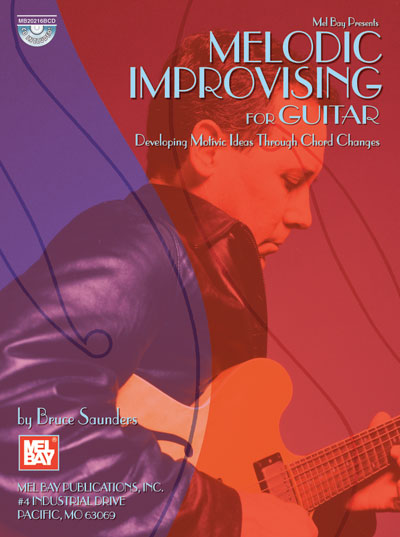
SAUNDERS BRUCE, MELODIC IMPROVISING FOR GUITAR. CD TABLATURE

SAUNDERS BRUCE, MELODIC IMPROVISING FOR GUITAR. CD TABLATURE
Developing Motivic Ideas Through Chord Changes
 

Product Description:
"Melodic Improvising" is a systematic, detailed method to help the intermediate to advanced guitarist create melodies over harmony. Using techniques developed through his 15 years of teaching improvisation at the world-renowned Berklee College of Music, Bruce Saunders' book teaches guitarists the same techniques used by pianists and brass and woodwind players to create melodic solos; a necessary book for any guitarist wishing to play "outside the box."


Product Number: 20216BCD
Format: Book/CD Set
ISBN: 0786668458
UPC: 796279089869
ISBN13: 9780786668458
Series: Non-Series
Publisher: Mel Bay Publications, Inc.

Introduction

One of the most common problems I encounter with guitarists inexperienced with playing over chord changes is continuing one idea, theme, pattern or motive through the changes. Often, the guitarist will stop the idea or line when the harmony changes and begin a completely new idea with no relation to the previous theme, perhaps because guitarists are accustomed to playing "shapes" and approaching improvisation visually rather than musically.This is not to say that the guitarist should ignore any visual cues, but that he/she should not rely exclusively on a box or grid, etc. With this in mind, I have compiled a series of exercises that, when used correctly, might help students develop more consistent melodic lines and phrases. Whenever possible, I will try to give as many visual devices as possible to help you make the transition from sight to sound. The student is encouraged to go well beyond the boundaries of what is presented here with his/her own patterns, exercises and development. Remember that the most crucial aspect of this concept is continuing the pattern or line through the chord changes. Some of the notes have more weight than others. For instance, the chord tones contained in the scale will sound much stronger than the non-chord tones. Nonchord tones landing on downbeats have much less weight than chord tones. It is also immediately apparent when the pattern or scale is broken. There are certainly many scales other than the ones I have picked that you could use on certain chord qualities. In some instances I used scales that might be more familiar to beginning and intermediate players. Try all of these exercises with other scales, other patterns and other intervals. Listening closely to great improvisers is very important. Masters of jazz improvisation such as Wes Montgomery, Louis Armstrong, Dewey Redman, Miles Davis, Sonny Rollins, Charlie Parker, Jim Hall, John Coltrane, Joe Henderson, Wayne Shorter, et.al. might share some common improvisational techniques but the most important shared trait would be simply an ability to make music. For instance, a strong time feel, a personal sound, great harmonic sense and something else that is undefined but could be called genius. Specific notes may be important but great melodic choices alone don't necessarily mean a great solo. For obvious reasons, this method will explore only a few of the ways notes and rhythms are put together. The method presented here is totally inorganic and to improvise mechanically using only patterns such as these will produce an unmusical, stiff solo. The student should practice inorganically and improvise organically. You should have some way of practicing these techniques with chordal accompaniment. A sequence, a loop, a tape, a recording, a friend, a gig, a trust fund to hire a rhythm section; something. It would be helpful if you can play through changes slowly at first and really explore a specific concept. In short, it's vital to hear how melodies relate to chords.


contents

CHAPTER ONE - STEPWISE MOVEMENT

Stepwise major CD

Stepwise major CD

Stepwise dominant "Isotope" CD

Stepwise dominant "Ask Me Now" CD

Stepwise minor CD

Stepwise melodic minor CD

Stepwise melodic minor CD

Mixolydian & Melodic Minor "Well, You Needn't" CD

Stepwise pentatonic CD

Mixed Stepwise F Blues CD

ETUDE I - "I Like You" (slow) CD

"I Like You" (fast) CD

ETUDE 2 - "Tell You Later" (slow) CD

"Tell You Later" (fast) CD

ETUDE 3 - "Lunar" (slow) CD

"Lunar" (fast) CD # 19


CHAPTER TWO - INTERVALLIC MOVEMENT

Thirds major CD

Major prerequisite - F and A b Major :

Thirds F Major CD

Thirds Ab Major CD

Thirds Mixed Major & Mixolydian CD

Thirds Mixed 3 tonic system CD

Thirds Melodic Minor CD

Thirds Melodic Minor CD

Fourths Melodic Minor CD

ETUDE 4 - "What Things" (slow) CD

"What Things" (fast) CD

ETUDE 5 - "If Not For You" (slow) CD

"If Not For You" (fast) CD

ETUDE 6 - "Little Feet" (slow) CD

"Little Feet" (fast) CD


CHAPTER THREE - PATTERNS, TRIADS &

CHORDS THROUGH CHANGES

Major triads & Dominant chords CD

Major triads & Dominant cycle CD

Major triads & minor chords CD

Triads & Altered Dominant CD

Triads & Dom (b9b13) chords CD

Triads & tritone subs CD

Triads with minor and diminished chords

Triads (close) minor & diminished CD

Triads (close) minor ii-V-i CD

Triads (close) "Solar" (slow) CD

"Solar" (fast) CD

Triads (close) F Blues (slow) CD

F Blues (fast) CD

Triads (close) Bb Blues (slow) CD

Bb Blues (fast) CD

Triads (close) "Serenity" (slow) CD

"Serenity" (fast) CD

Triads, arpeggios & Melodic minor CD

Triads, arpeggios & Melodic minor CD

Open triads & minor ii-V"s CD

Open triads & minor ii-V"s CD

Chordal subs. & arpeggios CD

ETUDE 7 - "It Happens" (slow) CD

"It Happens" (fast) CD

ETUDE 8 - "Stella Artois" (slow) CD

"Stella Artois" (fast) CD

ETUDE 9 - "Blues for Joe" (slow) CD

"Blues for Joe" (fast) CD

ETUDE 10 - "Side Step" (slow) CD

"Side Step" (fast) CD

APPENDIX MORE INTERVALS (ADDITIONAL INTERVALLIC STUDIES)

Melodic Minor

Harmonic Major

ABOUT THE AUTHOR

Prezzo: €19,99
€19,99

JAZZ GUITAR STANDARDS CHORD MELODY SOLOS BOOK 2 CD TABLATURE SPARTITI CHITARRA LIBRO

JAZZ GUITAR STANDARDS: CHORD MELODY SOLOS. SHEET MUSIC BOOK with 2 CD & GUITAR TABLATURE .

LIBRO DI MUSICA JAZZ, CON 2 CD.

SPARTITI PER CHITARRA.

ACCORDI, PENTAGRAMMA E TABLATURE.

Product Description:
This collection of jazz standard chord solos for guitar is compiled from Mel Bay and Warner Bros. collaborations Jazz Guitar Standards Vol. 1 and 2. What makes this work so special is that each artist has personally recorded their solo guitar arrangement. The book comes with the CDs which have all 44 tunes. This book is a wonderful anthology of solo guitar that can be used for performances as well as educational purposes.

Song Title: Composer/Source:
A Foggy Day
All of You
All the Things You Are
Alone Together
April in Paris
Arranger Index
As Time Goes By
Beautiful Love
Bluesette
Body and Soul
But Not for Me
Bye Bye Blackbird
Can't Help Lovin' Dat Man
Days of Wine and Roses
East of the Sun (and West of the Moon)
Embraceable You
Have You Met Mis Jones?
Honeysuckle Rose
How High the Moon
I Can't Get Started
I Could Write a Book
I Love You
I've Got You Under My Skin
In Your Own Sweet Way
Invitation
It Don't Mean a Thing
Just Friends
Long Ago (and Far Away)
Lover Man (Oh, Where Can You Be?)
Misty
Moonlight in Vermont
My Funny Valentine
Night and Day
Satin Doll
Smoke Gets in Your Eyes
Someone to Watch Over Me
Speak Low
Summertime
The Way You Look Tonight
Watch What Happens
What Is This Thing Called Love?
What's New?
Yesterday
You Go to My Head
You Stepped Out of a Dream

Prezzo: €109,99
€109,99

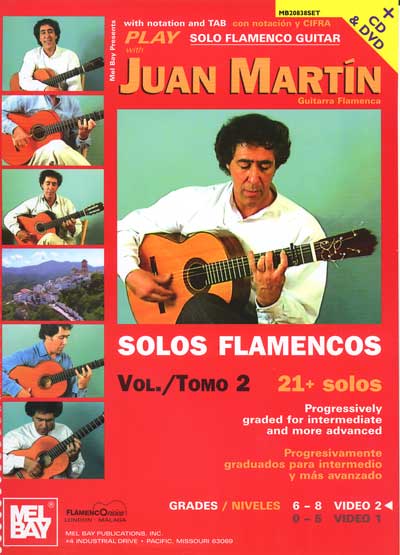
MARTIN JUAN PLAY SOLO FLAMENCO GUITAR VOL2 LIBRO CD DVD TABLATURE SPARTITI CHITARRA

MARTIN JUAN, PLAY SOLO FLAMENCO GUITAR VOL.2. CD DVD TABLATURE

LIBRO DI MUSICA CON CD E DVD, SPARTITI PER CHITARRA. ACCORDI, PENTAGRAMMA E TABLATURE. 

SOLO FLAMENCOS TOMO VOL. 2

Progressively graded for intermediate and more advanced GRADES 6 - 8

This second volume, of a two-part series, contains a book, CD and DVD by internationally recognized flamenco guitarist, Juan Martin. Provided are more than 21 solos, progressively graded in the three higher grades, 6 to 8, to suit players at intermediate and more advanced stages, who already have some experience of the instrument and techniques of flamenco. The music for all these is accurately written in notation and flamenco tab (cifra) and (except for the two final solos) is also included on the companion CD. The DVD contains over 60 minutes of music. All text is provided in both English and Spanish.
 

INTRODUCTION

Welcome to the second volume of Solos Flamencos!

I hope you will find it meets your needs for more technically demanding music which can help you to feel that you are really beginning to master the challenges of the solo flamenco guitar. The tremendous success of the first volume has greatly encouraged us in the preparation of this second volume. Messages of appreciation from players in all parts of the world have brought us great pleasure and satisfaction. The main content of this volume follows the format of the first volume, with seven solos demonstrated at each of the grades 6 - 8. In addition there are four recorded extras on the CD and DVD; these consist of two brief sequences of Solea, a Garrotin (an easier solo which could help you to get started) and more falsetas for Bulerias. Finally, as a further extra in the book, there are two of my solo compositions presented only in music notation and cifra tablature, which are not demonstrated on the CD or the DVD. There is a separate introduction and explanation for these. It is not always easy to rate music at the higher grades in terms of its relative difficulty but I hope you will recognise a progressive trend as you advance from Grade 6 to Grade 8. Many factors are relevant to the grading (with which not all players will be able to agree), but I have taken into account not only considerations of technical difficulty and speed, but also those more fundamental considerations of musical expressiveness, summed up in the two fundamental concepts of compas and aire. The player should aim for an interpretation in which the difficulty of the solo is not apparent to the listener - what matters, of course, is whether it is musically satisfying and whether it can move the emotions. Technical skill is always only a means to an end. Certainly there are occasions when the bravura of a virtuoso technique is absolutely right, especially in the lighter styles (Rumbas, Bulerias, etc.). Even so, the good flamenco guitarist always tries to play with expressive aire and, if it's possible, with that magical spirit of duende, rather than exciting the audience just because he or she can. What I am aiming for here is music for the player whose technical skills are developing to the point where the basic elements are assured. For this reason I have not included the lists of technical requirements at each grade level which are a feature of Volume 1. There are new techniques introduced in the solos but most of the basic elements are illustrated in that volume. At this level, the choice of music continues further the approach adopted previously. I have included here my own compositions and also fundamental elements and solos that pay homage to the great masters of the recent past, particularly Sabicas and Nino Ricardo. Following Ramon Montoya, these two giants of the art were largely responsible for the establishment of the flamenco guitar as a solo instrument, and the value of their genius cannot be overstated. Both of them were exceptionally creative in their melodic and rhythmic originality. I also acknowledge, particularly in a solo Bulerias that evokes the impetuous aire of his first recordings, the incomparable contribution of Paco de Lucia. Today the flamenco guitar embraces other musical traditions such as jazz and pop music, and you will want to discover and pursue your own creative pathway and musical tastes. The aim of these two volumes is to help you establish a solid foundation in the art of flamenco solo playing which acknowledges the history of its evolution and the possibilities for further development and exploration that will take it still further. For me, the flamenco guitar is both a melodic and a percussive instrument, capable of intense beauty of sound and also of powerfully exciting rhythmic drive. Its music arises within a broader and still evolving tradition of flamenco artistry, a unique cultural heritage comprising the cante, the baile and the guitar. A basis of rasgueo rhythm in palos a compas is the uniquely flamenco heart-beat of the music which gives its pulsation and structure. If this is ignored or relegated to insignificance, and the music lacks strong melodic themes intensified by the amazingly expressive sounds of the guitar, I think flamenco guitar-playing can be in danger of deteriorating into aimless and unmusical doodlings or empty technical dazzle. But this is my philosophy and you will want to develop your own! I hope these volumes can help and direct you towards achieving your goals. iViva el arte - y vamos a tocar!

Contents:

Grade 6
La Cana --
Farruca --
Colombianas --
2 Sevillanas --
Sevillana II --
Bulerias (de Sabicas) --
Granadinas (Lorca's Dream) --
Garrotin (Noche de San Juan) --

Grade 7

Solea --
Seguiriya y Cabales --
Bulerias (de Paco) --
Tarantas --
Milonga (del Recuerdo) --
Tangos --
Zambra Mora --

Grade 8

Solea (de Ricardo) --
3 Sevillanas (Sevillana 1) --
Sevillana 2 --
Sevillana 3 --
Solea por medio (Esencia) --
Rondena -- Aurora
Rumba (Rumba nostalgica) --
Serranas (de Ricardo) --
Bulerias (con metronomo) --

Solea A (Another falseta Orta falseta) --
Solea B -- Ritmo Falseta 
Garrotin -- de Sabicas
Bulerias (Ritmpo y falsetas) --
Solea (por escrito) --
Harlequin (Arlequin) Rumba

Prezzo: €37,99
€37,99

DIORIO JOE, SOLO GUITAR CONCEPTS. DVD

DIORIO JOE, SOLO GUITAR CONCEPTS. DVD

CHORD FRAGMENTS
HARMONIES
ARRANGING SOLO PIECES
FILLS
COMPING
BASS LINES
INTERVALS
CHORD INVERSIONS
STADARDS: STELLA BY STARLIGHT -AUTUMN LEAVES.
running time: 51:23.

Product Description:
In this DVD guitar master Joe Diorio shares his thoughts and techniques on solo jazz guitar playing. Concepts covering the most crucial elements of solo guitar playing are taught in a relaxed atmosphere which also presents Diorio playing his own solo guitar arrangements. This is a must have DVD for any jazz guitarist. Diorio also shares his thoughts on tapping into ones inner creativity and expressing it in an original way on the guitar.

Prezzo: €27,00
€27,00

BACH J. S. FOR ELECTRIC GUITAR John Kiefer toccata fuga in re minore BWV 565 CD TABLATURE SPARTITI

BACH J. S., FOR ELECTRIC GUITAR. John Kiefer. 6 pezzi, tra i quali la famosa Toccata e Fuga in re minore di 6 minuti e 20 secondi. SHEET MUSIC BOOK WITH CD & GUITAR TABLATURE. 

LIBRO della MUSICA DI BACH PER CHITARRA ELETTRICA, CON CD. 

SPARTITI PER CHITARRA : 

PENTAGRAMMA E TABLATURE. 

TRASCRIZIONE COMPLETA PER CHITARRA ELETTRICA, DALL'ORIGINALE PER ORGANO, DI TUTTA LA CELEBRE Toccata And Fugue In D Minor Bwv 565 .


Unlike many Bach editions for guitar, these transcriptions are meant to be performed using a pick. Although a few of the pieces may be played on a standard acoustic guitar, most require an electric guitar or a guitar with a cutaway. All pieces are in the original keys and their ranges may require notes as high as the twenty-second fret. Written in notation and tablature, these six pieces make great sight reading exercises. The included CD will prove an asset in learning these often challenging pieces.

ABOUT THE AUTHOR
John Kiefer developed an interest in the guitar at a young age. Among his classical guitar teachers were Howard Wallach at San Jactinto College and William Gangel at Southwest Texas State University. Mr. Kiefer is a graduate of the Guitar Institute of Technology in Los Angeles, California, as well as the University of Houston where he received a Bachelor's degree in music composition. He has studied composition with Robert Albury, George Burt at Rice University, and he is currently studying with Michael Horvit and Reynaldo Ochoa at the University of Houston where he is working on a Master's degree in music composition. John is the author of a series of electric guitar transcriptions and companion CDs published by Mel Bay Publications including Classical Music for Electric Guitar, and Christmas Music for Electric Guitar. His guitar compositions include numerous works for classical and electric guitar in various settings. His sex t e t for flute, oboe, bass clarinet, percussion, electric guitar and cello was selected as the winner of the first annual Brown New Music composition competition at Brown University in Providence, Rhode Island where it was performed in the spring of2001. Hex e n bra u for electric guitar and orchestra was premiered in October of 2001 by the Baytown Symphony Orchestra with the composer as soloist. Mr. Kiefer currently teaches at Lee College in Houston, Texas.

PREFACE
Unlike many Bach editions for guitar, these transcriptions are meant to be performed using a pick. Even though a few of the pieces may be played on a standard guitar, the others require an electric guitar or a guitar with a cutaway. The highest note used is the D on the 22nd fret of the first string. All pieces are in their original keys. Octaves have been occasionally raised or lowered to suit the range of the guitar. One of the techniques employed in this collection is hybrid picking. Hybrid picking is a right hand technique combining the use of the pick (held by the thumb -p-and the index finger -i-) with the remaining right hand fingers simultaneously. The indications are m - 2nd finger, a - 3rd finger, and c- 4th finger. All slurs (hammer-ons and pull-offs) are indicated on the tablature by an arc between two or more numbers. Glissandos (slides) are notated with a diagonal line. This collection consists of music written for flute (Badinerie), violin (Preludio and Gigue) and organ (Toccata and Fugue in D minor, Fantasia in G, and Praeludium in A minor). In its original setting, the Badinerie (flute part) is accompanied by a small orchestra consisting of two violins, a viola, and basso continuo.

Contents:
Fantasia In G Major Bwv 572 (Tres Vitement) (1:57) -- Johann Sebastian Bach, Transc. By: John Kiefer
Gigue In E (From Partita No.3 Bwv 1006) (2:04) -- Johann Sebastian Bach, Transc. By: John Kiefer
Toccata And Fugue In D Minor (Bwv 565) (6:19) -- Johann Sebastian Bach, Transc. By: John Kiefer
Badinerie (From Suite No. 2 Bwv 1067) (1:24) -- Johann Sebastian Bach, Transc. By: John Kiefer
Praeludium In A Minor (Bwv 543) (2:11) -- Johann Sebastian Bach, Transc. By: John Kiefer
Preludio In E (From Partita No.3 Bwv 1006) (2:16) -- Johann Sebastian Bach, Transc. By: John Kiefer
 

Prezzo: €25,99
€25,99

PORTRAITS OF CHRISTMAS FOR FINGERSTYLE Alex De Grassi-Ed Gerhard-L. Juber-M. Anderson CD TABLATURE

CHRISTMAS FOR FINGERSTYLE PORTRAITS OF. Alex De Grassi, Ed Gerhard, Laurence Juber, Muriel Anderson, e altri. SHEET MUSIC BOOK WITH CD & GUITAR TABLATURE . 

LIBRO DI MUSICA  CON CD. 

SPARTITI PER CHITARRA : 

ACCORDI, PENTAGRAMMA, TABLATURE .

Product Description:
Christmas carols get a breath of fresh air in the hands of the twelve master solo guitarists presented in this collection. Their contemporary, yet classic treatment of these pieces is absolutely stunning and charged with emotion. All music in notation and tablature.

Picture yourself in Bethlehem asJesus is being I born in a stable. Feel the still, cold air. See the vast black skyfIlledwith stars, and one in particular is shining above the rest. This song, more than any other, seems to take me there. The particular arrangement of Silent Night I've developed for this collection contains an intro, three verses and an ending, most of which sounds rather classical in nature. The second verse, however, moves into a jazz waltz rhythm. In this verse, the trick is to swing all the eighth notes so that the written eighths are actually timed as a quarter and eighth triplet You will also notice the letter "T" quite often in this piece. This indicates notes fretted by the left-hand thumb. Many of the chords that I use, as well as sustaining effects that I'm after, require the use of the thumb. Take special note at letter [AJ. The third set of notes in this measure is made by a partial bar of the index finger, while the bass note (previously fretted by the thumb) continues to sustain. This same figure happens in several other places as well. It may seem a bit awkward at first to finger it this way, but you'll see the point when you get used to it. The grace notes at letter [ID are played with a double rest stroke of the right-hand index and middle fingers. At letter [Q] (and the end of the next measure) you'll encounter "ghost notes." If you listen to the recording, you'll hear something happening at these spots, but it's hard to sayjust what it is. These little "ticks" are used for rhythmic effect and are simply muted pickstrokes. The right hand picks the 4th string while the left hand mutes it, preventing an actual note from sounding. I think you will find this arrangement to be fairly easy to play, and fun, too. It's a great one to pull out of the hat when the situation requires something light. john Standifer has been a multi-instrumentalist, writer, arranger, and producer on nearly a hundred Northwest album projects, demos, and radio commercials over thepast twentyyears. He has recently developed an intensive seminar, which he conducts nationally, called Praise Guitar Workshop. 


Format: Book/CD Set

Song Title: Composer/Source:
An Old English Carol - Billy Mclaughlin
Away In A Manger - Jay Leach
Bells Of Paradise - Laurence Juber
Coventry Carol - Muriel Anderson
God Rest Ye Merry Gentlemen - Harvey Reid
Good King Wenceslas - El Mcmeen
Jesus, Jesus, Rest Your Head - Rick Foster
Lo, How A Rose 'Er Blooming - Gary Lowry
O, Holy Night Adolphe Adam, - Arr. Ed Gerhard
Silent Night - John Standefer
The Holly & The Ivy - Alex De Grassi
What Child Is This / Marietta - Jonathan Burchfield

Prezzo: €129,99
€129,99
Condividi contenuti