MEL BAY

RENBOURN JOHN COMPLETE ANTHOLOGY OF MEDIEVAL & RENAISSANCE MUSIC FOR GUITAR. CD TABLATURE

RENBOURN JOHN, COMPLETE ANTHOLOGY OF MEDIEVAL & RENAISSANCE MUSIC FOR GUITAR. SHEET MUSIC BOOK WITH CD & GUITAR TABLATURE .

LIBRO DI MUSICA MEDIEVALE E RINASCIMENTALE CON CD .

SPARTITI PER CHITARRA CON TABLATURE . 

Product Description:
A collection of 28 fingerstyle guitar solos and duets by fingerstyle guitarist John Renbourn. These solos are drawn from Medieval and Renaissance lute dance tunes and solos. All solos are in notation and tablature. The online audio contains 17 of the solos from the book. 176 PAGES

The title of this collection - Mel Bay's Complete Anthology of Medieval and Renaissance Music for the Guitar - may be somewhat misleading. The guitar as we know it, with six single strings, did not emerge until the end of the eighteenth century, so, strictly speaking I suppose, there really isn't any music specifically for the instrument before that time. Also, of course, the body of early music is vast and this volume contains only a small number of selected pieces. However, for some time now I have periodically made transcriptions of early pieces mainly for my own enjoyment and, since virtually all of these are contained here, in effect this book represents the "complete collection" of my medieval and Renaissance arrangements. My own interest in early music runs parallel to my interest in western folk music. It was, and still is, intriguing to consider the characteristics that are common in both - the same old modal framework and the recurrence of particular note groupings, as well as strong metric and rhythmic similarities. I discovered that even whole pieces, thought to exist only in manuscript, occasionally cropped up remarkably intact in current folk playing, and instruments long assumed silent were found to be still sounding in remote areas of Europe. At some point I began trying out the application of one approach to the other, by taking a medieval dance tune and treating it as I would a jig or reel, or drawing on contrapuntal practice in making arrangements of folk songs. After a while I found myself with arrangements of a variety of pieces from the Middle Ages and the Renaissance. These were ones that appealed to me for their inherent musical characteristics, not simply because they were old and venerable. Quite often the attraction lay in the use of scale or mode - the arresting rise to the minor seventh at the opening of "Lamento di Tristan" for example, or the freshness of the major mode in "Stantipes" and "English Dance," that must at the time have had a heady effect. Or again, in contrast to these, the almost bizarre melodic content of "Der Judentanz." Others I liked largely for their phrasing and rhythmic makeup - the sneaky additive measures of the second "Saltarello" which contributes so much to the construction of the piece, and the underlying patterns of "Trotto," asymmetrical yet still eminently danceable. Then there were the developing concepts of early part-writing, the great period of Guillaume de Machaut, whose three-part canonic ballade maintains a spacious sense of modality while employing almost an entire chromatic scale, and later the schools of Renaissance counterpoint with works by Byrd and Dowland, both of whom made settings of popular tunes that have endured in the folk tradition. Pieces of this type are all included here, not as dry examples of period style but because each one has its own particular magic. As to the o~iginal instrumentation of the pieces, the earlier dance tunes would probably have been played--on whatever came to hand; blown, plucked or bowed. A number of the arrangements, though, are specificallyfor plucked instruments, such as the gittern, vihuela, bandora and lute. Others are keyboard pieces and even reductions of consort settings. I like to play them on the steel-string guitar. Metal-strung instruments have a long pedigree, going back to the medieval harp, and include the bandora, orpharion and cittern. I find that the balance and sustain of steel strings can be effective both for the dance tunes and for the more intricate contrapuntal pieces. This is not meant to deter the classical guitarist, who is probably already aware of at least some of the pieces, but rather to put forward the steel-string as being well-suited to music of this type~ The nylon-strung guitar has already inherited a good deal from the lute and vihuela repertoire but nearly all of the other arrangements here should work equally well.  


10. Se lo M'Accorgo

The authorship of this attractive Renaissance ltalian Iute piece is uncertain. It has been tentatively Iinked to the Fiorentine composer Vincenzo Galilei, father of the astronomer Galileo. The old Fiorentine language is certainly used for the title which can be translated as "Had I But Known." The piece opens on the subdominant before finally settling on the home key and bears comparison with "The Irish Ho-Hoane" in this respeet. The descending imitative passages in the second part seem to reflect the title and transfer well onto the guitar.

Recording:

Davey Graham, The Complete Guitarist

Kicking Mule SNKF 138.


11& 12. Bransle qay and Bransle de Bourgogne

These are both from the Donseries of Claude Gervaise, comprehensive collectiQ.ns of dance tunes set in four and fìve parts published in the mfèl-fifteen hundreds. Frequendy drawing on folk material, Gervaise produced working arrangements for the enaissance band which are often catehy as well as practical. the bransle was, I believe, a French country dance originally - taking its name from "branler" meaning to gyrate. The dance enjoyed widespread popularity, catehing on in England where it became known as the "brawl" and continuing as a firm favorite in Scotland. Many of the pieces in the Danseries are still colored by the old modes - "Bransle Gay," in section one. has a mixolydian feel before settling on d-dorian. "Bransle de Bourgogne" begins squarely in D major but shifts to e-dorian after eight barS. This piece too has some subtle touches - the attractive figure at measures thirteen and fourteen, for example, and the choice of E minor for the final dose rather than a retum te D major. Recordings:

Medievol ond Renaissance Music for the lrish and Medieval

Horps - VièJe,Recorders ond Tombourin.

Tumabout TV430 19S. John Renbourn, The Lady ond the UnicornoShanachie 97022.


13. The lrish Ho-Hoane

One of a number of attractive short anonymous keyboard pieces in the Fitzwilliom Virginal book. "Ho-Hoane" is evidently a variation of "Och-One," the Irish lament for the dead. The arrangement is rather plain but works well that way. However, there is certainly room for melodie ornamentation on the repeats.


14. Bandora lullaby

The bandora, together with the orpharion, were metalstrung plucked instruments that shared the solo repertoire of the lute as wel/ as being consort instruments. The larger bandora had seven courses tuned G c d g c'e' a', the top five courses being equivalent to the modern guitar tuning, having the interval of a third between strings two and three. A small amount of specific bandora music has survived. One source is William Barley's New book of Tablature of 1596. This charming piece is by the Elizabethan composer Anthony Holborne. I have had to alter a few notes here and there to suit the guitar. The originai can be found in The Complete Works ofAnthony Holbome - Music for Lute ond Bandoro. (Harvard Publications in Music.)


15. Pavanne d'Espagne

This piece, known in England as the "Spanish Pavin," enjoyed immense popularity throughout the reigns of Queen Elizabeth and James I. Brisker in tempo, its more ornate dance steps set it apart from the conventional stately pavan. The setting here is by French lutenist Nicholas Vailet, from Le Secret Des Muses, Book Il, 1616. I have been tempted to include three pieces by Val/et. The part writing is sparse but with strong c1ear Iines which transpose well onto the guitar. By using the tuning C G c g c' f, which extends the normal range of the guitar by a fourth, it is possible to duplicate the Iute para and retaitl the distinction between bass and treble. Other settings for the Iute are included in William Ballet's Lute Book and Thomas Robinson's Schoole of Musidce. An arrangement for keyboard by Dr. John Bull is te be found in the Frtzwilliom Virginal book.


16. Bouree I and Bouree "

Aiso from Nieholas Val/et's Le Secret Oes Muses, Book Il, a colleetion of popular songs and dance tunes arranged for solo Iute. 80th these pieces appeared earlier in the Terpsichore of Michael Praeterius and later, as variants, in Playford's The English Dandng Master.

Recordings:

Eugene M. Dombois, Iute, Michoel Proetorius

Terpsichore 1612. EMI C063-3Q-117.

James Tyler, Music ofthe Renaissance Virtuoso. Saga 5438.

John Renbourn, The B1ack Balloon. Shanachie 97009.


17. Mal Sirns

This piece has come down to us in a number of settings. It seems likely to have been a popular song and was known as the "English Echo" presumably from the imitative passages or chorus. Nicholas Val/et included a "Malsimmes, Bai Anglais" for solo Iute in Le Secret Oes Muses, Book " 1615, and yet another version in his second col/ection. There is also a keyboard setting by Giles Farnaby in the Fitzwilliom Virginal Book.


18. The Earle of Salisbury

The stately pavan was the most enduring of the court dances. The name is said to derive from "Padoana," the ancient dance of Padua, and the earliest noted version is from the beginning of the fifteen hundreds. This fine keyboard pavan is by one of· the outstanding English composers of the sixteenth century, William Byrd. Byrd included the piece in his colleetion Porthenio published in 161 l, the title page of which bears the inscription "the fìrst musicke that was ever printed for the virginalls." In spite of some necessary reductions in the outlay of the parts the piece as a whole, I think, transfers successfully onto the guitar.

Recording: John Renbourn, Sir John Alot Shanachie 97021.


19. Courante

Robert Ballard, lutenist to the French court, was a contemporary of Nicholas Vallet. His exceptional arrangements are contained in two· collections of Oiverses Pièces Mises sur le Luth, and include a number of pieces that appeared later in ...

Song Title: Composer/Source:

Alman - John Renbourn
Bandora Lullaby - John Renbourn
Bourree I - Bourree Ii - Nicolas Vallet
Bransle De Bourgogne - Claude Gervaise
Bransle Gay - Claude Gervaise
Courante - Robert Ballard
Fantasia - Alonso Mudarra
Gipsy Dance-Jew's Dance - Hans Neusiedler
Gittern Pavan - John Renbourn
Lachrimae Antiquae - John Dowland
Lamento Di Tristan-Rotta - John Renbourn
Mal Sims - John Renbourn
My Lord Willobie's Welcome Home - John Renbourn
Pavanne D'espagne - Nicolas Vallet
Redford's Meane - John Redford
Saltarello - John Renbourn
Salterello - John Renbourn
Se Lo M'accorgo - John Renbourn
Stantipes - John Renbourn
The Earl Of Salisbury - William Byrd
The English Dance - John Renbourn
The Irish Ho-Hoane - John Renbourn
The Moon Shines Bright - John Renbourn
Toy For Two Lutes - Thomas Robinson
Triple Ballarde - Guillaume De Machaut
Trotto - John Renbourn
Veri Floris - John Renbourn
Westron Wynde

Prezzo: €35,99
€35,99

PROCTOR CHRIS ONLY NOW CD GUITAR TABLATURE SPARTITI CHITARRA ACUSTICA LIBRO

PROCTOR CHRIS, ONLY NOW. SHEET MUSIC BOOK WITH CD & GUITAR TABLATURE

LIBRO DI MUSICA ACUSTICA CON CD. 

SPARTITI PER CHITARRA CON : 

ACCORDI, PENTAGRAMMA, TABLATURE.


TITOLI:
Adrenaline
Tap Room
Dialogues
Three Jigs: The Rambler / Kitty's Wedding / Langstrom's Pony
Slickrock Lament
Hotspot
Only Now
October's Window
Anymore

Prezzo: €99,99
€99,99

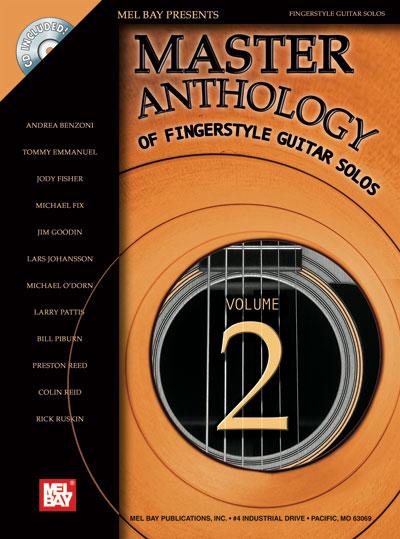
MASTER ANTHOLOGY OF FINGERSTYLE GUITAR SOLOS VOLUME 2 CD TABLATURE SPARTITI CHITARRA

MASTER ANTHOLOGY OF FINGERSTYLE GUITAR SOLOS, VOLUME 2. Accufuse, Preston Reed -Amico Mio, Andrea Benzoni -Celtic Overs, Jim Goodin -Clover, Colin Reid -Karla's Song, Larry Pattis -Only My Heart, Bill Piburn -Son Of A Gun, Tommy Emmanuel -Spirit Of Brother Marcel, Michael O'dorn -Stringin' The Blues, Michael Fix -Temptation Rag, Henry Lodge; arr. by Lars (Lasse) Johansson -The End Of The Beginning, Jody Fisher -The Return Of The Flute, Rick Ruskin. SHEET MUSIC BOOK WITH CD & GUITAR TABLATURE.

LIBRO DI MUSICA CON CD. 

SPARTITI PER CHITARRA CON: 

ACCORDI, PENTAGRAMMA, TABLATURE. 

Product Description:
This collection of twelve challenging fingerstyle guitar solos in notation and tablature presents works by both relative newcomers and seasoned world-class performers. This eclectic group of compositions should appeal to players and listeners alike, be it country, blues, ragtime, jazz, Celtic, or gorgeous ballads that suit your fancy. It will require serious practice for most guitarists to master these tunes, but the rewards should be commensurate whether you play strictly for your own enjoyment or make your living in whole or in part as a guitarist.

Featured artists include: Andrea Benzoni, Tommy Emmanuel, Jody Fisher, Michael Fix, Jim Goodin, Lars Johansson, Michael O'Dorn, Larry Pattis, Bill Piburn, Preston Reed, Colin Reid, and Rick Ruskin.

Song Title: Composer/Source:

Accufuse - Preston Reed
Amico Mio - Andrea Benzoni
Celtic Overs - Jim Goodin
Clover - Colin Reid
Karla's Song - Larry Pattis
Only My Heart - Bill Piburn
Son Of A Gun - Tommy Emmanuel
Spirit Of Brother - Marcel Michael O'dorn
Stringin' The Blues - Michael Fix
Temptation Rag - Henry Lodge; arr. by Lars (Lasse) Johansson
The End Of The Beginning - Jody Fisher
The Return Of The Flute - Rick Ruskin

Prezzo: €22,99
€22,99

MUSIC FROM THE BRITISH ISLES FOR ACOUSTIC GUITAR. CD TABLATURE

MUSIC FROM THE BRITISH ISLES. Raccolta di motivi arie e danze folkloristiche britanniche. Oltre a titoli conosciuti come "scarborought fair" e "greensleeves" troverete altri 50 brani completi, con i quali vi immergerete in un antico tempo. Buona parte delle melodie irlandesi di questa edizione sono state composte da un arpista cieco, vissuto intorno al 1725. Le canzoni e danze inglesi provengono invece dalla grande epoca del liuto inglese, tra il 1600 e il 1700, di cui J.Dowland fu il più alto esponente. Le danze scozzesi hanno un particolare stile e Brahms utilizzò in un suo pezzo per piano, una di queste. Tutti i titoli sono stati reperiti tra le polverose scartoffie di biblioteche abbandonate e sono suddivisi per ceppi etnici; irlandese, inglese, scozzese. CD TABLATURE


Irish Tunes

It's by chance or luck that I've written this section of Irish tunes, I was visiting Galway, Ireland, in 1979 and I stepped into a music store and purchased two small books of Irish fiddle tunes by Ted Furey, As I sat in my hotel room, I harmonized the melodies in simple settings. I really enjoyed the music. I heard a knock on the door, and it was another traveller who had heard my playing. She said she had been trying to hear some authentic Irish music. I had to laugh, but that was the start of this section. Most of the tunes presented here were originally for the Irish harp - melodies composed by the blind harper Turlough O'Carolan, who lived ·around 1725. All that has come down to us are just the melodies. I have no doubt that O'Carolan harmonized them; I've tried to arrange these tunes in an authentic style. Another great Irish harper, Roy D'All O'Cahan from 1650, wrote the air "O'Moore's Fair Daughter." The remaining tunes are jigs, reels, and hornpipes. These are popular country dances. The source of most of these tunes is the famous O'Neil Collection published at the turn of the century by Chicago Chief of Police Francis O'Neil. The "Irish Suite" by O'Carolan works very well in concert and is sure to please! The music in this section abounds with originality and the spirit of the Irish Land.


Song Title: Composer/Source:

Beauty in Tears - Arranged by Jamey Bellizzi
Believe Me, If All Those Endearing Young Charms - Arranged by Jamey Bellizzi
Black Heath - Arranged by Jamey Bellizzi
Blind Mary - Arranged by Jamey Bellizzi
Bumper Squire Jones - Arranged by Jamey Bellizzi
Captain O'Kane - Arranged by Jamey Bellizzi
Carolan's Farewell - Arranged by Jamey Bellizzi
Dik Sands Clog Dance - Arranged by Jamey Bellizzi
Donegal Reel - Arranged by Jamey Bellizzi
Dunse Dings - Arranged by Jamey Bellizzi
Eilis' Jig - Arranged by Jamey Bellizzi
English Country Gardens - Arranged by Jamey Bellizzi
English Dance - Arranged by Jamey Bellizzi
Father Walsh's Jig - Arranged by Jamey Bellizzi
Flight of the Wild Geese - Arranged by Jamey Bellizzi
Glenburnie Rant - Arranged by Jamey Bellizzi
Greensleeves - Arranged by Jamey Bellizzi
Haste to the Wedding - Arranged by Jamey Bellizzi
He's Bonny - Arranged by Jamey Bellizzi
It Was A Lover and HIs Lass - Arranged by Jamey Bellizzi
Jolly Good Ale and Old - Arranged by Jamey Bellizzi
Joy Gae Wee My Love - Arranged by Jamey Bellizzi
Kemp's Jig - Arranged by Jamey Bellizzi
Largo's Fairy Dance - Arranged by Jamey Bellizzi
Lili Bulero - Arranged by Jamey Bellizzi
Londonderry Hornpipe - Arranged by Jamey Bellizzi
Miss Hunter Of Blackness - Arranged by Jamey Bellizzi
Miss Johnston Of Hilton's Fancy - Arranged by Jamey Bellizzi
Moray's Frolic - Arranged by Jamey Bellizzi
O'Carolan's Concerto - Arranged by Jamey Bellizzi
O'Moore's Fair Daughter - Arranged by Jamey Bellizzi
Paddy the Piper - Arranged by Jamey Bellizzi
Pretty Peg - Arranged by Jamey Bellizzi
Primrose Lass - Arranged by Jamey Bellizzi
Scarborough Fair - Arranged by Jamey Bellizzi
Scottish Air - Arranged by Jamey Bellizzi
She's Fair And Fancy - Arranged by Jamey Bellizzi
Sheebeg Agus Sheemore - Arranged by Jamey Bellizzi
St. Martins - Arranged by Jamey Bellizzi
Staines Morris - Arranged by Jamey Bellizzi
The Ashgrove - Arranged by Jamey Bellizzi
The Boys of Blue Hill - Arranged by Jamey Bellizzi
The East Neuk Of Fife - Arranged by Jamey Bellizzi
The Jolly Breeze - Arranged by Jamey Bellizzi
The Lost Heart - Arranged by Jamey Bellizzi
The Morgan Rattler - Arranged by Jamey Bellizzi
The Snowy-Breasted Pearl - Arranged by Jamey Bellizzi
The Wind And The Rain - Arranged by Jamey Bellizzi
Under the Greenwood Tree - Arranged by Jamey Bellizzi
Willing Hands - Arranged by Jamey Bellizzi
Yeil Yeil - Arranged by Jamey Bellizz

Prezzo: €14,99
€14,99

EMMANUEL TOMMY FINGERSTYLE GUITAR METHOD CD TABLATURE LIBRO METODO CHITARRA FINGERPICKING

EMMANUEL TOMMY, FINGERSTYLE GUITAR METHOD. CD TABLATURE

LIBRO METODO PER CHITARRA ACUSTICA, CON CD. 

SPARTITI PER CHITARRA:

ACCORDI, PENTAGRAMMA E TABLATURE. 

The incomparable Australian guitarist Tommy Emmanuel presents four fingerstyle exercises plus an arrangement of the classic tune Freight Train and two signature compositions- Mister Guitar and Dixie McGuire. This book would serve either as a reference text for one of Tommy's workshops or as a helpful guide to developing fingerstyle guitarists working on their own. All selections are written in notation and tablature for the guitar in standard tuning. A convenient chord chart is provided in the appendix. All of the selections in the book appear on the companion CD.

Intermediate to advanced in difficulty, playing these tunes literally involves the thumbs of both hands! Gaining flexibility and control of your left thumb, you too can play like TE!


Dictation Notes with Tommy Emmanuel Getting Started on Fingerstyle ...

GETTING PREPARED

• Make sure your guitar is set up so it is comfortable for you to play.
• Choose a good set of strings
• Get in tune ...
TUNING
• If you have an electronic tuner and you just tune acoustically, that is fine.
• If you plug into a tuner, make sure you turn the microphone off.
• When you have a pick up in your guitar and you plug into the tuner, put the midrange flat out or on the lever,
whichever you understand. That gives the tuner, a real accurate tuner, a sparky signal and you will be able
to get your guitar really and truly in tune.
• It is always a good idea to practice tuning up as well as playing the guitar so you can get use to your guitar
sounding in tune. After a while you will find that you will end up training your own ear into what the sound
of being in tune really is.
NAILS ... ACRYLIC NAILS, NO NAILS OR FINGERPICKS
• What works for you?
• What sound are you going for?
CHOICE OF THUMBPICK
• I use Dunlop medium thumb pick ... not too big, small, thin, or thick ... it is right in the middle, like a
plectrum, but it is wrapped around your thumb.
• Some people use the slick picks, which are thinner.
• It depends on what kind of dynamic or strength you play with. Personally, if I use a slick pick, it would
probably fly across the room after the first bass note.
• I like something that hangs on to my thumb, doesn't make it turn blue on the end and it sticks on your thumb
properly.
• The thumb pick ~hould be pushed back so when you look at your thumb it is covering the end of your nail,
where it meets the flesh, first knuckle joint. When I look down at my thumb, it looks like there is 1/2 inch
of thumb sticking out.
• The thumb has to be independent to the fingers. It is important that you develop the thumb first before you
do anything with the fingers. You have to start training it. This takes time and dedication.
• In the key C. pick C, F, and G to play. Put your fingers down on the place of the guitar where the fret guard
is, down at the mouth. I rest the heal of my palm, the corner of the heal down and I take a little bit of
resonance out of the string to give it that music sound. Leave your fingers down and start with the A string
on the 3rd fret of the C chord. When you can get this slow and steady and use to it, go to C, G, and C.
• It is very important that with each chord change, I start the bass note on the root note. When I am playing
in C, the first note you play is C. Whatever chord you are playing, the first bass note should be the root note,
the note of that chord.
• Practice slowly. Keep the fingers down. Do in any key, E, A, G, B, A ...
• Practice until you can get a good feel, groove going and playing the thumb without the fingers coming up.
Get the thumb going first.
• It is important for you to become good at tapping your foot when you play. Chet use to say, pat your foot. It
will help you with your groove and your time. It will put a bit of bounce and confidence into your playing
and timing. You need to have a good time.
• I always tap my foot on 1 and 3. The only time I don't tap on 1 and 3 is in an extreme situation where I
would playa song where for me to get the right feel on it I would tap on the other beat or where I would tap
like a bass drummer. 
(CONTITUA)
 

Contents

Holding Position

Fingerstyle Notation

Learning to Read Tablature

Dictation Notes with Tommy Emmanuel

Getting Started On Fingerstyle Guitar

Tom's Thumb

Freight Train (simple version)

Freight Train

Mr. Guitar

Dixie McGuire

Thumbpickers Chord Chart  

Prezzo: €24,99
€24,99

EMMANUEL TOMMY ONLY Biskie-DriveTime-Luttrell-Mombasa-padre-Questions-robin-GUITAR TABLATURE LIBRO

EMMANUEL TOMMY, ONLY. GUITAR TABLATURE

LIBRO PER CHITARRA CON TABLATURE

NOTE FOR NOTE TRANSCRIBED SOLOS FROM THE ALBUM BY TOMMY EMMANUEL Certified Guitar Player.

Tommy Emmanuel has electrified audiences across the globe. This book contains note-for-note transcriptions of solos from Emmanuel's album Only in standard notation and tablature. Transcribed by Mark Pritcher.


TOMMY EMMANUEL
Hailed by Chet Atkins as "Without a doubt, one of the greatest guitar players on the
planet," Tommy Emmanuel has electrified audiences from Steve Kaufman's diminutive
Palace Theater in Maryville, Tennessee to the closing ceremony of the 2000 Olympics
in Sydney, Australia. Having concertized throughout much of the civilized world, this
dynamic performer who, in his words "happens to be a pretty good guitarist," made his
way to the fabled competition in Winfield Kansas as a guest artist for the first time in
2000. Shortly before Tommy's performances there, parking lot pickers were said to
have ceasedjamming and moved trance like in droves to a venue designed to hold perhaps 500,
now packed with three times that number ali to hear Tommy Emmanuel play
an acoustic guitar!
Although he has acted as a mentor to a dedicated few young guitarists in his native
Australia, Tommy seems destined to make his mark performing on the world stage. His
impeccable taste, flawless technique, and engaging personality have inspired fans and
critics alike.
 

ACKNOWLEDGEMENTS
I sincerely hope that you enjoy learning these works of art from Tommy's CD
"QNLY". Many thanks to Tommy for the joy that his music brings usoThe folks at Mel
Bay have been very gracious in providing space for the entire tunes. There is enough
variation in the choruses to make "repeats" impractical and I couldn't bear to leave
anything out. Italian guitarist Daniele Bazzani had worked on these tunes independently
and was kind enough to supply me with his notes early on, and that made my
task easier. Thanks to Brett Wood for help with some "impossible" licks. These tunes vary in difficulty, and please remember that interpreting notes and positions by ear can be subjective at best! Feel free to let me know if you have questions about the music. And very special thanks
to my wife Carol and daughter Katelynn, who allowed me to take on this project. I
Mark Pritcher, Tennessee
 

THOSE WHO WAIT Played with a plectrum (straight pick) 6th string = D; guitar tuned down 1/2 step

"We learn so much in life/ dont we? Ufe is our teacher. Ufe is the school/ and if we're
smart we learn the lessons and learn from each other. I think one of the hardest things
that I've ever had to learn is patience; and trust and faith in believing that things are
going to work out. That's really hard to learn/ to be patient. That's what this song is
about. About truly trusting that if your motives are right/ and everything about you is
heading in the right direction/ then there is no way that you can go wrong. /'
The plectrum is held by the thumb and first finger, and you then use the pick and your
second and third fingers to play the strings. This is sometimes called "hybrid picking".
For a given tune, and a desired effect, the plectrum gives a different sound than the
thumb pick. But if you have never played in this style it can be a challenge. Take it slow
and easy and you will get it! It is not practical to put a plectrum direction on each note,
but you can lay your right hand on the strings, and get a feel for what strings the pick
contacts, and which strings your second and third fingers touch comfortably. If this
style is new to you, go through the tune first using thumb and three fingers, and when
you are familiar with it, you can start on the hybrid technique. It is helpful to study
Tommy's performance videos or DVD's and watch his right hand. Also the fingering is
often critical. In places, fingering can be an individual thing, and you play the way your
left hand feels the best. But most of the time that I have indicated fingering, it is
because it is as Tommy intended it to be played. What seems to be awkward at times,
usually turns out to be brilliant because he has a way of making the melodic ideas flow
together, due in large part to the choice of fingering.
In this tune the tempo is fairly even throughout. It starts with natural harmonics at the
seventh fret, as you lay your first finger across the neck. Tommy uses his left-hand
thumb often to fret the 6th string. This is the case with the opening motif, starting
with the bass in measure 4. For the most part, let notes ring and sustain whenever possible,
even if it is not indicated in the music. Tommy's left hand reach is remarkable, as
you can tell from the five fret stretch in measure 26. Measure 32 has one of the awkward
fingerings on the hammer-on that will take some practice! The left hand thumb
is put to use again for the passage starting in measure 37. In measure 82, there is a
quick natural harmonic on the fifth string, and then you use your left hand to play the
hammer-on on the sixth string.


- Biskie

- DriveTime

- I've Always Thought Of You

- Luttrell

- Mombasa

- Ol Brother Hubbard

- Padre

- Questions

- Sonce We Met  

- Stay Close to Me

- The Robin

- Those Who Wait

- Timberlake Road

- Train to Dusseldorf. 


Prezzo: €36,99
€36,99

DYKES DOYLE DYKESOLOGY LIBRO CD GUITAR TABLATURE LIBRO Jazz In the Box-Zaccheus-Amazing Grace

DYKES DOYLE, DYKESOLOGY. CD TABLATURE

LIBRO DI MUSICA, SPARTITI PER CHITARRA CON CD E TABLATURE. 


- Jazz In the Box

- Zaccheus

- Twin Six Shooters

- The Lord's Prayer 

- Laguna Sand

- Mission of St. Holli

- Loving Rita

- Gitarre 2000 

- Amazing Grace

- And Can It Be?


Paperback: 79 pages
Publisher: Mel Bay; MB98626BCD edition (1999)
Language: English
ISBN-10: 078665063X
ISBN-13: 978-0786650637

Prezzo: €149,99
€149,99

ANDERSON MURIEL-HOMETOWN LIVE! CD TABLATURE SPARTITI LIBRO CHITARRA ACUSTICA WATER WIDE

ANDERSON MURIEL, HOMETOWN LIVE! Sheet music BOOK: 72 pages, WITH CD GUITAR & TABLATURE

LIBRO DI MUSICA, CON CD. 

SPARTITI PER CHITARRA CON: 

ACCORDI, PENTAGRAMMA, TABLATURE. 


Publisher: John August Music, Mel Bay Publications (1995)
Language: English
ISBN-10: 0786614471
ISBN-13: 978-0786614479


HOMETOWN LIVE!
by Muriel Anderson
This was originally a song I wrote about one of my favorite hangouts in Nashville (my second home), the Ultra Violet Cafe. Anne Sullivan recorded it as the title track for her CD, Ultra Violet Cafe. Renamed "Hometown/' ·this solo guitar arrangement incorporates the melody into the accompaniment. The basic concept of the composition is an arpeggio - feel with a gentle melody floating over the top. The right hand fingering is crucial to getting the fluid yet rhythmic character, especially in the introduction.
Note where the thumb (p) drops down to play the notes on the third string. Think of the notes played by the thumb as a separate rhythmic figure. Beginning in measure five, bring out the melody notes louder than the accompaniment. In general, the right hand fingering stays to the one-finger-per-string concept; the ring finger (a) plays the first string, the middle finger (m) plays the second string, and the index finger (i) plays the third string, although often the thumb takes the index finger's job and plays the third string. This adds to the cascading feel of the arpeggio. Exceptions: Where there are several consecutive melody notes on the same string, alternate fingers. Two consecutive notes on the third string (measure 24) are played index (i) - thumb (p). As is true of many of the compositions in this collection, some of the accompaniment notes are played so quietly that they are meant to be felt more than heard, These" ghost notes" help to subtly keep the rhythm moving along. After you've been playing the piece for a while, you may vary the accompaniment a little while keeping the chordal structure and feel of the piece intact. Play with dynamic swells and fades. Start by getting louder as the melody goes up and getting softer as the melody goes down. Then vary the dynamics as you feel the melody leads you. Also, sing the melody as you play it, and even make up lyrics to help phrase the melody. The piece ends with right hand harmonics an octave higher than the fretted note. With the right hand, touch the point on the string exactly twelve frets higher than the fretted note with the index finger, and pluck with the ring finger. This leaves the thumb free to play the bass notes.


NOLA by felix Arndt
I discovered Nola when I was experimenting with bluegrass banjo techniques on the guitar; using as many open strings as possible in scale passages and fingerjrg the succeeding notes on different strings. This technique is often called "cross-string fingerings," used extensively by Chet Atkins and others. The notes ring into each other with a harp-like or "cascading" sound. Cross-string fingering also allows the notes to be played more quickly than would be possible otherwise. Some of the left hand fingerings in this transcription are a bit difficult, but necessary in order to keep the notes ringing on as many different strings as possible. When I first started arranging Nola, I played it at a music store for my friend and mandolin teacher Jethro Burns while he played a descending line on the mandolin. With the new line in my ears, I went home to work on incorporating it as an inner voice into my solo arrangement. From measures 21-26, the new line fits into the solo arrangement on beats two and four of the measure (instead of beats one and three where it was originally played). Pay close attention to the fingerings in this section. The descending line is indicated with accents in the arrangement. When Nola is played in the key of G with the 6th string dropped down to D and the 5th string down to G, it is possible to play all the notes of the piano transcription on the guitar (although sometimes in a different octave). In addition, this tuning allows for a great number of open strings in both the melody and bass. As the arrangement evolved, some phrases were modified from the original to maintain the momentum of the piece in a more guitaristic way. The piano version of the long run beginning in measure 54 goes below the range of the guitar.
To change the octave register of these notes would disrupt the shape of the run. Because of the cascading nature of the run, the most graceful resolution to the problem (however nonstandard) was to shorten the run by three eight notes (one beat). This is the reason for the 9/8 bar in measure 55. Another option, to keep consistent 12/8 measures (if you're playing with a drummer, for instance), is to repeat the first three eighth notes at the beginning of measure 56. (These are the notes that are an octave lower in the piano arrangement.) Sometimes the same note functions as a bass note and a melody note. This is indicated in the music by a double note with the stems going in either direction, as in measure four, fourth note. In this case, the double note head indicates the note's (double) musical functions, not to play the same note on two different strings. The notes with x's marked "muffle" are played with a down-stroke with the backs of the nails, bringing the palm down to muffle the strings quickly after they are struck. This creates a percussive effect with just a hint of the harmony. For some right hand fingering suggestions for Nola, refer to Fingerstyle Guitar Magazine, NO.5. If you are comfortable with using the pinkie finger, there are a couple of places in the theme where it would be handy to use it (in addition to the ring, middle, and index fingers.) I originally wrote this arrangement to be played on a Martin 00-21 strung with nylon strings in the bass and steel strings in the treble. Then I came to prefer the sound played on all nylon strings, on my Paul McGill classical guitar.


PERFORMARNCE NOTES
A Roman numeral means to bar all (or part) of that fret. 1/2[Roman numeral] means to bar specifically half way across.
[SQUIGGLY LINE] means to strum down or arpeggiate. In Fantasia de Fuego and In Memory of a Friend, a squiggly line indicates a rasqueado: a down strum with the backs of the finger nails, one finger after another in quick succession starting with the pinkie finger, then ring, middle, index.
Measures are numbered from [!]as the first full measure.
Right hand fingerings are indicated by p = thumb, i = index, m = middle, and a = ring.
Thanks to all my students at Wheaton college who helped me carefully proofread this music. Special thanks to Kathy Tyers. Music typography by Paul Kurtz.

To order Muriel Anderson's recordings:
MURIEL ANDERSON, Elmhurst, IL 60126
Note: Anderson's CD Hometown Live! contains three additional selections not included on the book edition CD.


Titles - AUTHOR - YEAR
- Hometown - MURIEL ANDERSON - 1995
- It Never Gets Easier - MURIEL ANDERSON - 1995
- All Thumbs - MARK CASSTEVENS - 1995
- The Three Sisters - MURIEL ANDERSON - 1995
- Arioso - MURIEL ANDERSON - 1995
- Fantasia De Fuego - MURIEL ANDERSON - 1995
- In Memory of a Friend - MURIEL ANDERSON - 1995
- Mister Chester - MURIEL ANDERSON - 1995
- After Tonight - MURIEL ANDERSON - 1995
- Nola - FELIX ARNDT - 1995
- The Water Is Wide - AMERICAN FOLK SONG - 
- Andante From Symphony For a Country Gentleman - JEAN-FELIX LALANNE - 1995

Prezzo: €39,99
€39,99
Condividi contenuti