MEL BAY

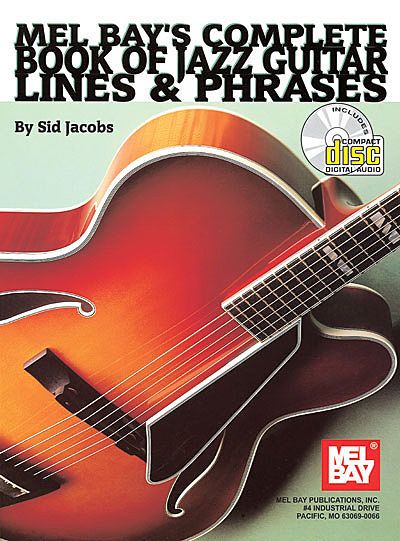
COMPLETE BOOK OF JAZZ GUITAR LINES & PHRASES Sid Jacobs CD TABLATURE LIBRO SPARTITI

COMPLETE BOOK OF JAZZ GUITAR LINES & PHRASES. Sid Jacobs. CD TABLATURE

LIBRO METODO DI MUSICA JAZZ, CON CD.

SPARTITI PER CHITARRA.

ACCORDI, PENTAGRAMMA E TABLATURE, 

Product Description:
An important addition to the improvising jazz guitarist's library, this thoughtful blend of text and musical examples focuses on the vocabulary of modern jazz and some of the applications of modern harmony. With examples written in standard notation and tablature, Jacobs offers instruction on bebop style phrases, playing fourths, inside-outside playing, pentatonic, whole-tone and symmetrical scales, slash chords, polychords, hip lines, fingerings and much more. The companion CD presents the material in the text played with chord accompaniment.

Product Number: 95737BCD
Format: Book/CD Set
Series: Complete
160 PAGES


Introduction

It has been said that a great composer doesn't borrow, he steals. If this book dealt with memorizing rules, I would certainly place "steal from the best" as rule number one. Some might feel uncomfortable about imitation but there is little to fear if you are judicious in what you steal and don't just "loot one store:' We learn to speak by imitation. We use an existing language to express our thoughts. It is no different for the improviser, using and connecting phrases from an existing idiom. If we substitute the term "line" with sentence and "improvisation" with conversation, we de-mystify the process. The way a person puts his words and phrases together gives him his conversational style and consequently, the more vocabulary he has, the better equipped he is to express himself. Similarly,the way a player connects his musical phrases gives him his improvising style, and the more vocabulary he has, the better equipped he is. The idiomatic phrases of the Jazz language distinguish it from other music. Through use of examples, we hope to illustrate some ideas that are used to create jazz lines and phrases. Improvising is an art. The ability to articulate your ideas clearly is a craft. When you connect your ideas creatively and extemporaneously, the craft is elevated to art. Improvisation is the art of jazz. Observe your own speech patterns and phrasing. You will notice that no two or three words have exactly the same volume. What I'm pointing out is that in conversation, we naturally use one of the first learned and first forgotten lessons in music: dynamics. In good conversation, one idea naturally flows to another. With fluency we make connections. In jazz improvisation, where the subject of our conversation is the chord changes or modulations, we need the ability to melodically imply the chord we are playing over and at any given point in time, smoothly connect to a close available chord tone or note in the key center. (See Example 1.)In this example the modulations and chord changes are made by moving to the closest available note.


About the Author Sid Jacobs

Sid Jacobs grew up in Miami, Fla. and began guitar lessons at the age of seven. As a teenager he became serious about jazz playing and would study and practice by day and sneak into the jazz clubs at night. When the Jacobs family moved to Nevada, he obtained a position as guitar instructor at the University of Nevada, Las Vegas. This made him, at eighteen, the youngest faculty member in the school's music department. While living in Nevada, Sid found work in the hotel pit orchestras, and as touring accompanist to a number of celebrity singers and jazz artists. After moving to Los Angeles, he developed the curriculum for the Jazz Guitar elective at the Musicians Institute (GIT)and the Advanced Bebop and Jazz Guitar course at the Dick Grove SchooL In 1991the CD It's Not Goodnight was released featuring his original compositions and improvisations. Among the many jazz artists Sid has performed with are Eddie Harris, Harold Land, Buddy Montgomery, Red Holloway, Conte Candoli, and in duo concert settings with guitarist Joe Diorio. Through his involvement in education, his personal associations with jazz notables, and his discipline, Sid continues to gain recognition as an influential educator, composer, and performing artist. In reviewing a live performance, Los Angeles Times jazz critic Don Heckman characterized him in this way, "... a highly articulate improviser... Never at a loss for a new phrase his improvisations seemed to unfold with the ever-changing fascination of a set of Bach variations:' Sid currently divides his time among his pursuits as GIT instructor, musical equipment manufacturer's consultant, performance and recording artist, and jazz clinician. Sid jacobs plays a Borys guitar and usesThomastik-Infeld strings.


Table of Contents:


About the Author Sid Jacobs .

Preface 

Introduction .

The Craft .

More Diatonic Sequences .

Smokin' A Half Note (Etude) .

Idioms .

Idiomatic ii or ii - V Shapes .

Idiomatic V - I Resolution Shapes .

Idiomatic I Major Shapes .

Sample II or II - V Lines .

Sample Major Lines .

Sample II - V - I Lines .

Some Additional Notes On the Idioms .

Some Miscellaneous Bebop Style Phrases .

Major 7th Lines .

Miscellaneous Phrases Over Common Progressions .

Another Blues in F (Etude) .

May The Fourths Be With You .

Triads (Fourth Triads) .

The Pentatonic Scale & Fourths .

Some Pentatonic Fourth Shapes .

Fourths Contours and Permutations .

Pentatonic Scales .

Pentatonics Inside Out .

The Madness - The Method

Ideas & Examples Combining Pentatonic Sounds .

Diatonic Fourths & Fifths

Fourths & Intervallic Sequences .

Piccardy Fourths (Etude)

Quartal Harmony .

Symmetrical Scales .

The "Magic Scale" (Augmented) .

Major Triads from the Augmented Scale

Minor Triads from the Augmented ("Magic") Scale

Some Augmented Scale Harmonies .

The Diminished Scale .

Some Diminished Scale Melodic Patterns .

Diminished Scale Harmony .

Whole Tone Scale

Whole Tone Scale Fingerings .

Some Whole Tone Lines

The Chromatic Scale .

Octave Displacement .

Polychords & Slash Chords .

Blues 4 Poly (Etude)

Kernels of Tomorrow (Etude) .

Final Notes .

Acknowledgments .


MEL BAY'S COMPLETE BOOK OF JAZZ GUITAR LINES & PHRASES

By Sid Jacobs

I wholeheartedly recommend this book to anyone who is serious about playing jazz guitar. It is a thorough, comprehensive and organized approach that can only come from someone who is a great musician and teacher.

-Bruce Forman


The plethora of disorganized, trendy guitar "methods" is ultimately confusing and overwhelming even to the most dedicated and devoted of students. Jacobs has brought us back to the simple musical truths that must inform all of our studies and music making. Jacobs' text is simple, clear, concise, and complete-It's the only jazz guitar "method" you'll ever need! -Fa reed Haque, Blue Note Recording Artist, Professor NIU (Northern Illinois University)


The Complete Book of Jazz Guitar Lines & Phrases is a concise, thorough exploration of the modern jazz vocabulary. It takes the mystery out of jazz harmony while stressing its creative applications. The explanations are clear and easy to follow, and the notated examples are fun, challenging, and musically relevant. I highly recommend this book to anyone interested in the study and advancement of jazz guitar. -John Hart


CD CONTENTS

Idiomatic II or II-V Shapes /p. 21 (5:58)

Idiomatic V-I Resolution Shapes /p.24 (2:14)

Idiomatic I Major Shapes /p. 27 (2:07)

Sample Major Lines /p.35 (3:03)

Sample II-V-I Lines /p.39 (1:46)

Some Miscellaneous Bebop Styles /p.43 (2:54)

Major 7th Lines /p.48 (1: 11)

Miscellaneous Phrases Common Program /p.51 (1:23)

Another Blues in F (Etude) /p.54 (1 :06)

May the Fourths Be with You /p.56 (:26)

Triads (Fourth Triads) /p.60 (1:10)

The Pentatonic Scale & Fourths /p.62 (1:25)

Some Pentatonic Fourth Shapes /p.64 (1 :45)

The Madness-The Method /p.78 (:55)

Ideas & Examples Pentatonic Sounds /p.81 (4:32)

Symmetrical Scales /p.95 (3:31)

The Magic Scale /p.100 (1 :50)

Major Triads from Augmented Scale /p.104 (1 :41)

Major Triads from Augmented (Magic) scale /p.105 (3:29)

Augmented Scale Harmonies /p.109 (1 :48)

The Diminished Scale /p.110 (4:04)

Diminished Scale Melodic Patterns /p.114 (5: 12)

Diminished Scale Harmony /p.119 (3:48)

Whole Tone Scale /p.123 (:23)

Some Whole Tone Lines /p.127 (1 :55)

The Chromatic Scale /p.131 (2:26)

Octave Displacement / p.137 (:59)

Polychords & Slash Chords /p.139 (7:52)

Blues 4 Poly (Etude) /p.148 (1:04)

Prezzo: €31,99
€31,99

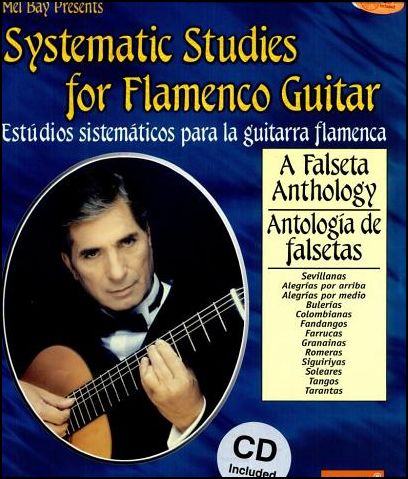
SYSTEMATIC STUDIES FOR FLAMENCO GUITAR Juan Serrano 2 CD TABLATURE A FALSETA ANTHOLOGY ALEGRIAS

SYSTEMATIC STUDIES FOR FLAMENCO GUITAR. Serrano. 447 Pagine, 10 sevillana, 10 alegrial por arriba, 10 alegrias por medios, 10 bulerias, 10 colombianas, 10 fandangos, 10 farrucas, 10 granainas, 10 romeras, 10 siguiriyas, 10 soleares, 10 tangos, 10 tarantas. SHEET MUSIC BOOK WITH 2 CD & GUITAR TABLATURE. 

447 PAGES !


LIBRO DI MUSICA FLAMENCO CON 2 CD.

SPARTITI PER CHITARRA : 

PENTAGRAMMA, TABLATURE. 

447 PAGINE .


A FALSETA ANTHOLOGY 

Product Description:
This masterful, comprehensive book presents ten Sevillanas plus ten falsetas of each of the following popular and traditional flamenco forms: Alegrias por Arriba, Alegrias por Medio, Bulerias, Columbianas, Fandangos, Farrucas, Granainas, Romeras, Siguiriyas, Soleares, Tangos, and Tarantas. This landmark text presents the systematic development of Flamenco tech- nique. Each of the dance forms contains performance notes & a brief history. In English & Spanish and written in standard notation and tablature. Includes companion 2-CD set.


INTRODUCTION

All of the flamenco forms are based on one traditional rhythmical phrase of 8 or 12 beats (musically 3/4,4/4, or 3/4 and 6/8). The rhythmical flamenco phrase is called compas. The melodic themes that are played between each compas are calledjalsetas. A falseta can be composed of several flamenco compases. The flamenco selections are composed of its traditional compas with some rhythmical variations and several falsetas. Between falseta and falseta the compas or one of its variations is played.
The falsetas melodically are all different and are composed of different techniques, tremolos, picados arpeggios, rasgueados and different chords.
Almost all of the flamenco aficionados know which is the compas of each form and how to play it. Many prefer not to play compositions of other guitarists, but they prefer to learn many new falsetas in order to make their own arrangements.
This book is composed of 10 Sevillanas and 10 falsetas of each one of the most popular and traditional of the flamenco forms: I
i Sevillanas, Alegrfas por Ar1iba, Alegr{as por Medio, Bulerfas, Colombianas, Fandangos, Farrucas.
Granainas, Romeras, Siguiryyas, Soleares, Tangos and Tarantas .
All of the falsetas can be used as technical studies. Each falseta is equivalent to one study. It is recommended that each of the falsetas be practiced very slowly, following the fingering marked in each, so that the fingers memorize the order that they must follow. Thus, the synchronization of the two hands can be perfected and the falsetas can be played with more ease.
There are many flamenco guitarists that play the notes very clearly with a good sound. These guitarists are called "clean guitarists" (clear) within the flamenco world. There are others that are good musicians and have a very good sense of rhythm, but do not have a good technique. The notes sound sloppy. These guitarists are called "dirty guitarists" (sloppy) in the flamenco world.
It doesn't matter what type of music is played, jazz, classical or flamenco. All of the notes should sound clear with each one having its musical value.
Note Falsetas are the melodic phrases that are played between compas and compas. Compas is the rhythmical phrase that is played between falseta and falseta.

SYMBOLS
• The numbers 1 - 2 - 3 - 4, signify the fingers of the left hand.
• The letters P - I - M - A - S signify the fingers of the right hand.
• The Roman numerals designate the position, I - II - III etc.
• A letter C preceding a Roman numeral signifies Barre: CI - CII - CIII etc.
• The numbers in circles designate the strings. For example, a three in a
circleG)
means the
note played on the third string, a four @) fourth string etc.
TRANSLATIONS FOR MUSIC AND TABLATURE
Freestroke ----Tirando
Reststroke ----Apoyando
Scale ------Picado
 

Format: Book/2-CD Set

Contents:
01) Introduction --
02) Sevillanas --
03) Alegrias Por Arriba --
04) Alegrias Por Medio --
05) Bulerias --
06) Colombianas --
07) Fandangos --
08) Farrucas --
09) Granainas --
10) Romeras --
11) Siguiriyas --
12) Soleares --
13) Tangos --
14) Tarantas


INTRODUCTION

All of the flamenco forms are based on one traditional rhythmical phrase of 8 or 12 beats (musically 3/4, 4/4, or 3/4 and 6/8). The rhythmical flamenco phrase is called compas. The melodic themes that are played between each compas are calledjalsetas. A falseta can be composed of several flamenco compases. The flamenco selections are composed of its traditional compus with some rhythmical variations and several falsetas. Between falseta and falseta the compas or one of its variations is played.

The falsetas melodically are all different and are composed of different techniques, tremolos, picados arpeggios, rasgueados and different chords.

Almost all of the flamenco aficionados know which is the compus of each form and how to play it. Many prefer not to play compositions of other guitarists, but they prefer to learn many new falsetas in order to make their own arrangements.

This book is composed of 10 Sevillanas and 10 falsetas of each one of the most popular and traditional of the flamenco forms:


Sevillanas, Alegrias por Arriba, Alegrias por Medio, Bulerias, Colombianas, Fandangos, Farrucas,

Granamas, Romeras, Siguiras, Soleares, Tangos and Tarantas


All of the falsetas can be used as technical studies. Each falseta is equivalent to one study. It is

recommended that each of the falsetas be practiced very slowly, following the fingering marked in each, so that the fingers memorize the order that they must follow. Thus, the synchronization of the two hands can be perfected and the falsetas can be played with more ease.

There are many flamenco guitarists that play the notes very clearly with a good sound. These guitarists are called "clean guitarists" (clear) within the flamenco world. There are others that are good musicians and have a very good sense of rhythm, but do not have a good technique. The notes sound sloppy. These guitarists are called "dirty guitarists" (sloppy) in the flamenco world.

It doesn't matter what type of music is played, jazz, classical or flamenco. All of the notes should sound clear with each one having its musical value.

Note Falsetas are the melodic phrases that are played between compas and compas. Compas is the rhythmical phrase that is played between falseta and falseta.

SYMBOLS

• The numbers 1 - 2 - 3 - 4, signify the fingers of the left hand.

• The letters P - I - M - A - S signify the fingers of the right hand.

• The Roman numerals designate the position, I - II - III etc.

• A letter C preceding a Roman numeral signifies Barre: CI - CII - CIII etc.

• The numbers in circles designate the strings. For example, a three in a

circle G) means the note played on the third string, a four 4 fourth string etc.

TRANSLATIONS FOR MUSIC AND TABLATURE

Freestroke ----Tirando

Reststroke ----Apoyando

Scale ------Picado


SEVILLANAS

Sevillanasare one of the most popular forms of the flamenco music. One complete Sevillana set is composed of four coplas; that is, four different Sevillanas-ealled 1st, 2nd, 3rd, and 4th. The reason is that the Sevillanas are danceable and each of them is adapted to the choreography of the dance. The complete dance is divided into four parts. The choreography of the dance is based on the rhythm, not the melody, therefore the order of the 4 Sevillanas that are in the composition can be interchanged.

This section is composed of 10 different Sevillanas in tone and melody. The order is in a progressive form in technical difficulty (advancement).

It is recommended learning all of the 10 Sevillanas; then playing the four that are liked best and interchanging them in any order. It is also recommended that the second not be attempted until the first is mastered and so on.

although the compas and the musical form of all of the Sevillanas are the same, the techniques and melodies are completely different in each one of them; therefore when the 10 Sevillanas are learned, it will be much easier to master the rest of the falsetas that make up this book.

The Sevillanas are measured in 3/4. A flamenco compas has 6 beats equivalent to 2 measures of 3/4.


SEVILLANAS

Las Sevillanas son unas de las formas mas populares entre la musica flamenca. Una composici6n completa de sevillanas consiste en cuatro copIas, 0sea, cuatro Sevillanas diferentes que se les llama primera, segunda, tercera y cuarta. La razon es porque las Sevillanas son bailables y cada una de elIas esta adaptada a la coreograffa del baile.

La danza completa esta dividida en cuatro partes. Las coreograffas del baile estan basadas en el ritmo y no en la melodia. Por 10 tanto, el orden de las cuatro Sevillanas que se esten usando en la composici6n puede ser cambiado a la conveniencia del guitarrista que las interprete.

Esta eccion de Sevillanas se compone de diez Sevillanas diferentes en tonos y melodfas. El orden esta en una forma progresiva en dificultad tecnica.

recomiendo que los estudiantes aprendan las diez Sevillanas y asf podran tocar las cuatro que mas les gusten y podran cambiar el orden a su conveniencia y gusto. Tambien recomiendo que hasta que no hayan aprendido bien la primera, no empiecen con la segunda y 10 mismo con todas las siguientes.

Aunque el compas y la forma musical de todas las Sevillanas es igual, las tecnicas y las melodfas son completamente diferentes en cada una de elIas. Por 10 tanto, cuando hayan aprendido estas diez Sevillanas les sera mucho mas facil el aprendizaje de todas las demas formas que componen este libro.

todas las Sevillanas se miden en tiempo de 3/4. El compas flamenco se compone de seis tiempos equivalente ados compases musicales de 3/4.

Prezzo: €69,99
€69,99

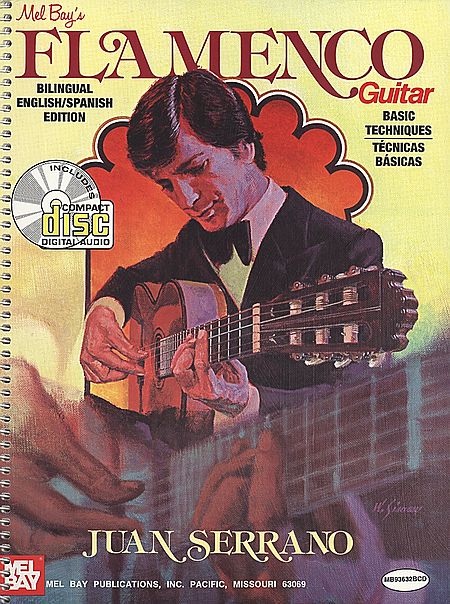
SERRANO JUAN FLAMENCO GUITAR TECNICAS BASICAS LIBRO CD TABLATURE CHITARRA METODO

SERRANO JUAN, FLAMENCO TECNICAS BASICAS. Metodo in inglese e spagnolo. CD TABLATURE

LIBRO DI SPARTITI DI MUSICA FLAMENCO PER CHITARRA, METODO CON CD E TABLATURE.


Product Description:
This book, written in both English and Spanish is the most authoritative method available on flamenco guitar technique. Juan Serrano is one of the world's premier flamenco concert soloist and is a seasoned teacher and performer in this vibrant, colorful musical genre. The text describes the history and development of flamenco music; teaches basic music theory; presents developmental studies on flamenco guitar techniques such as rasgueado and tremolo; and offers 14 exciting flamenco guitar solos. Written in notation and tablature.


The flamenco guitar descended from a long line of Spanish ancestors, and it is a deviation from its classical counterpart. According to one essayist on the subject, the guitar emanated from Egypt. Others like to believe that it evolved from the Greek~Assyrian cithara, brought into Spain by the Romans. However, the music of the guitar, that which accompanies the flamenco dance and song, in reality reveals evidence of Near-Eastem and Egyptian ancestry. During its acclirnatization in Spain, the minstrel and poet Bagdadi Ziryab added the fifth string. The Spanish guitar, accepted throughout the entire peninsula during the 10th Century, soon distinguished itself for the rasgueado technique. Since the beginning of the 19th Century it has had six strings: E, A, D, G, B, E. The music of the flamenco guitar depicts one of the rnarvels of the natural arts.


INTRODUCCION

La guitarra flamenca cuenta con una ilustre ascendencia hispana y marca una desviación de la clásica. Según algunos tratadistas, la guitarra es procedente de Egipto. Otros la suponen procedente de la citara Greco- Asiria importada a España por los Romanos. Pero la música de la guitarra tal como acompaña al baile o al cante flamenco acusa en efecto evidentes reminiscencias orientales. Durante su aclimatización en España el cantor y poeta Bagdadi Ziryab le añadió la quinta cuerda. La guitarra Española aclimatada en toda la peninsula en el Siglo X, pronto se distinguió por la técnica del rasgueado. Desde principios del Siglo XIX, la guitarra posee seis cuerdas: MI, LA, RE, SOL, SI, MI. La música de la guitarra flamenca constituye una de la maravillas del arte natural.


Format: Book/CD

Contents:

The history of flamenco
Music Theory
Learning Notes
Symbols
Tablature
Explanation of the Rasgueado
Preparatory Study
Rasgueado Exercises
Scale Study #1
Scale Study #2
Scale Study #3
Tremolo Study #1
Tremolo Study #2
Study for the Thumb
Studies in Legatos
Arpeggio Exercises
Study in C
Sevillanas I, II, III, and IV
Farrucas
Soleares
Alegrias
Alegrias para Baile
Fandangos de Huelva
Tempestad (Rumba flamenca)
Bulerias
Malaguena (Flamenca)
Malaguena (Regional)
Romance Flamenco

Prezzo: €34,99
€34,99

SERRANO JUAN KING OF THE FLAMENCO GUITAR CD TABLATURE CHITARRA LIBRO SPARTITI

SERRANO JUAN, KING OF THE FLAMENCO GUITAR. Mani vigorose e tendini tenaci, 230 pagine, Rapida introduzione alla tecnica di base della chitarra flamenca: rasgueado, studio sul tremolo, arpeggio, picado, golpe. SHEET MUSIC BOOK WITH CD & GUITAR TABLATURE. 

LIBRO DI MUSICA FLAMENCA. 

SPARTITI PER CHITARRA : 

PENTAGRAMMA E TABLATURE. 

Product Description:
Introduces basic flamenco studies, concert selections, and a brief history of the flamenco tradition. Includes the four basic song forms (siguiriyas, soleares, tangos, and fandangos) that influence all flamenco music.

Format: Book/CD Set
230 PAGES.

Contents:

Dos Colores -- Juan Serrano
Punta Umbria -- Juan Serrano
Tarifa -- Juan Serrano
Nostalgia -- Juan Serrano
Cueva Gitana -- Juan Serrano
Lamento Gitano -- Juan Serrano
Amigo Mariano -- Juan Serrano
Lagriamas De Granda -- Juan Serrano
Fantasy -- Juan Serrano
La Juderia -- Juan Serrano
Dos Colores -- Juan Serrano
Punta Umbria -- Juan Serrano
Tarifa -- Juan Serrano
Nostalgia -- Juan Serrano
Cueva Gitana -- Juan Serrano
Lamento Gitano -- Juan Serrano
Amigo Mariano -- Juan Serrano
Lagriamas De Granda -- Juan Serrano
Fantasy -- Juan Serrano
La Juderia -- Juan Serrano


CONTENTS:

Juan Serrano

Flamenco Guitar


Basic Techniques

Rasgueado

Tremolo Study

Arpeggio Exercise

Picado

Golpe

Farrucas

Soleares


Concert Selections

Lagriamas de Granda (Granainas) .

Nostalgia (Guajiras) .

Fantasy (Zambra) .

Dos Colores (Sole a por Bulerias) .


Flamenco Tradition

The Four Basic Flamenco Songs*


*Lamento Gitano (Siguiriyas) I

Techniques

Rasgueado

Tremolo

Alzapua

*La Juderia (Soleares)

*Cueva Gitana (Tangos)

*Punta Umbria (Fandangos)

Tarifa (Alegrias por medic-Derived from Soleares)

Amigo Mariano (Colombianas-Derived from Tangos) 

Prezzo: €43,99
€43,99

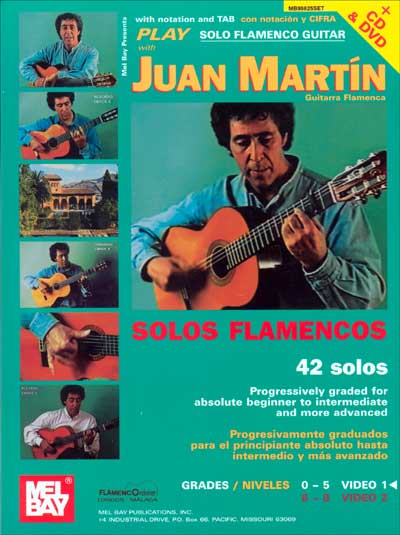
MARTIN JUAN PLAY SOLO FLAMENCO GUITAR VOL. 1 CD DVD TABLATURE CHITARRA METODO LIBRO

MARTIN JUAN, PLAY SOLO FLAMENCO GUITAR VOL. 1. SHEET MUSIC BOOK WITH GUITAR TABLATURE + CD + DVD. 

LIBRO METODO DI MUSICA FLAMENCO CON CD E DVD. 

SPARTITI PER CHITARRA CON: PENTAGRAMMA, TABLATURE. 


with notation and TAB    PLAY SOLO FLAMENCO GUITAR with

JUAN MARTiN


Guitarra Flamenca

SOLOS FLAMENCOS


42 solos

Progressively graded for absolute beginner to intermediate and more advanced

GRADES 0 - 5

con notacion y CIFRA

Progresivamente graduados para el principiante absoluto hasta intermedio y mas avanzado

CD Contents

Primera  Solea  First Solea

Tientos   Anhelo (Yearning)

Sevillana   Copla tradicional

Verdiales   Malaga, mi tierra

Alegrias en Mi   Alborozo (Jubilation)

Tangos   Festejo (Celebration)

Guajira   Fiesta cubana

Solea La base

Fandango de Huelva

Alegrias en mi con silencio

Bulerias por arriba

Rumba Rumba del dia nueve

Malaguelia Velez

Granadinas Albaicin

Solea para acompaliar

Tientos de Ricardo a Paco

Seguiriyas Sabicas y ritmeo

Alegrias Melocotones de Ronda

Verdiales Coplas malaguenas

Bulerias Diego en menor

Guajiras from Cania raja

Solea Solea gitana

Seguiriyas Falsetas clasicas

Zapateado Taconeos

Rumba Cancion popular, more advanced (mas avanzada)

Solea por Bulerias Raices

Tarantas Aires de La Union

Alegrias Tema inicial (Opening theme)

Sevillana   Mi copla

Solea   Falseta tradicional

Alegrias en la

Tarantos   Toque de las minas

Zorongo

Cantilias   Luz y sombra (Light and shade)

Seguiriya   Lamento

Rumba   Rumba flamenca

Solea Falsetas sencillas (Simple falsetas)

Fandango de Alosno

Rumba Cancion popular

Tangos Impulso

Carcelero

Farruca Ritmo del baile (Rhythm of the dance)


FLAMENCOVISION AND PATRICK CAMPBELL 

MEL BAY PUBLICATIONS, INC., PACIFIC, MO 63069. MADE AND PRINTED IN U.S.A.


Designed as a comprehensive multimedia teaching set, this book, CD, and DVD present 42 solos, progressively graded in 6 levels from absolute beginners to more advanced, to suit players of all levels. It contains examples of eighteen different palos (rhythmic forms) of flamenco, with a wealth of melodic falsetas and rhythms. The music for all these is accurately written in notation and flamenco tab (cifra) in the book, and is also recorded on the companion CD. The DVD video contains over 57 minutes of solo music, and also includes introduction by Juan Martín and brief scenes of Andalucia today, which help to place this profoundly exciting and deeply felt music in the landscape of its origins. Juan Martín has succeeded here is showing how even music which is simple and very easy to start with can express the essential sound and emotion of flamenco, to build step by step the skills necessary for the performance of concert solos. Written in English and Spanish.


INTRODUCTION

Welcome to my new video series! It can help you to play flamenco guitar whatever your present level of skill. Many people who would like to play flamenco on the guitar tell me they are discouraged by the apparent difficulty of the techniques required. I want to try to change that, because the marvellous art of flamenco is much more about feeling and rhythm, those essential components of aire and compas, than always about sheer speed or amazing technique. The exciting challenge for me has been to arrange and compose music which includes classic elements with more modern sounds and rhythms that will capture for the student the true essence of flamenco guitar right from the very start, without sounding too simplified or lacking that characteristic flamenco sound.

The solos in this project are in a progressive series of grades, from an initial Grade a up to grade 8. This book, CD and video, the first of two sets, contain the pieces for grades a to 5. The grades are intended to be in line with the levels of musical advancement required for the grade examinations of music colleges for any musical instrument. This is a new kind of challenge for flamenco, but the art is now becoming so international that I believe it is time to see flamenco guitar as an art that can be learned in a progressive way by anybody who has the necessary devotion, understanding and determination. To many devotees of flamenco the idea of a formal graded approach, possibly subject to examination, may seem quite alien and even unwelcome. I want to look to the future, however, and to join with others who now nurture the growing world-wide interest in this precious art and the need for systematic methods of teaching. The essence of flamenco is so strong and distinctive that I do not believe its future is threatened by the increasing numbers of people who find in its soul what they want to express and to enjoy in music, any more than the music of the Mississippi Delta has been impoverished by the world-wide interest in the art of the Blues. There are no formal standards or guidelines in flamenco that are widely established to mark the student's stages of progress. In this project, therefore, I have given much thought to what I believe should be the appropriate levels of skill and musicianship necessary for achievement of the grades which can mark the advancement of technical ability and musical understanding. The book contains more details about the contents and requirements of each grade.

I have been greatly encouraged in this project by my young son Carlos, whose need for interesting music to play from the start of his learning the guitar has given me a valuable purpose and focus in preparing the music, particularly with the earliest grades.

There is bound to be disagreement about whether a piece is right for the grade assigned, or whether it is too easy or too difficult. I think that sort of argument is both unavoidable and not really very helpful. I have tried to present a logical development of musical understanding and of techniques for the right and left hand, but the important thing is not to be too rigid about the sequence of grades. Students and players have to differ in their capacities and needs. The music always matters more than anything else! More advanced players will be able to incorporate the music of the video in their own arrangements, and they should find things worth learning at any grade.

My aim is to give the student music which he or she will enjoy playing and which will reward the effort to practise and learn. This is not primarily a project to explain technique, but I have included some brief notes about the individual pieces. I hope you will share in the enjoyment I have had in undertaking this project with my good friend and former student Patrick Campbell who has again worked hard to communicate my playing through video, the CD and the printed page. I would also like to thank Bill Bay and his team for their invaluable advice and encouragement with what we believe to be a new advance in learning methods for flamenco. Viva el arte - y vamos a tocar!


Contents:

CONTENIDO / CONTENTS
Introduction By Juan Martín
Introducción Por Juan Martín
The Elements of Flamenco Guitar-Playing
Los Elementos del toque de la guitarra flamenca
Symbols and Notation
Símbolos y Notación

GRADE / NIVEL O Notes and Requirements/Notas y requisitos
PRIMERA SOLEÁ First Soleá
TIENTOS Anhelo (Yearning)
SEVILLANA Copla tradicional
VERDIALES Málaga, mi tierra
ALEGRÍAS EN MI Alborozo (Jubilation)
TANGOS Festejo (Celebration)
GUAJIRA Fiesta cubana

GRADE / NIVEL 1
Notes and Requirements/Notas y requisitos
SOLEÁ Falsetas sencillas (Simple falsetas)
FANDANGO DE ALOSNO
RUMBA Canción popular
TANGOS Impulso
CARCELERO
FARRUCA Ritmo del baile (Rhythm of the dance)
SEVILLANA Mi copla

GRADE / NIVEL 2
Notes and Requirements/Notas y requisitos
SOLEÁ Falseta tradicional
ALEGRÍAS EN LA
TARANTOS Toque de las minas
ZORONGO
CANTIÑAS Luz y sombra (Light and shade)
SEGUIRIYA Lamento
RUMBA Rumba flamenca

GRADE / NIVEL 3
Notes and Requirements/Notas y requisitos
SOLEÁ La base
FANDANGO DE HUELVA
ALEGRÍAS EN MI con silencio
BULERÍAS POR ARRIBA
RUMBA Rumba del día nueve
MALAGUEÑA Vélez
GRANADINAS Albaicín

GRADE / NIVEL 4
Notes and Requirements/Notas y requisitos
SOLEÁ Soleá gitana
SEGUIRIYAS Falsetas clásicas
ZAPATEADO Taconeos
RUMBA Canción popular, more advanced (más avanzada)
SOLEÁ POR BULERÍAS Raíces
TARANTAS Aires de La Unión
ALEGRÍAS Tema inicial (Opening theme)

GRADE / NIVEL 5
Notes and Requirements/Notas y requisitos
SOLEÁ PARA ACOMPAÑAR
TIENTOS de Ricardo a Paco
SEGUIRIYAS Sabicas y ritmeo
ALEGRÍAS Melocotones de Ronda
VERDIALES Coplas malagueñas
BULERÍAS Diego en menor
GUAJIRAS from Caña rajá

APPENDIX: PUBLICATIONS BY/PUBLICACIONES DE IUAN MARTÍN

Prezzo: €32,99
€32,99

COMPLETE COUNTRY GUITAR BOOK Fred Sokolow CD TABLATURE flatpicking lead-Doc Watson-Clarence White-bluesy-Atkins/Travis fingerpicking-rockabilly-Nashville-Western swing

COMPLETE COUNTRY GUITAR BOOK. Fred Sokolow. CD TABLATURE

Product Description:
This book is an encyclopedia of Carter flatpicking style back-up, bluegrass back-up, Carter flatpicking style lead, Doc Watson-style lead, Clarence White-style bluesy lead, Atkins/Travis fingerpicking style, rockabilly guitar style, Nashville lead styles, and Western swing. The tunes and exercises in the book are included on the CD. Fred introduces each tune with page numbers to locate the corresponding material in the text. Stereo split track recordings allow you to hear the guitar through one speaker, separate from the band. In notation and tablature.

Product Number: 93935BCD
Format: Book/CD Set
ISBN: 0786628413
UPC: 796279042567
ISBN13: 9780786628414
Series: Complete
Publisher: Mel Bay Publications, Inc.
Date Published: 11/11/1997

Song Title: Composer/Source:
Amazing Grace Arr. By: Fred Sokolow
Arkansas Traveler Arr. By: Fred Sokolow
Banks Of The Ohio Arr. By: Fred Sokolow
Beautiful Brown Eyes Arr. By: Fred Sokolow
Bluegrass Back-Up Arr. By: Fred Sokolow
Bury Me Beneath The Willow Arr. By: Fred Sokolow
C & W Vamp Arr. By: Fred Sokolow
Can The Circle Be Unbroken Arr. By: Fred Sokolow
Careless Love Arr. By: Fred Sokolow
I Am A Pilgrim Arr. By: Fred Sokolow
I Never Will Marry Arr. By: Fred Sokolow
Jimmie's Blue Yodel Arr. By: Fred Sokolow
Just A Closer Walk With Thee Arr. By: Fred Sokolow
Lonesome Road Blues Arr. By: Fred Sokolow
Luther's Walk Arr. By: Fred Sokolow
Nine Pound Hammer Arr. By: Fred Sokolow
Railroad Bill Arr. By: Fred Sokolow
Red Apple Juice Arr. By: Fred Sokolow
Rockabilly Rave-Up Arr. By: Fred Sokolow
Rockin' With Carl Arr. By: Fred Sokolow
Roll In My Sweet Baby's Arms Arr. By: Fred Sokolow
Sally Goodin Arr. By: Fred Sokolow
Scotty's Boogie Arr. By: Fred Sokolow
Shamblin' Along Arr. By: Fred Sokolow
Soldier's Joy Arr. By: Fred Sokolow
Steel Bending Arr. By: Fred Sokolow
Take This Hammer Arr. By: Fred Sokolow
Talking Guitar Blues Arr. By: Fred Sokolow
The Great Speckled Bird Arr. By: Fred Sokolow
Turkey In The Straw Arr. By: Fred Sokolow
Wabash Cannonball Arr. By: Fred Sokolow
Wildwood Flower Arr. By: Fred Sokolow
Worried Man Blues Arr. By: Fred Sokolow
Wreck Of Old 97 Arr. By: Fred Sokolow


INTRODUCTION

Country guitar means a lot of things to different people. To some it's the easy strumming
of Hank Williams; to others it's Albert Lee or Jerry Reed playing a hot electric lead in a con-
temporary C&W tune; to still others it's Mother Maybelle Carter picking the "Wildwood Flower,"
Eldon Shamblin playing jazzy riffs on Bob Wills' "San Antonio Rose, " Lester Flatt backing up
Earl Scruggs on the "Foggy Mountain Breakdown, " or Carl Perkins rocking out, hillbilly
style, on "Blue Suede Shoes."
And there are still more performers who shaped the diverse traditions and styles of
country guitar playing: Jimmie Rodgers, Doc Watson, Merle Travis and many more.
All the traditions sparked by these major artists are very much alive. Listen to a country
radio station for an hour and you'll hear most of the above-mentioned styles demonstrated by
lead and back-up guitarists. Your enjoyment of one or two of these traditions prompted you to
pick up this book.
A discography at the end of "The Complete Country Guitar" will help you put these musical
influences in historical perspective. More importantly, the body of the book shows you how to
play in the styles of all these artists. Everything from mountain music to the modern Nashville
sound is examined. Licks and s cales are diagrammed and written out in music and tablature,
and a recording enables you to listen to all the tunes and musical examples while studying
the charts and paperwork. (The greatest pickers of all time learned by listening to records
and imitating them -- and few of them ever had any written aids.)
If you're a beginner, you'll want to start with the basics (tuning up, playing simple chords
and strums); otherwise you can open up to the chapter on your favorite type of country music ...
listen to the recorded tunes on the recording .... study the notes and diagrams that precede the
accompanying music and tab ... and finally, comparing the music/tab to the recording, play
like Clarence White or James Burton.
Whether you're a professional picker looking for some new licks or just someone who
wants to pick and sing some country favorites, I hope you find something useful and enjoyable
in this gold mine of guitar riffs.


SONGBOOKS
Countless songbooks are available that contain your favorite country tunes with
the words and music. Since most of them include chord grids, you can learn songs
from them. Just figure out (by ear or trial and error) which strum fits a given tune,
and read the chord grids while you strum. If the song is written in a difficult key
(Eb or B, for example) you can use the transposing method in the MUSIC THEORY
APPENDIX to change the key, or you can use a capo to make difficult keys easy.

HOW TO USE A CAPO
Various capos, made of rubber, metal and plastic are available at guitar stores. They depress
all of the guitar strings at whichever fret the capo is placed, which then raises the guitar's pitch.
If you playa G chord with the capo on the 2nd fret (acting as though the fret in front of the capo
were the 1st fret of the guitar), it's the same pitch as an A chord-because A is two frets higher
than G.
One of the capo's main uses is to enable you to raise a song's key (e. g. from G
to A) and still play in the original key's chord fingerings. This is handy if a song is
written in G but you can sing it better in A; or if you learned an arrangement using
G fingering but need to sing in a higher key. Here are some other situations in which
the capo is handy:
1. If a song is written in a difficult key (Ab or B, for example), or if someone's
singing voice calls for a difficult key, pick a nearby easy-to-play-in- lower
key and capo up the difference between the two keys. To play in Ab: G is one
fret below Ab, so capo up one fret and play G fingering. (You can use the
transposing method in the MUSIC THEORY APPENDIX to change all the
chords in the tune from the original key to the capoed key. ) To play in B: A
is two frets below B, so capo up two frets and play A fingering.
2. If you want to play higher up the neck - for variety's sake, or to sound different
from another guitar - but you want to stay in a given key: use the same
process as above. For instance, to playa tune in E, higher up the neck: C is
four frets below E, so capo up four frets and play in the key of C (using the
transposing chart if you need to). To play in G, way up the neck: D is five
frets below G, so capo up five frets and play in D.

PRACTICING SUGGESTIONS
Practice your chords and strums by playing along with the tunes on the recording.
Whether a song is an exercise in fingerpicking or electric lead styles, you can
accompany it with the strums in this chapter. The music /tab will tell you which chords
to play and your ear will tell you whether the rhythm is a country shuffle, waltz or
country frock beat.
It's also excellent practice to try to find by ear the appropriate strums and chords
to familiar songs. From childhood on, we all learn hundreds of nursery rhymes,
folk songs and country and pop tunes, most of which only use three or four chords.
Hunt for these - trusting your ear - on your guitar.
Try using songbooks or sheet music to learn some simple tunes. Once you know
the changes* to a tune, the best way to smooth out your rhythm and chord-changing
technique is to play with another guitarist -- especially one whose playing is at a
slightly higher level than yours. This can be demanding on both of you at times, but
it can also be a lot of fun.
Changes" = the musician's shortened term for "chord changes."


 CONTENTS
INTRODUCTION .
HOW TO READ TABLATURE.

BEGINNINGS
TUNING UP
FIRST POSITION CHORDS
HOW TO HOLD A FLATPICK .
STRUMMING PATTERNS
SONGBOOKS
HOW TO USE A CAPO
PRACTICING SUGGESTIONS

CARTER·STYLE BACKUP
THE CARTER·STYLE LICK
BASS RUNS (BURY ME BENEATH THE WILLOW IN 5 KEYS)
I NEVER WILL MARRY
AMAZING GRACE
JIMMIE RODGERS-STYLE BACKUP:
JIMMIE'S BLUE YODEL. .
HAMMERING·ON
PULLING-OFF
TAKE THIS HAMMER
I NEVER WILL MARRY
TALKING BLUES (TALKING GUITAR BLUES)

BLUEGRASS BACKUP
THE G RUN
MORE TAGS
EXTRA RHYTHM STROKES
LESS STROKES
ENDINGS
BANKS OF THE OHIO
ROLL IN MY SWEET BABY'S ARMS
WABASH CANNONBALL
AMAZING GRACE

CARTER·STYLE LEAD
FIRST POSITION MAJOR SCALES
G MAJOR SCALE & WILDWOOD FLOWER
C MAJOR SCALE
WABASH CANNONBALL & D MAJOR SCALE
THE GREAT SPECKLED BIRD
A MAJOR SCALE & WRECK OF OLD 97
E MAJOR SCALE & CAN THE CIRCLE
BE UNBROKEN
A WALTZ·TIME CARTER-STYLE LEAD:
BEAUTIFUL BROWN EYES

DOC WATSON-STYLE LEAD
FAST FLATPICKING TECHNIQUE
FIDDLE TUNES
SOLDIER'S JOY
TURKEY IN THE STRAW
ARKANSAS TRAVELER
SALLY GOODIN
EMBELLISHING A SIMPLE MELODY:
WRECK OF OLD 97 (PART I)
WRECK OF OLD 97 (PART II)
LONESOME ROAD BLUES
FLATPICKING EXERCISES

CLARENCE WHITE-STYLE BLUESY LEAD
BLUE NOTES (FLAT 3RDS. 5THS & 7THS)
CHOKING THE STRINGS
LONESOME ROAD BLUES
CROSSPICKING
NINE POUND HAMMER
RED APPLE JUICE
CROSSPICKING PATTERNS

FINGERPICKING MERLE TRAVIS CHET ATKINS-STYLE
FINGERPICKS
FINGERPICKING PATTERNS:
RAILROAD BILL .
I AM A PILGRIM
BASS RUNS & FINGERPICKING: .
I AM A PILG RIM
FINGERPICKING MELODY
RAILROAD BILL .
BANKS OF THE OHIO .
WORRIED MAN BLUES .
FANCIER FINGERPICKING & BANJO
ROLLS: WORRIED MAN BLUES .
MOVEABLE CHORD & HOW TO USE THEM .
FINGERPICKING ALL OVER THE FRET-
BOARD: I AM A PILGRIM .
CARELESS LOVE .
JUST A CLOSER WALK WITH THEE .

ROCKABILLY A LA SCOTTY MOORE & CARL PERKINS .
SCOTTY'S BOOGIE (pART I)
SCOTTY'S BOOGIE (PART II) .
THE MOVEABLE BLUES SCALE: .
ROCKIN' WITH CARL
BOOGIE WOOGlE BASS PATTERNS: .
ROCKIN' WITH CARL (BACKUP)
ROCKABILLY RAVE-UP .
CARELESS LOVE .

NASHVILLE LEAD STYLES .
CHORD FRAGMENTS HANK SNOW-STYLE:
WABASH CANNONBALL .
BURY ME BENEATH THE WILLOW .
CHORD FRAGMENT MAJOR SCALES: .
GREAT SPECKLED BIRD .
C & W VAMP .
SOME NEW F·FORMATION LICKS AND
A JAMES BURTON-STYLE SOLO .
BEAUTIFUL BROWN EYES
I NEVER WILL MARRY .
CHICKEN PICKIN' & SLIDING SCALES: .
RED APPLE JUICE .
ROLL IN MY SWEET BABY'S ARMS
MORE STRING-BENDING WITH THE SLIDING
SCALE: STEEL BENDING (pART I) .
PEDAL STEEL LICKS: .
STEEL BENDING (PART II)
NINE POUND HAMMER .
SOME PRACTICE SUGGESTIONS
THE LUTHER PERKINS-STYLE BACKUP
LICK: LUTHER'S WALK .

WESTERN SWING .
SALLY GOODIN
TAKE THIS HAMMER
A DIMINISHED SCALE .
WHEN TO USE THE DIMINISHED SCALE .
SHAMBLIN' ALONG
CARELESS LOVE .
TEXAS-STYLE CHORD COMPING: .
SALLY GOODIN BACKUP
MORE ABOUT PASSING CHORDS:
SHAMBLIN' ALONG BACKUP .
CARELESS LOVE BACKUP

EQUIPMENT APPENDIX .
GUITARS & STRINGS
AMPS & ELECTRICAL EQUIPMENT .

MUSIC THEORY APPENDIX .
NOTES ON THE GUITAR FRETBOARD
MAJOR SCALE & INTERVALS
CHORDS
CHORD FAMILIES & TRANSPOSING .

HOW TO PRACTICE WITH RECORDS .
DISCOGRAPHY .

Prezzo: €30,99
€30,99

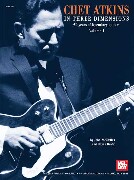
ATKINS CHET IN THREE DIMENSIONS VOLUME 1: 50 YEARS OF LEGENDARY GUITAR TABLATURE SPARTITI LIBRO

ATKINS CHET, IN THREE DIMENSIONS VOLUME 1: 50 YEARS OF LEGENDARY GUITAR. TABLATURE

LIBRO DI MUSICA FINGERSTYLE.
SPARTITI PER CHITARRA.
ACCORDI, PENTAGRAMMA E TABLATURE

By John McClellan and Deyan Bratic. For Guitar (Fingerpicking). Transcribed solos. Country. Book. 208 pages. Level: Advanced.

This tribute contains twenty-two of Chet's greatest solos and duets along with interviews with his daughter, Merle Atkins Russell and close friends such as Jerry Reed, Vince Gill, Eddy Arnold, Don Mclean and many others. This book offers touching insight into the character of an American original, who did much to shape the course of music history and the guitar. Most importantly, Chet Atkins helped thousands of people over the course of his life through kindness and generosity. To quote Jerry Reed, "There is only one." This book is a tribute to a special man, a special artist... a hero to the millions of lives he touched. The Atkins Family has shared many rare photographs which are presented in a special eight-page color insert. Selections include, Heartaches, Caravan, When You Wish Upon a Star (live version), Music to Watch Girls by, Stars and Stripes Forever, Jerry's Breakdown, Nashtown Ville and many others. All music is in standard notation and in tablature.


Introduction to the Music

Thoughts About Chet's Musicianship

In the words of Chet Atkins, "This is my opinion and it oughta be yours!" When you see a legitimate artist, you know it right away. Chet's core musicianship can be summed up succinctly. Rhythm, sound, color, counterpoint, and intonation were everything to Chet. Oftentimes, guitarists that play Chet's material make the mistake of playing too fast, out of tune, and with no regard for timbre or tone. To play Chet's music in this way is disrespectful to his artistry. We have an obligation to his memory to observe the following:

Play in tune! Chet never played out of tune.

Relax. Play in time, he never rushed his tempos, even when he played fast, the tempo was relaxed. He rode the beat, rather than pushing it.

Make a beautiful sound ... the quality of tone is important. Chet always had a beautiful fundamental in his sound. Listen to his old "Gretsch Country Gentlemen" on Chester and Lester, or his nylon sound on Chet Atkins Picks on Jerry Reed or The Night Atlanta Burned! Someone once said, "You will never produce a beautiful sound, if you don't first know what one is." Chet was all about playing pretty. Sound was everything.

He thought it was important to play to the strength of the guitar rather than to its weaknesses. He also felt the need to improve. I think we get set in our ways and stop growing, something Chet never did. Think about it! Don't arbitrarily make fingerings easier if it destroys the timbre of the phrase. When Chet fingered a passage a certain way, it was because the color of the notes was important to him! He used the color or timbre of the guitar better than any guitarist who ever lived. Chet also conceptualized music vertically and horizontally in a contrapuntal way, this influenced his fingerings, usage of color and his overall musical vision.

Sing. Chet was always singing! Singing through the guitar! He stressed the importance of knowing the lyrics to the songs you play, as this will help you create a more complete legato in your musical lines or phrases.

Listen to all types of music as Chet did. For example, he loved the jazz pianist Erroll Garner's Concert by the Sea. (available on CD at most record stores). Chet was very deep musically, he learned from everybody!

Jorge Morel called Chet, "The pure artist of the guitar!" I often think Chet is under appreciated. By considering the points I have just stated, we can all further Chet Atkins' memory and musical legacy.

About the Transcriptions

If you want to really learn from the master, listen carefully to a given piece several hundred times. This is the level of dedication given to Chet and his music within these pages! Every attempt has been made to transcribe " hat Chet really played into notes in a musical score. But how can one accurately translate so many nuances?

Musical notation isn't enough. It's like trying to explain the secret to producing a painting by Monet or a fine wine. It is impossible! You will find errors, and that is a good thing. It means you're listening and you care. Any mistakes that exist are made because we are human, not because of complacency. Our criteria for transcribing Chet's music was baser upon the diversity of the music and the diversity of Chet's fans. The musical elements that made each piece unique include sound/timbre, phrasing, rhythm, and technique. All these elements were given an extra degree of scrutiny during the transcribing and final proofing. We also used current computer technology to assure accuracy in translating the notes from the recording to the guitar, and finally, to paper...

... ou doing up here?" I told him. In order for him to sign my book, he had to give me his guitar, there was just no where to put it. He said, "Hold this!" He took the book; he was looking for suitable page to sign; he never did anything in a hurry. He was very careful. As he was looking at the book, he said, "Play me a little something!" So I put my foot up on the rung of the stool, I played, "Quiet Nights," that Jobim tune. He signed the book and we swapped back. All this is happening in a few seconds. He said, "You got a nice touch there ... you want to play on this show with me tonight?" Meanwhile, I could hear them start the introduction of Chet. He is getting off the stool, and I turned and said, "I don't have anything prepared, I better not!" Then, they were saying, "Here he is ... Chet Atkins!!" And walking away he says, "You'll be fine, sit there until I call you." And that was it. So then I got a choice, stay there like he told me to do, because he is going to call me, and if I'm not there, then that embarrasses him. I wasn't so stupid that I didn't know that! I am kind of stuck ... it is ice cold in there, I was freezing, my hands were pouring sweat. I was scared to death, but I didn't dare do something as rude as not play. Eventually, Boyce Hawkins, the host, is holding this cheap Gibson CO classical, asking Chet questions you would ask Chet Atkins. He asked Chet to play another one. Chet said, "Well Boyce, I found a kid out there in the studio. His name is David Conrad, he is from North Carolina ... " He remembered everything I said to him in those few seconds back stage, he just tossed it off! So he said, " Let's get him out here, he'll pick a tune for us!" ow, this Boyce fellow, freaked ... this was a live show shot to tape. He was looking from left to right, right to left, like a dog watching television. There I am, Chet kind of waving to me to come on in. I walked across the front and shook their hands and sat down between them. Boyce proceeds, now he is profesional and he cannot allow dead air space, so he jumps right in and says, "So you're from North Carolina. Are you in school? I said, "No sir, I am about to start college, I am visiting friends here. He said, "Chet says you're a pretty good guitar player, but I need you to play for the folks. You have got to prove it!" He shoves that little neo-classic into my hands, I'm trying to tune while he is asking me what I was going to play! The action was bad, not unplayable, mind you, but not ideal. Chet is sitting there and Boyce is looking at me and I am trying to tune this piece of junk of a guitar, Boyce says, "What are you going to play for us?" I said, "I would like to play "One Note Samba," by Jobim. I like Bossa Nova a lot!" Now keep in mind, As I'm still trying to tune ... something inside of me is telling me this is not what they are wanting to hear. The instant it became awkward, Chet gets up and went around and took the guitar from me and handed me his. Chet said, "I think he would rather play this one." It was a Juan Estruch, a beautiful guitar. I think this one was stolen while he was on one of his tours, it just never showed up at the airport. What a wonderful guitar, and personally at seventeen years old, I had never played a guitar that fine, never held one. The action was really low, perfect for me, of course, it came tuned and it played itself. It was just like velvet! I shouted, "A-flat," the band set up a groove, and away I went. Chet was sitting over there just noodling and tuning that bad guitar. I was very comfortable with the piece. When it came time for the bridge (sings the bridge), I just knew the chord progression there. It dawned on me, I had never done any chord melody there. So when I arrived at the bridge, I yelled, "Take the bridge!" I leaned over into Chet's face and he just ripped on through it, and played the heck out of it. On the bad guitar, of course the tone was all together different with Chet playing. From that point on, we were a duet. When we finished that one, we did "Satin Doll" and "Girl from Ipanema." Man, there were as many people coming up to me after the show as there was for Chet. At this point, I'm thinking, "I am not going home. I am not going to college. Momma can just send all my stuff over here!" We finally made our way to each other. I said, "This was one of the most wonderful things of my life, I'm committed to this! What can I say? Were do we go from here? Chet looked at me, then said, "Well, you're going back home to North Carolina and go to college, and I am going to go get a haircut! [laughs] He could see I was pretty disappointed and said, "Nah!, you go back home, I'm going to be here anytime you want or need me. Stay in touch, I'm not going anywhere! Go to school and come back and I'll be here ... we will pick another one!" Back then, there were a lot of golf tournaments throughout the South, still are, Pro-Am and Pro-Celebrity etc ... Chet, Jerry Reed, Boots Randolph and Floyd Cramer had a show called the All Stars. The whole deal with them, they made X. Cosse [Chet's manager] book these shows around golf tournaments. They would come and play, ...

Contents:

Preface
Acknowledgements
Introduction to the Music
David Conrad - "It's a Wonderful Life"
Caravan
Black Mountain Rag
Minuet - J.S. Bach
Eddy Arnold - "Make the World Go Away"
Heartaches
Cy Coben on Chet - "Chet's Tune"
Streets of Laredo
Tony Brown - "The King of Nashville"
Lagrima
Johnny Smith - "Walk Don't Run, Chet..."
Take Five
Going Home
Bob Beckham - "I know That's Right!"
Music to Watch Girls By
Vince Gill - "I Was in Guitar Heaven"
Avalon
Minute Waltz
Mainstreet Breakdown
Merle Atkins Russell - "Thank You Very Little"
The Stars and Stripes Forever
Jerry Reed on Chet - "Hail to the Chief"
Drive In
Jerry's Breakdown
Jorge Morel - "The Pure Artist of the Guitar"
Choro da Saudade
Recuerdos de la Alhambra
When you Wish Upon a Star
John McClellan - "A Boy's Tale"
Ray Stevens - "I Haven't Got the Carrot Yet!"
Oh By Jingo
Don Light - "He Nailed it Again!"
Nashtown Ville
Harry Warner - "They Called Him, Sir"
La Vie en Rose
Don McLean - "Starry, Starry Night"
Vincent (Starry, Starry Night)

Prezzo: €46,99
€46,99

5-STRING BANJO STYLES FOR 6-STRING GUITAR. CRAIG DOBBINS. CD TABLATURE

5-STRING BANJO STYLES FOR 6-STRING GUITAR. Dobbins. CD TABLATURE

Product Description:
This book/CD set presents six complete songs and 19 licks and patterns (in both standard and open G tuning) in the styles of banjoists Earl Scruggs and Allen Shelton, and guitarists Chet Atkins and Jerry Reed. (Also included is the 3-finger roll tour de force ‘Strike It Rich’ by 2001Winfield Fingerstyle Guitar Champion Richard Smith.) Written in standard notation and tablature, with fingerings, chord diagrams, and performance notes; a discography is included for further listening. The companion CD includes performances of all the songs, and the licks and patterns are demonstrated both slowly and up to tempo. For intermediate to advanced level guitarists.

I got the idea for this arrangement of "Weeping Willow" (also known as "Bury Me Beneath the Willow") from the banjo playing of Allen Shelton. Allen was with the legendary bluegrass band Jim and Jesse and the Virginia Boys for many years. Allen's recording of Weeping Willow is on his LP Five String Dobra and Banjo

Performance notes ... I begin the arrangement in classic Shelton-style, using aforward roll (p-i-m) pattern.

At measure 18 I change to claw hammer picking. I play the melody notes with my thumb and index finger, and the strums with the back of my middle fingernail.

At measure 34, I take a verse "up the neck," as bluegrass banjo players say, using block chords.

At measure 50, it's back to Shelton-style. I stole the ending lick from another one of my favorite banjo players, Buck Trent. Don't forget to tune your guitar to open G (D G D G B D, 6th-1st strings).

About the recording ... I used a Takamine classical, equipped with an L.R. Baggs pickup.

Product Number: 20622BCD

Format: Book/CD Set
ISBN: 0786670088
UPC: 796279092401
ISBN13: 9780786670086

Discography

For inspiration, check out these banjo players ...

Earl Scruggs
A true legend, his very name is synonymous with bluegrass banjo. Check out his classic 1950's tracks with Flatt & Scruggs on the albums Foggy Mountain Banjo and Foggy Mountain Jamboree (Columbia Records).
Earl's playing can also be heard on the landmark Will the Circle Be Unbroken CDs by the Dirt Band (with special guests).

Allen Shelton
Allen was with the legendary bluegrass band Jim and Jesse and the Virginia Boys for many years.
His pIay-ing can be heard on many recordings by Jim and Jesse, and on his own LP Five String Dobro and Banjo
(Atteiram Records).

Buck Trent
Buck was featured as banjoist and lead guitarist with Porter Wagoner, and recorded with Porter and Dolly Parton, among others. His "underground classic" LP Sounds of Now and Beyond (RCA Records) featured acoustic banjo, electric banjo, and electric nylon string banjo. For a list of Buck's current CDs and cassettes log on to . . . and guitar players, too!

Chet Atkins
Another legend whose very name is synonymous with his instrument. Just a few classic Atkins tracks featuring rolls are "Cascade" (from Me and My Guitar), "Rocky Top" (from Yestergroovin'), "Hellacious" (from Pickin'My Way), "Dizzy Fingers" (45 rpm single), and "Cosmic Square Dance" (from Stay Tuned).

Jerry Reed
Jerry adapted the three finger roll to create a new style all his own. His classic RCA albums Jerry Reed Explores Guitar Country and Georgia Sunshine are must-haves, as well as his duet albums with Chet Atkins
(Me and Jerry/Me and Chet.)

Carl Jackson
Carl played banjo with Jim and Jesse, banjo and guitar with Glen Campbell, and is also a respected compositer, vocalist, and producer. For a taste of his three finger roll style on guitar, check out "Hap Towne Breakdowne", from Steve Wariner's CD No More Mister Nice Guy (Arista Records).

About the music ...
This Richard Smith original is the title cut from the 1998 album by the Richard Smith Guitar Trio. With strong support from brothers Rob (on guitar) and Sam (on bass), Richard navigates the neck from stem to stem with melodic banjo rolls, pull offs, and even a little bit of b1uegrassy flatpicking.
Performance notes ... Richard plays three finger rolls with his thumb (p), index (i), and middle (m) fingers, varying the pattern to fit the melody. There's at least one spot (measure 7) where he uses afour finger roll (p-i-m-a). The lick can be played with a three finger roll however, by dragging your thumb across the 4th and 3rd strings. I have transcribed the first verse (beginning at measure 9) exactly as it is on the recording. Each repeat contains a few variations, which I have not included due to space limitations. At the first bridge (measure 44), Richard plays double stops (two note harmonies) above sustained bass notes. There's some great Jerry Reed style pull off licks in measures 46 and 54. At the second bridge (measure 60), Richard "flatpicks" Doc Watson style with his thumbpick. (For this hybrid picking technique, Richard favors a thin thumbpick, filed very short.) Play the scales in measures 78-80 and 85-86 with an alternating thumb and index finger. Check the fingering for the proper pattern (p-i or i-p).
About the recording ...
Says Richard: "I actually used a guitar that my Dad bought in Spain in the early 70's. A souvenir guitar from a touri t shop. You know, real cheap, about 20 dollars! I think the label inside says something like Viancee Tatay Thomas. It plays great though, and the sound is pretty good. Nice treble. It's also slightly smaller than a regular classical, so it's comfortable to sit around and play in the living room."

Acknowledgements
Introduction
Weeping Willow
Lonesome Road Blues
Old Joe Clark
Lily of the Valley
Hang Loose
Strike it Rich
Licks and Patterns
19 Exercises
Discography
About the Author 

Prezzo: €20,99
€20,99

TARREGA IN TABLATURE Ben Bolt BOOK CD GUITAR TABLATURE CHITARRA Recuerdoes De La Alhambra

TARREGA, IN TABLATURE. 25 composizioni per chitarra: Marieta! -Rosita -la mariposa -capricho arabe -recuerdos de la Alhambra, Maria. SHEET MUSIC BOOK WITH CD & GUITAR TABLATURE. 

LIBRO METODO DI MUSICA CLASSICA CON CD .
SPARTITI PER CHITARRA CON:
PENTAGRAMMA E TABLATURE.


By Francisco Tarrega (1852-1909), edited by Ben Bolt. Guitar solo book (includes tablature) for guitar. Text language English, Spanish, French, Japanese. 125 pages. With guitar tablature, standard notation and introductory text.

The importance of Francisco Tarrega in the history of the classic guitar is immeasurable. With his original compositions and transcriptions, Tarrega brought the classical guitar to new heights by giving it a repertoire of its own and consequently influencing virtually every modern day classical guitarist. In this volume, Ben Boldt presents 29 pieces by Tarrega in standard notation and tablature. Text in English, Spanish, French, and Japanese. Titles include:

Contents:
Prelude In E
Prelude In A Minor
Lagrima
Prelude In G Major
Prelude In D Major
Prelude In D Minor
Prelude In D
Prelude (Endecha)
Prelude (Lento)
Prelude (Moderato)
Prelude
Prelude
Prelude
Prelude
Prelude In A
Prelude In A Minor
Prelude In A Major
Danza Mora
Marieta! (Mazurca)
Mazurca En Sol
Maria
Minuetto
Adelita (Mazurca)
Pavana
La Alborada
Capricho Arabe (Serenata)
The Butterfly (La Mariposa)
Rosita
Recuerdoes De La Alhambra

Prezzo: €24,99
€24,99

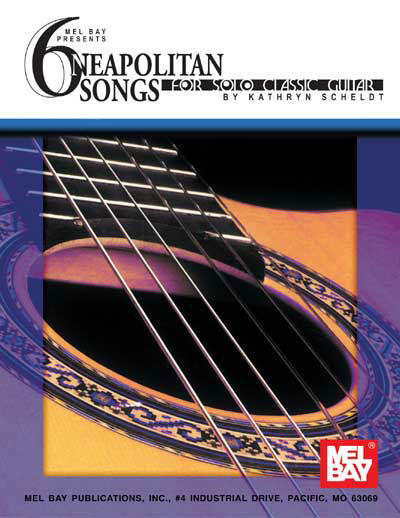
6 NEAPOLITAN SONGS FOR SOLO CLASSIC GUITAR-KATHRYN SCHELDT-MEL BAY-REGINELLA-SPARTITI

6 NEAPOLITAN SONGS FOR SOLO CLASSIC GUITAR, Kathryn Scheldt.
For Italy, the country of beauty, romance and song; the land that inspired this book. 

LIBRO DI MUSICA

SPARTITI PER CHITARRA, ACCORDI, PENTAGRAMMA.

Ogni pezzo e presentato in 2 versioni: per chitarra classica e per accompagnamento con la griglia degli accordi. 


Product Description:
Instructor, arranger, performer and songwriter Kathryn Scheldt gives you two versions of each song included: 1.) Solos for classic guitar intermediate to more advanced; including "Torna a Surriento" (Come Back to Sorrento). 2.) Chord accompaniments for guitar; melody for voice and/or treble instruments; original Neapolitan lyrics with English translations.
Format: Book

Song Title: Composer/Source:
'O Zampugnaro Innammurato A. Gill; Arranged by Kathryn Scheldt; Text and Music by A. Gill
Fenesta che Lucive! Arranged by Kathryn Scheldt; V. Bellini
Maria, Mari'!! E. di Capua; Arranged by Kathryn Scheldt; Text and Music by E. di Capua
Reginella G. Lama; Arranged by Kathryn Scheldt; Text by L. Bovio; Music by Gaetano Lama
Torna a Surriento E. de Curtis; Arranged by Kathryn Scheldt; Text by G.B. de Curtis; Music by E. de Curtis
Tu ca nun chiagne E. de Curtis; Arranged by Kathryn Scheldt; Text by L. Bovio; Music by E. de Curtis

Prezzo: €16,99
€16,99
Condividi contenuti