SPARTITI PER CHITARRA SOLISTA, SCALE MODI, ARPEGGI, SOLOING

LIBRI, METODI, MANUALI, SPARTITI, TABLATURE, SCALE, SOLOING, SCALE MODALI, ARPEGGI, PENTATONICHE,

LEAD GUITAR SECRETS LIBRO CD TABLATURE CHITARRA METODO SPARTITI SOLISTA SCALE

LEAD GUITAR SECRETS, GUITAR EDUCATIONAL. LIBRO CON CD E TABLATURE

HAL LEONARD

LIBRO METODO DI MUSICA ROCK, CON CD.
SPARTITI PER CHITARRA .
ACCORDI, GRAFICO DELLA TASTIERA, PENTAGRAMMA E TABLATURE.
PENTABLATURE

Lead Guitar Secrets
Unlock the Mysteries of Creating Great Solos
Series: Guitar Educational
Format: Softcover with CD - TAB
Author: Kirk Tatnall

Learn the fine art of lead guitar soloing from the ground up with Lead Guitar Secrets. This well-paced, methodical workbook focuses on the essential components of great guitar solos without the typical deluge of dry music theory instruction. You'll get hands-on training with: an 80-track audio CD featuring many play-along backing tracks for soloing practice; an organized, logical approach that takes you from basic melodic soloing over one chord to more advanced concepts with common chord progressions; a breakdown of the core fretboard scale patterns and how to effectively connect them up and down the neck; rhythmic phrasing and articulation techniques such as bending, vibrato & legato; tools and concepts that provide a solid foundation in improvisation; invaluable skills that are useful in all music genres; and more! Perfect for getting started with lead guitar or expanding one's existing soloing capabilities. The seasoned player could also gain a fresh perspective via the practical and systematic methodology, possibly unlocking some previously overlooked Lead Guitar Secrets.

€ 26.99
Inventory #HL 00696470
ISBN: 9781617803581
UPC: 884088548308
Width: 9.0"
Length: 12.0"
112 pages

Prezzo: €26,99
€26,99

GUITARIST'S GUIDE TO SCALES OVER CHORDS, THE FOUNDATION OF MELODIC SOLOING. CHAD JOHNSON. CD TABLATURE

GUITARIST'S GUIDE TO SCALES OVER CHORDS, THE FOUNDATION OF MELODIC SOLOING. CHAD JOHNSON. CD TABLATURE

LIBRO CON CD

Series: Guitar Educational
Format: Softcover with CD - TAB
Author: Chad Johnson

Lots of guitar players know several scales, but how many really know what to do with them? With Guitarist's Guide to Scales Over Chords, you'll learn how to apply the most commonly used scales in a musical manner. This book examines how scales and chords are closely linked and how this relationship is key to crafting memorable, intelligent solos. If you've been stuck in a pentatonic rut, or you feel that you're constantly relying on the same old patterns, this is the book for you! The book covers 14 scales in detail, and the CD contains 99 tracks, including 15 backing track progressions for practice.

96 pages 

Prezzo: €26,99
€26,99

GUITAR TRAINING SESSION SOLI E IMPROVVISAZIONI HEAVY-METAL Judge Fredd AC/DC DEEP PURPLE JUDAS PRIEST

GUITAR TRAINING SESSION, SOLI & IMPROVVISAZIONI HEAVY-METAL. Judge Fredd

LIBRO PER CHITARRA CON CD E TABLATURE

IN ITALIANO

Guitar Training Session è una collezione di metodi destinati a far lavorare il chitarrista in condizioni musicali simili a quelle del gruppo. Infatti, il CD allegato contiene 12 play-back completi (batteria - basso - chitarre) sui quali il chitarrista dovrà allenarsi all'improvvisazione, al ruolo di solista, e ciò con l'aiuto di esempi musicali e di numerosi consigli giudiziosi. Quest'opera è quindi più un supporto di espressione per il chitarrista che un metodo propriamente detto. Egli potrà applicarsi a riprodurre scrupolosamente gli esempi di soli presentati in questo libro ed arricchirsi in questo modo di qualche idea di interpretazione oppure potrà ispirarsene per elaborare delle improvvisazioni più personali. La scelta del metodo di lavoro rimane così libera ed aperta secondo il livello tecnico e l'approccio musicale di ognuno.

Guitar Training Session è una collezione di metodi destinati a
far lavorare il chitarrista in condizioni musicali simili a quelle del
gruppo. Infatti, il CD allegato contiene 12 playalongs completi
(batteria - basso - chitarre) sui quali il chitarrista dovrà allenarsi
all'improvvisazione, al ruolo di solista, e ciò con l'aiuto di esempi
musicali e di numerosi consigli giudiziosi.
Quest'opera è quindi più un supporto di espressione per il
chitarrista che un metodo propriamente detto. Egli potrà applicarsi
a riprodurre scrupolosamente gli esempi di soli presentati in
questo libro ed arricchirsi in questo modo di qualche idea di
interpretazione oppure potrà ispirarsene per elaborare delle
improvvisazioni più personali. La scelta del metodo di lavoro
rimane così libera ed aperta secondo il livello tecnico e l'approccio
musicale di ognuno.
Quest'opera, infine, presenta dei titoli di difficoltà variabile e
presenta diversi stili musicali (Hard Rock, Hard FM, Heavy
Metal, Trash ...) al fine di arricchire tutti gli aspetti del vostro modo
di suonare.
Guitar Training Session esiste ugualmente nelle versioni Blues,
Jazz ed in quella Rock.
 

PRESENTAZIONE
Guitar Training Session è una collezione di metodi destinati a far lavorare il chitarrista in condizioni musicali simili a quelle del gruppo. Infatti, il CD allegato contiene 12 play-back completi (batteria - basso - chitarre) sui quali il chitarrista dovrà suonare un'interpretazione guidata ma personale di soli di heavy-metal.
Quest'opera è quindi più un supporto di espressione per il chitarrista che un metodo propriamente detto. Egli potrà applicarsi a riprodurre scrupolosamente gli esempi di soli presentati nel libro ed arricchirsi in questo modo di qualche idea di interpretazione oppure potrà ispirarsene per elaborare delle improvvisazioni più personali.
La scelta del metodo di lavoro rimane in questo modo libera ed aperta secondo il livello tecnico e l'approccio musicale di ognuno.
Sembra importante invece, con questo tipo di lavoro, registrarvi mentre suonate le versioni proposte ed altre più personali, al fine di poter poi paragonarle.
Quest'opera, infine, presenta dei titoli di difficoltà variabile, dai più elementari ai più evoluti, sia per la struttura armonica che per le tecniche di interpretazione. Il chitarrista dovrà quindi lavorare secondo il suo livello e poi cominciare progressivamente con i titoli più difficili. Sarà pertanto interessante soffermarsi su ogni stile (Hard Rock, Hard FM, Heavy Metal, Trash ...) perchè corrispondono a certi movimenti musicali, certe epoche e devono quindi essere suonati nello "stile". Percio' sarà bene riferirsi ad una discografia seria che potrà rivelarsi un'ottima guida.
Oltre le informazioni relative ad ogni pezzo, sappiate che le scale pentatoniche minori, pentatoniche maggiori e blues potranno (e dovranno) essere utilizzate ad oltranza su ogni pezzo.

NOTAZIONE
Per delle ragioni pratiche, è il "vocabolario" anglo-sassone che è stato utilizzato, visto che è quello che è più spesso presente sul mercato dei metodi e quindi, a priori, quello che vi è più familiare.

A PROPOSITO DEI. CD
Il CD vi presenta i 12 titoli completi. Ogni pezzo inizia con la formazione completa (Basso - Batteria - Chitarre Ritmiche - Chitarra solo) poi, alla fine del primo ciclo, la chitarra solo sparisce al fine di darvi il cambio. Avete allora la scelta o di copiare l'esempio di solo suonato precedentemente (e verificare in questo modo l'esattezza della vostra esecuzione) oppure di improvvisare liberamente (e completare quindi il pezzo).
 

12 Assolo in stile:

LED ZEPPELIN, JIMMY PAGE

DEEP PURPLE, RITCHIE BLACKMORE

AC/DC , ANGUS YOUNG

JUDAS PRIEST, GLENN TIPTON

METALLICA, Kirk Hammett

AEROSMITH, JOE PERRY

ANTHRAX, Dan Spitz

YNGWIE MALMSTEEN

... e altri

Prezzo: €20,99
€20,99

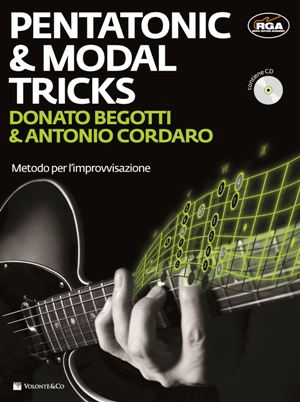
PENTATONIC & MODAL TRICKS CD chitarra TABLATURE Donato Begotti, Antonio Cordaro

PENTATONIC & MODAL TRICKS. CD TABLATURE

Donato Begotti, Antonio Cordaro

IN ITALIANO

Donato Begotti, che questa volta ha realizzato, insieme al bravissimo Antonio Cordaro, un corso d'improvvisazione diviso in otto lezioni, appositamente studiato per chi desidera imparare ad utilizzare le scale pentatoniche e i modi della scala maggiore, in maniera immediata e creativa. È frutto di anni di esperienza maturata nel campo della didattica Rock, Blues e Pop. Mediante lo studio di diversi generi musicali, si potrà:

sviluppare un fraseggio efficace,

ottenere una visione chiara della tastiera,

migliorare l'orecchio relativo,

potenziare la tecnica,

migliorare la conoscenza della teoria musicale,

stimolare la propria creatività.


Spiegazioni, consigli pratici, diteggiature e regole per guidare le tue improvvisazioni.

Nel CD, 48 esemi musicali e 46 basi per improvvisare, arrangiati come un disco e nello stile di chitarristi di fama mondiale. Per imparare, facilmente e divertendosi, a improvvisare. Pagine 80
 

Ciao e benvenuto in ''Pentatonic It Modal Tricks"!
• Che cos'è?
è un corso d'improwisazione diviso in otto lezioni, appositamente studiato per chi desidera
imparare ad utilizzare Ie scale pentatoniche ed i modi della scala maggiore, in maniera immediata e creativa.
è anche divertente! Suonerai infatti su basi musicali arrangiate come un disco e nello stile di chitarristi di fama mondiale.
è frutto di anni di esperienza maturata nel campo della didattica Rock, Blues e Pop. Mediante lo studio di diversi generi musicali:

Accordatore

BUON DIVERTIMENTO!
è comunque suggerito corredare lo studio di questa metoda con que//o delI'armonia.
2. A partire dalla secondo /ezione in poi.
3. Di lunga durata. per permetterti di improwisare per maggior tempo.

II principio portante
Costruire il proprio fraseggio modale utilizzando Ie scale pentatoniche come scheletro e struttura di base.
• L'esecuzione: è la prima traccia, il suo numero è sempre pari (es. 2, 4, 6 ecc.) e di colore nero
• La base: è la seconda traccia, il suo numero è sempre dispari (es. 3, 5, 7 ecc.) e di colore grigio
• Sviluppare un fraseggio efficace
• Ottenere una visione chiara della tastiera
• Migliorare I'orecchio relativo
• Potenziare la tecnica
• Migliorare la conoscenza della teoria musicale
• Stimolare la tua creatività

In ognuna incontrerai:
• Spiegazioni, diteggiature e regole. Per guidare Ie tue improwisazioni
• 4/5 esempi musicali. Per fare pratica sull'utilizzo della scala oggetto della lezione ed esserti di ispirazione per la creazione dei tuoi lick
• 1 assolo2 Per riassumere e consolidare, ad un livello piu alto, i principi affrontati nella lezione
• Descrizione delle lezioni
• CD audio
Contiene Ie tracce audio con Ie esecuzioni e relative basi3 :
 

Indice
Dediche
Credits
Indice
Gli Autori
Donato Begotti
Antonio Cordaro
Ciao e benvenuto in "pentatonic & Modal Tricks"
Che cos'è ?
Il principio portante
Descrizione delle lezioni
CD audio .
Il principio visto da vicino
Da dove iniziare?
Teoria
Le scale pentatoniche
I modi: Approccio Derivato e Parallelo
Esercizi l
Chord Tone
Ordine dei capitoli

lezione 1
Scale pentatoniche minori e maggiori
Diteggiature
Hotline l
Hotline 2
Hotline 3
Hotline 4
Hotline 5

Lezione 2
Pentatoniche "mixate" e colori "estranei"
Hotline l
Hotline 2
Hotline 3
Hotline 4
Assolo

Lezione 3
Il modo Eolio
Diteggiature
Hotline l
Hotline 2
Hotline 3
Hotline 4
Assolo

Lezione 4
modo Dorico
Diteggiature .
Hotline l .
Hotline 2 .
Hotline 3 .
Hotline 4 .
Assolo .

Lezione 5 .
Il modo Ionico .
Diteggiature .
Hotline l .
Hotline 2 .
Hotline 3 .
Hotline 4 .
Assolo .

lezione 6 .
Il modo Lidio .
Diteggiature .
Hotline l .
Hotline 2 .
Hotline 3 .
Hotline 4 .
Assolo .

Lezione 7 .
Il modo Misolidio .
Diteggiature .
Hotline l .
Hotline 2 .
Hotline 3 .
Hotline 4 .
Hotline 5 .
Assolo .

Lezione 8 .
Il modo Frigio .
Diteggiature .
Hotline l .
Hotline .2 .
Hotline 3 .
Hotline 4 .
Hotline 5 .
Assolo .
Fundamentals .
Consigli pratici .
The making of .
Ringraziamenti .
 

Prezzo: €19,99
€19,99

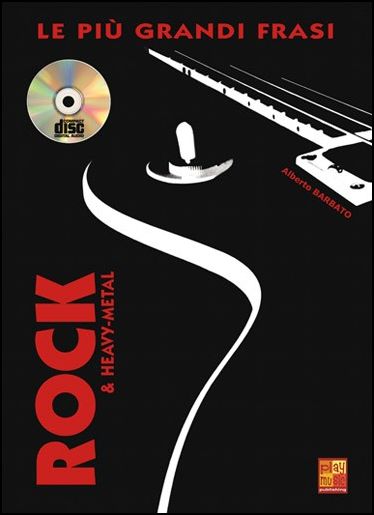
LE PIU' GRANDI FRASI ROCK & HEAVY-METAL CD TABLATURE Van Halen-Clapton-Satriani-Angus Young-VAI

LE PIU' GRANDI FRASI ROCK & HEAVY-METAL, LIBRO CON CD e GUITAR TABLATURE .

LIBRO DI MUSICA ROCK CON CD.

SPARTITI PER CHITARRA CON : 

ACCORDI, PENTAGRAMMA, TABLATURE . 

187 FRASI 

IN ITALIANO

Un'opera totalmente dedicata al Rock, una vera enciclopedia dello stile, una raccolta completa di frasi, di «clichés», di «licks» ricavati dai più grandi chitarristi. Troverete in quest'opera circa 200 frasi indispensabili, di difficoltà crescente. La pratica di queste frasi costituirà sia un lavoro di orecchio sia un lavoro tecnico che arricchirà notevolmente il vostro modo di suonare, la vostra scioltezza musicale ma anche e soprattutto la vostra capacità d'improvvisazione, acquistando un vero vocabolario rock. Ogni frase è accompagnata d'informazioni complementari come il supporto melodico utilizzato (scala, modo, arpeggio...) e l'accordo sul quale deve essere interpretato. Ciò per permettervi di capire tutto e quindi di essere capaci di utilizzare in seguito queste frasi in contesti diversi (tonalità...). Quest'opera non vuole essere un'opera a se stante, ma piuttosto il punto di partenza di un lavoro ancora più approfondito, più creativo.
Albert Barbato

Queste frasi hanno dunque anche lo scopo di aiutarvi a sviluppare le vostre proprie idee.
Il CD vi permetterà di sentire ogni frase e quindi di perfezionarne l'esecuzione.

ISBN 978-88-50723-76-8
 

AVVERTIMENTO
Le 187 frasi o "Iick" trascritte in questo libro fanno parte integrante del vocabolario musicale utilizzato nel "Rock". Sono ricavate dalle opere dei più grandi chitarristi (Van Halen, Clapton, Satriani, Angus Young, ecc.) e sono, oggi, per la maggior parte, dei "clichés", delle frasi di riferimento che potranno arricchire notevolmente il vostro modo di suonare.

La pratica di queste frasi costituisce sia un lavoro di orecchio sia un lavoro tecnico. Vi permetterà in certi casi di sentire nuovi "colori" e di poter ritrovarli sul vostro manico.
Affinché il vostro lavoro sia completamente efficace, non esitate a cercare le vostre proprie frasi utilizzando solamente l'inizio della frase o la fine, o il colore armonico o ancora il ritmo degli esempi di questo libro. Date libero corso alla vostra immaginazione e siate produttivi!
Questo libro, costituito da una serie di "Iick", non vuole essere un'opera a se stante, ma piuttosto il punto di partenza di un lavoro ancora più approfondito.
Troverete quindi con ogni frase delle informazioni complementari che riguardano:
• Il supporto melodico utilizzato (scala, modo, arpeggio, triade, ecc.).
• L'accordo sul quale deve (o puo' ) essere interpretata la frase.
Queste informazioni vi permetteranno di utilizzare le frasi in altri contesti (tonalità diversa, ecc.), di apportare variazioni, complementi al fine di personalizzarle ed integrarle cosi' facendo alla vostra esecuzione. Quando appare la parola SWING, cio' significa che l'interpretazione deve essere ternaria.
Per quel che riguarda il CD, non è stato ovviamente possibile fare 187 brani musicali diversi visto che la tecnica ci limita a 99. E quindi le frasi sono state suddivise in 19 gruppi di 10 frasi l'uno.
• La prima selezione racchiude le frasi: 1 a 10
• La 2a selezione racchiude le frasi :.11 a 20
• La 3a selezione racchiude le frasi: 21 a 30
ecc ...
• La 18a selezione racchiude le frasi: 171 a 180
• La 19a selezione racchiude le frasi: 181 a 187
Approfittate del CD per ben ascoltare ed individuare le frasi che vi piacciono. Utilizzatelo ugualmente per correggere i vostri errori e perfezionare in questo modo la vostra interpretazione.

GOING HOME - ALVIN LEE

STEVE VAI


Prezzo: €22,50
€22,50

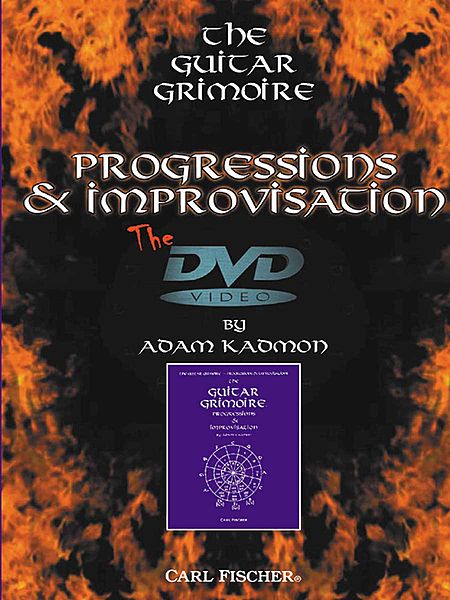
THE GUITAR GRIMOIRE PROGRESSIONS AND IMPROVISATION BY ADAM KADMON. FOR GUITAR INSTRUCTIONAL DVD.

THE GUITAR GRIMOIRE: PROGRESSIONS AND IMPROVISATION VOLUME 3. BY ADAM KADMON. FOR GUITAR. INSTRUCTIONAL DVD.


Standard notation. Duration 120 minutes. Published by Carl Fischer (CF.DVD4).
ISBN 082584908X. With Standard notation.
The wizard of the guitar himself reveals the mysteries of playing the guitar in this best-selling collection. Guitar students are given the opportunity to see and hear Adam Kadmon demonstrate the techniques that have helped make the books of the Guitar Grimoire series among the most popular guitar pedagogy publications of all time. With this series, which parallels the related books, guitar players have the opportunity to push their playing to much higher levels of achievement. Each DVD is appropriate for guitarists of all levels of skill.


Lesson 1 - Scale Tone Degrees
Lesson 2 - Circle of Fifths
Lesson 3 - Circle Progressions
Lesson 4 - Scale Tone Degree Alterations
Lesson 5 - Instant Song Creator
Lesson 6 - Improvising over 12-Bar Progressions
Lesson 7 - Soloing within a Window
Lesson 8 - Soloing over Diatonic and Circle Progressions
Lesson 9 - Soloing over Scale Tone Degree Progressions

Prezzo: €32,99
€32,99

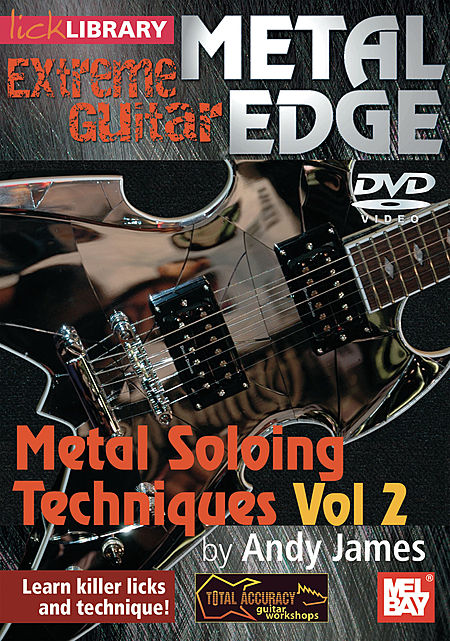
METAL EDGE: METAL SOLOING TECHNIQUES Volume 2, Andy James. DVD

METAL EDGE: METAL SOLOING TECHNIQUES Volume 2, Andy James. DVD 


Learn metal soloing techniques with Andy James. 

Take your shredding to the next level as you learn the killer technique used on three tracks from Andy’s latest album! 

Increase your musical knowledge with an arsenal of licks and techniques including string skipping, sweep picking, tapping techniques, alternate picking, metal rhythm techniques and much more. Also includes three jam tracks. 
 

Prezzo: €23,00
€23,00

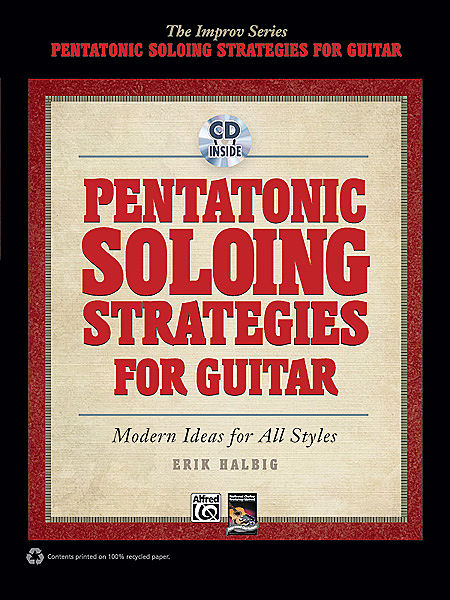
PENTATONIC SOLOING STRATEGIES FOR GUITAR, Modern Ideas for All Styles. Erik Halbig. CD TABLATURE


PENTATONIC SOLOING STRATEGIES FOR GUITAR, Modern Ideas for All Styles. Erik Halbig. CD TABLATURE

Pentatonic Soloing Strategies per la chitarra prende i più comuni strumenti di improvvisazione, le scale pentatoniche, e vi  fa vedere le sue praticamente illimitate possibilità.  Inizia con scale pentatoniche standard magiori e minori nelle 5 posizioni base e continua con la sfida delle variazioni pentatoniche per string skipping e sweep picking. Il libro culmina con le serie delle scale ?, compreso la 9-a tonica, diminuita, e la scala pentatonica a tono pieno aumentata. CD con la dimostrazione di tutti gli esempi inclusi nel libro.

Pentatonic Soloing Strategies for Guitar Modern Ideas for All Styles
By Erik Halbig
Item: 00-35302
UPC: 038081396064
ISBN 10: 0739070967
ISBN 13: 9780739070963

Series: The Improv Series
Category: Guitar Method or Supplement
Format: Book & CD
Instrument: Guitar

Pentatonic Soloing Strategies for Guitar takes the most common improvisational tool, the pentatonic scale, and shows you its almost limitless possibilities. It begins with standard major and minor pentatonic scales in the five basic positions and quickly moves into challenging pentatonic variations for string skipping and sweep picking. The book culminates with a series of substitution scales, including the rootless 9th, the half-diminished, and the whole-tone augmented pentatonic scales. A CD demonstrating all the examples in the book is included:

FEATURES

THEORY, FORMS AND VARIATIONS FOR MAJOR AND MINOR PENTATONIC SCALES.

PENTATONIC SCALE PATTERNS THAT INCORPORATE SWEEP PICKING AND STRING SKIPPING.

EXTENDED INTERVAL FINGERINGS

12 SUBSTITUION SCALES TO EXPAND YOUR TONAL VOCABULARY AND ADD COLOR TO YOUR PLAYING.

EXAMPLES IN TAB AND STANDARD MUSIC NOTATION.


INTRODUCTION
The pentatonic scale is a scale consisting of five notes. It can be found in almost every style of music, from early African-American spirituals such as "Swing Low, Sweet Chariot" to the classical compositions of Claude Debussy and Maurice Ravel to the bluesy rock guitar sounds of Jimi Hendrix, Jimmy Page, and Eric Clapton.
Players sometimes fall into the rut of playing the "same old pentatonic licks." This book-which will change how you think about the pentatonic scale-is the remedy for this situation.
This is not a beginner's book. To use it effectively, you should already have a working knowledge of music, music theory, and the minor and major pentatonic scales. However, a quick review of the basics is included on page 5. A review of the minor and major pentatonic scales follows (starting on page 11), after which you will learn many new and exciting ways to manipulate and rework these basic scales. Most importantly, practical applications are provided.
There are lots of new ideas in this book to stimulate your own creativity. You can write
down ideas that come to you on the blank page (page 95) at the end of this book. Good luck!

A compact disc is included with this book. Use the CD to help ensure you're capturing the
feel of the examples and interpreting the rhythms correctly. The symbol shown at the left
appears next to every example that is on the CD. Example numbers are above the symbol,
while the track number below the symbol corresponds directly to the example you want to
hear. If there's a decimal (1.1,1.2, etc.), it means that there's more than one example on the
track. Track I provides tuning notes for your guitar.

ABOUT THE AUTHOR
Erik Halbig holds a degree in studio/jazz guitar performance from the University of
Southern California School of Music. He has presented numerous clinics and special
seminars at the California and Nashville campuses of the National Guitar Workshop.
He is also the author of two other Alfred/National Guitar Workshop titles: Mastering
Rock Guitar (#14096) and Stand Alone Tracks: Country (#17805). Currently living
in Nashville, Tennessee, Erik is busy doing session work and touring. He has toured
and recorded with Sugarland, Sara Evans, Blackhawk, Tanya Tucker, Wynonna,
and many others.

Acknowledgements
Thanks to Bruce Bolen, Jr. at Fender Guitars, Myles Rose at Groove Tubes, Ryan
and Chris at Gadow Guitars, Derek Brooks at Ernie Ball, Danica Levy at Levy's
Leathers, James Heidrich at Bad Cat Amplifiers, Steve Blucher at DiMarzio,
Michael Tuttle, Don Grosh, and Ampeg Amplifiers.


CONTENTS
About the Author .
Introduction .
Getting Started .
Whole Steps, Half Steps, and Scales .
Standard Music Notation .
Tablature (TAB) .
Sliding .
The Guitar Fretboard .
Pentatonic Theory , .
The Major Scale .
The Minor Pentatonic Scale .
The Major Pentatonic Scale ; .
The Minor Pentatonic Scale .
Five Minor Pentatonic Scale Forms in A .
The Major Pentatonic Scale .
Five Major Pentatonic Scale Forms in A .
Variations .
Variation I-Sliding Combinations .
Variation 2- Weaving Combinations .
Variation 3-Extended Weaving Combinations .
Variation 4-Extended Weaving and Sliding Combinations .
Variation 5-Skipping and Weaving .
Variation 6-Sequenee Weaving .
Variation 7-Weaving and Sliding .
Extended Interval Fingerings .
Extended 4th Intervals .
Extended 5th Intervals ,. .
Extended 7th Intervals .
Penta-Scales .
Pentatonic Motives .
Four-Note Motives .
Five-Note Motives .
String-Skipping Pentatonics .
One-Note-Per-String Pentatonics-Sweep Picking .
One-Note-Per-String Pentatonic Combinations .
Substitutions .
Rootless 9th Pentatonic Scale .
Dominant 7th/9th Pentatonic Scale .
Minor 6th Pentatonic Scale .
Minor 6th Blues Pentatonic Scale .
Lydian Dominant Pentatonic Scale .
Half-Diminished Pentatonic Scale .
Lydian Pentatonic Scale .
Dominant Pentatonic Scale .
Altered Dominant Pentatonic Scale .
Whole Tone Augmented Pentatonic Scale .
Dominant 7b9 Pentatonic Scale .
Diminished Pentatonic Scale .
Conclusion .
 

Prezzo: €21,99
€21,99

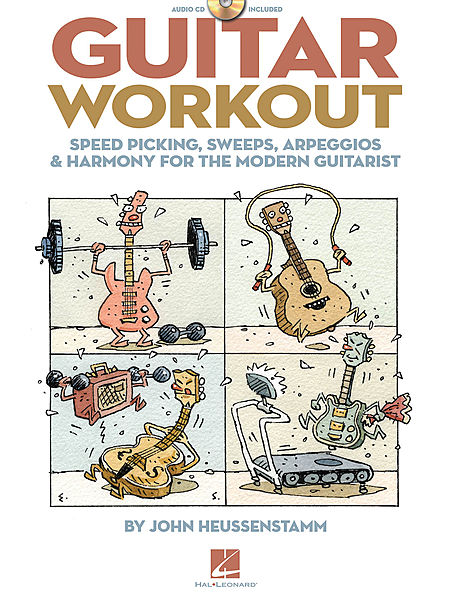
GUITAR WORKOUT, SPEED PICKING, SWEEPS, ARPEGGIOS HARMONY, John Heussenstam. CD TABLATURE

GUITAR WORKOUT, SPEED PICKING, SWEEPS, ARPEGGIOS AND HARMONY For The Modern Guitarist, John Heussenstam. CD TABLATURE

Guitar Workout

Speed Picking, Sweeps, Arpeggios & Harmony for the Modern Guitarist
Serie: Guitar Educational
Formato: Softcover with CD - TAB
Autore: John Heussenstamm

Guitar Workout è un programma intensivo e completo che aumenterà la tua velocità, agilità e creatività. Questo è  un libro di esercizi fondamentali per i chitarristi che vogliono accellerare e articolare lo speed picking. Preparazione professionale insieme alla migliore comprensione delle scale maggiori diatoniche, armonia delle scale, la tecnica del picking che richiede unione di riff e assoli superveloci con l'intelligenza e creatività melodica. Il chitarrista di fama internazionale John Heussenstamm vi dimostrerà gli esercizi di riscaldamento a note singole, esercizi per aumentare la velocità, schemi di ditteggiatura, sweeps, arpeggi, costruzione melodica.

Larghezza: 9.0"
Altezza: 12.0"
154 pagine


ABOUT THE AUTHOR

I come from a musical family.My great grandfather and grandmother Erica had a music conservatorium in Germany. Mygrandmother fled Germany soon after World WarIand settled in Hollywood, California, where she raised four children and taught classical piano and voice lessons. My uncle George taught advanced music theory at the college level and beyond. I started learning piano at the age of four, but that didn't last long! Like most kids, I found playing football on the street with my brothers much more to my liking. I fought with my grandmother about practicing the piano. She claimed that I did all my exercises correctly and had my parents excited about my potential as a pianist. Not long after that, I heard my uncle Peter practicing Flamenco guitar, and that was the sound that inspired me to learn. It was Peter that gave me my first guitar lesson when I was eight years old. In elementary school, they didn't offer guitar, so I was given a cornet from my uncle Sonny on my mother's side of the family. I played that horn for four years in the school band but eventually traded it for a Gibson EBOelectric bass. Around that time, my aunt Barbara, who was married to famous saxophonist George Weidler of the Stan Kenton Band, gave me an old Fender Precision bass and a Standel amp. I used to load that gear on my red wagon, haul it around the neighborhood, and jam for hours with kids in local surf bands. Back in the early sixties, there weren't many bassists, so I was in demand and constantly working in groups until I left high school. After graduating, I traveled to Mexico in a VWcamper on a three-month surfing trip with my brother Paul. I brought along an old Gibson L12 archtop jazz guitar and constantly practiced the entire tripwhenever my brother was driving, I would sit in the back of the vehicle and practice. By the end of the journey, I was ready to start playing in bands. When I turned 21, I hit the road and started touring. Through a friend, I got an audition with a group out of New Orleans called Lovera. That job introduced me to rhythm and blues, and that influence has remained with me. I try to instill in all my students the feeling of that music-a music that we should be proud of.My first jazz teacher, Tito at WestLAMusic, used to say to me, "You should be proud of the great jazz and blues that comes out of America." I also had private lessons with some great guitarists: Joe Pass, Ted Greene, and Bob Conti. I auditioned for a gig with the great soul singer Deniece Williams and got the job playing funky soul music. I was the only white guy in the band. Because of my experience with Lovera, I was familiar with that style. Deniece later went on to win two Grammy Awards, and I am proud to have been a small part of her career. While visiting my brother, Mark, in West Australia, I met my future wife, Julie. After returning to California, I briefly studied Indian music with Ali Akbar in San Rafael, California. We eventually returned to Australia and settled in Perth. From 1980 to 1990, I taught guitar and toured around Australia in my own bands. I've always had a burning desire to play music, and that has led me back to America where it all started. John Heussenstamm John is currently living in Laguna Beach, California, and teaches at The Guitar Shoppe in Laguna.  


CONTENTS:

TITLE

Foreword

Introduction

Section I: The Major Scale

Chapter 1 - Basic Major-Scale Theory

Chapter 2 - Picking

Chapter 3 - Positions and Fingerings

Chapter 4 - The Three-Octave System

Chapter 5 - Three-Note Exercises

Chapter 6 - Two-String Fingering Patterns

Chapter 7 - Concept Review

Section II: Arpeggios

Chapter 8 - Three-Note Arpeggios

Chapter 9 - Four-Note Arpeggios

Chapter 10 - Transferring Melodies

Chapter 11- Modern Inventions

Chapter 12 - Advanced Arpeggios

Chapter 13 - A Note on Musicianship

Chapter 14- Melodic Invention

Section III: Modes and Other Scales

Chapter 15- Modes

Chapter 16- Scale Treatment

Chapter 17 - The Harmonic Minor Scale

Chapter 18 - The Melodic Minor Scale

Chapter 19- The Diminished Scale

Chapter 20 - The Whole Tone Scale

Section IV: Pentatonic Scales

Chapter 21 - The Minor Pentatonic Scale

Chapter 22 - The Major Pentatonic Scale

Chapter 23 - The Minor Pentatonic 6th Scale

Chapter 24 - The Eastern Pentatonic Scale

Section V: Special Guitar Techniques

Chapter 25 - The Ornaments (Colorations)

Chapter 26 - Tapping

Chapter 27 - Monster Licks

Appendix

Harmonic Description (in the key of C)

Changing Keys

Understanding Keys

About the Author

Guitar Notation Legend

Prezzo: €25,99
€25,99

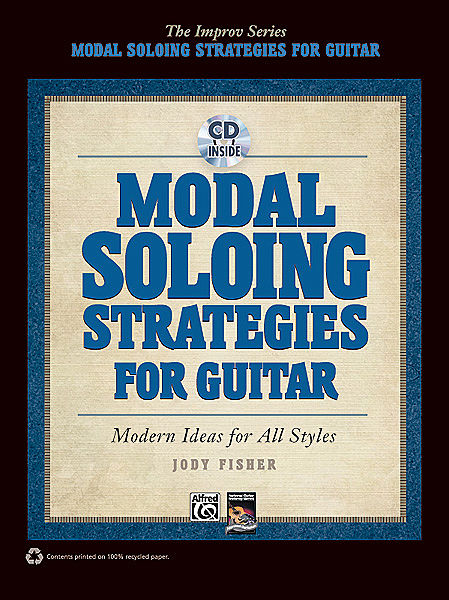
MODAL SOLOING STRATEGIES FOR GUITAR-MODERN IDEAS FOR ALL STYLES-JODY FISHER CD TABLATURE LIBRO

MODAL SOLOING STRATEGIES FOR GUITAR, Modern Ideas for All Styles. BOOK WITH CD & TABLATURE

LIBRO METODO DI MUSICA CON CD. 

SPARTITI PER CHITARRA CON:

ACCORDI, DISEGNO DELLA TASTIERA, PENTAGRAMMA, TABLATURE

SOLISTA, ARMONIA, STUDIO, MANUALE, 

By Jody Fisher
Item: 00-35461
UPC: 038081396576
ISBN 10: 0739071629
ISBN 13: 9780739071625

Series: The Improv Series
Category: Guitar Method or Supplement
Format: Book & CD
Instrument: Guitar

Modal Soloing Strategies for Guitar is a comprehensive, multi-faceted study of the seven major-scale modes. Start applying and understanding the modes through sample licks, extended solos, and play-along tracks. In addition, you'll play each mode in all 12 keys, learn different types of fingerings, and even learn the formula for each mode and its relationship to the diatonic chord. Soon, you'll be harmonizing the modes and deriving them by altering other scales. A CD with play-along tracks and demonstrations of all the examples in the book is included. 

FEATURES
• Each mode of the major scale in all 12 keys, examined from five different perspectives
• Harmonized modes with suggested voicings
• Open, closed, and single-string fingerings
• Licks and play-along tracks for every mode
• Extended solos showcasing the modes in various combinations
• Examples in TAB and standard music notation

ALSO AVAILABLE
Pentatonic Soloing Strategies for Guitar (35302)

The Improv Series
MODAL SOLOING STRATEGIES FOR GUITAR
Modern Ideas for All Styles
JODY FISHER

ISBN-10: 0-7390-7162-9 (Book & CD)
ISBN-13: 978-0-7390-7162-5 (Book & CD)
Alfred Music Publishing Co., Inc.

This book was acquired, edited, and produced by Workshop Arts, Inc., the publishing arm of the National Guitar Workshop.
Nathaniel Gunod, acquisitions, managing editor Burgess Speed, acquisitions, senior editor
Timothy Phelps, interior design Ante Gelo, .music typesetter

CD tracks 1, 4, 7, 10, 13, 16, 19, and 22 recorded by Robert Brown at Workshop
Sounds Studio, Cranford, NJ; tracks 2,3,5,6,11, 12, 14, 15, 17, and 18 recorded at
Studio Blue, Derry Hill, TX; tracks 8 and 9 recorded by Glenn Riley; tracks 20 and 21
recorded by Steve Robertson at Standing Room Only Studios, Fontana, CA

Alfred, the leader in educational publishing,
and the National Guitar Workshop,
one of America's finest guitar schools, have joined
forces to bring you the best, most progressive
educational toolspossible. We hope you will enjoy
this book and encourageyou to lookfor
other fine products from Alfred and the
National Guitar Workshop.

Cares. Contents printed on recycled paper.


INTRODUCTION

Welcome to Modal Soloing Strategies for Guitar, the only book about the modes
you may ever need. This book is for intermediate to advanced guitarists desiring
a thorough understanding of modes and their applications for improvising. For
those unfamiliar with the basics of notation and music theory, there is a review
starting on the next page. If you are already familiar with these basics, you can
skip the review and jump ahead to page 20.
The modes have been in existence for centuries as compositional tools for classical,
folk, and ethnic musicians, as improvisational devices for jazz musicians, and a
source of "new" sounds for rock, pop, and country artists. But, unfortunately,
the subject has been shrouded in mystery, causing many guitar students a lot of
confusion. The confusion may be due to an incomplete overview of the subject.
There are many ways of looking at modes and each one has an important place
in understanding and applying the modes to improvising, composition, or both.
Although modes can be derived from both major and minor scales, this book deals
only with the modes of the major scale. Each chapter is devoted to a particular
mode and will include:
• A notated list of the mode in twelve keys
• Perspective #1: The modal formula, a look at where the half steps occur in
the scale and how it relates horizontally to the fretboard
• Perspective #2: The mode's relationship to the diatonic harmony
• Perspective #3: The mode created by altering another scale
• Perspective #4: The mode's intervallic distance from the "parent" key,
measuring from the root of a chord
• Perspective #5: Deducing a mode's key signature
• Six closed-position fingerings
• Open-position fingerings in every key
• The harmonized mode, with sample chord voicings
• Mode usage
• Practice suggestions
• Licks
• Melodic patterns
• Backing track to practice soloing
Also, sample solos utilizing most of the modes in various combinations have been
included at the end of the book.
One way this book is different from many others is that three fingering options are
covered. The first is the horizontal approach along the single string. The second
is the use of "locked" fingerings or scales that are played in a fixed position. The
third fingering option is the "open" position. When any musical concept is explored
on the guitar, a more complete understanding is accomplished by examining all
three fingering options.
It should be noted here that, while a clear understanding of the modes is important,
it represents only a part of what is needed to become an accomplished improviser.
Modes, in conjunction with other scales, arpeggios, and licks, are only part of the
picture. Improvisation is a lifetime study. Try to keep this in mind.
Each chapter of this book is complete so it's all right to skip around. You can also
move straight through from beginning to end for a very comprehensive study. To
get the most out of this book, you need to transpose all exercises and fingerings in
all twelve keys. At first this may seem like a hassle, but in time it will get easier
and payoff in the form of greater fluency.
 

ABOUT THE AUTHOR
Jody Fisher has worked professionally in virtually all
styles of music during his career, from straight-ahead
and contemporary jazz to rock 'n' roll, country, and
pop. For several years, he was a director of the National
Guitar Workshop. He also taught guitar and jazz studies
at both the University of Redlands and Idyllwild School
of Music and the Arts (ISOMA TA). He is an active
performer in the Southern California area, where he
maintains a busy private teaching practice as well.

Acknowledgements
One does not survive in the music business without
help and support from a large network of family and
friends. I would like to thank my wife, Julie; my son,
Josh; Shauna Perry; and my parents, Howard and Edith
Fisher. Also, thanks to my brother, Rich; my uncle, Sid;
David Smolover, Nat Gunod, Ted Greene, Joe Diorio,
George Stanley, Bob Scarano; and the entire gang at
Caleb's Guitar.

Other Instructional Materials by Jody Fisher
3D-Day Guitar Workout (AlfredlNational Guitar Workshop-Book #17867)
Ear Trainingfor the Contemporary Guitarist (AlfredlNational Guitar Workshop-Book & CD #19370)
Jazz Skills (National Guitar Workshop-Book & CD #07-1012)
Rhythm Guitar Encyclopedia (AlfredlNational Guitar Workshop-Book & 2 CDs #14838)
Stand Alone Tracks: Smooth Jazz (AlfredlNational Guitar Workshop-Book & CD #17808)
The Complete Jazz Method:
Beginning Jazz Guitar (AlfredlNational Guitar Workshop-Book & CD #14120)
Intermediate Jazz Guitar (AlfredlNational Guitar Workshop-Book & CD #14123)
Mastering Jazz Guitar: Chord/Melody (AlfredlNational Guitar Workshop-Book & CD #14126)
Mastering Jazz Guitar: Improvisation (AlfredlNational Guitar Workshop-Book & CD #14129)
Jazz Guitar Harmony (AlfredlNational Guitar Workshop-Book & CD #20440)
Teaching Guitar (AlfredlNational Guitar Workshop-Book & CD #22916)
Jazz Licks Encyclopedia (AlfredlNational Guitar Workshop-Book & CD #19420)

A compact disc is included with this book. Use the CD to help ensure you're capturing the feel
of the examples and interpreting the rhythms correctly. The symbol shown at the left appears
next to every example that is on the CD. The track number below the symbol corresponds
directly to the example you want to hear. Track 1 provides tuning notes for your guitar.
0001 Soloing Strategies for Guitar


CONTENTS
About the Author
Introduction
otation and Theory Review 5
Tablature (TAB)
Scale Diagrams
Chord Diagrams
Reading Roman Numerals
Left-Hand Techniques
The Chromatic Scale
The Major Scale
Key Signatures
Intervals
Minor Scales

The Ionian Mode
In Every Key on Single Strings
Perspective #1: Finding the Half Steps
Perspective #2: Thinking in a Parent Key
Perspective #3: Altering a Scale
Perspective #4: In Relation to a Chord's Root...
Perspective #5: Adjusting Key Signatures
Fingerings: The Mode in Six Closed Positions
Open Position Fingerings: In Every Key
Harmonizing the Mode: Chord Voicings
Using the Mode: Improvisation
Melodic Patterns: For Practice
C Ionian Backing Track

The Dorian Mode
In Every Key on Single Strings
Perspective #1: Finding the Half Steps
Perspective #2: Thinking in a Parent Key
Perspective #3: Altering a Scale
Perspective #4: In Relation to a Chord's Root...
Perspective #5: Adjusting Key Signatures
Fingerings: The Mode in Six Closed Positions
Open Position Fingerings: In Every Key
Harmonizing the Mode: Chord Voicings
Using the Mode: Improvisation
Melodic Patterns: For Practice
D Dorian Backing Track

The Phrygian Mode
In Every Key on Single Strings
Perspective #1: Finding the Half Steps
Perspective #2: Thinking in a Parent Key
Perspective #3: Altering a Scale .
Perspective #4: In Relation to a Chord's Root...
Perspective #5: Adjusting Key Signatures .
Fingerings: The Mode in Six Closed Positions .
Open Position Fingerings: In Every Key .
Harmonizing the Mode: Chord Voicings ; .
Using the Mode: Improvisation .
Melodic Patterns: For Practice .
E Phrygian Backing Track .

The Lydian Mode .
In Every Key on Single Strings .
Perspective #1: Finding the Half Steps .
Perspective #2: Thinking in a Parent Key .
Perspective #3: Altering a Scale .
Perspective #4: In Relation to a Chord's Root... .
Perspective #5: Adjusting Key Signatures .
Fingerings: The Mode in Six Closed Positions .
Open Position Fingerings: In Every Key .
Harmonizing the Mode: Chord Voicings .
Using the Mode: Improvisation .
Melodic Patterns: For Practice .
F Lydian Backing Track .

The Mixolydian Mode .
In Every Key on Single Strings .
Perspective #1: Finding the Half Steps .
Perspective #2: Thinking in a Parent Key .
Perspective #3: Altering a Scale ,
Perspective #4: In Relation to a Chord's Root... .
Perspective #5: Adjusting Key Signatures .
Fingerings: The Mode in Six Closed Positions .
Open Position Fingerings: In Every Key .
Harmonizing the Mode: Chord Voicings .
Using the Mode: Improvisation .
Melodic Patterns: For Practice .
G Mixolydian Backing Track .

The Aeolian Mode .
In Every Key on Single Strings .
Perspective #1: Finding the Half Steps .
Perspective #2: Thinking in a Parent Key .
Perspective #3: Altering a Scale .
Perspective #4: In Relation to a Chord's Root... .
Perspective #5: Adjusting Key Signatures .
Fingerings: The Mode in Six Closed Positions .
Open Position fingerings: in every Key .
Harmonizing the Mode: Chord Voicings .
Using the Mode: Improvisation .
Melodic Patterns: For Practice .
A Aeolian Backing Track .

The Locrian Mode .
In Every Key on Single Strings .
Perspective #1: Finding the Half Steps .
Perspective #2: Thinking in a Parent Key .
Perspective #3: Altering a Scale .
Perspective #4: In Relation to a Chord's Root... .
Perspective #5: Adjusting Key Signatures .
Fingerings: The Mode in Six Closed Positions .
Open Position Fingerings: In Every Key .
Harmonizing the Mode: Chord Voicings .
Using the Mode: Improvisation .
Melodic Patterns: For Practice .
B Locrian Backing Track .

Concluding Solos .
Ionian/Dorian .
Ionian/Dorian/Phrygian .
Lydian/Dorian .
Mixolydian .
Aeolian/Mixolydian .
Locrian/Mixolydian/ Aeolian .

Modal Soloing Strategies for Guitar 


NOTATION AND THEORY REVIEW

Tablature (TAB)
Tablature (TAB) is a system of notation that graphically represents the strings and frets of the guitar fingerboard. Each note is indicated by placing a number, which indicates the fret to play, on the appropriate string.

Scale Diagrams
This book is loaded with scale diagrams. The top line represents the first string of the guitar, and the bottom line the sixth. The vertical lines represent frets, which are numbered with Roman numerals.

The root Scale tones First string
Frets Fret numbers

Chord Diagrams
Chord diagrams are similar to scale diagrams, except they are oriented vertically instead of horizontally. Vertical lines represent strings, and horizontal lines represent frets. Roman numerals are used to number the frets.

Chord Name First String -C7
Barre + Fret number
Frets Sixth String

Reading Roman Numerals
Roman Numeral Review
Here is a review of Roman numerals and their Arabic equivalents.
I or 1
II or 2
III or 3
IV or 4
V or 5
VI or 6
VII or 7

Left-Hand Techniques
SL= Slide
H = Hammer-on
P= Pull-off
Bend and Release
Whole-Step Bend
Half-Step Bend
Left-hand fingering
 

Prezzo: €27,99
€27,99
Condividi contenuti