SPARTITI PER CHITARRA SOLISTA, SCALE MODI, ARPEGGI, SOLOING

LIBRI, METODI, MANUALI, SPARTITI, TABLATURE, SCALE, SOLOING, SCALE MODALI, ARPEGGI, PENTATONICHE,

DIMINISHED WORKBOOK MBGU JAZZ CURRICULUM, by Bruce Saunders. CD TABLATURE

DIMINISHED WORKBOOK MBGU JAZZ CURRICULUM, by Bruce Saunders. CD TAB.

Product Description:
The Diminished Workbook is a comprehensive study and explanation of diminished chords and scales. It is geared toward guitarists but can be used with any concert key instrument. The book employs exercises, etudes and examples to illustrate the many different ways diminished chords can be used and is accompanied by a CD featuring a rhythm section of world-class New York musicians. Author Bruce Saunders is a Professor in the guitar department at world-renowned Berklee College of Music in Boston, is a respected member of the New York city jazz community and has many recording credits to his name, including his release on Mel Bay Records entitled 8 x 5. This is his fourth book for Mel Bay Publications. Standard notation and tablature.

96 PAGES

Contents:

I CHAPTER ONE: FUNCTIONS
ETUDE 1: Rhythm Changes
ETUDE 2: F and Bf Blues
ETUDE 3: Autumn Leaves Changes
II CHAPTER TWO: TRIADS & TRIAD PAIRS
Etude 4: "What is This Thing" changes and triad pairs
Etude 5: "O Grande Amor" changes and triad pairs
III CHAPTER THREE: f9 PENTATONIC SCALES
Etude 6: "Caravan" changes and f9 Pentatonic scales
IV CHAPTER FOUR: PATTERNS
Patterns 1-18
Chordal patterns
APPENDIX: PRACTICE TRACKS WITH RHYTHM SECTION
"What Is This Thing Called Love" changes
Blues in F
Blues in Bf
"Autumn Leaves" changes
ABOUT THE AUTHOR/SELECTED DISCOGRAPHY

Prezzo: €16,99
€16,99

MOCK'S DON JAZZ GUITAR MASTERCLASS CD TABLATURE CHITARRA LIBRO METODO SPARTITI

MOCK'S DON, JAZZ GUITAR MASTERCLASS. LIBRO CON CD E TABLATURE

LIBRO METODO DI MUSICA JAZZ CON COMPACT DISC

SPARTITI PER CHITARRA.

ACCORDI, PENTAGRAMMA E TABLATURE.


Category: Guitar Method or Supplement
Format: Book & CD
This amazing three-section set of personal lessons with jazz guitar guru Don Mock features hours of personal audio instruction, play-along tracks, and demonstrations, with a complete accompanying book of music examples, exercises, and transcriptions in notation and TAB. Section 1 covers the all-important, Wes Montgomery-inspired Octave Technique. Section 2 is devoted to the target tone concept, which simplifies the improvising process, enabling you to play sophisticated lines that resolve beautifully into the correct chord tones. Section 3 is devoted to turnarounds: short four-chord progressions often found at the end of tunes to setup and return to the beginning.

"Don, I know, mastering jazz guitar can take a lifetime, but are there a few concepts and techniques I can work on now to improve my playing?'" This is a pretty common question, and one I hear from students all the time. To many, the world of jazz guitar seems like it's made up of hundreds of difficult concepts and techniques along with a dizzying amount of complex theory. But a lot of players just want to learn a few manageable ideas to get under their fingers without being drowned in heavy concepts. I usually answer the question by reminding them that learning to play jazz can be a life-long endeavor, but it's also an ongoing "work in progress." You can't wait around practicing until you think you are good enough to playa gig. As Howard Roberts always said, "You are a guitar player from the first day you pick it up." Learn a few things and get out and play, then continue to develop your skills. The three ideas outlined in this book, octaves, turnarounds, and target tones, are important cornerstones of jazz guitar. Serious players at any level can jump into these subjects and have great results. It's important to remember that this is really an audio lesson with a companion book, not the other way around. Most of the in-depth discussion, demonstrations, and performances are on the CD; the book is for reference, showing the examples and short descriptions. And don't be surprised if, when I've finished performing some of the examples, I keep on playing to demonstrate additional ideas, or just 'cause I'm having too much fun to stop! Without a doubt, one of the single most emulated and beloved techniques in jazz guitar are octaves played in the style of the great Wes Montgomery. Virtually every jazz guitarist today uses octaves to some degree. I highly recommend to my students that they become proficient with octaves and able to play at least the melodies to tunes. It's one technique that can bring soulful fullness to melodies. This book focuses on the right-hand pick, or Wes/thumb techniques, and octave fingerboard shapes. You'll learn lots of Wes-inspired phrases as well as useful scale and arpeggio patterns. Arguably, the most powerful chord progression in jazz is the turnaround. Turnarounds are a lot more than a short group of chords found at the end of tunes. On closer examination, they are made up from smaller chord moves that are the essence of jazz and pop music, like major and minor II-V-I progressions. Numerous examples of substitution ideas, such as fiat-fives and secondary dominants, can be applied to turnarounds. Like a lot of players, I struggled with turnarounds, especially at faster tempos. My frustration led me to break down and analyze each of the four chords, and to learn some classic melodic lines for turnarounds. Then, I could at least manage improvising and comping over faster turnarounds. But when I came up with the simple idea that is outlined in this book, turnarounds quickly became my favorite type of progression. This book teaches you a simple approach to mastering turnarounds, centering on a basic "master melody" that captures the sound of each of the four chords. Then, it's simply a matter of moving the notes to different octaves to create variations of the line. All my students who apply this concept have made huge leaps in their playing of turnarounds, and e-mails from players around the world confirm they've had the same positive results. Another topic that sits at the top of my list of "must learn" concepts for jazz guitar is target tones. "Target tones" is really a cliche name for the art of using chromatics in improvising. I discovered early in my career that the chromatic scale alone was not the solution for creating melodic lines with chromatics. My search to understand it allIed to several books and recordings of everything from classical music to modern jazz. It became clear that good melodies often had mini-melodies contained within them that used the "wrong" non-scale tones to support, strengthen, and set up strong tones. I began using very basic fournote target-tone melodies within my scales and arpeggios. Immediately, I was creating lines that contained some, or even all, the "in-between" tones. But more importantly, the lines retained the sound of the chord I was soloing over. We'll go over a few easy target melodies and take aim at chord tones. It' a surprisingly simple but powerful concept that should have you playing traditional, modem, and bebop jazz chromatic melodies in a fairly short time. I hope you enjoy working on the three topics in this book. Feel free to begin with anyone of them. Be sure to listen to the CD, and take advantage of the play-along tracks.


Title MP3 File

Preface

Introduction

Tuning Notes

Fingerboard Octave Shapes

Muting Strings

Picking: Thumb vs. Pick

Octave Exercises

Octave Arpeggios

Octave Scales

Melodic Lines Using Octaves

"Blues Axis" Jazz Blues Tune

Conclusion

"Blues Axis" Play-Along Track

Am7 Groove Play-Along Track

II-V-I in C Play-Along Track

F7 Groove Play-Along Track

Minor II-V-I in Am Play-Along Track


Title MP3 File

Turnarounds

Introduction

Tuning Notes

The Standard I-VI-II-VTurnaround

Turnaround Master Melody

The Secondary Dominant in a Turnaround

Scales for Turnarounds

Turnarounds in Blues

8th-Note Turnaround Etude

Rhythmic Variations

Rhythmic Turnaround Etude 2

Flat Fifth Substitution

I-VI7-II-V in G Play-Along Track

I-VI7-117-Vin Bb,Play-Along Track

Jazz Blues in C Play-Along Track

I-VI7-II-V in G Latin Play-Along Track


Title MP3

Target Tones

Introduction

Tuning Notes

Target Melodies

Arpeggio Fingerings

Melodic 8th-Note Phrases Using Target Melodies

Targeting with 16th Notes

Target Melody Theory

Targeting Scale Tones

Rhythmic Phrasing

Blues and Jazz Chromatic Lines

Jazz Blues Solo Etude"

C7 Groove Play-Along

Cm7 Groove Play-Along

Cmaj7 Groove Play-Along

II-V-Iin C Play-Along Track

II-V-Iin E Minor Play-Along Track

Jazz Blues in Bb,Play-Along Track

Conclusion

About the Author

Don Mock is one of America's most respected guitar educators and players. Growing up in the

Seattle area, his musical upbringing parallels that of any guitarist who started out in the '60s.
First influenced by The Beatles and guitar heroes like Jimi Hendrix, Alvin Lee, Eric Clapton,
and Mike Bloomfield, Don soon discovered jazz and emulated many of the top players of the
time. His ability to learn the styles of other guitarists turned out to be quite an advantage, and
his reputation as a rock and jazz guitarist grew in the Northwest. After evolving through various
rock, blues, and jazz phases, borrowing from all the best, Don is now the master of his own
style, one that is a "fusion" in the purest sense of the word.
Don is well known among guitarists for his excellent technique and total command of the
instrument. His improvising concepts are the topic of several instruction books, including Hot
Licks, Fusion-Hot Lines, Artful Arpeggios, and Ten, and his popular Guitar Secrets series from
Alfred: Melodic Minor Revealed, Harmonic Minor Revealed, and Symmetrical Scales Revealed.
Don's latest works, Modal Mojo (the definitive study of modal playing) and Mastering the
Dominant Chord are also published by Alfred, as are his instructional videos The Blues from
Rock to Jazz and Jazz Guitar Rhythm Chops.
Don began his teaching career in 1972 at both the Cornish School of the Allied Arts and
Olympic Junior College in Washington state. In 1974, he met guitar legend Howard Roberts
and soon began to manage guitar teaching seminars in the Northwest for him. In 1977, Howard
brought Don to Los Angeles to help start the Guitar Institute of Technology (GIT), where Don
became a primary instructor and curriculum author. That same year, he teamed up with publisher
Roger Hutchinson (REH) to write and produce guitar method books. Don taught full time at GIT
until 1983, when he began a part-time arrangement, commuting back and forth from Seattle to
L.A. He has traveled around the U.S. and Europe, giving seminars to promote GIT.
In 1983, Don was called upon to direct most ofGIT's 300-plus videos, and in 1988, when REH
began its very successful instructional video line, he was hired as the primary director and
producer. His talent and expertise as a player and teacher, as well as a video producer, have been
a huge benefit to the many artists featured in REH videos, including Joe Pass, Allan Holdsworth,
Robben Ford, Scott Henderson, Herb Ellis, Steve Morse, Paul Gilbert, Pat Martino, Albert
Collins, Frank Gambale, Al DiMeo la, Keith Wyatt, John Petrucci, Joe Diorio, and Clint Strong.
Don is also a well-established live performer and recording artist, and became known for his
intense style and amazing guitar synthesizer while playing with an exciting fusion band in L.A.
The band performed at most of the top jazz venues and developed a large following of students
and fans. As a recording artist, he has appeared as a sideman on several albums and has two solo
efforts: Mock One and Speed of Light.
In 2004, Don joined Howard Roberts's son, Jay, in establishing the Roberts Music Institute in
Bellevue, Washington, where he lent his expertise to help develop the school's curriculum and
currently teaches classes on contemporary guitar playing.
Prezzo: €69,99
€69,99

MOCK DON MASTERING THE DOMINANT CHORD LIBRO CD TABLATURE SPARTITI METODO CHITARRA

MOCK'S DON, MASTERING THE DOMINANT CHORD. REAL-WORLD CONCEPTS AND TECHNIQUES FOR IMPROVISING. BOOK WITH CD & TABLATURE .

LIBRO METODO DI MUSICA, CON CD. MP3 AUDIO DI 2 ORE E MEZZA . 

SPARTITI PER CHITARRA :

ACCORDI, PENTAGRAMMA E TABLATURE . 

GUITAR AXIS
AUDIO WORKSHOP SERIES

By Don Mock
Category: Guitar Method or Supplement
Format: Book & CD

DOMINANT MASTER SCALES

DEMO SOLOS

USEFUL DOMINANT 7TH VOICING

EXTENDED AND ALTERED 7THS

FLAT-FIFTH SUBSTITUTION

EQUIVALENT MINOR CHORDS

7Ths IN BLUES, ROCK, AND JAZZ

PRACTICE TRACKS OF CLASSIC TUNES AND PROGRESSIONS


Real - World Concepts and Techniques for Improvising By Don Mock
Guitar Book & CD

Additional Information

Series: Audio Workshop Series
Author: Don Mock
Instrument: Guitar
Format: Book & CD
Page Count: 64
Item Number: 53-31949
ISBN 10: 0-7390-5756-1
ISBN 13: 978-0-7390-5756-8
UPC: 038081345697 

This powerful book and audio lesson will expand your knowledge of not only the familiar V dominant 7th, but all of the secondary dominant 7ths that can be found in major and minor keys. Join Don Mock as he builds "master scales" for each dominant 7th and shows you the best voicings and the theory behind how they function. You’ll also explore the subject of extensions and alterations that can be added to dominants and the two basic ways dominants operate which are "static" and "functioning." You’ll play them in progressions and tunes and learn sample solos that demonstrate the correct scales, arpeggios and melodies for the various dominants. Discover why the study of dominant 7th chords will offer you the "keys to the kingdom" for truly understanding the workings of music. This one magical little chord gives music it’s movement, energy and tension. Knowing how dominants work will also greatly improve your dealings with other chord types including major and minors.

Welcome to this lesson on dominant 7th chords. A whole lesson on a single chord may sound a bit boring but stay tuned. With the aid of the pages here in the book and the audio recording, I hope to expand your knowledge of not only the familiar "V" dominant 7th, but all of the other secondary dominant 7ths that can be found in major and minor keys. We'll learn the best voicings and uses for dominant 7ths and the theory behind how they function. We'll also explore the subject of extensions and alterations that can be added to dominants and the two basic ways dominants operate which are "static" and "functioning." We'll play them in progressions and tunes and learn some sample solos that demonstrate the correct scales, arpeggios and melodies for the various dominants. And you'll learn that the study of dominant 7ths offer you the "keys to the kingdom" for understanding the workings of music. This one magical little chord gives music it's movement, energy and tension. Knowing how dominants work will also greatly improve your dealings with other chord types including major and minors. We will begin with understanding the diatonic system, it's "cycle of 5ths" and secondary dominants. Most players don't have a clear understanding of how and why there can be several "secondary" dominants in a single key. I was one of those players. I learned to play Rock, Blues and Jazz primarily by ear, and although I could play convincing chords and melodic lines over secondary dominants, I really didn't fully understand what they were or where they came from. This led to a lot of frustrating playing situations on gigs where I had to basically "fake it" by ear through certain chord changes. Even during my early years teaching theory at GIT, I did not clearly understand the big picture of the diatonic system's secondary dominants. I figured they were based in some form of "classical" theory and didn't relate to the modern music I was playing. Was I ever wrong. When I finally pieced together the complete story of secondaries, I found it much easier to negotiate even the most difficult chord changes. And my chord choices and melodic lines began to make much more musical sense. This lesson may appear to be very intense with lots of lists, details and the "do's and don'ts" of dominant 7ths. And to an extent, it is, but after we learn the specifics of each dominant type, there is a very important section later on where we will simplify and streamline all the information covered into an easy and practical "player's approach" to dealing with dominant 7ths. But for now, let's start at the beginning and learn as much as you can about each dominant chord. Learn the master scales and chord voicings and check out the sample solos which are full of melodic phrases you can use in lots of situations. And play all the chord progressions to help train your ear. You'll find that each dominant has it's own unique personality and sound. And once you start to "hear" those, you'll have much more success dealing with them.

About the Music Notation in This Book.

The point of the lesson is to learn the theory and application of dominant 7ths in the easiest and most practical way. Some traditional "classical" notation rules are not followed such as lower-case Roman numerals usedfor minor chords. Only upper-case numerals are used. Also, chord symbols will always be notated as; "m" for minor, "maj" for major, "dim" for diminished and "aug" for augmented. Alterations will not be in parenthesis with very few exceptions. And to help you clearly understand and analyze dominants in "keys," chord symbols in the examples will usually be shown as basic "seventh chords" with no extensions or alterations added. 


The dominant 7th gives music movement, energy, and tension. This powerful audio lesson and book will expand your understanding of not only the familiar “V” dominant 7th, but all the secondary dominant 7ths in major and minor keys. Join Don Mock as he builds “master scales” for each dominant 7th, demonstrates the best voicings, and explains the theory behind how they function. You’ll explore extensions and alterations of dominants, as well as the two basic ways dominants operate, “static” and “functioning.” The included progressions and tunes give you a chance to practice, and sample solos demonstrate the correct scales, arpeggios and melodies. Discover why the study of dominant 7ths offers you the “keys to the kingdom” for truly understanding the workings of music. 


Don Mock has become one of America's most respected guitar educators and players. Growing up in the Seattle area, his musical upbringing probably parallels that of any guitarist who started out in the 60's. First influenced by the Beatles, and guitar hero's like Jimi Hendrix, Alvin Lee, Eric Clapton and Mike Bloomfield, Don soon discovered Jazz and emulated many of the top players of the time. Don's reputation grew from the rock guitarist to the jazz guitarist in the Northwest. His ability to quickly learn the styles of other guitarists turned out to be quite an advantage in the long run. After evolving through the various rock, blues and jazz phases, borrowing from all the best, Don is now the master of his own style, a style that is literally a "fusion" in the purest sense of the word. Don is well known among guitarists for his amazing technique and total command of the instrument. His improvising concepts have been documented in several instructional books including: "Hot Licks," "Fusion - Hot Lines," "Ariful Arpeggios," "Ten," his popular Warner/Alfred Guitar Scale Secrets series: "Melodic Minor Revealed," "Harmonic Minor Revealed" and "Symmetric Scales Revealed." His recent Guitar Axis Masterclass series include; "Octaves," "Turnarounds" and "Target Tones." Don's latest work; "Modal Mojo" is the definitive study of modal playing. He also has three instructional videos: "The Blues from Rock to Jazz," "Jazz Guitar Tips" and "Jazz Guitar Rhythm Chops." Don began his teaching career in 1972 at the Cornish School of the Allied Arts and Olympic Jr. College, both in Washington State. In 1974 Don met guitar legend Howard Roberts and soon managed guitar-teaching seminars in the Northwestfor Howard. In 1977, Howard brought Don to Los Angeles to help start the Guitar Institute of Technology (GIT). Don became a primary instructor and curriculum author for the school. That same year, Don teamed up with publisher Roger Hutchinson (REH) to write and produce guitar method books. Don taught full time at GIT until 1983 when he began a part-time arrangement commuting back and forth from Seattle to LA. He also traveled around the U.S. and to Europe giving seminars to promote GIT. LA., Don had an exciting fusion band and performed at most of the top jazz venues. The band developed a large following of students and fans alike. He became well known for his intense style and amazing guitar synthesizer. In 1983, Don was brought in to direct most ofGIT's 300 plus videos. And in 1988, when REH began its very successful instructional video line, Don was hired as the primary director and producer. His talent and expertise as a player and teacher, as well as video producer, have been a huge benefit to the many artists who have been featured in REH videos. Artists include: Joe Pass, Allan Holdsworth, Robben Ford, Scott Henderson, Herb Ellis, Steve Morse, Paul Gilbert, Pat Martino, Albert Collins, Frank Gambale, Al DiMeola, Keith Wyatt, John Petrucci, Joe Diorio, Clint Strong and many more. As a recording artist, Mock has appeared as a sideman on several albums and has two solo efforts: "Mock One" and "Speed of Light. " In 2004, Don joined Jay Roberts, son of Howard Roberts, to establish the Roberts Music Institute in Bellevue, Washington. Don added his expertise in developing the schools curriculum and also teaches classes on contemporary guitar playing.


CONTENTS

Title

Introduction .

What Is a Secondary Dominant? .

Diatonic Harmony .

The Diatonic Cycle of 5ths .

Static and Functioning Dominant 7ths .

Building "Dominant Master Scales" .

I7-C7 (The Secondary Dominant 17 Chord) .

II7-D7 (The Secondary Dominant 117Chord) .

III7-E7 (The Secondary Dominant 1117Chord) .

IV7 -F7 (The Secondary Dominant IV7 Chord) .

V-G7 (The Primary Dominant V Chord) .

VI7 -A 7 (The Secondary Dominant VI7 Chord) .

VI17-B7 (The Secondary Dominant VII7 Chord) .

Combining the Master Scales .

All Dominant Demo .

Extensions and Alterations for Dominant 7ths .

Useful Dominant 7th Voicings: Extended .

Useful Dominant 7th Voicings: Altered .

Additional Altered Dominant Voicings .

Extensions and Alterations that can be added to Dominant 7ths .

Diatonic Chord Substitutes for Dominant 7ths .

Dominant 7ths in Progressions .

I7-The Secondary Dominant 17 Chord .

I7 Demo Solo .

I7 continued .

II7- The Secondary Dominant 117Chord .

II7Demo Solo .

II7continued

III7-The Secondary Dominant 1117Chord .

III7Demo Solo .

III7continued .

IV7 - The Secondary Dominant IV7 Chord .

IV7 Demo Solo .

IV7 continued .

V- The Dominant V Chord .

V Demo Solo .

V continued .

VI7 - The Secondary Dominant VI7 Chord .

VI7 Demo Solo .

VI7 continued .

VI17-The Secondary Dominant VI17 Chord .

VI17 Demo Solo .

VI17 conti nued .

bV117-The Dominant bV117Chord .

bV117Demo Solo .

Flat-Fifth Substitution .

Diminished and Augmented Chords are Dominants Too .

Diminished and Augmented Scales .

Diminished/Whole Tone Demo Solo .

Minor/Major 7ths as Dominants .

Using Equivalent II Minor 7th Chords with Dominants .

Simplifying the 8 Dominants into 3 Basic Groups .

Chord Charts: Dominants in Tunes .

Prezzo: €247,99
€247,99

FLUID PENTATONICS Book 2. 84 Melodic Studies for Guitar Tim Quinn CD TABLATURE CHITARRA

FLUID PENTATONICS Book 2. 84 Melodic Studies for Guitar, Tim Quinn. CD TABLATURE

MBGU Rock Curriculum: Fluid Pentatonics, Book 2
84 Melodic Studies for Guitar
by Tim Quinn

Product Description:
Fluid Pentatonics for Guitar: 84 Melodic Studies for Rock Guitar is a comprehensive manual for developing blistering pentatonic motion that moves freely over the entire fretboard, using position-shifting slides, hammer-ons, and pull-offs for speed and fluidity. Emphasis is on overcoming the restrictive nature of traditional pentatonic "box" scale fingerings by developing pathways that continually shift between and connect the five pentatonic “boxes”. Complete whole-neck control is developed through an extensive series of repeating melodic exercises and etudes. Section One presents 35 sequential whole-neck studies, each of which spans the range of twelve frets, thus unlocking virtually every possible position shift. Section Two develops complete non-shifting control through a series of 15 interesting and useful sequential patterns, applied to each of the five pentatonic "boxes". Section Three presents 10 whole-neck/position-shifting studies that are non-sequential in design, in order to develop unpredictable melodic flow. Then, in Sections Four and Five, two vital extensions/variations of the pentatonic scale are fully explored; the Hexatonic and Dominant Pentatonic scales.

The result is a complete matrix of pentatonic moves and connections that allow the guitarist to float freely across the entire fretboard without being locked into any single particular pentatonic "box". The resulting sound is definitely NOT bluesy (very little string bending), but closer to a modern jazz-rock fusion style; fluid and unpredictable. Great for all guitarists in rock, jazz, fusion, blues, country, and pop styles who want to unlock complete whole-neck freedom and develop a fast, modern pentatonic sound. CD included. Presented in standard notation and tablature.

Aheartfelt thanks goes out to all the teachers who profoundly impacted my own playing and ~ learning ... thank you jack Petersen, Dan Haerle, Rich Matteson, and Tom johnson at the University of North Texas, as well as to my teachers at Berklee College of Music.To the musicians who have been so inspiring ... Steve Morse, Pat Martino. john Coltrane, Eric johnson, Chick Corea, jimi Hendrix, Frank Zappa, Barney Kessell, Wes Montgomery, Stevie Ray Vaughan, Albert King, jeff Beck, Steve Vai, Dexter Gordon, Cannonball Adderly, joe Satriani, Igor Stravinsky, EddieVan Halen, AI DiMeola, Greg Howe,joe Pass, Robben Ford, Vinnie Moore, Allan Holdsworth, and Carlos Santana; for the teachings of Paramahansa Yogananda; also to Bill Bay and the fine staff at Mel Bay Publications, Inc.;to Bruce Saunders for his caring engraving; to Dave Austin and George Sanchez for their generous assistance; to josquin DePres at Track Star Studios for much inspiration and guidance; to the many students who have been indispensable in helping me streamline these materials; to my parents who provided the music education and encouraged the young performer; and especially to my wife, Mari, who lovingly tolerated the thousands of hours with me at the guitar while I formulated these concepts ... thank you.

introduction

FLUID PENTATONICS is a scientific manual for developing fast and fluid pentatonic motion on the guitar that connects and constantly shifts between the traditional five pentatonic "box" scale fingerings, using position-shifting slides, hammer-ons, and pull-offs.Traditional pentatonic scales on the guitar consist of five "box-like" scale fingerings, each fingering having two notes on every string, which creates their box-like nature. These traditional patterns are extremely important and useful, but they can be very restrictive. This book is all about overcoming the restrictive nature of pentatonic boxes by developing fast and flowing whole neck fluidity and freedom that continually shifts between and connects the traditional five pentatonic box scale fingerings.

FLUID PENTATONICS develops fast pentatonic motion that defies stylistic categorization, which can be applied to all styles of music without sounding "bluesy". Blues-style pentatonic soloing is extremely useful, but it can also sound rather dated if that's all you do with pentatonic scales. This book unlocks an almost magical way of moving through pentatonic scales that is fast and flowing, which could perhaps be better described as "modern-age" pentatonic motion, because it is definitely NOT bluesy in its sound. In addition, FLUID PENTATONICS also has two chapters that develop interesting alternative takes on the pentatonic scale. These studies, in the sections on "Hexatonic" and "Dominant Pentatonic" soloing, offer two vital extensions/variations on the traditional pentatonic scale. These chapters present two collections of extremely powerful and practical melodic studies that are indispensable for developing a modern pentatonic sound. By playing the patterns and studies herein on a regular basis, for weeks, months, and years, the player's control over the instrument will continue to unfold and grow ever more ferocious and powerful. This book is the second book in the 'FLUID SOLOING SERIES',a unified set of four books that develops different aspects of whole neck fluid motion on the guitar. The two "Comprehensive" soloing etudes at the very end of this book are included to demonstrate some of the techniques from the other three books, as well as the techniques in this one, all used in combination to create an exciting soloing style that is flowing and varied in its melodic patterns. Ifyou like the content of this book, check out the other books in the series as well. Happy pentatonics, friends, and may the force be with you!

Contents:

Introduction

Section One: HORIZONTAL SHIFTING STUDIES
This section develops 7 different sequence patterns, showing each sequence pattern applied in 5 whole neck studies.

Section Two: NON-SHIFTING SEQUENCING
15 Non-shfiting sequence patterns for continual motion within a single "blues-box" pentatonic scale fingering.
How to Apply a Sequence to All Five Pentatonic Fingerings

Section Three:WHOLE NECK MOTION STUDIES
5 Side-Shifting Studies
5 Whole Neck Motion Studies

Section Four: HEXATONIC STUDIES
5 Melodic Etudes
5 Scale Sequencing Exercises

Section Five: DOMINANT PENTATONIC RUNS
Section Six: SOLOING ETUDES
Appendix: "Guide For Using This Book"
Tablature Symbols Key

86 PAGES.

Prezzo: €27,99
€27,99

MOCK DON MOCK'S MODAL MOJO CD TABLATURE LIBRO SPARTITI METODO MUSICA CHITARRA

MOCK DON, MOCK'S MODAL MOJO. The "No Mystery" Approach to Modal Improvising. CD TABLATURE

LIBRO METODO DI MUSICA, CON CD. MP3 AUDIO DI 8 ORE.

SPARTITI PER CHITARRA CON: 

ACCORDI, PENTAGRAMMA E TABLATURE. 

CATEGORY: Guitar Method or Supplement
FORMAT: Book & CD

Modal Theory

Modal Fingerboard Patterns

Modal Comping and Rhythm Patterns

Challenging Modal Etudes

Substitute and Optional Modal Scales

Arpeggios and Pentatonic i Modes

28 Practice Grooves with Complete Play-Along Tracks in Major, Minorm and Dominant 7th Modes


Modal Mojo is an in-depth and complete lesson on modes for modern guitarists. With its 84-page book, and over eight hours of audio instruction, demonstration, and play-along tracks, this is truly one of the most complete studies of the modes available for players of any level. Mock includes etudes and rhythm examples for each mode as he takes you step-by-step through all 28 modal grooves. He demonstrates the use of arpeggios, sequences, intervals, chromatics, and optional scales to make your modal improvising more melodic and interesting. The book also features a special Resource Section, which illustrates the best scale patterns for the modes and important modal chord substitution concepts.

The 28 play-along grooves are performed live by guitarist Don Mock, bassist Steve Kim, and drummer Dave Coleman, and cover all the common and not-so-common Dominant 7th, Major and Minor modes. The tracks are creative real-world performances with dynamic and color changes, which can inspire new ideas from the practicing musician. The trio performs the grooves using contemporary jazz, Latin, fusion, and rock feels in various tempos and keys. Not only are the play-along grooves a valuable resource for developing improvisational skills, but also offer a wealth of ideas for rhythm and comping.


With over eight hours of audio instruction, demonstrations, and play-along tracks, as well as an 84-page book, this is one of the most complete studies of modes available for modern guitarists of any level. Don Mock includes etudes and rhythm examples for each mode as he takes you step-by-step through 28 modal grooves. He demonstrates the use of arpeggios, sequences, intervals, chromatics, and optional scales to make your modal improvising more melodic and interesting. The book's special resource section illustrates the best scale patterns for the modes and important modal chord substitution concepts.

Performed live by guitarist Don Mock, bassist Steve Kim, and drummer Dave Coleman, the 28 play-along grooves cover the dominant 7th, major, and minor modes. The trio performs the grooves using contemporary jazz, Latin, fusion, and rock feels in various tempos and keys. The play-along grooves are a valuable resource for developing improvisational skills and offer a wealth of ideas for rhythm and comping.

Modal Mojo is an in-depth lesson on modes for contemporary guitarists. Each of the 13 modes on the play-along CD is explored from both a single-note improvisational and rhythm guitar point of view. You'll notice that this book contains very little text; it's intended to be used for reference to show the modes, patterns, scale harmonies, examples, and etudes in music notation and tablature. Join me on the audio CD, where you will find the demonstrations and my discussions about each example. And we'll do a lot of playing, too: we'll learn the correct mode, its fingerings, and some optional scales for each of the 28 tracks on the play-along CD. The modes are divided into three sections: minor, major, and dominant. I'll demonstrate each mode and talk about concepts you can use to make your modal playing melodic and interesting. I've also included an etude for each mode. The etudes, which are sample solos from 8 to 32 bars in length, include intervals, arpeggios, chromatics, and rhythms: all the ingredients for an interesting improvised solo. I'll take you through each etude slowly, then we'll play it up to tempo with the corresponding modal groove. Next, we'll get into the details about how to play interesting modal rhythm parts. We'll look at the scale harmony and theory for each mode, and discover ways to use extended and substitute chords to create convincing rhythm parts. In the Resource Section, you'll find fingering patterns for all the primary "parent" scales that the modes are derived from. These include the major scale, harmonic and melodic minor scales, and pentatonic scales. I've also included a hybrid scale called a minor sixth pentatonic. The Resource Section also includes the most useful patterns for the symmetrical diminished and whole tone scales, as well as a special chapter on the three principles of chord substitution. Modal Mojo addresses the most common modes a modem guitar player might encounter. All seven modes derived from the major scale are included. From the melodic minor scale we'll look at the Lydian #5, Lydian/Dominant, and Super-Locrian modes. We'll study the Ionian #5 and the Phrygian/Dominant modes from the harmonic minor scale, as well as one other modal groove, which is not really considered a mode: the Dominant 7#9. You'll find this popular groove discussed in both the dominant modes section and the minor modes section. The study and understanding of modes and the scale harmonies derived from them is truly a study of the workings of music. Although our emphasis is on playing rhythm and soloing on single-chord extended modal grooves, the knowledge you'll gain will go a long way toward understanding key centers, theory, and how chords work together in progressions. Be sure to understand the mode, what its parent scale or key center is, and the chords that are built off of its scale tones. Make it a point to notice the sound and color modes create. And don't forget to take advantage of the guitar fingerboard as a guide to find solutions: think of it as a slide rule, remembering that chord shapes and scale patterns can be moved up or down to new locations. Modal Mojo is organized in a way that allows you to start with any mode you choose. If modes are new to you, I would recommend tackling the modes of the major scale first. From the minor category, these include Dorian, Phrygian, Aeolian, and Locrian. The major mode category includes Ionian and Lydian, and the dominant group includes Mixolydian.


CONTENTS:


CD #1

Title Example MP3 File Page Title Example MP3 File Page

Introduction

Modes: An Overview

The Modal Naming Game


Minor Modes

Track I

A Dorian

A Dorian Rhythms

A Dorian Etude


Track 2

D Dorian

D Dorian Rhythms


Track 3

E Dorian

E Dorian Rhythms


Track 4

C Aeolian

C Aeolean Rhythms

C Aeolian Etude


Track 5

A Aeolian

A Aeolian Rhythms


Track 6

B Phrygian

B Phrygian Rhythms


Track 7

A Phrygian

A Phrygian Rhythms

A Phrygian Etude


Track 8

B Locrian

B Locrian Rhythms

B Locrian Etude


Track 9

E Locrian

E Locrian Rhythms


Track 10

Dominant 7(#9)

Dominant 7(#9) Rhythms

A7(#9) Etude


Major Modes


Track 1

D Ionian

D Ionian Rhythms

D Ionian Etude


Track 2

Bb Ionian 4

Bb Ionian Rhythms


Track 3

A Lydian

A Lydian Rhythms


Track 4

G Lydian

G Lydian Rhythms


Track 5

C Lydian

C Lydian Rhythms

C Lydian Etude


Track 6

F Lydian (#5)

F Lydian (#5)Rhythms

F Lydian (#5)Etude


Track 7

C Lydian (#5)

C Lydian (#5)Rhythms


Track 8

F Ionian (#5)

F Ionian (#5)Rhythms

F Ionian (#5)Etude


Dominant Modes


Track I

G Mixolydian

G Mixolydian Rhythms

G Mixolydian Etude


Track 2

E Mixolydian

E Mixolydian Rhythms


Track 3

B Mixolydian

B Mixolydian Rhythms


Track 4

C Lydian/Dominant

C Lydian/Dominant Rhythms


Track5

Bb Lydian/Dominant.

Bb Lydian/Dominant Rhythms

Bb Lydian/Dominant Etude


Track 6

A Phrygian/Dominant

A Phrygian/Dominant Rhythms

A Phrygian/Dominant Etude


Track 7

F#Phrygian/Dominant.

F#Phrygian/Dominant Rhythms


Track 8

Dominant 7(#9)

C7(#9)Rhythms


Track 9

Dominant 7(#9)

G7(#9) Rhythms

G7(#9) Etude


Track 10

Altered Dominant

B7 Altered Rhythms

B7 Altered Etude

Resource Section


PLAY-ALONG TRACKS MENU

CD#2

Minor Modal Grooves

MP3 Track Title Time Tempo (bpm) Style

1 Dorian Am7 12:42  118  Bossa

2 Dorian Dm7 6:28  110  Swing

3 Dorian Em7 6: 13  112  Rock/Funk

4 Aeolian Cm7 8:51  101  Light Rock

5 Aeolian Am7 6:22  128 Quasi-Reggae

6 Phrygian 8m7 5:10  170  6/4Rock

7 Phrygian Am7 6:30  96  Funk

8 Locrian 8m 7(b5) 7:26  112  Funk

9 Locrian Em7(b5) 6:53  128  Rock

10 Dominant 7(#9)A7(#9) 9:47  98  Funk


Major Modal Grooves

MP3Track Title Time Tempo (bpm) Style

1 Ionian Dmaj7 5:32 105 R&B

2 Ionian amaj7 10:24 128 Light Rock/Funk

3 Lydian Amaj7(#11) 5:58 166 Fast 8th

4 Lydian Gmaj7(#11) 9: 17 90 Slow Rock

5 Lydian Cmaj7(#11) 9:04 101 Funky

6 Lydian (#5)Fmaj7(#5) 6:16 94 Funk

7 Lydian (#5)Cmaj7(#5) 5:55 98 Medium 3,4 Swing

8 Ionian (#5)Fmaj7(#5) 7:09 94 Modern Swing


Dominant Modal Grooves

MP3 Track Title Time Tempo (bpm) Style

1 Mixolydian G7 5:31 115 Latin/Rock

2 Mixolydian E7 5:52 112 Medium Shuffle

3 Mixolydian 87 7:20 108 7/4 Medium Rock

4 Lydian/Dominant C7(#11) 8:28 94 Medium Funk/Rock

5 Lydian/Dominant Bb7(#11) 5:34 104 Swing

6 Phrygian/Dominant A7(b9) 6:31 110 Fusion

7 Phrygian/Dominant F(#7,b9) 5:42 117 Latin

8 Dominant 7(#9)C7(#9) 7:04 90 Funk

9 Dominant 7(#9)G7(#9) 8:07 108 Shuffle

10 Altered Dominant 7 87 7:29 126 Funk/Rock

Prezzo: €27,99
€27,99

PENTATONIC IMPROVISATION ERIK HALBIG CD TABLATURE LIBRO METODO SPARTITI CHITARRA

PENTATONIC IMPROVISATION, ERIK HALBIG. Modern Pentatonic Ideas for Guitarists of All Styles. CD TABLATURE

LIBRO METODO DI MUSICA CON CD.

SPARTITI PER CHITARRA.

ACCORDI, PENTAGRAMMA E TABLATURE.


By Erik Halbig
Category: Guitar Method or Supplement
Format: Book & CD
Instrument: Guitar

CATEGORY: GUITAR METHOD OR SUPPLEMENT
FORMAT: BOOK & CD

THIS UNIQUE AND CREATIVE APPROACH TO IMPROVISING WITH THE PENTATONIC SCALE WILL TAKE GUITAR PLAYERS' SOLOING SKILLS TO A NEW LEVEL. DESIGNED TO SPARK A MODERN, DYNAMIC FIRE UNDER IMPROVISING CHOPS, PENTATONIC IMPROVISATION MAY CHANGE YOUR DEFINITION OF "PENTATONIC" FOREVER! A CD DEMONSTRATING ALL THE EXAMPLES IN THE BOOK IS INCLUDED. 

Prezzo: €27,99
€27,99

SOLOING STRATEGIES FOR GUITAR Licks Tricks Tips Lead Guitarist Tom Kolb LIBRO CD TABLATURE

SOLOING STRATEGIES FOR GUITAR, Licks, Tricks, Tones, and Tips for the Aspiring Lead Guitarist, Tom Kolb. CD TABLATURE

Series: Guitar Educational
Softcover with CD - TAB
Author: Tom Kolb

Expand your improvisational horizons with this incredible resource for all guitarists! Soloing Strategies for Guitar explores a variety of improvisational concepts and techniques, backed up with fingering patterns, exercises, and lick examples galore. In addition, each chapter includes several extended solos (in the styles of rock, blues, funk, jazz, and country) based entirely on the techniques brought forth in each lesson. Furthermore, each chapter features Quick Theory Tutorials that you can refer to if you need to brush up on your music theory. You'll also find a section called Tone Tips that precedes each solo. Here you get suggestions for guitar, amp, and effects settings. To top it all off, there's a variety of play-along tracks on the accompanying audio CD that you can jam along with, complete with chord charts and soloing suggestions. 112 pages.

Prezzo: €26,99
€26,99

THE DIATONIC CYCLE-Exercises All Jazz-Traditional-Contemporary Musicians-Laura De Cosmo 343 esercizi

THE DIATONIC CYCLE, Essential Exercises for All Jazz, Traditional and Contemporary Musicians, Emile, Laura De Cosmo. 343 esercizi, 184 pagine.

LIBRO DI MUSICA. ARMONIA. 

SPARTITI IN CHIAVE DI VIOLINO CON :

ACCORDI E PENTAGRAMMA, NOTE.  

Series: Jazz Instruction

Author: Emile De Cosmo
Author: Laura De Cosmo

Renowned jazz educators Emile and Laura De Cosmo provide more than 300 exercises to help improvisors tackle one of music's most common progressions: the diatonic cycle. This book is guaranteed to refine technique, enhance improvisational fluency, and improve sight-reading! 344 pages

Prezzo: €23,99
€23,99

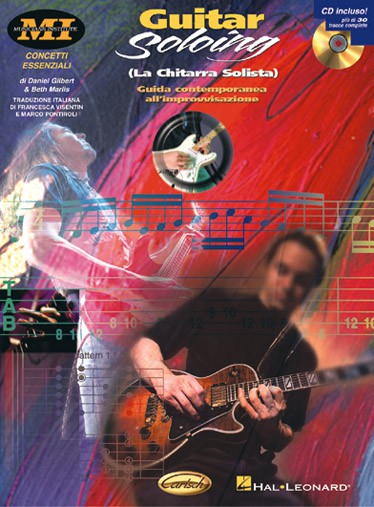
GUITAR SOLOING CHITARRA SOLISTA LIBRO CD TABLATURE arpeggi tecnica improvvisazione melodica

GUITAR SOLOING, LA CHITARRA SOLISTA. IN ITALIANO. LIBRO CON CD E TABLATURE DELLA CHITARRA.

LIBRO DI MUSICA CON CD, METODO,
SPARTITI PER CHITARRA. ACCORDI, GRAFICO DELLA TASTIERA, PENTAGRAMMA E TABLATURE. 

Guida contemporanea all'improvvisazione.

Una risorsa completa per imparare l'arte del SOLOING e dell'improvvisazione melodica.

il CD include oltre 30 tracce dimostrative e basi per esercitarsi.

Scale, modi, arpeggi, tecnica e esercizi di visualizzazzione della tastiera

Rock, Blues, Jazz, e altri stili

Sequenze, frasi e licks

Concetti essenziali - studiato per i programmi del MUSICIANS INSTITUTE.

Una risorsa completa per imparare l'arte della nota singola e dell'improvvisazione melodica. Il CD include oltre 30 tracce dimostrative e basi per esercitarsi. Scale, Modi, Arpeggi, Tecnica ed esercizi di visualizzazione. Rock, Blues, Jazz e altri stili. Sequenze, frasi e licks. Questo libro è una guida per imparare e gestire l'arte dell'improvvisazione sulla chitarra nella musica popolare. Due dei migliori insegnanti del M.I. hanno tracciato un metodo intuitivo e progressivo per sviluppare le capacità di esecuzione di assoli di qualità professionale in qualsiasi stile. Ciascun capitolo offre diagrammi, esercizi, tecniche, licks e alcuni suggerimenti sulla loro applicazione pratica. Il Cd allegato contiene delle basi molto belle che aiutano all'esercizio nell'applicazione delle tecniche qui presentate. Vi sono anche 36 licks, ciascuno all'inizio di ogni traccia. Questo libro offre delle solide basi per comprendere e usare il manico della chitarra in modo creativo. Prendete tutto il tempo che occorre e lavorate su ogni capitolo quanto è necessario. 160 Pagine.

Questo libro è una guida per imparare e gestire I'arte dell'improvvisazione sulla chitarra nella musica popolare. Due dei migliori insegnanti del M.1. hanno tracciato un metodo intuitivo e progressive per sviluppare Ie capacità di esecuzione di assoli di qualita professionale in qualsiasi stile. Ciascun capitolo offre diagrammi, esercizi, tecniche, licks, e alcuni suggerimenti sulla loro applicazione pratica. II Cd allegato contiene delle basi molto belle che aiutano all'esercizio nell'applicazione delle tecniche qui presentate. Vi sono anche 36 licks - ciascuno all'inizio di ogni traccia. Questo libro offre delle solide basi per comprendere e usare il manico della chitarra in modo creativo. Prendete tutto il tempo che occorre e lavorate su ogni capitolo quanto è necessario.

A proposito degli Autori

Daniel Gilbert è un chitarrista di New York che lavora presso il Musician Institute dal 1979. Ha scritto la maggior parte del curriculum per chitarra della scuola, inclusi "L'improvvisazione sulla corda singola", "La chitarra ritmica funf(', e "La tecnica applicata". Insieme con la sua produzione in sala di registrazione, Daniel continua a fare serate nei locali, jam sessions, seminari in California, ed anche in Giappone, Europa e la costa Orientale. Sta attualmente lavorando al suo secondo album di musica strumentale jazz, rock e blues. (II suo primo album, "Mr. Invisable", è distribuito in  Europa).

Beth Marlis insegna al Musician Institute dal 1987. Insegna Improvvisazione su corda singola, Lettura, Chitarra Ritmica, Storia della Musica, e Open Counselling (Consigli per gli Studenti - n.d.t.). Durante il suo stage, ha ricevuto un Master (una laurea) dall'U.S.C., e ha suonato con diversi artisti come Harold Land, Brownie Mc Gee, Louis Bellson, Helen Reddy. Ha partecipato inoltre a diversi video musicali, progetti in studi di registrazione e film, mantenendo la sua carriera come professionista a Los Angeles.


Iniziamo
Obbiettivi
• Dare delle indicazioni guida per la posizione delle mani.
• Suonare gli esercizi base di coordinazione della mano dx e sx con pennate alternate.
• Iniziare a comprendere la disposizione della tastiera.
• Suonare una scala maggiore su un'ottava in qualsiasi tonalità usando uno schema la cui tonica si trovi sulla 6a e 4a, o sa e 3a corda.
• Suonare le note delle scale in una progressione di accordi in una tonalità maggiore usando ritmi
in semiminime e crome.
 
ESERCIZIO 1: stretching
È molto importante incominciare la nostra sessione di pratica con degli esercizi di riscaldamento e
di stretching (stiramento). Lo scopo di questi esercizi è assicurarci che il nostro modo di suonare sia
rilassato e naturale, e non stressante per i nostri muscoli e per le giunture. Proseguendo nell'esplorazione
di questo libro verranno suggeriti diversi esercizi di riscaldamento. Iniziamo con un buon movimento di
base per rilassarci, che migliorerà la circolazione del sangue e il rilassamento dei muscoli.
Sedetevi, o state in piedi in modo confortevole ed alzate entrambe le mani sopra la testa; scuotetèle
fortemente per circa 10 o 20 secondi, dopodiché lasciatele cadere lateralmente. Dovreste sentire il
sangue che corre lungo la punta delle vostre dita. Ripetete.
 
Posizione della mano sinistra (per la maggior parte delle persone)
Posizionate la vostra mano in modo da avere un dito per tasto sulla sesta corda, in prima posizione
(la parola "posizione" si riferisce al tasto dove il vostro dito indice viene posizionato). La parte centrale
del vostro pollice dovrebbe toccare la parte centrale della tastiera approssimativamente sotto il vostro
dito medio. L'angolo del vostro polso nei confronti del braccio dovrebbe essere naturale; inclinate le
vostre dita lungo la tastiera, e quando una delle dita non schiaccia la corda, tenetela il più vicino
possibile al manico.
 
Posizione della mano destra (per la maggior parte delle persone)
Tenete fermamente in mano il plettro tra il pollice e l'indice; le dita e il palmo della mano possono essere a forma di coppa, sempre in modo rilassato. Il polso dovrebbe essere morbido sopra il ponte (un leggero contatto contro il ponte è accettabile, sempre che il polso non sia incollato al ponte, o da nessuna altra parte). Non deve mai esserci tensione in eccesso sulla mano destra, né sul polso, e nemmeno sul braccio.
 
Posizione del plettro ed esecuzione delle note 
Inclinandolo leggermente aiuta a produrre un buon suono, e permette di scivolare dalla corda, in preparazione alla successiva pennata. Il movimento per ciascuna pennata viene dal polso e dalla mano. Durante la pennata, il plettro dovrebbe rimanere vicino alle corde; mantenete quindi la pennata corta, tuttavia usate energia a sufficienza per produrre un suono forte. Ci dovrebbe essere il minor movimento possibile in verticale, lontano dalla parte frontale della chitarra.
 

Suggerimenti per la pratica

Avrete bisogno di trovare il "posto giusto" per I'allenamento quotidiano. Gli ingredienti necessari per un ambiente ideale sono:

a) Una sedia comoda, per aiutarvi nella postura ottimale (non appendetevi alla chitarra!) dovete

rimanere rilassati e concentrati. Potete anche suonare in piedi (per simulare un'esperienza tipica dal vivo ...).

b) Un posto tranquillo dove non sarete disturbati (questo a volte è difficile!)

c) Un banco, un leggio, o qualcosa di simile all'altezza giusta dove posizionare questo libro, un metronomo (o una drum machine, o un sequencer), della carta, e un registratore.

d) Anche una buona illuminazione è importante per eliminare sforzi e fatiche agli occhi.

e) Questo è il vostro laboratorio Sebbene non sara sempre possibile esercitarvi nel luogo ideale, dovreste tentare di trovare questi elementi dovunque vi allenerete.


Indice

Introduzione

Suggerimenti per la pratica .

Capitolo 1 Iniziamo .

Le scale maggiori e loro sequenze .

Le scale maggiori e gli arpeggi

La scala pentatonica maggiore

Le scale pentatoniche maggiori e i bending

La scala minore .

Arpeggi su scale minori .

La scala pentatonica minore .

Frasi costruite sulle pentatoniche minori

Scale maggiori con tre note per corda ..

Economizzare la pennata sulle scale minori: litre note per corda" .

Arpeggi maggiori .

Arpeggi minori e sweep picking.

Collegare tutti gli schemi ..

Scale su tre ottave

Cromatismi e note di passaggio .

Suonare i centri tonali .

La Modulazione .

II blues

Varianti blues

Blues minore

La scala Dorica

La scala Dorica e sue varianti .

La scala Misolidia .

Frasi Misolidie .

Arpeggi di 7a maggiore .

Arpeggi di 7a minore .

Arpeggi di 7a dominante.

Arpeggi di 7a minore b5 .

Combinare Ie scale maggiori con gli arpeggio .

Combinare Ie scale minori con gli arpeggio

La scala minore armonica ....

Suonare sulle tonalita minori ..

Suonare ancora in tonalita minori

Improwisare su progressioni di accordi

Improwisare su una canzone .

Epilogo


Guitar Soloing
The Contemporary Guide to Improvisation
Series: Musicians Institute Press
Publisher: Musicians Institute Press
Format: Softcover with CD - TAB
Composer: Beth Marlis
Composer: Daniel Gilbert

A comprehensive source for mastering the art of single note, melodic improvisation. The CD includes over 30 tracks for demonstration and play-along. The topics covered include: scales, modes, arpeggios, technique and visualization exercises; rock, blues, jazz, and other styles; and sequences, phrases, and licks.

Inventory #HL 00695190
ISBN: 9780793581863
UPC: 073999951905
Width: 9.0"
Length: 12.0"
160 pages

Description
A comprehensive source for mastering the art of single-note, melodic improvisation by Daniel Gilbert and Beth Marlis. Covering scales, modes, arpeggios, technique and visualisation exercises, rock, blues, jazz and other styles, sequences, phrases and licks, this is an effective and well constructed method from the Musicians Institute Essential Concepts series. The included CD features over 30 tracks for demonstration and playalong.

Musicians Institute Press is the official series of Southern California's renowned music school. MI instructors, some of the finest musicians in the world, share their vast knowledge and experience with you, no matter what your current level. 

Prezzo: €29,99
€29,99

ARPEGGIOS FOR THE MODERN GUITARIST, The Complete Guide, Including Theory, Patterns, Techniques. CD TABLATURE

ARPEGGIOS FOR THE MODERN GUITARIST, The Complete Guide, Including Theory, Patterns, Techniques and Applications. CD TABLATURE

Series: Guitar Educational
Medium: BOOK W/CD TAB
Author: Stephen Ross

Using this no-nonsense book/CD pack, guitarists will learn to apply and execute all types of arpeggio forms using a variety of techniques, including alternate picking, sweep picking, tapping, string skipping, and legato. This is not just another arpeggio book, but a methodical approach to expanding your skills as a guitarist - and as a musician!

INTRODUCTION


Why this book?
OK, so here's another book on arpeggios. What makes this one different from the others? Most arpeggio
books I have seen focus primarily on forms with little information on how to play them effectively. In this
book, the forms given are designed around certain techniques such as sweep picking, alternate picking, legato
playing, two-hand tapping, and multi-finger tapping. If you can play one form well using one particular technique,
you should not have too much trouble playing the other forms well using that same technique.
Prerequisites
Many musicians think of arpeggios as an intermediate to advanced topic-and they're right! To use this book
effectively, you should understand what scales and modes are, know how to play and transpose them in
different keys, understand basic chord theory, and have some knowledge of meter and rhythm.
 
Methodology
An arpeggio book must teach the student arpeggio forms and show how to execute and apply them. The challenge
in creating a successful text is carefully blending and balancing these topics.
 
1. Learning arpeggio forms: To learn arpeggio forms effectively, they must be organized in a
structured and logical manner. This book organizes arpeggios by tonality and harmonic complexity.
The tonality of the arpeggio is simply designated as major, dominant, minor, diminished,
or augmented. Harmonic complexity is closely related to the number of notes in the
chord formula; for example, a Gmaj13 arpeggio is considered more harmonically complex than a G major.
To make memorizing arpeggio forms easier, forms that are harmonically complex are sometimes
built by stacking basic forms; for example, seventh arpeggios, which have four-note
chord formulas, can be built by stacking three-note triad forms. This approach is utilized
quite frequently throughout the text.
 
2. Playing arpeggio forms: This book integrates practice tips and execution notes throughout
each chapter. Techniques covered in this book include alternate picking, sweep picking, hammer-
ons and pull-offs, two-hand tapping, and string skipping.
 
3. Application: Integrating arpeggios into your playing style is the part of the process that
takes the longest amount of time, but is also the most rewarding. By the time you are finished
with this book, you should be well on your way to integrating the arpeggio forms illustrated
in this book as well as your own into your playing style
Prezzo: €24,99
€24,99
Condividi contenuti